Printed in The Islamic Republic of Iran, 2017 © Shiraz University
A SVM Model to Predict the Hot Deformation Flow Curves of AZ91
Magnesium Alloy
M. Rakhshkhorshid
*1, N. Mollayi
2and A.R. Maldar
31Department of Mechanical Engineering, Birjand University of Technology, POBOX 97175-569, Birjand, Iran 2Department of Computer Engineering, Birjand University of Technology, POBOX 97175-569, Birjand, Iran 3National Engineering Research Center of Light Alloy Net Forming, School of Materials Science and Engineering,
Shanghai Jiao Tong University, Shanghai 200240, China
Abstract: In this work, a support vector machine (SVM) model was developed to predict the hot deformation flow curves of AZ91 magnesium alloy. The experimental stress-strain curves, obtained from hot compression testing at different deformation conditions, were sampled. Consequently, a data base with the input variables of the deformation temperature, strain rate and strain and the output variable of flow stress was prepared. To develop the support vector machine (SVM) model, the overall data was divided into two subsets of training and testing (randomly selected). Root mean square error (RMSE) criterion was used to evaluate the prediction performance of the developed model. The low RMSE value calculated for the developed model showed the robustness of it to predict the hot deformation flow curves of tested alloy. Also, the performance of the SVM model was compared with the performance of some previously used constitutive equations. The overall results showed the better performance of the SVM model over them.
Keywords: Support Vector Machine, Radial Basis Function, Hot compression, Flow stress.
1. Introduction
Low density, high strength to weight ratio and excellent castability are the main characteristics of
magnesium alloys that make them good candidates for transportation industries applications [1-3]. However, because of low workability of these alloys at room temperature (that is the result of their HCP crystal structure); almost all manufacturing processes of them are conducted at elevated temperatures [1,
4]. Finite element simulation is an efficient way to analyze and control the metal forming processes. To develop a finite element simulation (especially, at hot working condition) it is needed to describe the flow stress of under studied material through a constitutive model. As explained by Lin and Chen [5], the
constitutive models can be divided into three categories including phenomenological models, physical-based models and artificial neural network (ANN) models [5].
Phenomenological models are models which are used to fit a mathematical function on the experimental flow curves obtained at different deformation conditions (usually, through the hot compression testing). Johnson-Cook and Arrhenius-type equations are the most famous models of this category that have ever been used to describe the flow stress behavior of different materials [6, 7]. As a case study, the predictability of Johnson-Cook and Arrhenius-type equations for modeling the hot deformation behavior of Mg-6Al-1Zn has been evaluated by Abbasi-Bani et al. [8].
Besides the three main categories of phenomenological models, physical-based models and artificial neural network (ANN) models (categorized by Lin and Chen [5]), the ability of support vector machine (SVM) technique to predict the flow stress of austenitic stainless steel 304 has been investigated by Desu et al. [13], in a recent work. According to the literature survey, this is the only work conducted to examine the capability of SVM for flow stress modeling. This technique acts as a black box and, in a way similar to the ANN models, can be used as a lateral module accompanying with a FEM code for flow stress description of the materials.
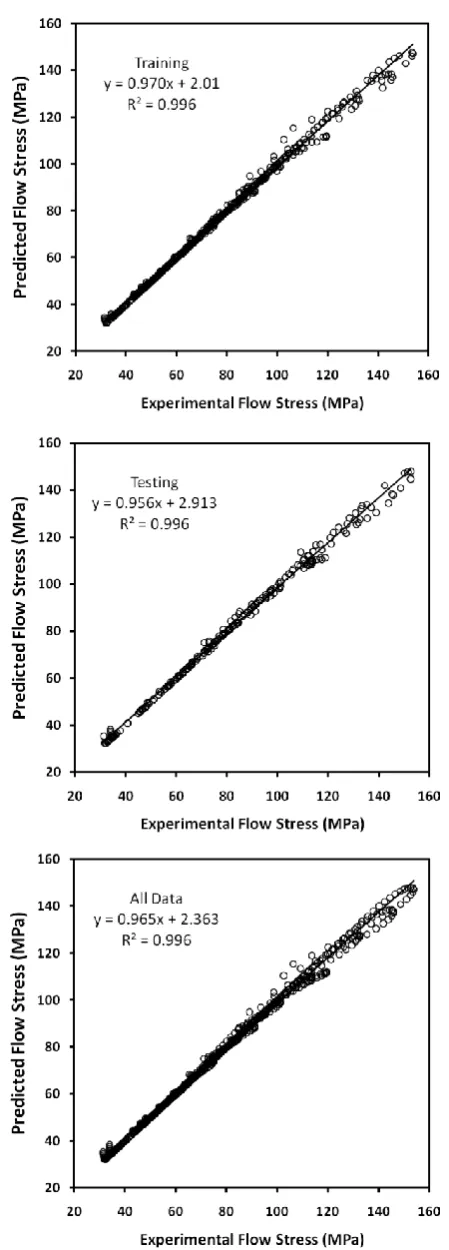
The main contribution of the present study is to evaluate the capability of the SVM model to predict the hot deformation flow curves of AZ91 magnesium alloy. For this reason, the experimental flow curves of tested alloy, obtained from hot compression testing (at different deformation temperatures and strain rates), were sampled for different strains with a predefined interval. Thus, a data base with the input variables of the deformation temperature, strain rate and strain and the output variable of flow stress was prepared. To develop the support vector machine (SVM) model, the overall data was divided into two subsets of training and testing (randomly selected). The training data set was used to establish the SVM model. Scatter diagrams together with the root mean square error (RMSE) criterion were used to compare the results of modeled flow curves with the experimental ones for both training and testing data sets. Also, the performance of the developed SVM model was compared with the performances of three previously examined constitutive equations on the same experimental flow curves [14].
2. Experimental Flow Curves
325 °C 350 °C
375 °C 400 °C
425 °C
Fig. 1. Experimental flow curves of AZ91 magnesium alloy obtained at different deformation conditions [15].
3. Phenomenological Models
In this section, the results of previously used phenomenological constitutive models to describe the hot deformation flow curves of AZ91 magnesium alloy are presented from the literature (previous work of the Author(s)) [14]. These include the Arrhenius equation with strain dependent constants, the exponential equation with strain dependent constants and a recently developed simple model (developed based on a power function of Zener-Hollomon parameter and a third order polynomial function of ε power a constant number). The overall results are as follows:
3.1. Arrhenius-type equation
3.2. Exponential-type equation
Using the exponential equation with strain dependent constants the hot deformation flow stress of AZ91 magnesium alloy can be described through the following equation:
𝜎 = (𝑙𝑛𝜀 ̇ + 𝑄
𝑅𝑇 − 𝑙𝑛𝐴
")/𝛽 (6)
while the strain dependent constants of this equation can be calculated using the following relations [14]:
𝛽 = −5.913𝜀3 + 6.204𝜀2 − 1.886𝜀 + 0.251 (7)
𝑄 = −937464.653ε3 + 1181186.145ε2 − 564241.074𝜀 + 258298.730 (8)
𝑙𝑛𝐴" = 181.5𝜀3 − 161.9𝜀2 + 21.02𝜀 + 26.16 (9)
3.3. The equation developed based on a power function of Zener-Hollomon parameter and a third order polynomial function of ε power a constant number
Using the developed model based on a power function of Zener-Hollomon parameter and a third order
polynomial function of ε power a constant number, the hot deformation flow stress of AZ91 magnesium
alloy can be described as follows [14]:
𝜎 = 𝜀 ̇0.122𝑒𝑥𝑝 (0.122×144998
𝑅𝑇 ) × (−3.333 + 41.335𝜀
0.4− 74.551𝜀0.8 + 41.322𝜀1.2) (10)
4. Support Vector Machine
As mentioned before, SVM can be used for applications such as classification and regression. In SVM method for regression, using N training data ({(xi, yi) | i = 1, ..., N}) the input space x is transferred into a higher dimensional feature space (applying the kernel functions) at the first; then, a linear machine is constructed in the feature space [18, 19]:
𝑓(𝑥) = 𝑊𝑇∅(𝑥) + 𝑏 (11)
where 𝑊 = [𝑤1, … , 𝑤𝑁]𝑇 is the weight vector that controls the smoothness of the model, ∅(𝑥) is the transformation function (kernel function) and b is the bias. In the relation above, the values of weights and bias vectors are calculated by minimizing the regularized risk function [14]:
𝑅(𝑓) =1
2‖𝑊‖
2+ 𝐶 ∑ 𝐿(𝑦
𝑖, 𝑓(𝑥𝑖)) 𝑁
𝑖=1 (12)
where 𝐿(𝑦𝑖, 𝑓(𝑥𝑖)) is the epsilon sensitive loss function:
𝐿(𝑦𝑖, 𝑓(𝑥𝑖)) = {
0 𝑖𝑓 |𝑦𝑖− 𝑓(𝑥𝑖)| < 𝜀
Two nonnegative slack variables 𝜉𝑖 and 𝜉𝑖∗ are introduced to measure the deviation of training data points outside the ε insensitive zone. So, in SVM, the optimization problem is to minimize the following function [21, 22]:
min 1 2‖𝑊‖
2+ 𝐶 ∑ 𝜉 𝑖+ 𝜉𝑖∗ 𝑁
𝑖=1 (14)
subject to
𝑦𝑖− 𝑊𝑇∅(𝑥𝑖) − 𝑏 ≤ 𝜀 + 𝜉𝑖 𝑖 = 1, … , 𝑁 (15)
−𝑦𝑖+ 𝑊𝑇∅(𝑥𝑖) + 𝑏 ≤ 𝜀 + 𝜉𝑖∗ 𝑖 = 1, … , 𝑁 (16)
𝜉𝑖, 𝜉𝑖∗≥ 0 𝑖 = 1, … , 𝑁 (17)
Using Lagrange multiplier, the dual form of this optimization problem can be solved as in the follow:
max −1
2∑ (𝛼𝑖− 𝛼𝑖 ∗) 𝑁
𝑖,𝑗=1 (𝛼𝑗− 𝛼𝑗∗)𝐾(𝑥𝑖, 𝑥𝑗) − 𝜀 ∑𝑁𝑖=1(𝛼𝑖+ 𝛼𝑖∗) + ∑𝑖=1𝑁 𝑦𝑖(𝛼𝑖− 𝛼𝑖∗) (18)
subject to
∑𝑁𝑖=1(𝛼𝑖− 𝛼𝑖∗)= 0, 𝛼𝑖, 𝛼𝑖∗∈ [0, 𝐶] (19)
where 𝛼 and 𝛼∗ are Lagrangian multipliers and 𝐾(𝑥
𝑖, 𝑥𝑗) = ∅(𝑥𝑖)𝑇∅(𝑥𝑗) is the kernel matrix. In addition to the latter constraints, Karush-Kuhn-Tucker conditions should also be satisfied [22, 23]. Usually, a Gaussian radial basis function is used as the kernel function:
𝐾(𝑥𝑖, 𝑥𝑗) = 𝑒𝑥𝑝 (− ‖𝑥𝑖−𝑥𝑗‖2
2𝜎2 ) (20)
Thus, the final form of the function 𝑓(𝑥) is given by:
𝑓(𝑥) = ∑𝑁𝑖=1(𝛼𝑖− 𝛼𝑖∗)𝐾(𝑥𝑖, 𝑥) + 𝑏 (21)
It is obvious that the prediction performance of a SVM model, depends on the proper selection of its parameters including: kernel parameter 𝜎, the capacity C and the parameter of 𝜀.
5. Results and Discussion
The experimental flow curves obtained from hot compression tests at different deformation temperatures
and strain rates [15] were sampled for the strains in the range of 0.05 to 0.5 with step size of 0.01. Thus, a data base with the input variables of the deformation temperature, strain rate and strain and the output variable of flow stress with 690 patterns was prepared. The prepared data base was divided into two
subsets of training and testing. Two third of the overall data (i.e. 460 randomly selected patterns) was used as training data to develop the SVM model and the rest was used to test the developed SVM model for unseen data. The online SVR toolbox for MATLAB application developed by Parrella [23] was
applied to predict the flow stress of tested alloy. The RMSE criterion was used to assess the prediction performance of the developed model:
𝑅𝑀𝑆𝐸 = √1
𝑛∑ (𝑦𝑖− 𝑓(𝑥)𝑖) 𝑛
𝑖=1 (22)
As can be seen there is a good agreement between the experimental flow stresses and the modeled ones. These, together with low RMSE value, obtained for training, testing and overall data (see table 1) shows the robustness of the SVM model to predict the hot deformation flow curves of tested alloy.
Table 1. RMSE values obtained for training, testing and overall data patterns.
Training data patterns Testing data patterns Overall data patterns
RMSE criterion (MPa) 1.83 2.28 1.99
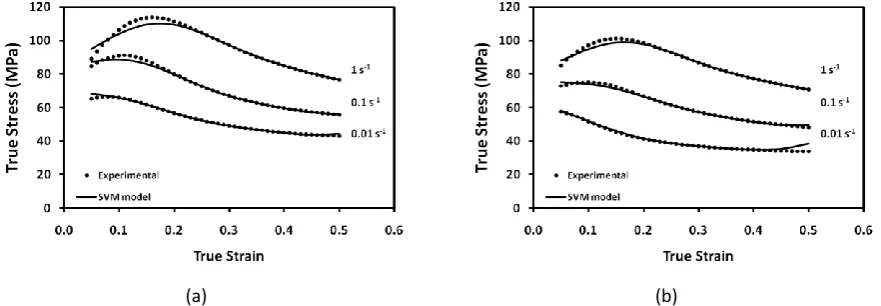
Also, a comparison between the experimental and calculated flow curves (using the SVM model) at deformation conditions with two temperatures of 375 and 400 °C with different strain rates are presented in Figs. 3a and 3b, respectively.
(a) (b)
Fig. 3. The comparison between the experimental and modeled flow curves (using the SVM model) at deformation conditions with two temperatures of (a) 375 and (b) 400 °C with different strain rates.
As can be seen, there is a good consistency between the modeled and experimental flow curves. Moreover, as can be seen the strain hardening and work softening stages appeared in DRX flow curves of tested alloy can be modeled, simultaneously. These together with the low RMSE value of 1.99 MPa obtained for overall data shows the high performance of the developed SVM model in modeling the hot deformation flow curves of the tested alloy. In Table 2, the RMSE value obtained for the developed SVM model is compared with the RMSE values of the other previously examined constitutive equations [14].
Table 2. RMSE values obtained for the SVM model and previously examined constitutive models.
Examined model RMSE criterion (MPa)
SVM model (current study) 1.99
Arrhenius equation with strain dependent constants [14] 4.96
exponential equation with strain dependent constants [14] 5.88
simple model developed based on a power function of Zener-Hollomon parameter and a third order polynomial function of ε power a constant number [14]
10.51
As presented in Table 2, the RMSE value obtained for the developed SVM model shows the better performance of it over the other investigated constitutive models.
6. Conclusion
[1] L. Yang, H. Hou, Y.H. Zhao, X.M Yang, Effect of applied pressure on microstructure and mechanical properties
of Mg-Zn-Y quasicrystal-reinforced AZ91D magnesium matrix composites prepared by squeeze casting,
Trans. Nonferrous Met. Soc. China 25 (2015) 3936-3943.
[2] Y. Li, Y. Chen, H. Cui, J. Ding, L. Zuo, J. Zhang, Hot deformation behavior of a spray-deposited
AZ31 magnesium alloy, Rare Metals 28 (2009) 91–97.
[3] K.U. Kainer, Magnesium—Alloys and Technology, Wiley-VCH, Germany, (2003).
[4] S.J. Liang, Z.Y. Liu, E.D. Wang, Mechanical properties and texture evolution during rolling process
of an AZ31 Mg alloy, Materials Letters 62 (2008) 3051–3054.
[5] Y.C. Lin, X.M. Chen, A critical review of experimental results and constitutive descriptions for metals
and alloys in hot working, Materials and Design 32 (2011) 1733–1759.
[6] L. Gambirasio, E. Rizzi, On the calibration strategies of the Johnson–Cook strength model: Discussion and
applications to experimental data, Materials Science and Engineering: A 610 (2014) 370–413.
[7] Z. Akbari, H. Mirzadeh, J.M. Cabrera, A simple constitutive model for predicting flow stress of medium carbon
microalloyed steel during hot deformation, Materials and Design 77 (2015) 126–131.
[8] A. Abbasi-Bani, A. Zarei-Hanzaki, M.H. Pishbin, N. Haghdadi, A comparative study on the capability of Johnson–
Cook and Arrhenius-type constitutive equations to describe the flow behavior of Mg–6Al–1Zn alloy, Mechanics
of Materials 71 (2014) 52-61.
[9] P.J. Zerilli, R.W. Armstrong, Dislocation-mechanics-based constitutive relations for material
dynamics calculations, Journal of Applied Physics 61 (1987) 1816–1825.
[10]Y.C. Lin, M.S. Chen, J. Zhang, Constitutive modeling for elevated temperature flow behavior of
42CrMo steel, Computational Materials Science 424 (2008) 470–477.
[11]D.L. Preston, D.L. Tonks, D.C. Wallace, Model of plastic deformation for extreme loading conditions, Journal of
Applied Physics 93 (2003) 211–20.
[12]H. Mirzadeh, J.M. Cabrera, J.M. Prado, A. Najafizadeh, Modeling and prediction of hot deformation flow curves,
Metallurgical and Materials Transactions A 43 (2012) 108–123.
[13]R.K. Desu, S.C. Guntuku, A. Balu, A.K. Gupta, Support Vector Regression based Flow Stress
Prediction in Austenitic Stainless Steel 304, Procedia Materials Science 6 ( 2014 ) 368 – 375.
[14]M. Rakhshkhorshid, A.R. Maldar, A comparative study on constitutive modeling of hot deformation flow curves
in AZ91 magnesium alloy, Iranian Journal of Materials Forming 3(1) (2016) 27-37.
[15]G.R. Ebrahimi, A.R. Maldar, R. Ebrahimi, A. Davoodi, Effect of thermomechanical parameters on
dynamically recrystallized grain size of AZ91 magnesium alloy, J. Alloys Compd. 509 (2011) 2703–
2708.
[16]M. Rakhshkhorshid, S.H. Hashemi, Experimental study of hot deformation behavior in API X65
steel, Mater. Sci. Eng., A 573, (2013) 37–44.
[17]M. Shaban, B. Eghbali, Determination of critical conditions for dynamic recrystallization of a
microalloyed steel, Mater. Sci. Eng., A 527, (2010) 4320–4325.
[18]V. N. Vapnik, Statistical learning theory. In S. Haykin (Ed.), Adaptive and learning systems for
[19]B. Lela, D. Bajić, S. Jozić, Regression analysis, support vector machines, and Bayesian neural network approaches
to modeling surface roughness in face milling, Int J Adv Manuf Technol 42 (2009)
1082–1088.
[20]C. Campbell, Kernel methods: a survey of current techniques, Neurocomputing 48 (2002) 63–84.
[21]V.N. Vapnik, The Nature of Statistical learning Theory, Springer, New York, (1995).
[22] A.J. Smola, B. Scholkopf, A tutorial on support vector regression, Stat. Comput. 14 (3) (2004) 199–
222.
[23]F. Parrella, Online support vector regression, A thesis presented for the degree of Information
![Fig. 1. Experimental flow curves of AZ91 magnesium alloy obtained at different deformation conditions [15]](https://thumb-us.123doks.com/thumbv2/123dok_us/8956064.1865432/3.595.67.516.72.559/experimental-curves-magnesium-alloy-obtained-different-deformation-conditions.webp)