Journal Vol. 2, N
www.jie
Mode
probl
N. Shira Abstrac This pap price. Th are prese destinati shortage demand. criteria s coefficie Keywor solution; Received: Revised: J Accepted:1.
Int
A su retailers compan in suppl (Diaby, of Industria No. 1, pp. 27ems.icms.ac.
eling an
lem cons
azi 1, M. Sey
ct
per considers he objective ented here: v ion. Fixed ch e cost that inc . The model
scenario bas ent of variatio
rds
:
Fixed c ; mean; stand: March 2014-1
July 2014-19
: August
2014-troductio
upply chain s and custo nies to custoly chain. Th 1991; Eski al Engineeri 7-40 .ir
nd solvin
sidering
yyed-Esfahs a three-stag of the proble variable costs harge exists curs when th is formulate sed solution
on are comp
charge trans dard deviatio
12
-20
on
n is a netwo omers (N omers throu he cost of di
igun et al.,
ing and Ma
ng a th
stochast
hani 2 , H. So
ge fixed cha em is to max s that are rel
whenever th he manufactu ed as a mixed
approach to ared as the a
portation pro on; coefficien
ork of supp Jawahar & gh the ware istribution a 2005). The
nagement S
hree-stag
tic dema
oleimani 3,*
arge transpor ximize the pr ated to amou here is a tran urer does not d integer pro o find the o acceptable cr
oblem; stoch nt of variatio
pliers, manu & Balaji, 20 ehouses and
accounts for refore distr
Studies
ge fixed
and and p
rtation proble rofit for supp unt of transp nsfer from a
t have enoug ogramming p optimal solut riteria to deci
hastic optimi on.
ufacturers, 009). The d distributio
r about 30 p ribution pro
charge
price
em regarding plying deman portation costsource to a gh products f problem and tion. Mean, ide about the
ization; mult
transporters problem o on centres is percent of th
blem is an
transp
g stochastic nds. Three ki
t between a s destination, for supplying d is solved us standard de e best solutio
ti-criteria sce
s, distributi of transport s an importa he product’ important p
ortation
N. Shirazi, M. Seyyed-Esfahani, H. Soleimani
Journal of Industrial Engineering and Management Studies (JIEMS), Vol. 2, No. 1 Page 28
transport homogeneous products from several sources to several destinations so that the total cost can be minimized . In a transportation problem, when fixed cost is also taken into account, the problem is known as fixed charge transportation problem (FCTP). The objective of an FCTP is to find the combination of routes that minimises the total distribution costs satisfying the supply and demand constraints (Vinay & Sridharan, 2012). So, the fixed-charge transportation problem is an extension of the classical transportation problem that considers two kinds of cost (variable and fixed costs) (Raj & Rajendran, 2011; Schaffer & O'Leary, 1989).Variable cost depends on per unit of transported and linearly increases with it. Fixed charge incurs whenever a nonzero quantity is transported from a source to a destination (Adlakha & Kowalski, 1999; N Jawahar & Balaji, 2009).In FCTP, the parameters (for example variable costs, fixed charges, price and demand) can be deterministic and Non-deterministic. Some research can be refer as deterministic (Adlakha, Kowalski, & Lev, 2010; N Jawahar & Balaji, 2009; N. Jawahar & Balaji, 2012; Lotfi & Tavakkoli-Moghaddam, 2013), etc. On the other hand, few works are undertaken with non-deterministic parameters in FCTP. Non-non-deterministic parameters can be different approaches such as fuzzy (Kundu, Kar, & Maiti, 2014; Yang & Liu, 2007), interval (Safi & Razmjoo, 2013), chaos, stochastic etc. To the best of our knowledge, there are not any works about FCTP when parameters of demand and price are stochastic in a 3-stage supply chain. In this paper, we focus on a 3-stage FCTP. We try to find quantity of transported products from a manufacturer plant to a distribution centre and from a distribution centre to a retailer and a retailer to a customer when the parameters of demand and price are nondeterministic to obtain maximum income.
The organization of this paper is as follows: Section 2 presents the literature review of FCTP to find gaps. Section 3 describes the mathematical model and its descriptions. Section 4 explains the solution methodology. Sensitivity analysis is presented in Section 5. Finally, in Section 6, conclusions are provided and some areas of further research are then stated.
2.
Literature review
Literature review includes two sections: deterministic parameters and nondeterministic parameters in FCTP. Further, number of stages is considered in these two sections. There are many studies regarding deterministic parameters for FCTP. Review is categorised based on number of stage.
2011) formulate single stage fixed-charge problems with polynomials. Using polynomial formulations. They show structural similarity between different kinds of linear and fixed charge formulations. Lotfi and Tavakkoli-Moghaddam (Lotfi & Tavakkoli-Moghaddam, 2013) propose a genetic algorithm using priority-based encoding (pb-GA) for linear and nonlinear fixed charge transportation problems in which new operators for more exploration are proposed. They modify a priority-based decoding procedure proposed by Gen et al. (Gen, Kumar, & Ryul Kim, 2005)to adapt with the FCTP structure. Pintea et al. (Pintea, Sitar, Hajdu-Macelaru, & Petrica, 2012) describe some hybrid techniques for solving the fixed charged transportation problem. The problem is a two chain supply network. Classical nearest neighbor algorithm is used basically to find the best distribution centres.
Now we point some studies about FCTP with Non-deterministic parameters. A few works are done about uncertain FCTP. Safi and Razmjoo (Safi & Razmjoo, 2013) consider the fixed charge transportation problem under uncertainty, particularly when parameters are given in interval forms. All of parameters (i.e., variable costs, fixed charges, supply and demand parameters) are in interval forms. In this case it is assumed that both cost and constraint parameters are arrived in interval numbers. Considering two different order relations for interval numbers, two solution procedures are developed in order to obtain an optimal solution for interval fixed charge transportation problem (IFCTP). Kundu et al (Kundu et al., 2014) consider two fixed charge transportation problems with type-2 fuzzy parameters. Unit transportation costs, fixed costs in the first problem and unit transportation costs, fixed costs, supplies and demands in the second problem are type-2 fuzzy variables.
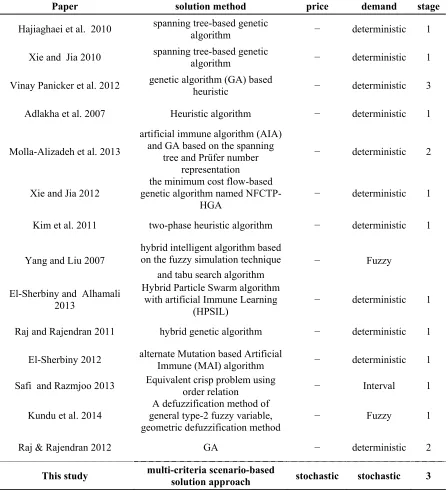
A defuzzification method of general type-2 fuzzy variable is outlined and compared numerically with geometric defuzzification method. Yang and Liu (Yang & Liu, 2007) investigate the fixed charge solid transportation problems under a fuzzy environment, in which the direct costs, the fixed charges, the supplies, the demand, and the conveyance capacities have been considered as fuzzy variables. They designed a hybrid intelligent algorithm based on the fuzzy simulation technique and tabu search algorithm to solve them. Table presents a review on some papers. The first row shows characteristics of this study. According to the above discussion, some gaps are considered in this paper:
Most of the works in the literature consider the FCTP with deterministic parameters. Few works consider nondeterministic parameters, as seen in Table 1.
Demand and transportation costs are considered under uncertainty (see Table 1). We consider price and demand in an uncertain environment.
In nondeterministic works, fuzzy and interval are two main nondeterministic approaches. To the best of our knowledge we cannot find any papers with stochastic approach (about demand and price) in 3-stage supply chain.
N. Shirazi, M. Seyyed-Esfahani, H. Soleimani
Journal of Industrial Engineering and Management Studies (JIEMS), Vol. 2, No. 1 Page 30
Table 1: A review of planning under uncertainty for FCTP
Paper solution method price demand stage
Hajiaghaei et al. 2010 spanning tree-based genetic algorithm − deterministic 1
Xie and Jia 2010 spanning tree-based genetic algorithm − deterministic 1
Vinay Panicker et al. 2012 genetic algorithm (GA) based heuristic − deterministic 3
Adlakha et al. 2007 Heuristic algorithm − deterministic 1
Molla-Alizadeh et al. 2013
artificial immune algorithm (AIA) and GA based on the spanning
tree and Prüfer number representation
− deterministic 2
Xie and Jia 2012
the minimum cost flow-based genetic algorithm named
NFCTP-HGA
− deterministic 1
Kim et al. 2011 two-phase heuristic algorithm − deterministic 1
Yang and Liu 2007
hybrid intelligent algorithm based
on the fuzzy simulation technique − Fuzzy and tabu search algorithm
El-Sherbiny and Alhamali 2013
Hybrid Particle Swarm algorithm with artificial Immune Learning
(HPSIL)
− deterministic 1
Raj and Rajendran 2011 hybrid genetic algorithm − deterministic 1
El-Sherbiny 2012 alternate Mutation based Artificial Immune (MAI) algorithm − deterministic 1
Safi and Razmjoo 2013 Equivalent crisp problem using order relation − Interval 1
Kundu et al. 2014
A defuzzification method of general type-2 fuzzy variable, geometric defuzzification method
− Fuzzy 1
Raj & Rajendran 2012 GA − deterministic 2
This study multi-criteria scenario-based solution approach stochastic stochastic 3
3.
Problem description
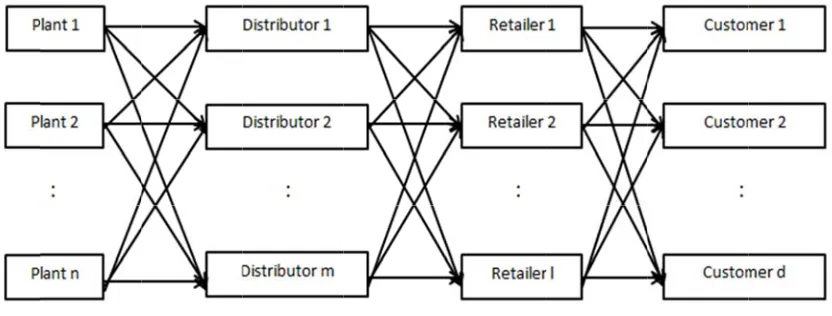
The presented three-stage fixed charge transportation problem includes n plants, m distributors, l retailers and d customers (see Figure 1). The characteristics of the model are as follows:
The model is scenario-based. Demand and price are nondeterministic and it could be different for each scenario. Scenarios are created randomly in the three groups with poor, medium and high logic.
The number and capacity of all facilities, and all cost parameters are predetermined.
Each of the m distribution centres can ship products to any of the l retailers. In other words, a retailer can replenish the inventory from multiple distribution centres.
Each of the n plants can ship products to any of the m distribution centres. In other words, a distribution centre can replenish the inventory from multiple plants.
The production shortage is allowed. The backorder penalty cost is considered.
Notations are presented as follows: i: Set of plants (i =1 to n)
j: Set of distribution centres (j = 1 to m)
r: Set of retailers (r = 1 to l) K: Set of customers (k = 1 to d)
S: Demands and price scenarios (s = 1 to g)
ijs
x : Number of quantity transported from plant i to distributor j under scenario s.
ij
c : Unit cost of transportation between plant i and distributor j.
ij
f : Fixed transportation cost between plant i and distributor j.
jrs
u : Number of quantity transported from distributor j to retailer r under scenario s.
jr
b : Unit cost of transportation between distributor j and retailer r.
jr
o : Fixed transportation cost between distributor j and retailer r.
rks
t : Number of quantity transported from retailer r to customer k under scenario s.
rk
v : Unit cost of transportation between retailer r and customer k.
rk
q : Fixed transportation cost between retailer r and customer k.
ks
D : Demand at customer k under scenario s.
ks
P : Sales price at customer k under scenario s.
ks
H : Number of units backordered at customer k under scenario s.
k
Hc : Unit cost of backorder at customer k.
i
Am : Capacity at plant i.
j
Ad : Capacity at distributor j.
r
Ar : Capacity at retailer r.
ijs
z : Binary variable that specifies whether the product is distributed from plant i to distribution centre j under scenario s. (zijs= 0 or 1)
jrs
y : Binary variable that specifies whether the product is distributed from distribution center j to retailer r under scenario s. (yjrs= 0 or 1)
rks
Journal o The fixe Maximi 1 1 1 g s k g d s k Z H
Subject 1 m ijs j x
1 n ijs i x
1 m jrs j u
1 l rks r t
1 n ijs i x
1 m jrs j u
, , ijs jrs x u ijs ijsz x
jrs j
y u
rks r
w t
0 ijs z
0 jrs y
0 rks w The obj total coof Industrial En
ed-charge tr ize: 1 1 g d ks ks k s ks k P D H Hc
to: i Am j Ad r Ar 0.8Dks
1 l jrs r u
1 d rks k t
,trsk 0
s z Mijs jrs y Mjrs rksw Mrks
0,1
0,1
0,1 jective func sts. The totngineering an
ransportatio
1 1 1
n m ij ijs i j c x
i= 1, …
j = 1,
r = k = j = r = ( fo i = j= r= i= j= r= ction (1) is t tal cost is th
nd Managemen
Figure 1: P
on problem
1 g ij ijs s f z
… , n
… , m
1, … , l
1, … , d
1, … , m
1, … , l
or all i, j, r, k = 1,…,n 1,…,m 1,…,l 1,…,n 1,…,m 1,…,l to maximiz he total cost
nt Studies (JIE
Proposed thre
is formulate
1 1 1
m l jr jr j r b u
s = 1,… , g
s = 1, … ,
s = 1, …
s = 1, …
s = 1,
s = 1,
k and s) j= 1,… r= 1,… k= 1,… j= 1,… r= 1,… k= 1, e the total p t transportat
N. Shira
EMS), Vol. 2,
ee-stage FCT
ed as follow
rso yjr jrs
g
g
… , g
… , g
… , g
… , g
…,m …,l …,d …,m …,l ,…,d profits that tion incurre
azi, M. Seyyed
No. 1
TP.
ws:
1 1 1
g l d rk s r k
v
s = 1, … , g s = 1, … , g s = 1, … ,s = 1, … , g s = 1, … , g s = 1, … , is calculate ed in supply
d-Esfahani, H
k rkst q wrk rks
g g g g g , g ed by total s ying the pro
plants to customers through distributors and retailers, considering the possible combination of routes, plus shortage costs. Constraint (2) represents plant capacity constraint. This constraint maintains that the product quantity which is distributed from the plant to the distribution centers must be less than or equal to capacity of the plant. Constraint (3) denotes distributor capacity constraint. This constraint implies that the quantity of products received in a distribution center from plants must be less than or equal to the capacity of the distribution center. Constraint (4) indicates retailer capacity constraint. This constraint maintains that the quantity of products received in a retailer from distribution centers must be equal to or less than the capacity of the retailer. Constraint (5) denotes customer demand constraint. This constraint maintains that the retailers must provide at least 80 percent of customer’s demand. So, the shortage is allowed. Constraint (6) is the balance constraints of distributors. This maintains that all entering flows to a distribution center and all issuing flows from it are equal. Constraint (7) is the balance constraints of retailers. This constraint guarantees that all entering flows to a retailer and all issuing flows from it are equal. Constraint (8) ensures the non-negativity nature of decision variables. Constraint (9) to (14) asserts the 0–1 binary nature of the binary variable. These constraints maintain that if > 0, then =1, if > 0, then = 1 and if > 0, then
=1 .
4.
Solution methodology
Scenario-based approaches for solving the stochastic programming problems are efficient methodologies (Kaut & Wallace, 2003; Listeş, 2007). In this paper, the problem is solved with using a multi criteria scenario based solution approach , that the first time is presented by Soleimani (Soleimani, Seyyed-Esfahani, & Shirazi, 2013). Mean, standard deviation and coefficient of variation, which are the mentioned criteria for finding the optimal solution.
The solution of this mathematical model consists of two plants, two distribution centers, two retailers and two customers. It is undertaken for two products and 16 scenarios. Then, 2 various possibilities for demands and prices based on the 4 range of the data in Table 2 are created randomly. A set of system’s parameters are presented in Table 3.
Table 2: Range of the demand and price in scenarios.
Low-quality Medium-quality High-quality Very High-quality
Demand 100─200 200─300 300─400 400─500
Price 10000─12000 12000─14000 14000─16000 16000─18000
Table 3: Parameters of the computational study
Parameter value
unit cost of transportation between plant i and distributor j ( ) = 100
= 200
N. Shirazi, M. Seyyed-Esfahani, H. Soleimani
Journal of Industrial Engineering and Management Studies (JIEMS), Vol. 2, No. 1 Page 34
= 300 = 100 = 200
fixed transportation cost between distributor j and retailer r( ) = 550
= 400 = 200 = 350
unit cost of transportation between retailer r and customer k ( ) = 300
= 150 = 200 = 200
fixed transportation cost between retailer r and customer k ( ) = 500
= 250 = 350 = 250
unit cost of backorder at customer k( ) = 10000
= 15000
capacity at plant I ( ) 500
capacity at distributor j ( ) 500
capacity at retailer r ( ) 500
The solution steps are illustrated as follows:
Step 1: all scenarios are solved by LINGO and the optimum points are obtained and recorded as candidate solutions for final optimal point. The results are illustrated in Table 4. Figure 2 presents the objective function values of 16 scenarios
Table 4: objective function values of 16 scenarios.
Scenarios S1 S2 S3 S4 S5 S6 S7 S8
Profit 251675 248507.5 391845 962130 91978.75 349452.5 910430 2.67E+05
Scenarios S9 S10 S11 S12 S13 S14 S15 S16
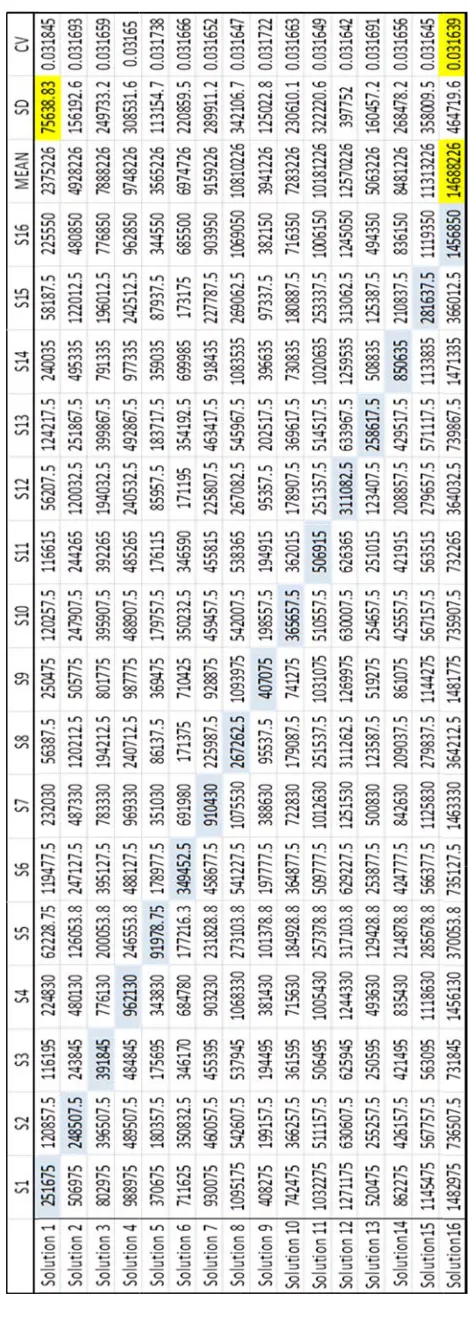
Step sce 6 sc 0.02 wit ans Step sce eva the valu sce Step acc crit and Step sen app
p 2: scenar narios with cenarios wi 25. The pro th high logi swers are ca p 3: the in narios and aluated in 1 performan ues). Then, narios. The p 4: We us ceptable crit teria of mak d 5).
p 5: optima nsitivity ana
proach.
Figu
rios in the t h poor logic ith high log obability of
ic is 0.1 .A alculated wi
nitial respo objective fu 6 different ces of a ca , weighted results are sed three cr teria to sel king final d
al solution alyses are u
ure 2: Objecti
three group have 0.5w gic have 2w f scenarios w After obtain
th using the onse of 16 function val scenarios s andidate sol average of presented i riteria (mea ect the bes decision of t
is selected undertaken
ive function v
ps with poo weight. 6 s weight. Th with medium ning the an e probability
scenarios lues are rec so the mode lution are ev f answers is
n Table 5. an, standard st solution. the best sol
based on th to determin
values of 16 s
or, medium scenarios w he probabili m logic is 0 nswer of 16 y of scenari (candidate corded. We el should b
valuated in s calculated
d deviation The last th lution in va
he analyses ne the relia
scenarios
and high l with medium
ity of scena 0.05. The pr 6 scenarios, ios.
solutions) have 16 so e solved 25 n 16 scenari d according
, and coeff hree column arious situat
s of three cr ability of th
logic are cl m logic have
arios with po robability o , weighted
are evalu olutions that
56 times. In ios (objectiv g to the pro
ficient of va ns of Table tions (see F
riteria and he develope
assified. 4 e w weight. oor logic is of scenarios average of
uated in all t should be n each row, ve function obability of
ariation) as e 5 are the Figures 3, 4
Journal oof Industrial Enngineering an
T
ab
le 5:
Scenari
o-b
ased
solu
tion
app
roac
h
for
stoc
h
astic mod
el
nd Managemennt Studies (JIE
N. Shira
EMS), Vol. 2,
azi, M. Seyyed
No. 1
d-Esfahani, HH. Soleimani
Page 36
i
We ana discusse The me This va solution Mean c uncertai decision variance fluctuat Table 5 So, it ca there ar approac solution
alyzed Tabl ed as follow ean objectiv
lue is maxi n. It is illustr
riteria is no in situation ns of deci e) as risk c ted environm
and Figure an be select re two diffe ch to make ns. It can be
le 5 and F ws:
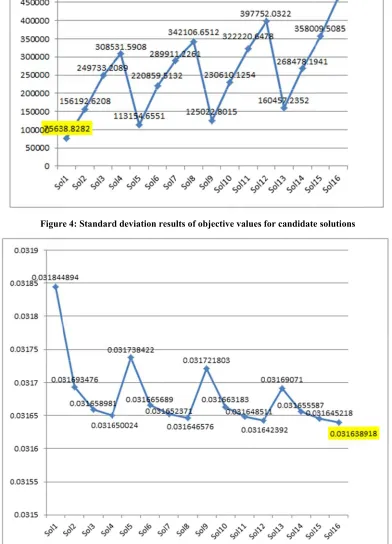
ve function v mum profit rated in Fig ot enough f ns there are sion maker criterion. E ment. SD i e 4. Accord ted as more erent optim e final dec selected as
Figure 3:
Figures 3, 4
value of sol t mean amo gure 3.
for selecting e fluctuation rs (Ogrycz Each of the s achieved ding to the T e reliable in mal solutions
ision. Solu s the final op
Mean results
4, and 5 fo
lution 16 th ong all solut
g optimal so ns and we zak, 2000).
solutions for all solu Table 5 and n uncertain c s. We can u ution 16 ha
ptimal solut
s of objective
for finding
hat is obtain tions. So, w
olution. Be need a risk We cons that have l utions of sc d Figure 4, conditions. use coeffici as the min
tion. It is pr
e values for ca
the optima
ned by scen we can selec
ecause in di k criteria to ider standa lower SD, cenarios. Re
solution 1 Regarding ient of vari nimum CV
resented in F
andidate solu
al solution,
nario 16 , is ct it as best
fferent con o ensure re ard deviati
it is more esults are p
has the min mean and S iation as an
Journal o
5.
Co
In this formulaof Industrial En
Figur
Figure 5
onclusion
paper, is c ated as a mixngineering an
e 4: Standard
5: Coefficient
and futu
consideredxed integer
nd Managemen
d deviation re
t of variation
re researc
a three-stag programmint Studies (JIE
esults of obje
n results of ob
ches
ge fixed ch ing problemN. Shira
EMS), Vol. 2,
ective values f
bjective value
harge transp m and is solv
azi, M. Seyyed
No. 1
for candidate
es for candida
portation pr ved using a
d-Esfahani, H
e solutions
ate solutions
roblem. Th multi-criter
H. Soleimani
Page 38
he model is ria scenario i
8
based solution approach to find optimal solution. First,16 scenarios with different logical are generated randomly. Then, initial solutions of scenarios are evaluated and weighted average of the results is calculated. Finally, mean, standard deviation and coefficient of variation are regarded as acceptable criteria in order to decide about best solution. This model can be expanded to a multi-product and multi-period for the future research.
References
1. Adlakha V., Kowalski, K. 1999. “On the fixed-charge transportation problem”. Omega, 27(3),
381-388.
2. Adlakha V., Kowalski, K. 2010. “A heuristic algorithm for the fixed charge problem”. Opsearch, 47(2), 166-175.
3. Adlakha V., Kowalski K., Lev B. 2010. “A branching method for the fixed charge transportation problem”. Omega, 38(5), 393-397.
4. Adlakha V., Kowalski K., Vemuganti R. R., Lev B. 2007. “More-for-less algorithm for fixed-charge transportation problems”. Omega, 35(1), 116-127.
5. Adlakha V., Kowalski K., Wang S., Lev B., Shen W. 2014. “On approximation of the fixed charge transportation problem”. Omega, 43(0), 64-70.
6. Antony Arokia Durai Raj K., Chandrasekharan R. 2012. “A genetic algorithm for solving the fixed-charge transportation model: Two-stage problem”. Computers & Operations Research, 39(9),
2016-2032.
7. Balinski, Michel L. 1961. “Fixed‐cost transportation problems”. Naval Research Logistics Quarterly, 8(1), 41-54.
8. Diaby, Moustapha. 1991. “Successive linear approximation procedure for generalized fixed-charge transportation problems”. Journal of the Operational Research Society, 991-1001.
9. El-Sherbiny, Mahmoud M., Alhamali, Rashid M. 2013. “A hybrid particle swarm algorithm with artificial immune learning for solving the fixed charge transportation problem”. Computers & Industrial Engineering, 64(2), 610-620.
10. El-Sherbiny, M.M.. 2012. “Alternate mutation based artificial immune algorithm for step fixed charge transportation problem”. Egyptian Informatics Journal, 13(2), 123-134.
11. Eskigun E., Uzsoy R., Preckel P.V., Beaujon G., Krishnan S., Tew J. D. 2005. “Outbound supply chain network design with mode selection, lead times and capacitated vehicle distribution centers”.
European Journal of Operational Research, 165(1), 182-206.
12. Gen, M., Kumar A., Ryul Kim J. 2005. “Recent network design techniques using evolutionary algorithms”. International Journal of Production Economics, 98(2), 251-261.
13. Hajiaghaei-Keshteli M., Molla-Alizadeh-Zavardehi, S., Tavakkoli-Moghaddam, R. 2010. “Addressing a nonlinear fixed-charge transportation problem using a spanning tree-based genetic algorithm”. Computers & Industrial Engineering, 59(2), 259-271.
14. Hitchcock, F.L. 1941. “The distribution of a product from several sources to numerous localities”. J. Math. Phys, 20(2), 224-230.
15. Jawahar, N, & Balaji, AN. 2009. “A genetic algorithm for the two-stage supply chain distribution problem associated with a fixed charge”. European Journal of Operational Research, 194(2),
496-537.
N. Shirazi, M. Seyyed-Esfahani, H. Soleimani
Journal of Industrial Engineering and Management Studies (JIEMS), Vol. 2, No. 1 Page 40
21. Listeş O. 2007. “A generic stochastic model for supply-and-return network design”. Computers & Operations Research, 34(2), 417-442.
22. Lotfi, M. M., & Tavakkoli-Moghaddam, R. 2013. “A genetic algorithm using priority-based encoding with new operators for fixed charge transportation problems”. Applied Soft Computing, 13(5), 2711-2726.
23. Molla-Alizadeh-Zavardehi, S., Sadi Nezhad, S., Tavakkoli-Moghaddam, R., & Yazdani, M. 2013. “Solving a fuzzy fixed charge solid transportation problem by metaheuristics”. Mathematical and Computer Modelling, 57(5–6), 1543-1558.
24. Ogryczak, W. 2000. “Multiple criteria linear programming model for portfolio selection”. Annals of Operations Research, 97(1-4), 143-162.
25. Panicker, V.V., Sridharan R., Ebenezer B. 2012. “Three-stage supply chain allocation with fixed cost”. Journal of Manufacturing Technology Management, 23(7), 853-868.
26. Pintea C.M., Sitar C., Hajdu-Macelaru M., Petrica P. 2012. “A Hybrid Classical Approach to a Fixed-Charged Transportation Problem. Hybrid Artificial Intelligent Systems, 7208, 557-566.
27. Raj, K Antony Arokia Durai, & Rajendran, Chandrasekharan. 2011. “A Hybrid Genetic Algorithm for Solving Single-Stage Fixed-Charge Transportation Problems”. Technology Operation Management, 2(1), 1-15.
28. Safi, M. R., & Razmjoo, A. 2013. “Solving fixed charge transportation problem with interval parameters”. Applied Mathematical Modelling, 37(18–19), 8341-8347.
29. Schaffer, Joanne R, & O'Leary, Daniel E. 1989. “Use of penalties in a branch and bound procedure for the fixed charge transportation problem”. European journal of operational research, 43(3),
305-312.
30. Soleimani H., Seyyed-Esfahani M., Shirazi M. 2013. “A new multi-criteria scenario-based solution approach for stochastic forward/reverse supply chain network design”. Annals of Operations Research, 1-23.
31. Vinay, VP, Sridharan, R. 2012. “Development and analysis of heuristic algorithms for a two–stage supply chain allocation problem with a fixed transportation cost”. International Journal of Services and Operations Management, 12(2), 244-268.
32. Xie F., Jia R. 2010. “A note on “Nonlinear fixed charge transportation problem by spanning tree-based genetic algorithm”, Computers & Industrial Engineering, 59(4), 1013-1014.
33. Xie F., Jia R. 2012. “Nonlinear fixed charge transportation problem by minimum cost flow-based genetic algorithm”. Computers & Industrial Engineering, 63(4), 763-778.