Http://www.ijetmr.com©International Journal of Engineering Technologies and Management Research [27]
CONSUMER PERCEPTION AND BRAND LOYALTY TOWARDS OVER
THE COUNTER BRAND MEDICINES OF MAJOR PHARMACEUTICALS
COMPANIES WITH SPECIAL REFERENCE TO RAJASTHAN
Abhishek Dadhich*1, Prof. (Dr.) Kavaldeep Dixit2
*1
Research Scholar, Rajasthan Technical University, Rajasthan, India 2
Vice Principal (Professor), International School of Informatics & Management, Rajasthan, India Abstract:
The study intends to explore the consumer perception towards over-the-counter (OTC) medicines and factors that influence consumer buying behavior for OTC brand medicines marketed by pharmaceutical companies. It also aims to study the impact of marketing mix factors on consumer perception and OTC brand loyalty. The research is descriptive in nature. It is based on primary data which is collected via structured questionnaire. The hundred respondents were participated in pilot study to understand and validate the questionnaire. The primary data obtained are analysed to identify the consumer perception and OTC brand loyalty promoted by the pharmaceutical companies. The study was conducted in period of 1 December 2016 to 31 March 2017. The respondents are from different districts of Rajasthan. 411 respondents participated on simple convenient non-probability sampling basis. In the study the dependent variables like consumer perception and brand loyalty with independent variables like consumer self-medication and OTC marketing mix factors are considered. It is observed in present study that OTC marketing mix factors like Place, Price and Promotion has positive impact on consumer perception and OTC brand loyalty whereas self-medication practices have negative impact. The study also revealed that Place (Product availability), Price and Promotions are the major influencing factor in considering consumer OTC medicine buying behavior.
Keywords: Over-The-Counter (OTC) Medicine; Pharmaceutical Marketing; Consumer Perception; Consumer Purchase Behaviour.
Cite This Article: Abhishek Dadhich, and Prof. (Dr.) Kavaldeep Dixit. (2017). “CONSUMER PERCEPTION AND BRAND LOYALTY TOWARDS OVER THE COUNTER BRAND MEDICINES OF MAJOR PHARMACEUTICALS COMPANIES WITH SPECIAL REFERENCE TO RAJASTHAN.” International Journal of Engineering Technologies and Management Research, 4(9), 27-38. DOI: https://doi.org/10.29121/ijetmr.v4.i9.2017.97.
Introduction 1.
Http://www.ijetmr.com©International Journal of Engineering Technologies and Management Research [28] represents one major strategy for containing healthcare cost. Amongst several reasons the major growth factors which is responsible for OTC medicine popularity is consumer convenience and savings in time and money with effective treatment cost and avoid lengthy treatment of prescribers.
On the other side, the growing world of fast technology and scientific advancement life become stressful due to changes takes place in daily lifestyle, less physical work, changing in food habit, work load stress on the body which get expressed in the form of mental and physical disorders like frequent headache, constipation, allergy, common cold, backache, acidity, and fatigue etc. which they are trying to manage with the use of Over the Counter (OTC) medicines. These leading factors steady increase in medication practices for the past many years. Thus, self-medication using OTC medicines represents the growing movement toward medical self-care and hence Pharmaceutical companies need to focus on their marketing and strategic planning segment.
The OTC medicine section in India is not identified distinctly under national medicines regulatory authority. The drug regulatory framework varies throughout the world and it’s depend on the local legislative framework. Therefore, the medicines that does not fall in the prescription drugs category is classified as Over the Counter medicines. The growth of the Indian OTC market has tremendously rise in compare to other OTC markets in the world. Globally India ranks 11th in terms of the OTC medicine market size. Indian pharmaceutical consumer healthcare segment is estimated up to USD 3 billion comprising mainly prescription to OTC medicine and pure OTC medicine segments and these consumer healthcare segments is expected to grow at 14 to 16% to become a USD14 to 18 billion markets by 2020.
To target the various types of customer pharmaceutical industry have successfully positioned themselves to create business opportunities for increasing profitability. Pharmaceutical marketing is a complex web where decision-makers determines the nature of the transaction (prescription drug) for which direct customer of Pharma industry is doctor and product cost payment and consumption done by end user which is Patient. But in the OTC marketing and drug promotion strategies Pharma industry direct advertise their product to the end user (Customer) which shows OTC product benefits and its uses. The pharmaceutical companies plan marketing strategies through which they deliver the value to the customer. The marketing strategy allows pharmaceutical business units to attain its marketing objectives. The pharmaceutical industry must consider various standards for promotional strategies of OTC drug product which are like advertising should be truthful and non-deceptive; not going to mislead shoppers acting moderately underneath the circumstances. OTC advertisers should have proof to duplicate their claims. OTC medicine advertisements can’t be unfair.
Http://www.ijetmr.com©International Journal of Engineering Technologies and Management Research [29] 1.1. Statement of the Problem and Need of the Study
As the numbers of OTC products are available in market with different therapeutic segment which are make available to consumers and most of the purchasing of OTC are made through Pharmacist or chemist retailer. The author here studied the consumer knowledge and perception regarding OTC brand medicine and analyzes the marketing strategies promoted by pharmaceuticals companies in Rajasthan as it will be helpful to understand their purchase behavior of the OTC products. By understanding the various factors that contribute to the perception of OTC products will be helpful to design effective promotional communication which will have more impact and positively enhance the growth for OTC medicine market.
2. Review of Literature
Srivastava RK W.S., (2017) in their research paper “Study of consumers' perception towards pharmaceutical over-the-counter products in emerging markets – India”, the study was conducted to know the consumer perception towards over the counter medicine and influencing factors for purchasing OTC medicine in India. In the study author studied demographic variables as well as independent variables like lifestyle, mental health, attitude and personality and some influencing factors like doctor advice, prior awareness, brand name and promotional strategy by pharmaceutical companies were also studied. The study results revealed that doctors and pharmacist are the most reliable source of information before taking OTC medicine, there is significant difference between male and female perception about the use of OTC medicine. The study results also revealed that most of the India population is aware of OTC products. The author suggested that OTC market is coming up future of the pharmaceutical industry due to increase in health awareness among people. To provide rich information about OTC product to consumer author suggested that FMCG model should be applied to the over the counter pharmaceutical marketing laterally with traditional marketing.
Shah Tejas, (2016) in his research article “Effectiveness of OTC Drug Advertising and Its Impact on Consumer Behavior”. The study was focused on to find out the influencing factor on consumer purchase decisions like, direct mail advertising, advertising, and inter-firm and intra firm communications. The study’s main objective was to find key variables of OTC drug advertising and research the effect of Over-The-Counter (OTC) medicine advertisement on consumers purchase behavior. Depending on variables the researcher structured various hypotheses which were followed by structured questionnaires. The personal interaction with the respondents was conducted by convenience sampling method who watched the OTC medicine advertisement. The questionnaires include independent variable such as knowledge and awareness, effectiveness, accurate, educate, information, preference, and persuasion as dependent variable. The results revealed that respondents disagreed with the statement that specific medicine advertisements are informative to the community. Likewise, participants had highest discrepancy regarding side effects and risks associated with OTC medicine advertisement.
Http://www.ijetmr.com©International Journal of Engineering Technologies and Management Research [30] may be carried out in identifying various media option and effective component in OTC advertisement.
Srivastava RK, (2014) in the research paper “Understanding of consumer’s awareness about brands in pharmaceutical industry—an empirical study”, the study was conducted to know the patient awareness about brand in pharmaceutical industry. The study was comprised of 442 respondents to find out their interest in finding out the details of prescription. The study includes judgment sampling method for selecting sample size. The study includes various demographic variables in relationship to pharmaceutical brand awareness. The study findings show that education is the major factor to understand the brand recall from pharmaceutical companies. The company name is important criteria before patient consuming medicine. The research results also revealed that income has significant relationship with the company recall. The author narrated that this study assists pharmaceutical companies to access their brand image from client perspective. The research study also helps in identifying similarity between firm assumed positioning strategies and customer perception of the strategy.
Ahmed Rizwan Raheem, (2014) in their research paper “Product Strategies in Pharmaceutical Marketing: A Perspective of Pakistani Pharmaceutical Industry”, the study analyzes the important and imperative parameters to bring a new product in a Pakistan pharmaceutical market. The author narrated that the pharmaceutical product is classified based on OTC medicine and prescription medicine and depending on the category of pharmaceutical product it was promoted to the healthcare professionals or directly to the public. He also stated that in pharmaceutical business, marketing part is invariably handled by the company’s own sales team because of extremely technical and scientific specialized nature of work, whereas the distributor is accountable only for the logistics arrangements. This paper also highlights a clear difference between general product marketing with pharmaceutical product marketing that pharmaceutical product is responsible for diagnosing and curing diseases whereas general product is only psychological need.
3. Objective of the Study
The objective of the present research pursuit is to make analysis of consumer perception regarding brand awareness, safety, availability, and marketing strategies of OTC product brands in Rajasthan.
Following are the key objective of proposed research
1) To analyze the consumer perception about OTC brand product, marketed by pharmaceutical companies and their brand loyalty with OTC product.
2) To determine the key influencers in purchase of OTC brand medicines by consumer.
4. Materials and Methods
Http://www.ijetmr.com©International Journal of Engineering Technologies and Management Research [31] study evaluates the major influencing factor and consumer preference towards the OTC brand promoted by the major pharmaceutical companies. The promotional medium and its impact on consumer perception and expectation from OTC brand medicine have also been researched with quantitative research.
4.1. Research Design
The research is descriptive in nature. It was based on the primary data. Primary data were collected via structured questionnaire. In the study, a sample size of 411 respondents was considered. Data obtained were analysed to identify the factors influencing perception of consumer for OTC products and their brand loyalty with OTC product.
4.2. Sample Size and Sampling Techniques
The simple convenient non-probability sampling was used for the present research. In the pilot study sample size of 100 respondents was considered from different age group, occupation, family income and qualification. Data were collected from different districts of Rajasthan. As shown in Table 1.
Table1: Socio-economic profile of sample
n %
Male 252 61.3
Female 159 38.7
25 25 years and below 117 28.5
26-35 years 222 54.0
36-45 years 63 15.3
45 years and above 9 2.2
Total 411 100
In the present study a sample size of 411 is considered for the descriptive research. The sample size was calculated as perKrejcie & Morgan formula. 61.3% of males and 38.7% of females participated in the study. The majority of sample size was consisting of 26-35 years age group which shows that younger population participated, as India has young population.
4.3. Research Questionnaire Design and Data Collection
Http://www.ijetmr.com©International Journal of Engineering Technologies and Management Research [32] 4.4. Reliability of the Questionnaire
The Cronbach’s alpha test was calculated to measure the internal consistency and reliability of the instrument use for consumer response. The Cronbach’s alpha was calculated as 0.830, thus the instrument was considered as reliable for the present study.
5. Results And Discussion
The data collected undertook for descriptive and inferential analyses.
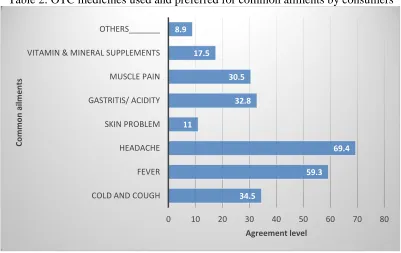
5.1. OTC Medicine used and Preferred for Common Ailments among Consumers
The respondents were asked how effective they found OTC medicine in different common ailments if they use it in last 6 months. 8 major common ailments were determined and respondents were asked to rank each factor on Likert scale from strongly disagree to strongly agree. Common ailments in which OTC medicine found more effective was considered by combined agree and strongly agree as higher to lower.
Table 2: OTC medicines used and preferred for common ailments by consumers
Inference
From the above table 2, it is observed that for headache 69.4% of consumers responded that they found OTC medicine effective, followed by 59.3% for fever, 34.5% consumer responded for cold and cough whereas for Gastritis and muscle pain it was 32.8%, 30.5% respectively. Least one common ailment categories for which consumer found OTC medicine effective was Vitamin& mineral supplements 17.5, Skin problem 11% and 8.9% for other categories like tooth pain, nasal decongestion, and nicotine replacement therapy (NRT) etc.
34.5
59.3 69.4 11
32.8 30.5 17.5
8.9
0 10 20 30 40 50 60 70 80
COLD AND COUGH FEVER HEADACHE SKIN PROBLEM GASTRITIS/ ACIDITY MUSCLE PAIN VITAMIN & MINERAL SUPPLEMENTS OTHERS_______
Agreement level
C
o
mmo
n
ai
lme
n
Http://www.ijetmr.com©International Journal of Engineering Technologies and Management Research [33] 5.2. Consumer Opinion on Referring Brand OTC Medicine on Different Parameters
The respondents were asked on which parameter they refer brand OTC medicine to others to find out the parameter on which they refer OTC brands to other friends and family members.
Table 3: Consumer opinion on referring brand OTC medicine on different parameters
OTC Parameter Frequency Percent
OTC brand familiarity 90 21.9
OTC brand quality 53 12.9
OTC brand safety 18 4.4
OTC brand effectiveness 62 15.1
OTC brand cost 18 4.4
OTC brand scheme 0 0
Total 241 100.0
Inference
In the above table 3, it is observed that major parameter on which consumer refer OTC brand products to others are 21.9% OTC brand familiarity followed by 15.1% responded for OTC brand effectiveness, 12.9% responded for OTC brand quality and 4.4% responded for both OTC brand safety and OTC brand cost. None of consumer responded for OTC brand scheme. Thus, the result revealed that increase in OTC brand familiarity among consumer is directly proportionate to OTC brand product refer by consumer. Hence, the pharmaceutical companies required to strengthen their marketing strategies at all promotional channels so that more the consumer get aware and more the OTC brand familiarity will increase among consumer.
Multiple Linear Regression Model 5.3.
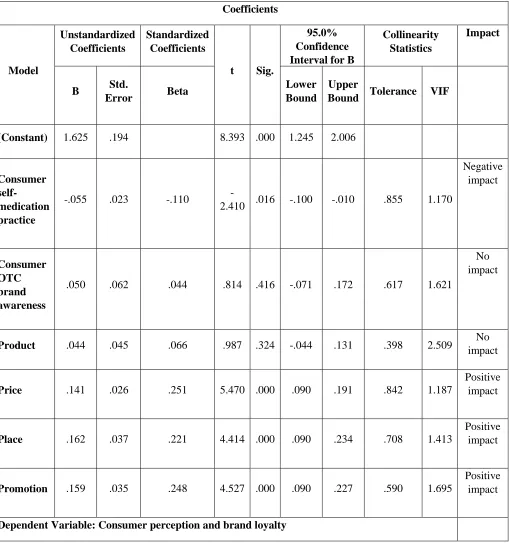
A multiple linear regression model was performed in which dependent variable consumer perception and brand loyalty whereas independent variables are consumer self-medication and Product, Price, Place, Promotion. In the present regression model, independent variables were computed by the amount that affected the dependent variable. The model summary presents important indicators for explaining power of the model. The R2 value illustrate how much change in the dependent variable is caused by the independent variables.
Inference
The multiple regression model with predictors Product, Price, Promotion, Place produced R2 = .284, F (6,404) = 26.758, P < .05 Thus, the results revealed that 28.4% variability was observed in dependent variable (Consumer perception and brand loyalty) due to predictors.
Http://www.ijetmr.com©International Journal of Engineering Technologies and Management Research [34] brand marketing impact than they should consider Price, Place, and Promotion as an important part of OTC marketing mix which perform positive impact on Consumer perception and brand loyalty about OTC brand product.
Table 4: Coefficients of ANOVA for consumer perception and brand loyalty
Coefficients
Model
Unstandardized Coefficients
Standardized Coefficients
t Sig.
95.0% Confidence Interval for B
Collinearity Statistics
Impact
B Std.
Error Beta
Lower Bound
Upper
Bound Tolerance VIF
(Constant) 1.625 .194 8.393 .000 1.245 2.006
Consumer
self-medication practice
-.055 .023 -.110
-2.410 .016 -.100 -.010 .855 1.170
Negative impact
Consumer OTC brand awareness
.050 .062 .044 .814 .416 -.071 .172 .617 1.621
No impact
Product .044 .045 .066 .987 .324 -.044 .131 .398 2.509 impact No
Price .141 .026 .251 5.470 .000 .090 .191 .842 1.187
Positive impact
Place .162 .037 .221 4.414 .000 .090 .234 .708 1.413
Positive impact
Promotion .159 .035 .248 4.527 .000 .090 .227 .590 1.695
Positive impact
Http://www.ijetmr.com©International Journal of Engineering Technologies and Management Research [35] From the above table 4, it was revealed that Price, Place, and Promotion have significant positive regression weight, indicating consumer responded with higher scores on this variable was expected to have higher dependent variable i.e. Consumer perception and brand loyalty after controlling the other variables in the present model. Thus, to make an OTC brand marketing impact on Consumer perception and brand loyalty, Price, Place and Promotion for OTC marketing mix must be considered by pharmaceutical companies because pricing of OTC product required to be consumer centric, place should be consider regarding product availability if more the OTC product available at different distribution channels more the consumer perception and brand loyalty will increase and promotion is also an important variable of marketing mix which should be consider by pharmaceutical companies if more the OTC brand awareness among consumer will promoted with influencing source of channels than more the consumer perception and brand loyalty will increase towards OTC brand product.
The above table of coefficient also shows the negative impact of consumer self-medication practice on dependent variable consumer perception and brand loyalty because more the self-medication practice will be performed by the consumer more the consumer awareness about different OTC brands will increase which is inversely proportional to consumer perception and OTC brand loyalty.
Following figure 1 presents the normal P-P plot of regression for consumer perception and OTC brand loyalty. The bubbles denote the observed responses against straight line representing expected responses. The co-linearity of both indicates the suitability of the model. Hence, it may be concluded that model is suitable and can be used to find out consumer perception and OTC brand loyalty level if responses for other independent variables are present or vice versa.
Http://www.ijetmr.com©International Journal of Engineering Technologies and Management Research [36] 5.4. Factors Affecting Consumer Buying Behavior in order of Most to Least Important
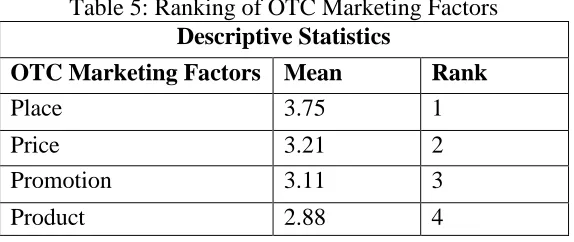
In this part of author’s aims to explore the importance level of OTC marketing factors, which factor is most important in influencing OTC brand product buying behavior and which is least important. To explore the opportunity, it is required to identify the major influencing factor of OTC marketing.
Table 5: Ranking of OTC Marketing Factors
Descriptive Statistics
OTC Marketing Factors Mean Rank
Place 3.75 1
Price 3.21 2
Promotion 3.11 3
Product 2.88 4
Inference
The above table 5 presents the mean level of all the OTC marketing factors, as the data was collected on 5-point Likert scale it ranges between 1-5 and the level of agreement shown my consumer for all the factors ranges between 3-4. Thus, it concluded that all the OTC marketing factors like Product, Price, Place, and Promotion are playing important role in building OTC product buying behavior.
As per the mean values all the OTC marketing factors are ranked, higher the mean value higher is the rank of the factor:
In the ranking of OTC marketing factors “Place” having highest rank with the mean value 3.75 showing high level of agreement among consumers. In OTC marketing “Place” is replace by “Product availability” and it is the most attractive factor for consumers. Customers get influenced when OTC product is easily available at all distribution channels like nearby chemist store, online pharmacy, and supermarket.
Place is followed by “Price” having mean value 3.21 with 2nd
rank, Price is the second most influencing factor in OTC marketing because to treat the common ailments consumer first choice of treatment is OTC brand product which is cost-effective in compare to regular treatment with prescription medicine and consumer also perceived that OTC product price is consumer centric.
Promotion begged 3rd rank having a mean value of 3.11, OTC product advertisement and its recommendation by experts are such factors which influence consumer OTC product buying decision. Hence, more the OTC promotion more the consumer awareness takes place to treat the common ailments. Advertisement with OTC product attributes, discounts, and offers attract consumer as an important factor of OTC marketing.
Http://www.ijetmr.com©International Journal of Engineering Technologies and Management Research [37] scientific based product and majority of these product can’t be customized as per consumer requirement.
6. Conclusion and Recommendation
The research results revealed that consumers are aware of brand OTC medicine and mostly they prefer to treat common ailments like headache, fever, and cold & cough, hence the OTC market is expanding gradually as a first line of treatment in Rajasthan. Consumer opined that OTC brand familiarity is the key factor in referring OTC brand medicine, this should be considered by pharmaceutical companies so that these OTC products marketed effectively at all distribution channels and more number of consumers will get aware about safe and effective use of OTC brand medicine. The Coefficients of ANOVA for consumer perception and brand loyalty revealed that consumer self-medication practice has negative impact on consumer perception and brand loyalty because more the consumer performed self-medication practices gradually the patients get more awareness about different OTC brand medicine available in market which is inversely proportional to consumer perception and OTC brand loyalty. Whereas price, place and promotion has positive impact on consumer perception and brand loyalty. The study also revealed that place, price and promotion are major key influencing factors for consumer OTC buying behavior which should be ponder while formulating OTC medicine marketing strategy.
References
[1] Arnum, P. V. (2011, june 02). Global Pharma Market Expected to Reach $1 Trillion. Retrieved march 6, 2016, from PharmaTech: http://www.pharmtech.com/global-pharma-market-expected-reach-1-trillion
[2] Bhangale, V. (2007). OTC Drug Marketing. International Marketing Conference on Marketing & Society (pp. 397-402). IIM, Kozikode: 402, Shubh Apartment, Opp.Kelkar College, 90 ft.Road, Mulund (E), Mumbai – 400 081. Retrieved from
http://dspace.iimk.ac.in/bitstream/handle/123456789/648/397-402.pdf?sequence=1
[3] Bhatia, D. (2012, September 12). Over The Counter (OTC) Healthcare - Changing Marketing Strategies. Retrieved November 21, 2016, from http://www.mbaskool.com:
http://www.mbaskool.com/business-articles/marketing/4934-over-the-counter-otc-healthcare-changing-marketing-strategies.html
[4] Centad. (2010). Competition Law and Indian Pharmaceutical Industry. New Delhi: Centre for Trade and Development (Centad). Retrieved from
http://www.cci.gov.in/sites/default/files/PharmInd230611_0.pdf
[5] Dr. Matthias Buente, S. D. (2013). Pharma emerging markets 2.0. (Booz & Company) Retrieved august 17, 2016, from strategyand.pwc:
http://www.strategyand.pwc.com/media/file/Strategyand_Pharma-Emerging-Markets-2.0.pdf [6] Forecast, M. D. (2016). Over The Counter (OTC) Drugs Market by Product Type (Analgesics,
Cough, Cold and Flu Products, Dermatological Products, Gastrointestinal Products, Vitamins, Minerals, Weight Loss Products, Sleep Aids, Ophthalmic Products, Smoking Cession Aids and Other Pr. Retrieved December 14, 2016, from http://www.marketdataforecast.com/market-reports/global-over-the-counter-drugs-market-509/
Http://www.ijetmr.com©International Journal of Engineering Technologies and Management Research [38]
[8] Gupta, S. (2013, October). Emerging Indian OTC Markets. Apeejay - Journal of Management Sciences And Technology, 1(1), 24-29. Retrieved August 5, 2016, from
http://www.apeejay.edu/aitsm/journal/docs/ajmst-010105oct13.pdf
[9] Handlin, A. (2010). Definition of Product Branding Strategy. (Houston Chronicle) Retrieved january 28, 2017, from http://smallbusiness.chron.com:
http://smallbusiness.chron.com/definition-product-branding-strategy-15785.html
[10] Markets, R. a. (2006). 'Winning Pharmaceutical Brand Management' Compiles the Independent Views of Twelve Different Pharmaceutical Brand Experts. businesswire. Retrieved June 19,
2016, from
http://www.businesswire.com/news/home/20060421005012/en/Winning-Pharmaceutical-Brand-Management-Compiles-Independent-Views
[11] Mazumdar, M. (2013). An Overview of the Indian Pharmaceutical. In M. Mazumdar, Performance of Pharmaceutical Companies in India (pp. 17-44). Springer. Retrieved 2 1, 2017, from http://link.springer.com/book/10.1007%2F978-3-7908-2876-4
[12] Md. Yaqub Khan, P. G. (2013). A Review on Marketing of OTC Drugs. Asian J. Res. Pharm. Sci., 3(2), 72-78. Retrieved from
http://www.asianpharmaonline.org/ajps/5_ajps_3_2_2013.pdf
[13] Oswal, R. J., & Deshmukh, A. A. (2012, May). A Study of Marketing Strategies Part 1: for Selected Pharmaceutical Medicine adopted by Pharmaceutical Companies in and around Pune Region. International Journal of Marketing and Technology, 2(5), 272-285. Retrieved from http://www.ijmra.us/project%20doc/IJMT_MAY2012/IJMRA-MT1161.pdf
[14] P. Kotler, K. K. (2011). Marketing Management (14 Ed.). Pearson Education.
[15] Palma, A. D. (2012, january 24). Pharma marketing and sales: When to make an Rx to OTC switch. Retrieved October 29, 2016, from eyeforpharma:
http://social.eyeforpharma.com/commercial/pharma-marketing-and-sales-when-make-rx-otc-switch.
[16] Sahay, A., & Jaikumar, S. (2016). Does Pharmaceutical Price Regulation Result in Greater Access to Essential Medicines? Indian Institute Of Managemen. Ahmedabad: Indian Institute Of Management. Retrieved from
https://web.iima.ac.in/assets/snippets/workingpaperpdf/2217512512016-02-01.pdf.
*Corresponding author.