Notre Dame Journal of Law, Ethics & Public Policy
Volume 18
Issue 1
Symposium on Marriage and the Law
Article 4
1-1-2012
What Does Convenant Mean for Relationships
Margaret F. Brinig
Steven L. Nock
Follow this and additional works at:
http://scholarship.law.nd.edu/ndjlepp
This Article is brought to you for free and open access by the Notre Dame Journal of Law, Ethics & Public Policy at NDLScholarship. It has been accepted for inclusion in Notre Dame Journal of Law, Ethics & Public Policy by an authorized administrator of NDLScholarship. For more information, please [email protected].
Recommended Citation
Margaret F. Brinig & Steven L. Nock,What Does Convenant Mean for Relationships, 18 Notre Dame J.L. Ethics & Pub. Pol'y 137 (2004).
WHAT DOES COVENANT MEAN FOR RELATIONSHIPS?
MARGARET
F.
BRINIG*STEVEN L. NOCK**
Both of us have thought substantially about covenant over the past several years.' The concept of covenant comes to us originally from religious sources, so we pay explicit attention
here to what the Bible and organized religion have to say about it. We also have drawn from our own disciplines of law, econom-ics, and sociology as they explain or draw from the initial concepts.
In this piece, we will first provide an analysis of covenant as we see it. We will continue with an original empirical test of whether covenant relationships differ from others, based upon new data from Louisiana, which offers both covenant and stan-dard marriages. What we will try to argue and prove is that, even granting the differences between couples who choose covenant marriages from those who do not, something special happens to the relationship itself, or the spouses in it, when they choose the covenant marriage option. We conclude by relating what we have found to the more common choice couples make today: whether to marry or to cohabit. Not all of what makes cohabiting relationships less successful than marriages not preceded by cohabitation is a question of differences in the couples before-hand (the selection effect). The more covenantal the
relation-* College of Law, University of Iowa.
** Department of Sociology, University of Virginia.
1. Steven L. Nock is the Principal Investigator of National Science Foun-dation Grants, Nos. SBR-9803736 and SES-9819156, and of private founFoun-dation support recently awarded to study the implementation, development, and mea-surable outcomes of covenant marriage in Louisiana. He is the author of MAR_
RIAGE IN MEN'S LrvEs (1998) [hereinafter NOCK, MARRIAGE IN MEN'S LIVES] and
such related articles as Commitment and Dependency in Marriage, 57J. MARRIAGE & FAM. 503 (1995) [hereinafter Nock, Commitment and Dependency].
Margaret F. Brinig is a consultant to the project. See MARGARET F. BRINIG, FROM COrRACr TO COVENANT (2000) [hereinafter FROM CONTRACT TO COVE-NANT]; Margaret F. Brinig, Economics, Law and Covenant Marriage, 16 GENDER ISSUES, Winter-Spring 1998, at 4; Margaret F. Brinig, Finite Horizons: The
Ameri-can Family, 2 INT'L J. CHILD. RTs. 293 (1994) [hereinafter Brinig, Finite Hori-zons]; Margaret F. Brinig, Status, Contract and Covenant, 79 CORNELL L. REv. 1573 (1994) (book review); Margaret F. Brinig, The Family Franchise: Elderly Parents
NOTRE DAME JOURNAL OF LAW, ETHICS & PUBLIC POLICY [Vol. 18
ship, the more the couple changes in relationship-enhancing ways.
I. AN ANALYSIS OF COVENANT
Though used rarely in law, the term Covenant is beginning to appear when applied to marital relationships. Those who have
at least heard of the covenant marriage options in Louisiana2 (and, presumably Arizona3 and Arkansas4) tend to fall into two camps: those who are strongly in favor5
and those who are strenu-ously opposed.6 More than fifty percent of the Louisiana adults surveyed in a Gallup7 poll commissioned by Nock and his col-leagues had never heard of the concept. Some county clerks advise against it, or fail to pass out the statutorily required brochures because they feel it is silly or too time-consuming. Not surprisingly, couples marrying after the Louisiana legislation took effect have largely opted for "standard marriage," though the number finding covenant marriage attractive has increased from about 1% for the first six months to approximately 2% thereafter.8 Most of the considerable media attention has
con-2. See LA. REv. STAT. ANN. §§ 9:272-9:275.1 (West 2000). 3. See ARIz. REV. STAT. ANN. §§ 25-901 to 25-906 (West 2000).
4. See Union Contract Marriage, ARK. CODE ANN. §§ 9-11-801 to -811
(Michie 2002).
5. See, e.g., Union Contract: Marriage Bill Back, TULSA WORLD, Nov. 28, 1998,
at 16; Micah A. Clark, Divorce 'Disease' Demands Cure, S. BEND TRIB., Dec. 15, 1998, at Al1; Maggie Gallagher, Covenants Inspire Marriages with New Commitment, SACRAMENTO BEE, July 21, 1997, at B7.
6. See, e.g., Ira Mark Ellman, Senate Bill Revives Horror of Fault Divorce, ARIz.
REPUBLIC, Mar. 6, 1998, at B5; Walter Kirn, The Ties That Bind: Should Breaking
Up be Harder to Do?, TIME, Aug. 18, 1997, at 48; Don McLeese, Louisiana Legislat-ing Levels of Love, AUSTIN AM.-STATESMAN, July 29, 1997, at Bi; Katha Pollitt, What's Right About Divorce, N.Y. TIMES, June 27, 1997, at A29.
7. Gallup Organization surveyed a random sample of 540 Louisiana citi-zens by phone between July and September of 1998. Only 43.1% indicated they had heard of covenant marriage, and only 35% were aware that the legislation had been enacted. When asked whether covenant marriage was a good idea or not, of those who had heard of covenant marriage, about 25% said it was really too soon to tell; among the remainder, 81% said that it was a "good idea" or a "very good idea." Likewise, 56% of respondents would have a favorable or very favorable reaction to their own child choosing a covenant marriage. See AlanJ. Hawkins et al., Attitudes About Covenant Marriage and Divorce: Policy Implications
from a Three-State Comparison, 51 FAM. Rel. 166 (2002).
WHAT DOES COVENANT MEAN FOR RELATIONSHIPS?
centrated on the rules for divorce, though the intent of the pro-ponents is to change the nature of marriage.
As the assessments of the Louisiana experiment continue, the concept of covenant itself deserves attention. "Covenant" has been around for many years, at least since Biblical times. It figures in the early common law of contracts as the "promise under seal," but is perhaps better known today as the "covenant not to compete" in employment9 and as the "restrictive cove-nant" in land sales.'0 Even the non-lawyer associates formality with the word and perhaps some feeling of being bound to do something. Here we will reexamine covenant, emphasizing its applications to the family."' The authors will draw on ideas from sociology, law, economics, religion, and feminist thought in look-ing at what makes a covenant relationship, as opposed to one that is not. We will empirically examine covenant concepts both in general and through some new findings based upon the Loui-siana covenant marriage study. In the end, we conclude that cov-enant-and particularly the explicit covenant of covenant marriage-depart in significant ways from secular, legal contracts.
A covenant involves at least three interrelated concepts: per-manence (even extending beyond the lives of the promising par-ties themselves), unconditional love, and involvement (or witness) of God, or, at minimum, the larger community. In some ways, these natural law concepts are reflected in law. For exam-ple, parties legally cannot change the essential content of their marital or parental responsibilities once they have entered into the relationship.1 2 On the other hand, parties to a covenant are
beyond law in certain respects (though law may attempt to be
imperialistic)." If law tries to change or re-define a relationship
9. See, e.g., Catherine L. Risk, Removing the 'Fuel of Interest'from the 'Fire of
Genius" Law and the Employee-Inventor, 1830-1930, 65 U. CHI. L. REv. 1127 (1998).
10. See, e.g., Leland B. Ware, Invisible Walls: An Examination of the Legal Strategy of the Restrictive Covenant Cases, 1999 WASH. U. L.Q. 737 (1999).
11. See also William Johnson Everett, Contract and Covenant in Human Com-munity, 36 EMORY L.J. 557 (1987) (a related paper by a religion professor).
Many of the ideas in this section of the paper first appeared in Margaret F. Brinig & Steven L. Nock, Covenant and Contract, 12 REGENT U. L. REv. 9 (2000). 12. See, e.g., In re Higgason's Marriage, 516 P.2d 289 (Cal. 1973) (in banc)
(spousal support during marriage); Kujawinski v. Kujawinski, 376 N.E.2d 1382 (Ill. 1978) (support of college-aged child following divorce); Huckaby v. Huck-aby, 393 N.E.2d 1256 (11. Ct. App. 1979) (support of child after divorce); Pap-pas v. PapPap-pas, 75 N.W.2d 264 (Iowa 1956) (support of child after divorce); Buchanan v. Buchanan, 197 S.E. 426 (Va. 1938) (support of child after divorce).
NOTRE DAME JOURNAL OF LAW, ETHICS & PUBLIC POLICY [Vol. 18
like that linking parent and child, such as by saying formal paren-tal obligations end when the child reaches majority, it contradicts the essential nature of the bond. If it says the marriage is cleanly broken when the parties divorce, law flies in the face of the unhappiness of many concerned as well as the teachings of the Church.14 While the law may define formal, secular obligations in these ways, it does not alter the fundamental enduring nature of those obligations accepted as part of covenant.
As covenant relationships develop, they show distinct pat-terns of call, response, promise, and sign. Biblical examples of covenant illustrate these patterns clearly, as in the familiar Old Testament story of Noah and the flood.15 Noah was called'6 because of his righteousness to build the ark to God's specifica-tions and to enter the ark with his family and the animals. He obeyed. The promises God made were that He would send no more devastating floods, that He would keep regular seasons, 7 that He would give people animals as well as plants for food, and that He would make humans fruitful.' In this account, we see the clear development of the four points just raised. Noah is called from being a farmer and herder to first building, then equipping, and finally waiting in the ark. He responds by doing what God commands, and is eventually promised God's
contin-14. The Catechism of the Catholic Church points out that:
The consent by which the spouses mutually give and receive one another is sealed by God himself. From their covenant arises "an insti-tution confirmed by the divine law .... even in the eyes of society." The covenant between the spouses is integrated into God's covenant with man: "Authentic love is caught up into divine love."
Thus the marriage bond has been established by God himself in such a way that a marriage concluded and consummated between bap-tized persons can never be dissolved. This bond, which results from the free human act of the spouses and their consummation of the marriage, is a reality, henceforth irrevocable, and gives rise to a cove-nant guaranteed by God's fidelity....
CATECHISM OF THE CATHOLIC CHURCH, §§ 1639-40 (2d ed. 1997) (emphasis in original).
Compare with the statement on divorce by the United Methodist Church: When a married couple is estranged beyond reconciliation, even after
thoughtful consideration and counsel, divorce is a regrettable alterna-tive in the midst of brokenness.... Although divorce publicly declares that a marriage no longer exists, other covenantal relationships result-ing from the marriage remain, such as the nurture and support of children and extended family ties.
THE BOOK OF DISCIPLINE OF THE UNITED METHODIST CHURCH, 161D (2000). 15. Genesis 6-8.
16. Genesis 7:1.
17. Genesis 8:18-22.
WHAT DOES COVENANT MEAN FOR RELATIONSHIPS?
ued patience and faithfulness. The symbol or sign is the rain-bow, which is to remind God and man of God's promise to refrain from again sending a flood.
As useful as Noah's story is for illustrating the common char-acteristics of covenant as expressed in the Bible, writers have thus far not paid much attention to its implications for families.'9 First, Noah's story obviously involves a family. God might have chosen Noah, his wife, his sons and their wives because, as a group, they could efficiently coordinate the work effort involved.2 ° He might have chosen this particular configuration because they had reasons to tolerate each other in the close con-fines of the ark for six months.2' From a practical point of view, He might have chosen Noah's family because the young couples could quickly, like the pairs of animals, repopulate the earth.
Noah was also very much the head of the family. Though he may have grumbled,2 2 and his sons may have muttered as they worked about what a strange father they had, the sons did what their father (acting for the Lord) commanded.23 Noah was directly in covenant with God but stood for the whole family in its dealings with those outside.2 4
Finally, Noah's story involves several generations. The older couple, Noah and his wife, would not produce more children but
19. For an exception, see MADELINE L'ENGLE, MANY WATERS (1986).
20. The earliest use for families was as economic units. See JEAN-Louis
FLANDRIN, FAMILIES IN FORMER TIMES 85-92 (Jack Goody & Geoffrey Hawthorn
eds., Richard Southern trans., 1979); MARY ANN GLENDON, THE NEW FAMILY AND THE NEW PROPERTY 12 (1981); EDWARD SHORTER, THE MAKING OF THE MODERN FAMILY 72 (1977) [hereinafter GLENDON, THE NEW FAMILY]; Frances E. Olsen,
The Family and the Market: A Study of Ideology and Legal Reform, 96 HART. L. REv.
1497 (1983).
21. See 3JAMES HENRY BERNARDIN DE SAINT PIERRE, STUDIES OF NATURE 589 (Henry Hunter trans., 2d ed.) (1799) ("We pass in succession through the love of our family, of our tribe, of our country, before we are instructed to love Mankind.").
22. For a very funny interpretation of the scene, see BILL COSBY, Noah and the Neighbors, on THE BEST OF BILL COSBY (Warner Bros. Ent. 1987).
23. See, e.g., Yoram Ben-Porath, The F-Connection: Family, Friends, Firms and the Organization of Exchange, 3 POPULATION & DEV. REV,. 1, 3 (1980) ("Parental decisions to have children and how to behave toward them in infancy and early childhood are unilateral but are probably affected by expectations concerning future mutual relationships.").
24. See id. at 12 ("Authority, discipline, altruism, and family solidarity affect the value of the signal, 'family affiliation,' for the rest of the world. The
presence of a head of family, serving as director for communication, trust, and redistribution, reduces transaction costs within the family by reducing the need for bilateral relationships.").
NOTRE DAME JOURNAL OF LAW, ETHICS & PUBLIC POLICY [Vol. 18
stood as a source of wisdom for the younger.25 They were able to see in the long run, not just the short-term.26 Noah's covenant
acted to bind future generations in their special relationship with God-in their duty to follow and honor Him. The sons and their wives also had a role, not just to produce more children, which was obviously important, but also in keeping Noah's traditions after he died.2 v
To see the characteristics of permanence, unconditional love, and God's witness, we need to look beyond Noah's most memorable year and to examine more of the Biblical account of salvation's history. The Easter liturgy of many Christian tradi-tions explains how the covenants begin with Adam and culminate in the death and resurrection of Christ. Let us briefly reflect on the story of Adam before we turn to a more systematic look at the three relational features of covenant.
Biblical covenant relationships promote interdependence and stability,28 and covenant ideas should even be promoted by the human institution of covenant marriage;29
the evidence that we will present here seems to support these propositions. Keep in mind that, unlike contracts, covenants need not extend only to husband and wife, but may also involve parents and chil-dren3°-even without the child's ability to consent.3 1
Thus, Adam's story32 is in many ways like that of the typical
parent-child relationship, since the God of Genesis created Adam without Adam's promise or even knowledge, and, after literally giving him the world, unilaterally imposed the condition of
obe-25. See RIcHARD A. POSNER, AGING AND OLD AGE 206-07 (1995) (describ-ing roles for the elderly in primitive societies where the elders were likely to have encountered unusual things, such as eclipses, before the young).
26. See Brinig, Family Franchise, supra note 1, at 412-13.
27. See id. at 411-12; see also Theodore C. Bergstrom, Economics in a Family
Way, 34J. ECON. LITERATURE 1903 (1996) (providing a discussion of the
biologi-cal interests of the second generation).
28. See MILTON C. REGAN, FAMILY LAW AND THE PURSUIT OF INTiMacy 4, 104, 183 (1993); Brinig, Status, Contract and Covenant, supra note 1, at 1587-88. 29. See generally Brinig, Economics, Law and Covenant Marriage, supra note 1. 30. See Elizabeth S. Scott & Robert E. Scott, Parents as Fiduciaries, 81 VA. L. REv. 2401 (1995).
31. See Brinig, Finite Horizons, supra note 1, at 300-01. Even implicit con-tracts are difficult to explain in this context since the child gives no consent. There may appear to be a covenant between the parents, see Scott & Scott, supra note 30, but clearly these are more involved than something like the third party beneficiary rule is. For an example of this doctrine applied to families,
see Drake v. Drake, 455 N.Y.S.2d 420 (N.Y. App. Div. 1982) (holding that the
WHAT DOES COVENANT MEAN FOR RELATIONSHIPS?
dience upon him.3 3 God was to walk in the Garden of Eden (keeping Adam company) and gave him all the green plants to eat and the beasts to name. Later, Genesis reports that He cre-ated Eve as a helpmate fitting for him. Presumably, Adam at this point had eternal life, for it was only in his disobeying the warn-ing not to eat of the fruit of the tree of knowledge of good and evil that he became subject to death.34 When he became disobe-dient, God did not turn away, but instead, since man now was "like one of us"3 in knowing good and evil, expelled him from the Garden so he would not be able to eat of the tree of life. Adam then had to till the soil and Eve to experience pain in childbearing, though God promised that the Savior would come from their seed.3 6
A. Unconditional Love
The Lord is merciful and gracious, slow to anger and abounding in steadfast love. He will not always chide, nor will he keep his anger for ever. He does not deal with us according to our sins, nor requite us according to our iniq-uities. For as the heavens are high above the earth, so great is his steadfast love towards those who fear him; as far as the east is from the west, so far does he remove our transgressions from us. As a father pities his children, so the Lord pities those who fear him. But the steadfast love of the Lord is from everlasting to everlasting upon those who fear him, and his righteousness to children's children, to those who keep his covenant and remember to do his commandments.37
The story of Hosea illustrates both how unconditional love works in the family and how the Bible analogizes unconditional family love to the love God has for mankind and especially for His people. Unconditional love strikes against the heart of con-tract law. In the Bible story, Hosea apparently was told by God to marry a woman of loose reputation and easy virtue. She had a series of lovers both before and after their marriage.3" Nonethe-less, the prophet continued to love her and, though he was angry at her unfaithfulness, he always took her back. He does not
33. For a beautiful fictional account of the story, see C.S. LEwis,
PERELAN-DRA (1943). Another parent-child relationship is explained in Hosea 11, where
God is pictured as a father who teaches Israel to walk and nurtures him. 34. See Genesis 3:19, 3:22-24.
35. Genesis 3:22-23 (Revised Standard).
36. Genesis 3:15-17.
37. Psalms 103:8-13, 103:17-18 (Revised Standard). 38. Hosea 1:3-5.
desert the promises he has made. Hosea's wife is of course the allegorical counterpart to Israel, which time and again was unfaithful to the covenants made by Abraham, Isaac, and Jacob. A contract-based world allows a breach of promises so that one party may engage in a better opportunity.3 9 This is called the concept of efficient breach.40 Contract also implies a need to pay some attention to balances between contracting parties. It is clear from the Christian Bible that if God kept such a balance, without the redeeming work of Christ, we would always fall short.4'
In stable, covenant-based families, couples do not keep pre-cise track of what they do for each other. Couples that do not keep precise track of who owes what to whom have more stable mar-riages. For example, in the National Survey of Families and Households, couples were asked in 1987-88 how much time they and their spouse spent each week on various household tasks.4 2 The second wave of the study tracked the same people five years later, in 1992-94. Some of the couples had divorced or sepa-rated during those five years, others remained intact. Those who thought the division of labor in the household and in the labor market was 'Just about fair" were more likely to divorce or sepa-rate than those who thought the division of work and household tasks were unfair to the other person.43
In contrast, a Virginia divorce case involves a wife who thought a contract-like tit-for-tat exchange was necessary. She testified that after the first several years of marriage she felt that a psychological wall was being erected between her and her hus-band.4 4 Each time he did something that wronged her another brick was added to the wall so that, finally, she could not commu-nicate with him at all.
Similarly, both Nock and Brinig have known couples who kept track of how many arguments they had, how many chores each did, or how often they engaged in sexual intercourse. (One
39. See Brinig, Status, Contract and Covenant, supra note 1, at 1586. 40. See, e.g., Ian Macneil, Efficient Breach of Contract: Circles in the Sky, 68 VA. L. REV. 947 (1983).
41. Romans 3:23; 2 Corinthians 3:4-6, 3:12-14.
42. See JAMES SWEET ET AL., CENTER FOR DEMOGRAPHY AND ECOLOGY, UNIV. OF WISCONSIN-MADISION, THE DESIGN AND CONTENT OF THE NATIONAL SURVEY OF FAMILIES AND HOUSEHOLDS (National Survey of Families and Households,
Work-ing Paper No. 1, 1988).
43. Steven L. Nock & Margaret F. Brinig, Weak Men and Disorderly Women: Divorce and the Division of Labor, in THE LAW AND ECONOMICS OF MARRIAGE &
DIVORCE 185 (Antony W. Dnes & Robert Rowthorn eds., 2002) [hereinafter Nock & Brinig, Weak Men].
WHAT DOES COVENANT MEAN FOR REIATIONSHIPS?
doomed couple whose home Brinig visited in the early seventies displayed a calendar with heart stickers posted on the days when they had had sexual intercourse.) Such keeping track, or expect-ing lovexpect-ing gestures to be returned, flies in the face of a covenant relationship. We may say covenant relationships are character-ized by duty or responsibility4" rather than by "inherently dynamic emotional states."46 Author Helen Fisher discusses bio-logical evidence suggesting that two different hormones (or pheromones) are given off during relationships.4 7 During the initial stage of the relationship, the hormones create sexual pas-sion and total concern with the other. After several years, these hormones fade and are replaced by ones of a different sort-the kind that characterizes affection rather than passion.48 Another way of looking at the phenomenon is to note that contracts fre-quently involve short-run relationships or even instantaneous exchanges (more like the passion)." Covenants, because they are designed to be permanent, assume that the balances will be righted eventually-that things will be "a wash,"50 or that any imbalance does not matter. (This is more like the affectionate relationships Fisher describes.) Their participants are thus more altruistic than are participants in contracts.
Keeping score of who does what and who owes whom appears to produce less satisfactory unions. Nevertheless, exten-sive dependencies are central to producing good marriages.5' In
other words, married people appear to thrive when they depend
45. SeeMARYANN GLENDON, RIGHTS TALK: THE IMPOVERISHMENT OF
POLIT-ICAL DISCOURSE 121-30 (1991) [hereinafter GLENDON, RIGHTS TALK].
46. REGAN, supra note 28, at 67.
47. See Helen Fisher, The Four Year Itch: Do Divorce Patterns Reflect our
Evolu-tionary Heritage?, 96 NAT'L HIST. 22 (1987). 48. See id. at 26.
49. See generally Anthony Kronman, Contract Law and the State of Nature, 1 J.L. ECON. & ORG. 1 (1985).
50. See Hosea 6:4-6. "What shall I do with you, 0 Ephraim? What shall I
do with you, OJudah? Your love is like a morning cloud, like the dew that goes early away." Id. (Revised Standard). In contrast, see G.K. CHESTERTON, WHAT'S
WRONG WITH THE WORLD 64, 67 (1910).
The child must depend on the most imperfect mother; the mother may be devoted to the most unworthy children; in such relations legal revenges are vain.... The essential element is not so much duration as security. Two people must be tied together in order to do them-selves justice; for twenty minutes at a dance or for twenty years in a marriage.
Id.
51. See, e.g., Nock, Commitment and Dependency, supra note 1 at 512-13; see
also Martha A. Fineman, Masking Dependency: The Political Role of Family Rhetoric, 81 VA. L. REV. 2181, 2191 (1995). But see MARTHA A. FINEMAN, THE NEUTERED
146 NOTRE DAME JOURNAL OF LAW, ETHICS & PUBLIC POLICY
on one another yet do not keep score. Sociologists and econo-mists have investigated factors that foster commitment in marriage. Such research seeks to determine why some individuals are more likely than others to remain in a marriage. Commitment is typi-cally understood as the perceived costs of ending the marriage. If an individual envisions no costs whatsoever to ending his or her marriage, then we may say such a person has no commitment to the union. Some economic theory argues that dependency is a primary factor in producing commitment.5 2 As couples negoti-ate the demands of married life, they come to depend on one another more and more. The routine demands of household labor, for instance, require a complex arrangement for
shop-ping, cleaning, caring for children, keeping the checkbook, and many other things. As couples settle into routines, they become increasingly interdependent. There are also very objective bases for dependency. Most wives earn less than their husbands and, therefore, may be presumed to be dependent on their spouse's
53 earnings.
Research shows that objective dependencies do foster com-mitment. When partners depend on one another for income or social status, there is greater commitment to the marriage. How-ever, objective dependencies of that sort are much less important than spousal obligations. In an analysis of the National Survey of Families and Households, Nock showed that the strongest predic-tor of individual commitment to a marriage is the imagined con-sequences of separation for the spouse.54 After removing the effects of objective types of dependencies (i.e., income, educa-tion, occupational status, children), the belief that separation would negatively affect one's husband or wife was significantly more important for individual commitment to a marriage than anything else. The imagined consequences of divorce for one's partner may be taken as a crude measure of an individual's sense of his or her marital obligations or their enduring nature.5 5 Both husbands and wives who believe their partners depend on them are much more committed to their marriages. Such
(1995) (arguing that the dependency of a wife upon her husband is precisely
what ails marriage from a woman's point of view).
52. See generally GARY S. BECKER, A TREATISE ON THE FAMILY 30-79 (1991).
53. Amy L. Wax, Bargaining in the Shadow of the Market: Is There a Future for
Egalitarian Marriage?, 84 VA. L. REv. 509, 522-23 (1997); see also Katherine T.
Silbaugh, Marriage Contracts and the Family Economy, 93 Nw. U.L. REV. 65 (1998). 54. Nock, Commitment and Dependency, supra note 1, at 513.
55. For an extended discussion of such obligations, see Carl E. Schneider,
Marriage, Morals and the Law: No-Fault Divorce and Moral Discourse, 1994 UTAH L.
WHAT DOES COVENANT MEAN FOR RELATIONSHIPS?
research suggests that marriages founded on extensive depen-dencies are stronger. It also suggests that married couples who envision mutual, long-term, and enduring obligations to each other have stronger marriages.
B. Permanence
I will sing of thy steadfast love, 0 Lord, for ever; with my mouth I will proclaim thy faithfulness to all generations. For thy steadfast love was established for ever, thy faithful-ness is firm as the heavens.
Thou hast said, "I have made a covenant with my chosen. I have sworn to David my servant: 'I will establish your descendants for ever, and build your throne for all generations.' 5 6
The Biblical story of David and Jonathan5 7 is one of the many that could be selected to show the permanence of covenant relationships-a concept closely related to the unconditional love discussed above. Jonathan made a covenant with David, because, the Bible reports, he "loved David as his own soul,"5 8 and he gave David his own robe and sword and bow and girdle.5 9 David said that if he had any guilt involving Jonathan's father Saul, Jonathan should slay David himself.6" Jonathan asked God to be witness that he would disclose faithfully whether Saul would do David harm or not; later,6 1 Jonathan blessed David and asked him not to cut off his loyalty from his house forever. "When the Lord cuts off every one of the enemies of David from the face of the earth, let not the name ofJonathan be cut off from the house
of David62 . . . . And as for the matter of which you and I have spoken, behold, the Lord is between you and me for ever." According to the Bible, God's covenant is thus an everlasting covenant.
A complication was introduced by the Mosaic Law, which appeared later in Jewish history. Nevertheless, as St. Paul explains:
56. Psalms 89:1-4 (Revised Standard). 57. 1 Samuel 18-20.
58. 1 Samuel 18:3 (Revised Standard). 59. 1 Samuel 18:4.
60. 1 Samuel 20:8.
61. 1 Samuel 20:6-13. David had become Saul's son-in-law by killing two
hundred Philistines. 1 Samuel 18:27.
148 NOTRE DAME JOURNAL OF LAW, ETHICS & PUBLIC POLICY
To give a human example, brethren: no one annuls even a man's will, or adds to it, once it has been ratified. Now the promises were made to Abraham and to his offspring. It does not say, "and to offsprings," referring to many; but, referring to one, "and to your offspring," which is Christ. This is what I mean: the law, which came four hundred and thirty years afterward, does not annul a covenant previously ratified by God so as to make the promise void.6 4
The Hebrews repeatedly broke God's law, given to Moses in the form of the Ten Commandments, not just in the time of Moses, but also in the succeeding generations. According to St. Paul, this written covenant did not replace the essential one God had made from the beginning-one that was finally fulfilled in
Christ.6 5
In the same way, various human rules and regulations (and even the law of the parties signified by their personal contract) cannot change the essential nature of the parent-child or hus-band-wife relationship. If we have a law requiring us to support
64. Galatians 3:15-17 (Revised Standard).
65. See id.; see also Jeremiah 31:31-34.
Behold, the days are coming, says the Lord, when I will make a new covenant with the house of Israel and the house ofJudah, not like the covenant which I made with their fathers when I took them by the hand to bring them out of the land of Egypt, my covenant which they broke, though I was their husband, says the Lord. But this is the cove-nant which I will make with the house of Israel after those days, says the Lord: I will put my law within them, and I will write it upon their hearts, and I will be their God, and they shall be my people. And no longer shall each man teach his neighbor and each his brother, and say 'Know the Lord,' for they shall all know me, from the least of them to the greatest, says the Lord; for I will forgive their iniquities and I will remember their sin no more....
Id. (Revised Standard).
The distinction between law and covenant also forms part of the background for the question put to Jesus by the Sadducees reported in Luke 20:27-36. A woman had married a series of men after their brothers died, according to the laws of Moses. If the marriage promises were forever, how could she be faithful to all of them? Jesus replied that in the world of men, there are marriages by the law of man. In heaven, the laws of man are no more. Id. See also Jeremiah 32:38:
They shall be my people, and I will be their God. I will give them one heart and one way, that they may fear me for ever, for their own good and the good of their children after them. I will make with them an everlasting covenant, that I will not turn away from doing good to them; and I will put the fear of me in their hearts, that they may not turn from me. I will rejoice in doing them good, and I will plant them in this land in faithfulness, with all my heart and all my soul.
WHAT DOES COVENANT MEAN FOR RELATIONSHIPS?
aged parents,6 6 this does not change our moral need to do so67 even beyond the poverty level,6" because such services "are pre-sumably rendered in obedience to natural promptings of love and affection, loyalty, and filial duty, rather than upon an expec-tation of compensation."" To take another example, our mar-riage vows to love one another are stronger than those the state makes against assault7 ° or marital rape, or even the divorce grounds of cruelty.7 2 Laws against child abuse cannot replace our duty as parents to meet our children's trust as well as to edu-cate and properly raise them.73 The covenant is thus like the "deeper magic" that C.S. Lewis writes of in The Lion, The Witch
and the Wardrobe.
"It means," said Aslan, "That though the Witch knew the Deep Magic [of blood sacrifice for sin], there is a magic deeper still which she did not know. Her knowledge goes back only to the dawn of Time. But if she could have looked a little further Back, into the stillness and the dark-ness before Time dawned, she would have read there a dif-ferent incantation. She would have known that when a willing victim who had committed no treachery was killed in a traitor's stead, the Table would crack and Death itself would start working backwards."74
66. See, e.g., VA. CODE ANN. §§ 20-61 (Michie 2000) (providing for misde-meanor punishment for any person deserting or willfully neglecting or refusing to pay support of an adult child or aged parent who is handicapped or other-wise incapacitated when the child or parent is in necessitous circumstances).
67. Cf 2 Corinthians 3:4-6, 3:12-14.
[S]uch is the confidence that we have through Christ toward God. Not that we are sufficient of ourselves to claim anything as coming from us; our sufficiency is from God, who has qualified us to be minis-ters of a new covenant, not in a written code but in the Spirit; for the written code kills, but the Spirit gives life....
2 Corinthians 3:4-6 (Revised Standard).
68. Mitchell-Powers Hardware Co. v. Eaton, 198 S.E. 496, 499-500 (Va. 1938) (stating that the obligor "must do more than relieve the pangs of hunger, provide shelter and furnish only enough clothes to cover the nakedness of the parent").
69. Jacobs v. Church, 36 Va. Cir. 277, 1995 WL 1055844 at *3 (Spotsylva-nia Co. 1995).
70. See, e.g., VA. CODE ANN. § 18.2-57 (Michie 1996); Counts v. Counts, 266 S.E.2d 895, 896 (Va. 1980).
71. See, e.g., VA. CODE ANN. § 18-67 (Michie 1996); Weishaupt v. Com-monwealth, 315 S.E.2d 847, 848 (Va. 1984).
72. VA. CODE ANN. § 20-91(6) (Michie 2000).
73. See Brinig, Finite Horizons, supra note 1, at 296.
150 NOTRE DAME JOURNAL OF LAW, ETHICS & PUBLIC POLICY
According to Hebrews 8, Christ acts as our high priest but mediates a better covenant, because God's response is no longer contingent upon Israel's (or the believer's) faithfulness. The law has been placed in people's minds and written on their hearts: "I will be their God, and they shall be my people.... I will remem-ber their sins no more."7" As the mediator of the new covenant, Christ is said to promise an eternal inheritance. For the first (Mosaic) covenant was ratified only at death and the scattering of blood, while Christ through the shedding of His blood offers for-giveness of sins. Unlike Aaron or the Old Testament priests, St. Paul posits that Christ entered not a sanctuary that was a copy of heaven but into heaven itself to appear in the presence of God on our behalf.7 6
C. Involvement of God as Witness
And Joshua wrote these words in the book of the law of God; and he took a great stone, and set it up there under the oak in the sanctuary of the LORD. And Joshua said to all the people, "Behold, this stone shall be a witness against us; for it has heard all the words of the LORD which he spoke to us; therefore it shall be a witness against you, lest you deal falsely with your God."7 7
Many of the Biblical descriptions of covenants involving God as witness are horizontal; that is, they involve covenants between people instead of promises made exclusively between man and God. With these horizontal covenants, between leaders or between kings and their people, God was called upon to serve as a witness. Then, if one of the parties was not present at the mak-ing of the promise or the promise needed to be executed some-time in the future, God (or a stone or a pillar, standing for God) was thought to remember since the covenant was permanent.
The commercial contract is typically a spot contract, with expectations of immediate or nearly immediate performance.78
Covenants, or especially important contracts like wills79 or
deeds,8" require other (disinterested) witnesses to be involved since everyone knows that both parties to the promise may not be
75. Hebrews 8:10, 12 (Revised Standard).
76. See Hebrews 9:24.
77. Joshua 24:26-27 (Revised Standard). Similar words appear with Jacob in Genesis 32, Moses, in Exodus 3 and Leviticus 26:44-45, and David in 2 Samuel 5. King Josiah makes a similar covenant in 2 Kings 23.
78. See generally Kronman, supra note 49, at 38-39.
WHAT DOES COVENANT MEAN FOR RELATIONSHIPS?
around at the critical time. Many of the Biblical covenants of this type involved kingship or the Levitic priesthood.
The Jacob story8 1 is a good one to use as an example since again it involves families. Jacob, whose youth and even birth involved some rather shady doing at his brother's expense,8 2 also had a stormy relationship with his father-in-law Laban. Laban had forced Jacob to serve twice the customary length of time to obtain his chosen bride, having to earn access to Leah before obtaining Rachel."' The two men also dispute ownership over large numbers of goats, which Jacob through artifice has caused to bear his markings rather than Laban's.84
When the covenant between the two men is made, 5 Jacob gets his kinsmen to help him set up a pile of stones. The two promise mutual non-aggression, and Laban gets Jacob to swear that he will not mistreat his wives (Laban's daughters) nor their children. Jacob leaves with the two wives, their considerable households, and the large fortune in disputed goats. This act shows the actual cleaving of Rachel and Leah from their father,8 6 as well as that God is to act as witness to the men's promises.
This heap is a witness, and the pillar is a witness, that I will not pass over this heap to you, and you will not pass over this heap and this pillar to me, for harm. The God of Abraham and the God of Nahor, the God of their father, judge between us.8 7
Jacob and his kinsmen ate that day by the heap, and after the mutual swearing of promises, Jacob offered a sacrifice on the mountain and called his kinsmen to eat, and they ate bread and spent the night on the mountain. The next morning Laban arose and kissed his grandchildren and his daughters and blessed them before returning home.88
Secular explanations for the importance of God's witness have been advanced by sociologists for over a century. French
81. Genesis 30-31. A beautiful fictional parallel is KATHERINE PATERSON,
JACOB HAVE I LOVED (1992).
82. These events are reported in Genesis 25:19-34, 27:1-28:1. 83. Genesis 29:1-30.
84. Genesis 30:25-43. 85. Genesis 31:43-55.
86. Genesis 2:24. This "cleaving" is whatJudith S. Wallerstein and Sandra Blakeslee assert makes up the first important step in successful marriages.
JUDITH S. WALLERSTEIN & SANDRA BLAKESLEE, THE GOOD MARRIAGE: How AND WHY LoVE LASTS (1995).
87. Genesis 31:52-53 (Revised Standard). 88. Genesis 31:54-55.
DAME JOURNAL OF LAW ETHICS & PUBLIC POLICY [Vol. 18
sociologist Emile Durkheim 9 argued that religion influences behavior because individuals experience social norms as divine. In trying to understand the influence of religion on the family, it is tempting to focus on individuals' religious beliefs or values. But Durkheim argued that another element is also important, perhaps more so.
The idea of a purely private religion is unthinkable, as is the idea of a purely private language. Religion is also a social institu-tion. A person's private faith is not a religion until it is held by others.9" A community of believers is a social reality. It is not necessarily a group of persons-a congregation, for example. Those who share a religious faith are bound together in a funda-mentally social relationship. They all conform, to some degree,
to the rules, norms, moral values, and beliefs of fellow believers.
Durkheim argued that the ability of religious beliefs to direct behaviors is inherently social. The social pressure to conform to group norms, he argued, is experienced as a divine power-something not springing from the group, but arising outside of
it.
Although modern people may form covenants with God, and our vocations (or "callings") do this, the making of these usually involves the witness of others as well as the indicia with which this discussion began.
D. Conclusions and Implications for Modem Relationships
Marriage, but not cohabitation, involves a covenant. Mar-riage is much more permanent than is cohabitation,9 and more apt to be characterized by unconditional love.9" Almost by defi-nition, the marriage ceremony involves at least the witness of the community,9 3 and frequently the witness and blessing of God.9 4
89. EMILE DURKHEIM, THE ELEMENTARY FoRms OF THE RELIGIOUS LIFE 237 (Joseph Ward Swain trans., Free Press 1965) (1915).
90. See, e.g., Welsh v. United States, 398 U.S. 333, 342 (1970) (holding
that a conscientious objector cannot refuse service on the basis of his "merely personal moral code"); Johnson v. Prince William County Sch. Bd., 404 S.E.2d 209, 211-12 (Va. 1991) (holding that bona fides of religious belief for home schooling not met when opposition to school attendance came from a "merely personal moral code").
91. See generally LYNNE M. CASPER & SUZANNE BIANCHI, CONTINUITY AND
CHANGE IN THE AMERICAN FAMILY (2002).
92. See Nock, Commitment and Dependency, supra note 1, at 505.
93. See, e.g., W. VA. CODE ANN. § 48-2-404 (Michie 2001) ("We are
WHAT DOES COVENANT MEAN FOR RELATIONSHIPS?
Covenant marriage, to the extent that it is more likely to be permanent than "traditional marriage" because of more pre- and post-marital counseling9 5 and because the "transaction costs" of divorce are higher,9 6 is still more likely to reflect the kind of cov-enants discussed earlier. We will examine both gradations of adult relationships.
Parent-child covenants illustrate some of the problems occa-sioned when law tries arbitrarily to cut off relationships at a given time.9 7 Because the parent-child relationship is a permanent one, the idea that children suddenly reach independence from parents at age eighteen is unrealistic, and perhaps undermines the earlier relationship.9 8 The fact that contemporary adults feel that they ought to be financially and often physically indepen-dent even when they become very old9 9 also contradicts the idea of covenant.l0 0
No-fault divorce, to the extent that it pretends a "clean break" can occur between spouses of long standing,'0 ° and par-ticularly between parents,102 also contradicts the characteristics of covenant. This suggests that rules ofjoint custody103 or of
cus-See, e.g., In re Estate of Dallman, 228 N.W.2d 187, 190 (Iowa 1977); Ex parte
Threet, 333 S.W.2d 361, 364 (Tex. 1960).
94. See FROM CONTRACT TO COVENANT, supra note 1, at 4.
95. Katherine Shaw Spaht, For the Sake of the Children: Recapturing the
Mean-ing of Marriage, 73 NOTRE DAME L. REV. 1547, 1567-69 (1998).
96. Margaret F. Brinig & F.H. Buckley, No-Fault Laws and At-Fault People, 18 INT'L REV. L. & ECON. 325, 325 (1998) (arguing that no-fault divorce pro-duces increase in rates of divorce) [hereinafter Brinig & Buckley, No-Fault
Laws].
97. Brinig, Finite Horizons, supra note 1, at 300-03.
98. The responsibility-based relationship is explained in Adams v. Palmer, 51 Me. 480, 484-85 (1863):
It is rather a social relation like that of parent and child, the obliga-tions of which arise not from the consent of concurring minds-but are the creation of the law itself; a relation the most important as affecting the happiness of individuals, the first step from barbarism to incipient civilization, the purest tie of social life, and the true basis of human progress.
Id.
99. See generallyJohn H. Langbein, The Twentieth-Century Revolution in Fam-ily Wealth Transmission, 86 MICH. L. REV. 722 (1988) (arguing that while still working, modem adults will prepare for their old age by investing in pension plans and other savings, and for their children by investing in their "human capital").
100. See FROM CONTRACT TO COVENANT, supra note 1, at 196-200. 101. Brinig, Family Franchise, supra note 1, at 422-23; Jana B. Singer,
Divorce Reform and Gender Justice, 67 N.C. L. REV. 1103, 1117-21 (1989).
102. Brinig, Family Franchise, supra note 1, at 419-20.
103. Margaret F. Brinig & F.H. Buckley, Joint Custody: Bonding and
NOTRE DAME JOURNAL OF LAW, ETHICS & PUBLIC POLICY [Vol. 18
tody shared to the extent that it was before the parties sepa-rated'0 4 may better promote the substantial and unconditional loving that should take place between parent and child.
Covenant is a concept that takes us beyond contract. Indeed, the idea that marriages (or society, for that matter) could be organized solely around contracts is flawed. In every contract there are actually two: one is the contract we make with another person, but the other is the hidden contract we all make among ourselves to obey the rules of the first contract.'0 5 Behind the idea of contracts, in other words, is the more fundamental idea of trust that contracts will be honored. While contracts pre-sume rational self-interest and seek to promote and protect it, trust is inherently non-rational. Covenant is more like trust than contract. Alternatively, covenant is faith not based on rationality.
1. Permanence
We introduced our topic with a notion of three things required of covenantal relationship, which we will repeat again here as a series of more modern takes on the topics of perma-nence, unconditional love, and community. An alternative way of thinking about the need for permanence looks at what hap-pens if we know that a relationship is not permanent, and in fact is about to terminate very soon. Economists refer to decision-making when the actor knows the end is in sight as the last period problem.1"6 Even if the decision maker has behaved in a cooperative way previously, in the last period he (or she) has every incentive to take advantage of the situation and try to cheat the other. In fact, this will lead to the "unraveling" of any coop-erative deals made since the other actor will also know of the likely defection and will take precautions.'0 7
A commercial contractual example of the last period prob-lem is the case of Bak-A-Lum Corp. of America v. Alcoa Bldg. Prods.,
Inc.1 °8 A distributor had served for some years as the exclusive distributor of ALCOA's goods. Eventually ALCOA arranged with
104. PRINCIPLES OF THE LAW OF FAMILY DISSOLUTION § 2.09 (2002); see also, John S. Murray, Improving Parent-Child Relationships within the Divorced Family: A
Call for Legal Reform, U. MICH. J.L. REFORM 563, 584-600 (1986).
105. Thus, the principled objection to "efficient breach" is that as a soci-ety we lose respect for this hidden contract. See Macneil, supra note 40.
106. Henry N. Butler, The Contractual Theory of the Corporation, 11 GEO. MASON L. REv. 99, 119 (1989); Mitu Gulati, When Corporate Managers Fear a Good
Thing is Coming to an End: The Case of Interim Nondisclosure, 46 UCLA L. REv. 675,
713-16 (1999).
WHAT DOES COVENANT MEAN FOR RELATIONSHIPS?
others to sell its products in the same geographic area, but did not tell the distributor, which meanwhile expanded its ware-house and spent significant sums advertising ALCOA's goods. When the distributor sued, the manufacturer explained its behavior as follows:
The men at [ALCOA] in charge of sales thought a period of secrecy ending with a sudden announcement to Mr. Dia-mond [plaintiff Bak-A-Lum's president] of the accom-plished fact of new distributors would avoid any risk of cooling plaintiff's interest in selling ALCOA products dur-ing the several months before the new distributors were named and made ready to go.1°9
The legal result in Bak-A-Lum was that ALCOA had to pay for what the distributor would have profited over a long enough
period of time to enable it to wind down the investments made in reliance on the continuation of the contract. In other words, the court was aware of the temptation that ALCOA feared: to take advantage in a self-serving way once a definite end of the rela-tionship is in sight.
2. Unconditional Love
The second basic characteristic of covenant relationships is unconditional love. We will see that marriage, unlike more fleet-ing relationships, features unconditional givfleet-ing rather than a series of reciprocal gift-giving.110 The many things spouses do for each other cannot simply be regulated as a series of contracts because so much of the giving is unconditional.
3. Partnership of God and Community
Finally, covenant relationships feature the presence or "part-nership" of God and the community. Marriage is unique because it involves the presence and partnership with God, or at least the larger community. Marriage is not simply contract or sexual connection involving only the couple themselves. The involvement of people in a community of others who share com-mon beliefs and values, and who regularly celebrate them in unchanging fashion, helps to infuse customary behaviors with a sense of awe and sacredness. This is the function of ritual.
Ritual gives us a sense of being able to relax in what is counted on, as Antoine de St. Exupery, speaking through the
109. Id. at 351.
110. See ALLEN PARKMAN, The Importance of Gifts in Marriage, ECONOMIC
INQUIRY (forthcoming) (manuscript on file with the authors).
[Vol. 18
fox, explains in The Little Prince.l" l In the book, the fox notes that it is important to set a regular hour of meeting with the Prince so the fox can look forward to it and prepare in joyful expectation. Such regularity will help prepare for unhappy events as well: if we know that a certain evil is coming, we can "rest up" to meet it. Thus the fox, knowing human schedules, gets a regular "day off' from the hunters who go drinking every Thursday.
The relationships among the religious faithful similarly come to be experienced as divine as a result of rituals. Durkheim noted that every religious tradition is based on scrupulous adher-ence to conventional rituals. Religion may be thought of as an institution that divides the world into two spheres: the sacred and the profane. The profane is understandable and ordinary. The sacred is mysterious. Rituals serve to connect the sacred with the profane. By reciting prayers, singing verses, kneeling, bowing, fasting, or feasting according to strict rules, individuals collec-tively experience the profane as sacred. Most individuals will say or sing things out loud in collective prayer or song that they proba-bly would not say in conversation. Something about the ritual makes it possible to say such things. According to Durkheim, something about the ritual transforms the profane into the sacred. And that something is the presence of other people doing exactly the same things.
The religiously faithful conform to standards of conduct held out as worthy by those of their faith. And Durkheim argued that such conformity springs from shared (i.e., collective) relig-ious conviction. Individuals do not experience such conformity
111. ANTOINE DE SAINT-ExuPtiRY, LE PETIT PRINCE 68 (Reynal & Hitchcock 1943):
Le lendemain revint le petit prince.
-I efit mieux valu revenird la mLme heure, dit le renard. Si tu viens, par exemple, a quatre heures de l'aprs-midi, ds trois heuresje com-mencerai d'Ltre heureux. Plus l'heure avancera, plus je me sentirai heureux. A quatre heures, driP, je m'agiterai et m'inquirterai: je dfcouvrirai le prix du bonheur! Mais si tu viens n'importe quand, je ne saurai jamais a quelle heure m'habiller le coeur .... I1 faut des rites.
-Qu'est-ce qu'un rite? dit le petit prince.
WHAT DOES COVENANT MEAN FOR RELATIONSHIPS?
as secular or social. The Ten Commandments are not under-stood or experienced as social norms. But the sanctions for dis-obeying them are completely social, whether individuals believe that rewards or punishments will follow in this life, or in another life. In short, the influence of religion according to Durkheim may be thought to reside in personal values, but such values exist in a social environment.1 12 It is only the witness of others that creates the experience of the divine. That is, religious conform-ity is a form of social control.
Public secular law cannot, even in principle, enforce the per-sonal commitment embodied in a marriage covenant. Nor should it ever be expected to. The former East Germany had a statute (§ 10 FGB) that mandated that housework was an equal responsibility of husbands and wives.1 13 Although this legislation might seem admirable to advocates of equality for women, and although it promoted a higher level of women's employment than did its West German counterpart"4 which allowed for nego-tiation of household management within each family, it did so at a significant cost to the family. Though in 1988 more than twice as many married women were employed in East Germany, crude divorce rates for 1989 were approximately fifty percent higher behind the Iron Curtain.'1 5
Even when couples attempt to share the workload in regard to household and childcare tasks, the balance achieved matters primarily because of how it is experienced and perceived. Some have proposed that the "solution" to the unequal organization of household responsibilities lies in equality like that of the German legislative experiment-achieving equal (or proportionate) shares of responsibility for tasks and responsibilities.'1 6 We stress, however, that equality is not the same thing as equity. The latter refers to the perceived fairness or justice in a particular circumstance. Research has shown that perceived fairness (i.e., perceived equity) is considerably more important in predicting and/or explaining divorce than is equality (or deviations from
it). 1 17
112. DURKHEIM, supra note 89, at 60-65.
113. Margaret F. Brinig, Equality and Sharing: Views of Household Across the
Iron Curtain, 7 EUR. J.L. & ECON. 55, 55 (1999). 114. § 1356 Nr. I BGB (C.H. Beck 1957).
115. WILLIAM J. GOODE, WORLD CHANGES IN DIVORCE PATrERNS 27, 129
(1993).
116. See, e.g., Linda C. McClain, The Domain of Civil Virtue in a Good Society: Families, Schools, and Sex Equality, 69 FoRDHAm L. REv. 1617, 1646 (2001).
117. Nock & Brinig, Weak Men, supra note 43, at 185; See Liana C. Sayer & Suzanne M. Bianchi, Women's Economic Independence and the Probability of Divorce:
NOTRE DAME JOURNAL OF LAW, ETHICS & PUBLIC POLICY [Vol. 18
On the other hand, recent empirical work by Nock and Brinig1 8 tends to show that privately negotiated arrangements, even if not strictly "equal" or "fair," have salutary effects on mari-tal stability.1 19 This research investigates the consequences of the actual arrangements selected by husbands and wives in the late 1980s. The data from the National Survey of Families and Households1 2 ° shows that so-called women's work endangers marriages, regardless of which spouse does it.12 1 Greater involve-ment in traditionally-female housework by either partner is asso-ciated with higher chances of divorce or separation.122 However, and more relevant for this project, the consequences of the time that husbands and wives spend in various tasks is strongly condi-tioned by perceptions of fairness. The most stable relationships were those in which husbands correctly perceived that their wives were doing more hours of paid and unpaid work, and agreed with their wives that the arrangement was "unfair to her."123
Autonomy thus works much better than state mandate, but occasionally couples deviate too far. When the state makes par-ticularly bad guesses, shadow institutions will take over. For example, limits on divorce (legislative divorce) led in the eight-eenth century to shadow institutions like informal marriage after one party just took off.124 Divorce reform, though it does affect the permanence of marriage, is likely to work the same way. Though a number of states have entertained proposals for mutual consent divorce or limiting "no-fault" divorce when there are minor children, none has passed.125 In fact, even the mod-ern covenant marriage legislation may be somewhat hampered by spouses just leaving the jurisdiction when they want to exit the marriage more quickly than their original choice would per-mit.1 26 We therefore prefer an emphasis on custody reform12 7
or on changing the nature of marriage.
118. Nock & Brinig, Weak Men, supra note 43. 119. Id. at 186-88.
120. See SWEET ET AL., supra note 42.
121. Nock & Brinig, Weak Men, supra note 43, at 186. 122. Id.
123. Id. at 188.
124. RICHARD CHUSED, PRIVATE ACTS IN PUBLIC PLACES: A SOCIAL HISTORY OF DIVORCE IN THE FORMATIVE ERA OF AMERICAN FAMILY LAWS 30-32 (1994).
125. See Divorce Reform Bills to Require Mutual Consent for No-Fault Divorce,
and/or Restrict Divorce Where There Are Children, at http://www.divorcereform.
org/con.html (last visited Oct. 12, 2003) (on file with the Notre Dame Journal of Law, Ethics & Public Policy). For updates, see id.
126. F.H. Buckley & Larry E. Ribstein, Calling a Truce in the Marriage Wars, 2001 U. ILL. L. REV. 561, 570; PRINCIPLES OF THE LAW OF FAMILY DISSOLUTION,
WHAT DOES COVENAAT MEAN FOR RELATIONSHIPS?
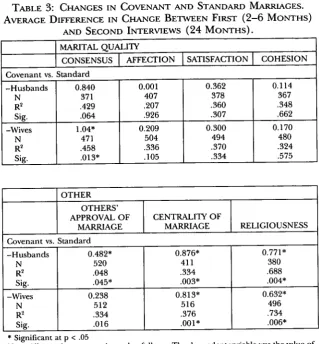
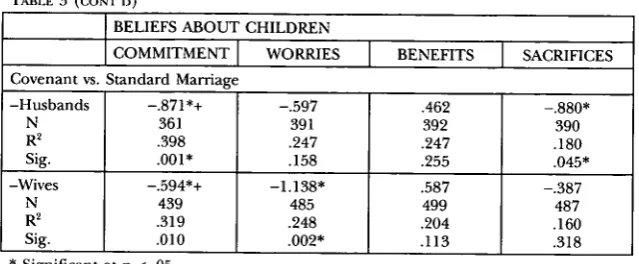
A recent paper by Nock, Sanchez, Wilson, and Wright1 28 sug-gests that covenant marriage in Louisiana may in fact be chang-ing the essential nature of marriage.' 29 Covenant marriage couples are different from those who select standard marriage from the very beginning. Covenant couples have marginally higher levels of completed education, are more politically con-servative, are more religious, are more likely to seek and receive marriage counseling, and have more support (in terms of approval of the marriage, and for help and assistance). Cove-nant couples are less likely to have cohabited before marriage. They are also more likely to rely on more pro-social forms of communication and conflict resolution (i.e., they are less likely to engage in destructive or hostile forms of conflict resolution such as avoidance, sarcasm, or hostility). However, at the time they marry, they have very similar incomes and labor force involvements to those of standard marriage couples.
Nock, Sanchez, Wilson, and Wright found that after the end of the second year of marriage, covenant couples were different (had changed) on a number of different indices. They describe
the difference as "institutionalization of the marriage."30 Covenant
couples describe their marriages as involving three parties: the husband, the wife, and the marriage itself. For covenant couples, the marriage warrants consideration apart from the individualis-tic concerns of either partner. In regard to some matters, cove-nant couples appear to defer to the interests of their marriage even when the individual concerns of the partners may appear to conflict. This orientation to married life arguably helps resolve the customary problems faced by newly married couples in regard to fairness and equity. First, covenant couples endorse traditional marital vows with strong personal commitments (mar-riage for life, the central role of children in mar(mar-riage, the role marriage plays in producing a complete individual, etc.) far
127. See Margaret F. Brinig & Douglas W. Allen, "These Boots Are Made for
Walking:" Why Most Divorce Filers are Women, 2 AM. L. & ECON. REV. 126, 138
(2000); PRINCIPLES OF THE LAW OF FAMILY DISSOLUTION, supra note 104, § 2.09,
at 236-37. West Virginia adopted the A.L.I. custody reform proposal in 2000.
See W. VA. CODE ANN. § 48-9-207 (Michie 2001).
128. STEVEN L. NOCK, LAURA SANCHEZ, JULIA C. WILSON & JAMES D.
WRIGHT, CENTER FOR FAMILY AND DEMOGRAPHIC RESEARCH, BOWLING GREEN ST. UNIV., INTIMATE EQUITY: THE EARLY YEARS OF COVENANT AND STANDARD MAR-RtAGES (Bowling Green St. Univ., Working Paper Series 03-04, 2003-2004),
available at http://www.bgsu.edu/organizations/cfdr/main.html (presented at the Annual Meeting of the Population Association of America, May 2003) (on file with the Notre Dame Journal of Law, Ethics & Public Policy).