Alien flora of Turkey: checklist, taxonomic composition
and ecological attributes
Ahmet Uludağ1,2, Necmi Aksoy3, Ayşe Yazlık2,4, Zübeyde Filiz Arslan2, Efecan Yazmış1, İlhan Üremiş5, Tiziana Antonella Cossu6,7, Quentin Groom8,
Jan Pergl4, Petr Pyšek4,9, Giuseppe Brundu6
1 Faculty of Agriculture, Çanakkale Onsekiz Mart University, Çanakkale, Turkey 2 Faculty of Agriculture and Nature Sciences, Düzce University, Düzce, Turkey 3 Faculty of Forestry, Düzce University, Düzce, Turkey 4 Institute of Botany, Department of Invasion Ecology, The Czech Academy of Sciences, CZ-25243 Průhonice, Czech Republic 5 Faculty of Agriculture, Mustafa Kemal University, Hatay, Turkey 6 University of Sassari, Department of Agriculture, Viale Italia 39, 07100 Sassari, Italy 7 Department of Collections, Royal Botanic Gardens, Kew, UK 8 Botanic Garden Meise, 1860 Meise, Belgium 9 Department of Ecology, Faculty of Science, Charles University, Viničná 7, CZ-128 44 Prague, Czech Republic
Corresponding author:Giuseppe Brundu ([email protected])
Academic editor:I. Kühn | Received 28 February 2017 | Accepted 24 April 2017 | Published 2 June 2017
Citation: Uludağ A, Aksoy N, Yazlık A, Arslan ZF, Yazmış E, Üremiş I, Cossu TA, Groom Q, Pergl J, Pyšek P, Brundu G (2017) Alien flora of Turkey: checklist, taxonomic composition and ecological attributes. NeoBiota 35: 61–85. https:// doi.org/10.3897/neobiota.35.12460
Abstract
The paper provides an updated checklist of the alien flora of Turkey with information on its structure. The alien flora of Turkey comprises 340 taxa, among which there are 321 angiosperms, 17 gymnosperms and two ferns. Of the total number of taxa, 228 (68%) are naturalized and 112 (32%) are casual. There are 275 neophytes (172 naturalized and 103 casual) and 61 archaeophytes (52 naturalized and 9 casual); four species could not be classified with respect to the residence time. In addition, 47 frequently planted taxa with a potential to escape are also listed. The richest families are Asteraceae (38 taxa), Poaceae (30),
Fabaceae (23) and Solanaceae (22). As for the naturalized alien plants, the highest species richness is found in Asteraceae (31 taxa), Poaceae (22), Amaranthaceae (18) and Solanaceae (15). The majority of alien taxa are perennial (63.8% of the total number of taxa with this life history assigned, including those with mul-tiple life histories), annuals contribute 33.8% and 2.4% are biennial aliens. Among perennials the most common life forms are phanerophytes, of which 20.3% are trees and 12.6% shrubs; woody vines, stem succulents, and aquatic plants are comparatively less represented. Most of the 340 alien taxa introduced to Turkey have their native ranges in Americas (44.7%) and Asia (27.6%). Of other regions, 9.1% origi-nated in Africa, 4.4% in Eurasia, 3.8% in Australia and Oceania and 3.5% in the Mediterranean. The majority of taxa (71.9%) were introduced intentionally, whereas the remaining (28.1%) were introduced
Copyright Ahmet Uludag˘ et al. This is an open access article distributed under the terms of the Creative Commons Attribution License (CC BY 4.0), which permits unrestricted use, distribution, and reproduction in any medium, provided the original author and source are credited.
accidentally. Among the taxa introduced intentionally, the vast majority are ornamental plants (55.2%), 10.0% taxa were introduced for forestry and 6.7% as crops. Casual alien plants are most commonly found in urban and ruderal habitats (40.1%) where naturalized taxa are also often recorded (27.3%). Plants that occur as agricultural weeds are typically naturalized rather than casual (16.0% vs 7.1%, respectively). However, (semi)natural habitats in Turkey are often invaded by alien taxa, especially by those that are able to naturalize.
Keywords
Alien flora, Turkey, casual and naturalized alien plants
Introduction
Turkey has a long tradition of floristic research and as a result its native flora is satisfac-torily investigated. With more than 12,000 plant taxa (Davis 1965–1985, Davis et al. 1988, Güner et al. 2000, 2012) and new species being continuously described, includ-ing new endemics (Güner et al. 2012, Özhatay et al. 2013, 2015), the flora of Turkey is the richest among the Mediterranean, European and neighbouring countries (Ekim and Güner 1986). The majority of this total number is represented by native taxa with 31% of endemics (Güner et al. 2012). Turkey's landscape and ecological diversity has contributed not only to a high floristic richness, but has also allowed for successful introductions and cultivation of a great number of crops, fruit species (Ercisli 2004) and forest trees (Atalay et al. 2014).
On the contrary, up to now there was only limited information on Turkish alien flora. Being located at the crossroads of three continents, there has always been an intense movement of humans and goods across Turkey over the history due to human migration, and in modern Turkey both plants and animals were being introduced intentionally and unintentionally in great quantities. Suitable conditions for the cultivation and use and subsequent naturalization of plants introduced into the country are supported historically. Turkey is a country of special significance in the history of agriculture, with some of the earliest sites of plant domestication nearly 10,000 years ago (Aksoy and Oksar 2015), and today 50% of the country area is agricultural land (FAO 2017).
However, such lack of a recent account on the alien flora represents a serious constraint to the management of those plants that are currently invasive or may become so in the fu-ture. As generally agreed, alien species lists form the basis for much of the current research on biological invasions, for guiding legislation and code of conducts, as input to decision making and risk assessment and in the formulation of management policies and strategies for nature conservation (Hoffmann and Broadhurst 2016, Woodford et al. 2016, Jacobs et al. 2017). From the scientific point of view, macroecological analyses of alien floras has re-ceived much attention recently and improved the understanding of historical flows of alien species among continents (van Kleunen et al. 2015), the dynamics of their accumulation (Seebens et al. 2017) as well as factors driving the variation in regional diversity of alien floras (Pyšek et al. 2009, 2010, 2015, Essl et al. 2011, Seebens et al. 2015).
The aim of this paper is therefore to fill the important gap in the knowledge on alien flora in one of the richest in species countries in Eurasia, by compiling the first comprehensive list of alien plants in Turkey and providing an analysis of its taxonomic composition, origin and ecological structure.
Methods Study area
Turkey is a large and diverse country located between 25°40' to 44°48'E, and 35°51' to 42°06'N. The total area is 814,578 km2 of which 97% is located in Asia and 3% in in
characteristics and topography allow for the existence of diverse microclimatic zones to exist in a relatively small area of 5,461 km2 (Güneralp et al. 2013). The 2,875-km long
border of Turkey with its neighbours Georgia, Armenia, Azerbaijan, Iran, Iraq, Syria, Greece and Bulgaria is associated with a high probability of entry and occurrence of alien plant species in habitats along adjacent roadside corridors that represent an impor-tant pathway for alien plants (Wilson et al. 2016).
Data sources used to compile the inventory
The first flora dedicated to Turkey is composed of the five volumes of Boissier’s Flora Orientalis (Boissier 1867–1884) and its supplement (Boissier 1888) where alien species are occasionally reported. However, the basic data source used for the present inven-tory is the Flora of Turkey and the East Aegean Islands (Davis 1965–1985, Davis et al. 1988, Güner et al. 2000, 2012). This source has been complemented with information extracted from all the available literature, such as, in particular, the papers published after 2000 in the Turkish Journal of Botany and elsewhere. In addition, dedicated stud-ies (Uremis et al. 2014, Arslan et al. 2015) and field surveys (e.g. Brundu et al. 2011) were taken into account as well as herbarium samples stored at the Düzce University Forestry Faculty Herbarium (DUOF) and other herbaria in Turkey (GAZİ, ISTO, AİBO and ISTE). We also screened the GBIF database, which holds 265,818 plant re-cords for Turkey (GBIF 2017); however, alien plant species are significantly underrep-resented in this source. We also used information from an ongoing project dedicated to the online flora of Turkey (Tübives– http://www.tubives.com/index.php) (Bakis et al. 2011), an initiative for a new Flora of Turkey with illustrations ‘Resimli Türkiye Florası Volume 1 (Güner 2014), and ‘Bizim Bitkiler’(http://www.bizimbitkiler.org. tr/v2/index.php), another online flora of Turkey which includes the last checklist of vascular flora of Turkey by Güner et al. (2012).
Classification of taxa and their characteristics
We classified alien plant species according to the stage they reached along the intro-duction-naturalization-invasion continuum (Richardson and Pyšek 2006, Richardson et al. 2000, 2011, Blackburn et al. 2011). However, due to a lack of data on the rate of spread we did not classify species as invasive and only classified them in two main cat-egories, casual or naturalized. The complete inventory (Suppl. material 1: Table 1) lists also additional species that are presently recorded only in cultivation outside urban areas, but over very large areas, such as tree species in planted forests, and that could start to naturalize in the future due to potentially strong propagule pressure or climate change. These species are, however, not taken into account for data analyses. Taxa were further classified with respect to their residence time, i.e. separated into archaeophytes and neophytes (see e.g. Pyšek et al. 2004, 2012 for delimitation). Affiliation of taxa to families follows the approach of the Angiosperm Phylogeny Group (Stevens 2001 onwards, APG IV 2016). Plant names have been verified using IPNI (International Plant Name Index, http://www.ipni.org/), The Plant List (2010, version 1, published on the Internet; http://www.theplantlist.org/), WCSP and the African Plants Database (APD, version 3.4.0), updated by the Conservatoire et Jardin botaniques de la Ville de Genève and the South African National Biodiversity Institute, Pretoria, South Africa (http://www.ville-ge.ch/musinfo/bd/cjb/africa). We followed, to our best attempt, the accepted and correct nomenclature according to current taxonomic standards.
Information on life history, region of origin, pathway of introduction (intentional vs accidental) and habitat affiliation was extracted from literature and from the above cited sources for each species.
Life forms were classified as follows: therophytes, hydrophytes, chamaephytes, geophytes, hemicryptophytes and phanerophytes (Raunkiaer 1934, 1937). In addi-tion, growth form and life history were assigned according to the Thesaurus of Plant Characteristics for Ecology and Evolution (Garnier et al. 2017) and other specific literature (Pérez-Harguindeguy et al. 2016). Growth-forms reported for aquatic plants follow Brundu (2015).
The checklist has been archived on the Global Biodiversity Information Facility (Uludag et al. 2017).
Statistical analysis
Results
Species numbers and taxonomic composition
The alien flora of Turkey comprises 340 taxa, among which there are 321 angiosperms, 17 gymnosperms and two ferns. Of the total number of taxa, 228 (67.1%) are naturalized and 112 (32.9%) are casual (Appendix 1; for the complete list of taxa, which includes additional 47 frequently planted taxa noted above, see Suppl. material 1). Related to the total plant diversity of ~12,000 species in the Turkish flora, the contribution of alien taxa is ~2.8% and that of naturalized taxa ~1.9%. Of the taxa for which the classification according to residence time was possible, there are 275 neophytes (172 naturalized and 103 casual) and 61 archaeophytes (52 naturalized and 9 casual).
Turkey’s alien flora includes representatives of 92 families and 251 genera. There are seven families with at least 10 aliens that together comprise 44.7% of the total alien taxa richness of the country; the richest are Asteraceae (38 taxa, corresponding to 11.2% of all aliens), Poaceae (30, 8.8%), Fabaceae (23, 6.8%) and Solanaceae (22, 6.5%). As for the naturalized alien plants, the highest species richness is found in Asteraceae (31 taxa, 13.6% of the total number of naturalized aliens), Poaceae (22, 9.6%), Amaranthaceae
(18, 7.9%) and Solanaceae. Over a half of the naturalized alien richness (51.8%) is concentrated in eight families that contain more than four naturalized taxa (Table 1).
The most represented genus is Amaranthus with 13 taxa that are all naturalized, contributing thus 3.3% and 5.7% to all aliens and naturalized aliens, respectively.
Solanum is also rather rich in aliens, but of the 11 taxa only five are naturalized. Other genera, that are represented by more than five species and the naturalization success of their representatives is high, are Euphorbia (88.9% of all aliens in the genus are natural-ized), Acacia (83.3%) and Oxalis (100%). The 11 genera with at least four alien taxa in Turkey together account for 17.6% of the total alien plant richness and 26.3% of the naturalized richness of the country (Table 2).
Ecological attributes
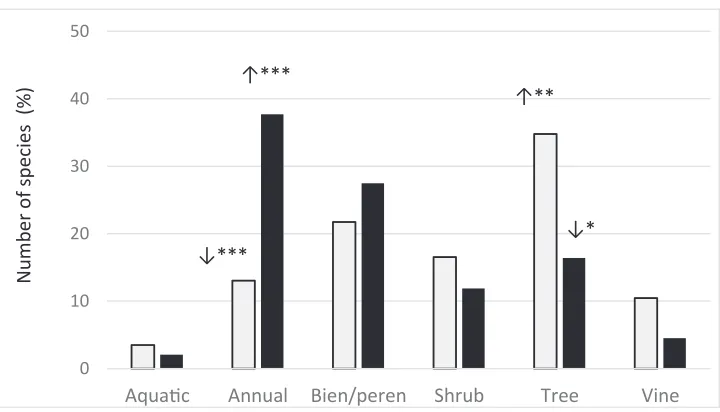
The majority of alien taxa are perennial (63.8% of the total number of taxa with this life history assigned, including those with multiple life histories), annuals are also greatly represented (33.8%) and only 2.4% are biennials. Among perennials the most common life forms are phanerophytes, i.e. trees (20.3%) and shrubs (12.6%); woody vines, stem succulent, bambusoid and aquatic plants are comparatively less represent-ed. There were significant differences in the counts per life history between casuals and naturalized species (χ2 = 29.85, DF = 0,6, p<0.001). This significant difference was
Table 1. The most represented families in the alien flora of Turkey, ranked according to the total number of alien taxa, with their representatives classified according to their status. For each family, the number of casual and naturalized taxa and the percentage of naturalized among total aliens are provided. Family names follow APG classification (Stevens 2001 onwards, APG IV 2016).
Family Total no. of alien taxa No. of casual taxa No. of naturalized taxa % of naturalized taxa
Asteraceae 38 7 31 81.6
Poaceae 30 8 22 73.3
Fabaceae 23 11 12 52.2
Solanaceae 22 7 15 68.2
Amaranthaceae 18 0 18 100.0
Euphorbiaceae 11 1 10 90.9
Rosaceae 10 6 4 40.0
Cupressaceae 9 3 6 66.7
Pinaceae 8 4 4 50.0
Oxalidaceae 7 0 7 100.0
Sapindaceae 7 2 5 71.4
Convolvulaceae 6 2 4 66.7
Aizoaceae 5 0 5 100.0
Apocynaceae 5 2 3 60.0
Moraceae 5 3 2 40.0
Table 2. The most represented genera in the alien flora of Turkey, classified according to their status. For each genus, number of casual and naturalized taxa and percentage of naturalized among total aliens in the genus are provided. Genera are ranked according the total number of alien taxa.
Genus Total no. of alien taxa No. of casual taxa No. of naturalized taxa % of naturalized taxa
Amaranthus 13 0 13 100.0
Solanum 11 6 5 45.5
Euphorbia 9 1 8 88.9
Oxalis 7 0 7 100.0
Acacia 6 1 5 83.3
Acer 4 1 3 75.0
Bidens 4 0 4 100.0
Cotoneaster 4 1 3 75.0
Erigeron 4 0 4 100.0
Ipomoea 4 0 4 100.0
Paulownia 4 4 0 0.0
Figure 1. Frequency of alien species in the flora of Turkey categorized according to their Raunkiaer’s life forms, shown separately for casuals (white bars, n = 112) and naturalized taxa (black bars, n = 228). Bars indicate the percentage contribution of each life form to the total numbers of incidences within casual and naturalized. Significant differences and their directions are indicated above bars (. < 0.1, * < 0.05, ** < 0.01, *** < 0.001).
0 10 20 30 40 50
Aqua�c Annual Bien/peren Shrub Tree Vine
Nu
m
be
r o
f
spe
cies
(%
) ↑***
↓***
↑**
↓*
Table 3. Structure of the alien flora of Turkey according to origin and number of casual and naturalized species, with percentages of naturalized taxa among total aliens.
Native range Total no. of alien taxa No. of casual taxa No. of naturalized taxa % of naturalized taxa
America 152 48 104 30.6
Asia 94 33 61 17.9
Africa 31 13 18 5.3
Eurasia 15 2 13 3.8
Australia &
Oceania 13 8 5 1.5
Mediterranean 12 1 11 3.2
Europe 9 1 8 2.4
Garden origin
& hybrids 8 5 3 0.9
Other &
unknown 6 1 5 1.5
Most of the 340 alien taxa introduced to Turkey have their native ranges in Ameri-cas (44.7%) and Asia (27.6%). Of other regions, 9.1% originated in Africa, 4.4% in Eurasia, 3.8% in Australia and Oceania, and 3.5% in the Mediterranean (see Table 3 for species numbers with respect to the area of origin).
Table 4. Habitats in which the alien plant taxa are found in Turkey, shown separately for casual and natu-ralized taxa, with percentages of the total shown for each category. Natural/semi-natural habitats include the categories of the CORINE Land cover class 3 (Forest and semi-natural areas).
Habitat Casual alien % Naturalized alien %
Natural/semi-natural habitats 56 28.4 145 28.3 Urban/ruderal habitats 79 40.1 140 27.3
Coastal habitats 34 17.3 96 18.7
Agricultural land 14 7.1 82 16.0
Riparian habitats/wetlands/lakes 14 7.1 50 9.7
introduced intentionally, the vast majority are ornamental plants (55.2%), 10.0% taxa were introduced for forestry (planted forest, reforestation, sand dune stabilization or soil protection) and 6.7% as crops (i.e. plant taxa cultivated for the production of food, forage, fruit, fibre, dye or drugs).
Casual alien plants are most commonly found in urban and ruderal habitats (40.1% of their total number) where naturalized taxa are also often recorded (27.3%). Plants that occur as agricultural weeds are typically naturalized rather than casual (16.0% vs 7.1%, respectively. However, (semi)natural habitats in Turkey are often invaded by alien taxa, especially by those that are able to naturalize (Table 4).
Discussion and conclusions
This is the first comprehensive compilation and analysis of all available records on alien plant taxa in Turkey. It provides the first assessment of their status, introduction purposes and main types of invaded habitats. It also pinpoints knowledge gaps in the geographic and biogeographic distribution and the quantification of environmental and economic impacts.
the number reaches 3,749 taxa (Lambdon et al. 2008) or 4,140 according to the most recent account in GloNAF database (van Kleunen et al. 2015).
This is the first comprehensive catalogue for Turkey and it is based mainly on literature and herbarium data, with only a limited number of dedicated field surveys. Other Mediterranean countries such as France, Italy or Spain have a longer tradition of floristic research on alien plants, whose appearance and establishment have long been documented by botanists there (e.g., by Saccardo 1909). It is therefore possible that casual species are underestimated in the dataset, as casuals in general, and escaped or-namentals in particular (Pergl et al. 2016b), are rarely recorded in botanical works nor are they often collected in herbaria. Another possible explanation for the lower number of alien plants than in some other European countries is that although cultivation of ornamental plants dates back to ancient times, there has been rapid development and change in the ornamental plants sector in Turkey only after the 1980s and this devel-opment has gained speed only in the 2000s (Çelik and Arisoy 2013).
The rate of naturalization (proportion of naturalized to all aliens) is 67% in Tur-key, i.e. the same as in Cyprus but higher than in Greece (41%), Spain (53%), Portugal (47%) and Italy (51%) (Arianoutsou et al. 2010). On the contrary, with the exception of Bulgaria, there is only very limited knowledge on the alien flora of Georgia, Arme-nia, Azerbaijan, Iran, Iraq, Syria which impedes comparisons between these countries and, at the same time, forecasting of future trends for the entire Mediterranean region.
National inventories of alien plants are one of the key components for evaluating the status of biodiversity in a given country, as well as threats to endangered species, and provide source data for creating relevant indicators (Lambdon et al. 2008, Celesti-Grapow et al. 2010, Pyšek et al. 2012, van Kleunen et al. 2015, Latombe et al. 2017). Such data are needed for early warning systems, prioritization of management and implementation of effective policy measures (Brunel et al. 2010). The publication of checklists also helps neighbouring countries and trading partners to assess the threat from potential invasions of new species to arrive and checklists can contribute to so-called horizon scanning exercises looking for potential new threats (Roy et al. 2014, Latombe et al. 2017).
Acknowledgments
PP and JP were supported by long-term research development project RVO 67985939 and Premium Academiae award to PP from The Czech Academy of Sciences. The au-thors also acknowledge support from the COST Action TD1209 “Alien Challenge” and FA1203 “SMARTER”. AU and NA have been supported partly by the ESENIAS-TOOLS project which is funded by the Financial Mechanism of the European Economic Area (2009–2014). We gratefully acknowledge G. Domina and two anonymous reviewers whose comments and suggestions greatly helped to improve the present research.
References
Acar C, Seyran HK, Uzun P (2014) The analysis and assessment of the vegetation on coastal revetments: the case of Trabzon (Turkey). Rendiconti Lincei, Scienze Fisiche e Naturali 25: 141–153. https://doi.org/10.1007/s12210-014-0301-5
Akman Y, Ketenoǧlu O (1986) The climate and vegetation of Turkey. Proceedings of the Royal Society of Edinburgh, Section B: Biological Sciences 89: 123–134. https://doi. org/10.1017/S0269727000008964
Aksoy U, Oksar RE (2015) An overview of horticulture in Turkey. Chronica Horticulturae 55: 17–22.
APG IV (2016) An update of the Angiosperm Phylogeny Group classification for the orders and families of flowering plants: APG IV. Botanical Journal of the Linnean Society 181: 1–20. https://doi.org/10.1111/boj.12385
Arianoutsou M, Bazos I, Delipetrou P, Kokkoris Y (2010) The alien flora of Greece: taxon-omy, life traits and habitat preferences. Biological Invasions 12: 3525–3549. https://doi. org/10.1007/s10530-010-9749-0
Arslan ZF, Uludag A, Uremis I (2015) Status of invasive alien plants included in EPPO Lists in Turkey. EPPO Bulletin 45: 66–72. https://doi.org/10.1111/epp.12176
Atalay I, Efe R, Öztürk M (2014) Ecology and classification of forests in Turkey. Procedia - So-cial and Behavioral Sciences 120: 788–805. https://doi.org/10.1016/j.sbspro.2014.02.163 Atalay I (2002) Ecoregions of Turkey. Publ. no. 163. The Ministry of Environment and
For-estry Press, Ankara.
Atalay I (2010) Applied climatology. Meta Press, Izmir.
Atalay I (2011) Soil formation, classification and geography. Ed 4. Meta Press, Izmir.
Bakiş Y, Babaç MT, Uslu E (2011) Updates and improvements of Turkish Plants Data Service (TÜBİVES). In: 6th International Symposium on Health Informatics and Bioinformatics (HIBIT), IEEE, 136–140. https://doi.org/10.1109/HIBIT.2011.6450823
Blackburn TM, Pyšek P, Bacher S, Carlton JT, Duncan RP, Jarošík V, Wilson JRU, Richard-son DM (2011) A proposed unified framework for biological invasions. Trends in Ecology and Evolution 26: 333–339. https://doi.org/10.1016/j.tree.2011.03.023
Boissier E (1867–1884) Flora Orientalis, sive enumeratio plantarum in Oriente a Graecie et Aegypto ad Indiae fines hucusque observaturum, Vol. 1–5. H. Georg, Bibliopolam, Ge-nevae et Basileae.
Boissier E (1888) Flora Orientalis, sive enumeratio plantarum in Oriente a Graecie et Aegypto ad Indiae fines hucusque observaturum. Supplementum (Ed. R. Buser). H. Georg, Bibli-opolam, Genevae et Basileae.
Brundu G, Aksoy N, Brunel S, Eliáš P, Fried G (2011) Rapid surveys for inventorying al-ien plants in the Black Sea region of Turkey. EPPO Bulletin 41: 208–216. https://doi. org/10.1111/j.1365-2338.2011.02455.x
Brundu G (2015) Plant invaders in European and Mediterranean inland waters: profiles, dis-tribution, and threats. Hydrobiologia 746: 61–79. https://doi.org/10.1007/s10750-014-1910-9
Brunel S, Schrader G, Brundu G, Fried G (2010) Emerging invasive alien plants for the Mediterranean Basin. EPPO Bulletin 40: 219–238. https://doi.org/10.1111/j.1365-2338.2010.02378.x
Celesti-Grapow L, Alessandrini A, Arrigoni PV, Banfi E, Bernardo L, Bovio M, Brundu G, Cagiotti MR, Camarda I, Carli E, Conti F, Fascetti S, Galasso G, Gubellini L, La Valva V, Lucchese F, Marchiori S, Mazzola P, Peccenini S, Pretto F, Poldini L, Prosser F, Siniscalco C, Villani MC, Viegi L, Wilhalm T, Blasi C (2009) The inventory of the non-native flora of Italy. Plant Biosystems 143: 386–430. https://doi.org/10.1080/11263500902722824 Celesti-Grapow L, Alessandrini A, Arrigoni PV, Assini S, Banfi E, Barni E, Bovio M, Brundu
G, Cagiotti MR, Camarda I, Carli E, Conti F, Del Guacchio E, Domina G, Fascetti S, Galasso G, Gubellini L, Lucchese F, Medagli P, Passalacqua NG, Peccenini S, Poldini L, Pretto F, Prosser F, Vidali M, Viegi L, Villani MC, Wilhalm T, Blasi C (2010) Non-native flora of Italy: Species distribution and threats. Plant Biosystems 144: 12–28. https://doi. org/10.1080/11263500903431870
Çelik Y, Arisoy H (2013) Competitive analysis of outdoor ornamental plants sector: a case study of Konya province, Turkey. Journal of Horticultural Research 21(2): 5–16. https:// doi.org/10.2478/johr-2013-0016
Crawley MJ (2007) R book. John Wiley & Sons, Chichester. https://doi.org/10.1002/9780-4705 15075
DAISIE (2008) European Invasive Alien Species Gateway. http://www.europe-aliens.org/index.jsp Davis PH (Ed.) (1965–1985) Flora of Turkey and the East Aegean Islands, Vol. 1 (1965), Vol.
2 (1967), Vol. 3 (1970), Vol. 4 (1972), Vol. 5 (1975), Vol. 6 (1978), Vol. 7 (1982), Vol. 8 (1984), Vol. 9 (1985). Edinburgh University Press, Edinburgh.
Davis PH, Mill RR, Tan K (Eds) (1988) Flora of Turkey and the East Aegean Islands, Vol. 10. Edinburgh University Press, Edinburgh.
Ekim T, Güner A (1986) The Anatolian Diagonal: fact or fiction? Proceedings of the Royal Society of Edinburgh, Section B: Biological Sciences 89: 69–77. https://doi.org/10.1017/ S0269727000008915
Ercisli S (2004) A short review of the fruit germplasm resources of Turkey. Genetic Resources and Crop Evolution 51: 419–435. https://doi.org/10.1023/B:GRES.0000023458.60138.79 Erginöz AM, Doğan E (1997) Türkiye’de Kıyı Alanları Yönetimi ve Yapılaşması. Arion
Yayınları.
Essl F, Dullinger S, Rabitsch W, Hulme PE, Hülber K, Jarošík V, Kleinbauer I, Krausmann F, Kühn I, Nentwig W, Vilà M, Genovesi P, Gherardi F, Desprez-Lousteau M-L, Roques A, Pyšek P (2011) Socioeconomic legacy yields an invasion debt. Proceedings of the Na-tional Academy of Sciences of the United States of America 108: 203–207. https://doi. org/10.1073/pnas.1011728108
FAO (2017) FAOSTAT, Turkey country indicators. http://www.fao.org/faostat/en/#country/223 [Accessed 23 February 2017]
Garnier E, Stahl U, Laporte M-A, Kattge J, Mougenot I, Kühn I, Laporte B, Amiaud B, Ah-restani FS, Bönisch G, Bunker, DE, Cornelissen JHC, Díaz S, Enquist BJ, Gachet S, Jaureguiberry P, Kleyer M, Lavorel S, Maicher L, Pérez-Harguindeguy N, Poorter H, Schildhauer M, Shipley B, Violle C, Weiher E, Wirth C, Wright IJ, Klotz S (2017) To-wards a thesaurus of plant characteristics: an ecological contribution. Journal of Ecology 105: 298–309. https://doi.org/10.1111/1365-2745.12698
GBIF.org (2017) GBIF Occurrence. http://doi.org/10.15468/dl.7wm2qs [Download on 2nd January 2017]
Güner A (Ed.) (2014) Resimli Türkiye Florası, Ed. 1. Baskı, İstanbul. Türkiye İş Bankası Kültür Yayınları, İstanbul.
Güner A, Aslan S, Ekim T, Vural M, Babaç MT (Eds) (2012) Türkiye Bitkileri Listesi (Damarlı Bitkiler) [List of Turkey Plants]. Nezahat Gökyiğit Botanic Garden and Flora Research So-ciety Publishing, Istanbul.
Güner A, Özhatay N, Ekim T, Başer KHC (Eds) (2000) Flora of Turkey and the East Aegean Islands, Vol. 11, Suppl. 2. Edinburgh University Press, Edinburgh.
Güneralp B, Tezer A, Albayrak I (2013) Local assessment of İstanbul: biodiversity and ecosys-tem services. In: Elmqvist T et al. (Eds) Urbanization, biodiversity and ecosysecosys-tem services: challenges and opportunities: a global assessment. Springer Netherlands, 291–311. https:// doi.org/10.1007/978-94-007-7088-1_16
Hoffmann BD, Broadhurst LM (2016) The economic cost of managing invasive species in Australia. NeoBiota 31: 1–18. https://doi.org/10.3897/neobiota.31.6960
Jacobs LEO, Richardson DM, Lepschi BJ, Wilson JRU (2017) Quantifying errors and omis-sions in alien species lists: The introduction status of Melaleuca species in South Africa as a case study. NeoBiota 32: 89–105. https://doi.org/10.3897/neobiota.32.9842
Latombe G, Pyšek P, Jeschke JM, Blackburn TM, Bacher S, Capinha C, Costello MJ, Fernán-dez M, Gregory RD, Hobern D, Hui C, Jetz W, Kumschick S, McGrannachan C, Pergl J, Roy HE, Scalera R, Squires ZE, Wilson JRU, Winter M, Genovesi P, McGeoch MA (2017) A vision for global monitoring of biological invasions. Biological Conservation (in press). https://doi.org/10.1016/j.biocon.2016.06.013
Nentwig W, Bacher S, Pyšek P, Vilà M, Kumschick S (2016) The Generic Impact Scoring System (GISS): a standardized tool to quantify the impacts of alien species. Environmental Monitoring and Assessment 188: 315. https://doi.org/10.1007/s10661-016-5321-4 Önen H (Ed.) (2015) Türkiye İstilâcı Bitkiler Kataloğu. Ezgi Ofset Matbaacılık, Ankara. Özhatay N, Kültür Ş, Gürdal B (2013) Check-list of additional taxa to the Supplement Flora
of Turkey VI. J. Fac. Pharm. Istanbul 43(1): 33–82.
Özhatay N, Kültür Ş, Gürdal B (2015) Check-list of additional taxa to the Supplement Flora of Turkey VII. J. Fac. Pharm. Istanbul 45(1): 61–86.
Pérez-Harguindeguy N, Díaz S, Garnier E, Lavorel S, Poorter H, Jaureguiberry P, Bret-Harte MS, Cornwell WK, Craine JM, Gurvich DE, Urcelay C, Veneklaas EJ, Reich PB, Poorter L, Wright IJ, Ray P, Enrico L, Pausas JG, de Vos AC, Buchmann N, Funes G, Quétier F, Hodgson JG, Thompson K, Morgan HD, ter Steege H, van der Heijden MGA, Sack L, Blonder B, Poschlod P, Vaieretti MV, Conti G, Staver AC, Aquino S, Cornelissen JHC (2016) New handbook for standardised measurement of plant functional traits worldwide. Australian Journal of Botany 64: 715–716. https://doi.org/10.1071/BT12225_CO Pergl J, Sádlo J, Petrusek A, Laštůvka Z, Musil J, Perglová I, Šanda R, Šefrová H, Šíma J,
Vohralík V, Pyšek P (2016a) Black, Grey and Watch Lists of alien species in the Czech Republic based on environmental impacts and management strategy. NeoBiota 28: 1–37. https://doi.org/10.3897/neobiota.28.4824
Pergl J, Sádlo J, Petřík P, Danihelka J, Chrtek J Jr., Hejda M, Moravcová L, Perglová I, Štajerová K, Pyšek P (2016b) Dark side of the fence: ornamental plants as a source for spontaneous flora of the Czech Republic. Preslia 88: 163–184.
Pyšek P, Richardson DM, Rejmánek M, Webster G, Williamson M, Kirschner J (2004) Alien plants in checklists and floras: towards better communication between taxonomists and ecologists. Taxon 53: 131–143. https://doi.org/10.2307/4135498
Pyšek P, Danihelka J, Sádlo J, Chrtek Jr J, Chytrý M, Jarošík V, Kaplan Z, Krahulec F, Morav-cová L, Pergl J, Štajerová K, Tichý L (2012) Catalogue of alien plants of the Czech Re-public (2nd edition): checklist update, taxonomic diversity and invasion patterns. Preslia 84: 155–255.
Pyšek P, Jarošík V, Hulme PE, Kühn I, Wild J, Arianoutsou M, Bacher S, Chiron F, Didžiulis V, Essl F, Genovesi P, Gherardi F, Hejda M, Kark S, Lambdon PW, Desprez-Loustau A-M, Nentwig W, Pergl J, Poboljšaj K, Rabitsch W, Roques A, Roy DB, Shirley S, So-larz W, Vilà M, Winter M (2010) Disentangling the role of environmental and human pressures on biological invasions across Europe. Proceedings of the National Academy of Sciences of the United States of America 107: 12157–12162. https://doi.org/10.1073/ pnas.1002314107
distri-bution characteristics in their native range and species traits. Diversity and Distridistri-butions 15: 891–903. https://doi.org/10.1111/j.1472-4642.2009.00602.x
Pyšek P, Manceur AM, Alba C, McGregor KF, Pergl J, Štajerová K, Chytrý M, Danihelka J, Kartesz J, Klimešová J, Lučanová M, Moravcová L, Nishino M, Sádlo J, Suda J, Tichý L, Kühn I (2015) Naturalization of central European plants in North America: species traits, habitats, propagule pressure, residence time. Ecology 96: 762–774. https://doi. org/10.1890/14-1005.1
R Core Team (2015) R: a language and environment for statistical computing v.3.1.2. R Foun-dation for Statistical Computing, Vienna.
Raunkiaer C (1934) The life-forms of plants and statistical plant geography. Clarendon Press, Oxford, UK.
Raunkiaer C (1937) Plant life forms. Claredon Press, Oxford, UK.
Řehák J, Řeháková B (1986) Analýza kategorizovaných dat v sociologii [Analysis of categorized data in sociology]. Academia, Prague.
Richardson DM, Pyšek P, Rejmánek M, Barbour MG, Panetta FD, West CJ (2000) Naturali-zation and invasion of alien plants: concepts and definitions. Diversity and Distributions 6: 93–107. https://doi.org/10.1046/j.1472-4642.2000.00083.x
Richardson DM, Pyšek P (2006) Plant invasions: merging the concepts of species invasiveness and community invasibility. Progress in Physical Geography 30: 409–431. https://doi. org/10.1191/0309133306pp490pr
Richardson DM, Pyšek P, Carlton JC (2011) A compendium of essential concepts and termi-nology in biological invasions. In: Richardson DM (Ed.) Fifty years of invasion ecology: the legacy of Charles Elton. Blackwell Publishing, Oxford, 409–420.
Roy HE, Peyton J, Aldridge DC, Bantock T, Blackburn TM, Britton R, Clark P, Cook E, Dehnen-Schmutz K, Dines T, Dobson M, Edwards F, Harrower C, Harvey MC, Minchin D, Noble DG, Parrott D, Pocock MJO, Preston CD, Roy S, Salisbury A, Schönrogge K, Sewell J, Shaw RH, Stebbing P, Stewart AJA, Walker KJ (2014) Horizon scanning for invasive alien species with the potential to threaten biodiversity in Great Britain. Global Change Biology 20: 3859–3871. https://doi.org/10.1111/gcb.12603
Rumlerová Z, Vilà M, Pergl J, Nentwig W, Pyšek P (2016) Scoring environmental and socio-economic impacts of alien plants invasive in Europe. Biological Invasions 18: 3697–3711. https://doi.org/10.1007/s10530-016-1259-2
Saccardo PA (1909) Cronologia della flora Italiana. Padova. Tipografia del Seminario, 388 pp. Seebens H, Blackburn TM, Dyer EE, Genovesi P, Hulme PE, Jeschke JM, Pagad S, Pyšek P,
Winter M, Arianoutsou M, Bacher S, Blasius B, Brundu G, Capinha C, Celesti-Grapow L, Dawson W, Dullinger S, Fuentes N, Jäger H, Kartesz J, Kenis M, Kreft H, Kühn I, Lenzner B, Liebhold A, Mosena A, Moser D, Nishino M, Pearman D, Pergl J, Rabitsch W, Rojas-Sandoval J, Roques A, Rorke S, Rossinelli S, Roy HE, Scalera R, Schindler S, Štajerová K, Tokarska-Guzik B, van Kleunen M, Walker K, Weigelt P, Yamanaka T, Essl F (2017) No saturation in the accumulation of alien species worldwide. Nature Commu-nications 8: 14435. https://doi.org/10.1038/ncomms14435
economies under climate change. Global Change Biology 21: 4128–4140. https://doi. org/10.1111/gcb.13021
Stevens PF (2001 onwards) Angiosperm phylogeny website. Version 12, July 2012 [and more or less continuously updated since]. http://www.mobot.org/MOBOT/research/APweb/ Uludağ A, Aksoy N, Yazlık A, Arslan ZF, Yazmış E, Uremis I, Cossu T, Groom Q, Pergl J,
Pyšek P, Brundu G (2017) Alien flora of Turkey: checklist, taxonomic composition and ecological attributes. https://doi.org/10.15468/7j1dof
Uremis I, Uludağ A, Arslan ZF, Abaci O (2014) A new record for the flora of Turkey: Eich-hornia crassipes (Mart.) Solms (Pontederiaceae). EPPO Bulletin 44: 83–86. https://doi. org/10.1111/epp.12096
van Kleunen M, Dawson W, Essl F, Pergl J, Winter M, Weber E, Kreft H, Weigelt P, Kartesz J, Nishino M, Antonova LA, Barcelona JF, Cabezas FJ, Cárdenas D, Cárdenas-Toro J, Castaño N, Chacón E, Chatelain C, Ebel AL, Figueiredo E, Fuentes N, Groom QJ, Hen-derson L, Inderjit, Kupriyanov A, Masciadri S, Meerman J, Morozova O, Moser D, Nick-rent DL, Patzelt A, Pelser PB, Baptiste MP, Poopath M, Schulze M, Seebens H, Shu W, Thomas J, Velayos M, Wieringa JJ, Pyšek P (2015) Global exchange and accumulation of non-native plants. Nature 525: 100–103. https://doi.org/10.1038/nature14910
Wilson JRU, García-Díaz P, Cassey P, Richardson DM, Pyšek P, Blackburn TM (2016) Bio-logical invasions and natural colonisations are different: the need for invasion science. NeoBiota 31: 87–98. https://doi.org/10.3897/neobiota.31.9185
Winter M, Schweiger O, Klotz S, Nentwig W, Andriopoulos P, Arianoutsou M, Basnou C, Delipetrou P, Didžiulis V, Hejda M, Hulme PE, Lambdon PW, Pergl J, Pyšek P, Roy DB, Kühn I (2009) Plant extinctions and introductions lead to phylogenetic and taxo-nomic homogenization of the European flora. Proceedings of the National Academy of Sciences of the United States of America 106: 21721–21725. https://doi.org/10.1073/ pnas.0907088106
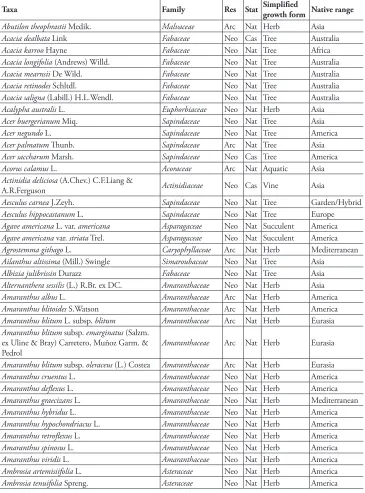
Table A1.List of naturalized and casual alien taxa in the flora of Turkey. Taxa are ordered alphabetically. Each taxon is listed together with its family, residence time (Res: Arc = archaeophyte, Neo = neophyte); invasion status (Stat: Cas = casual, Nat = naturalized), simplified growth form and native range.
Taxa Family Res Stat Simplified growth form Native range
Abutilon theophrastii Medik. Malvaceae Arc Nat Herb Asia
Acacia dealbata Link Fabaceae Neo Cas Tree Australia
Acacia karroo Hayne Fabaceae Neo Nat Tree Africa
Acacia longifolia (Andrews) Willd. Fabaceae Neo Nat Tree Australia
Acacia mearnsii De Wild. Fabaceae Neo Nat Tree Australia
Acacia retinodes Schltdl. Fabaceae Neo Nat Tree Australia
Acacia saligna (Labill.) H.L.Wendl. Fabaceae Neo Nat Tree Australia
Acalypha australis L. Euphorbiaceae Neo Nat Herb Asia
Acer buergerianum Miq. Sapindaceae Neo Nat Tree Asia
Acer negundo L. Sapindaceae Neo Nat Tree America
Acer palmatum Thunb. Sapindaceae Arc Nat Tree Asia
Acer saccharum Marsh. Sapindaceae Neo Cas Tree America
Acorus calamus L. Acoraceae Arc Nat Aquatic Asia
Actinidia deliciosa (A.Chev.) C.F.Liang &
A.R.Ferguson Actinidiaceae Neo Cas Vine Asia
Aesculus carnea J.Zeyh. Sapindaceae Neo Nat Tree Garden/Hybrid
Aesculus hippocastanum L. Sapindaceae Neo Nat Tree Europe
Agave americana L. var. americana Asparagaceae Neo Nat Succulent America
Agave americana var. striata Trel. Asparagaceae Neo Nat Succulent America
Agrostemma githago L. Caryophyllaceae Arc Nat Herb Mediterranean
Ailanthus altissima (Mill.) Swingle Simaroubaceae Neo Nat Tree Asia
Albizia julibrissin Durazz Fabaceae Neo Nat Tree Asia
Alternanthera sessilis (L.) R.Br. ex DC. Amaranthaceae Neo Nat Herb Asia
Amaranthus albus L. Amaranthaceae Arc Nat Herb America
Amaranthus blitoides S.Watson Amaranthaceae Arc Nat Herb America
Amaranthus blitum L. subsp. blitum Amaranthaceae Arc Nat Herb Eurasia
Amaranthus blitum subsp. emarginatus (Salzm. ex Uline & Bray) Carretero, Muñoz Garm. &
Pedrol Amaranthaceae Arc Nat Herb Eurasia
Amaranthus blitum subsp. oleraceus (L.) Costea Amaranthaceae Arc Nat Herb Eurasia
Amaranthus cruentus L. Amaranthaceae Neo Nat Herb America
Amaranthus deflexus L. Amaranthaceae Neo Nat Herb America
Amaranthus graecizans L. Amaranthaceae Neo Nat Herb Mediterranean
Amaranthus hybridus L. Amaranthaceae Neo Nat Herb America
Amaranthus hypochondriacus L. Amaranthaceae Neo Nat Herb America
Amaranthus retroflexus L. Amaranthaceae Neo Nat Herb America
Amaranthus spinosus L. Amaranthaceae Neo Nat Herb America
Amaranthus viridis L. Amaranthaceae Neo Nat Herb America
Ambrosia artemisiifolia L. Asteraceae Neo Nat Herb America
Ambrosia tenuifolia Spreng. Asteraceae Neo Nat Herb America
Taxa Family Res Stat Simplified growth form Native range
Ammannia coccinea Rottb. Lythraceae Neo Nat Herb America
Amorpha fruticosa L. Fabaceae Neo Cas Shrub America
Araujia sericifera Brot. Apocynaceae Neo Nat Vine America
Armeria maritima (Mill.) Willd. Plumbaginaceae Arc Cas Herb Europe
Artemisia annua L. Asteraceae Neo Nat Herb Asia
Artemisia verlotiorum Lamotte Asteraceae Neo Nat Herb Asia
Arundo donax L. Poaceae Arc Nat Bambusoid Asia
Aster subulatus (Michx.) Hort. ex Michx. Asteraceae Neo Nat Herb America
Avena byzantina K.Koch Poaceae Arc Cas Herb Garden/Hybrid
Azolla filiculoides Lam. Azollaceae Arc Nat Aquatic America
Bauhinia variegata L. Fabaceae Neo Nat Tree Asia
Berberis veitchii C.K.Schneid. Berberidaceae Arc Nat Shrub Asia
Berberis thunbergii DC. Berberidaceae Arc Nat Shrub Asia
Bidens bipinnata L. Asteraceae Neo Nat Herb Asia
Bidens campylotheca Sch.Bip. Asteraceae Neo Nat Herb America
Bidens cernua L. s.l. Asteraceae Neo Nat Herb America
Bidens frondosa L. Asteraceae Neo Nat Herb America
Bougainvillea buttiana Holttum & Standl. Nyctaginaceae Neo Nat Vine America
Bougainvillea glabra Choisy Nyctaginaceae Neo Cas Vine America
Bougainvillea spectabilis Willd. Nyctaginaceae Neo Nat Vine America
Brachychiton populneus (Schott & Endl.) R.Br. Sterculiaceae Neo Nat Tree Australia
Bromus tectorum L. Poaceae N/A Nat Herb Eurasia
Broussonetia papyrifera (L.) L’Hér. ex Vent. Moraceae Neo Nat Tree Asia
Bryophyllum delagoense (Eckl. & Zeyh.) Druce Crassulaceae Neo Cas Succulent Africa
Buddleja davidii Franch. Scrophulariaceae Neo Nat Shrub Asia
Caesalpinia gilliesii (Hook.) D.Dietr. Fabaceae Neo Nat Shrub America
Calendula officinalis L. Asteraceae Arc Nat Herb Eurasia
Callistemon citrinus (Curtis) Skeels Myrtaceae Neo Cas Tree Australia
Callistemon viminalis (Sol. ex Gaertn.) G.Don Myrtaceae Neo Cas Tree Australia
Camellia japonica L. Theaceae Arc Nat Shrub Asia
Canna indica L. Cannaceae Neo Nat Bambusoid America
Caragana arborescens Lam. Fabaceae Neo Nat Shrub/Tree Asia
Carex vulpinoidea Michx. Cyperaceae Neo Nat Herb America
Carpobrotus acinaciformis (L.) L.Bolus Aizoaceae Neo Nat Succulent Africa
Carpobrotus edulis (L.) N.E.Br. Aizoaceae Neo Nat Succulent Africa
Carthamus tinctorius L. Asteraceae Arc Cas Herb Asia
Cascabela thevetia (L.) Lippold Apocynaceae Neo Cas Tree America
Catalpa bignonioides Walter Bignoniaceae Neo Nat Tree America
Cedrus atlantica (Endl.) Carrière Pinaceae Neo Cas Tree Africa
Cedrus deodara (Roxb. ex D.Don) G.Don Pinaceae Neo Nat Tree Asia
Ceiba speciosa (A.St.-Hil.) Ravenna Malvaceae Neo Nat Tree America
Cenchrus incertus M.A.Curtis Poaceae Arc Nat Herb America
Centaurea pullata L. Asteraceae Arc Nat Herb Mediterranean
Chaenomeles japonica (Thunb.) Lindl. ex Spach Rosaceae Neo Cas Shrub Asia
Taxa Family Res Stat Simplified growth form Native range
Chenopodium giganteum D.Don Chenopodiaceae Arc Nat Herb Asia
Cichorium endivia L. Asteraceae Arc Cas Herb Asia
Citrullus colocynthis (L.) Schrad. Cucurbitaceae Arc Cas Vine Eurasia
Citrus trifoliata L. Rutaceae Neo Cas Tree Asia
Coix lacryma-jobi L. Poaceae Neo Nat Herb Asia
Commelina communis L. Commelinaceae Neo Nat Herb Asia
Convolvulus tricolor L. Convolvulaceae Arc Cas Vine Mediterranean
Cortaderia selloana (Schult. & Schult.f.) Asch.
& Graebn. Poaceae Neo Cas Bambusoid America
Cosmos bipinnatus Cav. Asteraceae Neo Cas Herb America
Cotoneaster adpressus Bois Rosaceae Neo Cas Shrub Asia
Cotoneaster franchetii Bois Rosaceae Neo Nat Shrub Asia
Cotoneaster horizontalis Decne. Rosaceae Neo Nat Shrub Asia
Cotoneaster salicifolius Franch. Rosaceae Arc Nat Shrub Asia
Crassocephalum crepidioides (Benth.) S.Moore Asteraceae Neo Nat Herb Africa
Cryptomeria japonica (Thunb. ex L.f.) D.Don Cupressaceae Neo Cas Tree Asia
Cupressus arizonica Greene Cupressaceae Neo Nat Tree America
Cupressus macrocarpa Hartw. Cupressaceae Neo Nat Tree America
Cuscuta campestris Yunck. Cuscutaceae Neo Nat Herb America
Cymbalaria muralis P.Gaertn., B.Mey. & Scherb. Plantaginaceae Arc Nat Herb Mediterranean
Cynoglossum wallichii var. glochidiatum (Wall. ex
Benth.) Kazmi Boraginaceae Arc Nat Herb Asia
Cyperus congestus Vahl Cyperaceae Neo Nat Herb Africa
Cyperus esculentus L. Cyperaceae Arc Nat Herb Unknown
Cyperus rotundus L. Cyperaceae Arc Nat Herb Eurasia
Dalbergia sissoo DC. Fabaceae Neo Cas Tree Asia
Datura innoxia Mill. Solanaceae Neo Nat Herb America
Datura metel L. Solanaceae Neo Cas Herb Asia
Datura stramonium L. Solanaceae Neo Nat Herb America
Deutzia gracilis Siebold & Zucc. Hydrangeaceae Arc Nat Shrub Asia
Deutzia scabra Thunb. Hydrangeaceae Neo Nat Shrub Asia
Dichondra repens J.R.Forst. & G.Forst. Convolvulaceae Neo Cas Herb Asia
Dichrocephala integrifolia (L.f.) Kuntze Asteraceae Neo Nat Herb Africa & Asia
Dieffenbachia seguine (Jacq.) Schott Araceae Neo Nat Herb America
Digitaria sanguinalis (L.) Scop. Poaceae Neo Nat Herb Europe & Africa
Diplachne fusca (L.) P.Beauv. Poaceae Neo Nat Herb Unknown
Duchesnea indica (Jacks.) Focke Rosaceae Neo Cas Herb Asia
Duranta erecta L. Verbenaceae Neo Nat Shrub/Tree America
Dysphania ambrosioides (L.) Mosyakin &
Clemants Amaranthaceae Neo Nat Herb America
Dysphania botrys (L.) Mosyakin & Clemants Amaranthaceae Arc Nat Herb Eurasia
Dysphania multifida (L.) Mosyakin & Clemants Amaranthaceae Neo Nat Herb America
Echinochloa colonum (L.) Link Poaceae Neo Nat Herb Unknown
Echinochloa oryzoides (Ard.) Fritsch Poaceae Arc Nat Herb Asia
Taxa Family Res Stat Simplified growth form Native range
Egeria densa Planch. Hydrocharitaceae Neo Nat Aquatic America
Eichhornia crassipes (Mart.) Solms Pontederiaceae Neo Nat Aquatic America
Elatine ambigua Wight Elatinaceae Neo Nat Aquatic Asia
Eleusine indica (L.) Gaertn. Poaceae Neo Nat Herb Africa
Elodea canadensis Michx. Hydrocharitaceae Neo Nat Aquatic America
Elsholtzia ciliata (Thunb.) Hyl. Lamiaceae Neo Nat Herb Asia
Eragrostis curvula (Schrad.) Nees Poaceae Arc Nat Herb Africa
Erigeron annuus (L.) Pers. Asteraceae Neo Nat Herb America
Erigeron bonariensis L. Asteraceae Neo Nat Herb America
Erigeron canadensis L. Asteraceae Neo Nat Herb America
Erigeron sumatrensis Retz. Asteraceae Neo Nat Herb America
Erythrina crista-galli L. Fabaceae Neo Cas Tree America
Erythrina flabelliformis Kearney Fabaceae Neo Cas Tree America
Eucalyptus camaldulensis Dehnh. Myrtaceae Neo Cas Tree Australia
Eucalyptus grandis W.Hill Myrtaceae Neo Cas Tree Australia
Euonymus fortunei (Turcz.) Hand.-Mazz. Celastraceae Arc Nat Shrub Asia
Euonymus japonicus Thunb. Celastraceae Arc Nat Shrub/Tree Asia
Eupatorium cannabinum L. Asteraceae Arc Nat Herb Europe
Euphorbia chamaesyce L. Euphorbiaceae Neo Nat Herb America
Euphorbia heterophylla L. Euphorbiaceae Neo Cas Herb America
Euphorbia humifusa Willd. Euphorbiaceae Arc Nat Herb Asia
Euphorbia lagascae Spreng. Euphorbiaceae Arc Nat Herb Mediterranean
Euphorbia lathyris L. Euphorbiaceae Arc Nat Herb Mediterranean
Euphorbia nutans Lag. Euphorbiaceae Neo Nat Herb America
Euphorbia prostrata Aiton Euphorbiaceae Neo Nat Herb America
Euphorbia serpens Kunth Euphorbiaceae Neo Nat Herb America
Euphorbia supina Rafin. Euphorbiaceae Neo Nat Herb America
Fallopia aubertii (L.Henry) Holub Polygonaceae Neo Nat Vine Asia
Fatsia japonica (Thunb.) Decne. & Planch. Araliaceae Neo Nat Shrub/Tree Asia
Ficus elastica Roxb. ex Hornem. Moraceae Neo Cas Tree Asia
Ficus macrophylla Desf. ex Pers. Moraceae Neo Cas Tree Australia
Ficus microcarpa L.f. Moraceae Neo Cas Tree Asia
Forsythia × intermedia Zabel Oleaceae Neo Cas Shrub Garden/Hybrid
Fragaria × ananassa (Duchesne ex Weston)
Duchesne ex Rozier Rosaceae Neo Cas Herb America
Gaillardia pulchella Foug. Asteraceae Neo Cas Herb America
Galinsoga ciliata (Rafin) S.F. Blake Asteraceae Neo Nat Herb America
Galinsoga parviflora Cav. Asteraceae Neo Nat Herb America
Galinsoga quadriradiata Ruiz & Pav. Asteraceae Neo Nat Herb America
Gasteria obliqua (Aiton) Duval Xanthorrhoeaceae Neo Cas Succulent Africa
Gazania rigens (L.) Gaertn. Asteraceae Neo Cas Herb Africa
Geranium pusillum L. Geraniaceae Neo Nat Herb Eurasia
Gleditsia triacanthos L. Fabaceae Neo Cas Tree America
Gomphocarpus fruticosus (L.) W.T.Aiton Apocynaceae Neo Nat Herb Africa
Taxa Family Res Stat Simplified growth form Native range
Gypsophila pilosa Huds. Caryophyllaceae Arc Nat Herb Asia
Heliotropium curassavicum L. Boraginaceae Neo Nat Herb America
Hemerocallis fulva (L.) L. Hemerocallidaceae Neo Nat Herb Asia
Hibiscus trionum L. Malvaceae Arc Nat Herb Africa
Homalocladium platycladum (F.Muell.)
L.H.Bailey Polygonaceae Neo Cas Shrub Oceania
Hoya carnosa (L.f.) R.Br. Apocynaceae Neo Cas Vine Asia
Hydrangea macrophylla (Thunb.) Ser. Hydrangeaceae Neo Nat Herb Asia
Hydrocotyle ramiflora Maxim. Umbelliferae Neo Nat Aquatic Asia
Imperata cylindrica (L.) Raeusch. Poaceae Neo Nat Herb Asia
Ipomoea nil (L.) Roth Convolvulaceae Neo Nat Vine America
Ipomoea purpurea (L.) Roth Convolvulaceae Neo Nat Vine America
Ipomoea tricolor Cav. Convolvulaceae Neo Nat Vine America
Ipomoea triloba L. Convolvulaceae Neo Nat Vine America
Jacaranda mimosifolia D.Don Bignoniaceae Neo Cas Tree America
Juncus tenuis Willd. Juncaceae Neo Nat Herb America
Juniperus chinensis L. Cupressaceae Neo Nat Shrub/Tree Asia
Juniperus horizontalis Moench Cupressaceae Neo Nat Shrub America
Justicia brandegeeana Wassh. & L.B.Sm. Acanthaceae Neo Cas Shrub America
Kalanchoe blossfeldiana Poelln. Crassulaceae Neo Cas Succulent Africa (Madagascar)
Kerria japonica (L.) DC. Rosaceae Neo Cas Shrub Asia
Kniphofia uvaria (L.) Oken Liliaceae Neo Cas Succulent Africa
Koelreuteria paniculata Laxm. Sapindaceae Neo Cas Tree Asia
Lagerstroemia indica L. Lythraceae Neo Cas Tree Asia
Lantana camara L. Verbenaceae Neo Cas Shrub America
Lepidium virginicum L. Brassicaceae Neo Nat Herb America
Leucaena leucocephala (Lam.) de Wit Fabaceae Neo Cas Tree America
Ligustrum ovalifolium Hassk. Oleaceae Neo Cas Shrub/Tree Asia
Liquidambar styraciflua L. Altingiaceae Neo Cas Tree America
Livistona mariae F.Muell. Arecaceae Neo Cas Palm Australia
Lonicera japonica Thunb. Caprifoliaceae Neo Cas Vine Asia
Lonicera ligustrina var. yunnanensis Franch. Caprifoliaceae Neo Cas Vine Asia
Lonicera periclymenum L. Caprifoliaceae Neo Nat Vine Europe & NW Africa
Ludwigia peploides (Kunth) P.H.Ravens.l. Onagraceae Neo Cas Aquatic America
Lycianthes rantonnei (Carrière) Bitter Solanaceae Neo Nat Shrub America
Lysimachia japonica Thunb. Primulaceae Neo Nat Herb Asia
Maclura pomifera (Raf.) C.K.Schneid. Moraceae Neo Nat Tree America
Magnolia grandiflora L. Magnoliaceae Neo Cas Tree America
Malus floribunda Siebold ex Van Houtte Rosaceae Arc Nat Shrub/Tree Asia
Matricaria discoidea DC. Asteraceae Neo Nat Herb America
Matricaria matricarioides (Less.) Porter Asteraceae Neo Nat Herb America
Melia azedarach L. Meliaceae Neo Nat Tree Asia
Mesembryanthemum cordifolium L.f. Aizoaceae Neo Nat Succulent Africa
Taxa Family Res Stat Simplified growth form Native range
Mesembryanthemum nodiflorum L. Aizoaceae Arc Nat Succulent Mediterranean & S Africa
Microstegium vimineum (Trin.) A.Camus Poaceae Neo Nat Herb Asia
Mirabilis jalapa L. Nyctaginaceae Neo Cas Herb America
Miscanthus sinensis Andersson Poaceae Neo Cas Bambusoid Asia
Myriophyllum spicatum L. Haloragaceae Neo Cas Aquatic Eurasia
Myriophyllum verticillatum L. Haloragaceae Neo Cas Aquatic Circumboreal
Nandina domestica Thunb. Berberidaceae Neo Cas Bambusoid Asia
Nephrolepis exaltata (L.) Schott Nephrolepidaceae Neo Cas Fern America
Nicotiana glauca Graham Solanaceae Neo Nat Shrub/Tree America
Oenothera biennis L. Onagraceae Neo Nat Herb America
Oenothera glazioviana Micheli Onagraceae Neo Nat Herb Garden/Hybrid
Oenothera parodiana Munz Onagraceae Neo Nat Herb America
Oldenlandia capensis L.f. var. capensis Rubiaceae Neo Nat Herb Africa
Oldenlandia capensis var. pleiosepala Bremek. Rubiaceae Neo Cas Herb Africa
Opuntia ficus-indica (L.) Mill. Cactaceae Neo Nat Succulent America
Opuntia microdasys (Lehm.) Pfeiff. Cactaceae Neo Nat Succulent America
Oryza sativa L. Poaceae Arc Cas Herb Asia
Oxalis articulata Savigny Oxalidaceae Neo Nat Herb America
Oxalis corniculata L. s.l. Oxalidaceae Arc Nat Herb America
Oxalis debilis var. corymbosa (DC.) Lourteig Oxalidaceae Neo Nat Herb America
Oxalis floribunda Lehm. Oxalidaceae Neo Nat Herb America
Oxalis pes-caprae L. Oxalidaceae Neo Nat Herb Africa
Oxalis pes-caprae f. pleniflora (Lowe) Sunding Oxalidaceae Neo Nat Herb Africa
Oxalis stricta L. Oxalidaceae Neo Nat Herb America
Panicum capillare L. Poaceae Neo Nat Herb America
Panicum miliaceum L. Poaceae Arc Nat Herb Asia
Parkinsonia aculeata L. Fabaceae Neo Cas Tree America
Parthenocissus quinquefolia (L.) Planch. Vitaceae Neo Cas Vine America
Paspalum dilatatum Poir. Poaceae Neo Nat Herb America
Paspalum distichum L. Poaceae Neo Nat Herb America
Paspalum thunbergii Kunth ex Steud Poaceae Arc Cas Herb Asia
Passiflora caerulea L. Passifloraceae Neo Cas Vine America
Paulownia elongata S. Y. Hu. Paulowniaceae Neo Cas Tree Asia
Paulownia fortunei (Seem.) Hemsl. Paulowniaceae Neo Cas Tree Asia
Paulownia fortunei x Paulownia tomentosa Paulowniaceae Neo Cas Tree Garden/Hybrid
Paulownia tomentosa Steud. Paulowniaceae Neo Cas Tree Asia
Pelargonium zonale (L.) L’Hér. ex Aiton Geraniaceae Neo Nat Shrub Africa
Perilla frutescens (L.) Britton Lamiaceae Neo Cas Herb Asia
Phacelia tanacetifolia Benth. Hydrophyllaceae Neo Cas Herb America
Phaseolus vulgaris L. Fabaceae Neo Cas Vine America
Phyla canescens (Kunth) Greene Verbenaceae Neo Nat Herb America
Phyla nodiflora (L.) Greene Verbenaceae Neo Nat Herb America
Phyllostachys bambusoides Siebold & Zucc. Poaceae Neo Nat Bambusoid Asia
Taxa Family Res Stat Simplified growth form Native range
Physalis angulata L. Solanaceae Neo Nat Herb America
Physalis philadelphica var. immaculata Waterf. Solanaceae Neo Nat Herb America
Physalis pubescens L. Solanaceae Neo Nat Herb America
Phytolacca americana L. Phytolaccaceae Neo Nat Herb America
Picea glauca (Moench) Voss Pinaceae Neo Nat Tree America
Pinus pinaster Aiton Pinaceae Arc Nat Tree Mediterranean
Pinus ponderosa Douglas ex C.Lawson Pinaceae Neo Nat Tree America
Pinus radiata D.Don Pinaceae Neo Cas Tree America
Pittosporum tobira (Thunb.) W.T.Aiton Pittosporaceae Neo Cas Shrub Asia
Platycladus orientalis (L.) Franco Cupressaceae Neo Nat Tree Asia
Plumbago auriculata Lam. Plumbaginaceae Neo Cas Shrub Africa
Polygala myrtifolia L. Polygalaceae Neo Cas Shrub Africa
Polygonum perfoliatum L. Polygonaceae Neo Nat Vine Asia
Polygonum thunbergii Siebold & Zucc. Polygonaceae Arc Nat Herb Asia
Populus × canadensis Moench Salicaceae Neo Nat Tree Garden/Hybrid
Populus deltoides Bartr. ex Marsh. Salicaceae Neo Nat Tree America
Portulaca grandiflora Hook. Portulacaceae Neo Cas Herb America
Portulaca oleracea L. s.l. Portulacaceae Arc Nat Herb Mediterranean
Pseudosasa japonica (Steud.) Makino Poaceae Neo Cas Bambusoid Asia
Pseudotsuga menziesii (Mirb.) Franco var.
menziesii Pinaceae Neo Cas Tree America
Pseudotsuga menziesii (Mirb.) Franco var. glauca
(Beissn.) Franco Pinaceae Neo Cas Tree America
Quercus rubra L. Fagaceae Neo Cas Tree America
Rhapis excelsa (Thunb.) Henry Arecaceae Neo Nat Palm Asia
Ricinus communis L. Euphorbiaceae Arc Nat Shrub Africa
Robinia hispida L. Fabaceae Neo Cas Tree America
Robinia pseudoacacia L. Fabaceae Neo Nat Tree America
Rudbeckia hirta L. Asteraceae Neo Cas Herb America
Russelia equisetiformis Schltdl. & Cham. Plantaginaceae Neo Cas Shrub America
Salix babylonica L. Salicaceae Neo Nat Tree Asia
Santolina chamaecyparissus L. Asteraceae Arc Nat Herb Mediterranean
Saponaria officinalis L. Caryophyllaceae Arc Nat Herb Eurasia
Schefflera arboricola (Hayata) Merr. Araliaceae Neo Cas Shrub Asia
Schinus molle L. Anacardiaceae Neo Cas Tree America
Schinus terebinthifolius Raddi Anacardiaceae Neo Cas Tree America
Scopolia carniolica Jacq. Solanaceae Arc Nat Herb Europe
Sequoia sempervirens (D.Don) Endl. Cupressaceae Neo Cas Tree America
Sequoiadendron giganteum (Lindl.) J.Buchholz Cupressaceae Neo Cas Tree America
Setaria faberi R.A.W.Herrm. Poaceae Neo Nat Herb Asia
Setaria italica (L.) P.Beauv. Poaceae N/A Nat Herb Unknown
Setaria viridis (L.) P.Beauv. Poaceae Neo Nat Herb Eurasia
Sicyos angulatus L. Cucurbitaceae Neo Nat Vine America
Sida spinosa L. Malvaceae Neo Nat Herb America
Sigesbeckia pubescens (Makino) Makino Asteraceae Neo Cas Herb Asia
Taxa Family Res Stat Simplified growth form Native range
Solanum angustifolium Mill. Solanaceae Neo Cas Herb America
Solanum elaeagnifolium Cav. Solanaceae Neo Nat Herb America
Solanum jasminoides J.Paxton Solanaceae Neo Cas Vine America
Solanum luteum Mill. s.l. Solanaceae N/A Nat Herb Mediterranean & E Asia
Solanum lycopersicum L. Solanaceae Neo Cas Herb America
Solanum pseudocapsicum L. Solanaceae Neo Cas Herb America
Solanum pseudocapsicum var. diflorum (Vell.)
Bitter Solanaceae Neo Cas Herb America
Solanum sisymbriifolium Lam. Solanaceae Neo Nat Herb America
Solanum sodomaeum L. Solanaceae Neo Nat Shrub Africa
Solanum tuberosum L. Solanaceae Neo Cas Herb America
Solidago canadensis L. Asteraceae Neo Nat Herb America
Sorghum × drummondii (Nees ex Steud.) Millsp.
& Chase Poaceae Neo Cas Bambusoid Garden/Hybrid
Sorghum bicolor (L.) Moench Poaceae Arc Cas Bambusoid Africa
Spiraea × vanhouttei (Briot) Zabel Rosaceae Neo Cas Shrub Garden/Hybrid
Sporobolus fertilis (Steud.) Clayton Poaceae Neo Nat Herb Asia
Sporobolus indicus (L.) R.Br. Poaceae Neo Nat Herb America
Strelitzia reginae Banks Strelitziaceae Neo Cas Herb Africa
Styphnolobium japonicum (L.) Schott Fabaceae Neo Cas Tree Asia
Symphyotrichum laeve (L.) Á.Löve & D.Löve Asteraceae Neo Nat Herb America
Symphyotrichum squamatum (Spreng.)
G.L.Nesom Asteraceae Neo Nat Herb America
Syringa vulgaris L. Oleaceae Neo Nat Shrub Europe
Tagetes erecta L. Asteraceae Neo Nat Herb America
Tagetes minuta L. Asteraceae Neo Nat Herb America
Tecoma capensis (Thunb.) Lindl. Bignoniaceae Neo Cas Vine Africa
Thuja plicata Donn ex D.Don Cupressaceae Neo Nat Tree America
Tradescantia fluminensis Vell. Commelinaceae Neo Nat Herb America
Tradescantia pallida (Rose) D.R.Hunt Commelinaceae Neo Cas Herb America
Tropaeolum majus L. Tropaeolaceae Neo Nat Vine America
Ulex europaeus L. Fabaceae Neo Nat Shrub Europe
Veronica persica Poir. Plantaginaceae Neo Nat Herb Asia
Vinca minor L. Apocynaceae Arc Nat Herb Europe
Vitis riparia Michx s.l. Vitaceae Neo Cas Vine America
Washingtonia robusta H.Wendl. Arecaceae Neo Cas Palm America
Weigela florida (Bunge) A.DC. Caprifoliaceae Neo Nat Shrub Asia
Wisteria sinensis (Sims) Sweet Fabaceae Neo Nat Vine Asia
Withania somnifera (L.) Dunal Solanaceae Arc Nat Shrub Asia
Xanthium spinosum L. Asteraceae Neo Nat Herb America
Xanthium strumarium L. s.l. Asteraceae Arc Nat Herb America
Yucca gloriosa L. Asparagaceae Neo Cas Succulent America
Zantedeschia aethiopica (L.) Spreng. Araceae Neo Cas Herb Africa
Supplementary material 1
Alien flora of Turkey: checklist, taxonomic composition and ecological attributes
Authors: Ahmet Uludağ, Necmi Aksoy, Ayşe Yazlık, Zübeyde Filiz Arslan, Efecan Yazmış, İlhan Üremiş, Tiziana Antonella Cossu, Quentin Groom, Jan Pergl, Petr Pyšek, Giuseppe Brundu
Data type: List of alien plants
Explanation note: List of alien taxa in the flora of Turkey. Taxa are ordered alphabeti-cally. Each taxon is listed together with its family, residence time, invasion status, life-form according to Raunkiaer, growth for according to the Thesaurus of Plant Characteristics for Ecology and Evolution, simplified growth-form, life history, reasons for intentional and accidental introduction. The last five columns on the right list habitats where the species is found in Turkey. This list includes also 47 frequently planted taxa.