Research Paper:
The Effect of Solution-focused Couple Therapy on
Communication Patterns and Flexibility in Divorce
Applicant Couples
Somayeh Bagheri1 , Afsaneh Khajevand Khoshli1* , Javanshir Asadi1
1. Department of Psychology, Gorgan Branch, Islamic Azad University, Gorgan, Iran.
* Corresponding Author: Afsaneh Khajevand Khoshli, PhD.
Address: Department of Psychology, Gorgan Branch, Islamic Azad University, Gorgan, Iran.
Tel: +98 (911) 1901081
E-mail: [email protected]
Introduction: Satisfactory marital relations are the basis of the proper performance of families; it leads to qualification development, increased compatibility power, and adaptability among family members.
Objectives: The present study aimed to determine the effect of Solution-Focused Couple Therapy (SFCT) on communicational patterns and flexibility in divorce applicant couples.
Materials and Methods: This was a quasi-experimental study with a pre-test/ post-test and a control group design. The statistical population of the present study included all divorce applicant couples referring to the Marham clinic of Sari City, Iran, in the second half of the year 2017. Of them, 32 people were selected by purposive sampling method. To collect data, we used the Communication Patterns Questionnaire (CPQ) by Christensen and Sullaway (1984) and the Flexibility Inventory of Dennis and Vander Wal (2010). as the obtained data we analyzed using descriptive statistical methods, including frequency, percentage, mean, and standard deviation. Besides, we employed the Multivariate Analysis of Covariance (MANCOVA) and t-test to investigate the hypotheses in SPSS. Additionally, the Scheffe posthoc test was used for the two-by-two comparison of the groups.
Results: The present study results revealed that the experimental and control groups significantly differed in the solution-focused technique, and the male demands/female withdraws (t=2.44, P≤0.000) and mutual constructive communication (t=8.39, P≤0.000) subcomponents. The effect of training solution-focused technique on flexibility (F=55.63, P<0.001), alternative (F=57.85, P<0.001), control (F=17.27, P<0.001), and alternatives for human behavior (F=26.56, P<0.001) of the study subjects was statistically significant.
Conclusion: SFCT affects communicational patterns and flexibility in divorce applicant couples. It is suggested that SFCT be the priority of clinical interventions to increase communicational patterns and flexibility in divorce applicant couples.
A B S T R A C T
Keywords:
Divorce, Couple therapy, Communication, Marriage
Citation Bagheri S, Asadi J, Khajevand Khoshli A. The Effect of Solution-Focused Couple Therapy on Communication Pat-terns and Flexibility in Divorce Applicant Couples. Avicenna J of Neuropsychophysiology. 2019; 6(3):133-140. http://dx.doi. org/10.32598/ajnpp.6.3.200.1
:
http://dx.doi.org/10.32598/ajnpp.6.3.200.1 Use your device to scan
and read the article online
Article info:
Received: 20 Jan 2019
Accepted: 03 May 2019
1. Introduction
ne of the main factors influencing the survival, durability, and development of a family is healthy relations based on compat-ibility and mutual understanding among family members and between wife and husband, in particular. Satisfactory marital relations are the basis of the proper functions of families; it leads to qualification development, increased compatibility
pow-er, and adaptability among family members [1].
Accord-ing to psychologists, divorce is the most valid indicator of dissatisfaction in marital relations and a kind of
emo-tional dissociation of couples or one of the spouses [2].
Such emotional dissociation is painful and accompa-nies different losses and harms for couples. In other words, divorce is a process that begins with the couples’ experience of emotional crisis and terminates with their attempt to solve conflicts through a new situation with new roles and lifestyles. Due to numerous reasons, in-cluding rapid socioeconomic and cultural changes, the family structure faces extensive adversity. According to studies, Iran ranks the fourth country worldwide
respect-ing the ratio of divorce frequency to marriage [3].
Fur-thermore, studies indicated that divorce endangers the
mental health of family members and the society [4].
Studies on divorce susceptible couples reported
ineffi-cient communicational patterns [5], couples’ inflexibility
[6], marital boredom [7], as well as improper emotional
self-disclosure, and alexithymia [8], result in the
emer-gence of relationship problems in couples.
Practically, it is essential to pay attention to commu-nicational patterns, concerning their effect on the rate of marital satisfaction and alternations in the commu-nicational patterns, compared to other efficient factors
in marital incompatibility [9]. The communicational
pat-terns could determine the rate of marital satisfaction to the extent that >90% of the troubled and incompatible couples recognize these issues as their main problem. Deficient communicational patterns decrease the mutu-al understanding of couples. Such issues mutu-also lead to the couples’ inability to support each other, trying to satisfy each other, and understanding their viewpoints regard-ing conflict-creatregard-ing problems. They eventually result in marital problems as well as dissatisfaction. Instead, healthy and constructive communicational patterns
comprise the main factors of marital compatibility [10].
Cognitive flexibility plays a vital role in the health and wellbeing of families, especially couples. Cognitive flex-ibility is defined as the rate of an individual’s acceptance
in the face of internal and external experiences. This personality trait exists in different degrees in various people, and it determines the reaction type of an indi-vidual in encountering new experiences. Cognitive flex-ibility indicates that flexflex-ibility necessitates the ability to establish a relationship with the present as well as the power of distinguishing the self from inner
psychologi-cal experiences and thoughts [11]. Flexible people are
curious about their internal and external worlds, and their lives are experientially rich; they admire new ex-periences and are open to more exex-periences. Instead of avoiding internal and external experiences, they
at-tempt to acquire new experiences [12].
Various couple therapy and family therapy approaches have been developed to reduce communicational con-flicts and troubles in couples. Couple therapy aims to help couples obtain more appropriate compatibility with current problems and learn more effective
com-munication methods [13]. Solution-Focused Couple
Therapy is an effective couple of therapy in solving
marital problems among couples [14]. The short-term
SFCT is a psycho-cognitive therapeutic approach reduc-ing depression, anxiety, stress, and conflicts, as well as increasing marital satisfaction. Solution-focused thera-pists believe that the realities are built socially, and there are numerous realities and solutions instead of one sensible external reality.
Moreover, this model recognizes clients as qualified and skillful individuals capable of solving their problems
by the least help of others [15]. The key assumption
of SFCT is that existing trouble or problem attracts an individual to therapy. To determine the direction, con-tinuing the discussion is not required; the cause of any problem is not necessarily related to its solution, and the clients have resources to use for creating change. This therapy relies on this point that solving problems thoroughly and rapidly is unrealistic, and small steps
and accessible goals are more in concern [16].
Attempting to control conflicts in families increases familial support through developing emotions, decreas-ing negative emotions, and organizdecreas-ing behaviors; SFCT could decrease couples’ incompatibility. Accordingly, this study aimed to investigate the effect of SFCT on the improvement of communicational patterns and flexibil-ity in divorce applicant couples.
2. Materials and
M
ethods
cant couples referring to the Marham Clinic of Sari City, Iran, in the second half of the year 2017 included the statistical population of the present research (N=100). We applied a purposive sampling technique to select the study participants.
The couples meeting the study inclusion criteria who achieved low scores in the Communication Patterns Questionnaire of Christensen and Sullaway (1984) and the Flexibility Inventory of Dennis and Vander Wal (2010) were selected as samples and randomly as-signed into three groups (two experimental and one control groups). Each group comprised of 16 individuals. The study inclusion criteria included age range of 25-45 years, educational level of higher than a diploma, the lack of chronic diseases, the lack of consuming medi-cation interfering with the therapy process, the ack of substance dependence, and having average economic status. The study exclusion criteria included the nonco-operation of the couples during the study, affection by biopsychological diseases during the study, being ab-sent from the therapy process for more than two ses-sions, and turning from terminating their shared lives.
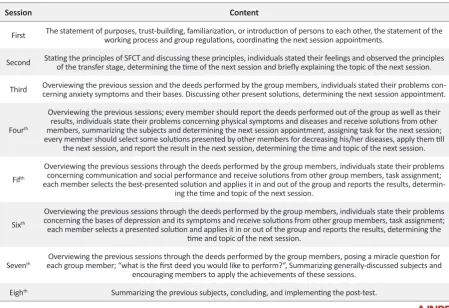
Having obtained the necessary permissions, we re-ferred to the Marham Clinic of Sari City and selected the study participants. Forty-eight individuals were selected and randomly assigned to experimental and control groups (16 individuals per group). Then, the experimen-tal groups were provided with explanations respecting the therapy’s logic, the study purpose, and the signifi-cance of their presence in the study. Moreover, they were assured that all of their information would remain confidential. Accordingly, the SFCT sessions adapted from the therapeutic protocol and employed in the study conducted by Shakarami, Davarnia, and Zahrakar
[17] were conducted among the experimental groups
for 8 sessions (Table 1). After performing the
therapeu-tic sessions, the subjects of both groups completed the mentioned questionnaires as the post-test. Finally, the obtained pre-test/ post-test data were prepared for sta-tistical analysis.
The Communicational Patterns questionnaire of Christensen and Sullaway (1984)
This questionnaire was developed by Christensen and Sullaway in 1984. It has 35 items and comprises four subscales, including 1- mutual constructive
communi-Table 1 The outline of the Solution-Focused Therapeutic Sessions
Session Content
First The statement of purposes, trust-building, familiarization, or introduction of persons to each other, the statement of the working process and group regulations, coordinating the next session appointments.
Second Stating the principles of SFCT and discussing these principles, individuals stated their feelings and observed the principles of the transfer stage, determining the time of the next session and briefly explaining the topic of the next session.
Third Overviewing the previous session and the deeds performed by the group members, individuals stated their problems con-cerning anxiety symptoms and their bases. Discussing other present solutions, determining the next session appointment.
Fourth
Overviewing the previous sessions; every member should report the deeds performed out of the group as well as their results, individuals state their problems concerning physical symptoms and diseases and receive solutions from other members, summarizing the subjects and determining the next session appointment, assigning task for the next session; every member should select some solutions presented by other members for decreasing his/her diseases, apply them till
the next session, and report the result in the next session, determining the time and topic of the next session.
Fifth
Overviewing the previous sessions through the deeds performed by the group members, individuals state their problems concerning communication and social performance and receive solutions from other group members, task assignment; each member selects the best-presented solution and applies it in and out of the group and reports the results,
determin-ing the time and topic of the next session.
Sixth
Overviewing the previous sessions through the deeds performed by the group members, individuals state their problems concerning the bases of depression and its symptoms and receive solutions from other group members, task assignment; each member selects a presented solution and applies it in or out of the group and reports the results, determining the
time and topic of the next session.
Seventh each group member; “what is the first deed you would like to perform?”, Summarizing generally-discussed subjects and Overviewing the previous sessions through the deeds performed by the group members, posing a miracle question for encouraging members to apply the achievements of these sessions.
cation, 2- demand/male withdrawal communication. 3- demand/female withdrawal communication, and 4- mutual avoidance communication. In Iran, Ebadatpour
[18] validated this scale; the achieved correlation
coef-ficients for the three subscales of mutual constructive communication, mutual avoidance communication, and demand/withdrawal communication were 0.58, 0.58, and 0.35, respectively. Besides, all of them were significant at 0.01 alpha level. To determine the reliabil-ity of the questionnaire, we computed the internal con-sistency of the scale’s subscales. The obtained numbers were 0.50, 0.51, 0.52, and 0.55, respectively, for the mu-tual constructive, mumu-tual avoidance, male demands/fe-male withdraws, and fedemands/fe-male demands/demands/fe-male withdraws subscales. The couples rate each behavior adjusted on a 9-point Likert-type scale from 1 (it is absolutely impos-sible) to 9 (it is absolutely posimpos-sible).
The Flexibility Inventory of Dennis and Vander Wal (2010)
The Cognitive Flexibility Inventory (CFI) was construct-ed by Dennis and Vander Wal in 2010. It possesses 20 items and is employed to evaluate the rate of an individ-ual’s progress in clinical and nonclinical tasks, the prog-ress rate in developing flexible thoughts in cognitive-be-havioral therapy for depression, and other psychological diseases. The concurrent validity of this inventory with Beck’s Depression Inventory (BDI-II) equals -0.39, and its convergent validity with the Cognitive Flexibility Scale of
Martin and Robin equals 0.75 [19]. In this research, the
test-retest coefficient of 0.71 and Cronbach’s alpha coef-ficient of 0.90 was obtained for the total scale.
To analyze the obtained data, descriptive statistical methods, including frequency, percentage, mean, and standard deviation, were used. We also employed the Multivariate Analysis of Covariance (MANCOVA) to ex-amine the hypotheses in SPSS.
3. Results
The study subjects were 32 married couples (16 in the experimental group and 16 in the control group) with the Mean±SD age of 38.47±7.01 years for the experimental group and 36.60±6.12 years for the control group; such findings suggest the groups’ homogeneity in terms of age. The Mean±SD score of mutual constructive commu-nication in the pre-test was 18.3±4.5, which increased to 24.3±3.3 in the post-test. The same value for demands/ female withdraws was 18.6±2.9 in pre-test which de-creased to 16±3.2 in post-test; female demands/male withdraws pre-test Mean±SD score was 16.1±5.1 which decreased to 15.4±4.3 at post-test; mutual avoidance communication pre-test Mean±SD score was 18.5±4.2 which decreased to 14.7±3.3 in post-test; flexibility pre-test Mean±SD score was 91.5±8.8 which increased to 100. (7.7) in post-test; alternatives pre-test Mean±SD score was 50.5±8.3 which increased to 55.6±6.4 in post-test; The pre-test Mean±SD score of the control group was 32.8±6.1 which increased to 35.1±5.1 in post-test; Alternatives pre-test Mean±SD score for human behav-ior was 8.1±2.2 which increased to 9.3±2.2 in post-test.
The MANCOVA was used to investigate the effect of SFCT on the communicational patterns and flexibility of divorce applicant couples. First, the homogeneity of the regression line slope was investigated that indicated the correlation between conditions and pre-test score was not significant (F=3.11, P>0.05). Therefore, the collected data supported the homogeneity of the regression slope. The Kolmogorov-Smirnov test results revealed that the data distribution was normal in each of the three groups as well as in the pre-test and post-test stages. The Lev-ene’s F-value for the equality of variances of the research variables in the experimental and control groups sug-gested that the variance of the components was unequal among the studied groups; thus, the condition for imple-menting covariance analysis was established.
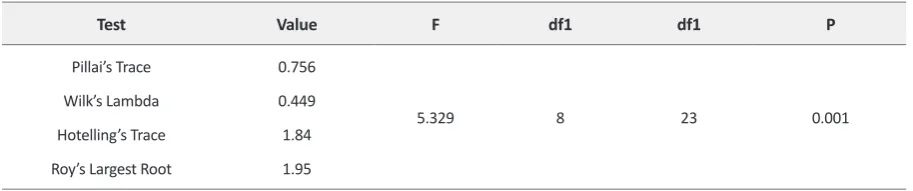
According to Table 2, the F statistics of MANCOVA
re-garding the difference between the experimental and
Table 2. MANCOVA data for communicational patterns and flexibility between the control and experimental groups
Test Value F df1 df1 P
Pillai’s Trace Wilk’s Lambda Hotelling’s Trace Roy’s Largest Root
0.756 0.449 1.84 1.95
control groups in the components of communicational patterns and flexibility was statistically significant at 0.001 (Wilks’ Lambda=0.449, F=5.32, P<0.001). There-fore, there was a significant difference between the experimental and control groups in at least one of the components of communicational patterns and flexibil-ity in the post-test (after controlling the pre-test scores and the interaction between the components of com-municational patterns and flexibility). In the following, the effects of the components of communicational pat-terns and flexibility are examined.
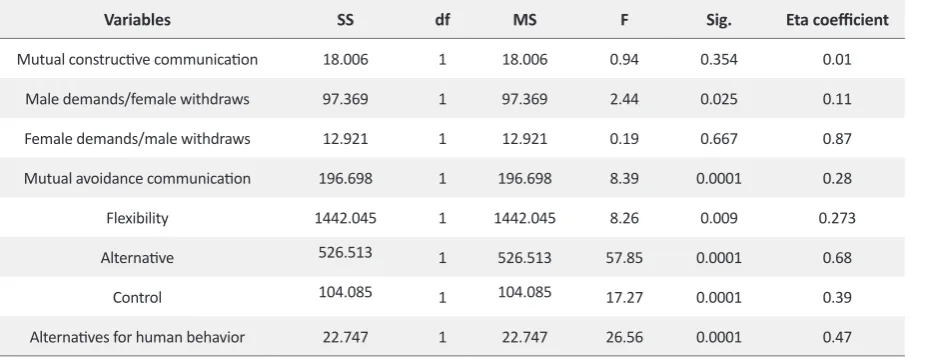
Table 3 presents a significant difference between the control and experimental groups in the male demands/ female withdraws (F=2.44, P≤0.025) and mutual avoid-ance communication (F=8.39, P≤0.0001). The effect of the SFCT on flexibility (F=55.63, P<0.001), alternative (F=57.85, P<0.001), control (F=17.27, P<0.001), and al-ternatives for the human behavior (F= 26.56, P<0.001) of the study subjects was statistically significant. The eta squared value also revealed that about 65% of the flexibility variance, 68% of the alternative variance, 39% of the control variance, and 47% of the alterna-tives for human behavior variance wee determined by SFCT training.
4. Discussion
The obtained data of the mean differences suggested a statistically significant difference between the experi-mental and the control groups in the male demands/ female withdraws and mutual avoidance communica-tion components. These results were in line with those
of Gonzalez et al. [20], and Doss et al. [21] that reported
SFCT was effective on marital components.
Accordingly, the purpose of the SFCT, similar to all therapeutic interventions, is to help clients create so-lutions leading to a greater quality of life. SFCT focuses on exceptions rather than incorrect matters created in communications. A solution-focused therapist discloses those times at which there is no problem, or it is sim-pler or less difficult to cope with the problems. For ex-ample, the following questions are asked from the cli-ents: “when is it simpler for you not to argue with your partner?”, “when do you and your partner enjoy each
other’s company?” [22]. In the collaborative couple
therapy sessions, the clients were required to remind the memorable situations and moments they experi-enced with their partners to analyze how they behaved in those situations. These exceptions extraction in marital relationships assists the clients to feel they can re-experience beautiful moments with their partners. When the couples begin the jobs, they both enjoy, their
relationships improve [23].
Moreover, the clients were required to admire any positive behavior of their partners, even if it was very insignificant, and emphasize their strengths. Thus, they could improve their emotional relationships with their partners by admiring them; consequently, they could es-tablish better relationships with them. The SFCT mainly emphasizes insignificant changes until the more consid-erable changes are achieved. Besides, its therapeutic fo-cus is on the issues that might change. When a member of a couple successfully takes the first step for changes and, consequently, observes these changes in his/her partner, her/his eagerness to continue this process of change increases. Thus, he observes more significant changes in his/her marital relationship after a while. The resultant modifications creates hope in the couples
con-Table 3. The MANCOVA scores with pre-test control and post-test analysis of the components of communicational patterns and flexibility
Variables SS df MS F Sig. Eta coefficient
Mutual constructive communication 18.006 1 18.006 0.94 0.354 0.01
Male demands/female withdraws 97.369 1 97.369 2.44 0.025 0.11
Female demands/male withdraws 12.921 1 12.921 0.19 0.667 0.87
Mutual avoidance communication 196.698 1 196.698 8.39 0.0001 0.28
Flexibility 1442.045 1 1442.045 8.26 0.009 0.273
Alternative 526.513 1 526.513 57.85 0.0001 0.68
Control 104.085 1 104.085 17.27 0.0001 0.39
cerning the future of their relationships as well as their marital lives. They substitute positive feelings towards their partners to negative and hostile attitudes and
en-joy more intimate feelings towards each other [24].
The clients preserve their lifeless and ordinary com-municational patterns; however, they lose their power after some time. The primary purpose of the solution-focused approach is to disarrange this pattern through the extensive minor repairs of time, duration, and place of trouble. The couples are guided to change a suc-cession or consider new aspects. For example, in the therapeutic sessions, females are requested to change the time, place, and way of continuing their arguments
[25]. The solution-focused therapists believe that
mari-tal problems remain or aggregate through the method the partner employs to solve them. The SFCT reminds couples of the skills of solving problems when they nec-essary and develops long-term solutions for them. The change in one partner leads to a change in the other
individuals of a system [26].
One of these skills was responding to an exception question technique. In the SFT, the sudden cognitive change of clients to identify and distinguish excep-tions often leads to an upwards movement resulting
in a noticeable improvement [27]. In the therapeutic
sessions and via the exception question technique, the clients could remember those times they had no spe-cific problem in communicating with their partners; in case the problems existed, they were of very low in-tensity. Extracting these moments allows the clients to perceive how their marital relationships were and how they acted so that they can now behave similarly. The therapist could help the clients develop significant and observable changes. The SFCT poses the idea of con-trol to the couples since they can observe the changes or the potential for changes. This active control, be-sides participation in the therapy, allows the clients to touch the control of problems and guidance of their
behaviors [28].
Moreover, the obtained results revealed the signifi-cant effects of SFCT training on flexibility, alternative, control, and alternatives for human behavior. Flexibility was defined as a person’s ability to prevent a dominant but inefficient and inappropriate response, as well as the ability to achieve more far-off alternative responses
[24]. Individuals with cognitive flexibility could examine
new problems and situations at different levels, present choices and alternative ideas, and better tolerate con-flicts. Individuals with less flexibility can hardly forger their initial learning. They insist on their earlier learnings
with negative consequences. This insistence hurts their compatibility with new conditions and leads to
incom-patibility in their relationships [25].
In this respect, SFT considers clients as qualified and powerful specialists able to solve their problems. It also considers the therapy as a process through which clients and therapists reconstruct desirable realities. Through-out the therapy process, it was paramount for the ther-apist to establish the shared relationships through the correction of language, beliefs, and performances of the clients, and to employ change-focused language and questions. Solution-focused therapy believes that clients can identify and shape effective solutions for problatic situations. It necessarily concentrates on the em-powerment and flexibility of clients by discovering solu-tions and previous excepsolu-tions for problems. Besides, it encourages clients to repeat efficient behaviors shaping
the basis of solutions for materializing objectives [26].
A critical intervention in solution-focused therapy is seeking exceptions for being flexible. Clients could find the times at which there is no stress and anxiety or more manageable times by them. Such a measure could be use-ful in reconstructing their perceptions of choices and en-vironment and, consequently, increasing their flexibility with their partners. Freedman and Combos described ex-ception seeking as solutions in which individuals acquire some experiences, i.e., inconsistent with their stories. By highlighting different events, they create an atmosphere to write new stories for themselves. If the clients can dis-tinguish exceptions, their repetition and development can become the correct part of their solution. At excep-tional times, clients are discovering a kind of life with no
problem or with the least intense problems [29].
recom-mended to conduct longitudinal and qualitative studies in the future. It is suggested that future studies control demographic variables, such as economic status, re-ligion, and ethnicity, as well. Concerning the results of the research hypotheses on the effect of the SFCT meth-ods, it is suggested to apply this method when the rate of problems is less to achieve better preventive results. A solution-focused counseling method is an ability-fo-cused approach that can be exploited in different cases according to study results. Given the supported efficacy of this approach in the present study, it is recommend-ed that counselors extensively use it either personally or collaboratively.
The SFCT affects the communicational patterns and flexibility of divorce applicant couples. It is suggested that SFCT be the priority of clinical interventions to in-crease the communicational patterns and flexibility of divorce applicant couples.
Ethical Considerations
Compliance with ethical guidelines
All ethical principles were considered in this article. The study participants were informed about the re-search purpose and its implementation stages and signed the informed consent. They were also assured about the confidentiality of their obtained information.
Funding
This research did not receive any specific grant from funding agencies in the public, commercial, or not-for-profit sectors.
Authors' contributions
Conceptualization, writing-original draft: Somayeh Bagh-eri; Supervision, Methodology: Afsaneh Khajevand Khoshli; Investigation: Javanshir Asadi; Writing-review & editing; funding acquisition, resources: All author.
Conflict of interest
The authors declared no conflicts of interest.
References
[1] Givertz M, Segrin C. The association between overinvolved par-enting and young adults’ self-efficacy, psychological entitlement,
and family communication. Communication Research. 2014; 41(8):1111-36. [DOI:10.1177/0093650212456392]
[2] Wilson SR, Chernichky SM, Wilkum K, Owlett JS. Do family commu-nication patterns buffer children from difficulties associated with a parent’s military deployment? Examining deployed and at-home parents’ perspectives. Journal of Family Communication. 2014; 14(1):32-52. [DOI:10.1080/15267431.2013.857325]
[3] Schrodt P, Witt PL, Shimkowski JR. A meta-analytical review of the demand/withdraw pattern of interaction and its associations with individual, relational, and communicative outcomes. Communica-tion Monographs. 2014; 81(1):28-58. [DOI:10.1080/03637751.201 3.813632]
[4] Carroll SJ, Hill EJ, Yorgason JB, Larson JH, Sandberg JG. Couple com-munication as a mediator between work-family conflict and marital satisfaction. Contemporary Family Therapy. 2013; 35(3):530-45. [DOI:10.1007/s10591-013-9237-7]
[5] Henry CS, Sheffield Morris A, Harrist AW. Family resilience: Mov-ing into the third wave. Family Relations. 2015; 64(1):22-43. [DOI:10.1111/fare.12106]
[6] Rossetto KR. Relational coping during deployment: Managing com-munication and connection in relationships. Personal Relationships. 2013; 20(3):568-86. [DOI:10.1111/pere.12000]
[7] Carvalho J, Francisco R, Relvas AP. Family functioning and infor-mation and communication technologies: How do they relate? A literature review. Computers in Human Behavior. 2015; 45:99-108. [DOI:10.1016/j.chb.2014.11.037]
[8] Wadsby M, Priebe G, Svedin CG. Adolescents with alternating resi-dence after parental divorce: A comparison with adolescents living with both parents or with a single parent. Journal of Child Custody. 2014; 11(3):202-15. [DOI:10.1080/15379418.2014.943448]
[9] Badr H. New frontiers in couple-based interventions in cancer care: Refining the prescription for spousal communication. Acta Oncolog-ica. 2017; 56(2):139-45. [DOI:10.1080/0284186X.2016.1266079]
[PMID]
[10] Cigrang JA, Wayne Talcott G, Tatum J, Baker M, Cassidy D, Son-nek S, et al. Intimate partner communication from the war zone: A prospective study of relationship functioning, communication frequency, and combat effectiveness. Journal of Marital and Fam-ily Therapy. 2014; 40(3):332-43. [DOI:10.1111/jmft.12043][PMID]
[11] Markham MS, Coleman M. The good, the bad, and the ugly: Di-vorced mothers’ experiences with coparenting. Family Relations. 2012; 61(4):586-600. [DOI:10.1111/j.1741-3729.2012.00718.x]
[12] De Shazer S, Dolan Y. More than miracles: The state of the art of solution-focused brief therapy. London: Routledge; 2012. [DOI:10.4324/9780203836484]
[13] Tambling RB. Solution-oriented therapy for survivors of sexual assault and their partners. Contemporary Family Therapy. 2012; 34(3):391-401.
[14] Epstein NB, Berger AT, Fang JJ, Messina LA, Smith JR, Lloyd TD, et al. Applying western-developed family therapy models in China. Journal of Family Psychotherapy. 2012; 23(3):217-37. [DOI:10.1080 /08975353.2012.705661]
[16] Beyebach M. Change factors in solution-focused brief therapy: A review of the Salamanca studies. Journal of Systemic Therapies. 2014; 33(1):62-77. [DOI:10.1521/jsyt.2014.33.1.62]
[17] Choi JJ, Akdeniz R. Solution-focused approach with multicultural families. Solution-focused brief therapy: A multicultural approach. New York: SAGE Publication; 2014. [DOI:10.4135/9781483352930.n9]
[18] Hoyt MF. Solution-focused couple therapy: Helping clients construct self-fufilling realities. London: Routledge; 2013. [DOI:10.4324/9780203782576]
[19] Ward A, Knudson-Martin C. The impact of therapist actions on the balance of power within the couple system: A qualitative analysis of therapy sessions. Journal of Couple & Relationship Therapy. 2012; 11(3):221-37. [DOI:10.1080/15332691.2012.692943]
[20] Gonzalez Suitt K, Franklin C, Kim J. Solution-focused brief therapy with Latinos: A systematic review. Journal of Ethnic & Cultural Di-versity in Social Work. 2016; 25(1):50-67. [DOI:10.1080/15313204 .2015.1131651]
[21] Doss BD, Mitchell A, Georgia EJ, Biesen JN, Rowe LS. Improve-ments in closeness, communication, and psychological distress mediate effects of couple therapy for veterans. Journal of Consult-ing and Clinical Psychology. 2015; 83(2):405-15. [DOI:10.1037/ a0038541][PMID]
[22] Chenail RJ, George SS, Wulff D, Duffy M, Scott KW, Tomm K. Clients’ relational conceptions of conjoint couple and family therapy qual-ity: A grounded formal theory. Journal of Marital and Family Ther-apy. 2012; 38(1):241-64. [DOI:10.1111/j.1752-0606.2011.00246.x]
[PMID]
[23] Javanmiri L, Kimiaee SA, Abadi BA. The study of solution-focused group counseling in decreasing depression among teenage girls. International Journal of Psychological Studies. 2013; 5(1):105-111. [DOI:10.5539/ijps.v5n1p105]
[24] Sarvi Z, Ghazi M. Effectiveness of group counseling with solu-tion focused (brief) therapy (sfbt) on increasing self-efficacy of fifth grade primary school female students. Modern Applied Science. 2016; 10(12):1-6. [DOI:10.5539/mas.v10n12p1]
[25] Gingerich WJ, Peterson LT. Effectiveness of solution-focused brief therapy: A systematic qualitative review of controlled outcome studies. Research on Social Work Practice. 2013; 23(3):266-83. [DOI:10.1177/1049731512470859]
[26] Jalali F, Hashemi S, Kimiaei S, Hasani A, Jalali M. The effective-ness of solution-focused brief couple therapy on marital satis-faction among married prisoners and their wives. International Journal of Offender Therapy and Comparative Criminology. 2018; 62(10):3023-37. [DOI:10.1177/0306624X17733662][PMID]
[27] Mullet N, Zielinski M, Jordan SS, Brown CC. Solution-focused brief therapy for families: When a loved one struggles with sub-stance abuse. Journal of Systemic Therapies. 2018; 37(3):15-28. [DOI:10.1521/jsyt.2018.37.3.15]
[28] Sung J, Mayo N, Witting AB. A Theoretical investigation of postmodern approaches used in medical settings: Solution-focused brief therapy. The Family Journal. 2018; 26(2):200-7. [DOI:10.1177/1066480718778527]