Copyright © 2008 by Iranian Occupational Health Association (IOHA) IJOH 8: 151-157, 2016
ORIGINAL ARTICLE
Identification of the Ergonomic Interventions Goals from the
Viewpoint of Ergonomics Experts of Iran using Fuzzy Delphi
Method
MOJTABA AHMADI
1, SEYED ABOLFAZL ZAKERIAN
1*, HAMED SALMANZADEH
2,
ALIREZA MORTEZAPOUR
11Department of Occupational Health, School of Public Health, Tehran University of Medical Sciences, Tehran,
Iran;
2Faculty of Industrial Engineering, Khaje Nasir Toosi University of Technology, Tehran, Iran.
Received April 20, 2016; Revised May 29, 2016; Accepted July 22, 2016
This paper is available on-line at http://ijoh.tums.ac.ir
ABSTRACT
One of the most important elements of successful implementation and management an ergonomics program in an organization is to have suitable goals. In any industry, the goals of ergonomic interventions should be known and understood to determine their benefits. This study aimed to identify and determine the most important goals of ergonomic interventions from the perspective of experts of Iran in the industries using fuzzy Delphi method. In this qualitative study, which is carried out in 2016, the viewpoints of ergonomics experts of Iran were collected during the three-phase fuzzy Delphi through a series of questionnaires. The data was analyzed using content analysis and fuzzy logic. The ergonomics experts have identified eight criteria as the goals of ergonomic interventions which include increasing employee productivity, reducing staff fatigue, promoting physical health, increasing safety, enhancing job satisfaction, improving the quality of products or services, reducing compensation costs and increasing immaterial value and reputation of organizations. The first five criteria with an average of more than 70% agreement have been reached a consensus by the experts. "Increasing productivity", "reducing fatigue" and "improving physical health" are the most important goals of ergonomic interventions considered as ergonomic criteria to evaluate an ergonomics program. The viewpoints of the Iranian ergonomics experts had a lot in common and were really close to the global approach based on International Ergonomics Association definition of ergonomics and human factors.
KEYWORDS: Goals of ergonomic interventions, Fuzzy Delphi method, Ergonomics program
INTRODUCTION
Focusing on globalization and
subsequent changes in the organizations’ goals and policies are the facts that managers and employees face every day [1]. At the moment, labor costs have a great impact on organizations [2]. Since work-related stress has adverse effects on safety and health of staff as well as organizational productivity to prevent workers' exposure to occupational stress, task/job requirements should not exceed the limitations and capabilities of the * Corresponding Author: Seyed Abolfazl Zakerian
Email: [email protected]
workers [3]. The best way to prevent occupational injuries is to implement intervention and workplace modification [4]. According to the National Institute for Occupational Safety and Health (NIOSH), occupational ergonomics is defined as "science of adjustment the working conditions and job requirements with ability of workers" [5]. Therefore, applying the principles of ergonomics increases the coordination
between human and working systems
Identification of the Ergonomic Interventions Goals … ijoh.tums.ac.ir | 152
Long-term success of corrective programs of ergonomics in an organization depends on extent of which the program is well founded. Wasting resources and losing credibility and trust of employees and management will occur, when a corrective program is not planned effectively. One of the most important factors in successful accomplishment of ergonomics programs in an organization is determining an appropriate goal or target [8], therefore, one of the simple and usual definitions of success is achieving the desired goals [9]. Managers who have successful ergonomics programs in their
organization always have determined
additional goals besides reducing physical illnesses, because the purpose of ergonomics is not limited to the injuries management and prevention. Furthermore, these goals are considered as evaluation criteria of their program's performance [8]. Thus, in any industry the goals of ergonomic interventions should be known and understood to identify its advantages and benefits [10].
Some common indicators were
presented as the most important goals of ergonomics that include comfort, health, satisfaction, safety, product quality and productivity [3, 11-17]. These investigations have all been done in developed countries. There is no difference in ergonomic
approaches between developed and
developing countries. However, applications of ergonomics in various countries are
different which means “what is the
requisiteness of conducting ergonomic intervention in a particular industry or country?” [18]. For example, the necessities of ergonomics in industrially developing countries are different from developing countries. Moreover, most references agree on just some of the goals, while others do not and vice versa [3, 11-17].
Accordingly, this inquiry intended to identify and overview the most usual necessities of implementing the ergonomic principles only in Iranian workplaces because of two reasons. First of all, the employers and stakeholders as well as junior Iranian ergonomists, for better understanding, should be aware of the most important and prevalent ergonomic-related problems in the workplaces of Iran. Secondly, these could be considered as the criteria for assessing the effectiveness
of ergonomics programs. Since such
investigation has not been done in Iran, technical knowledge and standpoints of a group of ergonomics experts of Iran on this issue would be very helpful.
There are many methods for taking the viewpoints of experts such as focus groups, nominal group technique and Delphi
method. Due to the difficulties of
simultaneous access to ergonomics specialists of Iran, Delphi method was used in this study. Delphi method is a way to obtain group knowledge which often is used in qualitative researches for identifying nature and fundamental elements of a phenomenon [19]. It is a structured process for data gathering during successive rounds and ultimately, reaching consensus of a group of experts [20]. The name of Delphi was proposed in the late 1950s in the U.S.A military defense project for the first time [21]. Delphi method has been described as a fast, inexpensive and relatively effective way to combine the knowledge and ability of the group of experts [22]. Its main purpose is to reach the most reliable consensus of experts through a series of structured questionnaires during sequential rounds, with controlled feedback [19]. This technique uses verbal terms to measure the opinions.
Verbal terms have limitations to reflect the respondent's subjective judgments. In 1998 fuzzy numbers were used, rather than absolute numbers, to resolve the ambiguities of qualitative answers of respondents [23]. Triangular fuzzy numbers were used in Delphi method [24].
This study aimed to identify and determine the most important goals of ergonomics programs in Iranian industries from the viewpoint of the experts using Delphi method.
MATERIALS AND METHODS
Fuzzy Delphi Method: The procedure of fuzzy Delphi method is like the classic Delphi. However, the only difference is that the aggregation of viewpoints in fuzzy Delphi method is based on fuzzy sets. Either fuzzy spectrum development methods or prevalent fuzzy sets can be utilized to fuzzification the qualitative answers [20]. Triangular fuzzy numbers as the most common fuzzy set correspond to five-point Likert scale shown in Table 1 were used to express the importance of indicators.
Table 1. Triangular fuzzy numbers equivalent 5-point scale
Not important Slightly important Moderately important Important Very important
153| IJOH | September 2016 | Vol. 8 | No. 3 Ahmadi, et al
After selecting a suitable fuzzy spectrum, experts’ views will be collected qualitatively and recorded as fuzzy numbers. Then, experts’ opinions should be aggregated. One of methods for consensus is fuzzy average method if the view of each expert is displayed as fuzzy numbers. Fuzzy average of n triangular fuzzy numbers will be calculated by Equation 1 in which l, m and u represent the minimum value, most likely value and maximum value of a triangular fuzzy number, respectively.
Equation 1:
∑ ∑ ∑
In the next step, a defuzzification method is required to obtain the crisp values. In fuzzy approach methods, the researcher plans to convert the final fuzzy number into a certain and explicit value, eventually. This is called defuzzification. One of defuzzification methods is calculated by Equation 2 [25].
Equation 2:
( ) ( )
Finally, a cut-off point must be selected to determine the agreed items. Since usually previous studies have taken the amount of 70% as a reliable threshold, in this study, the threshold of 0.7 was determined. If an item’s value is smaller than the threshold, the item has not been agreed by all experts and must be omitted. Only those values that are greater than or equal to the threshold will be approved [20, 26-29].
Implementation of Fuzzy Delphi method:
This qualitative study was carried out in Iran, in 2016 that used the viewpoints of ergonomics experts of Iran to identify the most important goals of ergonomic interventions in workplaces through fuzzy Delphi method.
Initially, the panel of experts was formed. Usually, between 6 to 12 members for the Delphi technique is ideal and a panel of experts between 5 to 10 members is sufficient if it is combined with different fields. However, the quality of participants is more important than their quantity [30]. In the present research, we tried to select participants who were experts and connoisseurs in the field of study, so the data quality was high enough. The panel of experts was formed, through Purposeful Sampling and Snowball method, from Tehran, Shahid Beheshti, Shiraz and Hamadan Universities of Medical Sciences, University of Social Welfare and Rehabilitation Sciences, Khajeh Nasir Toosi University of Technology, as well as Danesh Farayand Kimia and Karpanika companies, Iran. In Snowball method, the researcher identifies
a few people first, and then they will be asked to introduce some experts in the intended field [31]. For the participants, inclusion criteria were considered as the following:
For university professors:
• Being expert in ergonomics field
• Having at least 5-yr academic work experience in ergonomics
• Having experience of ergonomics projects in workplaces
For ergonomics specialists in industries:
• Ph.D. or master's degree in ergonomics
• Having at least 10-yr ergonomics and safety related experience in industries
• Interested in topic of ergonomic
Finally, a group of 7 faculty members and 4 industrial ergonomics specialists was formed. Before beginning, participants were informed of the importance and conditions of the study and then fuzzy Delphi process was conducted. The aim of the Delphi method in this study was to identify the assessment criteria of modifying workplaces or determine the goals of ergonomic interventions. Delphi has a series of questionnaire or survey steps, such that the initial questionnaire forms the next steps [32].
Fuzzy Delphi method was conducted in three rounds. The questionnaire of the first round consists of three parts.
The first part was included thanks to the participants and brief description of the study. In the next section, demographic information of participants was collected. This information contains their fields of education, work experiences and their position in the relevant job. In the last part, the participants were asked to answer the unstructured question “what are the goals and purposes of ergonomic interventions in workplaces?” and list the items based on their own experiences and studies.
In the second round, a new questionnaire was designed according to the first round’s results in which all items listed by the experts were included. The experts were asked to rate the importance of the items with a five-point scale which was set in the questionnaire as "very unimportant", "unimportant", "moderately important", "important" and "very important". In the third round, the result was provided to those participants whose opinions were far different from the others to get feedback and reconsider their own views if they would like.
Identification of the Ergonomic Interventions Goals … ijoh.tums.ac.ir | 154
numbers were defuzzified. The research team agreed on the threshold of 0.7 for reaching a consensus based on previous studies.
Therefore, only those items whose values were greater than or equal to 0.7 were accepted as the goals of ergonomics in the industry from the viewpoint of ergonomics experts.
RESULTS
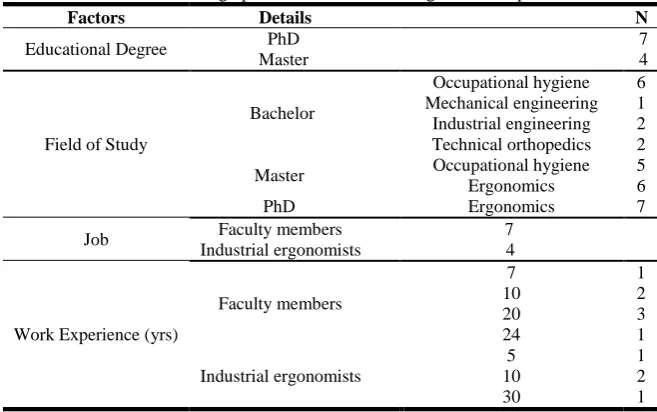
The first part of the questionnaire of the first round was about demographic information. The experts were asked for information such as their last educational degrees, different levels of education, work experience and job position. Details are presented in Table 2.
Table 2. Demographic information of the ergonomics experts
Factors Details N
Educational Degree PhD 7
Master 4
Field of Study
Bachelor
Occupational hygiene 6 Mechanical engineering 1
Industrial engineering 2 Technical orthopedics 2
Master Occupational hygiene 5
Ergonomics 6
PhD Ergonomics 7
Job Faculty members 7 Industrial ergonomists 4
Work Experience (yrs)
Faculty members
7 1
10 2
20 3
24 1
Industrial ergonomists
5 1
10 2
30 1
The main question of study was propounded in the shape of open-answered and the experts were asked to list what the question is going to achieve. After collecting questionnaires, data were analyzed using content analysis. All similar items were merged. For example, the answers of "increasing workplace's safety",
"Increasing the safety level" and "Increasing employee safety" all of them point to one concept named "safety". Therefore, such cases have been integrated and framed under a single term. Eventually, data were sorted in eight titles shown in Table 2.
Table 2. The results of the first round of the Delphi method
Goals of ergonomic interventions 1 Increasing physical health
2 Reducing physical and mental fatigue 3 Increasing safety
4 Enhancing job satisfaction 5 Increasing employee productivity 6 Improving quality of products or services 7 Reducing compensation claims
8 Increasing immaterial value and reputation of organizations
During the second round, participants rated the items obtained from the first round by a five-point scale. The purpose of this round was to
screen the most important items. Table 4 shows the fuzzy average points of each item.
Table 3. Fuzzy average of the experts' opinions
Goals of ergonomic interventions Fuzzy average
Increasing physical health 0.545, 0.800, 0.902
Reducing physical and mental fatigue 0.568, 0.820, 0.973
Increasing safety 0.477, 0.730, 0.932
Enhancing job satisfaction 0.500, 0.750, 0.932
Increasing employee productivity 0.636, 0.890, 0.977 Improving quality of products or services 0.375, 0.630, 0.875
Reducing compensation claims 0.341, 0.590, 0.795
155| IJOH | September 2016 | Vol. 8 | No. 3 Ahmadi, et al
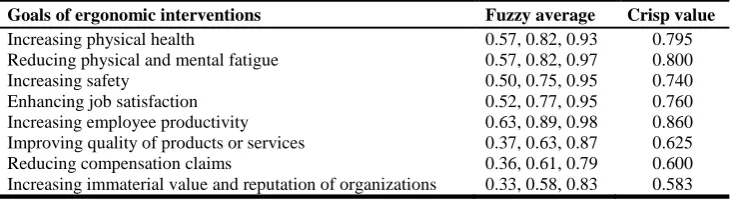
In the last round of Delphi, only one person with awareness of the views of others changed some of his own opinions. Fuzzy average
of the views and related crisp values are demonstrated in Table 5.
Table 4. The results of the fuzzy Delphi method
Goals of ergonomic interventions Fuzzy average Crisp value
Increasing physical health 0.57, 0.82, 0.93 0.795
Reducing physical and mental fatigue 0.57, 0.82, 0.97 0.800
Increasing safety 0.50, 0.75, 0.95 0.740
Enhancing job satisfaction 0.52, 0.77, 0.95 0.760
Increasing employee productivity 0.63, 0.89, 0.98 0.860
Improving quality of products or services 0.37, 0.63, 0.87 0.625
Reducing compensation claims 0.36, 0.61, 0.79 0.600
Increasing immaterial value and reputation of organizations 0.33, 0.58, 0.83 0.583
DISCUSSION
This study is a qualitative research to identify and determine the most important goals of ergonomic interventions by eleven ergonomics experts of Iran using fuzzy Delphi method. The results of the first phase of this study show the eight common goals. Five, out of eight, indicators including "increasing physical health", "reducing physical and mental fatigue", "increasing employee productivity", "increasing safety" and "enhancing job satisfaction" have certain values larger than 0.7 which means the experts reached a consensus on these five indices as the ergonomics goals. From their point of view, “productivity”, “fatigue” and “physical health” are more important out of all goals. The experts noted in their descriptions that increasing fatigue has a direct impact on reducing physical health. Moreover, the criteria “fatigue” in this study, took physical and mental aspects of health into consideration while physical health was limited to physical conditions. So the criteria “fatigue” became more important than physical health”. Based on the definition of the International Ergonomics Association (IEA), goals of ergonomics are generally classified as performance-centered and person-centered [12]. The criteria “physical health”, “fatigue”, “safety” and “job satisfaction” are person-centered, also “productivity” and “quality” are categorized in performance-centered goals group. The criteria, “reducing compensation claims” and “increasing reputation of organizations” are not classified in the definition of IEA. These are more general than both person and performance centered goals, so these could belong to organizational goals. "Job Satisfaction", "safety", "health" and even "reducing fatigue" are all the subsets of the quality of working life [33, 34]. Therefore, from the perspective of ergonomics experts, improving the quality of working life in the workplace is a crucial factor considered by managers and supervisors of industries. Since the aim of using Delphi method was not prioritization, thus the common goals of ergonomic interventions in various industries have
just been identified and not prioritized. The reliability of Delphi method depends on 1) the suitability of the method to a particular issue, 2) the selection of the panelists and their specialties, 3) the design and execution of the questionnaire, 4) the feedback and 5) the consensus [35] that depends on panel size [36]. Due to the difficulties of simultaneous access to ergonomics specialists of Iran, Delphi method was used because it does not need to bring the experts together. Therefore, Delphi was applicable to this study’s issue. A common recommended number of respondents (6 to 12 experts) have been chosen who were well known, and expert in the field of ergonomics and familiar with the workplace environment of Iran. The questionnaires were designed and administered as simple as possible and locally. The respondents were given feedback to reconsider their responses if necessary and reached consensus finally through a reliable threshold value. According to this, the results were obtained under the reliable circumstances.
Finally, the industrial executives would be informed of the outcome of ergonomic interventions. They also can use these results as the criteria to evaluate and predict how much useful an ergonomics program would be in their workplace.
CONCLUSION
The results reflect the homogeneous insights of the Iranian ergonomics experts about the goals of ergonomic interventions. The viewpoints of faculty members of universities and industry executives are very close to each other and their points to the indices under study have a large overlap. The viewpoints of the Iranian ergonomics experts are really close to the global approach of IEA definition of ergonomics and human factors.
ACKNOWLEDGEMENT
Identification of the Ergonomic Interventions Goals … ijoh.tums.ac.ir | 156
declare that there is no conflict of interest.
REFERENCES
1. Albayrak E, Erensal Y.C, Using analytic hierarchy process (AHP) to improve human performance: An application of multiple criteria decision making problem. J Intell Manuf 2004; 15(4): 491-503.
2. Rivero LC, Rodríguez RG, Pérez MDR, Mar C, Juárez Z. Fuzzy Logic and RULA Method for Assessing the Risk of Working. 6th International Conference on Applied Human Factors and Ergonomics and the Affiliated Conferences, 26 – 30 July 2015; Las Vegas, United States. 3. Jaffar N, Abdul-Tharim AH, Mohd-Kamar IF,
Lop NS. A literature review of ergonomics risk factors in construction industry. The 2nd International Building Control Conference, 11-12 July 2011; Penang, Malaysia.
4. Chiasson MÈ, Imbeau D, Aubry K, Delisle A, Comparing the results of eight methods used to evaluate risk factors associated with musculoskeletal disorders. Int J Ind Ergonom
2012; 42(5): 478-488.
5. Humantech Inc. Benchmarking Summary: Ergonomics Processes That Get Results. A White Paper by Humantech, Inc. February 2011.
6. Dashti M. Investigate the effect of participatory ergonomics interventions on improve safety and reduce accidents of Tabriz Nab Steel Company in 1389-1390. MSc thesis, Shahid Beheshti University of Medical Sciences and Health Services, Tehran, Iran, 2011.
7. Naeini HS. Occupational Health Promotion throughout an Interventional Ergonomic Design (Case Study: An Ergonomic Cart Design at a Food Manufacturing Company in Iran). Int J Occup Hyg 2015 Dec 28;7(4):172-6.
8. Ip W, Rostykus W. Five Critical Elements for Managing an Ergonomics Program. ASSE Professional Development Conference and Exposition, 8-11 June 2014; Orlando, Florida, USA.
9. Wynn M, Room to move Critical success factors for an ergonomics initiative. Ind Eng
2008; 40(6): 47-52.
10. ATA Inc. Maintenance Human Factors Program Guidelines. Air Transport Association of America Inc. 2002.
11. Eklund J, Ergonomics, quality and continuous improvementconceptual and empirical relationships in an industrial context.
Ergonomics 1997; 40(10): 982-1001.
12. Falzon P. Developing ergonomics, developing people. 8th South-east Asian Ergonomics Society Conference SEAES-IPS, 23-25 May 2005; Denpasar, Bali, Indonesia.
13. Gupta S, Ergonomic applications to dental practice. Indian J Dent Res 2011; 22(6): 816.
14. Murphy LA, Robertson MM, Carayon P, The next generation of macroergonomics: Integrating safety climate. Accid Anal Prev
2014; 68: 16-24.
15. Peacock B. Measurement in manufacturing ergonomics. In: Charlton SG, O'Brien TG (Eds). Handbook of Human Factors Testing and Evaluation. 2nd edn. CRC Press, Florida, USA, 2001; pp. 157-179.
16. Rubio S, Díaz E, Martín J, Puente JM, Evaluation of subjective mental workload: A comparison of SWAT, NASA‐TLX, and workload profile methods. Appl Psychol 2004; 53(1): 61-86.
17. Thatcher A, Green ergonomics: definition and scope. Ergonomics 2013; 56(3): 389-398. 18. McNeill M, Parson K, ONeill D, Ergonomics in
Industrially Developing Countries. J Silsoe Res Inst 2000; 1-20.
19. Habibi A, Jahantigh FF, Sarafrazi A, Fuzzy Delphi Technique for Forecasting and Screening Items. Asian J Res Bus EconManag
2015; 5(2): 130-143.
20. Habibi A, Izadyar S, Sarafrazi A. Fuzzy Multicriteria decision making. Katibe Gil Publishing, Rasht, Iran, 2014.
21. Dalkey N, Helmer O, An experimental application of the Delphi method to the use of experts. Manag Sci 1963; 9(3): 458-467. 22. Powell C, The Delphi technique: myths and
realities. J Adv Nurs 2003; 41(4): 376-382. 23. Kaufmann A, Gupta MM. Fuzzy mathematical
models in engineering and management science. Elsevier Science Inc., New York, USA, 1988.
24. Ishikawa A, Amagasa M, Shiga T, Tomizawa G, Tatsuta R, Mieno H, The max-min Delphi method and fuzzy Delphi method via fuzzy integration. Fuzzy Set Syst. 1993; 55(3): 241-253.
25. Bojadziev G, Bojadziev M. Fuzzy logic for business, finance, and management. World Scientific Publishing co., Singapore 1997. 26. Keeney S, Hasson F, McKenna HP, A critical
review of the Delphi technique as a research methodology for nursing. Int J Nurs Stud 2001; 38(2): 195-200.
27. Zeigler VL, Decker-Walters B, Determining psychosocial research priorities for adolescents with implantable cardioverter defibrillators using Delphi methodology. J Cardiovasc Nurs
2010; 25(5): 398-404.
28. Tabrizi JS, Gharibi F, Developing a national accreditation model via Delphi Technique. J Hosp 2012; 11(2): 9-18.
29. Hung HL, Altschuld JW, Lee YF,
157| IJOH | September 2016 | Vol. 8 | No. 3 Ahmadi, et al
30. Somerville JA. Effective use of the Delphi process in research: Its characteristics, strengths and limitations. PhD dissertation, Oregon State University, Oregon, USA, 2007. 31. Macnee CL, McCabe S. Understanding nursing
research: Using research in evidence-based practice. 2nd ed, Lippincott Williams & Wilkins, Philadelphia, USA, 2008.
32. Ahmadi F, Nasiriani K, Abazari P, Delphi technique: tool in research. Iran J Med Educ
2008; 8(1): 175-85.
33. Baptista F, Moro P. Ergonomics and Quality of Life. In: Karwowski W. International
encyclopedia of ergonomics and human factors. 1st ed. Crc Press, Florida, USA, 2001; pp. 1675-1677.
34. Mazloumi A, Kazemi Z, Nasl-Saraji G, Barideh S. Quality of Working Life Assessment among Train Drivers in Keshesh Section of Iran Railway. Int J Occup Hyg 2015 Oct 11;6(2):50-5.
35. Song H. Delphi-based scenario planning studies on futures of curriculum for teacher education in China. ProQuest, 2007.