ISSN: 2251-6204
Modern Journal of Language
Teaching Methods
2
Modern Journal of Language Teaching
Methods
(MJLTM)
www.mjltm.com
This e-book is in copyright.
No reproduction may take place without the express written permission
of the Modern Journal of Language Teaching Methods (MJLTM)
No Unauthorized Copying
All rights reserved. No part of this book may be reproduced, stored in a
retrieval system or transmitted in any form or by any means Electronic,
mechanical, photocopying or otherwise, without the prior written
permission of the Modern Journal of Language Teaching Method.
Director:
Mohammad Shahbazi Rad
Editor – in – Chief:
Hamed Ghaemi
3
Editor – in – Chief:
Hamed Ghaemi, Islamic Azad University, Iran
Director
Mohammad Shahbazi Rad, Dean of Jahan Elm Institute of Higher Education, Mashhad, Iran
Managing Editor
Aqil Izady SadrEditorial Board:
Abednia Arman, PhD in TEFL, Allameh Tabataba’i University, Tehran, Iran Azizi Masoud, PhD Candidate in Applied Linguisitcs,
University of Tehran, Iran Basiroo Reza, PhD Candidate in TEFL, University of Tehran, International Campus, Iran Elahi Shirvan Majid, PhD Candidate in TEFL, Ferdowsi University of Mashhad, Iran Fernández Miguel,
PhD, Chicago State University, USA
Ghaemi Hamide, M.A. in Speech and Language Pathology, Mashhad
University of Medical Sciences, Iran
Grim Frédérique M. A., Associate Professor of French, Colorado State University, USA
Kargozari Hamid Reza, PhD Candidate in TEFL, Payame Noor University of Tehran, Iran
Kaviani Amir, Assistant Professor at Zayed University, UAE
Kirkpatrick Robert, Assistant Professor of Applied
Linguistics, Shinawatra International University, Thailand
Rezaei Saeed, PhD Candidate in TEFL, Sharif University of Technology, Tehran, Iran Shahbazirad Mohammad, PhD candidate in English language and Literature, Yerevan State University, Armenia
Weir George R. S., PhD in Philosophy of Psychology, University of Strathclyde, Glasgow, UK
Zegarac Vladimir, PhD, University of Bedfordshire, UK
4
TABLE OF CONTENTS
Abstracting/Indexing ... 5
The Power of Ads as Teaching Materials ... 6
Kantatip Sinhaneti
An Investigation of The Effects of Extensive Reading on the Writing Ability of EFL Students: The Effect of Group Work ... 14
Razieh Ahmadi
Cross-Cultural Study of Politeness Strategies Applied in Translations of English Requests as Face-Threatening Acts into Persian ... 31
Mojde Yaqubi
Metacognitive Strategies and Learner Autonomy in EFL Reading ... 45
Arif Sariçoban
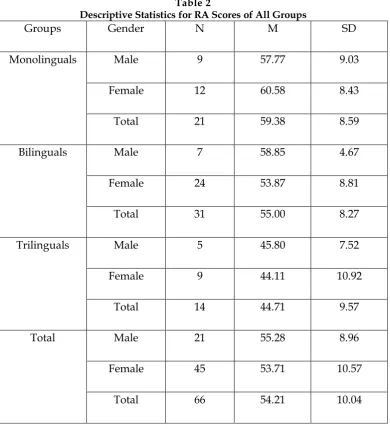
Multilingualism and Reading Anxiety: Evidence from Trilingual, Bilingual, and Monolingual EFL Learners ... 69
Sima Modirkhamene, Fahimeh Sokhandan
The Effects of Planning Time and Task Complexity on Second/Foreign Language Learners’ Oral Discourse ... 79
S. Saber Alavi, Thomas Chow Voon Foo
The Factors Leading to Success in Learning English at Leading Highschools in Bangkok ... 94
Robert Kirkpatrick, Amporn Jianrattanapong
Rhetoric of Written Teacher Commentary and Its Effect on Student Revision ... 112
Maliheh Rezaei,
The Degree of Iranian Foreign Language Anxiety ... 131
Fakhri Mesri
5
Abstracting/Indexing
Index Copernicus 2011
Linguistics Abstract
EBSCO Publication
Lulu
Publication
6
THE POWER OF ADS AS TEACHING
MATERIALS
Associate Professor Dr. Kantatip Sinhaneti Program Director,
Master of Education in Teaching English as an International Language Shinawatra University
Bangkok, Thailand [email protected]
ABSTRACT
In designing materials for EFL classrooms, the use of “ads” cannot be underestimated. This paper will first describe the eight values of Ads in interplaying with the teaching and learning of foreign or second language classroom. Students have been exposed to ads in their daily living and this pool of knowledge will make it easier for them to think, speak and write when responding to ads. Ads description is often short and carries more than literal meaning and thus is a good short reading text for students to read between the lines in order to understand the real meaning. Students can also gain an insight into social and in particular cultural values of the people communicated in that particular community. Next, the paper will describe how teachers can exploit “ads” in language teaching in several ways e.g. in consolidating oral language skills, teaching vocabulary and reading comprehension, eliciting discussions in the class, supporting activities including writing and giving presentations, eliciting critical thinking, interpretation and association skills. Different sources of ads including printed ads, TV ads and online ads will be drawn upon to exemplify the design of various tasks.
KEYWORDS: teaching materials, authentic materials, material development
Introduction
In designing materials for EFL classroom, the use of “ADS”cannot be downplayed. (Sinhaneti 1985) Roy F. Fox (2002:119) underscored a high value of ads in teaching and learning in the classroom saying that “the study of advertising-especially the evocative, highly visual magazine and TV advertising-provides many rich opportunities for learning and teaching.” Firstly, students have been exposed to ads in their daily living and this “deep pool of knowledge and curiosity makes it easier for them to think, speak, and write when responding to ads.” Secondly, there are no limit to advertising’s topics, characters, situations, styles, products and appeals and so it is easy for teachers to find the sources for their teaching materials. Thirdly, ads can easily elicit student responses because students realize that ads represent real communication messages containing specific objectives, purposes and target audiences. Fourthly, ads can be a good tool for teachers to articulate students’ thinking skills since visual images and the messages they conveyed may be more appealing for their reaction when compared to print material. In Roy Fox words (2002:120) “This allows teachers more opportunities to extend and build on this thinking and language.” Teachers can also use ads for further association or interpretation of the meaning since advertising is highly intertextual. Students can interpret or associate each sign, each symbol, each picture, each word the way they think or feel and at the same time come up with other associated meanings and interpretations. Seeing an ad for a pair of hiking shoes may mean just having more comfortable shoes around in the house or a vacation in the mountain or walking
7
gracefully along the catwalk. “Associating one thing with another is a common way in which people respond to images, as well as think through or with images.”(Paivio, 1990) Ads, in addition are very good for teaching reading between the lines. Ads descriptions is often short and carry more than literal meaning and thus is a good short reading text for students to read between the lines in order to understand the real meaning. Furthermore, ads are considered a public discourse, a real language communication. Moreover, according to Davies (1996)80% of students learning is visual and visual images influence thinking and verbal literacy skills. According to Fleckenstein (1996) and Paivio(1990), “Students construct meaning by interacting with images just as much as they do with language.” Finally, students can gain an insight into social and cultural values of the people communicated in that particular language community. Students will develop many kinds of such language insight or “health” using Fox’s term (2002:121)
Physical health, -by learning about tobacco, drugs, nutrition, and exercise; emotional health-by gaining perspective on media-imposed definitions of beauty,sexuality, maturity and problem solving and by exploring such issues as instant gratification; social health-by exploring how ads communicate attitudes, values and ideologies, including those of consumption,competition and materialism; and cultural health-by exploring if, when, and how ads present groupings of people, such as examining stereotypes of gender, race and class.” Such use of “Ads” as a didactic tool for cultural value is an important ingredient in foreign language teaching and learning. Culture and language learning always walk hand in hand. Thus using ads to teach is a good reflection of the society culture of the language being taught. Students will not only get to practice the language skills but also get to understand the embedded culture such ads have reflected. Traditional cultures, variety of customs, international consumer culture are all portrayed in the ads. (William Leiss, Stephen Kline, Sut Jhally and Jackie Botterill, 2006) Leiss et al (2006:30) have emphasized this cultural reflection of the lifestyle of the people from the ads as “Rather, ads evolved alongside other, more general changes in society that loosened up and diversified the range of approved cultural models that guide the search for personal satisfaction. These models were later baptized “lifestyles.”
Teachers can exploit ads in language teaching in several ways. For example ads can be used in consolidating oral language skills, teaching vocabulary and reading comprehension, eliciting discussions in the class, supporting activities including writing and giving presentations, eliciting critical thinking, interpretation and association skills. Peter Sharma and Barney Barrett (2007) supported this strongly by saying:
Pictures and photographs have many uses in the classroom, especially with lower levels you can use them to teach vocabulary, prompt discussions and support activities such as presentations. Like texts, images can be copied and pasted into word-processor documents or incorporated into presentation slides. They can be used to create flashcards and added to vocabulary exercises.
The following is an illustration of how printed ads, television ads, online ads can be exploited in classroom teaching.
Printed ads
Task 1 this task implies simple response plus critical thinking and association or interpretation:
Level Pre Intermediate Time 30-40 minutes
Preparation Teachers need about 4-5 advertisements. In Class
8
1 Teachers show one advertisement and demonstrate it to set as examples. Then they can show the class the four, five commercials they have chosen. The first time students just view them.
2 Give the ads to the students (work in pair or in group) and let each comes up with the answer to the following questions. Teachers can of course choose the questions that are proper for their objectives and the target students. For example if teachers wish their students to exercise their critical thinking skills or association and interpretation skills they may select questions type 4,5,6,8,9 rather than the general question types of who, what, where, why and how.
1 What is this ad trying to do? 2 How is the ad trying to do this?
3 Who is the intended audience of this ad?/ Who are the potential customers? 4 What do you like about this ad?
5 What is the story behind these pictures?
6 What are you thinking about when you look at each picture? 7 What product or service do you think this ad is selling?
8 What do you think the creator of this ad is trying to make people think? 9 What message is the ad communicating?
10 Would this ad be more successful in the US,UK or in your country and why? Task 2
This task is designed for intermediate level students. Level Intermediate
Time 30-50 minutes
Preparation you will need about 5 advertisements
In Class 1 Show the class all advertisements the teachers have chosen. Then ask them to think about the advertisements in terms of the criteria in step 2.
2 Ask students to work in pair or in small groups. Each person should describe the advertisement by analyzing it in terms of the following considerations:
1 Target group: who is expected to use the product or service?
2 Consider 1A the consumer age (children/young people/ethnic groups/yuppie/culturati) ( yuppie means young born professionals, culturati means a highly educated and affluent audience who develop lifestyles and consumption habits to distinguish themselves from the mass) 1B National/global market segment (the product is intended for using in particular country or can be used internationally)
3 price 4 durability 5 utility 6 style
7 luxury/social appeal
Task 3 this task is designed for more advanced students. Level Intermediate upwards
Time 30-50 minutes
Preparation 1 Teachers will need to prepare some guidelines for analysis of printed advertisements like the list shown below, and have enough copies to give out to students working in pair or small groups.
2 Teachers will need 4 to 5 printed advertisements.
In class 1 Ask the students, working in pair or in small groups, to look through “guidelines for analysis of advertisements” below. Note that there is no model answer for their decision.
9
2 The students then view the 5 advertisements and decide on the following points:
A. Which of the characteristics listed (in the separate worksheet as in appendix 1) are exemplified in each advertisement?
B Which two of these characteristics most contribute to making an advertisement effective?
C Which of the five advertisements is the most effective? (This can also be done on a whole class vote) Reasons to explain the choice must be given.
Appendix 1 is student worksheet. Ideas concerning these 7 categories are adapted from Michael J. Rouse and Sandra Rouse‘s Business Communications A Cultural and Strategic Approach (2002). More ideas on this can be found in the book Video by Richard Cooper, Mike Lavery and Mario Rinvolucri (1991) Appendix 2 is the the explanation of the 7 categories. Appendix 3 is samples of ad description for “airline ads”
Task 4 Further exploitation of “Airline ads”
Teacher can lead class discussion on the similarities/ differences or generalizations of the message conveyed from all airline ads. The discussion can be taken a step further on their critical thinking and association skills for example if they could choose a country for vacation what country will they go? Which airline will they choose? Why? What will they do there?
Teachers can teach vocabulary used in travel context and reading skills from these same ads. Teachers can teach expressions like "in style, on board, breakaway, escape, fleet, route, destination, benefit, taking reservations, hot seats(not literal meaning), legroom, cabin crew, in-flight entertainment, fares” or “adjectives” such as “spacious, award-winning, domestic, exclusive, tiresome, impressive, cost-saving, wide (selection)” all of which are from these ads. Likewise, this ad activity can be a good warm-up activity for teaching about the travel content.
In addition, there are often good advertisements ( both print and broadcasting) that highlights on cultural issues and teachers can make use of this featuring advertisements to generate discussions of pertinent cultural issues shown in such advertisements. AT & T advertisements, for example, are a good example for this cultural purpose. By looking at each advertisement students can identify what countries each advertisement it represents, why they think so, any clear evidences etc. This is a good prompting activity for generating further discussion.
Television ad and Online Ads are easily accessible to students. Teachers can thus assign students to find television ad and /or online ads at home and report back to class after due date. This can also be done as a small project for individual students. It should be fun and meaningful to students because they can choose their own piece of ads to report to. Also online ads will match their interest of doing something online, as using this technology is so timely for the students. Teachers can harness technology to complement and enhance teaching and learning a language. Peter Sharma and Barney Barrett (2007:132) stated this clearly: Nowadays our teaching role is far wider than inputting new knowledge. We also facilitate learning. While our learners study or communicate using technology, we monitor activities and ensure that learning opportunities are maximized. We run learner-training sessions, informing learners of the potential of technology, and encourage our learners to take an advantage of the many opportunities to practice away from the confines of the classroom. Technology will continue to play a part in our lives. The future will be exciting. If the new technologies lead to better learning outcomes, then that is a good thing for teachers and learners.
Online ads will enhance reading skills while television ads will enhance students ’listening skills. To ensure that students try listening and reading, teachers can assign 5 pieces for online reading ads and 5 for television’s listening ads. Teacher
10
may design a work sheet for students to fill in each time they complete one piece of assignment. For instance to complete a project students need to do at least 10 pieces of ads either online or on television based on the features below. Such task can be assigned as homework or a small individual project. The student worksheet or report card should contain the following points.
1 Source (online /TV) 2 dates recorded 3 title of ad
4 reason why choosing
5 analysis of ad features based on the criteria shown in the previous task
Tasks from commercial spots and ads from the Internet
Websites or ads in the internet which provide information of many kinds are now easily accessible for web surfers. In particular the travel websites are not only viewed by travelers but also are sources of information for general public seeking information about specific countries. (Ngampornchai, 2009) The travel website from The Tourism Authority of Thailand is no exception, along with travel commercials. They portray various aspects of Thai tradition, value, and lifestyle and are authentic listening materials that teachers can make use in the classroom. This will motivate students because they are relevant, meaningful and give familiar context that Thai students already have in their schema. Ngampornchai (2009:104) cited this Thai life portrayal in the web as follows:
Jory (1999) investigating advertising messages, reported that signifiers such as temples, ancient ruins, Thai patterned textiles, elephants, Thai style wooden houses, and paintings of peasant life are overwhelming present in Thai commercials. These symbols emphasize and remind Thai people of their cultural identity that is concerned with Buddhism, peasant life, and nature-bound heritage. The Tourism Authority of Thailand video spots of 30 or 60 seconds long are a good example of this category such as the website of Thai Tourism Authority (TAT) at
http://www.tatnews.org?TAT_Videos/index.asp and http://www.tatnews.org/TAT_ADVERTISING_CAMPAIGN/4581.asp and they
are available online.
Task 1 Watch the Thai TV spots on Amazing Thailand and write down the 7 wonders shown in the video. Students can do this as an individual or a pair work activity. Later on, the teacher can generate class discussion.
Task 2 Watch the TAT TV Commercials on “Thailand Talks to the World” and ask students to identify vocabulary or phrases in that ad that show what the Thais can offer to others. This can be a good activity for word forms and accuracy. These “adjective plus noun forms” like “absolute joy, genuine hospitality, endless indulgence, infinite tranquility, scenic adventure, absolute thrills, irresistible temptations, extraordinary attractions” can all be elicited from watching these commercials. The spot on “Liverpool” can be exploited to teach adjectives, their comparative and superlative degree forms and their grammatical usage. Examples of adjectives from this spot are exciting, fantastic, warm, hot, amazing, and beautiful.
Task 3 Likewise in the spot on “So Much to Do”, “Let’s Take a Break”, “Travel Vignette.” the teacher can elicit a discussion and /or writing activity based on the various actions portrayed from the spot: e.g. elephant riding, parasailing, riding the tuktuk, going to the seaside, having a Thai style massage, cooking Thai food, going shopping, golfing, experiencing the water festival, boxing, diving, going to the spa, trekking, hiking, river rafting.
Task 4 Given the word “smiles, fun, joy, bliss,” students in pair looks at some of the pictures taken from the TAT ad campaign on Amazing Thailand, Amazing
11
Value and then match the pictures with the words and give reasons to support their decision.
Such ideas of using the travel ads / commercials are directly applicable for teachers all around the world because these tourism ads/commercials are always easy to find and considered a good source for language teaching in various aspects as mentioned above.
Reading, interpreting from ads helps motivate students' ability to think, to associate, to interpret, and at the same time develop their spoken and written language through their visual perception and their ability to connect verbal and visual text. Roy Fox from the University of Missouri-Columbia reiterated the benefits of this and his statements below serve very well as a conclusion of the paper. (2002:133)
After the course ended, the classroom teacher and I agreed that students’ motivation, thinking, and language (spoken and written) benefited from their study of advertising. From the outset, students were confident in using English to express their thoughts, feelings and questions about advertising, as well as about their own culture and social issues.
In their second language, students articulated abstract, incomplete thoughts about complex issues, such as gender and culture. This in turn often elicited further thinking and language from others, creating an authentic, social context for growing ideas, for developing language and literacy skills.
References
Cooper Richard, Mike Lavery and Mario Rinvolucri (1991) Video Resource Books for Teachers Oxford: Oxford University Press page 26-7
Davies, J (1996) Educating students in a media-saturated culture. Lancaster, PA: Technomic.
Fleckenstein, K (1996) Images,words, and narrative epistemology. College English, 58, 914-933.
Fox, Roy F. (2002) “Images across Cultures: Exploring Advertising in the Diverse Classroom” in Language and Image in the Reading-Writing Classroom: Teaching Vision. Edited by Kristie S Fleckenstein, Linda T.Calendrillo, Demetrice A.Worley, Lawrence Erlbaum Associates, page 119-134.
Jory, P. (1999) Thai identity, globalization and advertising culture. Asian Studies Review, 23, 461-487.
Leiss,William, Stephanie Kline, Sut Jhally and Jackie Botterill (2006) Social Communication in Advertising: Consumption in the Mediated marketplace 2nd
edition London:Routledge
Ngampornchai Anchalee (2009) Thai Culture Revisited: An Investigation of self-Representation through Travel Web Sites NIDA Journal of Language and Communication Vol 14, Issue14, June pp99-120
Paivio, A. (1990) Mental representations: A dual coding approach. New York: Oxford University Press.
Rouse, Michael J. and Sandra Rouse (2002) Business Communications A Cultural and Strategic Approach..London: Thomson and Learning
Sharma, Peter and Barney Barrett.(2007) “Blended Learning” Using technology in and beyond the language classroom. Macmillan Education: Oxford
Sinhaneti,Kantatip (1985) A Didactic Look at “Ads” Paper presented at 5th
European Symposium on LSP, Leuven, Belgium http://www.tatnews.org?TAT_Videos/index.asp
http://www.tatnews.org/TAT_ADVERTISING_CAMPAIGN/4581.asp
12
Appendix 1
Advertizer Product Image Transference & Aspiration
Lifestyle Product Information (Performance)
Demonstration Endorsement Humour Art
Company 1
Company 2
Company 3
Company 4
Company 5
Appendix 2
Guidelines for the analysis of effective advertisements
1 Aspiration and product-image transference: the message is through the images of persons or lifestyles to which the target audience might aspire, the implicit message with this style is that if you use the advertised products/services, you will become that to which you aspire. For example, the message in some automobile advertising where the car is placed in an aspirational context is that if you purchase the car you will become or will be demonstrating that you already are successful in life. This format suggests that there is a magical transfer of the qualities of the context eg the expensive exotic locale that only the successful can afford, to the purchaser.
2 Daily life/lifestyle: this theme shows a situation with which the target audience would identify and then places the product “naturally” in that setting in a way that suggests that the product improves the quality of daily life or enhances lifestyle. 3 Product information: this provides information about the product and its performance.
4 Demonstration: sometimes new products need to be demonstrated to show how they work; this is to convince that it is easy to use this product.
5 Endorsement: celebrities or famous stars are often used to motivate a target audience especially to appeal to specific age group. For example, to advertise sporting goods famous sports star can be used to endorse the product.
13
6 Humor: advertising that can utilize tasteful humor is often successful because people tend to remember humorous stories well.
7 Art: this is the advertising inspired by art because some target audiences are visually literate.The message may not be immediately clear to the audiences and this makes them think about the advertisement, mentally searching for the link between the images/sound/text and the product. Keeping the ads in audiences’ minds makes for successful advertising for particular target audiences.
Appendix 3
1 FinnAir Ad
1.1 Escape the Ordinary Get away in style ,get on board Finnair Breakaway from the boredom and jet off with our gorgeous new fleet to Asia and Europe. Book your escape at finnair.com
1.2Designed for Business
Welcome on board the youngest fleet in Europe.We fly the shorter,faster northern route from Bangkok to 50 major European cities, via Helsinki. Our excellent timetable and award-winning business class make sure you arrive at your destination sooner and well-rested.By joining the Finnair Corporate Programme you are entitled to enjoy immediate cost savings and other benefits-read more at finnair.com/corporate
2 AirAsia Ad I’m Hot
Now taking reservations The seat, not the girl
Assigned seating has never been cooler with our Hot seats. You get to board first and be right up front or enjoy spacious legroom.
3 Cathay Pacific Ad
“My passion for travel really connects me with my passengers.” Aya Kitamichi, Flight Attendant, Cathay Pacific Airways
One of the things Aya enjoys is connecting with passengers on the ground, as a model in the Cathay Pacific signature “walking on Air”show-a stage show of our history and cabin crew uniforms since 1946. Meet Aya and other members of the Cathay Pacific team at www.cathaypacific.com. And while you’re there, check out our great fares to over 111 destinations worldwide-you’ll be happy to know that when she’s not modeling, Aya is still connecting with our passengers in the air. Great service. Great people. Great fares. Visit cathaypacific.com
14
AN INVESTIGATION OF THE EFFECTS OF
EXTENSIVE READING ON THE WRITING
ABILITY OF EFL STUDENTS: THE EFFECT OF
GROUP WORK
Razieh AhmadiMazandaran Univesity,Babolsar [email protected]
ABSTRACT
This study attempted to investigate the impact of extensive reading (ER) on writing ability of Iranian EFL students. It also took a further step to explore the effect of adding group work activity to extensive reading program to find its possible positive effect on improving writing ability. The present research had two experimental groups with no control group. The candidates were 35 students majoring in English Literature as ER plus GW (group work) group and 30 students majoring in English Language Teaching as ER group both taking the course of reading comprehension (II) at the University of Mazandaran. The candidates were first given a reading comprehension test taken from TOEFL from which 24 students were chosen as the participants of this study according to their marks. The ER plus GW group read one graded reader each week at home, discussed the summary or related topic in the groups of five or six. The group members took notes on each other's talk including new vocabulary and language structure. ER group, on the other hand, read one book each week and wrote its summary at home without any discussion. Both groups were asked to write about a common topic one before and one at the end of the program as their pre/posttest. Their writings then were subjected to analysis of the error-free T-units to calculate the means for later comparisons. The results of t-tests revealed that adding group work to ER was fairly effective in improving the investigated writing aspects. A friendly interview with ER plus GW group for the sake of participants' self-rating of group work at the end of the program showed that the majority suggested reading a common book in groups would be more interesting and effective than different stories in each group which is in contrast with the nature of ER.
KEY WORDS: Extensive reading, writing ability, group work.
Introduction
In language learning, reading is a very important and active skill. The ability to read in a second language is considered to be an essential skill for students. Learning to read requires cognitive effort and is a long process in both the first and second language (Grabe, 2006). There are four styles considered for reading including: skimming, scanning, intensive reading (IR), and extensive reading (ER). However, nowadays, extensive reading is not considered as a reading style but rather as an approach to second and foreign language reading instruction (Day and Bamford, 2004).Harold Palmer was the first person who applied the term ER and IR in 1968. Intensive reading is reading complex material under the teacher's control by the aim of detailed understanding (Imrie, 2004; Nishino, 2007; Gardner, 2004; etc). On the other hand, ER is a kind of rapid, silent reading of large and easy to understand material without teachers' help in a stress-free environment, usually done outside the classroom (Asraf and Ahmad, 2003; Imrie, 2007; Gardner, 2004 Nishino, 2007). For many decades, people have been increasingly interested in ER
15
programs. Extensive reading is being employed in reading classes for both native and non-native English students. The purpose of ER is improving reading skills by reading a large quantity of materials that are comprehensive and pleasurable enough. It can help improve reading skills in native and foreign languages and have a positive effect on the enhancement of other language skills. Research studies show that students become better and more confident readers through employing ER program. Furthermore, they write better, their listening and speaking abilities improve, and their vocabularies get richer. In addition, ER makes students motivated to learn the target language and develop positive attitudes toward the new language. ER has gained its theoretical support from Krashen's Input Hypothesis. Research has confirmed that comprehensible input is among the key factors contributing to language acquisition. Regarding extensive reading, it is the input hypothesis that is of central importance. Nevertheless, Krashen's model has been widely contested, and some researchers (Tsang, 1996; Lee and Hsu, 2009) have questioned the claim that comprehensible input is the only way to acquire language. As a result, Krashen has acknowledged that extensive reading alone may not always ensure language acquisition. He continues to view reading as a "powerful means of developing reading comprehension ability, writing style, vocabulary, grammar and spelling", as well as a means of promoting cognitive development and lowering writing apprehension (Krashen, 2004: 37). Mason (2005) proposed that the current trend in ER is to add some output-oriented activities because it is believed that reading alone is not enough. In the Interaction Hypothesis, Michael Long proposes that while both input and output are necessary for second language acquisition, in order to gain a greater understanding of how this works, one should focus more attention on the interactions language learners engage in.
The present study drew on Long's interaction hypothesis as its theoretical background, since it proposed that interaction plus providing input would guarantee the learning. In other words, Long's theory acted as a complement for input hypothesis since it accepts the influence of input on language acquisition and adds the element of interaction for further positive impacts. The purpose of this investigation was to explore whether adding group element to ER would result in improving the writing ability of the learners. Over the past decades, an increasing number of studies have been conducted within English as a second or foreign language context on extensive reading. The purpose of those studies was to investigate the impact of ER on the improvement of language skills.ER program has been found to be very helpful and effective in increasing learners' language proficiency. Research has shown improvement of the vocabulary through ER (see e.g. Matsuka and Harish, 2010; Benettayeb, 2010), speed reading (Bell, 2001; Mason and Krashen 2001; Tanaka, 2007), reading comprehension (Tanaka, 2007; Yamashita, 2008), attitude and motivation toward reading (Asraf and Ahmad, 2003; Nishino, 2007), listening (Day and Bamford,1982; Schieppegnell, 1984), affect (Powell, 2005), and writing (Tsang, 1996; Lee and Hsu, 2009).
All of these studies have shown that there is a high correlation between ER and different areas of a language except in the writing skill. Of course, that is to say that success has not been attained in all aspects of writing through employing an ER program. Furthermore, just a small number of writing criteria have been examined through employing ER program. Some writing criteria examined in research studies so far include: fluency, accuracy, word count, range of language structure, expression, complex structure, general improvement, content, language use, etc (Tsang,1996; Abu Saleem,2010; Han, 2010). Thus, it is evident that writing improvement via extensive reading program, among the other language skills, needs more examination. In other words, the reason why ER has not been
16
successful in improving some aspects of writing remains unanswered in foreign and native language learning setting. Therefore, this study attempted to shed more light on this issue with the hope that the findings would contribute to the teaching of reading and writing in both EFL and ESL contexts.
A brief review of the related literature would seem necessary to support the claims for the implementation of this study. Tudor and Hafiz (1989), for example, worked on 31 ESL university students in the United Kingdom employing twenty weeks ER program including 16 students, aged 10-11 as an experimental group and 15 students without treatments as control group. The learners were asked to read graded readers according to their interest and report on what they had read and their reaction to it. The results implied general improvement in reading and writing in experimental group concluding that extensive L2 input in a tension-free environment can attribute to the improvement of learners' language skills both receptive and productive. Hafiz and Tudor (1990) also carried out an empirical research on 25 male learners aged 15-16 who studied in the secondary school of Pakisan. They read 104 simplified readers during a year and wrote 6 essays. These participants showed significant gains in fluency (writing readiness and vocabulary), accuracy (accuracy of expression), not in the range of language structure and expression after a 90-hour program. Close to the previous study, Lai (1993) administered an experiment on the participants from Hong Kong, secondary school students, aged 11-15 without any control group. They were compared with the educational department project which was carried out before on some secondary students without ER. The learners read graded readers and short passages and their reading comprehension, their speed in reading, and writing ability were examined through writing essays around the topic of "my family" one at the start of the program and one at the end. It was a four-week program conducted in summer. The results suggested that very little improvement was gained in their writing ability such as word count and accuracy but not in complex structure and T-unit.
In the same vein, Tsang (1996) conducted a valuable study by 144 high elementary to low intermediate EFL secondary students in Hong Kong, comparing the impacts of three different program on writing including extensive reading, writing practice, and regular program as control group. English, in this country, is regarded as an auxiliary language which means English is not full second or foreign language. The treatments were an input-based reading program and an output-based writing program. Students in reading program were asked to read some graded readers in various areas of interest and participants in writing program were given 8 essay-writing tasks to complete in 24 weeks. He concluded that the program that included ER was significantly effective in writing ability of learners. The participants showed improvement over content, language use, and overall impression but not in organization, vocabulary and mechanics. According to the findings, Tsang recommended ER program in English teaching syllabus as an effective material. He mentioned to shortage of time and absence of teacher feedback in the program as the possible reasons of failure in enhancement of some aspects including organization, vocabulary, and mechanics. Taking insight from Tsang (1996), Mason and Krashen (1997) carried out a research on 26 elementary level learners in Japan. Employing ER program, they asked the participants in experimental group to read graded readers and control group had detailed study of some short passages. The experimental group showed considerable gains in reading speed, reading comprehension, and writing ability. In their study of 71 EFL university students of Japan, Mason and Krashen (1997) employed ER program using graded readers. The participants were asked to write summary of
17
the books which were rated by two native speakers as good, not good, and average. At the end, more summaries were classified as good in the post-tests. Mason (2004) carried out a research according to Tsang's suggestion of adding feedback element on behalf of teacher in his article (1996). Mason worked on 104 first year college students of Osaka. ER students were asked to read 1000 pages from graded readers each semester and write a brief summary of the books. The reading was done at home. Grammatical feedbacks including spelling, articles, tense, infinitive, and plural were provided by the teacher. He concluded that providing feedback is not of any significant importance on improving writing ability of the learners. So, there should be other elements influencing the improvement in writing ability. Recently, in their study of a group of Taiwanese college students, Lee and Hsu (2009) investigated the effectiveness of ER on writing ability which resulted in improvement in organization, mechanics, and vocabulary which were not improved in Tsang's (1996) study.
The above results suggested that ER should be an integral part of the curriculum in schools and universities. The spirit of ER should be appreciated with its focus on reading for pleasure and information. It seems to be clear that research studies on ER indicated that learners (ESL students in general and EFL learners in particular) would benefit from reading extensively. None of the studies mentioned above, however, has considered the impact of ER on the use of some important elements in writing such as run-on sentences, vocabulary errors including word choice (spelled correctly but wrong word) and word form (wrong form of an appropriate or incorrectly spelled word), as some of the most problematic aspects of writing ability of EFL/ESL learners. The present study, according to the effectiveness of interaction in writing ability (Storch, 2001; 2002) investigated the impact of group work in ER program and its influence on writing ability of EFL learners. Studying the first three summary writing of the participants, the researcher found the above-mentioned errors were more frequently occurring.
Adding Group Element to ER
The influence of group work has been examined in L1 setting employing ER program which resulted in gains in attitude and reading comprehension. To examine the impact of group work, Heal (1998) employed a class reader program using group activities to increase students' motivation to read the L2 book which the class was studying. The class read a particular book, met in groups to answer questions about the section of the book the class was supposed to read. At the beginning of the program, the teacher provided and made the questions herself; however, later, each group wrote questions for the other groups. The researcher reported that this approach was successful in increasing the quantity of students' reading. In another study, Manning and Manning (1984, cited in Jacobs and Gallo 2002) examined 414 fourth grade native students in the US. In their study, they intended to test the value of combining ER with peer interaction. Four conditions were considered in their examination: 1) no ER. 2) ER without follow-up activities. 3) ER accompanied by individual teacher-student conference about students reading and 4) ER plus interaction with peers about students reading. The results showed that students who did ER accompanied by peer interaction outperformed students in the three other conditions on reading achievement gains. Furthermore, the ER with teacher conferences and ER plus peer interaction conditions attained significant gains on the attitude variable. Considering the positive impacts of adding group element to ER program, the present study attempted to examine ER impacts and better learning through interaction among learners in the form of group work. In EFL setting, few researches have been carried out about the impact of group/pair work activity on ER on boosting motivation and positive attitude
18
toward reading which resulted in considerable gains. However, none of them considered the effect of group work on improving the writing ability so far. There is a need for more research to investigate the impacts of the group element in EFL setting. Besides, to the best of researchers' knowledge, the effect of ER on writing improvement has not been examined in an EFL setting like Iran and there is a need for more research to see if extensive reading can be introduced as an effective approach to enhance writing and what possible role could be considered for group work in such contexts. Therefore, this study intended to examine the effect of group element on improving writing ability of EFL students of Mazandaran University employing extensive reading program. The research questions that guided this study are as follows:
1. Does the use of group work have any impact on the writing ability of the learners?
1.1. Is there a significant difference in EFL learners' writing ability after ER program?
2.1. Is there a significant difference in EFL learners' writing ability after ER program plus group work?
2. How do the learners self-report the impact of group work?
In order to investigate the above mentioned research questions, the following null hypotheses were proposed:
1. The use of group work does not have any impact on the writing ability of the learners.
1.1. There is not a significant difference in EFL learners' writing ability after ER program.
1.2. There is not a significant difference in EFL learners' writing ability after ER program plus group work.
2. The learners will not like the idea of group work after ER.
Method Participants
Sixty five first year students, both male and female students majoring in English Language and Literature and English Language Teaching studying at the department of foreign languages of Mazandaran University participated in this study. Their ages ranged from 19 to 23. The participants were divided into two experimental groups: the one in which group work is employed along with ER (ER plus GW) in English Literature class and the other one which only used ER (ER group) in English Language Teaching class.All of the participants took a reading comprehension test at the beginning of the course. This was done to homogenize the subjects and control the effect of reading proficiency on the final analysis of the results.
Materials
Reading Comprehension Test
The candidates were given a reading comprehension test of TOEFL. The rationale behind such a test was to homogenize the subjects and select the ones with the same level of proficiency from among 65 students. The reading comprehension tests were chosen from TOEFL Reading flash (2002) and included 23 items. In the literature class, the students whose scores were 2 SD above and below the mean score (14) were selected as the ER plus GW group. The same procedure was employed to select the participants in the TEFL group.
Graded Readers
19
Fifty fiction graded readers in three levels including intermediate, upper intermediate and advanced were used in this study which was introduced to the students to choose from. The students were also allowed to choose any other books that they were willing to read but were directed to take the difficulty level of the books into consideration. These graded readers were from the Readers, Oxford book worms, Heinemann, Penguin Readers, and Cambridge University Press Series.
Checklist sheet
A checklist sheet for each book has been given to the participants for recording some information related to the books they have read such as date of reading, title of the book, new vocabulary, overall evaluation, and so on. It helped to trace and monitor students' developing habits and interests. Input from this monitoring process, helped to record students' progress, maintain the lists of titles, and select new titles for the class library.
Procedure
Thirsty five English Literature students as ER plus GW group made six groups, five in each. The teacher divided these students according to the grade of their previous course in reading. Each individual student read one book of his/her interest each week. The students themselves selected the books for the purpose of encouraging more involvement; furthermore, learners' motivation to read increases when they are interested in what they are reading. The reading occurred at home and a short discussion on the topic of the book or any related issues regarding the books they have read was held for 25 minutes in the class as a group work activity. Thus, each student could talk for about 5 minutes; it could play an absolutely crucial role in keeping them focused on what they have read. While working in groups, the members took notes on each other's' talk including new vocabularies and language structures.ER program was employed in the reading class for 90 minutes, once a week. The analysis was done on 12 students whose scores were among 12-16.
Thirty English Language Teaching students comprised the ER group. The course they were studying was reading (II). They chose one book per week according to their interest. After reading the book at home, they filled out the checklist sheet, wrote the summary of the book at home, and handed them in to the teacher the next session. Like experimental group, ten books would be read till the end of the program. This group did not have group work activity and discussion part. Extensive reading was one activity of their reading course with a separate mark considered for it. The writings of 16 students whose scores were among 12-16 were examined at the end. The researcher studied the first three summary writing of the learners of both groups and observed that the most problematic areas of their writings were the three aspects mentioned before which were run-on sentences, vocabulary errors including word choice and word form. Overall accuracy was chosen by the researcher as the most important criteria to compare the two groups. Therefore, after an analysis of students writing, these four criteria were selected to be examined in this study. T-test was used to compare means of the error-free T- units between the two groups with regard to their written papers. The collected data was analyzed through SPSS software. As mentioned before (see 3.3.1) the total number of participants chosen at the end, according to their marks, in ERG was 16 and in ER plus GW were 12. Since the nature of paired sample t-test requires equality of the two groups, 12 writings of the learners in EG were randomly examined.
20
In order to answer the first part of the first research question and to investigate whether there is a significant difference in EFL learners' writing ability after ER program, four writing criteria including run-on sentences, word choice (spelled correctly but wrong word), word form (wrong form of an appropriate or incorrectly spelled word), and overall accuracy have been examined in students' wittings of pre-posttests. The number of error-free T-units has been counted. The total number of errors per the total number of T- unit (E/T) was subtracted from 1 and multiplied by 100 i.e., (1 – E/T) 100 to examine the four writing criteria.This formula was presented by Wolfe-Quintero et al, 1998 (cited in Hartshorn, 2008). This formula was used to count the errors regarding the writing criteria mentioned above. Then, the mean score of each variable was counted. At the end, these numbers used to run to paired samples t-test to investigate the participants' writing improvements from pre-test to post-test using SPSS software. The error-free T-units counted by the researcher were checked against those counted by a second rater to ensure inter-rater reliability and avoid subjectivity. To answer the second part of the first research question and to examine whether there is a significant difference in EFL learners' writing ability after ER program plus group work, the same steps mentioned above have been followed to examine to what extent the students' writings improved by adding group element to extensive reading program. To address the second question and investigate whether the students agreed with adding group element to extensive reading program, an attitude questionnaire regarding ER and group work was not available. Thus, a friendly interview was used to learn more about their ideas regarding the usefulness of the group work activities. This was supposed to elicit more from the learners since they were personally involved and they mentioned themselves that they felt more comfortable talking about their reactions than writing or filling out a questionnaire.
Results
Research question1
Part 1 of question 1: "Is there a significant difference in EFL learners' writing ability after ER program plus group work?" To answer this research question, first the mean score of the first variable WC (word choice error) in ER group was calculated and then the participants' marks were run to paired sample t-test formula to investigate the difference between the results in pre-test and post-test. Based on table 2, it is shown that sig=0/73 and since it is more than 0/05, the null hypothesis that there is not a significant difference in EFL learners' writing ability after ER program is accepted. Although it can be seen that there is a three numbers raise in the post-test, the change is not meaningful according to t-test. The second variable that was analyzed in the ER group was the run-on sentences (RO). The same steps as mentioned above were taken for this variable too. Regarding table1, sig=0/26 and since it is more than 0/05, this investigated item (i.e. run-on sentences) confirms the null hypothesis which was: "there is not a significant difference in EFL learners' writing ability after ER program is accepted". WF (word form error) was the third variable examined in the ER group.Table1 shows that sig=0/013 and it is less than 0/05. So the above hypothesis which was: "there is not a significant difference in EFL learners' writing ability after ER program is accepted", is rejected regarding this variable. The last variable OA (overall accuracy) was investigated in the writing of ER group and the same steps were followed for analyzing it. According to the table 1, sig=0/025 and it is less than 0/05 and the above hypothesis which was: "there is not a significant difference in EFL learners' writing ability after ER program is accepted", is rejected.
21
Table1. Paired sample t-test for four variables in ERG
Part 2 of question1: "Is there a significant difference in EFL learners' writing ability after ER program plus group work?" To answer this research question, the above steps were followed to calculate the mean score of the three variables mentioned above (WC, RO, WF, and OA). Then the data were run to SPSS software to calculate the paired sample t-test score between the pre- and posttest marks. The first variable is WC (word choice error).Table2 shows that sig=0/004 that is less than 0/05. Thus, it rejects the null hypothesis which was: "there is not a significant difference in EFL learners' writing ability after ER program plus group work". The next variable analyzed is RO (run-on sentence).According to table2, sig= 0/63 that is more than 0/05 and the above null hypothesis which was: "there is not a significant difference in EFL learners' writing ability after ER program plus group work", is accepted. It shows that run-on sentences were manifested more in post-tests of the participants. Group work did not make the learners able to overcome this problem. More than that, as the mean score shows, participants showed weaker performance compared with pre-test. WF (word form) is the third variable examined in the writings of ER plus GW group. Table 2 shows that sig=0/021 and it is less than 0/05. As a result, the above null hypothesis which was: "there is not a significant difference in EFL learners' writing ability after ER program plus group work", is rejected. The last variable analyzed is OA (overall accuracy).According to table 2, sig= 0/001 that is less than 0/05. Then, the null hypothesis which was: "there is not a significant difference in EFL learners' writing ability after ER program plus group work", is rejected.
Through an overall overview of the above analysis, one can infer that extensive reading program has been influential in improving some aspects of writing in this study such as OA and WF; it has been less effective in enhancing two other aspects which are RO and WC. Adding group element to ERP brings about improvement in three aspects of writing which are WF, WC, and OA but not in RO. It is noteworthy that learners gained a lower mean of RO in post-test than in their pre-test.
Table2.Paired sample t-test for four variables in ER plus GWG
Variable T df Sig
WC(pre-post) -0/34 15 0/004
RO(pre-post) -0/485 11 0/63
WF(pre-post) -2/68 11 0/021
OA(pre-post) -4/8 11 0/001
Variable T df Sig
WC(pre-post) -0/34 15 0/73
RO(pre-post) -1/175 15 0/26
WF(pre-post) -0/34 15 0/013
OA(pre-post) -2/48 15 0/025
22
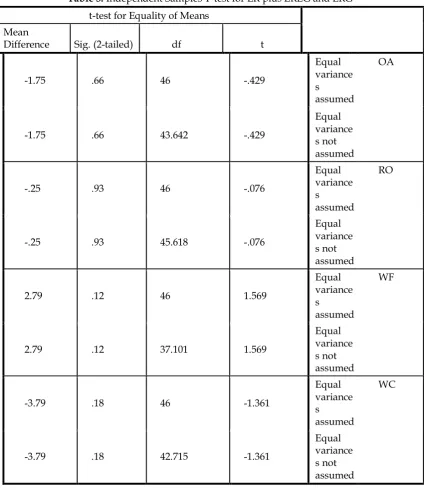
Also, an independent samples t-test at the 0/05 level of significance as the standard was performed to determine whether group work activity was effective through comparing the overall means of ER plus GW and ER group from the pre-test to post-test. Table 17.4 illustrates the results of this analysis.
According to the above table, the results show that sig in all of the variables are the same in both groups and more than 0/05. Therefore, the null hypothesis that "there
Table 3. Independent Samples T-test for ER plus EREG and ERG t-test for Equality of Means
t df Sig. (2-tailed) Mean Difference OA Equal variance s assumed -.429 46 .66 -1.75 Equal variance s not assumed -.429 43.642 .66 -1.75 RO Equal variance s assumed -.076 46 .93 -.25 Equal variance s not assumed -.076 45.618 .93 -.25 WF Equal variance s assumed 1.569 46 .12 2.79 Equal variance s not assumed 1.569 37.101 .12 2.79 WC Equal variance s assumed -1.361 46 .18 -3.79 Equal variance s not assumed -1.361 42.715 .18 -3.79
23
is not a significant difference in EFL learners' writing ability after ER program plus group work", is accepted
Research Question 2
"How do the learners self-report the impact of group work?" To answer this research question, first it was assumed to apply an attitude questionnaire regarding ER and group work; however, to my knowledge, there was not such a questionnaire available. As a result, an unstructured interview with the participants of ER plus GW group was designed. Since they did not allow the researcher to audio record the discussion because they felt shy and uncomfortable, their talk were written down and then analyzed. Some of the notes the researcher took included as follows:
- I think group work was not good because I did not want to share my personal ideas with my classmates (3 students).
- Some of the members in a group did not prepare themselves well for the discussion and just listened to the others. They did not participate in the discussion so it decreased the quality of the group work activity (5 students).
- I liked the idea of group work; however if the books in each group were the same, it was better. Because it made the discussion more effective and every individual could share his/her idea with the other members about the same book. (15 students)
- I did not have any problem with group work activity. It was almost effective and helped me with writing the summary in a better way. (12 students)
The number of learners who were against adding group element to ER was counted. 12 students were for and 23 students were against with applying group work in such a way they experienced in their class. This number is in line with the second null hypothesis; however, the reasons brought in discussion part might reject this hypothesis.
Discussion
Regarding the first part of the first research question which was "Is there a significant difference in EFL learners' writing ability regarding selected items (run-on sentences, vocabulary errors including word form and word choice, and overall accuracy) after ER program?", findings of the study showed that ERG's writing improved from the pre-test to post-test which was in line with the studies of Tsang (1996), Lee and Hsu, (2009), Abu Saleem, (2010) and Han, (2010). They investigated the relationship between extensive reading and writing improvement of high school and college students. Their programs, especially the program in the study of Tsang and Abu Saleem, were very close to the one which was used in the present study. Tsang (1996) believed that extensive reading was a very effective approach in improving different aspects of writing. He recommended ER in English teaching syllabus as an effective material. In their studies, these four researchers worked on some writing criteria such as general improvement, organization, mechanics, vocabulary, content, and language use. However, the present study examined some other criteria which were more problematic in the participants' writing namely word choice, word form, and run-on sentences.
The second part of the first research question was" Is there a significant difference in EFL learners' writing ability regarding selected items (run-on sentences, vocabulary errors including word form and word choice, and overall accuracy) after ER program plus group work?". A survey in the literature revealed that group work element has been found to be effective on improving reading comprehension as Manning and Manning (1984, cited in Jacobs and Gallo, 2002) proposed in their study. They intended to test the value of combining ER with peer interaction. Heal
24
(1998), also, carried out a research on the effect of group work on the attitude of learners toward reading. He suggested that group work was a very effective factor in changing learners' attitude and increasing quantity of reading. However, the present study is not consistent with these researches. Although the findings of paired t-test performed for each group showed that group work was effective in improving writing to a great extent, findings of the independent t-test revealed that the performance of both groups was almost the same; thus, group work cannot be considered as the reason of ER plus GW groups' improvement. The following sections will explain the analysis of the four variables in details:
According to the findings of the study, related to the first variable that is WF (word form), ER group outperformed ER plus GW group after ERP. First, it might imply that group work element did not influence that much on improving the vocabulary errors i.e. word form error (wrong form of an appropriate or incorrectly spelled word) in learners' writings. And second, that this aspect of writing may require a longer time to develop and in the short term, as was the case of this study, one should not expect a huge difference. It is worth mentioning that ER plus GWG has improved in terms of WF errors. RO is the third variable ending in ERG's outperformance. Why run-on sentences problems and word form errors did not show a considerable improvement in ER plus GWG might be answered by the claim that these are two aspects of writing which require a big deal of reading and concentration to be improved. Perhaps, in ER plus GWG, the learners paid their close attention to group work. They were to read, discuss in groups, and finally write their summaries. Group work might have played an intruding role ending in lack of concentration on writing and full concentration on doing the group work activity. However, ERG, on the other hand, without any group work activity, tried to just concentrate on their reading only and immediately writing their summaries. Building on the studies on the effect of ER on improving some writing criteria which ended in positive results (Tsang, 1996; Mason, 2004), it might be implied that mere ER is influential and GW was an intruding factor. Since, to the best of the researchers' knowledge, there were almost no studies on this area, this reason should be viewed with caution. There is a need for more studies to examine the reason precisely. The next variable analyzed was WC (word choice) in which ER plus GWG outperformed ERG leading to the conclusion that group work was somehow helpful in enhancing word choice error (spelled correctly but wrong word) related to vocabulary errors. So group work activity and interaction between learners, according to Long, was a factor helping the learners to concentrate on each other's' talk; perhaps they were able to choose a better and more appropriate word through repetition and taking notes on their group members' talk.
According to the findings of paired t-test, one can imply that group work can be an influential and effective element added to extensive reading program to improve writing ability of EFL learners. Relying on Long's interaction hypothesis both input and output are necessary for second language acquisition; interaction among learners in negotiation around meaning through clarification requests, confirmation checks, comprehension checks, and repetition makes input more comprehensible, meaningful, accessible, and more useful. The members of the groups listened to each other's speech and took notes on the new vocabularies and new structures. Therefore, it is expected that group work activities should have influenced their writings. However, because the comparison of the two groups indicated no significant differences between their performances, the above-mentioned claim cannot hold true unless it is investigated in depth in future. According to the data, the last variable (OA) received higher mean score in ER plus GW group than in ER group. Overall accuracy (OA), as the most important writing aspect in the present study, was selected for the purpose of contrasting the two
25
groups which improved in ER plus GWG. It supports the idea introduced by Mason and Krashen (2004) according to which besides massive reading, some output-oriented activities should be added to ER to result in better language acquisition. According to Long's interaction hypothesis on which the present study is relied, while both input and output are necessary for second language acquisition, in order to gain a greater understanding of how this works, one should focus more attention on the interactions language learners engage in to end in more success.
Regarding learners' self-rating of adding group element to ERP, since finding an appropriate attitude questionnaire related to ER and group work was not accessible for the researcher, an unstructured interview to ER plus GWG was designed instead. According to the result, the majority of the participants (i.e. 18 out of 35) disagreed with adding group work activity to extensive reading during the program in their reading class. Most of the students (n=15) reject adding such an element claiming that it was better if all of the group members read a common book. Since each member read a different book, while presenting the summary or the points related to the book, the members did not listen well and the process got a bit tiring for them. As far as the nature of ER has concerned, such a claim is not applicable in ERP. Building on Waring's (2007) idea, each individual should choose a book of his/her interest and level of proficiency. There should not be any force in choosing the books. Three learners suggested that because of the fact that they did not want to tell the group members what they have got and experienced in their reading, they were silent during group discussion. In their opinion, it was better that the program was individual. In the same vein, five learners declared that since some of the students did not prepare themselves well before presenting in groups, they could not talk about the summary in an acceptable manner and the group work activity was not of any advantage for them. They asked the researcher to omit group work activity and shift ERP to an individual activity. At the first sight, ER might seem an individual act as it was before 1984. However, adding group/pair work activity and interaction between learners in ERP have been found to be influential in improving some language skills such as reading comprehension and increasing positive attitude (Manning and Manning, 1984, cited in Jacobs and Gallo 2002), increasing the quantity of reading and motivation toward reading(Heal, 1998). However, its effect on writing enhancement has not been examined so far.
Despite disagreement mentioned above, the results of the interview revealed that group work activity was considered to be influential in enhancing writing ability of the learners. It was favored by the majority of the participants and even most of the learners who disagreed with adding group work (i.e.15 out of 23) suggested that they liked group work activities if they had read a common book in the group. One can imply that group work was not rejected totally; they were satisfied with the activity basically with a bit modification. It supports Long's interaction hypothesis in such a way that interaction among learners makes input more comprehensible and adding some out-put oriented activity leads to a better language acquisition. As mentioned before, the results of the independent t-test revealed that there was not any considerable difference between the two groups from their pre-test to post-test. Thus, although the results of the paired sample t-test, which was run in each group, supported the idea of group work activity in writing improvement, the results of the independent t-test showed that the improvement was not meaningful and considerable; the performance of the both groups was almost the same.
26
CONCLUSION
As discussed previously, the aim of this study was to examine the effect of group work in extensive reading program to discover whether it is effective in enhancing learners' writing ability. Four aspects of writing ability were chosen in the present study including run-on sentences, vocabulary errors including word choice and word form, and overall accuracy. These aspects were selected according to the problems observed in the first three samples of the learners' summary writings. Two writing classes taught by the same instructor were selected for this study as two experimental groups. The study had no control group. English literature class as ER plus GW group and teaching English class as ER group. Extensive reading program was used in ER plus GWG accompanied by group work activity in the sense that the students were to read one graded readers each week and discuss it in the group while other members took notes of the speakers' new vocabulary and structure. ERG had extensive reading program alone without group work activity and discussion. They were supposed to both read a book and write the summary at home. Ten books were introduced to be read till the end of the program which was nine months. 65 students studied in these two classes; however, this number changed into 24 for the final analysis according to their marks in the reading comprehension test. Both groups were asked to write around the same topic one before and one at the end of a program.
One research question (part one of the first research question) was to investigate the relationship between ER and improving writing ability of EFL learners while examined in ERG resulting in acceptable improvement this confirmed the previous studies' findings (Tsang, 1996; Han, 2010, Abu Saleem, 2010). The next part of the first research question was to investigate the relationship of ER and improving writing ability after group work. Previous studies (Hill, 1997; Manning and Manning 1998 as cited in Jaccobs and Gallo, 2002) offered that group work can be an effective element added to ERP to improve any language skill. Reading comprehension and motivation toward reading were among the language skills which enhanced by group element in ERP. In this respect, this study did not supported previous studies that have suggested adding group work activity makes a good improvement in language skills. The results of the independent t-test showed that there was not a considerable difference between the two groups from the pre-test to post-test. The second research question was how the learners self-reported the impact of group work. An unstructured interview with ER plus GWG and counting the number of participants who were for and against adding group work activity to extensive reading program showed that just 12 out of 35 students agreed with adding such an element in the program.
A certain limitation of this study is related to the nature of ERP. Previous studies on ER were conducted in separate classes in the name of ERP class; the whole activities were directly related to ER. However, in the present study, ER was considered a part of those reading classes' activities due to university constraints. Therefore, the results of this study should be viewed with caution. Another limitation related to this study was lack of time which resulted in withdrawing the efforts to find and apply a questionnaire in responding the second research question which was related to the students' idea about adding group work to ERP. Since an appropriate attitude questionnaire regarding ER and group work was not available, a friendly talk was employed to elicit as much information as possible to answer this question. Naturally, an attitude questionnaire would gain more reliable results.
Further research is needed to examine the effect of group work activity directly through sound recording of group discussion to compare it with students' writings in order to discover the real effect of group work and writing improvement.
27
Furthermore, it should be interesting if future studies focus on the effect of extensive reading and peer feedback on writing improvement. The relationship between ER and peer feedback on writing improvement could be an interesting subjects to be examined. Since finding three reading classes with the same teacher was almost a difficult job, the researcher could not consider a control group. If there was a control group without any ER program, the results were more accurate and acceptable. So, further researches can be designed with