JIEM, 2015 – 8(3): 763-782 – Online ISSN: 2013-0953 – Print ISSN: 2013-8423 http://dx.doi.org/10.3926/jiem.1326
Effects of Environmental Factors on Corporate Strategy and
Performance of Manufacturing Industries in Indonesia
Rachmad Hidayat, Sabarudin Akhmad, Mu’alim
Industrial Engineering Department, University of Trunojoyo Madura (Indonesia)
[email protected], dr.rachmad.mt@gmail. com, [email protected]
Received: November 2014 Accepted: May 2015
Abstract:
Purpose:
the purpose of this study was to examine and obtain empirical evidence of the
effects of external and internal environmental factors on the strategy and performance of
manufacturing companies.
Design/methodology/approach:
This study used primary data obtained by distributing
questionnaires to 150 respondents of manufacturing companies in Indonesia spreading over six
major cities in Java such as Jakarta, Banten, Bandung, Yogyakarta, Semarang and Surabaya.
Samples were taken by using the systematic random sampling technique. The technique was
used since those major cities had different numbers of manufacturing companies. Subsequently,
the feasibility of the model was tested. Several indices of model feasibility would be used to test
the model developed in this structural equation model. In case of a sub-optimal model, a model
modification was to be performed by adding or removing paths so that the chi-square values
would decrease by the values of the index.
Practical implications:
The internal and external environmental factors through the operating
and remote environments had effects on the strategy of manufacturing companies in Indonesia.
However, both internal and external environments did not affect the performance of
manufacturing companies in Indonesia. There was a tendency that manufacturing companies
were to observe the occurring macro-economic conditions. Manufacturing industries were
faced with the pressures from competition, customers and suppliers that affected companies’
revenue. Performance of manufacturing industries was more influenced by macro-economic
conditions that have not recovered from the global crisis.
Originality/value:
This study was conducted to determine the effects of environmental
factors on the corporate strategy and performance. The effects of the industrial environments
are crucial since the more complicated changes in the industrial environments the greater the
impacts it has on the resources, structures and processes in the company. Environmental
factors of the industry present both organizational strengths and weaknesses, which would
affect the strategy and performance of the industry.
Keywords:
environment, corporate strategy, performance and manufacturing industries
1. Introduction
The industrial sector plays an important role in the Indonesian economy. In general, this sector considerably contributes to the formation of the Gross Domestic Product (GDP) and foreign exchange earnings. It is believed that the industrial sector is the one capable of leading other sectors in an economy that is geared towards progress. Industrial products constantly have higher terms of trade and create greater added values than other products. This is due to the fact that the industrial sector has a wide variety of products and is capable of providing the users with high benefits (Dumairy, 2000).
8.48% in comparison to that of the previous year. The textile industry also experienced a decrease of 8.32%, while unclassified machinery and equipment industry decreased by 8.31%. In 2013, the national manufacturing industry grew by 6.40%. The figure was higher than the 2013 economic growth (GDP), which was 6.23%. Fertilizer, chemical, and rubber material sector enjoyed growth of 10.25%; cement and non-metal mineral product sector 7.85%; food, beverage and tobacco 7.74%; and transport vehicle, machine tool, and equipment sector 6.94%. The growth of the manufacturing industry was supported by the high level of investment in the domestic industrial and consumption sector. This sector contributed up to 20.85% of the national GDP. Meanwhile, the exports of manufacturing product for January to November of 2013 contributed up to 60.02% of the total national exports. With regard to exports, non-oil exports of industrial products during January to November of 2013 reached US $ 107.05 billion. The figure contributed 60.02% of the total national exports. In 2013, exports of industrial products were targeted to rise up to US $ 125 billion. This represented the target for 2013, which was part of the long-term development of national industry.
According to Pearce and Robinson (2003: page 57) external (business) environments can be grouped into three interrelated categories: the operating environments, the industrial environments and the remote environments. Operating environments, also called the competitive or task environments, are those factors in a competitive situation that affect the success of a company in acquiring the needed resources and/or in marketing its products and services profitably. According to Pearce and Robinson (2003: page 82), some of these factors include: the competitive position of the company, the reputation of the company in the eyes of suppliers/sellers and creditors. Kotler and Armstrong (2013: page 148) identified the remote environments as the main macro-environments that include natural and technological environments, social environments, economic and cultural environments, and political, law and security environments.
According to Wheelen and Hunger (2012: page 162), internal factors are those strategic factors that need to be analyzed and diagnosed by the management in determining the strengths and weaknesses of the company. The indicators of internal factors are: (1) marketing and distribution; (2) research and development; (3) operations and production management; (4) human resources, and (5) finance and accounting.
Corporate strategy focuses on diversification strategy with indicators: product diversity, technological linkage and market diversity.
Performance is a company's achievements for a certain period, which reflects the level of corporate health. Chi, Kilduff and Gargeya (2009) argue that a more comprehensive corporate performance is based on the achievement of strategic objectives. Performance is measured on the basis of: (1) financial perspective with regard to increased returns, increased sales and improved cost effectiveness; (2) customer perspective in terms of improvements in confidence and cost reduction strategies; (3) business process perspective with regard to an increase in service quality and integrated customer service; and (4) learning and commitment perspective including an increased productivity and personnel commitment.
The present study was conducted on large manufacturing industries in Indonesia. Performance of manufacturing industry was more influenced by macro-economic conditions that have not recovered from the global crisis. These conditions were also exacerbated by the increase in fuel prices for industries and the heated political conditions ahead of the legislative and presidential elections. In recent unfavorable situations, most of the studied industries preferred a concentric diversification strategy (creating new products with technological linkage to the existing ones) (Hidayat & Hairil, 2009).
This study was conducted to determine the effects of environmental factors on the corporate strategy and performance. The effects of the industrial environments are crucial since the more complicated changes in the industrial environments, the greater the impacts it has on the resources, structures and processes in the company. Environmental factors of the industry present both organizational strengths and weaknesses, which would affect the strategy and performance of the industry. Wheelen and Hunger (2012: page 87) argue that, in order to achieve optimal performance, a strategy must be formulated with due regard to the environment. A company’s successful competitive strategy leads to victory in the face of market competition and competitors in terms of product innovation (Babatunde & Adebisi, 2012). Thus, the purpose of this study was to examine and obtain empirical evidence of the effects of external and internal environmental factors on the strategy and performance of manufacturing companies.
2. Methods
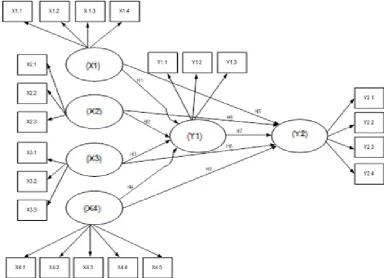
included industrial environments, operating environments, remote environments, internal environments, corporate strategies and corporate performance. The structural equation model expressing the causal relationships among variables was:
Y2 = 1X1 + 2X2 + 3X3 + 4X4 + 5Y1 + Z1 (1)
The measurement models determining the indicators capable of measuring the latent variables were:
X1.i = iX1 + ei, i = 1, ...4 (2)
X2.i = 4+iX2 + e4+i, i = 1, ...3 (3)
X3.i = 7+iX3 + e7+i, i = 1, ...3 (4)
X4.i = 10+iX4 + e10+i, i = 1, ...5 (5)
Y1.i = 15+iY1 + e15+i, i = 1, ...3 (6)
Y2.i = 18+iY2 + e18+i, i = 1, ...4 (7)
Notes: Y2=performance; Y1=corporate strategy;1, 2, 3, 4=regression weight; X1=industrial
environments; X2=operating environments; X3=re mo te e nvir onments; X4=internal environments. The research framework is as Figure 1.
Notes: X1.1=threat of new entrants; X1.2=strength of the buyer/seller; X1.3=threat of substitute products; X1.4=competition among members of the industry; X2.1=competitive position of the company; X2.2=company’s reputation in the eyes of suppliers; X2.3=company’s reputation in the eyes of creditors; X3.1=nature and technology; X3.2=socio-economy and culture; X3.3=politics, laws and security; X4.1=marketing and distribution; X4.2=research and development;
X4.3=operations and production Management; X4.4=human resources, X4.5=finance and accounting; Y1.1=product diversity: Y=1.2technological linkage; Y1.3=market diversity; Y2.1=financial perspective; Y2.2=customer perspective; Y2.3=business process perspective;
Y2.4=learning and commitment perspective. Hypotheses proposed in this study were:
Hypotheses 1. The industrial environments had a significant effect on the corporate strategy of manufacturing industries in Indonesia..
Hypotheses 2. The operational environments had a significant effect on the corporate strategy of manufacturing industries in Indonesia.
Hypotheses 3. The remote environments had a significant effect on the corporate strategy of manufacturing industries in Indonesia.
Hypotheses 4. The internal environments had significant effects on corporate strategy of manufacturing industries in Indonesia.
Hypotheses 5. The industrial environments had significant effects on the performance of manufacturing industries in Indonesia.
Hypotheses 6. The operating environments had significant effects on the performance of manufacturing industries in Indonesia.
Hypotheses 7. The remote environments had a significant effect on the performance of manufacturing industries in Indonesia.
Hypotheses 8. The internal environments had a significant effect on the performance of manufacturing industries in Indonesia.
Hypotheses 9. The corporate strategy had significant effects on the performance of manufacturing industries in Indonesia.
3. Result and Discussion
Instruments were subjected to validity and reliability tests. An instrument was considered valid if the significance value was less than 5%. (Ghozali, 2009: page 84). The purpose of reliability tests was to determine the level of reliability of the questionnaire, or whether a person’s answers to statements were consistent or stable. An instrument was considered reliable if the Cronbach’s alpha was greater than 0.6. (Ghozali, 2009: page 102). Results of the validity tests showed that all indicators of the study were valid as indicated by the sig. value (2-tailed) of 0.000 < 0.05. This indicated that the measures used in the study were appropriate. Reliability tests showed that all the 22 indicators of the study were reliable indicator as indicated by the value of Cronbach’s alpha of 0.804 > 0.6. This indicated that respondents were stable in answering the statements of the study questionnaire.
Confirmatory tests of all indicators were performed in order to measure the latent variables with a cutoff value of 0.5. Results for exogenous variables indicated that there were four indicators with a value of less than 0.5 and for endogenous variables there was one indicator with a value of less than 0.5.
3.1. SEM Analysis
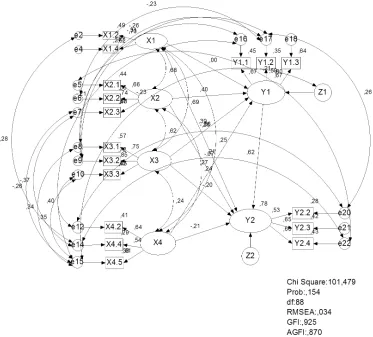
Prior to performing a structural equation modeling (SEM) analysis, SEM assumptions were subjected to normality test, outlier test and multicollinearity test. Data was considered normal if the multivariate critical ratio was –2.58 < c.r. > 2.58. (Kline, 2011). The normality test indicated that data was multivariate normal with a multivariate critical ratio of 1.959. This means that data was normally distributed with a sample of 150 respondents. SEM analysis generated the initial model as shown in Figure 2.
Figure 2 shows that the result of the chi-square (2) goodness-of-fit test = 197.233, p = 0.000; it means that the model for testing the study hypotheses was not good one. Thus, a modification was performed by considering the alternative modifications in the modification indices in order to refine the model. An unfit model is allowed to be modified by modification indices as recommended by AMOS program (Mustafa & Wijaya, 2012). The final model after model modification is shown in Figure 3.
Figure 2. Results of early-stage SEM analysis
3.2 Hypothesis Testing
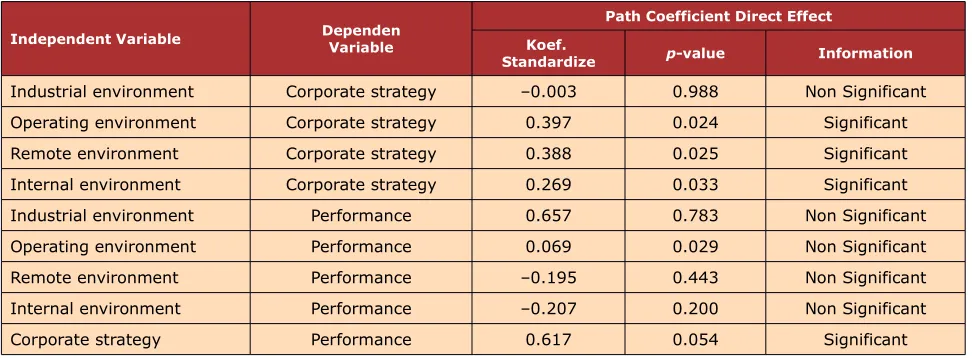
Hypotheses of this study were tested by partially testing each of the paths of direct effects from the results of structural equation modeling (SEM). Testing of the direct effect hypothesis indicated the value of C.R. > 1.96 and P <0.05, meaning that the effect was significant. Testing of the indirect effects is the side effect of direct effects. The coefficient of indirect effects was obtained by multiplying the coefficients of direct effects that formed it. If the multiplying coefficient of direct effects was significant, results of the testing of indirect effects were considered significant. (Ferdinand, 2000: page 167) Results of hypothesis testing are shown in Table 1.
Independent Variable DependenVariable
Path Coefficient Direct Effect
Koef.
Standardize p-value Information
Industrial environment Corporate strategy –0.003 0.988 Non Significant Operating environment Corporate strategy 0.397 0.024 Significant Remote environment Corporate strategy 0.388 0.025 Significant Internal environment Corporate strategy 0.269 0.033 Significant Industrial environment Performance 0.657 0.783 Non Significant Operating environment Performance 0.069 0.029 Non Significant Remote environment Performance –0.195 0.443 Non Significant Internal environment Performance –0.207 0.200 Non Significant
Corporate strategy Performance 0.617 0.054 Significant
Table 1. Results of hypothesis testing
3.2.1. Effects of Industrial Environments on Corporate Strategy
threats of industrial environments affected corporate strategy, but it was in a negative direction.
Results of the descriptive analysis indicated that, in the face of the conditions of industrial environments that have not recovered from the global crisis, most companies studied preferred a concentric diversification strategy (creating new products with technological linkage to existing products). These results supported the study conducted by Nurhayati (2004) that showed that environmental factors of the industry did not significantly affect the strategy. This study was inconsistent with those of Hidayat (2004) and Hidayat and Hairil (2009). Hidayat (2004) found that industrial environments had a significant effect on the determination of the marketing strategies. Hidayat and Hairil (2009) revealed that industrial environmental factors had effects on diversification strategy.
3.2.2. Effects of the Operating Environments on Corporate Strategy
Results of the testing of the second hypothesis showed that the hypothesis of a significant effect of the operating environments on corporate strategy was accepted. Results of the analysis provided a standardized path coefficient of –0.397 with a p-value of 0.024; thus, results of hypothesis testing were considered significant. These results supported the second hypothesis that the operational environments had a significant effect on the corporate strategy of manufacturing companies. Results of this study revealed a tendency that the factors of the corporate operating environments affected the corporate strategy. The extent of improved capability of the operating environments as characterized by increased competitive position of the company, the company’s reputation in the eyes of suppliers, the company’s reputation in the eyes of creditors, the ability to recruit reliable human resources, and research and development capabilities proved to be capable of altering corporate strategy. Manufacturing firms tended to alter their strategies tailored to the operating environments that showed improved conditions.
These results supported the theory of an interrelationship between the operating environments and corporate strategy. Pearce and Robinson (2003: page 174) suggests that an internal analysis should identify the strengths and weaknesses underlying corporate strategy. Managers should develop an assessment of the company’s key strengths on the basis of the correspondence between those strengths and the existing or expected market opportunities so that managers can eventually develop a series of corporate strategic measures. These results were understandable given that the managers more carefully addressed the improvement in operating conditions of the company.
capabilities and core competencies had significant effects on the company’s ability to make important strategic decisions, including those relating to market entry or exit, investment in new technology, building of new or additional manufacturing capabilities and establishment of strategic cooperation. This finding also supported studies conducted by Nurhayati (20034, Hidayat (2004), Hidayat and Hairil (2009) and Lee (2010). Nurhayati (2004) found that the operating environments had positive significant effects on competitive strategy. Hidayat (2004) argued that the operating environments had positive significant effects on marketing strategy. Hidayat and Hairil (2009) suggested that the operating environments significantly affected diversification strategy. Lee (2010) maintained that almost all operating environmental factors had effects on the choice of the company’s business strategy, except the level of competition. These findings suggested that the effectiveness of the company’s strategy would largely depend on the company’s attention to their operating environmental factors.
3.2.3. Effects of Remote Environments on Corporate Strategy
Results of the testing of the third hypothesis showed that the hypothesis of a significant effect of the remote environments on corporate strategy was accepted. Results of the analysis provided a standardized path coefficient of 0.88 with a p-value of 0.025; thus, results of hypothesis testing were considered significant. These results supported the third hypothesis that the remote environments had a significant effect on the strategy of manufacturing firms. In order to relate the company to its environments, an environmental analysis and diagnosis is necessary, which in turn could produce strategies that are based on and considering the remote environments of the industry. Opportunities and threats should be considered prior to developing strategies.
In the global era in which the environments change dynamically and often turbulently industries require strategies capable of making companies closer to their goals. In other words, companies are always required to achieve optimal performance. Wheelen and Hunger (2012: page 87) maintains that a strategy should be formulated by taking the environments into account. Strategy is a unified, broad and integrated plan linking corporate excellence to the environmental challenges, designed to ensure that the main goals are achieved. The concept of equivalence holds that the good performance of the company is affected by the choice of strategy and the strategy chosen is affected by environmental factors (Nandakumar, Ghobadian & O'Regan, 2010). Oyewobi, Wndapo and Rotimi (2013), Tan, Shen and Langston (2012) concluded that dimensions of business environment have moderating effects on organisational strategies.
3.2.4. Effects of the Internal Environments on Corporate Strategy
Results of the testing of the fourth hypothesis showed that the hypothesis of the significant effects of internal environments on corporate strategy was accepted. Results of the analysis provided a standardized path coefficient of 0.268 with a p-value of 0.033; thus, the results of hypothesis testing were considered significant. These results supported the fourth hypothesis that the internal environments had significant effects on the strategy of manufacturing firms. In making corporate strategy decisions, managers are strongly influenced by the internal conditions of their companies. The company’s internal conditions such as an excellent research and development, abundant human resources and healthy corporate financial and accounting conditions affect the strategies adopted by managers. Results of this study agree with those of Ward and Duray (2000) that, in the long term, the company's internal environments strongly influence corporate strategy but, in the short term, the effect would be relatively small. Kariuki, Awino and Ogutu (2011) argues that the internal environments have direct impacts on corporate strategy. Consistent with this notion, Mason (2007); Babatunde and Adebisi (2012) reveal the fact that some companies have better internal environmental (accounting and financial) conditions that other companies. In fact, it turns out that most of those companies adopt new strategies at the time of their internal conditions improve.
the study conducted by Kabadayi, Eyuboglu and Thomas (2007) indicated that the internal factors affected managers in strategy decision making.
3.2.5. Effects of Industrial Environments on Performance
Results of the testing of the fifth hypothesis showed that the hypothesis of a significant effect of industrial environments on performance was rejected. Results of the analysis provided a standardized path coefficient of 0.657 with a p-value of 0.783; thus, the results of hypothesis testing were considered non-significant. These results rejected the fifth hypothesis that the industrial environments had significant effects on the performance of the manufacturing industry. The findings of this study indicated that the stronger the pressures of industrial environments the more the performance of the manufacturing industry would decline. Managers will immediately respond to any changes in the industrial environments in order to maintain and sustain their companies’ performance.
These results were inconsistent with the theory of Hitt et al. (2005: page 55) that, in comparison to other environmental factors, the industrial environments have stronger direct effects on performance. The intensity of competition in the industry and potential industry earnings are a function of the five competitive forces: the threat of new entrants, the power of buyers, the power of suppliers, the threat of substitute products and competition among industry members.
Pearce and Robinson (2003: pages 78-92) argue that the competition among members of the industry occurs because they jockey for position by using various tactics such as price competition, product introduction and advertising war. Such a fierce competition results from a number of factors such as the growing number of players within in an industry, the slow growth of the industry and the higher costs. As a result, it causes a decline in profits and havoc in the industry, resulting in a decrease in the performance of the industry.
dominant in influencing the decline in industry performance. Results of this study supported those of Nurhayati (2004) and Hidayat (2004) that the industrial environments had non-significant effects on the performance of the industry. Furthermore, Hidayat and Hairil (2009) argue that the industrial environments had no significant effect the performance of the industry. The stronger the pressure of the industrial environments the lower the performance of manufacturing industry will be.
3.2.6. Effects of the Operating Environments on Performance
Results of the testing of the sixth hypothesis showed that the hypothesis of the significant effects of the operating environments on performance was rejected. Results of the analysis provided a standardized path coefficient of 0.069 with a p-value of 0.029; thus, the results of the hypothesis testing were considered non-significant. These results rejected the sixth hypothesis that the operating environments had significant effects on the performance of the manufacturing industry. Results of this study revealed a tendency that the operating environmental factors of the company were capable of considerably contributing to the improvement in performance; however, this was not proven in this study. At the time of this study, the performance of the manufacturing industry was more influenced by the macro-economic conditions that have not recovered from the global crisis. This condition was also exacerbated by the increase in fuel prices and the heated political conditions after the election for governor of East Java and ahead of legislative elections in 2014.
3.2.7. Effects of the Remote Environments on Performance
Results of the testing of the seventh hypothesis showed that the hypothesis of the significant effects of the remote environments on performance was rejected. Results of the analysis provided a standardize path coefficient of –0.195 with a p-value of 0.443; thus, the results of the hypothesis testing were considered non-significant. These results rejected the seventh hypothesis that the remote environments had a significant effect on the performance of the manufacturing industry. This condition was caused by the poor remote environmental conditions that were not stable due to the global recession and the high political risks. Poor performance was likely due to the uncertain economic situations caused by the global economic crisis, leading to managers’ preferring to maintain the existing performance.
The remote environments include demographic, economic, natural, technological, political, legal and socio-cultural as well as security factors. Economic factors have a significant direct effect on the performance of the industry since the patterns of consumption are influenced by the relative prosperity of various segments of the market that affect the industry. Social factors have a major impact on all products, services, markets and customers. Social factors affecting companies are beliefs, values, attitudes, opinions, and lifestyles of the people in the external environments of the company, which have been evolving from the influences of culture, ecology, demography, religion, education, and ethnicity. Political factors determine the legal and regulatory parameters that limit the operation of the company. Political constraints are imposed on the company through the decisions regarding fair trade, antitrust laws, taxation program, the minimum wage provisions, policies on pollution and pricing, administrative boundaries, and many more measures intended to protect workers, consumers, the general public and the environment.
study showed no significant relationship since the remote environmental conditions were indeed unstable. Results of this study were inconsistent with those of the previous studies. Hidayat and Hairil (2009) argued that the remote environmental factors had effects on the performance of the company. Oyewobi et al. (2013); Tan et al. (2012) concluded that dimensions of business environment have moderating effects on organisational performance.
3.2.8. Effects of the Internal Environments on Performance
Results of the testing of the eighth hypothesis showed that the hypothesis of the significant effects of the internal environments on performance was rejected. The results of the analysis provided a standardize path coefficient of –0.207 with a p-value of 0.200; thus, the results of the hypothesis testing were considered non-significant. These results rejected the eighth hypothesis that the internal environments had a significant effect on the performance of the manufacturing industry. These results were inconsistent with the theory that reveals that the higher the ability of the company’s internal environments, the higher the performance will be. Parnell (2013: page 43) maintains that the company’s performance will ultimately depend on the company’s ability to maintain and manage the resources of its internal environments. Meanwhile, David (2013: page 171) argues that the marketing and distribution, research and development, operations and production management, human resources and finance and accounting are the core part of most businesses. Internal audit is crucial to determine whether a business organization is healthy or not. Therefore, many organizations that are successful in internal audit and capable of achieving competitive advantages could eventually improve their performance.
Hitt et al. (2003: page 81) suggests that an effective analysis of the internal environments is how to exploit the company’s core competencies and meet the standards of competition that have impacts on the customer value creation. It is this value that will produce performance in the form of corporate profits. These findings were also inconsistent with those of Nurhayati (2004), Hidayat (2004), Sougata (2004) and Hidayat and Hairil (2009) that the internal environments had positive significant effects on performance of the company.
3.2.9. Effects of Corporate Strategy on Performance
This finding implied that the higher the level of diversification, the higher the performance of the manufacturing industry would be.
Under conditions of high uncertainty as at the time of this study, a manager is required to be able and keen in determining the right strategy, which in turn will improve the company’s competitiveness. Results of the descriptive analysis showed that, in the current unfavorable, most of the studied industries preferred concentric diversification strategy (creating new products with technological linkage to the existing ones). This could be observed from the respondents’ answers to the statement regarding technological linkage among products with a score of 3.68 or most of them agreed with the statement. Beal (2000) observed that the quantity of diversification affected profitability or, in other words, empirically demonstrated an association between diversification and performance. This study supported previous studies conducted by Forman and Hunt (2005), Ellitan (2006), Anatan (2006) and Hidayat and Hairil (2009), as well as Suroso (2009) that corporate strategy had a significant effect on the performance of the company.
4. Conclusion
References
Anatan, L. (2006). Agile Supply Chain: Through Competitive Excellence. Sinergi, 8(1), Hal. 13-21.
Babatunde, B.O., & Adebisi, A.O. (2012). Strategic Environmental Scanning and Organization Performance in a Competitive Business Environment. Economic Insights – Trends and Challenges, 64(1), 24-34.
Beal, R.M. (2000). Competing effectively: environmental scanning, competitive strategy and organisational performance in small manufacturing firms. Journal of Small Business Management, 38(1), 27-47.
Bernhofen, D.M., & Brown, J.C. (2011). Testing the General Validity of the Heckscher-Ohlin Theorem: The Natural Experiment of Japan. CESifo Working Paper Series, No. 3586.
http://dx.doi.org/10.2139/ssrn.1965962
Chi, T., Kilduff, P.P.D,, & Gargeya, V.B. (2009). Alignment between business environment characteristics, competitive priorities, supply chain structures, and firm business performance. International Journal of Productivity and Performance Management, 58(7), 645-669. http://dx.doi.org/10.1108/17410400910989467
Collis, D.J., & Montgomery, C.A. (2005). Corporate strategy: resources and the scope of the firm. 2nd edition. USA: McGraw-Hill.
David, F.R. (2013). Strategic Management. Concepts and Cases. Harlow: Pearson Education Ltd. Dumairy. (2000). Indonesian Economy. Jakarta: Erlangga.
Ellitan, L. (2006). Innovation Strategy and Performance Manufacturing Company in Indonesia: Model Approach Simultaneous and Sequential Model. Journal of Management, 6(1).
Ferdinand, A. (2000). Structural Equation Modeling in Management Research: Applications Complex Models in Research for Thesis and Dissertation. 2th Editions. Semarang: Diponegoro University.
Forman, H., & Lancioni, R. (2002). The determinants of pricing strategies for industrial products in international markets. Journal of Business-to-Business Marketing, 9(2), 29-64.
http://dx.doi.org/10.1300/J033v09n02_03
Forman, H., & Hunt J.M. (2005). Managing the influence of internal and external determinants on international industrial pricing strategies. Industrial Marketing Management, 34, 133-146.
Ghozali, I. (2009), The Application of Multivariate Analysis with SPSS. 4th Editions. Semarang:
Diponegoro University.
Hidayat, I. (2004). Determinants of Marketing Strategy and Corporate Performance: Study Results Cement Industry Managers. Entrepreneur Magazine, 6, 11-19.
Hidayat, R., & Hairil, B. (2009). Influence of Environmental Factors t o Strategies and Performance Manufacturing Industry in East Java. Semesta Journal, 12(1), 11-21.
Hitt, M.A., Ireland, R.D., & Hoskisson, R.E. (2005). Strategic Management. Competitiveness and Globalization. Mason, Ohio: South Western, Thomson.
Kabadayi, S., Eyuboglu, N., & Thomas, G.P. (2007). The performance implications of designing multiple channels to fit with strategy and environment. Journal of Marketing, 71(4), 195-211.
http://dx.doi.org/10.1509/jmkg.71.4.195
Kariuki, P.M., Awino, Z.B., & Ogutu, M. (2011). Effect of Firm Level Factors, Firm Strategy, Business Environment on Firm Performance. Business Environment Journal, 1-27.
Kline, R.B. (2011). Principles and Practice of Structural Equation Modeling. 3rd ed. New York: The Guilford Press.
Kotler, P., & Armstrong, G. (2013). Principle of Marketing. 14th edition. New Jersey: Prentice Hall.
Lee, R.P. (2010). Extending the Environment–Strategy–Performance Framework: The Roles of Multinational Corporation Network Strength, Market Responsiveness, and Product Innovation.
Journal of International Marketing, 18(4), 58-73. http://dx.doi.org/10.1509/jimk.18.4.58
Mason, R.B. (2007). The external environment’s effect on management and strategy A complexity theory approach. Management Decision, 45(1), 10-28.
http://dx.doi.org/10.1108/00251740710718935
Mustafa, Z., & Wijaya, T. (2012). Techniques Guide SEM and PLS statistics with SPSS AMOS. Yogyakarta: Cahaya Atma Pustaka.
Nandakumar, M.K., Ghobadian, A., & O'Regan, N. (2010). Business-level strategy and performance: The moderating effects of environment and structure. Management Decision,
48(6), 907-939. http://dx.doi.org/10.1108/00251741011053460
Oyewobi, L.O., Windapo. A., & Rotimi, J.O.B. (2013). The effects of business environments on corporate strategies and performance of construction organisations In Smith, S.D. & Ahiaga-Dagbui, D.D. (Eds.). Procs 29th Annual ARCOM Conference. 2-4 September. Reading,
UK, Association of Researchers in Construction Management, 691-701.
Parnell, J.A. (2013). Strategic Management: Theory and Practice. 4th ed. Sage Publications. Pearce, J.A. & Robinson, R.B. (2003). Strategic management: formulation, implementatio and
control. Boston: Richard D. Irwin.
Sougata, R. (2004). Environment-strategy-performance linkages: A study of Indian firms during economic liberalization. Vikalpa, 29(2), 9-23.
Tan, Y., Shen, L., & Langston, C. (2012). Competition environment, strategy, and performance in the Hong Kong construction industry. Journal of Construction and Engineering Management. 138(3), 352-360. http://dx.doi.org/10.1061/(ASCE)CO.1943-7862.0000407
Ward, P.T., & Duray, R. (2000) Manufacturing strategy in context: environment, competitive strategy and manufacturing strategy. Journal of Operations Management. 18(2), 123-138.
http://dx.doi.org/10.1016/S0272-6963(99)00021-2
Wheelen, T.L., & Hunger, J.D. (2012). Strategic Management and Business Policy. Toward Global Sustainability. 13th ed. Boston: Pearson Education, Inc., publishing as Prentice Hall.
Journal of Industrial Engineering and Management, 2015 (www.jiem.org)
Article's contents are provided on a Attribution-Non Commercial 3.0 Creative commons license. Readers are allowed to copy, distribute and communicate article's contents, provided the author's and Journal of Industrial Engineering and Management's names are included.