JIEM, 2016 – 9(4): 933-963 – Online ISSN: 2013-0953 – Print ISSN: 2013-8423 http://dx.doi.org/10.3926/jiem.2035
Optimization in Supply Chain Management, the Current State and
Future Directions - A Systematic Review and Bibliometric Analysis
Mahmood Movahedipour1, 2 , Mengke Yang3 , Jianqiu Zeng1 , Xiankang Wu4 , Shafaq Salam1
1School of Economic and Management, Beijing University Post and Telecommunications (China) 2Academic Center for Education, Culture and Research, (ACECR) (Iran)
3School of Automation, Beijing University of Posts and Telecommunications (China) 4School of Computer Science, Beijing University of Posts and Telecommunications (China)
[email protected] ,[email protected] ,[email protected] , [email protected] ,[email protected]
Received: July 2016
Accepted: September 2016
Abstract:
Purpose: The purpose of this paper is finding the current state of research and identifies high-potential area for future investigation in optimization in supply chain management.
Design/methodology/approach: In this paper we present Bibliometric and Network analysis to examine current state research on optimization in supply chain management to identify established and emergent research field for future investigation. The systematic research review which we used in our study have not grasp or assess by other researchers on this topic. Firstly, based on our methodology Bibliometric analysis began by identifying 1610 publications raised from scientific journals, included literatures from 1994 to March of 2016. Secondly, we applied PageRank algorithm in our data for citation analysis to indicate the significance of a publication. Thirdly, the topological decision variables analysis is done based on Louvain method for network data clustering, for this proposes we used the rigorous tools.
Research limitations/implications: We presented some limitation in our research in some fields which could allow new researchers and practitioners conduct the future research to grow up in different dimensions.
Practical implications: Practitioners or policy maker usually are not familiar with these type researches so this is why mush of these survey remain in theatrical and conceptual. Future investigation needs to play in practical application domain instead stop merely in opinion.
Originality/value: Based on our research, the researchers have more attention to work in conceptual analysis due to other fields but we believe that in facility location problem there many remarkable rooms still exist for future research to development. We also contributed more details in the papers.
Keywords: supply chain management, systematic review, bibliometric, network analysis
1. Introduction
In the real world, business is highly competitive and dynamic. The rapid rate of innovation, technology, globalization and consumers expectations are modified the type of worldwide market competitions from traditional supply chains to new competitive supply chains (Scs) (Ponomarov & Holcomb, 2009). The past recent decades, the growing role of global supply chains was associated with increased interconnectedness among suppliers and manufacturers, which led to higher dependency among firms in the supply chains and a higher level of supply chain complexity.
Supply chain Management (SCM) is monitor processing and system implementation to manage the service and flow of the goods in order to capture maximize the efficiency and value added in SCs. Also SCM spans all operation, storage of raw materials, work-in-process inventory and finishing the goods from starting stage to customer point. Now supply chains network have faced challenges like as high demand variability, short life of products, and different expectations and requirements of customers; adapting to these challenges increased supply chain complexity and resulted in more instability and unpredictability (Stefanovic, Stefanovic & Radenkovic, 2009)
In recent years, the number of publication has increased extremely in the supply chain management area; authors found the lack of comprehensive systematic review in SCM. The main aim of our research is to present established survey streams and fertile new research field with potential for future investigation. Network analysis will done after bibliometric analysis to identifying the area which researchers have/have not more attention to. With these tools also we can introduce some clusters for our study to identify emerging relevant area according to researcher and organization characteristics. Using these type literature review, provide opportunity for future survey which did not grasp or assess previously. Our research beginning with identifying more than 2000 papers, after applying refinement and filtering, it reached to 1610 publications. All publications raised from scientific journals, included from 1994 to March of 2016. We used two rigorous software for citation, co-citation and clustering classification analyses to identifying four major clusters. Our systematic review identified different clusters set, for area classification of current models and future insight, to evaluated emergent/mature field of studies.
The reminder of this paper is organized as follows: Section 2, in this section, we introduce our research methodology and clarify to gathering data for bibliometric analysis from organizations, journals and authors. We describe “BibExcel” and “Gephi” as the bibliometric and network analysis software in Section 3 and 4. In section 4 the assessment of the result is provided. Section 5 presented the conclusion and weakness/limitation in this research, and mentions some suggestion for future direction.
2. Methods and Procedures
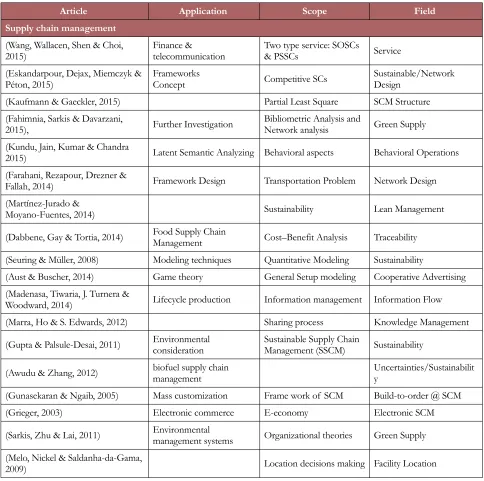
In Table 1, we tried to show recent literature review which they have dealing with Supply Chain Management in different field and neighboring domains. In column 1 and 2 shows the corresponding paper main topic and 3 column field related to SCM. In order to find out, the method which others researcher use in the recent literature reviews in different part of SCM; we provided Table 1. There are different trend between authors for example see Fabbe-Costes and Jahre (2008), and Meixell and Norbis (2008).
also they mentioned 37 papers to classified to supply chain decision making to addressing in different typical parts in supply chin such as rout, procurement and inventory. They showed that combination of inventory and production making decision is frequently use in facility location and allocation cases. In another part they taxonomy 18 papers in different network structure respected to closed loop or reverse logistic activity in different layers (Huscroft, Hazen, Hall, Skipper & Hanna, 2013). They reach this conclusion just few papers concentrated on both closed-loop and forward logistic models comprehensively.
Article Application Scope Field
Supply chain management
(Wang, Wallacen, Shen & Choi,
2015) Finance & telecommunication Two type service: SOSCs & PSSCs Service
(Eskandarpour, Dejax, Miemczyk &
Péton, 2015) FrameworksConcept Competitive SCs Sustainable/Network Design
(Kaufmann & Gaeckler, 2015) Partial Least Square SCM Structure
(Fahimnia, Sarkis & Davarzani,
2015), Further Investigation Bibliometric Analysis and Network analysis Green Supply
(Kundu, Jain, Kumar & Chandra
2015) Latent Semantic Analyzing Behavioral aspects Behavioral Operations
(Farahani, Rezapour, Drezner &
Fallah, 2014) Framework Design Transportation Problem Network Design
(Martínez-Jurado &
Moyano-Fuentes, 2014) Sustainability Lean Management
(Dabbene, Gay & Tortia, 2014) Food Supply Chain Management Cost–Benefit Analysis Traceability
(Seuring & Müller, 2008) Modeling techniques Quantitative Modeling Sustainability
(Aust & Buscher, 2014) Game theory General Setup modeling Cooperative Advertising
(Madenasa, Tiwaria, J. Turnera &
Woodward, 2014) Lifecycle production Information management Information Flow
(Marra, Ho & S. Edwards, 2012) Sharing process Knowledge Management
(Gupta & Palsule-Desai, 2011) Environmental consideration Sustainable Supply Chain Management (SSCM) Sustainability
(Awudu & Zhang, 2012) biofuel supply chain management Uncertainties/Sustainability
(Gunasekaran & Ngaib, 2005) Mass customization Frame work of SCM Build-to-order @ SCM
(Grieger, 2003) Electronic commerce E-economy Electronic SCM
(Sarkis, Zhu & Lai, 2011) Environmental management systems Organizational theories Green Supply
(Melo, Nickel & Saldanha-da-Gama,
2009) Location decisions making Facility Location
2.1. Research Methodology
The aim of a systematic literature reviews is to direct toward the map of literature to distinguish the gap research to transparent the edge of sciences (Su, Chen & Yang, 2016). Key words search, literature searching and using different type typical analyzing made the structure of literature review which made by an iterative cycle processing (Saunders, Lewis & Thornhill, 2009), also (Pazhani, Ventura & Mendoza, 2016) suggested designing bibliography methodology to building mind road map for structure the literature review. As this approach also we use these steps, introducing the suitable search terms for data collecting and reach to initial result, after refinement and elimination, the result will send to data statistics analysis, at the end comprehensive data evaluation will be done to reach clustering classification to show direction for future scholars in this field.
2.2. Introducing the Appropriate Research Terms
Six main keywords are used to starting for our research and data collection. Our keywords are “Supply Chain”, “Framework Design”, “Sustainable development”, “Optimization OR Optimisation”, “Network Design” and “Modeling OR Modelling”. Combined these key words including, (1) “Framework Design” AND “Sustainable development” AND “Supply Chain”, (2) “Network Design” AND “Sustainable development” AND “Supply Chain”, (3) Optimization OR Optimisation AND “Supply Chain”, (4) Modeling OR Modelling AND “Supply Chain”. There are different decisions – making in supply chain network design but suppose that the most important one is facility locating in different layers of supply chain (Eskandarpour et al., 2015), in continue perhaps logistics system configuration, re-organization, outsourcing modelling and re-configuration are critical issue in supply chain networks optimization. Using different method of optimization for taking these strategical decisions are essential for supply chain network design. So authors believe that with employ of these keywords will completely cover the main interest.
2.3. Initial Research
Research Key Words Result of Search(Papers) Result of Searchafter refinement (Papers)
“Framework Design” AND “Sustainable development” AND “Supply Chain” 203 178
“Network Design” AND “Sustainable development” AND “Supply Chain” 194 134
Optimization OR Optimisation AND “Supply Chain” 1170 845
Modeling OR Modelling AND “Supply Chain” 602 453
Total 2196 1610
Table 2. The initial researching result before and after refinement
2.4. Research Refining Result
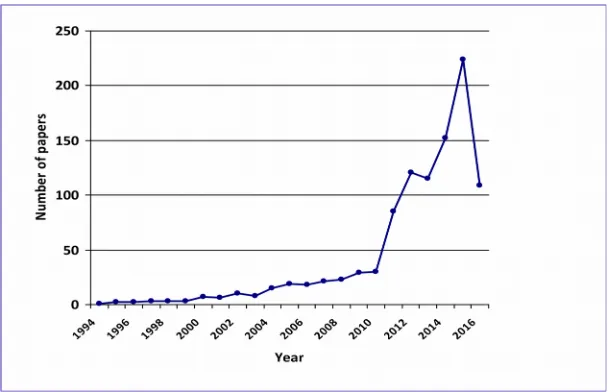
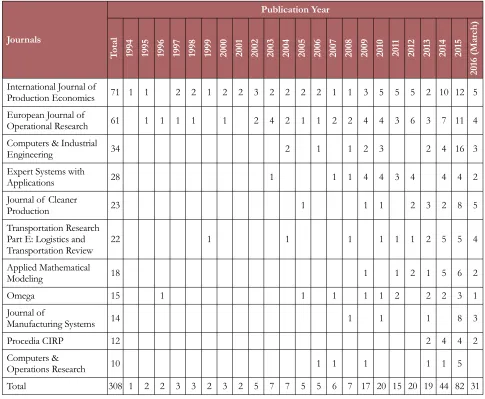
2.5. Initial Statistic Data
Figure 1 shows the numbers of article trend in optimization in supply chain network. In our first survey shows that all the 1610 papers published in 501 journals, the 11 top journals which published at least 10 articles during in 22-years ago is appeared in Table 3. We found that 308 identified papers published in these 11 journals, it is about 20% of all papers publication. Also there are some more statistic data for each journal which we did not present in Table 3, such as self-citation rate. The value of self-citation index use for visibility and scientific authority. For example both International Journal of Production Economics and European Journal of Operational journals which show in the top of list, have high level ranking among the others. Journals Publication Year T ot al 19 94 19 95 19 96 19 97 19 98 19 99 20 00 20 01 20 02 20 03 20 04 20 05 20 06 20 07 20 08 20 09 20 10 20 11 20 12 20 13 20 14 20 15 20 16 ( M ar ch )
International Journal of
Production Economics 71 1 1 2 2 1 2 2 3 2 2 2 2 1 1 3 5 5 5 2 10 12 5
European Journal of
Operational Research 61 1 1 1 1 1 2 4 2 1 1 2 2 4 4 3 6 3 7 11 4
Computers & Industrial
Engineering 34 2 1 1 2 3 2 4 16 3
Expert Systems with
Applications 28 1 1 1 4 4 3 4 4 4 2
Journal of Cleaner
Production 23 1 1 1 2 3 2 8 5
Transportation Research Part E: Logistics and
Transportation Review 22 1 1 1 1 1 1 2 5 5 4
Applied Mathematical
Modeling 18 1 1 2 1 5 6 2
Omega 15 1 1 1 1 1 2 2 2 3 1
Journal of
Manufacturing Systems 14 1 1 1 8 3
Procedia CIRP 12 2 4 4 2
Computers &
Operations Research 10 1 1 1 1 1 5
Total 308 1 2 2 3 3 2 3 2 5 7 7 5 5 6 7 17 20 15 20 19 44 82 31
2.6.Data Processing
Bibliometric is systematic way to help us to measure the impact of scientific publications. Also with context of this toolkit the impact of scholar and productivity is measured by the number of citation with bibliometric. Our data processing divided in two sections; first it started with bibliometric analysis and then network analysis which presented in section 4 and 5 respectively. We used BibExcel software package to bibliometric analysis, it could provide easily statistics data such as title, author, abstract, research area, topic and affiliation. BibExcel selected among the other software package because of its flexibility and compatibility with the some application like as Gephi and Pajek (Costa, Celano, Fichera & Trovato, 2010). After bibliometric processing all data conduct to network analysis, Pajek (Dabkowski, Breiger & Szidarovszky, 2015) VOSviewer (Jie, Xiaohong, Shifei & Jovanovic, 2014) and Gephi (Beiler, 2016) are existing software package for literature network analysis. Gephi is exploration and leading visualization free open-source package for all type networks and could runs on different operating system. We chose Gephi as network analysis software due to high capability to visualization in various graph (Wehbe, Hattab & Hamzeh, 2016) and efficiently to work with dataset.
3. Bibliometric Analysis Method
There are some popular software package for bibliometric analysis which many scholar used them for research and study, such as, SITKIS (Artto, Martinsuo, Gemünden & Murtoaro, 2009), NVivo (Lu & Yuan, 2011), Citespace (Chen, Liu, Luo, Webber & Chen, 2016), Network workbench (Gomez-Jauregui, Gomez-Jauregui, Manchado & Otero, 2014), HistCite (Garfield, 2009) Publish or Perish (Hall, 2011), BibExcel (Fahimnia et al., 2015). Each of these software has special ability, for example: Citespace is designed as a toolkit for analyzing trend and progressive knowledge filed visualization and HistCite is a tool to make historiographical diagrams get direct from citations.
The output searching in Web of Science has different file format, we selected RIS format with full record content which BibExcel could extract the bibliographic information. Our study is concentrated on following information: Journal name, location of organization, authors name, key words and reference. In continue 3 below section will show the output files of BibExcel analysis to provide statistic data.
3.1. Ranking of Authors in Our Study
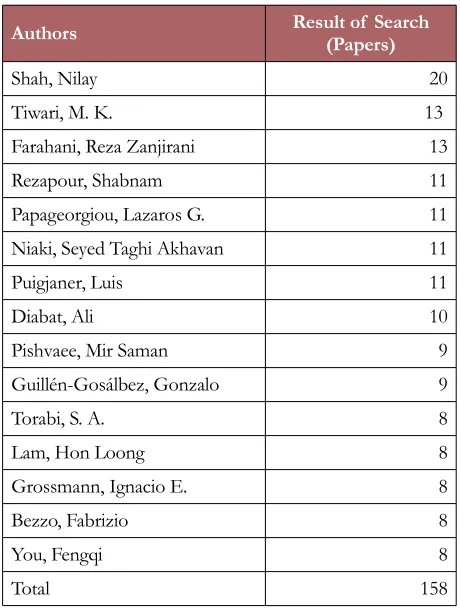
The input data of bibliographic can be sort and analysis by BibExcel; it has some toolbars which help us to extract different data from RIS file. Table 4 shows the top 15 contribution authors with 8 or more publication in our records; also beside of each we mentioned the number of publication. It is clear to see that Shah and Tiwari are in high raking in this table and dominated over the list.
Authors Result of Search(Papers)
Shah, Nilay 20
Tiwari, M. K. 13
Farahani, Reza Zanjirani 13
Rezapour, Shabnam 11
Papageorgiou, Lazaros G. 11
Niaki, Seyed Taghi Akhavan 11
Puigjaner, Luis 11
Diabat, Ali 10
Pishvaee, Mir Saman 9
Guillén-Gosálbez, Gonzalo 9
Torabi, S. A. 8
Lam, Hon Loong 8
Grossmann, Ignacio E. 8
Bezzo, Fabrizio 8
You, Fengqi 8
Total 158
Table 4. The authors with 8 or more publication
processing in supply chain network, planning and scheduling, future challenging and infrastructure design especially in chemical industry. Tiwari with engineering background, study in computational Intelligence in manufacturing and logistics. Farahani and Rezapour contributed on facility location and distribution planning, transportation planning, graph theory, production operations management. In the middle of list Papageorgiou with 11 number publication works on these fields: chemical engineering, biotechnology, mathematics modeling and distributed energy resources. Less than 1% of all publication is provided by these 15 top authors. Majority leading scholars in this list tend to study in optimization in different section of supply chain network issue, such as network design, mathematical approach and production plan. Grossmann and Lam have published some papers in the field of process systems engineering and green sustainable and broad mathematical programming tools in sustainable processes. The other researcher usually trend to work on general modeling framework, empirical approach and environment issue. For example, Pishvaee used fuzzy theory in his case study and using multi-objective optimization in environmental supply chain network design.
3.2. Affiliation
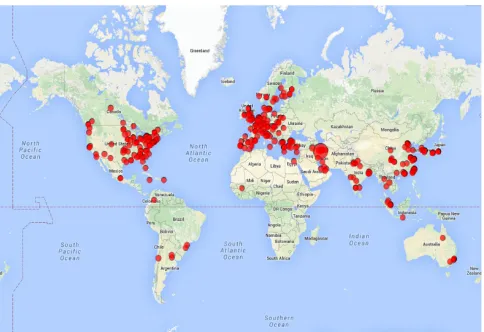
Figure 2. (Red circles) graphical location of all institutions
Table 5 shows greater breakdown in geographical area in globe, like as Europe, USA and Asia. Also we add Oceania and Canada to this list, the remain of the country and the articles without affiliation records indicated in 4 and 5 row, respectively.
Institutions location Number of publication Percentage (%)
Europe 663 41.11
United States and Canada 554 34.40
Asia 290 18.01
Oceania 43 2.67
Rest of Globe 25 1.55
No affiliation in Web of Science records 35 2.17
Table 5. Contribution of Institutions based on geographical area
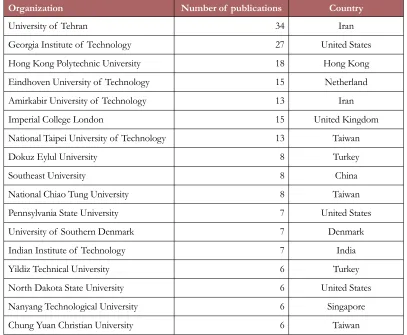
University of Technology are presented productively scholars with Shah, Tiwari and Farahani. It should be noted during several years, different publication for one researcher may have submitted from different organization.
Organization Number of publications Country
University of Tehran 34 Iran
Georgia Institute of Technology 27 United States
Hong Kong Polytechnic University 18 Hong Kong
Eindhoven University of Technology 15 Netherland
Amirkabir University of Technology 13 Iran
Imperial College London 15 United Kingdom
National Taipei University of Technology 13 Taiwan
Dokuz Eylul University 8 Turkey
Southeast University 8 China
National Chiao Tung University 8 Taiwan
Pennsylvania State University 7 United States
University of Southern Denmark 7 Denmark
Indian Institute of Technology 7 India
Yildiz Technical University 6 Turkey
North Dakota State University 6 United States
Nanyang Technological University 6 Singapore
Chung Yuan Christian University 6 Taiwan
Table 6. The 17 top organizations with 6 or more publication
3.3. Most Common Words Statistics
Word Repetition
Supply chain 702
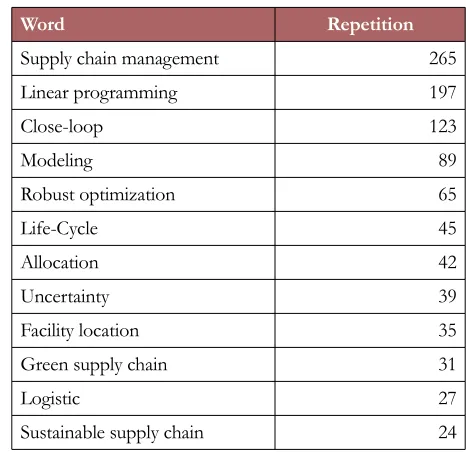
Network 371 Design 370 Optimization 288 Management 197 Planning 130 Production 122 Location 116 Integrated 111 Algorithm 97 Analysis 80 Inventory 65 Logistic 51 Word Repetition
Supply chain management 265
Linear programming 197
Close-loop 123
Modeling 89
Robust optimization 65
Life-Cycle 45
Allocation 42
Uncertainty 39
Facility location 35
Green supply chain 31
Logistic 27
Sustainable supply chain 24
Table 7. The most common words in title of articles Table 8. The most common words in keywords of articles
4. Network Analysis
The bibliographic output file which getting from the Web of Science, is in RIS format, these files cannot use directly to Gephi software. For this order, we need one mediator software to create dataset, BibExcel used as operator for reformatted the data and present graphic dataset. For this purpose different information such as authors names and references extracted from BibExcel then based on the software instruction we continue to reach output files: “.NET” which it need for Gephi for network analysis. With the Web of Science bibliographic output we could conduct our study for citation analysis too.
4.1. Citation Analysis
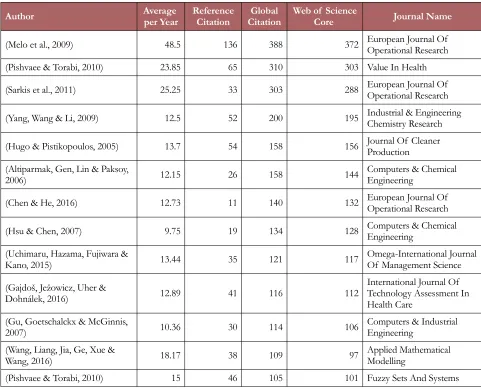
Citation analysis is a systematic way of measuring the relative importance an author or a publication by counting the number of times that author and publication has been cited by other, for this purpose 1610 nodes is created to examine the grade of connection between each node. The primary output of Gephi revealed that near 45% of all publication cited to each. Table 9 shows 13 publications with most citation in Web of Science database. “Average per Year” is the quantity number of local citation divided to the number of years from publication in Web of Science, “Reference Citation” show the number which each paper cited within 1610 paper-network, “Global Citation in all databases” means number of times which mentioned paper cited among all of Web of Science data base such as: “SciELO Citation Index” and “Chinese Science citation”, and “Web of Science Core collection” is the overall Web of Science citation for publication. As it shown in Table 9, the rank of papers in “Global Citation in all databases” is more or less the same as “Reference Citation”, it maybe means that that selection of keywords is done with proper way. Another point is the huge difference numbers between these two columns indicated that optimization in supply chain management got more attention from authors in different disciplines. We see that in Table 9 (Melo et al., 2009) dominated the list but following to Table 4 his name is not in the 15 top authors but also in this list we see Shah, Pishvaee & Torabi as 15 top authors. In Table 9 (Melo et al., 2009) is the top of all columns, it seems that, the invited review which made by Melo and S. Nickel, presented significant contribution of integration local decision with other strategic decisions and received huge attention between researcher. Also the average citation per year for this paper is near two times duo to second paper.
see that 8 out of ten top cited papers published in journal which their filed is Engineering/Mathematic, this evidence shows that perhaps in optimization for supply chain management still we need more intensive research as strategic supply chain planning due to solution method.
Table 9. Top authors with more global citation in Web of Science Core database
4.2. PageRank Analysis
Very usual method for understanding the level of paper is to counting the number of citation in different database which we indicated in section 4. 1, but also there is a evaluated model to measure average accuracy in in dataset. (Buckley & Voorhees, 2005) explained “MAP” - Mean Average Precision - based on probabilistic model (Huang, Huang, Wn, An, Liu & Poon, 2006) with citation graph using, e.g. see Figure 4. C, the papers represented as nodes and citation between the papers indicated as directed edge. So, with apply linkage analysis algorithm in citation graph the ranking grade of each node/paper could be computed. There are three famous linkage analysis algorithm to measuring the publication significance
Author Average per Year ReferenceCitation CitationGlobal Web of ScienceCore Journal Name
(Melo et al., 2009) 48.5 136 388 372 European Journal Of Operational Research
(Pishvaee & Torabi, 2010) 23.85 65 310 303 Value In Health
(Sarkis et al., 2011) 25.25 33 303 288 European Journal Of Operational Research
(Yang, Wang & Li, 2009) 12.5 52 200 195 Industrial & Engineering Chemistry Research
(Hugo & Pistikopoulos, 2005) 13.7 54 158 156 Journal Of Cleaner Production
(Altiparmak, Gen, Lin & Paksoy,
2006) 12.15 26 158 144 Computers & Chemical Engineering
(Chen & He, 2016) 12.73 11 140 132 European Journal Of Operational Research
(Hsu & Chen, 2007) 9.75 19 134 128 Computers & Chemical Engineering
(Uchimaru, Hazama, Fujiwara &
Kano, 2015) 13.44 35 121 117 Omega-International JournalOf Management Science
(Gajdoš, Ježowicz, Uher &
Dohnálek, 2016) 12.89 41 116 112
International Journal Of Technology Assessment In Health Care
(Gu, Goetschalckx & McGinnis,
2007) 10.36 30 114 106 Computers & Industrial Engineering
(Wang, Liang, Jia, Ge, Xue &
Wang, 2016) 18.17 38 109 97 Applied Mathematical Modelling
(Yin, Huang & Li, 2011): Degree Distribution, HITS and PageRank. Degree Distribution, this linkage analysis algorithm uses the definition of “Popularity of a document”. It means the number of citation for each paper show the ranking of paper (Borodin, Roberts, Rosenthal & Tsaparas, 2005). For first time HITS (Hyperlink-Induced Topic Search) presented by (Kleinberg, 1999), the idea behind of this algorithm is computing the importance of deferent type of Web Pages. We have two type attributes for identifying the importance of Web Pages, hub and authority, hub attribute record the page quality as useful resources and authority attribute record the page quality as source itself. These two authorities could compatible to paper citation network analysis. In general world we can say that “PageRank algorithm” is a new version of “Degree Distribution algorithm” which considers separated weight for each node/paper. In our study we used Page Rank algorithm as publication network analyzer.
Page Rank algorithm presented by Larry Page and Sergey Brain in 1998. The primary application of PageRank was ranking web pages in Google based on the keywords searching to indicated page’s relevance or importance and indicated the relationship between them, also, many authors study the Search Engine Optimization (SEO) topics based on Page Rank algorithm. These properties could the expanding to explore in citation network. The PageRank algorithms formula with N publication is:
(1)
Where
PR(A), donated PageRank of paper A which has been cited by paper Ti in the citation network.
C(Ti), presented the number of citation in Ti.
d [0,1], damping factor, with residual probability damping factor defined as 0.85 (Yin et al., 2011).
N, the number of publication in citation network.
Attention if C(Ti) = 0 then in above formula, the number of publication will be instead of C(Ti).
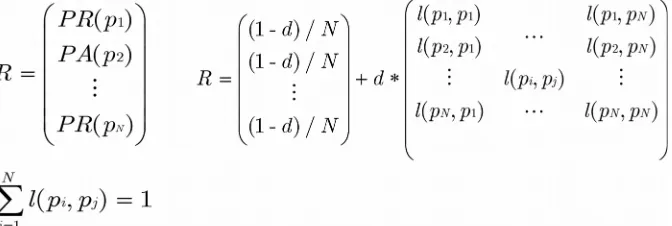
Now if we consideration PageRank for P1, P2, …, PN, the equation is as fallow:
(2)
M(pi) is the set of papers which cited to pi.
PR(pj) PageRank value of pj.
In this case we need to introduce eigenvector. PR(pi) numbers dominated in right of eigenvector, this
made PageRank a practically proper metric.
The eigenvector is:
(3)
In Table 10 pretest the 10 top PageRank value in our study. With consider Table 9 and 10 we find that seven of publications are the same, these publications included, as new item in Table 10 (Papageorgiou, 2009), (Costa et al., 2010) and (Prakash & Deshmukh, 2011). These paper published after 2005 and cited by high-cited papers. The interesting point is, not only these three papers (Costa et al., 2010),(Pishvaee & Torabi, 2010) and (Sarkis et al., 2011) located in both tables (Table 9 and Table10) also they published after 2010. The outcome of this section given us the impact of citation from the high-cited publication is greatly important for PageRank algorithm and also can see that maybe PageRank give us better general view as prestige of papers. Although this topic is most popular between the researchers and discuss by expert to explore to find new solution for more accuracy in this field for example see (González-Pereira, Guerrero-Bote & Moya-Anegón, 2010)
Author PageRank Global Citation Local citation
(Costa et al., 2010) 0.0342 158 54
(Papageorgiou, 2009) 0.0223 88 22
(Melo et al., 2009) 0.0212 388 136
(Costa et al., 2010) 0.0196 53 8
(Pishvaee & Torabi, 2010) 0.0176 310 65
(Sarkis et al., 2011) 0.0134 303 33
(Prakash & Deshmukh, 2011) 0.0845 132 16
(Altiparmak et al., 2006) 0.0832 114 30
(Amiri, 2006) 0.0078 140 11
(Gajdoš et al., 2016) 0.0067 116 41
4.3. Co-citation Analysis
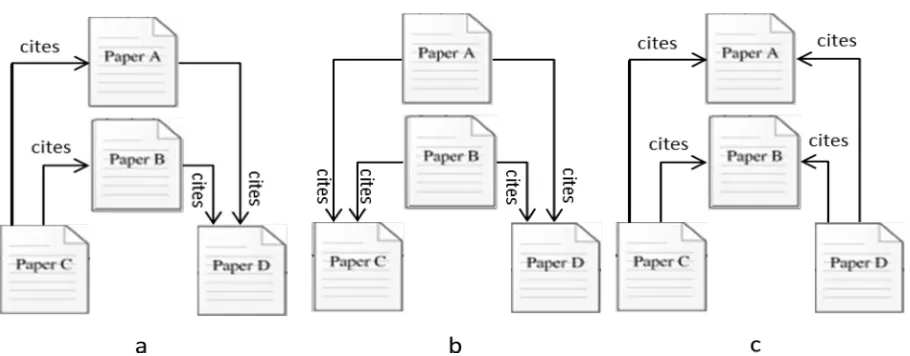
Henry Small proposed the co-citation in 1973 (Small, 1973). Co-citation analysis is an assessment of similarity the publications which share to each citation. Definition of co-citation is to finding the relationship of two publication which cited to each by another paper (Wang et al., 2016) As indicated in Figure 3(b) Paper C and Paper D are cited by Paper A, and Paper B. So, Paper C and Paper D have co-citation strength of 2. Also Citation and Bibliographic coupling is shown in Figure 3(a) and Figure 3(c), respectively. Bibliographic coupling employ in citation analysis to make a similarity relationship between papers is a similar measure as co-citation (Wang et al., 2016).
Figure 3. Citation relationship (a), Co-citation relationship (b) and Bibliographic coupling(c)
4.3.1. Publication Classification with Clustering Method
Clustering is one the most critical approach in data mining analysis, clustering means the data fall into same module/cluster with more similarity than other (Chen & He, 2016). The case of our study, where represented papers in the citation network is indicated in a group with same research field, a cluster can be identified, into the cluster the density of edge and arrow is high. There are many fields that clustering algorithm extended in them, for example genetic engineering, customer segmentation and publication analysis, normally these type data are numerical and classified attributes (Hsu & Chen, 2007). The optimization of modularity tools in Gephi is under Louvain method, an iterative method to optimized modularity as the algorithm progresses. Modularity index is defined between -1 and 1 which present the density of edges inside due to outside of communities. According to (Uchimaru et al., 2015) modularity index is defined as:
(4)
Here
is sum of link weight penetrating node i, is sum of link weight penetrating node j.
The “Kronecker” delta d(ci, cj) is 1 and 0 when nodes i and j are assigned to the same community and
.
Figure 5. The evolution of clusters positions over time
providing the field with the fundamental knowledge, concepts, techniques, theories, applications and
utilities. The number of publications in different clusters varies from 24 to 115 papers. The 4th cluster with 115 nodes/papers is the largest cluster and first cluster with 20 nodes/papers is smallest module. Figure 4(a&b) shows the positioning of the four clusters with/without arcs.
Publications in same cluster usually have robust co-citation connection and often these papers present in same topic field. So the accurate analysis of publication of a cluster can conduct our study to reach the field of the cluster (Fahimnia et al., 2015). In order to find out the research area of each cluster we consider top publications with high value PageRank. The topical reference as publication classification is showing in Table 10, the senior scholars in first cluster included (Cortinhal, Lopes & Melo, 2015), (Pishvaee & Torabi, 2010) and (Santoso, Ahmed, Goetschalckx & Shapiro, 2005). The labeling for this cluster as major research filed is “Network design, Mathematical modeling, and Optimization approach”. Table 11 (Cluster 1-3) indicated the enabling of jointly sustainable economic development, conceptual analysis and experimental study which researchers have more desire to concentrated in optimization in supply chain management. Sure this conclusion will not appear without modeling and design strategy (Cluster 4). The number of publications in second cluster is half of the first cluster, lead papers included (Accorsi, Cascini, Cholette, Manzini & Mora, 2014), (Pishvaee, Razmi & Torabi, 2014) and (Grossmann & Guillén-Gosálbez, 2010). Environmental impact assessment is the term which we use for labeling of this cluster. With monitoring of four major clusters (Cluster 1-4) shows, identifying real problems statement in an organization, practical problem solving and prescriptive analytics received less consideration by researchers. This result also applied by some review publication such as (Melo et al., 2009), (Eskandarpour et al., 2015) and (Fahimnia, Farahani, Marian & Luong, 2013). So, the initial result of this classification is the opportunity for conduct the future survey in formal modelling of optimization in supply chain management to practical/operation effort. Although some recent researcher focused near to this gap, for example (Suzuki, 2016) and (Han & Kim, 2016), but it is clear that all these efforts cannot be capture by our four clusters.
Cluster Number of publication Cluster labeling
1st 115 Network design, mathematical modeling, Optimization approach – Conceptualanalysis to reveal descriptive studies
2nd 57 Environmental sustainability, Lifecycle assessment, Green/Sustainable supply chain -Assessing the environmental impact
3rd 37 Operational planning, logistics systems, inventory - Experimental study
4th 24 Modeling and design strategy- Perception of the desire in the study field in future
program
The Clusters 1 and 4 overlap with modeling development, Cluster 4 focuses on strategy design pattern and theory development with creating new modeling. Many relevant strategic decisions in supply chain management such as: located of plants, transportation modes and distribution centers are located in this cluster. In Cluster 1 focuses on analytical computations by the evaluating data, taking new established analysis and integrated supply chain design model. Nearly the most publications in first cluster are older paper due to other clusters, we expected in next decade the second cluster will grow up faster and the gap between our two popular clusters (Cluster 1 and Cluster 2) become less.
4.3.2. Evolution of Clusters Over Years
To help understand the evolution of optimization in supply chain management evaluation over time, we also complete a dynamic co-citation analysis covering all papers in the four clusters. The evolution is graphically presented in Figure 5. The size of a circle represents the PageRank value of each paper, so the larger the size of a circle, the more highly-cited and prestigious the corresponding paper. It can be expected that the research papers in Clusters 3 and 4 will continue to grow in next decade and in other side we see stabilize in Clusters 1 and 2.
5. Conclusion and Some Suggestions for Future Study
This paper provided a systematic analyzed review of optimization within context the supply chain management. There are many literature reviews published within the scope of this topic, but there are a handful of researchers involved in bibliometric and network analysis to evaluate information and data clustering. Moreover, in this paper we identified classification, characterized and labeled our data (section 4.3.1) to show which part of this topic has been paid more attention, or rarely considered by researchers to guide the further investigation and strengthen SCM planning needs.
Furthermore, we found out that the majority of significant papers were publishing at the beginning of the last decade. Considering Figure 1 it is not surprising to see that in 2010 we faced a high rate of increase in publications regarding the supply chain management area. International Journal of Production Economics and European Journal of Operational Research are more popular journals in this field; we see that many scholars in United States and Asia attend to publish their papers in European journals.
Our network analysis conclusion shows that, optimization in supply chain management can be divided into four clusters/categories, labeling of the popular cluster (Cluster 1) is: Conceptual analysis and analytical modeling. We recognize that facility optimization problem may be getting saturated in this field. The name of the second cluster, which is far behind is: Environmental sustainability and green supply chain network, articles which were published in this cluster are younger compared to the first cluster; it seems that green supply chain could be as an emerging area, as our research result experimental study and design strategy pays less attention in to this topic.
However, this type of research has some limitations and needs further investigations.
First, designing “Key words search model” to ensure capturing the most effective keywords and field area. We can make a pool of papers but we should be sure to maximize coverage in our research. It is fundamental approach for this type review. Second, bibliometric and network analyzing is associated with a huge number of papers, so using professional software to enhance reliable results is necessary. Third, database plays the main role in systematic review, hence the importance of database should be considered, Scopus is relatively comprehensive due to others (Wang & Waltman, 2016), so to achieve suitable advantage, this database is suggested. We believe this paper can create an objective and professional understanding in order to navigate the further mapping and direction for broaden research.
Acknowledgement
References
Accorsi, R., Cascini, A., Cholette, S., Manzini, R., & Mora, C. (2014). Economic and environmental assessment of reusable plastic containers: A food catering supply chain case study. International Journal of Production Economics, 152, 88-101. http://dx.doi.org/10.1016/j.ijpe.2013.12.014
Altiparmak, F., Gen, M., Lin, L., & Paksoy, T. (2006). A genetic algorithm approach for multi-objective optimization of supply chain networks. Computers & Industrial Engineering, 51(1), 196-215.
http://dx.doi.org/10.1016/j.cie.2006.07.011
Amiri, A. (2006). Designing a distribution network in a supply chain system: Formulation and efficient solution procedure. European Journal of Operational Research, 171(2), 567-576. http://dx. doi. org/10. 1016/j. ejor. 2004. 09. 018
Artto, K., Martinsuo, M., Gemünden, H.G., & Murtoaro, J. (2009). Foundations of program management: A bibliometric view. International Journal of Project Management, 27(1), 1-18.
http://dx.doi.org/10.1016/j.ijproman.2007.10.007
Aust, G., & Buscher, U. (2014). Cooperative advertising models in supply chain management: A review. European Journal of Operational Research, 234(1), 1-14. http://dx.doi.org/10.1016/j.ejor.2013.08.010
Awudu, I., & Zhang, J. (2012). Uncertainties and sustainability concepts in biofuel supply chain management: A review. Renewable and Sustainable Energy Reviews, 16(2), 1359-1368.
http://dx.doi.org/10.1016/j.rser.2011.10.016
Batagelj, V., & Mrvar, A. (2011). Pajek – Program for Analysis and Visualization of Large Networks Reference Manual: List of Commands with Short Explanation. Version 2. 05. Ljubljana, Slovenia.
Beiler, M.O. (2016). Organizational sustainability in transportation planning: Evaluation of multi-jurisdictional agency collaboration. Journal of Transport Geography, 52, 29-37.
http://dx.doi.org/10.1016/j.jtrangeo.2016.02.013
Borodin, A., Roberts, G.O., Rosenthal, J.S., & Tsaparas, P. (2005). Link analysis ranking algorithms, theory, and experiments. ACM Transaction on Internet Technologies, 5, 231-297
http://dx.doi.org/10.1145/1052934.1052942
Buckley, C., & Voorhees, E.M. (2005). Retrieval system evaluation. MIT Press.
Chen, J.-Y., & He, H.-H. (2016). A fast density-based data stream clustering algorithm with cluster centers self-determined for mixed data. Information Sciences, 345, 271-293. http://dx.doi.org/10.1016/j.ins.2016.01.071
Chopra, S., & Meindl, P. (2004). Supply Chain Management. Strategy, Planning & Operation (2nd ed.). Pearson Prentice-Hall.
Cortinhal, M.J., Lopes, M.J., & Melo, M.T. (2015). Dynamic design and re-design of echelon, multi-product logistics networks with outsourcing opportunities: A computational study. Computers & Industrial Engineering, 90, 118-131. http://dx.doi.org/10.1016/j.cie.2015.08.019
Costa, A., Celano, G., Fichera, S., & Trovato, E. (2010). A new efficient encoding/decoding procedure for the design of a supply chain network with genetic algorithms. Computers & Industrial Engineering, 59(4), 986-999. http://dx.doi.org/10.1016/j.cie.2010.09.011
Dabbene, F., Gay, P., & Tortia, C. (2014). Traceability issues in food supply chain management: A review. Biosystems Engineering, 120, 65-80. http://dx.doi.org/10.1016/j.biosystemseng.2013.09.006
Dabkowski, M., Breiger, R., & Szidarovszky, F. (2015). Simultaneous-direct blockmodeling for multiple relations in Pajek. Social Networks, 40, 1-16. http://dx.doi.org/10.1016/j.socnet.2014.06.003
Doreian, P. (2006). Exploratory Social Network Analysis with Pajek, W. de Nooy, A. Mrvar, V. Batagelj. Cambridge University Press, New York (2005). Social Networks, 28(3), 269-274.
http://dx.doi.org/10.1016/j.socnet.2005.12.002
Eskandarpour, M., Dejax, P., Miemczyk, J., & Péton, O. (2015). Sustainable supply chain network design: An optimization-oriented review. Omega, 54, 11-32. http://dx.doi.org/10.1016/j.omega.2015.01.006
Fabbe-Costes, N., & Jahre, M. (2008). Supply chain integration and performance: a review of the evidence. International Journal of Logistics Management, 19(2), 130-154.
http://dx.doi.org/10.1108/09574090810895933
Fahimnia, B., Farahani, R.Z., Marian, R., & Luong, L. (2013). A review and critique on integrated production–distribution planning models and techniques. Journal of Manufacturing Systems, 32(1), 1-19.
http://dx.doi.org/10.1016/j.jmsy.2012.07.005
Fahimnia, B., Sarkis, J., & Davarzani, H. (2015). Green supply chain management: A review and bibliometric analysis. International Journal of Production Economics, 162, 101-114.
http://dx.doi.org/10.1016/j.ijpe.2015.01.003
Gajdoš, P., Ježowicz, T., Uher, V., & Dohnálek, P. (2016). A parallel Fruchterman–Reingold algorithm optimized for fast visualization of large graphs and swarms of data. Swarm and Evolutionary Computation, 26, 56-63. http://dx.doi.org/10.1016/j.swevo.2015.07.006
Garfield, E. (2009). From the science of science to Scientometrics visualizing the history of science with HistCite software. Journal of Informetrics, 3(3), 173-179.http://dx.doi.org/10.1016/j.joi.2009.03.009
Gephi (2013). Gephi makes graph handy.
Gomez-Jauregui, V., Gomez-Jauregui, C., Manchado, C., & Otero, C. (2014). Information management and improvement of citation indices. International Journal of Information Management, 34(2), 257-271.
http://dx.doi.org/10.1016/j.ijinfomgt.2014.01.002
González-Pereira, B., Guerrero-Bote, V.P., & Moya-Anegón, F. (2010). A new approach to the metric of journals’ scientific prestige: The SJR indicator. Journal of Informetrics, 4(3), 379-391.
http://dx.doi.org/10.1016/j.joi.2010.03.002
Grieger, M. (2003). Electronic marketplaces: A literature review and a call for supply chain management research. European Journal of Operational Research, 144(2), 280-294.
http://dx.doi.org/10.1016/S0377-2217(02)00394-6
Grossmann, I.E., & Guillén-Gosálbez, G. (2010). Scope for the application of mathematical programming techniques in the synthesis and planning of sustainable processes. Computers & Chemical Engineering, 34(9), 1365-1376. http://dx.doi.org/10.1016/j.compchemeng.2009.11.012
Gu, J.X., Goetschalckx, M., & McGinnis, L.F. (2007). Research on warehouse operation: A comprehensive review. European Journal of Operational Research, 177(1), 1-21.
http://dx.doi.org/10.1016/j.ejor.2006.02.025
Gunasekaran, A., & Ngaib, E.W.T. (2005). Build-to-order supply chain management: a literature review and framework for development. Journal of Operations Management, 23(5), 423-451.
http://dx.doi.org/10.1016/j.jom.2004.10.005
Gupta, S., & Palsule-Desai, O. (2011). Sustainable supply chain management: Review and research opportunities. IIMB Management Review, 23(4), 234-245. http://dx.doi.org/10.1016/j.iimb.2011.09.002
Han, J.-H., & Kim, Y.-D. (2016). Design and operation of a two-level supply chain for production-time-dependent products using Lagrangian relaxation. Computers & Industrial Engineering, 96, 118-125.
http://dx.doi.org/10.1016/j.cie.2016.03.018
Hsu, C.-C., & Chen, Y.-C. (2007). Mining of mixed data with application to catalog marketing. Expert Systems with Applications, 32(1), 12-23.http://dx.doi.org/10.1016/j.eswa.2005.11.017
Huang, X., Huang, Y., Wen, M., An, A., Liu, Y., & Poon, J. (2006). Applying data mining to pseudo-relevance feedback for high performance text retrieval. Proceeding of the 6th IEEE international conference on data mining. 295-306. http://dx.doi.org/10.1109/icdm.2006.22
Hugo, A., & Pistikopoulos, E.N. (2005). Environmentally conscious long-range planning and design of supply chain networks. Journal of Cleaner Production, 13(15), 1471-1491.
http://dx.doi.org/10.1016/j.jclepro.2005.04.011
Huscroft, J.R., Hazen, B.T., Hall, D.J., Skipper, J.B., & Hanna, J.B. (2013). Reverse logistics: past research, current management issues, and future directions. International Journal of Logistics Management, 24(3), 304-327. http://dx.doi.org/10.1108/ijlm-04-2012-0024
Jie, L., Xiaohong, G., Shifei, S., & Jovanovic, A. (2014). Bibliometric Mapping of “International Symposium on Safety Science and Technology (1998-2012)”. Procedia Engineering, 84, 70-79.
http://dx.doi.org/10.1016/j.proeng.2014.10.411
Kaufmann, L., & Gaeckler, J. (2015). A structured review of partial least squares in supply chain management research. Journal of Purchasing and Supply Management, 21, 259-272.
http://dx.doi.org/10.1016/j.pursup.2015.04.005
Kleinberg, J. (1999). Authoritative sources in a hyperlinked environment. Journal of ACM, 46, 604-632.
http://dx.doi.org/10.1145/324133.324140
Kundu, A., Jain, V., Kumar, S., & Chandra, C. (2015). A journey from normative to behavioral operations in supply chain management: A review using Latent Semantic Analysis. Expert Systems with Applications, 42, 796-809. http://dx.doi.org/10.1016/j.eswa.2014.08.035
Lu, W, & Yuan, H. (2011). A framework for understanding waste management studies in construction. Waste Management, 31(6), 1252-1260. http://dx.doi.org/10.1016/j.wasman.2011.01.018
Marra, M., Ho, W., & Edwards, J. (2012). Supply chain knowledge management: A literature review. Expert Systems with Applications, 39(5), 6103-6110. http://dx.doi.org/10.1016/j.eswa.2011.11.035
Martínez-Jurado, P.J., & Moyano-Fuentes, J. (2014). Lean Management, Supply Chain Management and Sustainability. Journal of Cleaner Production, 85, 134-150. http://dx.doi.org/10.1016/j.jclepro.2013.09.042
Meixell, M.J., & Norbis, M. (2008). A review of the transportation mode choice and carrier selection literature. International Journal of Logistics Management, 19(2), 183-211.
http://dx.doi.org/10.1108/09574090810895951
Melo, M.T., Nickel, S., & Saldanha-da-Gama, F. (2009). Facility location and supply chain management – A review. European Journal of Operational Research, 196(2), 401-412. http://dx.doi.org/10.1016/j.ejor.2008.05.007
Papageorgiou, L.G. (2009). Supply chain optimisation for the process industries: Advances and opportunities. Computers & Chemical Engineering, 33(12), 1931-1938.
http://dx.doi.org/10.1016/j.compchemeng.2009.06.014
Pazhani, S., Ventura, J.A., & Mendoza, A. (2016). A serial inventory system with supplier selection and order quantity allocation considering transportation costs. Applied Mathematical Modelling, 40(1), 612-634.
http://dx.doi.org/10.1016/j.apm.2015.06.008
Pishvaee, M.S., Razmi, J., & Torabi, S.A. (2014). An accelerated Benders decomposition algorithm for sustainable supply chain network design under uncertainty: A case study of medical needle and syringe supply chain. Transportation Research Part E: Logistics and Transportation Review, 67, 14-38.
http://dx.doi.org/10.1016/j.tre.2014.04.001
Pishvaee, M.S., & Torabi, S.A. (2010). A possibilistic programming approach for closed-loop supply chain network design under uncertainty. Fuzzy Sets and Systems, 161(20), 2668-2683.
http://dx.doi.org/10.1016/j.Fss.2010.04.010
Ponomarov, S.Y., & Holcomb, M.C. (2009). Understanding the concept of supply chain resilience. International Journal of Logistics Management, 20(1), 124-143. http://dx.doi.org/10.1108/09574090910954873
Prakash, A., & Deshmukh, S.G. (2011). A multi-criteria customer allocation problem in supply chain environment: An artificial immune system with fuzzy logic controller based approach. Expert Systems with Applications, 38(4), 3199-3208.http://dx.doi.org/10.1016/j.eswa.2010.09.008
Santoso, T., Ahmed, S., Goetschalckx, M., & Shapiro, A. (2005). A stochastic programming approach for supply chain network design under uncertainty. European Journal of Operational Research, 167(1), 96-115.
Sarkis, J., Zhu, Q., & Lai, K.-H. (2011). An organizational theoretic review of green supply chain management literature. International Journal of Production Economics, 130(1), 1-15.
http://dx.doi.org/10.1016/j.ijpe.2010.11.010
Saunders. M., Lewis. P., & Thornhill, A. (2009). Research Methods for Business Students. Pearson, Harlow.
Seuring, S., & Müller, M. (2008). From a literature review to a conceptual framework for sustainable supply chain management. Journal of Cleaner Production, 16(15), 1699-1710, Sustainability and Supply Chain Management. http://dx.doi.org/10.1016/j.jclepro.2008.04.020
Small, H. (1973). Co-citation in the scientific literature: a new measure of the relationship between two documents. Journal of the American Society for Information Science, 24, 265-269.
http://dx.doi.org/10.1002/asi.4630240406
Stefanovic, D., Stefanovic, N., & Radenkovic, B. (2009). Supply network modelling and simulation methodology. Simul. Model. Pract. Theory, 17(4), 743-766. http://dx.doi.org/10.1016/j.simpat.2009.01.001
Su, M., Chen, C., & Yang, Z. (2016). Urban energy structure optimization at the sector scale: considering environmental impact based on life cycle assessment. Journal of Cleaner Production, 112(2), 1464-1474.
http://dx.doi.org/10.1016/j.jclepro.2015.01.059
Suzuki, Y. (2016). A dual-objective metaheuristic approach to solve practical pollution routing problem. International Journal of Production Economics, 176, 143-153. http://dx.doi.org/10.1016/j.ijpe.2016.03. 008
Uchimaru, T., Hazama, K., Fujiwara, K., & Kano, M. (2015). Nearest Correlation Louvain Method for Fast and Good Selection of Input Variables of Statistical Model . ∗ IFAC-PapersOnLine, 48(8), 123-128.
http://dx.doi.org/10.1016/j.ifacol.2015.08.168
Wang, N., Liang, H., Jia, Y., Ge, S., Xue, Y., & Wang, Z. (2016) Cloud computing research in the IS discipline: A citation/co-citation analysis. Decision Support Systems, 86, 35-47.
http://dx.doi.org/10.1016/j.dss.2016.03.006
Wang, Q., & Waltman, L. (2016). Large-scale analysis of the accuracy of the journal classification systems of Web of Science and Scopus. Journal of Informetrics, 10(2), 347-364.
http://dx.doi.org/10.1016/j.joi.2016.02.003
Wang, Y., Wallacen, S., Shen, B., & Choi, T.-M. (2015). Service supply chain management: A review of operational models European Journal of Operational Research, 247(3), 685-698.
Wehbe, F., Hattab, M.A., & Hamzeh, F. (2016). Exploring associations between resilience and construction safety performance in safety networks. Safety Science, 82, 338-351.
http://dx.doi.org/10.1016/j.ssci.2015.10.006
Yang, G.F., Wang, Z.P., & Li, X.Q. (2009). The optimization of the closed-loop supply chain network. Transportation Research Part E-Logistics and Transportation Review, 45(1), 16-28.
http://dx.doi.org/10.1016/j.tre.2008.02.007
Yin, X., Huang, J.X., & Li, Z. (2011). Mining and modeling linkage information from citation context for improving biomedical literature retrieval. Information Processing & Management, 47(1), 53-67.
http://dx.doi.org/10.1016/j.ipm.2010.03.010
Journal of Industrial Engineering and Management, 2016 (www.jiem.org)
Article's contents are provided on an Attribution-Non Commercial 3.0 Creative commons license. Readers are allowed to copy, distribute and communicate article's contents, provided the author's and Journal of Industrial Engineering and Management's