The Relationship Between Pre-Service
Elementary School Teachers’ Metacognitive
Science Learning Orientations and Their Use
of Constructivist Learning Environment
Zubeyde Demet Kirbuluta and Muhammed Sait Gokalpb Corresponding author: [email protected]
aElementary Education, Harran University, Sanliurfa, 63190, Turkey bScience Education, Dumlupinar University, Kutahya, 43000, Turkey
Keywords: metacognition, science learning orientations, constructivist learning environment
International Journal of Innovation in Science and Mathematics Education, 22(6), 1-10, 2014.
Abstract
The purpose of this study was to investigate the relationship between pre-service elementary school teachers’ metacognitive science learning orientations and their use of constructivist learning environment. A total of 178 pre-service elementary school teachers participated in this study. Constructivist Learning Environment Survey (CLES) and Self-Efficacy and Metacognition Learning Inventory—Science (SEMLI-S) were administered to the participants. In this study the CLES consisted of four dimensions: Uncertainty (U), Critical Voice (CV), Shared Control (SC), and Student Negotiation (SN). The SEMLI-S also includes four dimensions: Constructivist Connectivity (CC), Monitoring, Evaluation and Planning (MEP), Science Learning Self-efficacy (SE), and Learning Risks Awareness (AW). Four separate Multiple Linear Regression analyses were conducted. The results revealed that the SE and the AW were significant predictors for the U; the MEP and AW were significant predictors for the CV; the AW was significant predictor for the SN. None of the predictors contributed to the SC.
Introduction
Recently, considerable research has been made in the conceptualization and the measurement of learning environment (Dorman, Fraser, & McRobbie, 1995; Partin & Haney, 2012). Partin and Haney (2012) described learning environment as “the format of the course and how it affects the development of the student” (p. 105). Several researchers have developed instruments to assess learning environment (What Is Happening In This Classroom (WIHIC), Aldridge and Fraser 2000; Constructivist Learning Environment (CLES), Taylor, Fraser, & Fisher, 1997; Learning Environment Inventory (LEI), Walberg and Anderson 1968). In the literature, it was reported that learning environment plays a crucial role in students’ course performance, attitude toward science, and motivation on learning (Fraser, & Walberg, 2005; McRobbie & Fraser, 1993).
von Glasersfeld (1993) asserted that “Knowledge is always the result of a constructive activity and, therefore, it cannot be transferred to a passive receiver. It has to be actively built up by each individual knower” (p. 26). Jonassen (1991) proposed the principles to design learning environments which are based on constructivism. Some of these principles are as follow: i) real world environments, which are relevant to learning context, should be created, ii) in order to solve real-world problems, realistic approaches should be focused, iii) the instructor should act as a coach and analyzer of the strategies when solving the problems, iv) instructional goals and objectives should be negotiated, and v) learning should be internally controlled and mediated by the learner.
Learning environment is closely related to cognitive, metacognitive, and motivational factors (Schraw, Crippen, & Hartley, 2006). In the literature, there are few studies focusing on the relationship between constructivist learning environment and metacognition. The seminal work on metacognition was Flavell’s study on metamemory (Flavell, 1971). Metacognition was called as “fuzzy” concept by researchers (Brown, 1987; Flavell, 1981; Veenman, Hout-Wolters, & Afflerbach, 2006) due to vagueness of its definition and categorization. Numerous terms such as metamemory, metaaffection, and metareading related to metacognition are evident in the literature (Kluwe, 1987). Metacognition is defined as “the active monitoring and consequent regulation and orchestration of these processes in relation to the cognitive objects” (p. 232). According to Brown (1987) metacognition refers to “one’s knowledge and control of own cognitive system” (p. 66). White (1988) defined metacognition as “inner awareness or process, not an overt behaviour” (p. 73). Many researchers proposed different categorizations for metacognition (Brown, 1978; Chi, 1987; Flavell, 1979). For example, Flavell (1979) categorized metacognition as “metacognitive knowledge” and “metacognitive experience”. According to Flavell (1979), metacognitive knowledge consisted of “person”, “task”, and “strategy” variables. Chi (1987) conceptualized metaknowledge as meta-declarative knowledge, meta-strategies, and meta-procedural knowledge. In line with Flavell’s (1979) study, Brown (1978) categorized metacognition as knowledge of cognition and regulation of cognition. Due to vagueness of the definition and categorization of metacognition, its measurement is problematic. Several assessment techniques could be used to assess metacognition such as interviews (Zimmerman and Martinez-Pons 1990), self-report instruments (e.g. the Assessment of Cognitive Monitoring Effectiveness (ACME), Osborne, 1998), and thinking-aloud protocols (Afflerbach, 2000). All these assessment techniques have advantages and disadvantages. For example, interviews and thinking-aloud protocols provide rich information about learners’ metacognition, they are very time consuming to conduct and analyse the data and could be used with small sample of students. Self-report instruments were criticized with their domain-general approach (Thomas, Anderson, & Nashon, 2008). Contrary to the disadvantages of these instruments, Thomas et al. (2008) developed a domain-specific instrument to assess students’ metacognition, learning processes, and self-efficacy in science education. In this study, student metacognition was assessed via Self-Efficacy and Metacognition Learning Inventory—Science (SEMLI-S) developed by Thomas et al. (2008). It should be noted that researchers agreed that metacognition was an essential element underlying student thinking skills and conceptual understanding (Adey, Shayer, & Yates, 1989; Beeth, 1998; Hennessey, 1999; Hewson, Beeth, & Thorley, 1998).
classroom performance, beliefs about knowledge, beliefs about ways of knowing, beliefs about learning, and self-regulated learning. Schommer-Aikens (2004) contended that teachers’ views of classroom learning environment were affected by their metacognition and epistemological beliefs. Schommer-Aikens stated that epistemological beliefs influence both student learning and teacher instruction. Based on Schommer-Aikens’ embedded model of epistemological beliefs, Yilmaz-Tuzun and Topcu (2010) conducted a study to investigate the relationships among constructivist learning environment, metacognition, and epistemological beliefs of elementary pre-service teachers. They found that compared to epistemological beliefs, metacognition was influential on elementary pre-service teachers’ perceptions of constructivist learning environment. In other words, metacognitive students were better of perceiving the characteristics of constructivist learning environment. In the literature, there are also studies examining the relationship between epistemological beliefs and constructivist learning environment (Tsai 2000) or metacognition and epistemological beliefs (Bedel, 2012; Belet & Guven, 2011). For example, Tsai studied with 10th grade students and reported that students having constructivist epistemological beliefs preferred constructivist learning environments. Belet and Guven (2011) found a strong relationship between primary school teacher trainees’ metacognitive strategy use and epistemological beliefs.
Collectively, a common theme of the literature related to learning environment was to investigate the relationships among students’ cognitive and affective learning outcomes and their perceptions of classroom learning environment. Researchers in science education emphasized that learning environments should provide ways for students to control their own learning and to evaluate the ideas from other sources (Wolf and Fraser 2008). However, studies especially on examining the relationship between pre-service teachers’ metacognitive science learning orientations and their use of constructivist learning environment are scarce. Currently, in Turkey, curriculums have been designed based on constructivist approach. Thereby, it is crucial to reveal teacher perceptions of constructivist learning environment. Taking the effect of metacognition on learner thinking skills and conceptual understanding (Adey et al., 1989; Baird & Northfield, 1992; Beeth, 1998; Hennessey, 1999; Hennessey, 2003) into consideration, the purpose of this study was to investigate the relationship between pre-service elementary school teachers’ metacognitive science learning orientations and their use of constructivist learning environment.
Method
SampleThe sample of this study consisted of 178 second-year pre-service elementary school teachers (134 females and 44 males) enrolled in a public university in Turkey. The female pre-service teachers were the 75% of the sample whereas the male pre-service teachers were 25% of the sample.
Instruments
Constructivist Learning Environment Survey (CLES)
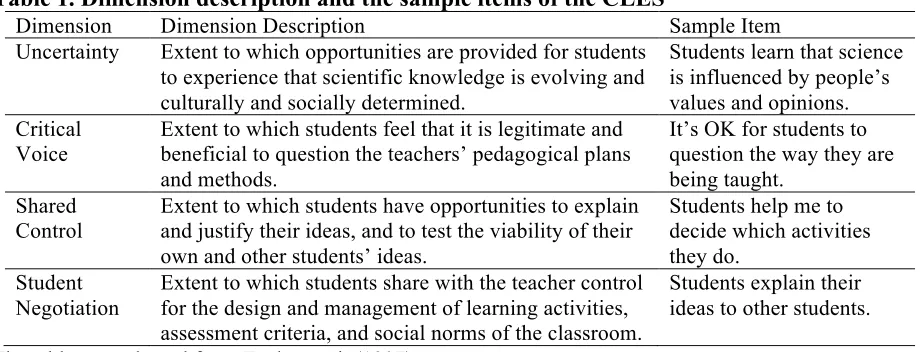
The CLES was developed by Taylor et al. (1997) to measure student or teacher perceptions of constructivist learning environment. It was adapted into Turkish by Aydin et al. (2012) considering teacher preferred version of the CLES. The CLES includes 30 items in a five-point Likert type scale ranging from almost never (1) to almost always (5). The five dimensions of this instrument were defined by Taylor et al. (1997) as Learning about the World or Personal Relevance (PR) (from item 1 to 6), Learning about Science or Uncertainty (U) (from item 7 to 12), Learning to Speak Out or Critical Voice (CV) (from item 13 to 18), Learning to Learn or Shared Control (SC) (from item 19 to 24), and Learning to Communicate or Student Negotiation (SN) (from item 25 to 30). Table 1 shows the description of the dimensions and sample items for each dimension.
Table 1. Dimension description and the sample items of the CLES
Dimension Dimension Description Sample Item
Uncertainty Extent to which opportunities are provided for students to experience that scientific knowledge is evolving and culturally and socially determined.
Students learn that science is influenced by people’s values and opinions. Critical
Voice
Extent to which students feel that it is legitimate and beneficial to question the teachers’ pedagogical plans and methods.
It’s OK for students to question the way they are being taught.
Shared Control
Extent to which students have opportunities to explain and justify their ideas, and to test the viability of their own and other students’ ideas.
Students help me to decide which activities they do.
Student Negotiation
Extent to which students share with the teacher control for the design and management of learning activities, assessment criteria, and social norms of the classroom.
Students explain their ideas to other students. The table was adapted from Taylor et al. (1997).
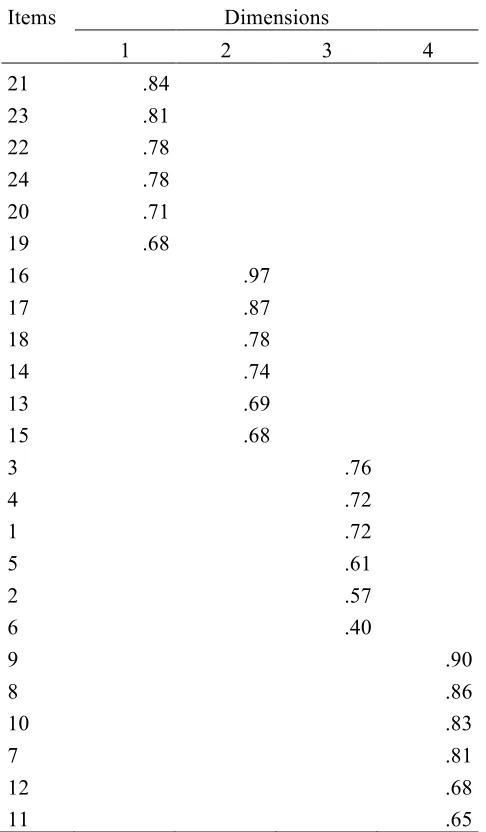
dimensions explain 75% of the total variance. Four-dimension pattern coefficients of the items in the CLES are shown in Table 3.
Table 2.Eigenvalues and total variance explained by factors for the CLES
Component Initial Eigenvalues Rotation Sums of Squared Loadings
Total % of Variance Cumulative % Total % of Variance Cumulative %
1 12.73 53.03 53.03 12.73 53.03 53.02
2 2.24 9.35 62.38 2.24 9.35 62.38
3 1.83 7.64 70.01 1.83 7.64 70.01
4 1.14 4.75 74.77 1.14 4.75 74.77
5 .90 3.75 78.51
6 .63 2.64 81.15
Table 3. Factor pattern coefficients of the items for the CLES
Items Dimensions
1 2 3 4
21 .84
23 .81
22 .78
24 .78
20 .71
19 .68
16 .97
17 .87
18 .78
14 .74
13 .69
15 .68
3 .76
4 .72
1 .72
5 .61
2 .57
6 .40
9 .90
8 .86
10 .83
7 .81
12 .68
Self-Efficacy and Metacognition Learning Inventory—Science (SEMLI-S)
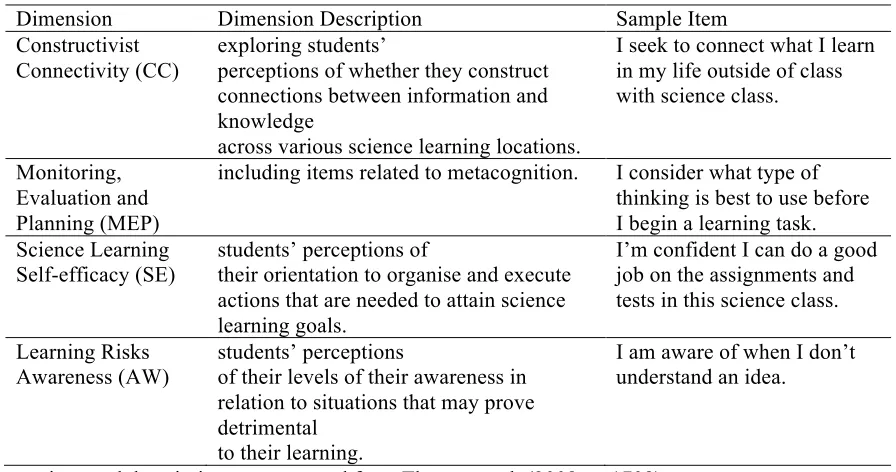
The SEMLI-S was developed by Thomas et al. (2008) to examine pre-service elementary school teachers’ metacognitive science learning orientations. In this study, adapted version of SEMLI-S which has 19 items at four dimensions as Constructivist Connectivity (CC), Monitoring, Evaluation and Planning (MEP), Science Learning Self-efficacy (SE), and Learning Risks Awareness (AW) was used (Gokalp & Kirbulut, 2013). Table 4 shows the description of the dimensions and the item samples.
Table 4. Dimension description and the sample items of the SEMLI-S
Dimension Dimension Description Sample Item
Constructivist Connectivity (CC)
exploring students’
perceptions of whether they construct connections between information and knowledge
across various science learning locations.
I seek to connect what I learn in my life outside of class with science class.
Monitoring, Evaluation and Planning (MEP)
including items related to metacognition. I consider what type of thinking is best to use before I begin a learning task. Science Learning
Self-efficacy (SE)
students’ perceptions of
their orientation to organise and execute actions that are needed to attain science learning goals.
I’m confident I can do a good job on the assignments and tests in this science class. Learning Risks
Awareness (AW) students’ perceptions of their levels of their awareness in relation to situations that may prove detrimental
to their learning.
I am aware of when I don’t understand an idea.
Dimensions and descriptions were quoted from Thomas et al. (2008, p. 1708).
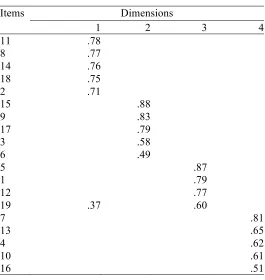
The Cronbach alpha coefficient for the SEMLI-S scores was found to be .87. Moreover, It was calculated for the dimensions of CC, MEP, SE, AW and found to be .86, .73, .84, and .80, respectively. Exploratory factor analysis with principal component and direct oblimin rotation was conducted to validate structure of the SEMLI-S. The results of the EFA were parallel with the results of (Gokalp and Kirbulut 2013). In the current study, it was seen that four factor was explained 61% of the variance of the data (see Table 5). Moreover, item distribution to the factors and pattern coefficients of the items can be seen in Table 6.
Table 5. Eigenvalues and total variance explained by factors for the SEMLI-S
Component Initial Eigenvalues Rotation Sums of Squared Loadings
Total % of Variance Cumulative % Total % of Variance Cumulative %
1 5.93 31.21 31.22 5.93 31.22 31.22
2 2.49 13.08 44.30 2.49 13.08 44.30
3 1.73 9.10 53.40 1.73 9.10 53.40
4 1.46 7.68 61.07 1.46 7.68 61.07
5 .90 4.72 65.79
Table 6. Factor pattern coefficients of the items for the SEMLI-S
Items Dimensions
1 2 3 4
11 .78
8 .77
14 .76
18 .75
2 .71
15 .88
9 .83
17 .79
3 .58
6 .49
5 .87
1 .79
12 .77
19 .37 .60
7 .81
13 .65
4 .62
10 .61
16 .51
Procedure
The SEMLI-S and CLES was published at an online survey tool provided by a science related website. The public access to these two instruments was restricted and only the pre-service teachers who invited to the survey were able to take. The SEMLI-S and CLES was
administrated to the participants in a computer laboratory during fall semester of 2012-2013 academic year. The data provided by participants stored in an online database. After getting all responses, the data were exported to the offline data file. This file was used to analyse the data
Data analysis
In order to investigate the role of the dimensions of the pre-service elementary school teachers’ metacognitive science learning orientations in predicting their use of constructivist learning environment, four separate Multiple Linear Regression (MLR) analyses were conducted. The outcome variables were the dimensions of the CLES: the U, the CV, the SC, and the SN. The predictor variables were the dimensions of the SEMLI-S: the CC, the MEP, the SE, and the AW.
Results
In total four MLR analyses were carried out to see if the dimensions of the SEMLI-S were significant predictors of the dimensions of the CLES. The first MLR was conducted to see if the dimensions of the SEMLI-S were significant predictors of the U. The results of this MLR indicated that the four predictors (SE, AW, CC, MEP) explained 15.5% of the variation in the U. It was found that the SE predicted U (β = .19, p<.05), as did the AW (β = .28, p<.05).
dimensions of the SEMLI-S. The MEP (β = .17, p<.05) and AW (β = .32, p<.05) were the significant predictors of the CV. At the next MLR, it was found that none of the predictors was significantly predicted the SC. The last MLR was carried to see if four dimensions of the SEMLI-S were the significant predictors of the SN dimension of the CLES. The results of that analysis showed that 19.3% of the variance accounted by the predictors. It was found that the AW significantly predicted the SN (β = .35, p<.05).
Conclusion and discussion
The study was carried to investigate the relationship between pre-service elementary school teachers’ metacognitive science learning orientations and their use of constructivist learning environment. It was hypothesized that the pre-service elementary school teachers’ use of constructivist learning environment are related with their metacognitive science learning orientations. This relationship was investigated by taking each of the dimensions of the SEMLI-S and CLES. The MLR was employed to have evidences about this relationship. In line with Schommer-Aikins’ study (2004) and Yilmaz-Tuzun and Topcu’s study (2010), it can be concluded that the data supports the SE and AW dimensions of the metacognitive science learning orientations can be used to predict to what extent pre-service elementary school teachers design learning environment suitable to convey the idea of uncertainty and limitations of scientific knowledge. Moreover, in contrast to Yilmaz-Tuzun and Topcu’s study (2010), it was found that the pre-service elementary school teachers’ scores on the MEP and AW dimensions of the SEMLI-S can be used to predict their scores on the CV dimension of the CLES. This means that if pre-service elementary teachers monitor, evaluate, and plan their pedagogical actions and if they were aware of the limitations of their learning, they establish more social learning environment. One other results of the current study suggested that pre-service elementary school teachers’ approach to give opportunities to their students to speak out on their own pedagogical actions cannot be predicted by any dimensions of the SEMLI-S. It was also concluded that pre-service elementary school teachers’ scores on the AW dimension of the SEMLI-S can predict their preference of providing classroom climate for students to discuss their ideas with other students. Presence of relationship between student negotiation and metacognition was also corroborated the earlier studies (Schommer-Aikins, 2004; Yilmaz-Tuzun & Topcu, 2010).
Implications for practice
References
Adey, P., Shayer, M., & Yates, C. (1989). Cognitive acceleration: The effects of two years of intervention in science classes. In P. Adey, J. Bliss, J. Head, & M. Shayer (Eds.), Adolescent development and school science (pp. 240-247). London: Falmer Press.
Afflerbach, P. (2000). Verbal reports and protocol analysis. In M. L. Kamil, P. B. Mosenthal, P. D. Pearson, & R. Barr (Eds.), Handbook of reading research (pp. 163-179). Mahwah, New Jersey: Lawrence Erlbaum Associates. Aldridge, J. M., & Fraser, B. J. (2000). A cross-cultural study of classroom learning environments in Australia and
Taiwan. Learning Environments Research, 3(2), 101-134.
Aydin, S., Boz, Y., Sungur, S., & Cetin, G. (2012). Examination of pre-service chemistry teachers’ preferences for creating constructivist learning environment. Hacettepe University Journal of Education, 42, 36-47.
Baird, J. R., & Northfield, J. R. (1992). Learning from the PEEL experience. Melbourne, Victoria: Monash University Press.
Beeth, M. E. (1998). Teaching for conceptual change: Using status as a metacognitive tool. Science Education, 82(3), 343-356.
Bedel, E. F. (2012). An examination of locus of control, epistemological beliefs and metacognitive awareness in preservice early childhood teachers. Educational Sciences: Theory and Practice, 12(4), 3051-3060.
Belet, S. D., & Guven, M. D. (2011). Metacognitive strategy usage and epistemological beliefs of primary school teacher trainees. Educational Sciences: Theory and Practice, 11(1), 51-57.
Brown, A. L. (1978). Knowing when, where, and how to remember: A problem of metacognition. Advances in Instructional Psychology, 1, 77-165.
Brown, A. (1987). Metacognition, executive control, self-regulation, and other more mysterious mechanisms. In F. E. Weinert & R. H. Kluwe (Eds.), Metacognition, motivation, and understanding (pp. 65-116). Hillsdale, New Jersey: Lawrence Erlbaum Associates.
Chi, M. T. H. (1987). Representing knowledge and metaknowledge: Implications for interpreting metamemory research. In F. E. Weinert & R. H. Kluwe (Eds.), Metacognition, motivation, and understanding (pp. 239-266). Hillsdale, New Jersey: Lawrence Erlbaum Associates.
Dorman, J. P., Fraser, B. J., & McRobbie, C. J. (1995). Associations between school-level environment and science classroom environment in secondary schools. Research in Science Education, 25(3), 333-351.
Driscoll, M. P. (2000). Psychology of learning for instruction. Needham Heights: Allyn & Bacon.
Flavell, J. H. (1971). First discussant’s comment: What is memory development the development of? Human Development, 14(4), 272-278.
Flavell, J. H. (1979). Metacognition and cognitive monitoring: A new area of cognitive-developmental inquiry.
American Psychologist, 34(10), 906-911.
Flavell, J. H. (1981). Cognitive monitoring. In W. P. Dickson (Eds.), Children's oral communication skills (pp. 35-60). New York: Academic Press.
Fosnot, C. T., & Perry, R. S. (2005). Constructivism: A psychological theory of learning. In C. T. Fosnot (Eds.),
Constructivism: Theory, perspectives, and practice (pp. 8-38). New York: Teachers College Press. Fraser, B. J., & Walberg, H. J. (2005). Research on teacher-student relationships and learning environments:
Context, retrospect and prospect. International Journal of Educational Research, 43(1), 103-109.
Gokalp, M.S., & Kirbulut, Z.D. (2013). Investigating pre-service elementary school teachers’ metacognitive science learning orientations. Anthropologist, 16(1-2), 177-184.
Hennessey, M. G. (1999, April). Probing the dimensions of metacognition: Implications for conceptual change teaching-learning. Paper presented at the annual meeting of the National Association for Research in Science Teaching, Boston, MA.
Hennessey, M. G. (2003). Metacognitive aspects of students’ reflective discourse: Implications for intentional conceptual change teaching and learning. In G. M. Sinatra & P. R. Pintrich (Eds.), Intentional conceptual change
(pp. 103-132). Mahwah, New Jersey: Lawrence Erlbaum Associates.
Hewson, P. W., Beeth, M. E., & Thorley, N. R. (1998). Teaching for conceptual change In K. G. Tobin & B. J. Fraser (Eds.), International handbook of science education (pp. 199-218). Netherlands: Kluwer Academic Publishers.
Kluwe, R. H. (1987). Executive decisions and regulation of problem solving. In F. E. Weinert & R. H. Kluwe (Eds.),
Metacognition, motivation, and understanding (pp. 31-64). Hillsdale, New Jersey: Lawrence Erlbaum Associates.
McRobbie, C. J., & Fraser, B. J. (1993). Associations between student outcomes and psychosocial science environments. Journal of Educational Research, 87(2), 78-85.
Osborne, J.W. (1998). Measuring metacognition: Validation and assessment of cognition monitoring effectiveness. Unpublished PhD thesis. Buffalo: State University of New York.
Partin, M. L., & Haney, J. J. (2012). The CLEM model: Path analysis of the mediating effects of attitudes and motivational beliefs on the relationship between perceived learning environment and course performance in an undergraduate non-major biology course. Learning Environment Research, 15, 103-123.
Schommer-Aikins, M. (2004). Explaining the epistemological belief system: Introducing the embedded systemic model and coordinated research approach. Educational Psychologist, 39(1), 19-29.
Schraw, G., Crippen, K. J., & Hartley, K. (2006). Promoting self-regulation in science education: Metacognition as part of a broader perspective on learning. Research in Science Education, 36, 111-139.
Stevens, J. (2009). Applied multivariate statistics for the social sciences (5th ed.). New York: Routledge. Tabachnick, B. G., & Fidell, L. S. (2007). Using multivariate statistics (5th ed.). Boston: Allyn and Bacon. Taylor, P. C., Fraser, B. J., & Fisher, D. L. (1997). Monitoring constructivist classroom learning environments.
International Journal of Educational Research, 27(4), 293-302.
Thomas, G., Anderson, D., & Nashon, N. (2008). Development of an instrument designed to investigate elements of science students' metacognition, self-efficacy and learning processes: The SEMLI-S. International Journal of Science Education, 30(13), 1701-1724.
Tsai, C. C. (2000). Relationships between student scientific epistemological beliefs and perceptions of constructivist learning environments. Educational Research, 42(2), 193-205.
Yilmaz-Tuzun, O., & Topcu, M. S. (2010). Investigating the relationships among elementary school students’ epistemological beliefs, metacognition, and constructivist science learning environment. Journal of Science Teacher Education, 21(2), 255-273.
Veenman, M. V. J., Van Hout-Wolters, B. H. A. M., & Afflerbach, P. (2006). Metacognition and learning: Conceptual and methodological considerations. Metacognition Learning, 1(1), 3-14.
von Glasersfeld, E. (1993). Questions and answers about radical constructivism. In K. Tobin (Eds.), The practice of constructivism in science education (pp. 23-38). Washington DC: AAAS Press.
Walberg, H.J. & Anderson, G.J. (1968). Classroom climate and individual learning. Journal of Educational Psychology, 59(6), 414-419.
White, R. T. (1988). Learning science. London: Blackwell.
Wolf, S. J., & Fraser, B. J. (2008). Learning environment, attitudes, and achievement among middle-school science students using inquiry-based laboratory activities. Research in Science Education, 38(3), 321-341.