Integrating Scientific Practice Into Online
Environments
Janelle Pagea and Cameron Earlb
Corresponding author: Janelle Page ( [email protected])
aDepartment of Rural Human Biosciences, La Trobe University, BendigoVIC 3550, Australia bDepartment of Health and Environment, La Trobe University, BendigoVIC 3550, Australia
Keywords: online learning, flexible delivery, microbiology practicals, food safety
International Journal of Innovation in Science and Mathematics Education, 21(3), 34-41, 2013
Abstract
This paper focuses on an innovation converting laboratory based food microbiological activities into a flexible online format for a subject offered at the La Trobe Rural Health School (Bendigo). Until 2012, this subject contained face-to-face laboratory sessions to demonstrate the applications of a number of microbiological techniques. Offering this subject in a face-to-face format alone has become impractical with more students choosing to learn off campus. It is important to note that the outcomes of the laboratory sessions were not for the students to gain a level of competency but a clear understanding of the microbiological techniques and processes.
The laboratory sessions were replaced with a series of short purpose made videos demonstrating techniques such as sampling and culturing; the findings were presented in PowerPoint presentations supported with verbal commentary; and the learning outcomes were assessed using an online quiz. Additionally, online activities included a project activity booklet that incorporated general questions for the students to undertake prior to attempting that quiz. The students demonstrated good understanding of the key aspects of food microbiology, sampling techniques, and food safety management approaches through the quiz results. Additionally, the students were supportive of the online format, as reported in the survey data, as it provided a flexible study-option and higher level of accuracy within the demonstrations.
Introduction
As universities transition towards a more student centred approach to teaching and learning, academic staff are faced with new challenges in the design, delivery and educational outcomes required to meet the changing needs of students enrolled in higher education courses. Students, particularly those coming from regional areas, may have challenges with geographic distance and competing priorities such as paid employment (McInnis, James & McNaught, 1995), forcing universities to explore avenues to increase access and flexibility in course delivery. Also to keep students motivated, academics must design a curriculum that is engaging, relevant and conducive to the online environment.
be challenging when working within the online environment. Academics must also consider the different styles, times, paces and places of learning to encourage engagement and retention. Hughes (2006) added the importance of providing students with clear guidance to assist their transition from the face-to-face medium to an online learning environment.
Graduates from university must be work ready and in response to this, La Trobe University has implemented the Future Ready: Strategic Plan 2013-2017 to address the changing needs and attitudes of students. Academics are being encouraged through the implementation of this plan to be creative in their teaching strategies by blending traditional face-to-face delivery with online educational resources (La Trobe University, 2013). This movement in higher education is well supported in the literature with numerous authors reporting success with online content delivery, confirming that this medium can work as well as traditional face-to-face delivery (for example: King and Hildreth, 2001; Gilman, 2006).
While online learning is now a recognised teaching method, there are still various limitations in the types of activities that can be effectively conducted in this environment. Scientific laboratory based activities have traditionally been offered in face-to-face classrooms where techniques and skills are a required learning outcome. However, the student cohorts within this trial come from non-biology majors and do not have skill development as a learning outcome. McConnell and Schoenfeld-Tachner (2001) suggests that course objectives may still be met in non-biology majors where the development of the skills needed to manipulate laboratory equipment are not as important as developing an understanding of the process undertaken along with the outcome of the experiment.
This paper examines students’ perceptions of undertaking an online practical activity as a substitution for hands on experiments in a food microbiology class.
Background
This paper reviews a trial of the integration of an online food microbiological learning experience into cohorts of undergraduate and graduate students within the Environmental Health programs delivered by the Faculty of Health Sciences, La Trobe University (Bendigo). The majority of undergraduate students had access to the Bendigo campus and received a mixed mode delivery of face-to-face lectures and tutorials, while the postgraduate students had virtually no direct access and received all content for the subject online. Both cohorts undertook the food microbiological practical online. It is important to note that the purpose of these activities is to build knowledge on food microbiological techniques and not to provide skills training.
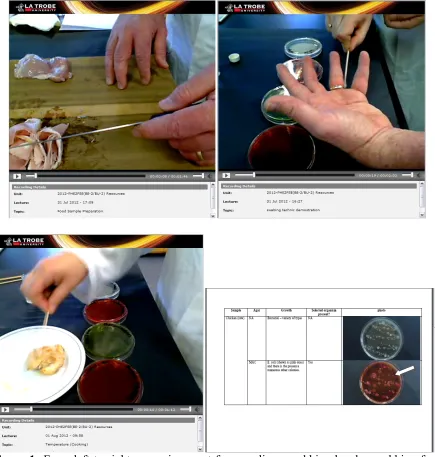
incubator. Figure 1 provides an indication of the production quality of the video and PowerPoint resources.
Photographs were taken of the resulting agar plates showing growth of key food poisoning microorganisms present. The photographs, along with brief discussions explaining different agar mediums used, numbers of colonies, and interpretation of results were placed in separate PowerPoint presentations for the students to review. The project activity booklet guided students through each step of the experiments shown within the videos and provided a mechanism to guide students to analyse and interpret each activity being demonstrated. Once completed, this booklet aided the students in completing the assessment (an online quiz).
The quiz was aligned to the subject objectives and tested knowledge on key concepts of microbiological food safety. The questions were multiple-choice to allow electronic marking, and students had one hour to complete the test and were limited to one attempt. This online test made up 10% of the overall mark for the subject.
The study
A cross sectional design was used for this study (Morton, Hebel and McCarter 1990; Protney and Watkins 1993) involving a survey methodology for the collection of self-report data from the study cohort. This study was conceptualised as an exploratory study so no formal hypothesis testing was conducted. The results are presented in a descriptive form only in tables showing counts and percentages. Survey Monkey was used as the data collection tool as study participants were off campus.
Survey Instrument
The survey tool for the study was designed to collect data on student perspective on the overall learning experience, functionality of the activity, linkages with the assessment items and general satisfaction as a participant. The survey was delivered through Survey Monkey. The survey instrument had been piloted and modified prior to the study. The questionnaire was designed for completion in 15 to 25 minutes and contained a combination of closed and open questions.
Statistical methods
The associations between variables are summarised in tables showing counts and percentages. As this was an exploratory and descriptive study, little statistical testing was employed.
Study Participants
The study participants were students enrolled in Food Science Essentials (PHE2FSE) with 21 students enrolled in 2012 with 62% (n=13) participating in the review of the online microbiological activity. The study cohort consisted of undergraduate and postgraduate students within the Environmental Health academic programs provided at La Trobe University (Bendigo, Victoria).
Findings
Participants were asked to comment on a range of general factors such as instructions and support, with Table 1 providing a summary of these results. The participants considered there was adequate instruction to complete the online task, it was detailed enough and there was adequate support given to those who needed it. Overall, the participants considered the instructions were “detailed enough” and “super easy to understand”. Additionally, “the information we required [to do the practical] was presented in lectures and in the project activity booklet that we completed before doing the online quiz”.
Table 1: Summary of survey participant responses to level of instruction and support provided for the online practical activities
Questions Yes No NA
Were there adequate instructions provided to allow you to navigate through all the practical activities?
100% (n=13) 0 (n=0) 0 (n=0) Did you consider there was enough detail provided to
support your learning experience?
93% (n=12) 7% (n=1) 0 (n=0) If you needed assistance while undertaking these
activities did you receive adequate support from staff?
31% (n=4) 0 (n=0) 69% (n=9)
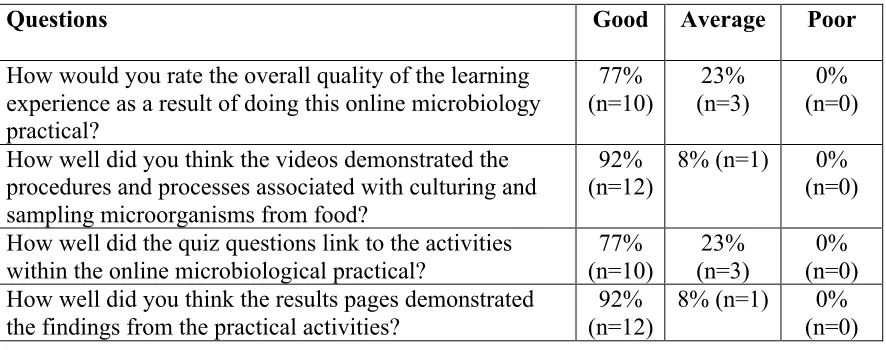
Table 2: Summary of survey participant responses to their learning experience and the quality of the online practical resources and quiz
Questions Good Average Poor
How would you rate the overall quality of the learning experience as a result of doing this online microbiology practical? 77% (n=10) 23% (n=3) 0% (n=0)
How well did you think the videos demonstrated the procedures and processes associated with culturing and sampling microorganisms from food?
92% (n=12)
8% (n=1) 0% (n=0)
How well did the quiz questions link to the activities within the online microbiological practical?
77% (n=10) 23% (n=3) 0% (n=0) How well did you think the results pages demonstrated
the findings from the practical activities?
92% (n=12)
8% (n=1) 0% (n=0)
For the video component of the activity the view was that “the videos were very informative and were done well”. One student did however suggest that it would be better to have “…one video with the [sampling process] and the results in one would be more beneficial”.
The quiz was seen as linking well with the objectives of the activity as “…the questions for the quiz [clearly focused on] the concepts of basic good food safety management conditions”.
Overall, participants considered that the online activity was “clearly set out [and] very helpful” and the materials were “very easy to understand” and “helped me to grasp the topic much better”.
The students provided positive feedback on their experiences with the online microbiological activities. Most commented on the flexibility the online activity provided them (“you can take your time”; “could have my notes open”; “didn't feel under time pressure”; and “nobody else to distract me or ask questions”). The students found the content relevant (“gained a bit of experience of how food safety can be managed”); the activities were “easy to follow” and they received “instant feedback” on their work.
The greater majority of the participants were satisfied with the overall experience (“was a good assessment”); however, one commented that “it was hard to see the overall flow of how these experiments are done”. Two students did provide recommendations -“having longer videos, putting more information in one video instead of breaking them up” and “[The quiz] could have been longer to really test you”.
Additionally it was noted that student learning outcomes, measured by the associated assessment, improved by 10% over the previous years cohort of students. This supports student comments that the experience of an online practical did not disadvantage their learning as they “still got the same information from it [the online practical] as if had attended [a face-to-face practical] and it took less time than if we had completed the practical ourselves”.
Discussion
The online food microbiological trial discussed in this article was considered by the academic staff and students to be innovative and successful at transitioning face-to-face laboratory activities to the online environment. Particular strengths of this activity were the use of professional laboratory staff to develop the instructional videos; the supportive project activity booklet that guided student analysis and knowledge development; and the flexibility of undertaking the activity at their leisure. Meeting student expectations was a key measure to the effectiveness of this trial with students providing constructive feedback as shown in the findings. Overall the participants found the online activity was easy to follow and aided in their understanding of the key topics associated with food safety.
From an academic perspective, the learning outcomes for the exercise were met as the greater majority of the class demonstrated a strong understanding of the main causes of microbiological contamination of food, and were able to identify key strategies to manage food safety through successfully answering the quiz questions and completing the project activity booklet. This cohort also attained a higher average mark for the equivalent assessment from the previous cohort. This was encouraging and supported the positive feedback provided by the students through their survey responses. It is important to note that considerable effort was taken to ensure that constructive alignment between the learning outcomes and the assessment task occurred.
activity has been redeveloped into the online learning environment, it cannot be assumed that learners will engage with the learning process. With this in mind and to compensate for losing the face-to-face contact, students were encouraged to actively participate in online forums to discuss the linkages between the theory and observational outcomes expected from the demonstrations in the week prior (through the La Trobe University LMS site). The general forums for discussion between students were available twenty four hours a day which were moderated by academic staff members as required. As suggested by Lim (2004) detailed guidance information on access, navigation, technical requirements and expected time required to complete the activity were provided the week before and academic staff were available at specific times to answer any technical or content questions during the activity.
Lance and Kitchen (2007) have suggested that the use of video footage within a teaching and learning strategy could ‘enhance or support a students’ preferred learning style’ in the higher education environment (Lance and Kitchen, 2007, p. 115). Consequently this strategy was adopted as the main pedagogical focus and a series of short, videos depicting key food sampling and safety demonstrations were developed. The challenges were numerous as there was no funding, training, or technological support for the developmental process and the production costs had to be kept low. As a result the making of the videos was based on the “YouTube” style of production that Duffy considers ‘popular, forceful and familiar’ (Duffy, 2008, p.124). This meant the videos were developed using simple language and visual effects, and focused clearly on the activity being demonstrated (and not the demonstrators). The use of video recordings has added benefits in the online environment as it can be relayed to large numbers of students simultaneously, is available on demand, is can be paused, re-viewed, and as described by one student “[You can] take your time, such as watching the videos, you could do it at a time that was suited to you”.
Recommendations
The key recommendations from undertaking this online food microbiological activity were: • Ensure that the students are provided detailed guidance information prior to
commencing the activity;
• Development of video footage that includes simple language that is targeted, concise and straight to the point with the visual focus on the activity being demonstrated in a medium that is natural (not over produced); and
• Ensure the online activities are aligned to the expected learning outcomes.
Conclusion
References
Bernard, R.M., Abrami, P.C., Lou, Y., Borokhovski, E., Wade, A., Wozney, L., Wallet, P.A., Fiset, M. & Huang, B. (2004). How does distance education compare with classroom instruction? A meta-analysis of the empirical literature. Review of Educational Research, 74(3), 379 – 439.
Candy, P. C., Crebert, G. & O’Leary, J. (1994). Developing lifelong learners through undergraduate education.
National Board of Employment, Education and Training, Australian Government Publishing Service. Clark, R.C. & Mayer, R.E. (2002). E-Learning and the Science of Instruction: Proven Guidelines for
Consumers and Designers of Multimedia Learning. San Francisco: Jossey-Bass Pfeiffer.
Dewhurst, D.G., McLeod, H.A. & Morris, T.A.M. (2000). Independent student learning aided by computers: An acceptable alternative to lectures? Computers and Education, 35(3), 223-241.
Duffy, P. (2008). Engaging the YouTube Google-Eyed Generation: Strategies for Using Web 2.0 in Teaching and Learning. The Electronic Journal of e-Learning, 6(2), 119-130
Gilman, S.L. (2006). Do online labs work? An assessment of an online lab on cell division. American Biology Teacher, 68(9), 131134
Herrington, J., Oliver, R. & Reeves, T.C. (2003). Patterns of engagement in authentic online learning environments. Australian Journal of Educational Technology, 19(1), 59-71.
Hughes, L. E. (2006). Improvement of classroom teaching through online course development. Focus on Microbiology Education 12 (3), 7-9.
Johnson, E. O., Charchanti, A. V., Troupis, T. G. (2012). Modernization of an anatomy class: From conceptualization to implementation. A case for integrated multimodal – multidisciplinary teaching.
Anatomical Sciences Education. 5:6, 354-366.
King, P. & Hildreth, D. (2001). Internet courses: are they worth the effort? Journal of College Science Teaching. 31(2), 112-115.
Lance, J. & Kitchin, P. (2007). Promoting the Individual Learning Styles of Masters Students Studying
Marketing-related Modules through the Use of YouTube Video-clips. Investigations in University Teaching and Learning, 4(2), 111-115.
La Trobe University (2013). Future Ready: Strategic Plan 2013-2017, La Trobe University Publication: Melbourne.
Lim, C. P. (2004). Engaging Learners in Online Learning Environments. TechTrends: Linking Research & Practice to Improve Learning, 48(4), 1623.
McConnell, S. & Schoenfeld-Tachner, R. (2001). Transferring your passion for teaching to the online environment: A five step instructional development model. EJournal of Instructional Science and Technology, 4(1).
McInnis, C., James, R. & McNaught, C. (1995). First year on campus: diversity in the initial experiences of Australian undergraduates. A commissioned project of the committee for the advancement of university teaching. Centre for the Study of Higher Education, University of Melbourne.
Morton, R.F., Hebel, J.R. & McCarter, R.J. (1990). A Study Guide to Epidemiology and Biostatistics, Aspen Publications, Maryland.
Movahedzadeh, F. (2012). Improving student success through hybrid mode of delivery in nonscience major biology classes. Education, 2(7), 333-339.
Portney, L.G. & Watkins, M.P. (1993). Foundations of Clinical Research: Applications to Practice, Prentice Hall, Sydney.
Quinn, C. N. (2011). Designing mLearning: Tapping into the mobile revolution for organizational performance. San Francisco; Pfeiffer, (A Wiley Imprint).
Russell, T.L. (1999). The “No significant difference” phenomenon. Raleigh: North Carolina University. Tapscott, D. (1997). Growing Up Digital: The Rise of the Net Generation. McGraw-Hill, New York.Wray, M., Lowenthal, R., Bates, B. & Stevens, E. (2008). Investigating perceptions of Teaching online & F2F. Academic