1
First Year Physics Students’ Expectations
of the Role of Mathematics in Physics
Jeanne Krieka, Reuben D. Koontsea
Corresponding author: Jeanne Kriek ([email protected])
aUniversity of South Africa
Keywords: use of mathematics in physics; expectations; tutorial sessions; self-efficacy; actual behavior
International Journal of Innovation in Science and Mathematics Education, 25(2), 1-16, 2017.
Abstract
Students’ use of mathematics in physics is one area where expectations impact significantly on the learning of physics. First-year physics students' expectations of the role of mathematics in physics were explored to determine if that provided an indication of their actual behavior when solving problems, a contributing factor to their learning of physics. Three data sources (Student Expectations of the Role of Mathematics in Physics (SERMP) survey, focus group interviews and students' test scripts) were used. A theoretical framework for physics education was selected which lead to a two-level system; a knowledge-structure level where associational patterns dominate, and a control structure level where one can describe expectations and epistemology. A survey and focus group interviews were used to investigate 193 University of Botswana (UB) 1st-year physics students’ expectations of
the use of mathematics in physics. To explore the effect of students’ expectations on their actual use of mathematics when solving physics problems these students' test scripts were analyzed. It was found that students were aware of what they were able to do (self-efficacy). Therefore students’ expectations need to inform the way teaching of physics is done, especially in tutorial sessions where the focus of some universities is on solving problems.
Introduction
Students' beliefs and expectations can be a contributing factor to the learning of science (Kritsadatan & Wattanakasiwich, 2014) and need to be considered when developing new teaching methods (Häkkinen, et al., 2016). Cognitive expectations are beliefs about the learning process, the structure of knowledge and what students think is required of them to pass a course. Therefore expectations are partly influenced by pedagogy as well as students’ prior learning and, in turn, inform students’ epistemological stance (Redish, Saul, & Steinberg, 1998). Students’ expectations of a particular subject play an important role in the posture that they assume and the subsequent learning culture that develops (Kritsadatan & Wattanakasiwich, 2014).
2
affect their learning behaviors. The role of mathematics in the teaching and learning in physics has been discussed in an article by Redfors, Hansson, Hansson, & Juter (2014), however, their focus was to describe what happens in the real world by organizing explanations through theories and theoretical models. All these cited studies fall short in terms of giving the background that may help explain what students' expectations are with regard to the use of mathematics in physics.
Students’ use of mathematics in physics is mainly during problem-solving (Maloney, 1994) and this is a critical dimension in the learning of physics. Problem-solving has been identified by institutions as a generic skill that is desirable and expected as a key competency in students when they finally graduate (Billing, 2007). Furthermore, it is regarded as the heart of the work of a physicist (Fuller, 1982). To a large extent problem-solving in physics implies the use of mathematics and will be referred to as the role of mathematics in physics in this study.
It is a valid expectation that how students use mathematics in physics would be based on their expectations of the role of mathematics in physics. This relationship between students’ expectations and their actual use of mathematics in physics should lead to the quality of learning that results.
Context
A component of physics programs at universities is tutorial sessions which form part of the learning process. Tutorial sessions are normally in classrooms, tutoring centers or on-line, and the aim is to appoint tutors or teaching assistants (TAs) to help students one-on-one. In face-to-face institutions, these tutors are normally honors or post graduate students. Physics tutorial sessions could be inquiry-based physics tutorials (Conlin, Gupta, Scherr, & Hammer, 2008) or recently the traditional teaching-assistant-led recitation was replaced in some institutions with worksheet-based group-learning activities (‘tutorials’) based on the model developed at the University of Washington (McDermott, Shaffer et al., 1998; McDermott, Shaffer, & Somers, 1994). During these sessions, students are led to make predictions and compare various lines of reasoning in order to build an understanding of basic concepts (Scherr & Hammer, 2009). However, this is not the practice in all universities. This study was done in a university where tutorial sessions are an opportunity for students to solve physics problems related to lectures and this is specifically where mathematics is used in physics.
This study was done in the University of Botswana (UB) and is the only institution currently offering physics degrees where all high school completers from urban, rural, resourced and under-resourced schools converge. Diverse trends in the background of students entering their physics degree courses, as well as the decreasing familiarity with mathematics, exacerbate the problem of use and understanding of mathematics in physics (Tinkers, Lambourne, & Windsor, 1999). Therefore it offers a rich and interesting population for investigating the topic.
Theoretical Framework and Methodology
3
manage prospective situations (Bandura, 1979; Lindstrom & Sharma, 2011). Self-efficacy beliefs are not simply predictions about behavior; they are concerned not with "that I believe I will do but with what I believe I can do" (Maddux, 2000, p. 4).
This fits with a theoretical framework for physics education which leads to a two level system; a knowledge-structure level where associational patterns dominate and a control structure level where one can describe expectations and epistemology (Redish, 2004). Expectations are epistemological frames that control the activation of knowledge resources.
A frame is a way to interpret an event, utterance, or situation in a particular way based on previous experience (Scherr & Hammer 2009). For example, an individual or group forms a sense of ‘What is it that’s going on here?’ (Goffman, 1986; MacLachlan & Reid, 1994; Tannen, 1993). Frames are also described as a cognitive process that depends on input from the physical world, from culture, and from social interactions such as learning. Frames, therefore, involve perceiving, interpreting, and activating a particular set of long-term memories for dealing with a situation. In simple terms, an individual’s expectations can be described through frames. For example, when students enter a learning environment they frame what is happening and an epistemological component would be: "How will I learn or build new knowledge here? Or what counts as knowledge here?" (Redish, 2004, p. 33).
Students' beliefs and expectations influence their behaviours in the learning and studying of physics (Kritsadatan & Wattanakasiwich, 2014; Redish, 2004) and therefore exploring first year physics students' expectations of the role of mathematics in physics could provide an indication of their actual behaviour when solving problems, a contributing factor to their learning of physics.
Research Question
The study, therefore, set out to explore two research questions, namely:
What are students’ expectations of the role of mathematics in physics?
Do their expectations of the role of mathematics in physics influence their actual use when solving physics problems?
Instruments
An expectation survey, focus group interviews as well as students’ test scripts were used to collect data.
Expectation Survey
4
The selection of questions from these three science education questionnaires was done as follows:
The MPEX questionnaire was originally designed to probe six clusters, namely independence, coherence, concepts, reality link, maths link, and effort. The survey for this study adapted items that were in the mathematics link cluster. For example, item 19 from MPEX stated “the most crucial thing in solving a physics problem is finding the right equation to use” and were used as item 11 in the expectation survey (see Appendix).
For the 50 items that constitute VASS there were no specific categories related to the role of mathematics in physics, however some items such as item 19: "Physicists use mathematics: (a) to express their knowledge in meaningful ways or (b) to get numerical answers to physics problems" were used to develop items for the survey around the same ideas (see for example item 16). Another example from VASS is item 35 which read: “The first thing I do when solving a physics problem is: (a) represent the situation with sketches and drawings (b) search for formulas that relate givens to unknowns”. This was changed to item 18 in the survey which reads, “The first thing that I do when solving a physics problem is to search for formulae that relate givens to unknowns”.
Similarly, EBAPS had items such as no. 20: "In physics and chemistry, how do the most important formulas relate to the most important concepts?" This was changed in the survey to item 19: "To be able to use an equation in a problem, I need to know what each term in the equation represents". EBAPS contributed to the construction of item 25 in the survey “I treat equations as representations of reality” where the original item 12 in EBAPS was “when learning science, people can understand the material better if they relate it to their own ideas”.
By carefully selecting relevant questions from the three mentioned questionnaires, the expectation survey as questionnaire resulted and was named Student Expectation of the Role of Mathematics in Physics (SERMP) (see Appendix A). SERMP consisted of thirty (30) items put along a 5-point Licker scale of; strongly agree, agree, neutral, disagree and strongly disagree.
Validity and trustworthiness of SERMP
The original MPEX instrument was validated by giving the survey to a variety of ‘experts’ and further refined after testing it through more than 15 universities and colleges in the USA (Omasits & Wagner, 2006). The VASS has been administered to over 10 000 US high school and university students and in many countries around the world. The validity and reliability of this instrument are discussed in Halloun, (2001, pp. 12, 13). The EBAPS, on the other hand, was validated after making two sets of revisions based on pilot subjects and informal feedback, and by getting approximately one hundred students, to whom it was administered, to write down their reasons for responding as they did to each item (Redish, 2003).
5
since they were teaching them and were considered as both face and content validity. Some of their overall comments included; aligning the items with the research questions and objectives, getting rid of negatively structured questions, and having only one statement in an item. All their suggestions were subsequently incorporated. Predicative validity was addressed by analyzing students’ test scripts to determine the behavior of the individuals when they were solving physics problems using mathematics.
Focus Group Interviews
Focus group semi-structured interviews were conducted with the students. Questions were also framed along the continuing analyses filtered from students’ responses to the SERMP as well as from their work on tests scripts. The interviews intended to further elicit “students’ expectations of the role of mathematics in physics”, with particular emphasis to the topic of electricity.
Validity and trustworthiness of the focus group interview
Prior to the interviews, the interview questions were shared and discussed with a colleague who advised on keeping the questions as open as possible, and allowing where possible, the interview to progress based on what the students were saying. The first interview was deliberately structured as general, with students asked to discuss the overall physics experience. This was to build rapport and establish proper context. Taking note of the context enhances validity and confirms the right questions to be asked. Rapport ensures reliability as students will discuss without any form of bias. That one researcher was involved in all the interviews, and that there were at least two interviews conducted per group, are other measures of reliability.
Test Scripts
A key source of data was the students’ work in their test scripts. Two sets of students’ test scripts were collected for the duration when the students were doing the electricity topic, which was the second semester. The first test consisted of questions mainly from the electric force and electric field subtopics while the second test covered the electric circuit subtopic. Both tests were divided into section A (25 marks) and Section B (75 marks). Section A was divided into 5 ‘short’ questions which accounted for five (5) marks each; students had to answer all questions in this section. Section B had 5 ‘long’questions which carried twenty-five (25) marks each; students had to answer 3 of the 5 questions in this section.
Validity and trustworthiness of the test scripts
Being aware of the course plan, the test scripts were valid, as the questions asked in the tests were from the same content reflected in the course plan.The UB Physics Department moderates all first-year test questions. The course instructor sets the test, and then a team of physics lecturers (normally 3–5 lecturers depending on the test) converges to assess and adjust the suitability, level and the timing that each question may require.
Participants
6 Pilot Study
SERMP was piloted midway through the first semester to three (3) tutorial groups (N = 40) chosen randomly; who would not be part of the groups that the questionnaire was given to for further analysis. A recurring comment from more than one student was that they did not understand the meaning of the word “intuitive “ which was used in item 16 that initially read, “a mathematical solution to a physics problem must make intuitive sense to me”. The item was changed to, “a mathematical solution to a physics problem must be meaningful to me”. The amount of time (at most 20 minutes) that it took students to complete the questionnaire was found to be both practical and fair.
Data Collection
The SERMP survey was administered during the tutorial sessions towards the end of the first semester. Each tutorial group was interviewed about 2-3 times during the semester for approximately one hour at a time and were audio recorded and later transcribed. Overall, 7 episodes of interviews covering approximately 7 hours were conducted. This was a period when the topic of electricity was being taught. The time interval between interviews of the same group was about 2-3 weeks.
Copies were made of students’ scripts submitted for marking, with their informed consent. Students work from the electric force; electric field and electric circuit subtopic were evaluated. The particular students’ solutions identified for even more detailed analysis were scanned and stored to make up this report.
Data Analysis
The SERMP survey is a pre–frame; where students indicate what they think about the use of mathematics in physics in general, based on their first semester’s experience. The semi-structured focus group interviews is a post-frame; where students were expected to reflect on their actual work on the electricity problems in the second semester and relate their mathematics experience. Data from the two instruments (SERMP and interviews) were corroborated to strengthen a particular frame or the resultant sub categories.
The analysis of the SERMP involved first noting students’ frequency response to individual items. Students’ responses to similar items were then put together into categories, however, due to the interlinking of the items in the SERMP there was some degree of overlap but in a bid to systematically search for meaning, and give a more organized and coherent view of students’ thinking, frames were created. Outstanding responses were also noted and their significance evaluated. These are worth noting because in qualitative studies, even “the point out of the graph” is important, as it may sometimes offer very valuable insight (Ritchie, Lewis, McNaughton Nicholls, & Ormston, 2003).
With regards to analysis of interview, the first step involved transcription of the audio-taped data. The transcription involved listening to the tapes several times, back and forth to pick all the important details. Cues such as gestures and tone were also taken note of during the time of the interview, as these are important aspects of communication as well (Gorrad, 2001).
7
These themes are similar to the categories used in the surveys. Points of emphasis, as well as recurring comments during the discussion, were also noted.
Thirty (30) scripts (10 from each tutorial group) were copied for analysis. Fifteen (15) students test scripts, five (5) from each of the tutorial groups M, V and H (referring to the rooms where the tutorials took place) were purposefully selected from the original 30 scripts for more detailed analysis. A comprehensive scan was done on each of the five per group for variation in terms of students’ approach and use of mathematics when solving the problems.
Integrating all the Analyses
The use of three data sources was so as to give more credence to the findings of the study. The different sources complement and corroborate each other. Depth would be achieved through triangulating the various data sources (survey, student’s scripts, and interviews). These three data sources were considered adequate to provide all the information required to answer the research questions. The various sampling sites: different tutorial groups (different tutors); different lecture streams (different lecturers); multiple tests (different electricity topics and questions); group interviews (multiple views) led to greater breadth.
What the students wrote in the survey, as well as what they said in the interviews about the role that mathematics plays in physics, was corroborated with the emerging trends when analyzing their mathematical use as applied to electricity physics problems in tests.
Results and Discussion
Data is presented by means of a frequency distribution of students’ response to the SERMP but only captured as an agreement percentage (see Table 1). In Table 1, the item in the SERMP and the corresponding percentage is indicated for example 9 (54.6%) would refer to item 9 in SERMP while 54.6% refers to the agreement percentage in this item.
Table 1: Analysis of SERMP
Relationship between mathematics and physics 9 (54.6%); 20 (10.9%); 23 (70.2%); 27 (80.3%)
Learn physics Understand physics No category Problem solving
Solve problems 1 (69.3 %) 24 (77.6%) 21 (65.1%)
Use of maths 14 (73.4%)
equation & test 29 (32%)
Find correct formula 18(91.1%); 11 (83.7%); 2(80.9%)
Knowledge 5 (70.1%)
Relationships 10 (75.4%)
Formulae to discovered 15 (57.8%)
Application of terms 19 (96.3%);
Derivations 22 (51.9%)
Application in everyday life 6 (73.2%)
Lecturer responsibility 17 (88.5%)
Equations as representation 25 (56.3%); 8 (58.6%)
Memorisation 4 (41.3%)
Solution and meaning 16 (84.9 %) 12 (50.3%)
Symbols in equations 13 (53.7%)
Apply to unknown 7 (28.3%)
8
The frames perceiving the relationship between mathematics and physics, to learn physics and to understand physics will be discussed by using students' responses to SERMP and supported with interview excerpts from the transcription of the audio-taped data. The no category were regarded as an opinion expressed by the students and were not regarded as relevant to the research questions, however, will be discussed as even “the point out of the graph” is important (see section on data analysis).
Relationship between Mathematics and Physics
Woolnough (2000) points out that since there is the real world, the physics world, and the mathematical world, each with different characteristics and belief systems, then mathematics and physics are different belief systems which are ontologically different. He further states that most students who perform well in mathematics and physics fail to make substantial links between these contexts largely because of conflicts between the different belief systems.
Items in SERMP related to the relationship between mathematics and physics were answered as follows: in item 27 the majority of students (80.3%) indicated that mathematics is useful in the physics classroom. Though in item 9 only (54.6%) students agreed that to solve problems in the physics class is the same compared to the mathematics class. A reason could be that in the physics class problem solving is a component of physics instruction and is performed to enhance conceptual understanding of students (Maloney, 1994).
The relationship between mathematics and physics were expressed in items 20 (10.9% - prefer to learn mathematics without physics) and item 23 (70.2% there can be no physics without mathematics). Students who took part in this survey were enrolled for an algebra-based physics course where the emphasis is on the relationship between variables and the majority of students indicated that they do not prefer to learn mathematics without physics. This supports the statement that they think there can be no physics without mathematics. This could also link to what Albe, Venturini, & Lascours (2001) reported: that university students’ performance in mathematics and physics showed that in both subjects, the students systematically prefer automatic, algorithmic procedures. The study noted that these preferences are overwhelming to the detriment of reflection on the role and status of procedures in mathematics and in physics. This was also confirmed in the interview with responses such as:"… you are being told about Coulomb’s law. It quite confuses you the first time. But once you do the calculations and see, you will get it" (M3).
Learn Physics
Mathematical expression forms are often used to describe models of physical events in the real world. The models are then manipulated mathematically and analyzed to make sense in relation to physical theories and the hypothesis or situation at hand, i.e. explanations of physical phenomena are organized through theories and theoretical models (Adúriz-Bravo, 2012). However students indicated in the SERMP that in order to learn physics you have to solve problems (Item 1 [69.3%], 24 [77.6%] & 21 [65.1%]) and know laws and equations (Item 5 [70.1%]).
9
means storage in the short term memory and it is suggested that information stored in short term memory is quickly forgotten after engagement with the task (Redish, 2004).
Understand Physics
In physics studies students have been found to struggle with explanations and the solving of physics problems when they need to relate theoretical models to real-world phenomena, especially while using mathematics, i.e. combining mathematical operations with conceptual reasoning about physical phenomena – realising that equations can express a supreme meaning (Kuo, Hull, Gupta, & Elby, 2012; Tuminaro & Redish, 2007; Uhden et al., 2012).
In the SERMP survey students indicated that the use of mathematics in problems makes understanding physics easier (Item 14 [73.4%]) and is also reflected in the focus groups, with comments such as: "Now as long as you can understand how the formula works it will be easy for somebody to pass" (H5). They also indicated that physical relationships can be explained using mathematics (Item 10 [75.4%]) and physics laws relate to experiences in real life (Item 6 [73.2%]).
With regards to the meaningfulness of a mathematical solution to a physics problem, students agree (84.9 %) and this was reflected in the interview with comments such as: "I think it is very important to understand the concepts" (H6); "if you don’t understand the concepts, you will have problems throughout" (H5). Only 50.3% appreciate that they sometimes get a mathematical solution and not understand the meaning. An example from the focus group echoed this idea: "I find the answer, not necessarily meaning I understand the concept" (M2). This indicated that although students know they have to understand mathematical solutions they don’t necessarily understand the solution; an indication of self-efficacy which is a person's belief of what they are capable of doing.
One of the key indicators of understanding is the ability to apply what you have learnt in different situations and this was also echoed by one of the students: "You need to apply maths in order to understand the physics" (M2) and "when you are taught concepts and then you might not get, but then when you apply maths then… it makes you believe, then you understand" (M1). However, only 28.3% of the students indicated that they can apply mathematical equations never seen before, again a good indication of students' self-reflection on their ability.
No Category
This category was established as outstanding responses, but its significance noted. An (Item 29 [32.6%]) agreement was indicated on the statement that if a student does not remember a particular equation needed for a problem in a test there is nothing they can do. This could be interpreted that they will actually engage and try to solve the problem rather than just quitting. This was also seen when students' test scripts were analyzed. Although their approach to answering the question was completely wrong they still tried.
There is a common myth that there is only one way to do science, namely the scientific method and this response could be interpreted that more than half (Item 15 [57.8%]) of the students agree that formulae describing physical relationships are "out there" to be discovered.
10
question was probed, the student explained what was happening in the class: "we are just given the solutions. And there is not much explaining of the key concepts, of which is vital" (H7). He further indicated "if you don’t get something from the lecturer, you are hoping to get it from the tutorials. And with our case, that’s not how it is". From this discussion, it shows that students would like more explicit explaining on how to use mathematics in physics and genuinely want to understand what the solution means.
Problem Solving
This frame will combine the responses from SERMP, interview excerpts as well as examples from two test scripts in order to address the second research question: Do their expectations of the role of mathematics in physics influence their behavior when solving physics problems?
The use of mathematics in physics is outlined as calculation, derivation and representation, and while acknowledging the role of calculation and derivation as important, the role of a special kind of problem-solving in which relationships are seen across physical domains needs to be emphasized (Tweney, 2011).
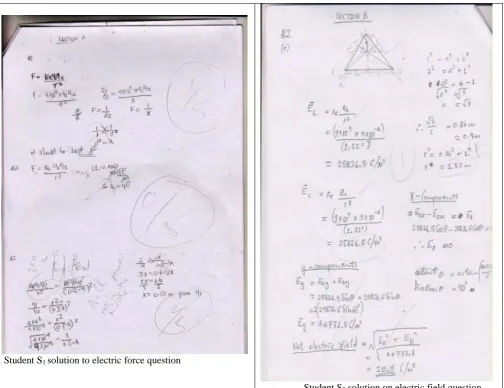
However, students rely on the ‘plug-and-chug’ approach when solving problems without really understanding the significance of the key concepts and relationships (Redish, 2005; Kuo et al., 2013). In this study the majority of students (Item 18 [91.1%]; item 11 [83.7%] and item 2 [80.9%]) indicated that they search for the correct formula and this was confirmed during the focus group interviews: "I only use the equation and get the answer" (M2) and "I just apply the equations" (M1). They also indicated that they often consult answers at the end of the book chapters without understanding as indicated by this comment: "I get a question, ok fine, I look for the correct mmm… the right formula to use, I use that formula, I check the answer at the back of the book" (M2). This was also seen when students solved problems in their test scripts. In these two examples, the formulas were written down without explanation as shown in Figure 1. Only student S2 indicated that he was calculating the x and y components as well as the net
11 Student S1 solution to electric force question
Student S2 solution on electric field question
Figure 1: Students' solution to questions on electric force and electric field respectively
A difference was noted when students indicated in the SERMP that they need to know each term in the equation (Item 19 [96.3%]) and that they think about the underlying concepts (Item 28 [79.8 %]) but when they reflected on their own understanding of the physical meaning of the equations only (Item 3 [41.8%]) agreed. An indication of self-efficacy was revealed in the interview: "even if you knew the equations, you may not be able to integrate it properly" (H5) and "ok the answer is correct but not necessarily understanding the concept...so I do have a problem sometimes" (M8).
This was also illustrated in the example of Student S2. If he understood the problem he would
have known that E1 = E2 without actually calculating both. Students do not seem to understand
that symbols in physics have a different purpose, that they represent meaning about physical systems rather than expressing abstract relationships.
This was also reflected in students' responses that there are physical relationships among variables (Item 8 [58.6%]), they take symbols in equations as representing numbers (Item 13 [53.7%]) and treat equations as representations of reality (Item 25 [56.3%]). Physical relationships (see the last section of student S1's work) and equations as representing numbers
12
test scripts. It could not be confirmed or refuted if students treated the equations as representations of reality.
Summary and Conclusion
First-year physics students' expectations of the role of mathematics in physics were explored and in addition, the effect of students’ expectations on their actual use of mathematics when solving physics problems was investigated.
To answer the two research questions, three data sources (expectation survey SERMP, focus group interviews and students' test scripts) were used to complement and corroborate each other. This study indeed confirmed that first-year physics students' expectations of the role of mathematics in physics provided an indication of their actual behavior when solving problems.
A contributing factor to students’ learning of physics is their expectations of the role of mathematics in physics and illustrated in frames. Frames were created in terms of the relationship between mathematics and physics and how they perceive to learn physics, understand physics and solve problems. Learning, understanding and solving problems in terms of the role of mathematics in physics are intertwined, as the one influences the other. However, it is clearly seen that these students were aware of what they were able to do (self-efficacy). For example, they indicated that they know that a mathematical solution to physics problems must be meaningful, but lack understanding of how to interpret solutions. This was also reflected in their test scripts and interviews.
Therefore students’ expectations need to inform the way teaching of physics is done especially in tutorial sessions where the focus of some universities is on solving problems. It is recommended that tutors need to be explicitly trained to concentrate on meaning, understanding, and application and not just encourage students to look for the appropriate formula to use.
In this way the following excerpt of a student: "I think actually getting a correct answer boosts your morale towards physics" (M3) can be changed to "actually understanding physics boosts your morale towards physics".
References
Albe, V., Venturini, P., & Lascours, J. (2001). Electromagnetic concepts in mathematical representation of physics. Journal of Science Education and Technology, 10(2), 197–203.
Adúriz-Bravo, A. (2012). A ‘semantic’ view of scientific models for science education. Science & Education 22(7), 1593–1611.
Bandura, A. (1986). Social foundations of thought and action: A social cognitive theory. Englewood Cliffs, NJ: Prentice- Hall Inc.
Bandura, A. (1979). Self-referent mechanisms in social learning theory. American Psychologist, 34, 439–441. Billing, D. (2007). Teaching for transfer of core/key skills in higher education: Cognitive skills. Higher
Education, 53, 483–516.
Chi, M.T.H., Feltovich, P.J., & Glaser, R. (1981). Categorization and representation of physics problems by experts and novices. Cognition Science, 5, 121–152.
Conlin, L.D., Gupta, A., Scherr, R. E., & Hammer, D. (2008). The dynamics of students' behaviours and reasoning during collaborative physics tutorial sessions, Physics Education Research Conference. AIP Conference Proceedings, Volume 951, pp. 69–72, (2007).
13
Fuller, R. G. (1982). Solving problems in physics. Physics Today (September), 43–47. Goffman, E. (1974). Frame analysis. New York: Harper & Row.
Gorrad, S. (2001). Quantitative methods in educational research: The role of numbers made easy. London: Continuum.
Häkkinen, P., Järvelä, S., Mäkitalo-Siegl, K., Ahonen, A., Näykki, P., & Valtonen, T. (2016). Preparing teacher-students for twenty-first-century learning practices (PREP 21): A framework for enhancing collaborative problem-solving and strategic learning skills. Teachers and Teaching. Theory and Practice, 23(1), 25–41.
DOI: 10.1080/13540602.2016.1203772 http://dx.doi.org/10.1080/13540602.2016.1203772
Halloun, I., & Hestenes, D. (1998). Interpreting VASS dimensions and profiles for physics students. Science and Education, 7(6), 553–577.
Halloun, I. A. (2001). Student views about science: A comparative survey. A monograph published, in 2001, by Educational Research Center, Lebanese University, Beirut, Lebanon.
http://modeling.asu.edu/R&E/IHalloun/VASS-2001Monograph.pdf
Kritsadatan, N., & Wattanakasiwich, P. (2014).First year students’ and physics teachers’ expectations in learning physics: Case study in Thailand. International Journal of Innovation in Science and Mathematics Education, 22(1), 32–42.
Kuo, E., Hull, M. M., Gupta, A., & Elby, A. (2013). How students blend conceptual and formal mathematical reasoning in solving physics problems. Science Education, 97(1), 32–57.
Larkin. J. H., McDermott. J., Simon. D. P., &.Simon. H. A. (1980a). Expert and novice performance in solving problems. Science, 208, 1335–1342.
Lindstrom, C., & Sharma, M.D. (2011). Self-efficacy of first year university physics students: Do gender and prior formal instruction in physics matter? International Journal of Innovation in Science and Mathematics Education, 19(2), 1–19.
MacLachlan, G. L., & Reid, I. (1994). Framing and interpretation. Carlton, Victoria: Melbourne University Press.
Maddux, J.E. (2000). Self-efficacy: The power of believing you can. In S. J. Lopez & C.R. Snyder (Eds.),
Handbook of positive psychology, (pp. 335–343). New York: Oxford University Press. https://www.google.co.za/webhp?sourceid=chrome-instant&ion=1&espv=2&ie=UTF-8#q=difference%20between%20self-reflection%20and%20self-efficacy
Maloney, D. P. (1994). Research on problem-solving: Physics. In D. L. Gabel (Ed.), Handbook of research in science teaching and learning, (pp. 327–354). New York: Macmillan.
McDermott, L. C., Shaffer, P. S., & the Physics Education Group at the University of Washington (1998).
Tutorials in introductory physics. Upper Saddle River, NJ: Prentice-Hall
McDermott, L.C., Shaffer, P.S., & Somers, M.D. (1994). Research as a guide for teaching introductory mechanics: An illustration in the context of the Atwood’s machine. American Journal of Physics, 62, 46– 55. Accessed from: http://dx.doi.org/10.1119/1.17740
Omasits C.J., & Wagner, J. D. (2006). Investigating the validity of the MPEX survey. Physics Education Research Conference, AIP Conference Proceedings, 818, 145–148, Salt Lake City, Utah.
Redfors, A., Hansson, L., Hansson, Ö., & Juter, K. (2014). The role of mathematics in the teaching and learning of physics. The ESERA 2013 Conference, 376–383.
https://www.esera.org/media/eBook_2013/strand%201/Andreas_Redfors_16Dec2013-2.pdf
Redish, E. F., Saul, J. M., & Steinberg, R. N. (1998). Student expectations in introductory physics American Journal of Physics,66, 212–224.
Redish, E. F. (2003). Teaching physics with the physics suite. New York: John Wiley & Sons.
Redish, E.F. (2004). A theoretical framework for physics education research: Modeling student thinking. University of Maryland – College Park, MD, USA.
Redish, E. F. (2005). Problem solving and the use of math in physics courses. Paper presented at the conference,
Worldview on Physics Education in 2005: Focusing on Change,Delhi.
Ritchie, J., Lewis, J., McNaughton Nicholls, C., & Ormston, R. (Eds.) (2003). Qualitative research practice: A guide for social science students and researchers. London: Sage.
Scherr, R.E., & Hammer, D. (2009). Student behavior and epistemological framing: Examples from collaborative active-learning activities in physics, cognition and instruction, 27(2), 147–174. DOI: 10.1080/07370000902797379
Tannen, D. (1993). What’s in a frame? Surface evidence for underlying expectations. In D. Tannen (Ed.)
Framing in Discourse, (pp. 14–56). New York, NY: Oxford University Press.
Tinkers, M. H., Lambourne, R .J. A., & Windsor, S. A. (1999). Flexible learning approach to physics (FLAP): A review after the first two years. International Journal of science Education,21(2), 213–230.
14
Tweney, R. D. (2011). Representing the electromagnetic field: How Maxwell’s mathematics empowered Faraday’s field theory. Science and Education, 20(7), 687–700.
Uhden, O., Karam, R,. Pietrocola, M., & Pospiech. G. (2012). Modelling mathematical reasoning in physics education. Science and Education, 21, 485–506.
15
Appendix A
The frequency distribution of Students' response to the SERMP
Item no
Item Disagree
(%)
Neutral (%)
Agree (%)
1 I solve mathematical physics problems in order to learn physics.
6.7 23.9 69.3
2 Problem solving in physics means finding the right equation to use.
6.4 12.8 80.9
3 I understand the physical meaning of equations used in this course.
14.3 43.9 41.8
4 A necessary skill in this course is being able to memorize all the mathematical equations that I need to know.
49.2 9.5 41.3
5 Learning physics is a matter of acquiring knowledge that is specifically located in the laws and equations.
8.8 21.1 70.1
6 Physics laws relate to what I experience in real life. 9.3 17.6 73.2 7 I am able to solve a mathematical physics problem that I
have never seen before.
40.4 31.3 28.3
8 I understand physics equations as relationship among variables.
8.4 32.9 58.6
9 Solving mathematical physics problems in the physics class is the same as doing so in the mathematics class.
26.5 18.9 54.6
10 Physical relationships can be explained using mathematics.
6.9 17.7 75.4
11 The most crucial thing in solving a physics problem is finding the right equation to use.
8.9 7.4 83.7
12 In solving a physics problem, I sometimes get a correct mathematical solution whose meaning I do not
understand.
23.8 26.4 49.7
13 I take symbols in physical equations as representing numbers.
19.5 26.8 53.7
14 The use of mathematics in problem solving makes physics easier to understand.
9.9 16.7 73.4
15 Formulae describing physical relationships are “out there” to be discovered.
13.9 28.3 57.8
16 A mathematical solution to a physics problem must be meaningful to me.
2.6 12.5 84.9
17 It is necessary for lecturers to explicitly discuss with students, how mathematics is used in physics.
2.6 8.8 88.5
18 The first thing that I do when solving a physics problem is to search for formulae that relate givens to unknowns
4.2 4.2 91.1
19 To be able to use an equation in a problem, I need to know what each term in the equation represents.
1.5 2.1 96.3
20 I would prefer to learn physics with no mathematics. 80.7 8.3 10.9 21 I learn physics in order to solve problems. 10.4 24.5 65.1 22 I spend a lot of time figuring out the physics derivations
in the text.
16
23 There can be no physics without mathematics. 21.5 8.4 70.2 24 The main skill to learn out of this course is to solve
physics poblems.
10.4 11.9 77.6
25 I treat equations as representations of reality. 12.5 31.3 56.3 26 I always see symbols as representing physical
measurements.
14.2 31.6 54.2
27 The mathematics that I learned in the mathematics class is useful when solving physics problems.
7.9 11.7 80.3
28 When I solve most physics problems, I think about the concepts that underlie the problem.
3.2 17.0 79.8
29 If I do not remember a particular equation needed for a problem, in a test there is nothing much I can do.
47.7 19.7 32.6
30 There should be more physics problems involving the use of mathematics than those where students just explain.