ISSN 2324-805X E-ISSN 2324-8068 Published by Redfame Publishing URL: http://jets.redfame.com
Comparing Effects of Different Applications on Pre-Service
Teachers: A Meta–Analysis
Şenel Elaldı1, Veli Batdı2 1Foreign Languages Department, University of Cumhuriyet, Sivas, Turkey
2Muallim Rıfat Education Faculty, Department of Educational Sciences, University of 7 Aralık, Kilis, Turkey
Correspondence: Şenel Elaldı, Foreign Languages Department, University of Cumhuriyet, Sivas, Turkey
Received: March 14, 2016 Accepted: March 31, 2016 Online Published: April 7, 2016 doi:10.11114/jets.v4i7.1456 URL: http://dx.doi.org/10.11114/jets.v4i7.1456
Abstract
This study attempts to reveal whether different applications have effects on retention and attitude of pre-service teachers studying in various branches in Turkey through meta- analysis. Studies carried out between 2005 and 2015 in national and international area, 324 (218 articles, 106 theses) were chosen. However, 23 studies (9 retention and 14 attitude) that met inclusion criteria were analyzed by using the MetaWin program. The effect sizes of different applications on retention and attitude were calculated. In terms of retention scores, while Learning Together Technique had the highest effect size (d= 2,0606 -a huge level-), the Jigsaw Technique had the lowest one (d= 0,5461-a medium level-). In terms of attitude scores, while Transformative Learning Theory had the highest effect size (d= 1,4760–a huge level-), Problem Based Learning had the lowest one (d= 0,0212- negligible) among the applications included in the study according to the classification of Thalheimer and Cook.
Keywords: different teaching methods, pre-service teachers, meta-analysis, retention, attitude 1. Introduction
In today’s era, education is a means of achieving social development and advancement. Fundamental process of education has been explained by Stenhouse (1975) as training (skills acquisition), instruction (information acquisition), initiation (socialization and familiarization with social norms and values), and induction (thinking and problem solving). In most educational systems, teaching process fits well with the background knowledge, the learning goals and the learning style of all learners by ignoring individual differences that exist between them (Ford & Chen, 2001). Accordingly, educators need to involve the participants and to build on their knowledge rather than assume the learners know nothing (McClelland et al., 2001).
Teacher quality has been an area of interest for many years with the recent focus on how much, and under what conditions teachers use effective instruction which impacts student achievement (McCaffrey et al., 2004). In teacher education programs teachers gain (1) subject matter content knowledge, (2) general pedagogical knowledge, (3) knowledge of context and (4) pedagogical content knowledge (Grossman, 1990). Subject matter content knowledge includes the amount and organization of knowledge of the substantive and syntactical structures of the subject (Schwab, 1964). General pedagogical knowledge is the general knowledge about teaching and beliefs that include knowledge about learning and learners, knowledge of the general principles of instruction, knowledge and skills related to classroom management, and knowledge about the purposes of education (Grossman, 1990). Knowledge of context includes teachers’ knowledge of alternative instructional methods that meet the needs of their students (Grossman, 1990). For pedagogical content knowledge, it is related to the ways of representing and formulating the subject that makes it comprehensible to students (Shulman, 1986). Although all of the knowledge bases are important to be a successful teacher, pedagogical content which combines the subject matter with the basics of teaching knowledge comes first in separating the expert teacher from the experienced teacher (Kerr, 1981). Accordingly, a successful teacher is an independent thinker who possesses a strong need to accomplish tasks, has a creative teaching style, adapts instruction to student needs, balances teacher talk and student performance, and uses high quality literature and materials (Grant & Drafall, 1991).
mission statement (Bluedorn, 2001). In the same vein, teaching methods are generally a set of teaching procedures, usually according to a definite, established, logical, or systematic plan (Valeen & Casado, 2000). It is obvious that there has been a reformative change in teaching methods in recent decades. According to Riding and Raynar (1998), this change is characterized as a quiet revolution. Proposals for educational reform are generally about the assumption that the "train is on the tracks and just needs to go faster" (Goodlad, 1990, p. 270). Furthermore, reform requires a fresh approach to the learner and the methodology (Kratz, 1986; Mackie, 1981). According to McCoy (1985), teaching methods are used to modify student behavior and learning outcomes in the cognitive, affective, and psychomotor domains. Seven essentials in a teaching process were explained by Blair (1984) as time use, diagnosis, direct instruction, and transfer of skills, flexible groupings, positive mind set, and classroom management. Furthermore, Madsen (1990) defined basic elements in teaching process as “knowledge of the subject matter and precisely what students should learn and effective delivery and sequencing of the subject” (p. 43). According to Brophy and Good (1986), student learning is dependent on: (1) quantity and pacing of instruction; (2) opportunities to learn, measured in time or amount of curriculum covered; (3) high expectations of student performance and maximum utilization of class time for academic activities; and (4) engagement of students in academic activities. However, pre-service teachers’ beliefs toward teacher education programs influence their experience through screening and reorganizing new knowledge (Kagan, 1992; Pajares, 1992). According to Richardson (1996), “attitudes and beliefs are important concepts in understanding a teacher’s thought processes, classroom practices, change, and learning to teach” (p. 113). According to Lortie (1975), pre-service teachers’ attitudes about teaching are formed from personal predispositions and they bring their attitudes into teacher preparation programs that function as filters in order to pre-service teachers make sense of knowledge and experiences they encounter. Similarly, Richardson (1996) defined pre-service teachers’ attitudes as their personal beliefs influence how they process and learn about effective teaching when teacher candidates are introduced to new information and methodologies during their teacher education program. Prior beliefs and attitudes have special significance in pre-service preparation programs (Feiman-Nemser, 2001). Moreover, pre- service teachers’ attitudes are so strong that they cannot be changed and affect students’ learning and teaching process (Kagan, 1992) due to being based on past experiences (Richardson, 1996). For Kent and Read (1998), attitudes are related to mental orientation that leads to a stance or a position about something. They contain three parts, the expressions of beliefs (cognitive), the expressions of behavior (affective) and the expressions of behavioral intention (cognitive). Since “pre-service teachers may not know what type of education will best aid them in their future classroom” (Decker & Rimm-Kaufman, 2008, p. 59), pre-service training programs form the ground of their pre-service teachers’ education by giving them the necessary classroom survival tools, and encouraging them to stay in the profession” (Quinn, 2011).
Four teaching methods have been identified based on the results of the current study. These include Learning Together Technique, the Jigsaw Technique, Transformative Learning Theory, and Problem Based Learning.
1.1 Learning Together Technique
Cooperative learning, which is such a method of today’s education, “comprised the efforts of small groups of students, by assisting each other in learning towards a common goal” (Açıkgöz, 1992, p. 246). According to Bromley and Modlo (1997), cooperative learning contributes to not only increase in the learning motivation of the class but also increase in sharing of meta-cognitive strategies in thinking and learning. Cooperative learning requires five elements which are Positive Interdependence, Individual Accountability, Interpersonal Skills, face-to-face Interaction and Group Processing (Johnson & Johnson, 1994). This method is applied with different techniques such as Learning Together, Student Teams, Group Investigation, Let’s Ask and Learn Together, Jigsaw, and the Reading-Writing-Presentation technique (Okur-Akçay & Doymuş, 2012).
The Learning Together (LT) technique was developed by Johnson and Johnson in 1989 (Johnson, Johnson & Holubec, 1998). Important principles In LT are as follows: heterogeneous grouping, positive interdependence, individual accountability, social skills, and group processing (Orprayoon, 2014). In addition, some important properties of this technique include the existence of the group goal, sharing the opinion and materials, work division and the group reward (Özsoy & Yıldız, 2004). When learning together technique is applied, positive interdependence among group members is formed through setting a common goal, applying the same resources, getting the same reward, evaluating the same perspective, and so forth (Orprayoon, 2014). Then, group processing is evaluated in terms of learners’ achievement as a group and academic contrasts are formed for further cooperative activity (Johnson & Johnson, 1995).
1.2 The Jigsaw Technique
interdependence, face-to-face promotive interaction, individual and group accountability, interpersonal skills, and group processing. Students are divided into groups of 5-6 per each and a subject is allocated equally to the group members, each student is given a section, and each member teaches his/her section to the other members of the group until the subject is understood completely (Göçer, 2010). In achieving of complete learning of a subject matter, each student becomes both a learner and a teacher as well (Kagan, 1992). According to Wong and Driscoll (2008), “jigsaw was developed to enhanced behaviors in the affective domain, such as improving intergroup cross-cultural cooperation in classrooms” (p. 16). However, there can be some obstacles stemming from the presence of dominant or slow students in the group or boredom of bright students in using the jigsaw technique (Adams, 2013). Additionally, discussion of team members should be conducted in a friendly learning environment and be monitored carefully; otherwise, teamwork would be waste of time (Al-Salkhi, 2015).
1.3 Transformative Learning
Transformative learning, which was first introduced in 1975 by Jack Mezirow, helps students examine their experiences in consideration of social issues and then take action to effect broader change (Cummins & Sayers, 1997). Mezirow (1996) asserts that “learning is understood as the process of using a prior interpretation on construe a new or revised interpretation of the meaning of one’s experience in order to guide future action” (p. 162). Accordingly, transformative learning is the “process of making meaning of one’s experience” (Taylor, 1998, p. 9). According to Kegan (2000), “informative learning changes what we know; transformative learning changes how we know” (p. 50). Mezirow (2003) remarks that “transformative learning may be understood as the epistemology of how adults learn to think for themselves rather than act upon the assimilated beliefs, values, feelings and judgments of others” (p. 1). Moreover, this learning is understood as a uniquely adult form of metacognitive reasoning (Mezirow, 2003) and offers a theory that is abstract and idealized, grounded in the nature of human communication (Taylor, 2007). Since experience is a key element in adult learning, it is through experience that learning occurs and mediated by a (self-) critical and reflective process that will lead the adult to awareness of himself and the world; to his personal and social development; and to the emergence of new and renewed knowledge (Aguiar & Silva, 2011, p. 554). In the same vein, the transformative learning theory sees the experience as a central aspect and it is associated with critical thinking and reflecting on experience (Taylor, 2007), and this theory suggests that adults’ assumptions and expectations underlying intentions, values, beliefs, and feelings can be changed only after critical reflection (Mezirow, 1997). According to Imel (1998), adults must learn to think for themselves, not through the eyes of others, and this process requires an evaluation of their own reflection.
Transformative learning’s phases include engaging disorienting dilemmas; self-examining feelings of fear, guilt, or shame; assessing assumptions critically; exploring options for new roles; planning a course of action; acquiring knowledge and skills to implement one’s plan; and, reintegrating one’s life on the basis of conditions dictated by one’s new perspectives become more reflective of the process (Mezirow, 2000). In addition, transformative learning has three dimensions: (1) changes in understanding of self; (2) revision of belief systems; and, (3) changes in lifestyle (McComish & Parsons, 2013).
1.4 Problem Based Learning
Problem Based Learning (PBL) is rooted in the “project method” of William Kilpatrick (1918) who asserted that learners should not be provided with answers but rather with experiences in learning to help them create the questions and to seek solutions to questions and problems (Kain, 2003). According to Dewey (1944), problem based model was the connection among doing, thinking, and learning. This learning model mainly focuses on the process of finding tentative solutions for the given problem (Prince & Felder, 2007). PBL has been introduced in the field of medical education for more than 40 years (Barrows, 1996). However, more and more education areas, gradually, apply PBL into their regular teaching processes (Barrows, 2000; Hmelo- Silver, 2004). PBL teaching process includes six steps: (1) Problem scenario; (2) Fact identification; (3) Hypothesis generalization; (4) Knowledge deficiencies identification; (5) New knowledge application; and (6) Process evaluation (Hmelo- Silver, 2004). The core issue of PBL is related to ill-structured problems which “help students learn a set of important concepts, ideas, and techniques” (Gallagher, 1997, p. 338). PBL approach enable students to gain various skills such as knowledge synthesis, critical thinking, research skill, oral presentation ability, and promoted interactions between students and faculty (Hays & Vincent, 2004) by thinking about these problems and solving them professionally. According to Vernon and Blake (1993), compared with traditional approaches, PBL had more benefits for academic achievement, academic progress, student evaluation of programs, and clinical functioning of students.
1.5 Purpose of the Research
been included:
Within the scope of the effect sizes “d” calculated from the recent research included in this study; 1. Which application is the most effective on retention of pre-service teachers?
2. Which application is the least effective on retention of pre-service teachers? 3. Which application is the most effective on attitude of pre-service teachers? 4. Which application is the least effective on attitude of pre-service teachers? 2. Method
A meta-analysis method which is the process of using statistical methods to combine the results of different studies and integrate the findings (Glass, 1976) was employed in this study. In meta-analysis studies, the research results are coded by being analyzed quantitatively and the combined analyzed data are used (Lipsey & Wilson 1993).
2.1 Literature Search Procedure
A comprehensive literature search of studies written between 2005 and 2015 was conducted by using national educational databases [Google Scholar, the Higher Education Council National Thesis and Dissertation Center, Ebscohost-Eric (National Academic Network and Information Center), Web of Science, Science Direct (The Turkish Academic Network and Information Center-ULAKBIM)], using different combinations of key words (e.g., different teaching methods (applications) and pre-service (prospective) teachers pre-service, (prospective) teachers and retention, pre-service (prospective) teachers and attitude, etc.). As a result of the literature search procedures. Over 324potential studies 218 articles, 106 theses) were generated for preliminary review. However, 23 studies (9 retention and 14 attitude) that met inclusion criteria were analyzed by using the MetaWin program.
2.2 Criteria for Inclusion
The following inclusion criteria were established in order to be included in the analysis.
1. The studies which evaluated different educational applications, including Web Based Active Learning, Multiple Intelligence Theory Based Teaching, The Jigsaw Technique, Problem Based Learning, Project Based Learning, and Learning Together Technique and were used to improve retention and attitude of pre-service teachers were involved in the study.
2. Only studies that used experimental and control groups were included.
3. Studies must have reported sample sizes, means and standard deviations, or t-test values, F-test values, or p-values, so that effect sizes could be calculated (Cooper & Hedges, 1994).
4. Studies could have been performed in Turkey, but the report had to be available in English or Turkish. 5. Unpublished theses were not included.
6. Studies had to have taken place from 2005 to 2015.
2.3 Coding of Studies
Studies needed to be coded to identify and examine the relationship between effects and the studies’ features. The study features were categorized in three main sections. The first section which was called ‘study identity’ included information related to the number of study, the name of study, the year and place of study, author information, and publication type (published or unpublished). Some information related to course type, grade levels, and the duration of implementation (weeks) were presented in the second section which was called ‘study contents’. Sample sizes, means
and standard deviation values used in the meta- analysis calculation were given in the 3rd section of coding called
“study data”.
The study characteristics generates the independent variables of the meta-analysis (Tarım, 2003).While the study characteristics which were coded in the coding form of this review including publication histories (publication type, publication year, author information), duration of implementation and study data (sample sizes, mean and standard deviation values) were the independent variables of this study, the dependent variables were retention and attitude of pre-service teachers for this meta-analysis.
2.4 Effect Size Calculations and Statistical Analyses
3. Results
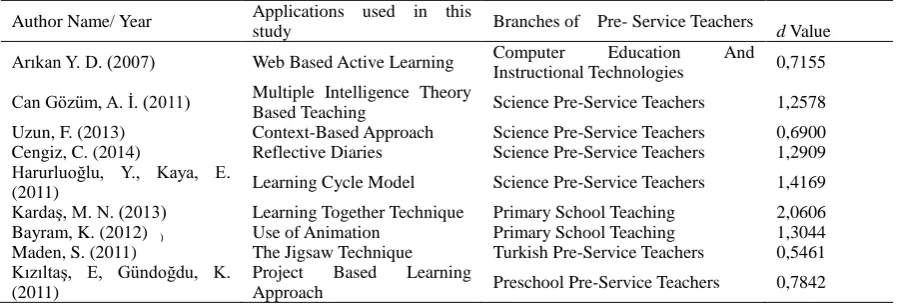
Among studies carried out between 2005 and 2015 in national area, 324 of them, 218 from articles, and 106 from theses, were chosen. However, 23 studies that met inclusion criteria were analyzed by using the MetaWin program. Of the 23 studies, 9 were related to retention (4 articles, 2 PhD theses, and 3 master’s theses) and 14 were related to attitude (2 articles, 6PhD theses, and 6 master’s theses). A total sample size of 1204 pre-service teachers were retained for the analysis. While 225 of them were in the experimental group, 220 in the control group in terms of retention, 383were in the experimental group, 376 were in the control group in terms of attitude. The study identity and effect size values of the studies included in this review in terms of retention are presented in Table 1.
Table 1. The study identity and effect size values of the studies included in this review in terms of retention
Author Name/ Year Applications used in this
study Branches of Pre- Service Teachers d Value Arıkan Y. D. (2007) Web Based Active Learning
Computer Education And
Instructional Technologies 0,7155 Can Gözüm, A. İ. (2011)
Multiple Intelligence Theory
Based Teaching Science Pre-Service Teachers 1,2578 Uzun, F. (2013) Context-Based Approach Science Pre-Service Teachers 0,6900
Cengiz, C. (2014) Reflective Diaries Science Pre-Service Teachers 1,2909
Harurluoğlu, Y., Kaya, E. (2011)
Learning Cycle Model Science Pre-Service Teachers 1,4169 Kardaş, M. N. (2013) Learning Together Technique Primary School Teaching 2,0606
Bayram, K. (2012) ) Use of Animation Primary School Teaching 1,3044
Maden, S. (2011) The Jigsaw Technique Turkish Pre-Service Teachers 0,5461
Kızıltaş, E, Gündoğdu, K. (2011)
Project Based Learning
Approach Preschool Pre-Service Teachers 0,7842
Table 1 shows that, in terms of retention scores, while Learning Together Technique had the highest effect size (d
=2,0606 -a huge level-) in primary school pre-service teachers, the Jigsaw Technique had the lowest one (d= 0,5461-a medium level-) in pre-service teachers studying in the department of Turkish Education. In addition, Learning Cycle Model (d= 1,4169); Use of Animation (d=1,3044); Reflective Dairies (d=1,2909); and Multiple Intelligence and Theory Based Teaching (d= 1,2578) techniques have a very large effect size. While Project Based Learning approach (d= 0,7842) and Web Based Active Learning (d= 0,7155) have a large effect size, Context Based approach (d= 0,6900) has a medium effect size according to the classification of Thalheimer and Cook (2002) which suggest that --0,15≤ is a negligible effect size, 0,15≤ is a small effect size, 0,40≤is a medium effect size, 0,75≤ is a large effect size, 1,10≤ is a very large effect size, and 1,45≤ is a huge effect size.
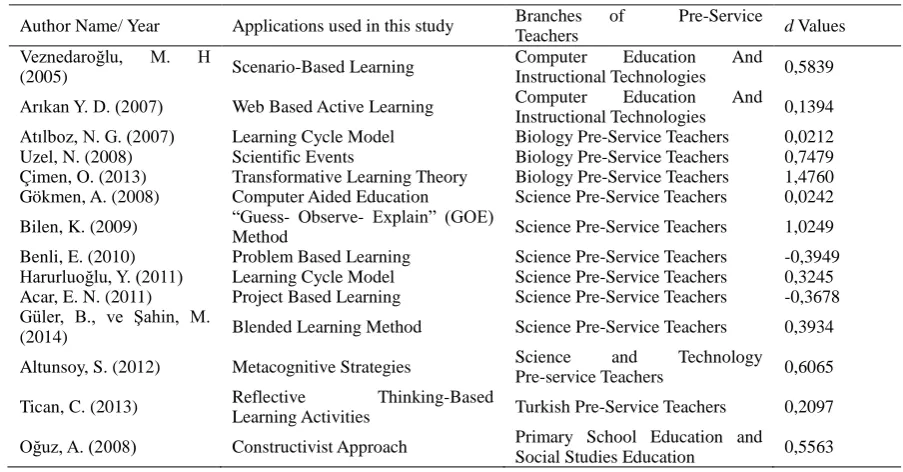
The study identity and effect size values of the studies included in this review in terms of attitude are presented in Table 2.
According to the results given in Table 2, in terms of attitude scores, while Transformative Learning Theory had the highest effect size (d= 1,4760 – a huge level-) in Biology pre-service teachers, Problem Based Learning had the lowest one (d= -0,3949- negligible) in Science pre-service teachers among the applications included in the study. Additionally, Project Based Learning (d= -0,3678) has a negligible effect size (-0,15≤ ) as well. Learning Cycle Model (d= 0,0212); Computer Aided Education (d= 0,0242); and Web Based Active Learning (0,1394) have a small effect size, (0,15≤).
Blended Learning Method (d= 0,3934); and Reflective Thinking Based Learning Activities (d= 0,2097) have a medium effect size (0,40≤). Constructivist Approach (d= 0,5563); Scenario-Based Learning (d= 0,5839); Metacognitive Strategies (d= 0,6065); and Scientific Events (d= 0,7479) have a large effect size (0,75≤). Guess- Observe- Explain”
(GOE) Method (d= 1,0249) has a very large effect size (1,10≤) according to the classification of Thalheimer and Cook
Table 2. The study identity and effect size values of the studies included in this review in terms of attitude
4. Discussion
In this study, the effect sizes of the 23 studies comprising different teaching applications were included in meta-analysis in terms of their effects on retention and attitude of pre-service teachers studying various branches of education faculties in Turkey.
The effect of learning together technique of the cooperative learning model on retention had a value of 2, 0606 which meant that retention was the highest in learning together technique among the other teaching applications included in the study such as web based active learning, multiple intelligence theory based teaching, context-based approach, reflective diaries, learning cycle model, learning together technique, use of animation, the jigsaw technique and project based learning approach. This finding is consistent with the results of other national and international studies (e.g., Bulut, 2009; Dishon & O’Leary, 1984; Ghaith, 2003; Johnson et al., 1981; Johnson, Johnson & Holubec, 1986; Johnson & Johnson, 1990; Okur Akçay & Doymuş, 2012; Orprayoon, 2014; Özsoy & Yıldız, 2004; Slavin, 1983; Slavin, 1991; Tran, 2014). According to Johnson, Johnson and Holubec (1986), cooperative learning activities enhance the accuracy of long term retention. Current findings are also consistent with the results of the meta-analysis study on the effectiveness of learning together technique conducted by the researchers (Kumar & Helgeson, 2000; Johnson, Johnson & Stanne, 2000). When Kumar and Helgeson (2000) conducted a meta-analysis on the effectiveness of cooperative learning strategies, their study revealed that learning together technique promoted the greatest effect followed by academic controversy, student-team achievement divisions, teams–game–tournaments, group investigation, jigsaw, and team assisted individualization. They also found that learning together technique had the greatest effect among the other techniques in comparison of the impact of cooperative learning lessons with individualistic learning. In the current meta-analytic study, the Jigsaw technique was found to be the least effective on retention scores of pre-service teachers. In a similar vein, Tomblin and Davis (1985) found Jigsaw technique to be less effective. Likewise, in Okebukola's (1985) study, Jigsaw was also less effective than teams-games-tournament and student teams/achievement divisions techniques. In the same vein, Newmann and Thompson (1987) hypothesized that the Jigsaw treatments were relatively less effective than the other techniques because they did not meet the criteria that Slavin (1983, 1989) has emphasized about cooperative learning techniques which are related to being group work toward a goal that can be achieved only through cooperation and students’ individually contributions to the achievement of group goal. Acccording to Slavin (1989) who reviewed and concluded a larger set of cooperative learning studies, Jigsaw is academically the least effective of the well-known cooperative learning techniques. On the other hand, in a study conducted by Maden (2011) who compared the effects of Jigsaw I technique and traditional teaching method on Turkish pre-service teachers’ academic achievement and retention scores, the results revealed that no significant difference was observed between experiment and control groups in favor of Jigsaw I technique. However, some studies conducted by Barrett (2005), Ernst and Byra (1998), Gömleksiz (2007), Huang (2000), and Şahin (2010) revealed Jigsaw technique to be more effective than traditional methods.
This study also revealed that in terms of attitude scores, Transformative learning theory had the highest effect size Author Name/ Year Applications used in this study Branches of Pre-Service
Teachers d Values
Veznedaroğlu, M. H
(2005) Scenario-Based Learning
Computer Education And
Instructional Technologies 0,5839 Arıkan Y. D. (2007) Web Based Active Learning
Computer Education And
Instructional Technologies 0,1394 Atılboz, N. G. (2007) Learning Cycle Model Biology Pre-Service Teachers 0,0212
Uzel, N. (2008) Scientific Events Biology Pre-Service Teachers 0,7479
Çimen, O. (2013) Transformative Learning Theory Biology Pre-Service Teachers 1,4760
Gökmen, A. (2008) Computer Aided Education Science Pre-Service Teachers 0,0242
Bilen, K. (2009)
“Guess- Observe- Explain” (GOE)
Method Science Pre-Service Teachers 1,0249
Benli, E. (2010) Problem Based Learning Science Pre-Service Teachers -0,3949
Harurluoğlu, Y. (2011) Learning Cycle Model Science Pre-Service Teachers 0,3245
Acar, E. N. (2011) Project Based Learning Science Pre-Service Teachers -0,3678
Güler, B., ve Şahin, M. (2014)
Blended Learning Method Science Pre-Service Teachers 0,3934
Altunsoy, S. (2012) Metacognitive Strategies
Science and Technology
Pre-service Teachers 0,6065 Tican, C. (2013)
Reflective Thinking-Based
Learning Activities Turkish Pre-Service Teachers 0,2097 Oğuz, A. (2008) Constructivist Approach
Primary School Education and
(d=1,4760–a huge level-). Similarly, some studies found transformative learning most effective in fostering learning (e.g., Brock, 2010; Brock, Florescu & Teran, 2012; King, 2002; Liodaki & Karalis, 2013; Mezirow, 1997; Ukpokodu, 2007). According to Mezirow (2003), Transformative learning involves critical reflection of assumptions that may occur either in group interaction or independently. Therefore, pre-service teachers’ age, collaboration, family support and critical incidents will promote Transformative learning and bring about new ways of defining their worlds and understanding (Mezirow, 1997).
Consistent with the result of the current study which revealed that problem based learning had the least effective method on Science pre-service teachers’ attitude scores, Albanese and Mitchell (1993) concluded that problem-based instructional approaches are less effective in teaching basic science content. Similarly, according to Johnston, Schooling and Leung (2009), problem based learning was less effective at imparting knowledge than usual teaching consisting of a lecture followed by a group tutorial. In addition, most studies have shown that there were no statistically significant differences in learner performance of problem based learning compared to students receiving lecture-based instruction (Albanese & Mitchell, 1993; Albano et al., 1996; Blake, Hosokawa & Riley, 2000; Kaufman & Mann, 1988). In a meta-analytic study comparing the impact of problem based learning and lecture–discussion instruction conducted by Culver (2000), it was concluded that there was “no convincing evidence that problem based learning improves knowledge base and clinical performance” (p. 259). In the same vein, according to Newman (2003), “existing overviews of the field do not provide high quality evidence with which to provide robust answers to questions about the effectiveness of problem based learning” (p. 5). On the other hand, Kirschner, Sweller and Clark (2006) have found that problem based learning is less effective and less efficient than guided instructional approaches used in teacher-centered and other more traditional educational activities. However, this statement has been subject to debate (Hmelo-Silver et al., 2007; Schmidt et al., 2007), it is obvious that the value of problem based learning is under discussion and context-dependent (Jansson et al., 2015).
Consequently, the impact of a certain classroom instructional approach on pre-service teachers’ retention and attitude scores is outweighed by teachers’ preferences or the nature of the interactions occurring in the classrooms. According to Grossman (1990), pre-service teachers tend to have predispositions toward specific subject matter—beliefs about the nature of a subject, how it should be taught and learned, the significance of the subject, and the teacher’s role in the subject instruction. Furthermore, it should be noted, in this respect, that pre-service teachers view teaching as a skill involving a process of transmitting knowledge and dispensing information (Kincheloe, 2003) and they display a tendency to “judge the quality of everything encountered on grounds of perceived practicality... [and] are drawn powerfully to the discrete and utilitarian” (Goodlad, 1990, p. 225). Therefore, in teacher education, providing appropriate selection of teaching methods within their social and cultural context, teachers will enable students to develop and refine the process of learning to teach.
References
(The references marked with an asterisk (*) are used in meta-analysis study.)
*Acar, E. N. (2011). The effect of project-based learning on scientific skill processes and attidues towards biology of
science teacher candidates, Published MA Thesis. University of 18 Mart, Çanakkale, Turkey.
Açıkgöz, K. Ü. (1992). İşbirlikli öğrenme: Kuram, araştırma, uygulama, Malatya: Uğurel Matbaası.
Adams, F. H. (2013). Using jigsaw technique as an effective way of promoting cooperative learning among primary six pupils in Fijai. International Journal of Education and Practice, 1(6), 64-74.
Aguiar, M., & Silva, A. M. (2011). Educational implications of transformative learning: A multicase study in Portugal.
In Proceedings of 9TH International Transformative Learning Conference Athens 2011. Greece: Athens, pp.550 – 556. Available online at: http://www.tlcathens2011.gr/Proceedings.
Albanese, M. A., & Mitchell, S. (1993). Problem-based learning: A review of the literature on its outcomes and implementation issues. Academic Medicine, 68(1), 52-81. PMID: 8447896
Albano, M. G., Cavallo, F., Hoogenboom, R., Magni, F., Majoor, G., Manenti, F., Schuwirth, L., Stiegler, I., & van der Vleuten, C. (1996). An international comparison of knowledge levels of medical students: The Maastricht Progress Test. Medical Education, 30,239–245. PMID: 8949534
Al-Salkhi, M. J. (2015). The effectiveness of jigsaw strategy on the achievement and learning motivation of the 7th primary grade students in the Islamic education. International Journal of Humanities and Social Science, 5(4), 111-118. ISSN 2220-8488 (Print), 2221-0989 (Online)
*Altunsoy, S. (2012). The effect of using metacognitive strategies on prospective science and technology teachers'
achievements in special theory of relativity and attitudes towards quantum physics, Published MA Thesis,
*Arıkan, Y. D. (2007). The effects of web-supported active learning activities on teacher trainees' achievement,
attitudes towards course and further retention levels. Published PhD Thesis. University of 9 Eylul, Izmir, Turkey.
*Atılboz, N. G. (2007). The effects of learning cycle model on preservice biology teachers understanding of diffusion
and osmosis concepts, biology teaching self-efficacy beliefs and attitudes towards biology teaching, Published PhD
Thesis. University of Gazi, Ankara, Turkey.
*Bayram, K. (2012). The effect of using animation on the candidate teachers' academic achievements, attitudes and
retention levels, Published MA Thesis. University of Necmettin Erbakan. Konya, Turkey.
Barrett, T. (2005). Effects of cooperative learning on the performance of sixth-grade physical education students.
Journal of Teaching in Physical Education, 24, 88-102. ISSN-0273-5024
Barrows, H. S. (2000). Problem-based learning applied to medical education. Southern, Illinois University Press, Springfield.
*Benli, E. (2010). The research of the effects of problem based learning to the permanence of information, the academic
success of science teacher candidates and their attitudes toward science, Published MA Thesis. University of Gazi,
Ankara, Turkey.
*Bilen, K. (2009). The effects of a laboratory instruction designed based on the -predict-observation- explain-strategy on pre-service teachers on conceptual achievement, science process skills, attitudes and views about the nature of
science. Published PhD Thesis. University of Gazi, Ankara, Turkey.
Blair, T. R. (1984). Teacher effectiveness: The know-how to improve student learning. The Reading Teacher, 38(2), 138-142. ERIC Number: EJ306577.
Blake, R. L., Hosokawa, M. C., & Riley, S. L. (2000). Student performances on Step 1 and Step 2 of the United States Medical Licensing Examination following implementation of a problem-based learning curriculum. Academic
Medicine, 75, 66–70.
Bluedorn, H. (2001). Formal arithmetic at age ten, hurried or delayed. Retrieved from http://www.triviumpursuit.com/articles/research
Brock, S. (2010). Measuring the importance of precursor steps to transformative learning. Adult Education Quarterly,
60(2), 122-142. http://dx.doi.org/10.1177/0741713609333084
Brock, S., Florescu, I., & Teran, L. (2012). Tools for change: An examination of transformative learning and its precursor steps in undergraduate students. International Scholarly Research Notices (ISRN Education). Retrieved from http://www.hindawi.com/journals/isrn/
Bromley, K., & Modlo, M. (1997). Using cooperative learning to improve reading and writing in language arts, Reading
and Writing Quarterly, 13(1), 21-35. http://dx.doi.org/10.1080/1057356970130103
Brophy, J., & Good, T. L. (1986). Teacher behavior and student achievement. In M.C. Wittrock (Ed.), Handbook of
research on teaching (3rd Ed.). New York: Macmillan
Bulut, S. (2009). The effects of cooperative learning techniques on pre-service teachers’ self-esteem, achievement and absences. Contemporary Psychology, Suvremena Psihologija, 12(1), 23-41.
*Can Gözüm, A. İ. (2011). The success analysis of enyzme subject on science candidate teachers which has been
processed according to multiple intelligence method, Published MA Thesis. University of Kafkas, Kars, Turkey.
*Cengiz, C. (2014). The effect of reflective journals kept by pre-service science teachers on reflective thinking and
achievement in general chemistry laboratory. Published PhD Thesis. University of Karadeniz Teknik, Trabzon,
Turkey.
Cooper, H. M. (1989). Integrating research: A guide for literature reviews. Newbury Park, CA: Sage
Cooper, H. M., & Hedges, L. V. (Eds.) (1994). The handbook of research synthesis. New York: The Russell Sage Foundation.
Culver, J. A. (2000). Effectiveness of problem-based learning curricula: Research and theory. Academic Medicine, 75, 259–266. PMID: 10724315
Cummins, J., & Sayers, D. (1997). Brave new schools: Challenging cultural illiteracy through global learning networks.
New York: St. Martin’s.
*Çimen, O. (2013). The effect of transformative learning model based environmental education on pre-service biology
teachers' perceptions of the environmental problems, Published PhD Thesis, University of Gazi, Ankara, Turkey.
teachers. Teacher Education Quarterly, 35(2), 45-60. ERIC Number: EJ817310 Dewey, J. (1944). Democracy and education. New York: The Free Press.
Dishon, D., & O'Leary, P. (1984). A guidebook for cooperative learning: A technique for creating more effective schools. Holmes Beach, FL: Learning Publications.
Ernst, M., & Byra, M. (1998). Pairing learners in the reciprocal style of teaching influence on student skill, knowledge and socialization. Physical Educator, 55, 24-38. ERIC Number: EJ569506
Feiman-Nemser, S. (2001). Helping novices learn to teach. Journal of Teacher Education, 52(1), 17-30. http://dx.doi.org/10.1177/0022487101052001003.
Ford, N., & Chen, S. Y. (2001). Matching/ Mismatching revisited: An empirical study of learning and teaching styles.
British Journal of Technology, 32(1), 5-22. http://dx.doi.org/10.1111/1467-8535.00173
Gallagher, T. (1997). Language and social skills: Implications for assessment and intervention with school-age children. In T. Gallagher (Ed.), Pragmatics of language: Clinical practice Issues (pp. 11-41). San Diego, CA: Singular Press.
Ghaith, G. (2003). Effects of the learning together model of cooperative learning on English as a Foreign Language reading achievement, academic self-esteem, and feelings of School alienation. Bilingual Research Journal, 27(3), 451-469. http://dx.doi.org/10.1080/15235882.2003.10162603
Glass, G. V. (1976). Primary, secondary, and meta-analysis of research. Educational Researcher,5, 3-8. Goodlad, J. (1990). Teachers for our nation’s schools. San Francisco: Jossey-Bass.
Göçer, A. (2010). A comparative research on the effectivity of cooperative learning method and jigsaw technique on teaching literary genres. Educational Research and Reviews, 5(8), 439-445. ISSN 1990-3839.
*Gökmen, A. (2008). The effect of computer assisted environmental instructon on pre-service science teachers’
achievement on matter cycle, Published MA Thesis, University of Gazi, Ankara, Turkey.
Gömleksiz, M. N. (2007). Effectiveness of cooperative learning (Jigsaw II) method in teaching English as a foreign language to engineering students (Case of Fırat University, Turkey). European Journal of Engineering Education,
32, 613-625. ERIC Number: EJ828304.
Grant, J. W., & Drafall, L. E. (1991). Teacher effectiveness research: A review and comparison. Bulletin of the Council
for Research in Music Education, 108, 31-48.
Grossman, P. L. (1990). The making of a teacher. Teacher knowledge and teacher education. New York: Columbia University, Teachers College Press.
*Güler, B., & Şahin, M. (2014). The effect of blended learning method on preservice elementary science teachers’ attitudes toward technology, self-regulation and science process skills. Necatibey Eğitim Fakültesi Elektronik Fen
ve Matematik Eğitimi Dergisi (EFMED), 9(1), 108-127.
*Harurluoğlu, Y., & Kaya, E. (2011). Öğrenme halkası modelinin fen bilgisi öğretmen adaylarının tohum-meyve-çiçek konularındaki başarılarına ve hatırlama düzeylerine etkisi. Iğdır Üniversitesi Fen Bilimleri Enstitüsü Dergisi, 1(4), 43-50.
Hays, J. R., & Vincent, J. P. (2004). Students’ evaluation of problem-based learning in graduate psychology courses.
Teaching of Psychology, 31(2), 124-126.
Hedges, L. V., & Olkin, I. (1985). Statistical methods for meta-analysis. Academic Press, Orlando, FL
Hmelo-Silver, C. E. (2004). Problem-based learning: what and how do students learn? Education Psychology Review,
16(3), 247-298. http://dx.doi.org/10.1023/B:EDPR.0000034022.16470.
Hmelo-Silver, C. E., Golan, D. R., & Chinn, C. A. (2007). Scaffolding and achievement in problem-based and inquiry learning: a response to Kirschner, Sweller, and Clark. Educ. Psychol.42, 99–107,
http://dx.doi.org/10.1080/00461520701263368
Huang, C. Y. (2000). The effects of cooperative learning and model demonstration strategies on motor skill performance during video instruction”. Proceedings of the National Science Council, 2, 255-268.
Imel, S. (1998). Transformative learning in adulthood. Washington, D.C.: Office of Educational Research and Improvement. (ERIC Document Reproduction Service No. ED42326).
Johnson, D. W., Maruyama, G., Johnson, R., & Nelson, D. (1981). Effects of cooperative, competitive and individualistic goal structures on Achievement: A meta-analysis. Psychological Bulletin,89(1), 47- 62.
Johnson, D. W., Johnson, R. T., & Holubec, E. J. (1986). Circles of learning: Cooperation in the classroom. Edina, MN: Interaction Book Company.
Johnson, D. W., & Johnson, R. T. (1990). Social skills for successful group work. Educational Leadership, 47(4), 29-33. Johnson, D. W., & Johnson, R. T. (1994). Learning together and alone. (4th ed.), Needham Heights, MA: Allyn and
Bacon
Johnson, D. W., & Johnson, R. T. (1995). Positive interdependence: key to effective cooperation in Hertz-Lazarowitz, R. & Miller, N. (eds.) Interaction in cooperative groups. The theorical anatomy of group learning. Cambridge: Cambridge University Press.
Johnson, D. W., Johnson, R. T., & Holubec, E. J. (1998). Cooperation in the classroom. Boston: Allyn and Bacon. Johnson, D. W., Johnson, R. T., & Stanne, M. B. (2000). Cooperative learning methods: A meta-analysis. Retrieved
from http://www.tablelearning.com/uploads/File/EXHIBIT-B.pdf
Johnston, J. M., Schooling, C. M., & Leung, G. M. (2009). A randomized-controlled trial of two educational modes for undergraduate evidence-based medicine learning in Asia. BMC Medical Education, 9(63), 1-8 http://dx.doi.org/10.1186/1472-6920-9-63
Kagan, D. M. (1992). Professional growth among preservice and beginning teachers. Review of Educational Research,
62, 129-169.
Kain, D. L. (2003). Problem-based learning for teachers, grades 6-12. Boston: Pearson Education, Inc.
*Kardaş, M. N. (2013). The effect of cooperative learning method on written expression skills of prospective primary
education teachers, Published PhD Thesis. University of Ataturk, Erzurum, Turkey.
Kaufman, D. M., & Mann, K. V. (1998). Comparing achievement on the Medical Council of Canada Qualifying Examination Part I of students in conventional and problem based learning curricula. Academic Medicine, 73, 1211–1213.
Kegan, R. (2000). What “form” transforms? A constructive-developmental approach to transformative learning. In J. Mezirow (Ed.) & Associates, Learning as transformation (pp. 35-70). San Francisco: Jossey-Bass.
Kent, H., & Read, J. (1998). Measuring consumer participation in mental health services: Are attitudes related to professional orientation? International Journal of Social Psychiatry, 44(4), 295-310.
Kerr, D. H. (1981). The structure of quality in teaching. In J. Soltis (Ed.), Philosophy and education (80th yearbook of
the National Society for the study of education). Chicago: University of Chicago Press.
*Kızıltaş, E., & Gündoğdu, K. (2011). The effect of project-based learning activities on academic achievement and learning retention of candidate teachers in personality theories course. Adnan Menderes Üniversitesi Eğitim
Fakültesi Eğitim Bilimleri Dergisi, 2(2), 20-29.
Kilpatrick, W. H. (1918). The project method. Teachers College Record, 19(4), 319-335. Retrieved from: http://people.umass.edu/~rwellman/Philosophy/Kilpatrick.pdf
Kincheloe, J. (2001). Getting beyond the facts: Teaching social studies/social sciences in the twenty-first century. New York: Peter Lang.
King, K. P. (2002). Keeping pace with technology, Vol. 1. Cresskill, NJ: Hampton Press.
Kirschner, P. A., Sweller, J., & Clark, R. E. (2006). Why minimal guidance during instruction does not work: an analysis of the failure of constructivist, discovery, problem-based, experimental, and inquiry-based teaching Educ.
Psychol. 41, 75-86. http://dx.doi.org/10.1207/s15326985ep4102_1
Kumar, D., & Helgeson, S. (2000). Effect of gender on computer-based chemistry problem- solving: Early findings.
Electronic Journal of Science Education, 4(4).
Kratz, H. E. (1986). Characteristics of the best teachers as recognized by children. Pedagogical Seminary, 3, 413- 418. Liodaki, N., & Karalis, T. (2013). Educational experiences and transformative learning in higher education in Greece: A
case study with student teachers. International Journal of Education, 5(2), 75-85. http://dx.doi.org/10.5296/ije.v5i2.3282
Lortie, D. C. (1975). Schoolteacher. Chicago: University of Chicago Press.
Mackie, R. (1981). Introduction. In R. Mackie (Ed.), Literacy and revolution: The pedagogy of Paulo Freire (pp. 1–11). New York, NY: Continuum
*Maden, S. (2011). Effect of jigsaw I technique on achievement in written expression skill. Kuram ve Uygulamada
Eğitim Bilimleri (KUYEB),11(2), 911-917. ERIC Number: EJ927383.
Madsen, C. K. (1990). Measuring musical response. Music Educators Journal, 77(3), 26–28. http://dx.doi.org/10.2307/3397835.
McCaffrey, D. F., Koretz, D. M., Lockwood, J. R., & Hamilton, L. S. (2004). Evaluating value-added models of teacher
accountability. Santa Monica, CA: Rand Corporation.
McClelland, J. W., Bearon, L. B., Fraser, A. F., Mustian, R. D., & Velazquez, S. (2001). Reaching older adults with nutrition education: Lessons learned during the partners in Wellness Pilot Project. Journal of Nutrition for the
Elderly, 21(2), 59-72.
McComish, D., & Parsons, J. (2013). Transformational learning and teacher collaborative communities, New Zealand
Journal of Teachers’ Work, 10(2), 239-245.
McCoy, C. W. (1985). The ensemble director as elective teacher: A review of selected research Update: The
Applications of Research in Music Education, 3(3), 9 -12.
Meng, D. Q., & Xiao, L. J. (2010). Jigsaw strategy as a Cooperative Learning Technique: Focusing on the language learners. Chinese Journal of Applied Linguistics, 33(4), 113-125.
Mezirow, J. (1996). Contemporary paradigms of learning. Adult Education Quarterly, 46(3), 158-172. http://dx.doi.org/10.1177/074171369604600303.
Mezirow, J. (1997). Transformative learning: Theory to practice. In P. Cranton (Ed.), Transformative learning in action:
Insights from practice – New directions for adult and continuing education, 74(pp. 5-12). San Francisco:
Jossey-Bass
Mezirow, J. (2000). Learning to think like an adult. In: J. Mezirow (Ed.) & Associates, Learning as transformation (pp. 3-34). San Francisco: Jossey-Bass.
Mezirow, J. (2003). Transformative learning as discourse. Journal of Transformative Education, 1(1), 58-63. http://dx.doi.org/10.1177/1541344603252172
Newmann, F. M., & Thompson, J. A. (1987). Effects of cooperative learning on achievement in secondary schools: A
summary of research. National center on effective secondary schools. Madison: University of Wisconsin.
Newman, M. (2003). A pilot systematic review and meta-analysis on the effectiveness of problem-based learning. Retrieved from http://www.ltsn-01.ac.uk/docs/pbl_report.pdf.
*Oğuz, A. (2008). The effects of constructivist learning activities on trainee teachers’ academic achievement and attitudes. World Applied Sciences Journal,4(6), 837-848.
Okebukola, P. A. (1985). The relative effectiveness of cooperative and competitive interaction techniques in strengthening students' performance in science classes, Science Education, 62,501-509.
Okur-Akçay & Doymuş, K. (2012). The effects of group investigation and cooperative learning techniques applied in teaching force and motion subjects on students’ academic achievements. Journal of Educational Sciences Research,
2(1), 109–123.
Orprayoon, S. (2014). Effects of cooperative learning on learning achievement and group working behavior of junior students in modern French literature course. The Journal of Effective Teaching,14(1), 80-98.
Özsoy, N., & Yıldız, N. (2004). The effect of learning together technique of cooperative learning method on student achievement in mathematics teaching 7th class of primary school. The Turkish Online Journal of Educational
Technology, 3(3), 49-54. ISSN: 1303-6521
Pajares, M. F. (1992) Teachers' beliefs and educational research: Cleaning up a messy construct, Review of Educational
Research, 62(3), 307-332.
Prince, M., & Felder, R. (2007). The many faces of inductive teaching and learning. Journal of College Science
Teaching,30(5), 14-20.
Quinn, J. M. (2011). Expectations and experience: A comparison of preservice and inservice teachers’ occupational
beliefs. Florida State University. PhD. Thesis. UMI Number: 3502882
(Eds.), Handbook of research on teacher education (2nd ed., pp.102-119). New York: Macmillan. Riding. R. J., & Raynar, S. (1998), Cognitive styles and learning strategies, D. Fulton Publishers.
Schmidt, H. G., Loyens, S. M. M., van Gog, T., & Paas, F. (2006). Problem-based learning is compatible with human cognitive architecture: commentary on Kirschner, Sweller, and Clark Educ. Psychol, 42, 91–97, http://dx.doi.org/10.1080/00461520701263350
Schwab, J. J. (1964). The structure of disciplines: Meanings and significance. In G. W. Ford & L. Pungo (Eds.), The
structure of knowledge and the curriculum. Chicago: Rand McNally.
Shulman, L. (1986). Those who understand: Knowledge growth in teaching. Educational Researcher, 15(2), 4-14. Slavin, R. E. (1983). When does cooperative learning increase achievement? Psychological Bulletin, 94, 429-445. Slavin, R. E. (1989). Cooperative learning and student achievement: Six theoretical perspectives. Advances in
Motivation and Achievement, 6, 161-177.
Slavin, R. E. (1991). Student team learning: A practical guide to cooperative learning. Washington, D.C.: National Education Association.
Stenhouse, L. (1975). An introduction to curriculum research and development, Heinemann, London, (pp.52-83). Şahin, A. (2010). Effects of jigsaw II technique on academic achievement and attitudes to written expression course,
Educational Research and Reviews,5(12), 777-787. ISSN 1990-3839.
Tarım, K. (2003). Kubaşık öğrenme yönteminin matematik öğretimindeki etkinliği ve kubaşık öğrenme yöntemine ilişkin
bir meta analiz çalışması.,Unpublished PhD Thesis. University of Çukurova, Adana, Turkey.
Taylor, E. W. (1998). Transformative learning: A critical review. ERIC Clearinghouse on Adult, Career, and Vocational Education (Information Series no. 374. http://dx.doi.org/10.1080/02601370701219475
Taylor, E. W. (2007). An update of transformative learning theory: A critical review of the empirical research (1999–
2005). International Journal of Lifelong Education, 26(2), 173–191. ERIC Number: EJ764361.
Thalheimer, W., & Cook, S. (2002). How to calculate effect sizes from published research articles: A simplified
methodology. A part of book. Retrieved from http://education.gsu.edu/coshima/EPRS8530/Effect_Sizes_pdf4.pdf
*Tican, C. (2013). The effects of reflective thinking-based teaching activities on pre-service teachers' reflective thinking
skills, critical thinking skills, democratic attitudes and academic achievement, Published PhD Thesis. University of
Gazi. Ankara, Turkey.
Tomblin, E. A., & Davis B. R. (1985). A study of cooperative learning environments. San Diego Public Schools, San Diego, California.
Tran, V. D. (2014). The effects of cooperative learning on the academic achievement and knowledge retention,
International Journal of Higher Education, 3(2), 131-140. http://dx.doi.org/10.5430/ijhe.v3n2p131
Ukpokodu, O. N. (2007). Fostering preservice teachers’ transformative learning in a social studies methods course: A reflection on transformative pedagogy. Social Studies Research and Practice, 2(3), 1-27. ISSN: 1933-5415
*Uzel, N. (2008). The effect of scientific activities upon scientific process skills, conceptual achievements and attitude
of pre-service biology teachers, Published MA Thesis. University of Gazi, Ankara, Turkey.
* Uzun, F. (2013). The effect of the general physics-I laboratory course based on context-based approach on preservice
science teachers' achievement, scientific process skills, motivation and recall. Published MA Thesis. University of
Marmara, Istanbul, Turkey.
Valeen, G., & Casado, M. (2000). Ethical principles for the hospitality curriculum. Cornell Hotel & Restaurant
Administration Quarterly, 41(2), 44-51. http://dx.doi.org/10.1016/S0010-8804(00)88897-7
Vernon, D. T., & Blake, R. L. (1993). Does problem-based learning work? A metaanalysis of evaluative research.
Academic Medicine, 7, 550-563.
*Veznedaroğlu, M. (2005). The effects of scenario based learning on attitudes and self- efficacy beliefs of teacher
candidates` towards teacher proficiency, Published MA Thesis. University of Ankara, Ankara, Turkey.
Wong, C., & Driscoll, M. (2008). A modified jigsaw method: An active learning strategy to develop the cognitive.
Journal of Physical Therapy Education, 22(1), 15-25.