_____________________________________________________________________________________________________
*Corresponding author: E-mail: [email protected];
Technology
3(4): 1-11, 2018; Article no.AJB2T.41058
ISSN:2457-0125
Effect of Inoculum Type on Anaerobic Co-Digestion
of Palm Oil Mill Effluent and Brewery Spent Grain for
Biogas Production
Utibe Amos Ofon
1*, Uduak Ugonma Ndubusi-Nnaji
1and Naomi Udo Asamudo
11
Department of Microbiology, University of Uyo, Akwa Ibom State, Nigeria.
Authors’ contributions
This work was carried out in collaboration between all authors. Author UAO designed the study, wrote the protocol and performed the statistical analysis. Author UUNN wrote the first draft of the manuscript and managed the analyses of the study. Author NUA managed the literature searches. All authors read and approved the final manuscript.
Article Information
DOI: 10.9734/AJB2T/2018/41058
Editor(s):
(1)Jayanta Kumar Patra, Assistant Professor, Research Institute of Biotechnology & Medical Converged Science, Dongguk University, Ilsandong, Republic of Korea.
Reviewers:
(1)Akinola David Olugbemide, Auchi Polytechnic, Nigeria. (2)Fatih Tufaner, Adiyaman University, Turkey. Complete Peer review History:http://prh.sdiarticle3.com/review-history/24652
Received 25th February 2018 Accepted 9th May 2018 Published 17th May 2018
ABSTRACT
The effect of different inocula on the anaerobic co-digestion of palm oil mill effluent (POME) and brewery spent grain (BSG) was evaluated for biogas production using laboratory scale bioreactors. The reactors (A: POME + BSG + cow dung, B: POME + BSG + swine dung, C: POME + BSG + swine dung + cow dung) were incubated at 35 ± 2°C for 30 days. The average biogas volume measured periodically by water displacement technique were 4.73, 38.64, and 36.45 mL gVS⁻¹ in reactors A, B and C respectively. The results indicated that reactor B produced 8.17 times more biogas than A and 1.06 times than C, whereas reactor C produced 7.71 times more gas than A, with significant differences at p = 0.05. The acidity of the digestates increased with a decrease in pH from 6.91 to 4.52, 7.33 to 5.20, and 6.73 to 5.46 in digesters A, B and C respectively. Whilst the total solid contents decreased from 18.22 ± 0.22 to 9.27 ± 0.01%, 19.05 ± 0.13 to 9.26 ± 0.01%, and 18.88 ± 0.03 to 8.62 ± 0.04%, volatile solids reduced from 10.9 ± 0.16 to 0.04 ± 0.01, 10.7 ± 0.07 to 0.28 ± 0.34, and 10.8 ± 0.09 to 0.09 ± 0.04% in reactors A, B and C respectively. The total anaerobic bacterial loads of reactors A, B and C respectively were 5.57± 0.46, 5.61 ± 0.39, 5.38 ±
0.48 Log₁₀ CFU g⁻¹. Methanogens associated with the biogas production were identified as members of the genera Methanothrix, Methanosarcina, Methanobrevibacter and
Methanocorpusculum. Contrary to using cow dung only as inoculum, the combined use of swine and cow dung for anaerobic co-digestion enhanced biogas production and/or yield.
Keywords: Anaerobic co-digestion; brewery spent grain; palm oil mill effluent; biogas.
1. INTRODUCTION
Interest in discovering an alternative source of clean and green energy such as biogas from eco-friendly, cheap and renewable resources have intensified in recent time. This is in part due to the ever-increasing hike in the prices of fossil fuels from non-renewable energy (such as diesel, petrol, kerosene) and its detrimental effects on the ecosystem [1].
The conversion of biodegradable waste into energy presents the enormous potential of resolving environmental issues while delivering energy, economic benefits and social stability to national governments. Biogas generation utilizes biomass resources to fulfil these energy requirements to power a wide range of processes and facilities via anaerobic digestion. Biogas generated from anaerobic digestion of various biomass is composed mainly of methane, (CH4), carbon (IV) oxide (CO2) and some other
gases in trace quantities [2]. Under anoxic conditions, anaerobic digestion, a process involving series of complex reactions allows a wide range of polymeric organic compounds such as lipids, proteins and carbohydrates to be decomposed by a vast array of microorganisms [3]. Anaerobic digestion (AD) generally consisting of four steps; hydrolysis, acidogenesis, acetogenesis and methanogenesis is, therefore, a promising technology for recovering energy from municipal solid waste [4] and serves as a very practical way to reduce waste.
All biodegradable biomass materials are well suitable for anaerobic digestion. This feedstock could be concentrated or diluted liquids, slurries or even solids. Feedstock commonly used include agricultural wastes and crop residues, animal wastes, forest residues and municipal solid wastes [5]. Although no crop is grown specifically for the purpose of anaerobic digestion to produce biogas, many agricultural crops and agro-industrial processes yield residues that can be used as feedstocks for biogas production. Wastes from these agricultural processes now provide an abundant biomass source for anaerobic digestion [6].
Palm oil mill effluent (POME) is one of such wastes that can be used for the production of biogas. Oil palm is the most productive oil-bearing crop in the world that thrives in both tropical and subtropical regions [7]. The crude palm oil produced has found applications in food and biodiesel production [8,9]. The wastes from the palm oil production include both solid, (empty fruit bunch, palm press fibre, palm kernel shell
and chaff) [10,11,12] and liquid wastes (Palm oil mill effluents) [13,14,15,16,17]. POME is
generally discharged into the ecosystem; the stream/water bodies from mills close to rivers and then it finds its way into the soil without adequate treatment [10]. POME discharged into the environment emits greenhouse gases which contribute to climatic change impacting on biodiversity through a change in breeding pattern, population and ecosystem deterioration [18]. Biogas is produced from POME using anaerobic digesters (in the closed pond digester system) and from aerobic digesters (open pond system) with the anaerobic digestion process yielding a higher concentration of biogas than that produced under aerobic conditions [19].
In addition to POME, brewery spent grain (BSG), another biodegradable waste is produced in large quantities by the brewing industry. At present, the use of the brewery spent grain as animal fodder or compost is well known. However, with the increasing costs of energy incurred by the brewing industry, anaerobic digestion has become an alternative but viable option for renewable energy (biogas) production from these waste substrates [20].
stable when a variety of substrates are used [24]. Misi and Forster [25] revealed that biogas yield increased from 60 to 230 LKg-1 by co-digesting cow manure with 50% molasses in a batch digester at 35°C. It is, therefore, the aim of this work to investigate and demonstrate the effect of inoculum type on the anaerobic co-digestion of brewery spent grain (BSG) and palm oil mill effluent (POME) for enhanced biogas production. The type and number of anaerobic microorganisms present after the process of anaerobic digestion will also be elaborated.
2. MATERIALS AND METHODS
2.1 Collection of Samples and Sample Sources
Whereas brewery spent grain (BSG) was collected from a disposal site of Champion Brewery PLC, palm oil mill effluent (POME) was obtained from a local mill. Cow dung and pig dung which served as inocula were collected from an integrated farm all located in Uyo Local Government Area of Akwa Ibom state. Prior to digestion, the POME was vigorously agitated to obtain a proper blend of the liquid and solid portion of the effluent in order to ensure adequate mass transfer and homogeneity whereas, the brewery spent grain was dewatered using a filter and sundried.
2.2 Experimental Design and Determination of Biomethane Potential
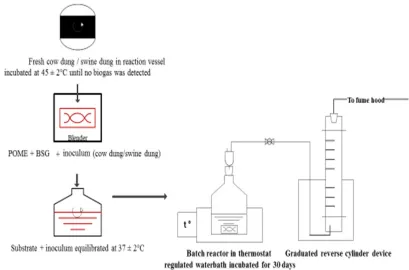
The biomethane potential assay (BMP) is an index of anaerobic biodegradation potential as it indicates the experimental value of the maximum quantity of methane produced per gram of volatile solid. To measure the sample digestion and biogas production, a modified method of [18] was employed. The experiment was set up in a batch mode and involved the use of 100 ml amber serum bottles (Gerresheimer 61020G, USA) and 20 mm aluminium cap with central moulded septum combination seal (FB67567, Fisher Scientific, UK) as a reactor. The reactors were in three (3) batches labelled A-C as follows: Batch A = 5 mg BSG + 55 ml POME + 5 mg cow dung; Batch B = 5 mg BSG + 55 ml POME + 5 mg swine dung; Batch C = 5 mg BSG + 55 ml POME + 2.5 mg cow dung + 2.5 mg pig dung. To ensure anaerobiosis, the reactors were sealed using standard hand operated crimper, 20mm cap size (JG Finneran 9300-20, USA). The experiment was carried out in a water bath at 45°C for 30 days. The volume of biogas
produced was measured volumetrically (following liquid displacement) by connecting the reactor to a graduated reverse cylinder device containing water as a barrier solution [5].
2.3 Analytical Methods
2.3.1 Determination of total solids
Standard methods for the examination of water and waste water [26] were adopted for the estimation of total solids drawn from each reactor. The samples were weighed on an electronic weighing balance. The pre-weighed wet samples kept in pre-weighed porcelain dish were dried to a constant weight in a hot air oven at 103 to 105ºC. The total solids in the sample were calculated using the formula given below:
TS= (Wd/Ww) x 100
Where,
The wd= weight of oven dried sample, g
Ww= weight of the wet sample, g
TS =total solids, %
2.3.2 Determination of volatile solids
The volatile solids of the substrates were also determined as per standard methods for the examination of water and waste waters [26]. The silica crucible having pre-weighed oven-dried samples will be placed in a muffle furnace at 550±50°C for 30 minutes. Thereafter dried sample (ash) will be cooled in desiccators. Following cooling, the weight of crucibles having burnt samples (ash) was taken immediately using a precision balance. The volatile solids content of the samples were calculated using the following formula:
VS = [(Wd-Wa)/Ww] x100
Where,
VS= volatile solids present in the wet sample, % Wa = weight of dry ash remaining after igniting
the sample in a muffle furnace, g Wd = weight of the dry sample, g
Ww = weight of the wet sample, g
2.3.3 Determination of pH
2.4 Culture-dependent Microbiological Assays
For the enumeration, isolation and characterization of isolates, serial dilutions of samples from digesters were made to isolate and enumerate the different species of the microbial consortia. Sampling was conducted at an initial time (t0) and final time (tf) for all digesters.
Following a ten-fold serial dilution, each dilution (10-3, 10-4, 10-5) was cultured in triplicates on Schaedler agar media (Oxoid, UK). After incubation under anaerobiosis (at 37ºC) for 48 h, colonies were picked based on their morphological differences and isolated (subcultured) on plates with fresh Schaedler media. Isolates were identified by gram-staining, motility and spore staining. Identified species were preserved at –4ºC by freezing pure cultures for further characterization. The population growth was equally determined by counting the total number of colonies arising on Schaedler agar plates [27,28,29].
2.5 Catabolic Substrate Assay for the Isolation of Methanogens
For the selective enrichment and growth of methanogens, basal media enriched with some
catabolic substrates and organic growth factors was used for their characterization. The organisms were identified based on their ability to utilize catabolic substrates such as acetate, formate, methanol, methanethiol, and dimethyl sulphide. Into separate beakers containing the basal media containing 9 ml of trace mineral solution, 5 ml of vitamin solution, 1 ml of 0.2% Resazurin solution, 1.45 K2HPO4.3H2O, 0.9 g
NH4Cl, 0.75 g KH2PO4, 0.5 g NaS.9H2O, 0.2 g
MgCl2 and1000 ml deionized water, 5 ml of the
organic growth factors (biotin and p-amino benzoate) were added [30]. The complex media were sterilized in theautoclave and 2 ml of each of the catabolic substrates were measured into separate petri dishes with respect to the isolates as labelled. The media was pour plated before a light inoculum of the pure isolate was streaked upon the plates which afterwards were incubated for48 hours under anaerobic condition before observation. To ensure anaerobiosis and validate the integrity of the test, the plates were incubated using the gaspak anaerobic system with a resazurin indicator strip (pink) which turns colourless upon oxygen elimination. Significant growth of the organisms was positive for the test while the absence of significant growth was otherwise.
2.6 Statistical Analysis
All experiments were performed in triplicates. The digestion process parameters (performances) data of each reactor were expressed as the mean ± standard deviation of the samples during the period of operation. An analysis of variance by SPSS (Statistical Package for the Social Science, version 20.0) was employed in this study to test the significance of the results, and P≤0.05 was considered statistically significant.
3. RESULTS AND DISCUSSION
3.1 Effect of Inoculum Type on Biogas Production
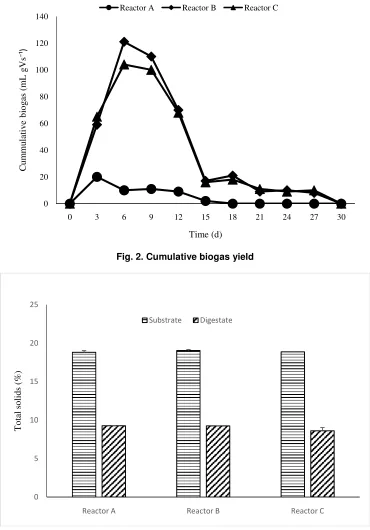
The purpose of co-digestion was to increase the carbon-nitrogen ratio of the substrates mix for adequate balancing of nutrients thereby increasing the load of biodegradable organic matter and encourage the synergistic and/or combined interaction among microbes involved in the anaerobic digestion process. The swine dung and cow dung equally served as different sources of microorganisms involved in the process of anaerobic digestion. Naturally, BSG being lignocellulosic is highly resistant to microbial decomposition, therefore, mechanical pretreatment was employed to increase the surface to volume ratio in order to increase the availability of the substrate to enzymatic attack from the methanogenic consortia involved in anaerobic digestion. The co-digestion of POME and BSG using swine dung (reactor B) was more productive (P = 0.05) with elevated biogas volume having a cumulative biogas yield of 425 mL gVS-1 with an average of 38.64 mL gVS-1. Reactor B produced 8.17 times more biogas than A and 1.06 times more biogas than C, whereas C produced 7.71 times more gas than A (Fig. 2). This suggests that combined activities of microorganisms associated with cow dung and swine dung could result in increased degradation of organic matter and biogas yield as also reported by Nasir et al. [22]. The initial steep rise in methane generation for reactor A (5 mg BSG + 55 ml POME + 5 mg swine dung) and reactor C (5 mg BSG + 55 ml POME + 2.5 mg cow dung + 2.5 mg pig dung) is probably due to the presence of sufficient quantities of organic matter (present in the substrates) which are needed for the methanogenesis process and consequently leading to more activity of the methane-forming bacteria. However, the steep rise was followed by sharp decline and then plateau (from day 15)
as a result of nutrient depletion and exhaustion. On the other hand, the methanogenic consortia in reactor A were either unable to overcome many environmental barriers (such as a change in pH, temperature) or utilize the substrates thus accounting for the low yield in the volume of biogas generated.
3.2 Total and Volatile Solid Contents of Substrate and Digestate
The reduction (18.22 ± 0.22 to 9.27 ± 0.01 mg gVS⁻¹, 19.05 ± 0.13 to 9.26 ± 0.01 mg % , and 18.88 ± 0.03 to 8.62 ± 0.04 mg %) in total solids and 10.9 ± 0.16 to 0.04 ± 0.01, 10.7 ± 0.07 to 0.28 ± 0.34, and 10.8 ± 0.09 to 0.09 ± 0.04% for volatile solids in reactors A, B and C respectively (as seen in Figs. 3 and 4) indicated that the methanogens involved in the production of biogas utilized a sizeable portion of the organic waste fraction. Again, this difference in TS/VS contents may be as a result of dissimilarity in substrate composition of the bioreactors. Some authors [3,20] have recorded a decrease in TS and VS of substrates after digestion.
3.3 Effect of pH on the Anaerobic Codigestion Process
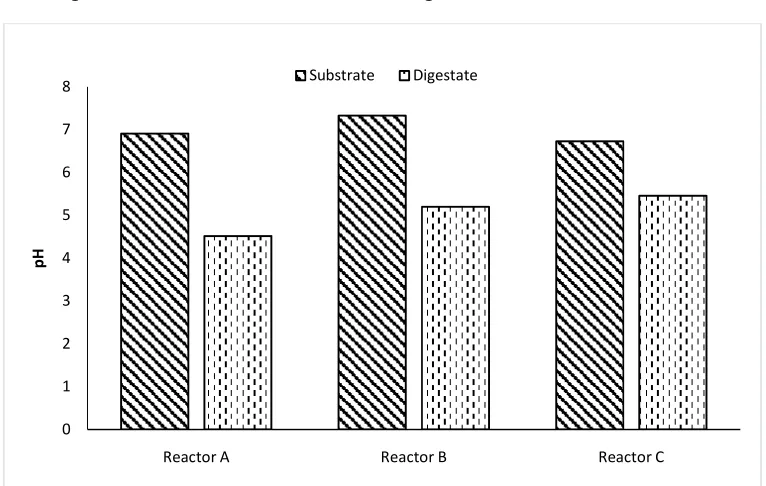
Similarly, there was a reduction in pH from 6.91 to 4.52, 7.33 to 5.20 and 6.73 to 5.46 in digesters A, B and C respectively (Fig. 5). This decline in pH was below the permissible and optimal range and could possibly have inhibited the activities of the methanogens from further production of biogas. The pH range for the optimal growth of methanogens is 6.8–7.5. The medium pH affects not only the cell surface charge but the ionization of organic compounds, and the microbial resistance to high temperature. In addition, pH also significantly influences enzyme activity [31]. Consequently, accumulation of intermediate (short chain acids) leads to pH drop during the anaerobic codigestion process. In order to maintain stable operation, it is necessary to add bicarbonate or carbonate as an alkalinity buffer to neutralize volatile fatty acids and carbon dioxide [32].
3.4 Estimation of Anaerobes and Isolation of Methanogens
425 mL gVS-1. Comparatively, reactors A and B had lower anaerobic bacterial loads than B in the order B>C>A. As stated earlier [18], the decrease in the rate of microbial growth,
particularly, the methane-forming bacteria may be attributed to the production of volatile. This clearly revealed that different inocula influenced the population of anaerobic microbial consortia
Fig. 2. Cumulative biogas yield
Fig. 3. Total solids of substrates and digestates from the three reactors
0 20 40 60 80 100 120 140
0 3 6 9 12 15 18 21 24 27 30
C
u
m
m
u
la
ti
v
e
b
io
g
as
(
m
L
g
V
s
⁻¹
)
Time (d)
Reactor A Reactor B Reactor C
0 5 10 15 20 25
Reactor A Reactor B Reactor C
T
o
ta
l
so
li
d
s
(%
)
Fig. 4. Volatile solids of substrates and digestates from the three reactors
Fig. 5. pH of substrates and digests
required for biodegradation of the substrates with a concomitant effect on the cumulative biogas yield thus corroborating the report of Wilkins et al. [33].
Again, the isolation of Methanosarcina, Methanothrix, Methanobacterium,
Methanobacterium and Methanocorpusculum
species as presented below (Table 1) shows their pivotal role in the generation of biogas from anaerobic digestion of the wastes under study and this was in agreement with the similar report by Guillermo and Matti [34].
0.0 2.0 4.0 6.0 8.0 10.0 12.0
Reactor A Reactor B Reactor C
V
o
la
ti
le
s
o
li
d
s
(%
)
Substrate
Digestate
0 1 2 3 4 5 6 7 8
Reactor A Reactor B Reactor C
p
H
8
Table 1. Biochemical and morphological characteristics of methanogens associated with the anaerobic co-digestion process
Is o la te C e ll s h a p e G ra m r e a c ti o n S p o re M o ti li ty
Catabolic substrates Organic
growth factors
pH Probable organism
M e th a n o l F o rm a te A c e ta te A lc o h o l D im e th y l s u lp h id e M e th a n e th io l B io ti n p -a m in o b e n z o a a te 5 .8 – 6 .3 7 .0 – 7 .5 8 .1 – 9 .1
1 Rod +/- - - - + - + - + + + + Methanobacterium sp
2 Rod - - - - + - - - - + + - + - Methanothrix sp
3 Rod + - - - + + - + - + + + Methanobacterium sp
4 Rod +/- - + - - + - + - + + + + + Methanobacterium sp
5 Coccoid - - + +/- - + + + + + + - + + Methanocorpusculum sp
6 Coccoid + - - + + - + + + - + + + + Methanosarcina sp
Fig. 6. Population of anaerobes in digesters
4. CONCLUSION
With the supply of missing nutrients by co-substrates, biogas production can be enhanced (as a result of synergism established in the digestion medium) through the co-digestion of substrates using a combination of different inocula such as cow and swine dung. The combination of different inocula indicates their effectiveness and potential application in the treatment of these wastes (under investigation) while generating biogas, a cleaner energy alternative from such cheap sources. This study has clearly demonstrated that different inocula affect the volume of biogas generated, hence the choice of appropriate inoculum-feedstock combination for optimum process optimization and scale-up is required.
COMPETING INTERESTS
Authors have declared that no competing interests exist.
REFERENCES
1. Chynoweth DP, Owens JM, Legrand R. Renewable methane from anaerobic digestion of biomass. Renewable Energy. 2000;22:1-8.
2. Solomon KR, Lora EES. Estimate of the electric energy generating potential for different sources of biogas in Brazil.
Biomass and Bio energy. 2009;33:1101-1107.
3. Lu Q, Yi J, Yang D. Comparative analysis
of performance and microbial
characteristics between high-solid and low-solid anaerobic digestion of sewage sludge under mesophilic conditions. Journal of Microbiology and Biotechnolnology. 2016;26(1):110–119.
4. Lim JS, Manan ZA, Wan-Alwi SR, Hashim H. A review on utilization of biomass from rice industry as a source of renewable energy. Renewable and Sustainable Energy Reviews. 2012;16:3084–3094. 5. Ali J, Singh RP, Durgapal V. Biogas
production from different organic biomass materials by anaerobic batch fermentation. American Journal of Biomass and Bioenergy. 2016;5(1):43–56.
6. Ravindranath NH, Somashekar HI, Nagaraja MS, Sudha P, Sangeetha G, Bhattacharya SC, Abdul-Salam P. Assessment of sustainable non-plantation biomass resources potential for energy in India. Biomass Bioenergy. 2005;29:178-190.
7. Izah SC, Ohimain EI. Microbiological quality of crude palm oil produced by smallholder processors in the Niger Delta, Nigeria. Journal of Microbiology and Biotechnology. 2013a;3(2):30-36.
8. Ohimain EI, Izah SC, Oyedeji AA. Employment effects of smallholder oil palm 5.2
5.25 5.3 5.35 5.4 5.45 5.5 5.55 5.6 5.65 5.7
Reactor A Reactor B Reactor C
M
ic
ro
b
ia
l
co
u
n
ts
(
L
o
g
₁₀
C
F
U
m
L
⁻
¹)
processing plants in Elele, Rivers State, Nigeria. International Journal of Applied Research and Technology. 2012a;1(6):83– 93.
9. Izah SC, Ohimain EI. The challenge of biodiesel production from oil palm feedstock’s in Nigeria. Greener Journal of Biological Science. 2013b;3(1):1-12. 10. Ohimain EI, Izah SC, Abah SO. Air quality
impacts of smallholder oil palm processing in Nigeria. Journal of Environmental Protection. 2013a;4:83-98.
11. Ohimain EI, Izah SC. Gaseous emissions from a semi-mechanized oil palm processing mill in Bayelsa State, Nigeria. Continental Journal of Water, Air and Soil Pollution. 2013a;4(1):15–25.
12. Ohimain EI, Izah SC. Energy self-sufficiency of smallholder oil palm processing in Nigeria. Renewable Energy. 2014a;63:426–431.
13. Ismali I, Hassan MA, Rahman NAA, Soon CS. Thermophilic biohydrogen production from palm oil mill effluent (POME) using suspended mixed culture. Biomass and Bioenergy. 2010;34:42–47.
14. Ohimain EI, Izah SC. Water minimization and optimization by small-scale palm oil mill in Niger Delta, Nigeria. Journal of Water Resources. 2013b;135:190–198. 15. Ohimain EI, Izah SC, Jenakumo N.
Physico-chemical and microbial screening of palm oil mill effluents for amylase production. Greener Journal of Biological Science. 2013c;3(8):314–325.
16. Ohimain EI, Daokoru-Olukole C, Izah SC, Eke RA, Okonkwo AC. Microbiology of palm oil mill effluents. Journal of Microbiology and Biotechnology Resources. 2012b;2(6):852–857.
17. Ohimain EI, Seiyaboh EI, Izah SC, Oghenegueke VE, Perewarebo TG. Some selected physico-chemical and heavy metal properties of palm oil mill effluents. Greener Journal of Physical Sciences. 2012c;2(4):131-137.
18. Alwari RA, Ahmad A, Ismail N, Kadir MOA. Anaerobic co-digestion of palm oil effluent with rumen fluid as a co-substrate. Desalination. 2011;269:50–57.
19. Ohimain EI, Izah SC. Potential contributions of palm oil mill effluents to greenhouse gas emissions in Nigeria. British Journal of Applied Science and Technology. 2014b;74:253-260.
20. Panjicko M, Zupanic GD, Zelic B. Anaerobic biodegradation of raw and
pretreated brewery spent grain utilizing solid anaerobic digestion. Acta Chimica Slovenica. 2015;62:818–827.
21. El-Mashad HM, Zhang R. Biogas production from co-digestion of dairy manure and food waste. Bioresource Technology. 2010;101:4021–4028.
22. Nasir IM, Ghazi TIM, Omar R. Anaerobic digestion technology in livestock manure treatment for biogas production - A review. Engineering and Life Sciences. 2012;12: 258–269.
23. Liu Y, Miller SA, Safferman SI. Screening co-digestion of food waste water with manure for biogas production. Biofuels Bioproduction Bioreferences. 2009;3:11– 19.
24. Mata-Alvarez J, Mace S, Llabres P. Anaerobic digestion of organic solid wastes. An overview of research achievements and perspectives. Bio-resource Technology. 2000;74(1):3-16. 25. Misi SN, Forster CF. Semi-continuous
anaerobic co-digestion of agro waste. Environmental Technology. 2002;23:445– 451.
26. APHA. Standard methods for the examination of water and wastewater, 14th edn. New York: American Public Health Association, Inc., New York. 2005;203– 206.
27. de Diego-Díaz B, Fernández-Rodríguez J, Vitas AI, Peñas FJ. Biomethanization of solid wastes from the alcoholic beverage industry: Malt and sloe. Kinetic and microbiological analysis. Chemical Engineering Journal. 2016;33(2):274–315.
28. Cheesbrough M. District laboratory practice in tropical countries part 2. UK: Cambridge University Press. 2006;45–70. 29. Holt JG. Facultative anaerobic
gram-negative rod. In: Bergey’s Manual of Determinative Bacteriology. 9th Edn. Baltimore: Williams and Wilkins. 1994;99– 179.
30. Zeikus JG. The biology of methanogenic bacteria. Bacteriological Reviews. 1977; 41(2):514–541.
31. Wang A, Li W, Yu H. Advances in biogas technology. Advances in Biochemical Engineering/Biotechnology. 2012;128:119– 141.
33. Wilkins D, Rao S, Lu X, Lee PKH. Effect of sludge inoculum and organic feedstock on active microbial communities and methane yield during anaerobic digestion. Frontiers in Microbiology. 2015;6:1100–1114.
34. Guillermo E, Matti H. Biogas production using anaerobic digestion of cattle and pig manure. Bioresource Technology. 2001; 23:102–110.
_________________________________________________________________________________ © 2018 Ofon et al.; This is an Open Access article distributed under the terms of the Creative Commons Attribution License
(http://creativecommons.org/licenses/by/4.0), which permits unrestricted use, distribution, and reproduction in any medium,
provided the original work is properly cited.
Peer-review history: