
ASSEMBLY CODE CLONE DETECTION FOR MALWARE
BINARIES
Mohammad Reza Farhadi
A thesis in
Concordia Institute for Information Systems Engineering
Presented in Partial Fulfillment of the Requirements For the Degree of Master of Information Systems Security
Concordia University Montr´eal, Qu´ebec, Canada
April 2013 c
Concordia University
School of Graduate Studies
This is to certify that the thesis prepared By: Mohammad Reza Farhadi
Entitled: Assembly Code Clone Detection for Malware Binaries
and submitted in partial fulfillment of the requirements for the degree of
Master of Information Systems Security
complies with the regulations of this University and meets the accepted standards with respect to originality and quality.
Signed by the final examining commitee:
Chair Dr. Yong Zeng Examiner Dr. Joey Paquet Examiner Dr. Roch Glitho Supervisor Dr. Mourad Debbabi Supervisor Dr. Benjamin C.M. Fung Approved
Chair of Department or Graduate Program Director
20
Dr. Robin A. L. Drew, Dean
Abstract
Assembly Code Clone Detection for Malware Binaries
Mohammad Reza FarhadiMalware, such as a virus or trojan horse, refers to software designed specifically to gain unauthorized access to a computer system and perform malicious activities. To analyze a piece of malware, one may employ a reverse engineering approach to perform an in-depth analysis on the assembly code of a malware. Yet, the reverse engineering process is tedious and time consuming. One way to speed up the analysis process is to compare the disassembled malware with some previously analyzed mal-ware, identify the similar functions in the assembly code, and transfer the comments from the previously analyzed software to the new malware. The challenge is how to efficiently identify the similar code fragments (i.e., clones) from a large repository of assembly code.
In this thesis, an assembly code clone detection system is presented. Its per-formance is evaluated in terms of accuracy, efficiency, scalability, and feasibility of finding clones on assembly code decompiled from real-life malware binary files and some DLL files from an Operating System. Experimental results suggest that the proposed clone detection algorithm is effective. This system can be used as the basis of future development of assembly code clone detection.
Acknowledgments
There are a number of people without whom this thesis might not have been written and fulfill the long road.
I would like to express my deepest gratitude to my advisors, Drs. Mourad Debbabi and Benjamin C. M. Fung, for their patience, enthusiasm, confidence on me to explore new research directions. I could not have imagined having better advisors for my Master’s study.
My sincere thanks also go to my friends and staff at Concordia University and Computer Security Lab. I am grateful for the chance to be a member of the lab.
And last, but not least, I would like to express my heartfelt appreciation to my kind and warm family, who share my passions. My deepest appreciation goes to my parents for their persistent encouragement and unconditional love. I am also grateful to my siblings for their love and encouragements, specially my sister Leila, who is always nearby with supportive and inspiration thoughts.
Contents
List of Figures vii
List of Tables ix
1 Introduction 1
2 Related Work and Background Knowledge 4
2.1 Matching Source Code Fragment . . . 5
2.2 Matching Assembly Code Fragments . . . 22
3 Problem Definition 36 4 The Clone Detection System 39 4.1 Pre-Processing . . . 39
4.1.1 Disassembler . . . 39
4.1.2 Token Indexer . . . 40
4.1.3 Normalizer . . . 41
4.2 Clone Detector / Searcher . . . 44
4.2.1 Regionizer . . . 44
4.2.2 Exact Clone Detector . . . 45
4.2.3 Inexact Clone Detector . . . 45
4.2.4 Clone Searcher . . . 51
4.3 Post-Processing . . . 51
4.3.1 Duplicate Clone Merger . . . 51
4.3.2 Maximal Clone Merger . . . 51
4.4 XML Output . . . 53
5 Experimental Results 60
5.1 Accuracy . . . 61 5.2 Efficiency . . . 63 5.3 Scalability . . . 63
6 Conclusion and Future Work 65
List of Figures
1 Annotated Parse Tree (Baxter et al. [13]) . . . 11
2 IRL Representation of the Sample code (Mayrand et al. [47]) . . . 17
3 Overview of MeCC (Kim et al., [38]) . . . 18
4 Example of Abstract Memory State (Kim et al. [38]) . . . 18
5 Example of Abstract Memory State Comparison (Kim et al. [38]) . . 18
6 “abcdabe$”’s Suffix Tree (Tairas et al. [56]) . . . 19
7 Arrays of Source Lines, Comment Lines, and Unique Identifiers (Zeid-man [61]) . . . 21
8 Shredding a Byte Sequence with n = 5 (Jang and Brumley, [29]) . . . 22
9 System Architecture (Dullien et al. [24]) . . . 29
10 Directed Graph and Adjacency Matrix (Briones and Gomez, [15]) . . 30
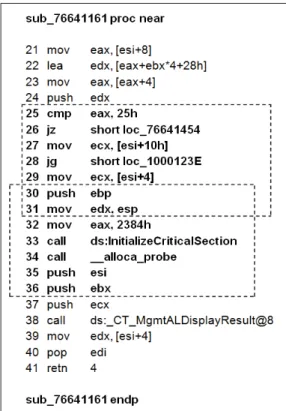
11 Proceduresub 76641161 . . . 37
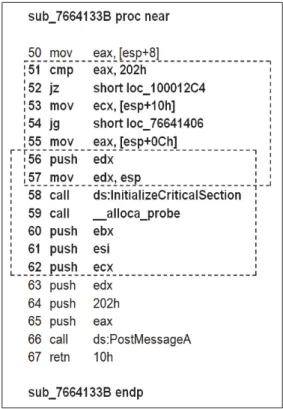
12 Proceduresub 7664133B . . . 38
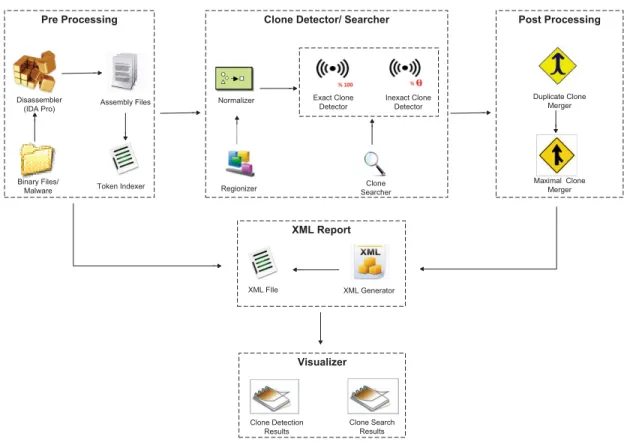
13 System Architecture . . . 40
14 Search Capability (Search for String “RpcTransServerFreeBuffer”) . . 41
15 Normalization Hierarchy for Registers . . . 42
16 Register Normalization Example . . . 42
17 Normalized sub 76641161 . . . 43
18 Normalized sub 7664133B . . . 43
19 Regionization for w= 15 and s= 1 . . . 44
20 Step 3 - Sliding Window Inexact Detection Method withSBSize= 5 47 21 Step 3 - Two-Combination Inexact Detection Method . . . 49
22 Duplicate Clone Merger with w = 10, s = 4, and an Overlapped Size of 0.6 . . . 51
23 Maximal Clone Merger with w= 5 ands= 1 . . . 53
25 Sample XML File (parameters) . . . 54
26 Sample XML File (assembly files) . . . 55
27 Sample XML File (clone files) . . . 56
28 Sample XML File (token references) . . . 57
29 Clone Detection (Input Parameters) . . . 58
30 Clone Search . . . 58
31 GUI (Clone File Pairs Found) . . . 59
32 GUI (Code Fragment of Clone Pair) . . . 59
33 Accuracy (DLL files) with s = 1 and maxOperands = 40 . . . 62
34 Runtime vs. Window Size (Malware Assortment) . . . 63
35 Scalability (with Sliding Window) . . . 64
List of Tables
1 Metrics (Bruschi et al [17]) . . . 27 2 Malware Specifications . . . 60 3 Number of Clones (Malware Assortment) . . . 62
Chapter 1
Introduction
Malware is any kind of software installed in computer systems without the owner’s adequate consent that performs malicious activities. Malware includes, among oth-ers, computer viruses, worms, trojan horses, spyware and adware. Their malicious activities range from simple email spamming to sophisticated distributed denial of service attacks. New methodologies are used every day to create malware software that can be hidden from the lens of computer systems protective software.
Reverse engineering, although a time-consuming process, is often the primary step taken to gain an in-depth understanding of a piece of malware. To achieve a more efficient analysis, the analyst can manually compare the assembly code with a repository of previously analyzed assembly code and identify identical or similar code fragments. By identifying the matched code fragments and transferring the comments from the previous study to the new assembly code, the analyst can minimize her redundant effort and put more attention on the new part of the malware. Yet, the comparison process itself is also time-consuming, and successfully identifying similar code fragments often depends on the experience and knowledge of the analyst. In this thesis, an assembly code clone detection system based on the framework proposed by Sæbjørnsen et. al [50] is presented, and the performance of the system in terms of accuracy, efficiency, scalability, and feasibility of finding clones on assembly code decompiled from real-life binary and malware files is evaluated.
The problem of assembly code clone detection is informally described as follows: Given a large collection of previously analyzed assembly files and a specific target assembly file or a piece of target assembly code fragment, a user would like to identify
all code fragments in the previously analyzed assembly files that are syntactically or semantically similar to the target assembly file or the piece of target assembly code fragment. The challenges of the problem can be summarized as follows:
Simple keyword matching won’t solve the problem: A simple method to identify the assembly code clone is to identify some keywords, such as constants, strings, and imports, in a code fragment, and then attempt to match them in other code fragments. Another alternative method is to perform a keyword search in RE-Google [1]. The keyword search capability is essential, yet insufficient, for assembly code clone detection because many code fragments do not contain any keywords or unique strings.
Large volume of data: The size of an assembly file can range from a couple of kilobytes to over dozens of megabytes of textual data. Depending on the user-specified parameters, each assembly file can be further decomposed into an array of regions with size proportional to the number of lines of an assembly file. The efficiency of a clone detection method refers to the period of time required for identifying all the clones. The scalability of a clone detection method refers to its capability of handling large collection of assembly code.
Syntactic and semantic clones: Two code fragments that are syntactically similar to each other are considered to be a syntactic clone. Two code fragments that perform the same computation but having different instructions are considered to be a semantic clone. Ideally, a clone detection algorithm should able to identify both types of clones. Yet, semantic clones are difficult to detect, especially in the context of assembly code.
The objectives of this thesis are (1) to introduce a formal framework for design and implementation of an assembly code clone detection, (2) to evaluate the feasibility of detecting exact clones with different levels of normalization, (3) to propose an accurate inexact clone detection, (4) to implement an efficient search capability on constants, strings, imports and code fragments, which are known to be valuable features for gaining insight into the binary files. Finally,
Contributions: The contributions of this thesis are summarized as follows. An assembly code clone detection framework based on Sæbjørnsen et al.’s work [50] is developed and significant extensions on its normalization and inexact clone detection method are made. The new normalization process improves the clone detection tool
by finding type I and type II clones. Sæbjørnsen et al. [50] presented an inexact clone detection method to identify clone pairs that are not exactly identical. The general approach is to first extract a set of features from each region and create a feature vector for each of them. Sæbjørnsen et al. used locality-sensitive hashing (LSH) to find the nearest neighbor vectors of a given query vector. Although this approach shows some encouraging results to identify clone pairs that were not exactly identical, it has an inappropriate assumption on the uniform distribution of vectors and the requirement of specifying precise probabilistic models. As the number of features increase (i.e., dimensions), the assumption on the uniform distribution of vectors may not hold. As a result, their approach may miss the vectors (clones) that are not uniformly distributed; therefore, increasing the chance of having false negatives. A new approach to address the issue of false negatives is presented and implemented in this thesis. This new approach can find Type III clones by an efficient feature extraction and filtering process algorithm. Finally, the framework is improved by storing the clone results in an XML file and visualizing the clones. Experimental results on real-life malware binaries obtained from the National Cyber-Forensics and Training Alliance (NCFTA) Canada suggest that our proposed clone detection algorithm is effective.
The thesis is organized as follows: Chapter 2 provides a literature review and background knowledge on source and assembly code clone detection. Chapter 3 for-mally defines the problem of assembly code clone detection. Chapter 4 discusses the implementation details and proposed algorithms used in the implemented assembly code clone detection tool. Chapter 5 presents the experimental results to illustrate the performance of the implemented assembly code clone detection system. Chap-ter 6 concludes the thesis and also suggests the potential extensions that can further improve the currently implemented system.
Chapter 2
Related Work and Background
Knowledge
In this chapter, first, the state-of-art techniques for source code fragment matching are summarized to analyze the feasibility of applying the techniques to assembly code fragment matching. These techniques are categorized into eight groups. For each category, the most promising techniques are identified based on the analysis and experimental results obtained from different literature reviews, survey papers, and case study papers.
Then, the state-of-art techniques for assembly code fragment matching are sum-marized and categorized into six groups. The most promising techniques are also identified and briefly described.
The procedure of clone detection consists of two phases, transformation and com-parison. The general idea is to transform the code into an intermediate format that facilitates more effective and efficient comparison.
Before describing the categorized techniques, the definition of code clone types with respect to textual and functional similarities is presented.
Clone Definition
Any two given similar code fragments can be similar in two different ways: textual and functional similarity. The following definitions of code clone types are widely used in the literature of clone detection and plagiarism (Roy et al. [48], [49]).
Textual Similarity:
also variations in layout) and comments.
• Type II: Structurally/syntactically identical fragments except for variations in identifiers, literals, types, layout, and comments.
• Type III: Copied fragments with further modifications. Statements can be changed, added, or removed in addition to variations in identifiers, literals, types, layout, and comments.
Functional Similarity:
• Type IV: Two or more code fragments that perform the same computation that is implemented through different syntactic variants. This type of clone is also called a semantic clone.
2.1
Matching Source Code Fragment
Text-Based Approach
Text-based clone detectors consider the target source program as a sequence of lines or strings, and compare every pair of code fragments to find identical sequences of strings. Since the match is based purely on the text of the lexical approach, the identified clones often do not correspond to any structural elements of the language. Most text-based techniques do not transform the source code into some intermedi-ate or normalized format, except for comments removal, whitespace removal, and some very basic preprocessing steps [23]. Text-based methods are robust to format alteration, but fragile to identifier renaming.
Johnson ([32], [33]) presented a pioneer work of a pure text-based approach that finds redundancy of code using fingerprints on a substring of the source code. The general idea of the method is to first calculate the signature of each line and then identify the matched substrings. First, a text-to-text transformation is performed on the source file for discarding uninteresting characters. Then, the file is divided into a set of substrings so that every character of the text appears in at least one substring. To compute the fingerprints of all length n substrings of a text, Johnson employed theKarp-Rabin fingerprinting algorithm [36] . A sliding-window technique in combination with an incremental hash function is used to identify sequences of lines having the same hash value as clones. For finding near-miss clones, his algorithm finds
a normalized/transformed text by removing all whitespace characters except for line separators and by replacing each maximal sequence of alphanumeric characters with a single letter, such as “a”.
For example, a line
f or(k = 1;k ≤n;k+ +) is transformed to
a(a=a;a≤a;a+ +) and another line
#define ABCD 123
is transformed to
#aaa
Marcus and Maletic [46] searched for similarities of high-level concepts extracted from comments and source code elements. They employed latent semantic indexing
[25] for finding similar code fragments in the source code. This information retrieval approach limits the comparison within comments and identifiers. Their results show that high-level, semantic clones can be detected with low computational cost. They also illustrated that their approach can be combined with other existing clone detec-tion approaches. One major drawback is that this approach alone cannot detect two functions with similar structure and functionality if comments do not exist and the identifiers’ names are different.
Ji et al. [31] introduced an adaptive local alignment method that considers the
frequencies of keywords in the clone detection scoring function. The basic idea of adaptive local alignment is that the matching score of keywords should reflect the frequencies of keywords. Specifically, their method assigns a high score for a keyword with low frequency, and a low score for a keyword with a high frequency. The rationale is that it is rare to see keywords of low frequency being used by two fragments at the same time. Therefore, two programs using the same keywords of low frequency should be considered similar.
Token-Based Approach
A token-based clone detector parses and transforms source code to a sequence of tokens using compiler style lexical analysis. All the whitespaces, including line breaks, tabs, and comments between tokens are removed from the token sequence. A sequence is then scanned for duplicated subsequences of tokens, and finally, the original code
portions representing the duplicated subsequences are returned as clones. Compared with text-based approaches, a token-based approach is usually more robust against code changes such as formatting and spacing. Since variables of the same type are mapped into the same token, a token-based approach is usually more robust against identifier renaming. However, this approach is generally fragile to statement reorder-ing and code insertion because it relies on sequential analysis. A reordered or inserted statement can break a token sequence that may otherwise be regarded as duplicate to another sequence. Token-based methods are also fragile to control replacement because, for example, for and while loops render different token sequences [44]
Kamiya et al. [34] proposed a multi-language token-based clone detection method called CCFinder, which extracts code clones in C, C++, Java, COBOL, and other source files. First, each line of source files is parsed into tokens by a lexer and the tokens of all source files are then concatenated into a single token sequence. The token sequence is then transformed based on the transformation rules of the language of interest, aiming at regularization of identifiers and identification of structures. For example,
void print lines(const setstring&s) { int c = 0;
setstring::const iterator i = s.begin();
for (; i != s.end(); ++i) { cout << c << ”, ”
<< *i << endl; ++c;
} }
is transformed to the following by some transformation rules.
void print lines ( const set & s ) { int c = 0;
const iterator i = s . begin ( );
for ( ; i != s . end ( ) ; ++ i ) { cout << c << ”, ”
<< * i << endl; ++ c;
} }
Then, all identifiers of types, variables, and constants are replaced with a special token, e.g., $p. This identifier replacement makes code fragments with different vari-able names be clone pairs. For example, the above code will become the following after the replacements of identifiers:
$p $p ( $p $p & $p ) { $p $p = $p ; $p $p = $p . $p ( ) ; $p ( ; $p != $p . $p ( ) ; ++ $p ) { $p << $p << $p << * $p << $p ; ++ $p ; } }
Burd and Bailey [18] conducted an independent experiment on CCFinder and found that CCFinder has a precision of 72% and recall of 72%, with a medium system of 16 KLOC. The recall rate of CCFinder is the best among all the tested methods in Burd and Bailey’s experiments. Experimental results suggest that CCFinder is promising for Type I and Type II clone detections for source code.
Baker ([10], [9]) proposed another token-based method calledDup. As in CCFinder, Baker also used a lexer to tokenize the source code, then compared the tokens of each line using a suffix-tree based algorithm. Transformation rules on the token sequence were not applied in the work, and the notion of parametrized matching was introduced by a consistent renaming of the identifiers. Dup requires a lot of user interactions to determine whether tokens are identical. For example, the user may specify the same token ID to different data types, such asint, short,long,float, anddouble, depending on requirements.
The token-based techniques discussed above (Kamiya et al. [34]; Baker [9], [10]) make use of asuffix tree to detect similarities in the token string. Recently, researchers
have shown that an alternative data calledsuffix arrays (Manber and Myers [45]) can provide the same efficiency for string matching with much reduced space requirements (Abouelhoda et al. [6]). Another limitation of these token-based techniques is the separation of parameter and non-parameter tokens, which can potentially cause false negatives in clone detection.
To address the above shortcomings in a token-based approach, Basit et al. [12] proposed a method called Repeated Tokens Finder (RTF). They made two contri-butions to the token-based approach: (1) RTF implements a flexible tokenization mechanism. (2) They consider the problem of clone detection as finding repeating substrings within the combined token string, and making the comparisons feasible by utilizing suffix arrays.
• Flexible tokenization mechanism: First, the language-specific tokenizer assigns a unique numeric ID to each token class of the source language, e.g., keywords, operators, comment markers, etc. Then, a single large token string is generated from all the source files. Identical segments of this token string are reported as clones that can be either exact clones (Type I) or parameterized clones (Type II) owing to the normalization of certain tokens according to the proposed tokenization. Next, RTF allows a user to suppress some insignificant token classes that may be considered noise in clone detection. For example, access modifiers, such as private, protected, and public, are not important for clone detection, and therefore should be suppressed. Furthermore, RTF allows a user to equate different token classes. For example,int,short,long,float, and double
can be merged into the same ID, so that code fragments that differ only in data types become a clone pair.
• Finding repeating substrings: RTF treats clone detection as finding repeating substrings within a large combined token string. In fact, RTF finds the non-extendable repeating substrings because any non-empty subsequence of a clone is also a clone. Specifically, RTF applies (the method of Abouelhoda et al. [6]) to the problem of source code clone detection.
Most works on clone detection assume that the source database is static and the clone detection operation is performed in a batch mode. When the source database
is updated, the entire detection operation has to be performed again. Most liter-ature in the field implicitly makes such an assumption, regardless of the program representation they operate on or the search algorithm they employ.
Recently, Hummel et al. [28] proposed a scalable token-based tool calledConQAT
for detecting clones in the environment of an incrementally updated source database. ConQAT is open source. Its token-based clone detection method is more or less similar to the previously discussed methods, such as CCFinder and Dup, and ConQAT can detect Type I and Type II clones. The major contribution of ConQAT is its capability to efficiently identify the clones when updates are performed on the source database, by maintaining a data structure calledclone index. It allows the lookup of all clones for a single file (and thus for the entire system), and can be updated efficiently when files are added, removed, or modified. For example, adding a new file may introduce new clones to any of the previously examined files and thus a comparison to all files is required if no additional data structure is used. The general idea of the clone index is similar to that of the inverted index used in document-retrieval systems in which a mapping is maintained between each word and all its occurrences. Similarly, the clone index maintains a mapping from sequences of normalized statements to their occurrences.
Tree-Based Approach
In the tree-based approach, the source code is first converted into an abstract syntax tree (AST) or a parse tree using a language-specific parser. Tree-matching techniques are then used to find similar subtrees, and the corresponding code seg-ments are returned as clone pairs or clone classes. Variable names and literal values in the source may be abstracted in the tree representation, allowing for more flexible detection of clones. In general, tree-based approaches can detect Type I clones. For Type II clones, the token-based approach is more effective. Since this approach dis-regards the information about variables (in order to make code differing on variables’ names appear the same on ASTs), it ignores data flow and is consequently fragile to statement reordering and to control replacement (Liu et al. [44]).
Baxter et al. [13] presented an AST-based clone detection method calledCloneDr. First, a language-specific parser generates an annotated parse tree. See Figure 1 for an example
Figure 1: Annotated Parse Tree (Baxter et al. [13])
The next step is to find the subtree clones by comparing every subtree to other subtrees for equality. Subtrees are compared using characterization metrics based on a hash function and tree matching. This approach works for detecting Type I clones. When locating Type II clones, hashing on complete subtrees fails precisely because a good hashing function includes all elements of the tree and, therefore, considers trees with minor differences to be mismatched. Baxter et al. [13] solved the problem by choosing an artificially “bad” hash function. This function must be characterized in such a way that the main properties one wants to find on Type II clones are preserved. Type II clones are usually created by copying and pasting code fragments, followed by making small modifications. These modifications usually generate small changes to the shape of the tree associated with the copied piece of code. Therefore, they argue that this kind of Type II clone often has only some different small subtrees. Based on this observation, a hash function that ignores small subtrees is a good choice. They used a hash function in their experiments that ignores only the identifier names (leaves in the tree). Thus, their hashing function puts trees that have similar modulo identifiers into the same hash bins for comparison. They further proposed some threshold-based similarity measures to measure the similarity of two subtrees.
Wahler et al. [58] proposed a method to find Type I and Type II clones at a more abstract level than an AST. A program AST is converted to an XML representation and a frequent itemset technique is applied to the XML representation of to find clones. They modified the frequent itemset technique to fit it to the problem of code clone detection.
Evans and Fraser [26] proposed a further abstraction, known as structural abstrac-tion, of a program’s AST for finding both Type I and Type II clones with gaps. While ASTs are built from a lexical abstraction of a program by parameterizing only AST leaves (abstracting identifiers and literal values), structural abstraction is obtained by further parameterizing the arbitrary subtrees of ASTs. For example,x=a[?] lexi-cally matchesx=a[i] because it includes only a leaf and a unary node that identifies the type of the leaf. x=a[?] also structurally matchesx=a[i+ 1] because it includes a binary AST node.
Similarity Distance-Based Approach
Brixtel et al. [16] presented a comprehensive similarity distance-based plagiarism detection framework. In this section, the only elaborated steps are the ones that are relevant to the problem of code fragments matching, namely normalization, segmen-tation, and similarity measure. Brixtel et al. do not present a predefined method for segmentation. A code segment can be a line or a block of code. The distance of two segments, s1 and s2, is measured by a distance function Dist(s1, s2).
The distance function can be the edit distance, e.g., Hamming or Levenshtein (Levenshtein [43]), by counting the number of operations (insertions, deletions, and replacements) required to transform s1 to s2. Another possible distance function is the information distance, which can be approximated using data compression, e.g., gzip. Let c(s) be the compressed version of a segment, and let |c(s)| be the size of the compressed version. The distance between two segments (or two strings) is:
Dist(s1, s2) = 1 - |c(smax1)|+(||cc((ss2)|−|c(s1,s2)|
1)|,|c(s2)|)
where |c(s1, s2)| denotes the compressed size of the concatenation of s1 and s2. Refer to (Cilibrasi and Vitanyi [20]) for the details of this formula.
Program Dependency Graph (PDG)-Based Approach
Program Dependency Graph (PDG)-based approaches attempt to identify a higher abstraction of a source code than the previously discussed approaches by considering the semantic information of the source code. PDG-based approaches use nodes to
represent expressions and statements, while the edges represent control and data de-pendencies. This representation abstracts from the lexical order in which expressions and statements occur to the extent that they are semantically independent. Intu-itively, PDGs encode the program logic and in turn reflect developers’ thinking when code is written. The search for clones is then turned into the problem of finding isomorphic subgraphs (Roy and Cordy [48]).
Krinke [41] proposed a clone detection method based on fine-grained program de-pendence graphs. His method, commonly known as Duplix (Roy and Cordy [48]), considers both the syntactic structure and data flow of a software program. The first step is to transform code fragments into fine-grained PDGs, and the second step is to identify similar subgraph structures from the PDGs. The vertices of the fine-gained PDG represent components of expressions. There are three types of edges between the vertices. Immediate control dependence edges are between the components of an expression, which are evaluated before the source code is evaluated. Value depen-dence edges represent the data flow between the expression components. Reference dependence edges represent the assignment of values to variables.
Komondoor and Horwitz [39] proposed a PDG-based clone detection method called PDG-DUP. The general idea is to first partition all PDG nodes based on the syntactic structure of the statement/predicate that the node represents. For each pair of matching nodes (r1, r2), PDG-DUP identifies the isomorphic subgraphs of the PDG that contains r1 and r2 using backward and forward slicing. The identified isomorphic subgraphs are clones.
Liu et al. [44] developed an efficient PDG-based plagiarism detection algorithm called GPLAG. They employed a relaxed subgraph isomorphism comparison by in-troducing a relaxation thresholdγ . Two subgraphs g and g’ are γ-isomorphic if their difference is within the threshold γ. Although subgraph isomorphism comparison is in general NP-complete, they developed GPLAG based on three observations, mak-ing GPLAG a feasible real-life application. First, PDGs cannot be arbitrarily large as procedures are designed to be of reasonable size for developers to manage. Sec-ond, PDGs are not general graphs and their peculiarity, like varieties of vertex types, makes backtrack-based isomorphism algorithm efficient. Finally, unlike traditional isomorphism comparison, a user usually is satisfied as long as one, rather than all, isomorphism between g and g’ is found. A user can look into the details once a pair
of matched procedures has been identified. These three factors make isomorphism comparison efficient in GPLAG.
Liu et al. identified five categories of source code alterations and considered their effect on the PDG. 1. Format alteration 2. Identifier renaming 3. Statement reordering 4. Control replacement 5. Code insertion
The first and second alteration remove blanks, insert comments, or rename the identifiers in the source code. Hence, these alterations do not alter the PDG because they do not affect the dependencies of the graph. Statement reordering changes the location of statements without causing error. This type of alteration also does not alter the PDG because the statements can be reordered if they do not have dependencies. Control replacement changes the control flow of the source code. For example, a for loop can be equivalently replaced by a while loop. This alteration can add a new program vertex to the subgraphs but does not affect the dependencies of subgraphs. The last alteration is code insertion, which inserts immaterial code into the program so that the original program logic does not change. These types of alterations can introduce new dependencies into the program but they are not supposed to interfere with existing dependencies.
Letnbe the number of procedures in the first source code file andmbe the number of procedures in the second source code file. To identify the clone pairs, Liu et al. observed that it is not necessary to perform a full isomorphism comparison forn∗m
pairs for PDGs. Most PDG pairs can in fact be excluded from detailed isomorphism testing because they are dissimilar, even with a high-level examination. Therefore, they proposed alossy filter to prune these dissimilar PDG pairs. Unlike conventional similarity measurement, usually based on a certain distance metric, this filter follows a similar reasoning to hypothesis testing: A PDG pair (g, g) is preserved until enough evidence is collected against the similarity between g and g. In comparison
with distance-based methods, this approach avoids the difficulty of proper parameter setting and also provides a statistical estimation of the false negative rate. Their experiment shows that GPLAG can efficiently prune 90% of the original search space.
Metrics-Based Approach
Most of the previously discussed approaches identify clones by directly comparing code. In contrast, metrics-based approaches gather different metrics for code frag-ments and compare the metrics vectors. There are several clone detection techniques that use various software metrics for detecting similar code. First, a set of software metrics calledfingerprinting functions are calculated for a class, a function, a method or even a statement, and then the metrics values are compared to find clones over these syntactic units. In most cases, the source code is parsed to its AST/PDG representation for calculating such metrics.
Kontogiannis et al. [40] proposed two approaches to detect clones. The first approach is nameddirect comparison of metrics values that classifies a code fragment in the granularity of begin-end blocks. Two code fragments are considered similar if their corresponding metrics values are close. The second approach uses a dynamic programming technique for comparingbegin-end blocks at the statement level.
Program features relevant for clone detection focus on data and control flow prop-erties. Kontogiannis et al. used the following metrics:
1. The number of functions called (fanout).
2. The ratio of input/output variables to the fanout. 3. McCabe cyclomatic complexity.
4. Modified Albrecht’s function point metric. And,
5. Modified Henry-Kafura’s information flow quality metric. Lets be a code fragment.
McCabe(s) = e - n + 2,
where e is the number of edges in the control flow graph, and n is the number of nodes in the graph.
Albrecht(s) = p1 ∗ VARS USED AND SET(s)+
p2 ∗ GLOBAL VARS SET(s)+
p3 ∗ USER INPUT(s)+
p4 ∗ FILE INPUT(s)
where p1,p2, p3 and p4 are weight factors.
Karfura(s) = (Kafura in(s) ∗ Kafura out(s))2,
where Karfura in(s) is the sum of local and global incoming dataflow to the code fragment s, and Karfura out(s) is the sum of local and global outgoing dataflow to the code fragment s.
Mayrand et al. [47] proposed a method calledCLAN that calculates 21 functional metrics, e.g., number of lines of source, number of function calls contained, and number of CFG edges, for each function unit of a program. Units with the similar metrics values are identified as code clones. Partly-similar units are not detected. It uses a representation of the source code calledIntermediate Representation Language (IRL) to characterize each function in the source code. For example, Figure 2 depicts the IRL representation of the following function:
int fct (int param) { int ret = 0; if (param != 0) { fct2(); ret = 1; } else { fct3(); ret = 2; } }
Metrics are calculated from names, layouts, expressions, and control flows of func-tions. A clone is defined only as a pair of whole function bodies that have similar metric values. This approach does not detect clones at other granularity levels such as segment-based clones, which occur more frequently than function-based clones. Very similar kinds of method-level metrics, such as the number of calls from a method, number of statements, McCabe’s cyclomatic complexity, number of use-definition of
non-local variables, and number of local variables, are features for identifying similar methods.
Figure 2: IRL Representation of the Sample code (Mayrand et al. [47]) Shawky and Ali [55] performed experiments on other metrics values: (1) the num-ber of inputs a function uses (2) the numnum-ber of outputs (3) the numnum-ber of declarative and executable statements (4) the average number of lines containing source for all nested functions (5) the number of edges, nodes, and connected components, and (6) the maximum nesting level of control constructs in a function.
Memory-Based Approach
Memory-based clone detection is a recently proposed approach by Kim et al. [38]. Unlike most of the previously described approaches that are based on textual or struc-tural similarity, the proposed Memory Comparison-based Clone Dectector (MeCC)
identifies clones by comparing programs’ abstract memory states, which are computed by a semantic-based static analyzer. The primary objective is to detect gapped clones (Type III) and semantic clones (Type IV). The clone detection ability of MeCC is independent of the syntactic similarity of clone candidates. MeCC has two phases: (1)its uses a path-sensitive semantic-based static analyzer to estimate the memory states at each procedure’s exit point, and (2) compares the memory states to identify clones. Figure 3 shows an overview of MeCC.
Figure 3: Overview of MeCC (Kim et al., [38])
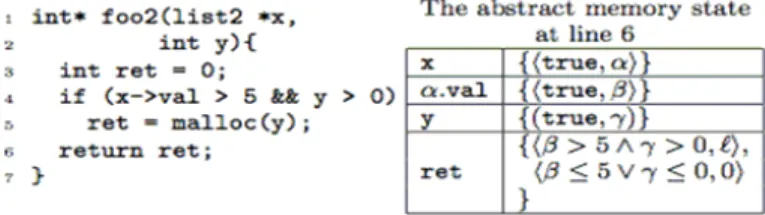
Figure 4: Example of Abstract Memory State (Kim et al. [38])
Figure 4 shows the abstract memory states of the sample programs foo and bar. The joined memory state at the return point of foo (line 6) is shown as the table in Figure 4.
Figure 5: Example of Abstract Memory State Comparison (Kim et al. [38]) Figure 5 shows another procedure calledfoo2, which is a semantic clone of proce-dure foo in Figure 4. Ignoring the names of variables, symbols, field variables, and variable types, MeCC can determine that β ≤ 5 ∨ γ ≤ 0 and β ≤ 5 ∨ (β > 5 ∧
γ ≤0) are in fact equivalent and therefore, the two fragments are clones.
Hybrid Approach
Different approaches have different strengths and weaknesses. The idea of the hy-brid approach is to use different approaches with the goal of combining their strengths
and avoiding their weaknesses. In this section, some papers that combine token-based or text-based approaches with tree-based or PDG-based approaches are reviewed to get the beneficial aspects of multiple approaches. This work can lead to analyzing large scale source codes and software with better precision. Also, it can increase the portability of syntactic and semantic approaches to assembly code clone detection.
Balazinska et al. [11] proposed a hybrid approach of characterization metrics and DPM (Dynamic Pattern Matching). Their paper discusses only the detection of whole methods, although the approach may also be applied to detect partial code fragments. Characteristic metrics valued are computed for each of the method bodies and compared to find clusters of similar methods. The token sequences for each pair of similar methods are then compared by the Dynamic Pattern Matching Algorithm of Kontogiannis et al., in order to identify cloned methods. Finally, the found cloned methods are classified into 18 categories.
Tairas et al. [56] developed a plug-in for the Microsoft Phoenix framework for automatic clone detection. They used AST nodes to generate a suffix tree, allowing analysis on the nodes. A path is made from the root to a leaf for each suffix of a string. This is done by evaluating each character in the suffix and generating new edges when there are no existing edges that represent the character in the suffix tree. A suffix tree is useful in string matching because duplicate patterns in the suffixes will be represented by a single edge in the tree.
Figure 6: “abcdabe$”’s Suffix Tree (Tairas et al. [56])
Figure 6 depicts the suffix tree for the string “abcdabe$”. The non-empty suffixes sorted by alphabetical order are:
abe$ abcdabe$
bcdabe$ be$ vcdabe$
dabe$ e$
$
The pattern ab is represented by a single edge. Two suffixes abcdabe$ and abe$
pass through this edge. The split at the end of this edge continues the two suffixes where the next character differs between them. By looking at the suffixes passing through the edge that represents the pattern ab, the location of this string pattern can be determined. Using the method for searching for certain edges in the suffix tree, duplicated functions can be determined.
Zeidman ([61], [62]) published two similar patents for detecting plagiarism in source code at the file level. His invention fully compares the features of each pair of source code. Each source file is represented by three arrays: an array of source lines, an array of comment lines, and an array of identifiers. His methodology employs five measures to identify clones: source line matching, comment line matching, word matching, partial word matching, and semantic sequence matching. Figure 7 illus-trates the array of source lines, the array of comment lines, and the array of unique identifiers of the function named fdiv. Zeidman provided an equation for each of the five measures and the similarity of two source files is the weighted sum of the five measures.
Figure 7: Arrays of Source Lines, Comment Lines, and Unique Identifiers (Zeidman [61])
Davis and Godfrey [22] proposed a novel technique to detect clones by analyzing the assembly-version of source code. Their work complements token- and text-based techniques for source code clone detection. First, the source code is normalized and is reduced to a sequence of simple operations. Then, it is compiled into assembly code. The comparison is performed on assembly instructions in functions. A search-based approach is used to find maximal pairings of distinct matched assembly code instruc-tions from two distinct assembly subsequences that occur in the same sequence. The search-based algorithm examines each instruction by walking through each function and each array of instructions within a function. Given two sequences of comparable instructions P and Q, the comparison process compares every pair of instructions in P and Q, assigns a positive weight to each matched pair, and assigns a negative weight for each unmatched pair. Consequently, the subsequences with high sum of weights are considered to be clones.
Keivanloo et al. [37] proposed a hybrid approach to improve the scalability of the current existing clone detection tools. They devise a divide-and-conquer algorithm
that splits a given data set into n random subsets and extracts clones from each subset independently. The drawback is that the algorithm will miss the clone pairs that span across two different subsets. Their algorithm provides a trade-off between recall and scalability.
2.2
Matching Assembly Code Fragments
Text-Based Approach
A text-based approach in binary clone detection considers the executable portion of a binary as a sequence of bytes or lines of assembly code and compares every pair of code segments to find identical sequences.
Jang et al. ([29], [30]) proposed a fingerprinting algorithm called BitShred based on bloom filters to cluster malware samples. In addition, they stated that BitShred can be used to detect software bugs resulting from copied code. However, they did not have any success in their experiments.
BitShred consists of three phases: shredding a file, creating a fingerprint, and comparing fingerprints. In the shredding phase, BitShred divides all executable code sections into fragments called shreds (i.e., n-grams). Figure 8 shows an example of shredding a byte sequence with n= 5.
Figure 8: Shredding a Byte Sequence with n = 5 (Jang and Brumley, [29]) Next, to improve storage efficiency and scalability, BitShred uses a Bloom filter
(Bloom, [14]) created from all shreds of a given file to represent the fingerprint of the file. Then, BitShred calculates similarity between two fingerprints by using the
Jaccard index, which is defined as the size of the intersection divided by the size of the union of the sample sets. In the case of comparing two Bloom filters, this is reduced to the ratio
JR(A, B) = S(BFA∧BFB)
where S(BF) is the total bits set in the Bloom filter BF.
Finally, files having a similarity score higher than a threshold t can be clustered together. Clustering is performed in two steps: first, malware samples with similarity equal to 1 are clustered. Similarity between every pair of the remaining samples is then calculated.
Token-Based Approach
Token-based binary clone detectors disassemble executable code segments and partition lines of assembly into opcodes and operands. Opcode and operand types may be generalized or filtered and the resulting sequence is scanned to find duplicates. Schulman ([52], [53], [54]) whitelists “boilerplate” code in binaries to be analyzed for litigation purposes. To address this, he designed a system to create a database of previously analyzed binaries to recognize duplicate functions. This appears to be the first work on detecting code clones at the functional level. In addition, this work was designed to handle a large volume of assembly code.
The basic idea of the system is to create a hash of each function in the binary being analyzed and to store it in the database. Identical hash values that occur in more than one binary indicate a code clone. This approach will detect some functions whose source code is identical, but will miss many others. Compiling source code does not always produce an identical assembly each time. Stack memory addresses may change, depending on the functions position in the binary. In addition, the binary may be compiled as Unicode versus ASCII, resulting in different assembly instructions. The source code may also have modifications such as different hard coded values in its variables, even though prior to this modifications the source was identical. To address these changes in the resulting assembly, the author normalizes the instructions in the following manner:
1. Only the opcode, not the operands, are used in the hash.
2. Opcodes are converted to their mnemonics. For example opcodes 51 and 52 are instructions for push ecx and push edx. The hash is now performed on the resulting generic opstring push instead of their numeric counterparts.
3. Location labels are added to the opstring as loc to add structure information for a more accurate hash.
4. Windows API calls are included in a normalized format (again, wide vs. ASCII formats are ignored).
5. Commonly occurring mnemonics such as mov, pop and push are ignored to further handle minor code changes.
An example of the resulting opstring for a function is:
loc,[MessageBox],cmp,jnz,ret
This string is hashed and stored in the database.
Karim et al. [35] addressed the problem of classifying new malware into existing malware families whose individual entries share common code. Their goal has been to create phylogeny models of malware based on features of their binary code, such as biologists create phylogeny models based on nucleotide, protein, and gene sequences of organisms. They built the models to handle program evolution through code rearrangements (instruction or block reordering). They experimented with ann-gram
comparison approach as well as its permutations, which they refer to asn-perms. They argueed that permutations could include instruction, block, or subroutine reordering. In such situations, the reordering can make sequence-sensitive techniques, such as
n-gram, produce undesirable results if they report similarity scores that are too low for reordered variants or descendants. Experiments were performed on artificially constructed permutations of worms as well as unrelated samples. This work evaluates the use ofn-grams versusn-perms for clustering malware samples into their respective families.
The first step is to use the tokenizer to transform an input program into a sequence of opcodes. Next,n-grams andn-perms are extracted from this sequence. Ann-perm would simply be an ordered n-gram. Subsequently, they create a feature occurrence matrix with entries i, j that refer to the number of times a feature (i.e., a specific
n-gram or n-perm) occurs in program j. Then, they create a symmetric similarity matrix where each i, j entry is the calculated similarity between programs i and j. Similarity is calculated by using the tf ∗ idf weighting (van Rijsbergen, [57]) and
cosine similarity measure (Zobel and Moffat, [63]). This method makes features that are common among many programs weighted lower and those features common within a program weighted higher.
Walenstein et al. [59] presented a mechanism called Vilo to search a database of previously analyzed malware binaries using a new malware sample as the search string. They adapted techniques from their previous work (Karim et al., [35]) to perform the similarity matching for the search.
In the Vilo method, whole programs are compared using “n-grams” and “n-perms” extracted from disassembled binaries that have been unpacked and unencrypted. They used a vector model for comparison. These extracted features are counted, weighted, and converted into vectors that are then compared using their cosine simi-larity measure (Zobel and Moffat, [63]). To perform a search using the Vilo method, a new sample is compared to each existing feature vector in the database.
Metrics-Based Approach
Sæbjørnsen et al. [50] presented a generalclone detection frameworkthat operates on binaries. It utilizes an existing tree similarity framework, models the assembly instruction sequences as vectors, and groups similar vectors together using existing “nearest neighbor” algorithms.
They first disassemble the input binaries by using a disassembler, such as IDA Pro [2], and then create intermediate representations of the assembly code. Then, a binary is partitioned into overlapping code segments that consist of a block of contiguous assembly extracted from within a function. These regions are created using a sliding window. Their method then creates a normalized instruction sequence, abstracting the information of memory location and registers. Next, it performs clone detection on the normalized structure sequence. They define two methods for creating clone clusters. The first method is anexact match that uses a hash for each code region, and a clone exists if there are any repeated hash values. The second method is an inexact match, which extracts a set of features from a code region and looks for other code regions with the same feature set. They count the number of occurrences of each feature to create a feature vector for each region. Next, they use
locality-sensitive hashing (LSH) (Andoni and Indyk, [7]) on each region and perform a distance calculation for clustering based on features for inexact matching.
Sæbjørnsen et al. utilized IDA Pro for disassembling the code. However, the rest of the implementation has no reliance on it. After the disassembly, the instructions are put into the ROSE intermediate representation (Schordan and Quinlan, [51]). The normalized code regions and feature vectors are then extracted and stored in a
SQLite database. Finally, both the exact or inexact match detectors run on top of the database.
Bruschi et al. [17] presented a technique to normalize assembly code to detect polymorphic and metamorphic malware. The main objective of this work is based on using a normalization technique to ease the comparison between malware samples. The authors developed a prototype implementation on top of Boomerang, an open source decompiler. The normalization is the process of transforming a piece of code into a canonical form. Bruschi et al. used the following normalization techniques:
• Instruction meta-representation: This is a high-level representation of machine instructions that mimics the semantics of assembly language (opcode, registers, memory address, and flags).
• Propagation: It is used to propagate forward values assigned or computed by intermediate instruction. Once an instruction defines a value, this variable is used by subsequent instructions without being redefined. The purpose is to generate high level expressions and to eliminate all temporary variables. The following list illustrates a propagation of values in high-level representation of assembly code:
• Dead code elimination: This technique consists of removing instructions that are never used.
• Algebraic simplification: It simplifies arithmetical and logical operations. • Control flow graph compression: A control flow can be heavily modified by
inserting fake conditional and unconditional jumps. As a result, its compression is necessary to ease browsing and analysis.
Bruschi et al. stated that it is not possible to compare samples by matching byte by byte in their formalized form. They adopted a method to measure the similarity
Metrics
m1: number of nodes in the control flow graph. m2: number of edges in the control flow graph. m3: number of direct calls.
m4: number of indirect calls. m5: number of direct jumps. m6: number of indirect jumps. m7: number of conditional jumps.
Table 1: Metrics (Bruschi et al [17])
between different pieces of code. The method was introduced by (Kontogiannis et al. [40]). A code is characterized by a vector of metrics’ values and a measure of distance between different code fragments. Table 1 shows the metrics employed by Bruschi et al.
These metrics identify the fingerprint of a code fragment as a 7-tuple (m1, m2, m3, m4, m5, m6, m7). The fingerprint is used for code fragments comparison. For the code fragments “a” and “b”, the comparison is represented by the Euclidean distance:
(mi,a−mi,b)2 fori= 0. . .7, wheremi,aand mi,b are theith metrics calculated on code fragments “a” and “b”.
Structural-Based Approach
In software engineering, a program is considered as a set of components or code blocks that are built to achieve computational tasks within computers and calculators. A program consists of a set of instructions written in high- or low-level languages and structured within blocks. The structural analysis of software is a process that is used to characterize the execution schema of a program. Furthermore, it allows retrieval of code information by browsing different parts of the code. The structural analysis can be used to detect bugs within programs and to make comparisons between programs. In this thesis, the second issue is of primary interest. Different structural analysis techniques for code similarity detection will be discussed in this section, as well as some works that are related to the detection based on structural analysis approach.
Dullien et al. [24] presented the results of research on executable code compar-ison for attacker correlation. They implemented a system that can identify code similarities in executable files. Dullien et al. based their approach on the struc-tural comparison of executable files. The goal of the system is twofold: querying for a particular feature within malicious code and recognizing similarities between
different malicious pieces of code. In order to query a large set of data, the authors implemented a function that hashes different control flow graphs. Specifically, they converted the set of edges in a control flow graph into a set of n-tuples of integers. A suitable encoding of each set is then constructed as follows: Let M be the set of all control flow graphs and Eg be the set of edges of a particular G belonging to M. The graph is represented with the following function:
This function outputs a set of integers that represents a given graph in a simple manner. Next, in order to encode the set of integers, the authors chose a Q5 vector
1,√2,√3,√5,√7 to convert integer tuples into a real number:
emb(z)→z0+z1√2 +z2√3 +z3√5 +z4√7 The hash, called MD-index, is computed by the following function:
Has(g) = √ 1 emb(t) where t∈tup(g)
Dullien et al. developed a matching algorithm based on the approximation to maximum sub-graph isomorphism problem. The algorithm attempts to map between nodes and edges by observing a list of characteristics:
• Byte hash: a traditional hash over the bytes of the function or a basic block • MD-index of a particular function
• MD-index of source and destination of call-graph edges
• MD-index of graph neighborhood of a node/edge (a sub-graph that is originated from a given node or edge)
• Small prime product: a simple way to compute a hash of mnemonics sequence. This method ignores compiler-induced reordering of instructions.
Figure 9: System Architecture (Dullien et al. [24])
Figure 9 shows the architecture of the system, where different components fetch data to perform desired computations. The system consists of four components:
• Unpacker is an unpacking component that removes encryption and obfuscation. The system monitors the statistical properties of the memory. Once the memory pages drops, the components assume that encryption/compression was removed. It writes memory dumps into the database.
• Disassembly extracts the control flow graphs and call-graphs.
• Scheduler performs a rough comparison based on MD-indices of functions in dis-assembly. It reduces the number of functions and blocks, which are susceptible to be compared with analyzed chunks of a given binary.
• Comparison component performs the comparison algorithm by querying the database. It writes the result of comparison back to the database.
Carrera and Erdlyi [19] addressed the challenge of having a large number of mal-ware samples. They developed a system based on graph theory to rapidly and au-tomatically analyze and classify malware based on its underlying code structure. This work is the predecessor to (Briones and Gomez, [15])’s and shares much in common with its underlying theory and implementation. After IDA Pro is used to disassemble a binary, their tool exports a subset of the information into the Re-verse Engineering Markup Language (REML). Carrera has continued with his work
on this tool and produced http://dkbza.org/idb2reml.html. Using this tool, they use
http://dkbza.org/pyreml.html to create a pythonic representation of the data that can be queried during the comparison.
They used operating system and library calls in creating their adjacency matrices. Here their work differs from (Briones and Gomez, [15]) who also used functions that had similar CFG features. However, after their algorithm exhausts matches, they do apply CFG signatures similar to the other paper.
Briones and Gomez, [15] designed an automated classification system for binaries with a similar internal structure. They used graph theory to identify similar functions that are used to classify malware samples. Their objective is to classify new samples to previously analyzed malware families, thus reducing reverse engineering efforts. Although their objective is different from the problem of matching code fragment studied in this thesis, the way they identify similar functions is relevant.
The input for their comparison algorithm is an unpacked binary disassembled with IDA Pro. The next step is to model binaries into adjacency matrices. For example, in Figure 10, each directed edge represents one function calling another and can be modeled as the following adjacency matrix. The rows represent the calling functions and the columns the called functions. To build these adjacency matrices, the algorithm identifies fixed points that consist of known API calls, function hashes, and function call graphs (CFGs).
Figure 10: Directed Graph and Adjacency Matrix (Briones and Gomez, [15]) To compare two binaries, their method creates an adjacency matrix for each binary using identified fixed points as the columns and unidentified functions as the rows. These initial adjacency matrices have identical columns. They determine known API calls as those identified by IDA Pro that are shared between the binaries. The function hashes are unique CRC32 hashes shared between the binaries. Finally, the functions CFGs are those that have a unique tuple with a minimum Euclidean distance. A tuple for a CFG consists of a number of basic blocks, a number of edges, and a number of subcalls.
The comparison algorithm, from each matrix, searches for the functions that have identical column entries and are unique in their respective matrices. These identical functions are removed from their matrices and are added as a column to both matrices. This process continues until no more matches are found. The remaining rows are unidentified functions with no match or functions that do not have a unique match. Their method can potentially match more functions by adding further fixed points that initially were not unique and by starting the match process over again. They defined similarity as a ratio of matched functions to total functions, where 0 indicates no matches and 1 indicates a complete match.
Implementation: Graph comparison on binaries is a computationally intensive pro-cess. In their implementation, they suggested some techniques to improve efficiency. First, they did not rely on IDA Pro for disassembly for efficiency reasons. Second, when comparing rows they first split the row into blocks of 32 bits for comparison.
They applied filtering when analyzing new samples to reduce the number of com-parisons. They filtered on file size, compiler type, number of API functions, number of custom functions, and entropy and checksum.
Flake [27] presented a method that constructs an isomorphism between the groups of functions that are used into two different versions of the same binary. He defined a graph centric analysis. This technique consists of representing an executable as a graph of graphs. The global structure is represented with a call graph, where each function represents a node. An edge exists between two function nodes fi and fj if and only if fi calls fj. Every function is represented with a Control Flow Graph (CFG). The CFG must have the following properties: a unique entry point and one or many nodes as an exit point (nodes that do not link to other nodes). In this work, the notion of structural matching is defined. It lies in matching the functions in two executable files by using the information generated from the call graph and different control flow graphs. In order to achieve the matching between two versions of the same executable, namelyA andB, Flake considered a formal representation for each version. A program is formalized as follows:
A={{a1, a2. . . an},{ae1, ae2. . . aem}}
B ={{b1, b2. . . bl},{be1, be2. . . bek}}
The program is represented by the nodes and their edges (aei and bei are 2-tuple containing two nodes that are directly connected). Flake based his work on finding
iterative mappings between node sets. The iterative mapping is used due to the fact that the cardinality of the two sets is likely different. Each mapping considers two different subsets with the same cardinality. An initial mapping is created. It maps elements of a subset A1{a1, a2. . . an} to B1{b1, b2. . . bl}. This mapping is used to create iteratively a sequence of mappings.
In order to compare the control flow graphs, Flake considered a heuristic matching method. The initial step consists of finding isomorphism between two graphs. Once that is done, a 3-tuple (αi, βi, γi) is associated with each node: αi represents the number of basic control blocks,βi is the number of edges within a node, andγi is the number of edges originating from the node. The mapping is denoted by a function that maps a call graph to 3-tuple. The function is represented as follows:
s:C →N3
The inverse function is as follows:
s−1 :N3 →ϕ({c1, . . . , co})
This function retrieves the set of functions that map to a 3-tuple. The initial map-ping is constructed by examining all 3-tuples that are generated from both program versionsA and B. The functions ai fromA and bj fromB are mapped to each other if and only if they map the same 3-tuple and no other element in {a1, a2, . . . , an} or {b1, b2, . . . , bl}. The mapping is formalized as follows:
p1(ai) = bj ⇔ |s−1(s(ai))|= 1 =|s−1(s(bj))| ∧s(ai) = s(bj)
If the cardinalities ofs−1(s(ai)) ands−1(s(bj)) are equal to one andai andbj have the same tuple, p1 maps ai and bj. Once the initial mapping is retrieved, improved mappingspi are built iteratively by creating small subsets. The algorithm to generate mappings is as follows:
• Take the ith element ai from Ai−1 and retrievepi−1(ai)
• LetAi be the set of all functionsak that have edges originating from ai leading toak inϕ and Bi be the set of all functionsbo that have edges originating from
pi−1(ai) leading to bo inϕ.
• Construct pi :Ai →Bi in the same way p1 was constructed
• pi(aj) := pi−1(aj) if aj ∈ Ai−1. If aj ∈/ Ai−1 and the construction of pi yielded a match, pi(aj) := pi(aj). If the construction of pi did not yield a match and
• Ai and Bi are the domain and image ofpi. The iteration carries on until all the nodes are browsed.
An implementation of the described method was developed as a plug-in for IDA Pro. A corroborated investigation has shown that the author is involved in the creation of the BinDiff tool.
BinDiff [3] is a tool that can compare binary files. It helps researchers find dif-ferences and similarities in disassembled code. It can also port symbols, comments, functions, and local names between disassembled code. BinDiff can be used to gather evidences for code theft or patent infringement. The following figure shows a screen-shot of BinDiff. It shows the changed functions.
Based on the idea of BinDiff, VxClass [4] can also be used to compare disassembly code. VxClass can ignore byte-level changes such as instruction reordering or string obfuscation so that it can discover small changes in the code. The user can upload a sample of malware in a specific database. First, VxClass filters the sample malware by sorting out items the user already analyzed. Then, it finds out if that security incident under investigation is related to any previously analyzed item(s). Next,
Figure
![Figure 1: Annotated Parse Tree (Baxter et al. [13])](https://thumb-us.123doks.com/thumbv2/123dok_us/762352.2596460/20.918.331.635.120.549/figure-annotated-parse-tree-baxter-et-al.webp)
![Figure 2: IRL Representation of the Sample code (Mayrand et al. [47]) Shawky and Ali [55] performed experiments on other metrics values: (1) the num-ber of inputs a function uses (2) the numnum-ber of outputs (3) the numnum-ber of declarative and executab](https://thumb-us.123doks.com/thumbv2/123dok_us/762352.2596460/26.918.359.615.190.539/figure-representation-mayrand-performed-experiments-function-declarative-executab.webp)
![Figure 6: “abcdabe$”’s Suffix Tree (Tairas et al. [56])](https://thumb-us.123doks.com/thumbv2/123dok_us/762352.2596460/28.918.353.625.702.821/figure-abcdabe-suffix-tree-tairas-al.webp)
![Figure 7: Arrays of Source Lines, Comment Lines, and Unique Identifiers (Zeidman [61])](https://thumb-us.123doks.com/thumbv2/123dok_us/762352.2596460/30.918.182.792.126.551/figure-arrays-source-lines-lines-unique-identifiers-zeidman.webp)
![Figure 9: System Architecture (Dullien et al. [24])](https://thumb-us.123doks.com/thumbv2/123dok_us/762352.2596460/38.918.244.727.128.412/figure-system-architecture-dullien-et-al.webp)

Outline
Related documents
In summary, apart from trade liberalization, there are at least two reasons behind the entry and exit decisions of each producer: i) Product replacement decisions. Some product
Cambridge Railway Station (CBG) Cineworld Cambridge Grand Arcade King's College Apple Store Cambridge Market Greens Addenbrooke's Hospital Grafton Centre. Revolution Bar
The purpose was to ‘ procure, develop and implement modern, integrated IT infrastructure and systems for all NHS organisations in England by 2010’ (Connecting for Health, 2004). As
A configuration which is essentially the reverse of the above off-take idea is generating the rotation in the pre-chamber (Fig. 15) by a nozzle flow and transfer it into the
Trans-Atlantic airfares, air-related taxes and surcharges (unless you purchase a land and air package or is otherwise mentioned in the price panels); any additional fees charged by
Provide assistance to LGUs to develop and implement local environment and natural resources management plans and programs (i.e., ICM plans, forest and watershed
This study adds to this body of work a detailed description of high school students’ views of mathematics as a tool for social inquiry in light of their mathematical investigations
