Exploring Interactive and Interactional Metadiscourse Markers in
Discussion Sections of Social and Medical Science Articles
Khadije Ghahremani Mina1 & Reza Biria2
1. Amin University, Fooladshahr, Isfahan, Iran
2. Islamic Azad University, Isfahan, Iran
E-mail: [email protected]
Received: August 4, 2017 Accepted: September 30, 2017 Online Published: December 20, 2017
Abstract
Metadiscourse markers are used as one of the tools which make writing more effective in social environment and are regarded as one of the most important features in communication among people for expressing the information through different linguistic expressions with cohesive and logical constructions. Accordingly, the present study aimed to identify interactive and interactional metadiscourse in a targeted sample of 100 English research articles written by Iranian writers utilizing Hyland’s taxonomy. The sample included the discussion sections of randomly selected articles with 70000 running words published between 2010 and 2016. The overall findings disclosed that, in interactive metadiscourse category, the use of transitions, frame markers, and evidentials in social science articles were more frequent than those in medical science texts. The results further revealed that the use of endophoric markers and code glosses were almost the same. In interactional metadiscourse corpora, however, the findings demonstrated that writers used hedges, boosters, and self-mentions more frequently in medical science articles compared to those in social sciences. Comparatively, the discussion sections in social science texts contained a higher percentage of engagement markers. It was also found out that there was no significant difference in the use of attitude markers in both disciplines. Notably, the social science authors seemingly preferred to employ interactive metadiscourse markers more, while the medical science authors used interactional metadiscourse markers more frequently in their research articles.
Keywords: interactional metadiscourse marker, interactive metadiscourse marker, medical science, metadiscourse marker, social science
1. Introduction
As Firoozian, Khajavi, and Vahidnia (2012) mentioned, interaction in written texts is considered as the same way as in spoken texts. Hence one of the most important actions in communication among people is expressing the information by different linguistic expressions named metadiscourse markers which are used to convey a cohesive and logical construction of information and show the writer makes his/her opinions based on the content. Metadiscourse is discourse about discourse and rather than informs, intends to direct the readers (Williams, 1981). In other words, writers use metadiscourse markers to connect themselves into their discourse to signal their opinions and commitments (Hyland, 2005a). The elements of metadiscourse are rhetorical tools that make a text reader-friendly and enable the writer to get the attention of the audience. Along with a rising recognition of their important functions in connecting writer, reader, and text, the self-reflexive expressions have considered much attention in research on academic discourse (Aguilar, 2008; Hyland, 2005b). Some previous studies have proved that the use of metadiscourse in academic communication can be affected by such factors as genre (Kuhi & Behnam, 2011), language/culture (Loi & Lim, 2013; Mur Dueñas, 2011), and discipline (Abdi, 2002; Hyland, 2005b; Khedri, Heng, & Ebrahimi, 2013).
The term of metadiscourse was first defined by Harris (1959) as a way of understanding language in use which helps writer or speaker to guide the receivers’ understanding of a text (cited in Hyland, 2005). To date, different definitions and classifications on metadiscourse have been proposed (Crismore, 1984; Vande Kopple, 1985). Vande Kopple (1985) expressed that metadiscourse is discourse about discourse and points to the writer’s or speaker’s linguistic signs in his text for interacting with his receivers. Crismore, Markkanen, and Steffensen (1993), against Vande
Kopple’s different definition, states metadiscourse as: "linguistic material in spoken or written texts, which does not add anything to the propositional content but that is intended to help the listener or reader organize, interpret, and evaluate the information given” (p.40).
Based on the significant role of metadiscourse in academic writings, the present research intended to investigate the type and frequency of metadiscourse markers in academic research articles by comparing their frequencies in the fields of social vs. medical sciences research articles. The discussion section of research articles was the main focus of the current study, because it took the form of an extended preface in which the nature of the study is defined.
2. Statement of the Problem
Writing is a skill which plays an important role in EFL learning. Although students can write, but their mastery in academic writing in some cases is not as good as their mastery in general English writing. They may have problems in producing cohesive texts or communicating their thoughts with their readers. Since the writers are not familiar with concepts of cohesion and cohesiveness, they may be unable to create a cohesive and coherent text. According to Hyland (1998), metadiscourse markers can be used as one of the important rhetorical tools in producing texts and persuading writers. Familiarity with metadiscourse markers can in part solve this problem. Although metadiscourse is not a new concept, it is increasingly important in writing and reading research articles and also it is an essential issue in listening and speaking.
The present article aims to follow specific objectives. First, investigating the frequency of interactive and interactional metadiscourse markers in academic English research articles in two fields of medical and social sciences written by Iranian authors. Second, exploring the differences in the use of interactive and interactional metadiscourse markers in the discussion sections of research articles. Along with these studies, the current research is to examine the metadiscourse features in the discussion section of English written texts by Persian authors in two fields of social and medical sciences to answer the following questions:
Do interactive metadiscourse markers used in discussion section of research articles of the social sciences differ from those employed in the medical sciences?
Do interactional metadiscourse markers used in discussion section of research articles of the social sciences differ from those employed in the medical sciences?
The findings of two categories will help teachers of English language to understand the strengths and weaknesses of learners, help learners to master the language and their weaknesses in regard to metadiscourse markers, and help material developers to provide proper texts and instructions for them. The findings of this study would also pave the way for successive researchers to put different aspects of metadiscourse markers used in academic writing, especially research articles published worldwide under the microscope.
3. Methodology
Two sets of corpora were built based on the random selection of 100 research articles written by Iranian writers in English from 2010 to 2016 taken from journals of social and medical sciences, 50 papers from each category, and only the discussion sections of research articles were analyzed, and they contained about 70000 running words (35000 from each category). The purpose of using social and medical science fields was that the authors assumed medical science authors were better in English and using metadiscourse markers in their research papers than social science ones. The articles were selected from SID database (http://www.sid.ir, https://www.journals.elsevier.com/the-social-science-journal,https://www.doi.org, Iran journal medical science, The Iranian Journal of Cardiac Surgery, Scholars Journal of Applied Medical Sciences) and (http://www.sciencedirect.com).
3.1 Analytical Framework
As stated earlier, these markers were identified and categorized based on Hyland’s (2005) classification of interpersonal metadiscourse markers (interactive and interactional). It was subdivided into categories for which the description is provided in Table 1 and 2.
Table 1. Interpersonal model of metadiscourse, interactive markers (Hyland, 2005)
Macro category Subcategory Examples
Transitions a) addition
b) comparison
c) consequence
and, furthermore. moreover, also, in addition anyway
in contrast, however, but, on the other hand, on the contrary
consequently, after all, then, therefore, as a consequence
Frame markers a) to sequence
b) to label stages
c) to announce goals
d) to shift topic
(in) Chapter X, first, next, lastly, I begin with, I end with
all in all, at this point, in conclusion, on the whole
my focus, goal, objective is to, I seek to, my purpose is to
back to, in regard to, return to, turn to
Endophoric markers noted above/see Fig./in Section 2
Evidentials according to X/(Y, 1990)/Z states
Code glosses namely/e.g./such as/in other words/that is/ to put it simply
For example/for instance
Hyland (2005) classifies interactive metadiscourse into five major categories which are transitions, frame markers, endophoric markers, evidentials, and code glosses. Two of them consist of some subcategories to mark their significant forms in text. Each main category performs special function. Transitions involve an array of devices, mainly conjunctions, applied to mark additive, contrastive, and consequential steps in the discourse, as was against to the external world. Frame markers refer to text boundaries or items of schematic text structure, including items used to sequence, to label text stages, to announce discourse goals, and to represent topic shift. Endophoric markers create more materials available and important to the reader in recovering the author’s goals by pointing to other parts of the text. Evidentials show the textual information’s source which originates the outside of current text. Code glosses refer to the ideational information’s restatement.
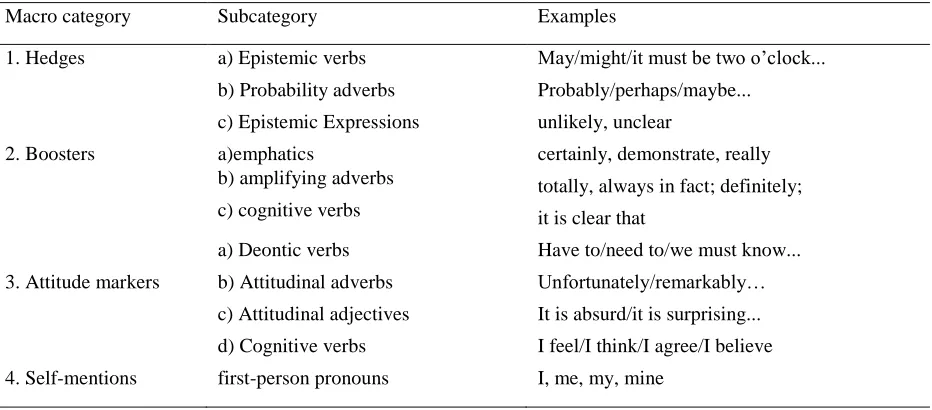
Table 2. Interpersonal model of metadiscourse, interactional markers (Hyland, 2005)
Macro category Subcategory Examples
1. Hedges a) Epistemic verbs
b) Probability adverbs
c) Epistemic Expressions
May/might/it must be two o’clock... Probably/perhaps/maybe...
unlikely, unclear
2. Boosters a)emphatics b) amplifying adverbs
c) cognitive verbs
certainly, demonstrate, really
totally, always in fact; definitely;
it is clear that
3. Attitude markers
a) Deontic verbs
b) Attitudinal adverbs
c) Attitudinal adjectives
d) Cognitive verbs
Have to/need to/we must know... Unfortunately/remarkably… It is absurd/it is surprising...
I feel/I think/I agree/I believe
4. Self-mentions first-person pronouns I, me, my, mine
5.Engagement markers a) second-person pronouns
b) interjection
c) imperative verbs
d) necessity modals
you, your, yourself
by the way, you may notice
consider, note that, see, look at
must, have to, should
He also organizes interactional metadiscourse into five main categories with specific functions which are hedges, boosters, attitude markers, self-mentions, and engagement markers. They were divided into some subcategories. Hedges (epistemic verbs, probability adverbs and epistemic expressions) signal the writer’s reluctance to display propositional information categorically. Boosters (emphatics and amplifying adverbs) represent certainty and emphasize the force of propositions. Attitude markers (deontic verbs, attitudinal adverbs, attitudinal adjectives and cognitive verbs) present the writer’s appraisal of propositional information, showing surprise, force, approval, importance, and so on. Engagement markers (second-person pronouns, interjection, imperative verbs and necessity modals) explicitly refer to the readers, either by focusing their attention selectively or by including them as text participants through second person, pronouns, imperatives, question forms, and so on (Hyland, 2001). Self-mentions (first-person pronouns)offer the extent of the presence of the writer in terms of possessives and first person pronouns, schematic text structure, including items used to sequence, to label text stages, to announce discourse goals, and to represent topic shifts.
Here, there are some examples from both corpora which are italic and underlined.
Examples:
A. Interactive Metadiscourse Markers
1. Transitions
a)addition
In addition to analysis of structural conditions, in the other side it is important how the intellectual discourse mission to expand public sphere.
b) comparison
He states most of different features of individualism which are clarified in contrast to previous conditions, he implies organizational ordered causalities (on the first step, the effects of financial economic), but he teaches it more than other things with real issues of humanity in all individual level.
c) consequence
As a result, high serum cholesterol level can be achieved due to hepatic dysfunction.
2. Frame markers
a) sequencing
The idea of individuality from Simmel’s point of view is designed as below: first, individuality as a separate entity (but not unique or full) and consequently, it is understood as the idea of quantitative individualism.
b) label stage
In summary, this is the first study demonstrating the effect of exercise training on visceral fat ABCG1, ABCG5, and visfatin genes expression.
c) announce goal
One existing study has focused on the effects of unsaturated free fatty acids on plasma concentration of adipokine peptide: Cooper et al. showed that dietary fatty acid composition significantly reduces plasma PYY concentration and can increase plasma ghrelin concentration that is not significant.
d) shift topic
With regard to the socio-economic situation of the Iranian society in this period, the following factors can be considered influential in the increase in the number of employed population in the agricultural sector, decrease in the degree self-sufficiency in the production of agricultural products, and increase in the import of agricultural products.
3. Endophoric markers
A high score in this part can be interpreted in this way, which management style in an organization is very important; because if it is assumed that all facilities be provided for research activities; but there were no comprehensive management to organize them, facilities will not be helpful.
4. Evidentials
According to the literature, the prevalence of cardiovascular involvement in patients with SLE has been estimated to be more than 50 and it was shown that the left-sided heart valves are affected most commonly.
5. Code glosses
Similar to other research studies, we also observed the highest prevalence of LBP in last year among health care workers (e.g. hospital staff, nurses, and dentists).
B. Interactional Metadiscourse Markers
1. Hedges
a) epistemic verbs
The collapse of traditional cooperatives (Boneh) as collective production units could demonstrate the downfall of traditional partnership units.
b) probability adverbs
Since the K+-ATPase has a significant role in insulin secretion of the pancreas; hyperglycemia indicates that insulin secretion process may be affected by MnO2.
c)epistemic expressions (probability adjectives)
This means that if a person has high level of cultural capital, it is probable to have quicker initializing of official values of society.
2. Boosters
a) intensifier adverb
Certainly there are different statistics in this regard because of prohibition and limitation resulting from that.
b) intensifier adjectives
According to the results of cultural capital and self-satisfaction, it is obvious that there is a weak and significant relation between these two variants.
c) intensifier verbs
These individuals are able to think and infer innovatively or have personal philosophies about the existence and truth.
3. Attitude markers
a) deontic verbs
The concept of intangible success factors is used to refer to individual intangible assets and also the activities related to improving or utilizing the assets, i.e. any intangible phenomena that are to be measured.
b) attitudinal adverbs
However, nasal trauma was significantly less in HHHFNC group compared with NCPAP.
c) attitudinal adjective
It is important to understand the cause of changes in body weight gain and glucose level and their correlation induced by MnO2 particles.
d) cognitive verbs
It is believed that mitral valve repair can be justified in specific patients.
4. Self-mentions
The authors concluded that napping is associated with elevated prevalence of diabetes and impaired fasting glucose.
5. Engagement markers
a) reader pronoun
You et al. studied the effect of GA in two types of lung cancer cells (A549 and Calu-6).
b) interjections
Television and satellite networks have led to formation of personality and identity of individuals and they are influenced by multiple and sometimes conflicting information. TV, print, and Internet advertising platforms that enable a variety of new modes and by the way, they prepare the ground for a new fashion trend toward families and especially young people.
c) directive imperatives
Note the use of Newton’s third law: the force of boundary on fluid is minus the force of fluid on boundary. d) necessity modals
It is, therefore, an inevitable need to understand scientifically such a growing in Iran, keeping an eye on its implications.
3.2 Data Analysis
The analysis of the selected texts was closely done based on Hyland’s (2005) taxonomy. The data were collected through extracting metadiscourse markers from the Iranian papers written in English. In this study, metadiscourse markers were counted and classified in their corresponding groups based on the category proposed. Each sample text was read and the number of metadiscourse markers was counted by the first rater one by one. Then, each sample text was reread by the second rater sentence by sentence to identify metadiscourse markers once again to make sure that any kind of mistake did not happen during first count. Finally, each metadiscourse marker was checked again to make sure it was correctly classified. After collecting data, the SPSS version 22 software was applied to achieve quantitative analysis. Furthermore, to examine whether there were any significant differences in the use of metadiscourse markers in the discussion sections of these research articles, a Chi-square analysis was run.
4. Results
4.1 The Use of Interactive Metadiscourse Markers in the Corpus
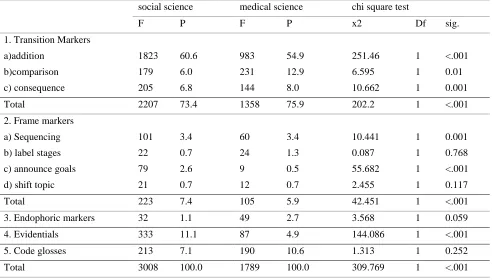
Based on the interactive metadiscourse markers result in the table 3, there was a significant difference (p<0.05) in the numbers of markers (evidentials, frame markers, and transition markers) used by authors in both groups. It was found that the authors of the social science articles used them more frequently compared to the medical science authors. There was no significant difference (p>0.05) between the use of endophoric markers and code glosses in two groups.
Table 3. Interactive metadiscourse markers
social science medical science chi square test
F P F P x2 Df sig.
1. Transition Markers
a)addition 1823 60.6 983 54.9 251.46 1 <.001
b)comparison 179 6.0 231 12.9 6.595 1 0.01
c) consequence 205 6.8 144 8.0 10.662 1 0.001
Total 2207 73.4 1358 75.9 202.2 1 <.001
2. Frame markers
a) Sequencing 101 3.4 60 3.4 10.441 1 0.001
b) label stages 22 0.7 24 1.3 0.087 1 0.768
c) announce goals 79 2.6 9 0.5 55.682 1 <.001
d) shift topic 21 0.7 12 0.7 2.455 1 0.117
Total 223 7.4 105 5.9 42.451 1 <.001
3. Endophoric markers 32 1.1 49 2.7 3.568 1 0.059
4. Evidentials 333 11.1 87 4.9 144.086 1 <.001
5. Code glosses 213 7.1 190 10.6 1.313 1 0.252
Total 3008 100.0 1789 100.0 309.769 1 <.001
Note: F: Frequency P: Percentage
In all of the subcategories of transition markers, there was a significant difference between two groups (p<0.05). The use of addition and consequence in social science articles and the use of comparison in the medical science articles significantly was more than other groups. The use of label stages and shift topic (subcategories of frame markers) in both groups was the same (p>0.05), but there was a significant difference (p<0.05) between applying sequencing and announce goals in these corpora. In the social science articles, they were used significantly more compared to the medical science ones.
Generally, there was a significant difference (p< 0.05) between using interactive metadiscourse markers in the social and medical science articles. That is, their frequency in the social science articles was significantly more than the medical science articles.
Table 4. The use of transition markers in the corpus
Example social science medical science
F P F P
a) Addition Beside 7 0.3 1 0.1
Additionally 1 0.0 8 0.6
As well as 8 0.4 9 0.7
Rather 11 0.5 2 0.1
In addition 19 0.9 25 1.8
Furthermore 6 0.3 10 0.7
Further 10 0.5 14 1.0
Moreover 11 0.5 0 0.0
And 1657 75.1 832 61.3
Also 90 4.1 81 6.0
Again 2 0.1 1 0.1
By the way 1 0.0 0 0.0
b) Comparison Similarly 2 0.1 5 0.4
Likewise 0 0.0 2 0.1
Equally 0 0.0 1 0.1
However 29 1.3 62 4.6
Though 2 0.1 2 0.1
Although 15 0.7 51 3.8
In contrast 3 0.1 7 0.5
Conversely 3 0.1 1 0.1
On the contrary 0 0.0 1 0.1
But 72 3.3 62 4.6
Still 8 0.4 3 0.2
Yet 11 0.5 2 0.1
While 24 1.1 17 1.3
Whereas 2 0.1 10 0.7
On the other hand 8 0.4 5 0.4
c) Consequence Because 43 1.9 31 2.3
So 32 1.4 5 0.4
Hence 4 0.2 9 0.7
As a result 7 0.3 6 0.4
Therefore 46 2.1 38 2.8
Thus 30 1.4 18 1.3
Consequently 9 0.4 2 0.1
In conclusion 3 0.1 7 0.5
Anyway 1 0.0 0 0.0
Nevertheless 3 0.1 7 0.5
Nonetheless 1 0.0 2 0.1
In any case 2 0.1 0 0.0
Of course 5 0.2 1 0.1
Thereby 1 0.0 1 0.1
Lead to 18 0.8 17 1.3
Total 2207 100.0 1358 100.0
Note: F: Frequency P: Percentage
As it was observed here, transition markers were applied more in the social science research articles, and among subcategories of this marker, addition and consequence markers were tended to be used in the social science articles more, but comparison markers were applied in the medical science texts more frequently.
Table 5. The use of frame markers in the corpus
Example social science medical science
F P F P
a) Sequencing (in) this part 1 0.4 0 0.0
(in) this section 1 0.4 0 0.0
Finally 14 6.3 7 6.7
First 26 11.7 23 21.9
Firstly 2 0.9 1 1.0
Last 9 4.0 10 9.5
Next 1 0.4 0 0.0
Second 20 9.0 5 4.8
Secondly 2 0.9 0 0.0
Subsequently 0 0.0 2 1.9
Then 13 5.8 11 10.5
Third 12 5.4 1 1.0
b) Label stages In conclusion 3 1.3 7 6.7
In sum 1 0.4 0 0.0
In summary 0 0.0 1 1.0
Now 8 3.6 6 5.7
Overall 7 3.1 5 4.8
So far 1 0.4 2 1.9
Thus far 0 0.0 3 2.9
To conclude 2 0.9 0 0.0
c) Announce goals (in) this part 1 0.4 0 0.0
(in) this section 1 0.4 0 0.0
Aim 10 4.5 1 1.0
Desire to 1 0.4 1 1.0
Focus 13 5.8 3 2.9
Goal 24 10.8 1 1.0
Intend to 2 0.9 1 1.0
Intention 7 3.1 0 0.0
Objective 12 5.4 0 0.0
Purpose 5 2.2 2 1.9
Seek to 2 0.9 0 0.0
Want to 1 0.4 0 0.0
d) Shift topic Back to 2 0.9 1 1.0
Now 7 3.1 6 5.7
Return to 1 0.4 0 0.0
Revisit 7 3.1 0 0.0
Turn to 1 0.4 0 0.0
With regard to 3 1.3 5 4.8
Total 223 100.0 105 100.0
Note: F: Frequency P: Percentage
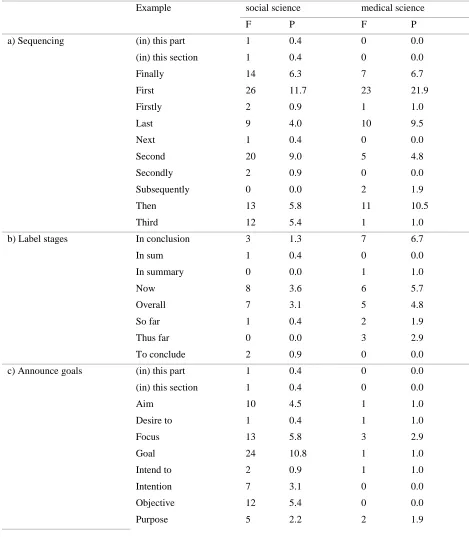
According to the results, the total use of frame markers was more in the social science research articles, respectively. Among subcategories of this marker, sequencing and announce goals were used more frequently in the social science texts, but there wasn’t a significant difference between the other two subtypes.
Table 6. The use of endophoric markers in the corpus
Example social science medical science
F P F P
(In) This part 1 3.1 1 2.0
(In) This section 1 3.1 1 2.0
Fig.X 2 6.3 7 14.3
PageX 0 0.0 1 2.0
Table X 3 9.4 4 8.2
X above 9 28.1 6 12.2
X before 8 25.0 21 42.9
X below 5 15.6 0 0.0
X earlier 1 3.1 5 10.2
X later 2 6.3 3 6.1
Total 32 100.0 49 100.0
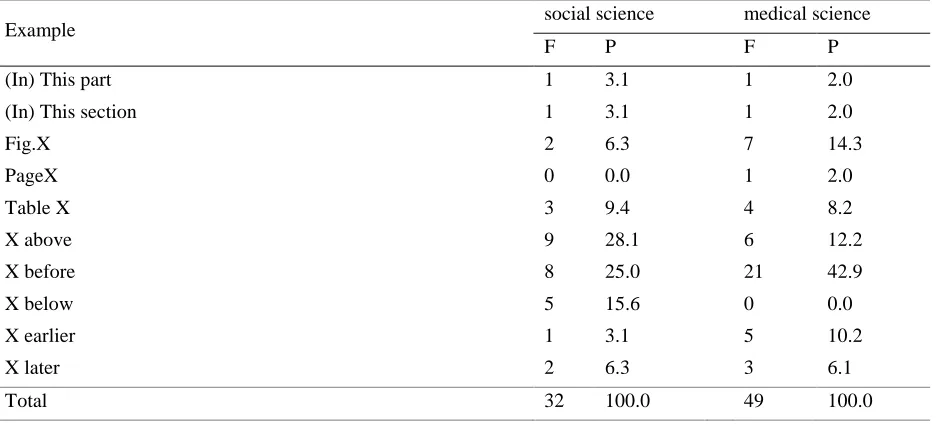
According to the results in this table, there wasn’t any prominent difference between two groups.
Table 7. The use of evidentials in the corpus
Example social science medical science
F P F P
According to X 56 16.8 22 25.3
Cited 3 0.9 1 1.1
Quoted 1 0.3 0 0.0
States 15 4.5 6 6.9
(Y, 1990) 258 77.5 58 66.7
Total 333 100.0 87 100.0
Note: F: Frequency P: Percentage
As it was observed, the authors of social science articles tended to use evidentials more frequently in their articles.
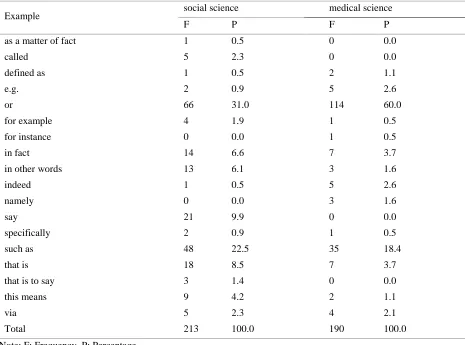
Table 8. The use of code glosses in the corpus
Example social science medical science
F P F P
as a matter of fact 1 0.5 0 0.0
called 5 2.3 0 0.0
defined as 1 0.5 2 1.1
e.g. 2 0.9 5 2.6
or 66 31.0 114 60.0
for example 4 1.9 1 0.5
for instance 0 0.0 1 0.5
in fact 14 6.6 7 3.7
in other words 13 6.1 3 1.6
indeed 1 0.5 5 2.6
namely 0 0.0 3 1.6
say 21 9.9 0 0.0
specifically 2 0.9 1 0.5
such as 48 22.5 35 18.4
that is 18 8.5 7 3.7
that is to say 3 1.4 0 0.0
this means 9 4.2 2 1.1
via 5 2.3 4 2.1
Total 213 100.0 190 100.0
Note: F: Frequency P: Percentage
As it was illustrated in Table 8, markers of this table like other tables of interactive metadiscourse were applied more frequent in the social science articles than medical science ones.
4.2 The Results of the Interactional Metadiscourse Markers and the Chi-square Used in the Corpus
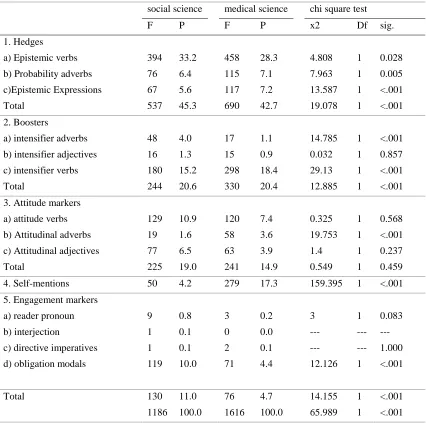
Based on the results in Table 9, the percentage of hedges, boosters, and self- mentions in the medical science articles was significantly more than their use in social science articles. Also, there was a significant difference (p<0.05) between two corpora. The percentage of engagement markers in the social science articles was respectively more than the medical ones. There was no significant difference (p>0.05) in applying attitude markers between two groups. In all of subcategories of hedges, a significant difference between two groups was observed (p<0.05). The medical
science authors applied epistemic verbs, probability adverbs, and epistemic expressions in their articles more frequently than the authors of social science articles.
Table 9. Interactional metadiscourse markers and the Chi-square used in the corpus
Note: F: Frequency P: Percentage
No significant difference was observed (p>0.05) in applying intensifier adjectives in two groups. In addition, the use of intensifier adverbs in the social science articles and the use of intensifier verbs in the medical science articles significantly was more than other groups (p<0.05). There was no significant difference between the use of label stages and shift topics in two groups (p<0.05). There was a significant difference (p>0.05) in applying the markers sequencing and goal announce markers. The makers sequencing and goal announce were used in the social science articles significantly more compared to the medical sciences texts.
social science medical science chi square test
F P F P x2 Df sig.
1. Hedges
a) Epistemic verbs 394 33.2 458 28.3 4.808 1 0.028
b) Probability adverbs 76 6.4 115 7.1 7.963 1 0.005
c)Epistemic Expressions 67 5.6 117 7.2 13.587 1 <.001
Total 537 45.3 690 42.7 19.078 1 <.001
2. Boosters
a) intensifier adverbs 48 4.0 17 1.1 14.785 1 <.001
b) intensifier adjectives 16 1.3 15 0.9 0.032 1 0.857
c) intensifier verbs 180 15.2 298 18.4 29.13 1 <.001
Total 244 20.6 330 20.4 12.885 1 <.001
3. Attitude markers
a) attitude verbs 129 10.9 120 7.4 0.325 1 0.568
b) Attitudinal adverbs 19 1.6 58 3.6 19.753 1 <.001
c) Attitudinal adjectives 77 6.5 63 3.9 1.4 1 0.237
Total 225 19.0 241 14.9 0.549 1 0.459
4. Self-mentions 50 4.2 279 17.3 159.395 1 <.001
5. Engagement markers
a) reader pronoun 9 0.8 3 0.2 3 1 0.083
b) interjection 1 0.1 0 0.0 --- --- ---
c) directive imperatives 1 0.1 2 0.1 --- --- 1.000
d) obligation modals 119 10.0 71 4.4 12.126 1 <.001
Total 130 11.0 76 4.7 14.155 1 <.001
1186 100.0 1616 100.0 65.989 1 <.001
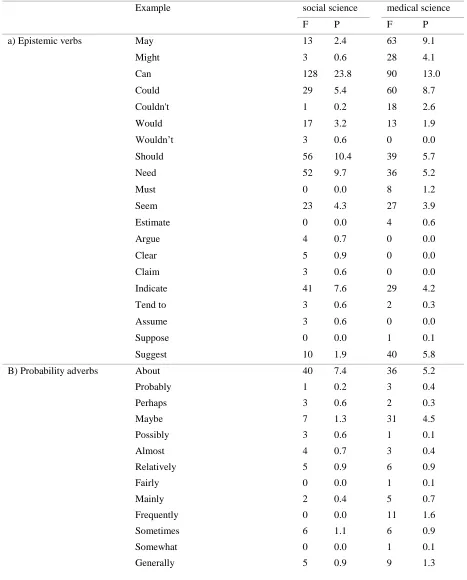
Table 10.The use of hedges in the corpus
Example social science medical science
F P F P
a) Epistemic verbs May 13 2.4 63 9.1
Might 3 0.6 28 4.1
Can 128 23.8 90 13.0
Could 29 5.4 60 8.7
Couldn't 1 0.2 18 2.6
Would 17 3.2 13 1.9
Wouldn’t 3 0.6 0 0.0
Should 56 10.4 39 5.7
Need 52 9.7 36 5.2
Must 0 0.0 8 1.2
Seem 23 4.3 27 3.9
Estimate 0 0.0 4 0.6
Argue 4 0.7 0 0.0
Clear 5 0.9 0 0.0
Claim 3 0.6 0 0.0
Indicate 41 7.6 29 4.2
Tend to 3 0.6 2 0.3
Assume 3 0.6 0 0.0
Suppose 0 0.0 1 0.1
Suggest 10 1.9 40 5.8
B) Probability adverbs About 40 7.4 36 5.2
Probably 1 0.2 3 0.4
Perhaps 3 0.6 2 0.3
Maybe 7 1.3 31 4.5
Possibly 3 0.6 1 0.1
Almost 4 0.7 3 0.4
Relatively 5 0.9 6 0.9
Fairly 0 0.0 1 0.1
Mainly 2 0.4 5 0.7
Frequently 0 0.0 11 1.6
Sometimes 6 1.1 6 0.9
Somewhat 0 0.0 1 0.1
Generally 5 0.9 9 1.3
c) Epistemic Expressions (probability adjectives)
Most 52 9.7 79 11.4
Probable 1 0.2 3 0.4
Possible 10 1.9 27 3.9
Apparent 1 0.2 3 0.4
Uncertain 1 0.2 0 0.0
Typical 1 0.2 4 0.6
In most cases 1 0.2 1 0.1
Total 537 100.0 690 100.0
Note: F: Frequency P: Percentage
According to the results, hedges were used in the medical science articles more than the social science articles and they were in higher sequence, and all subtypes of this maker were used more frequently in the medical texts compared to the social ones.
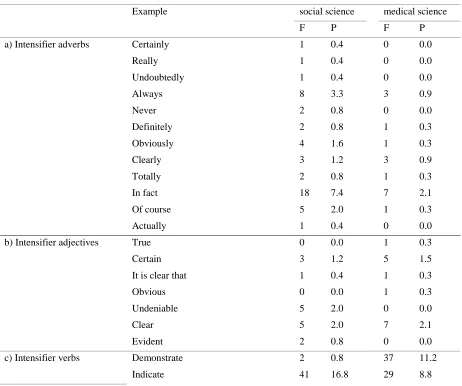
Table 11. The use of boosters in the corpus
Example social science medical science
F P F P
a) Intensifier adverbs Certainly 1 0.4 0 0.0
Really 1 0.4 0 0.0
Undoubtedly 1 0.4 0 0.0
Always 8 3.3 3 0.9
Never 2 0.8 0 0.0
Definitely 2 0.8 1 0.3
Obviously 4 1.6 1 0.3
Clearly 3 1.2 3 0.9
Totally 2 0.8 1 0.3
In fact 18 7.4 7 2.1
Of course 5 2.0 1 0.3
Actually 1 0.4 0 0.0
b) Intensifier adjectives True 0 0.0 1 0.3
Certain 3 1.2 5 1.5
It is clear that 1 0.4 1 0.3
Obvious 0 0.0 1 0.3
Undeniable 5 2.0 0 0.0
Clear 5 2.0 7 2.1
Evident 2 0.8 0 0.0
c) Intensifier verbs Demonstrate 2 0.8 37 11.2
Indicate 41 16.8 29 8.8
Show 90 36.9 164 49.7
Prove 10 4.1 3 0.9
Think 5 2.0 2 0.6
Decide 2 0.8 1 0.3
Know 9 3.7 2 0.6
Find 13 5.3 11 3.3
Found 8 3.3 49 14.8
Total 244 100.0 330 100.0
Note: F: Frequency P: Percentage
Based on the results in this table, boosters in the medical science articles were applied more, so in subcategory of intensifier verbs, they were used more frequently in the medical articles compared to the social science articles.
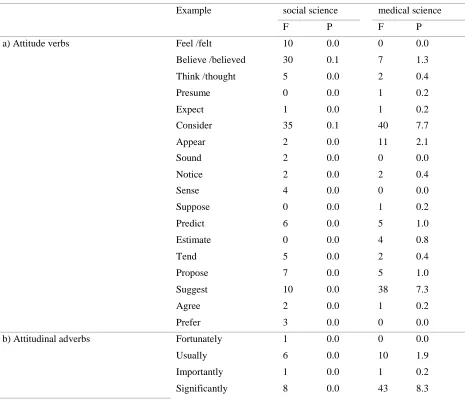
Table 12. The use of attitude markers in the corpus
Example social science medical science
F P F P
a) Attitude verbs Feel /felt 10 0.0 0 0.0
Believe /believed 30 0.1 7 1.3
Think /thought 5 0.0 2 0.4
Presume 0 0.0 1 0.2
Expect 1 0.0 1 0.2
Consider 35 0.1 40 7.7
Appear 2 0.0 11 2.1
Sound 2 0.0 0 0.0
Notice 2 0.0 2 0.4
Sense 4 0.0 0 0.0
Suppose 0 0.0 1 0.2
Predict 6 0.0 5 1.0
Estimate 0 0.0 4 0.8
Tend 5 0.0 2 0.4
Propose 7 0.0 5 1.0
Suggest 10 0.0 38 7.3
Agree 2 0.0 1 0.2
Prefer 3 0.0 0 0.0
b) Attitudinal adverbs Fortunately 1 0.0 0 0.0
Usually 6 0.0 10 1.9
Importantly 1 0.0 1 0.2
Significantly 8 0.0 43 8.3
Unfortunately 2 0.0 3 0.6
Correctly 1 0.0 1 0.2
c) Attitudinal adjectives Essential 5 0.0 8 1.5
Important 54 0.2 32 6.2
Interesting 0 0.0 1 0.2
Unusual 0 0.0 3 0.6
Usual 1 0.0 4 0.8
Remarkable 0 0.0 4 0.8
Desirable 2 0.0 0 0.0
Appropriate 14 0.1 7 1.3
Inappropriate 1 0.0 3 0.6
Understandable 0 0.0 1 0.2
Total 275 1.0 520 100.0
Note: F: Frequency P: Percentage
As it was observed here, the frequency of attitude verbs and attitudinal adjectives in the social science articles was significantly more compared to the medical science articles, but the authors utilized that the attitude adverbs in the medical science contexts were more than the social science articles.
Table 13. The use of self-mentions in the corpus
Example social science medical science
F P F P
We 36 0.1 79 15.2
Our 14 0.1 199 38.3
The author 0 0.0 1 0.2
Total 275 1.0 520 100.0
In this table, self-mentions were used more in medical science research articles compared to social science ones.
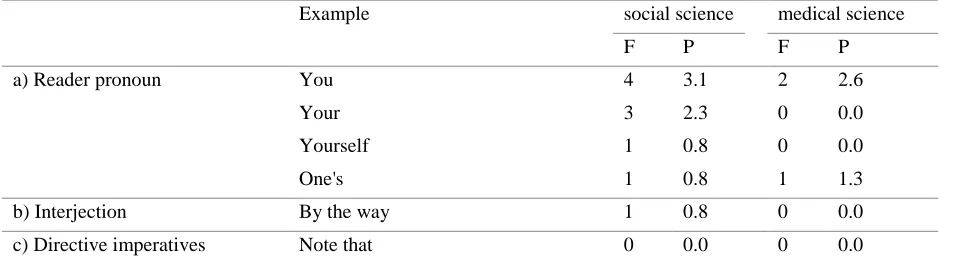
Table 14. The use of engagement markers in the corpus
Example social science medical science
F P F P
a) Reader pronoun You 4 3.1 2 2.6
Your 3 2.3 0 0.0
Yourself 1 0.8 0 0.0
One's 1 0.8 1 1.3
b) Interjection By the way 1 0.8 0 0.0
c) Directive imperatives Note that 0 0.0 0 0.0
Consider 1 0.8 0 0.0
Note 0 0.0 1 1.3
Think about 0 0.0 1 1.3
d) Obligation modals Do not 23 17.7 2 2.6
Have to 8 6.2 2 2.6
Need to 12 9.2 7 9.2
Must 0 0.0 8 10.5
Should 56 43.1 39 51.3
Would 17 13.1 13 17.1
Wouldn’t 3 2.3 0 0.0
Engagement markers 130 100.0 76 100.0
Note: F: Frequency P: Percentage
According to the results, obligations were used in the social science articles more than the medical science texts, respectively. But there wasn’t much difference among other subtypes of this marker.
5. Discussion
The present study aimed at exploring the difference between medical and social science articles in the use of interactive and interactional metadiscourse markers based on Hyland (2005) interpersonal taxonomy in the discussion sections of English written articles by both social and medical science Persian authors. Referring to the data analyses, the answers to the research questions were achieved. According to the obtained findings and the Chi square obtained results, in articles written by Persian in English, the use of transitions, frame markers, and evidentials, interactive metadiscourse was high in social science articles, but there was no significant difference in applying the endophoric markers and code glosses. As obtained results showed, the medical science research articles authors used hedges, boosters, self-mentions, and interactional metadiscourse markers more. The engagement markers were used in social science texts more frequently than the medical science. There was no significant difference in the case of attitude markers in both corpora. Totally, based on the results, social science authors applied interactive metadiscourse markers more, but medical science authors used interactional metadiscourse markers more frequently in their texts.
These results were in line with the results of the study by Firoozian, Khajavy, and Vahidnia (2012). In both corpora, interactive and interactional features were used as it was proved in this study. And it was against this study, because in both groups, writers used the interactive metadiscourse more than the interactional one. But in the study which I did interactive meradiscourse markers were used in social science more and interactional markers were employed in medical science articles more frequently. This study also was in line with the contrastive study conducted by Abdi (2002), the social sciences and natural sciences, were compared in terms of the use of interpersonal metadiscourse. The results of the analysis showed that social science writers employed interpersonal metadiscourse more frequently than natural science writers. This study is contrary to Zarei and Mansoori’s (2011) study in applying interactional and interactive metadiscourse markers. In their study, the applied linguistics writers used both interactive and interactional resources more than computer engineering, but in this study social science authors used interactive metadiscourse markers more, and medical science ones applied interactional markers more frequently. This study was contrary to Abdollahzadeh (2001) that Anglo-Americans used significantly more illocution markers and code glosses than Iranians. But this study was contrary to Abdollahzadeh’s (2003) study showing that Anglo-Americans used significantly more certainty and attitude markers than Iranians, but no significant use for them in two corpora in this study.
This study was matched with Faghih and Rahimpour’s (2009) contrastive study of metadiscourse markers in applied linguistics research articles in English and Persian written texts by Iranians showed that hedges were the most frequent
interactional devices in both groups the same as this study which showed the numbers of hedges was the highest. The analysis revealed that Iranians have used interactive metadiscourse more than interactional in the English written texts. To compare this study to Gillaerts and Van de Velde (2010) which conducted a study dealing with interpersonality in research article abstracts, we can say that research articles abstracts were considered to make more use of boosters and less use of hedges, which it was in contrary to this study that it was displayed the more use of hedges than boosters and attitude markers. Comparing this study with Mirshamsi and Allami’s (2013) study, it was observed that it was in line with applying transitions and contrary to attitude markers.
The research by Jalilifar and Kabezadeh (2012) was done to investigate variations in the use of textual metadiscourse markers in two major sections of research articles: introduction and method. It cleared that this study agreed in applying transitions and evidentials, frame markers which were applied frequently in this study too and disagreed in using endophoric markers which they didn’t have much significant difference. Also this study concords with the study which was conducted byCao and Hu (2015) in applying hedges and boosters and attitude markers.
6. Conclusion
It is believed that metadiscourse plays a key role in producing and constructing persuasive writings based on the people’s expectation and norms (Amiryousefi & Eslami Rasekh, 2010; Tuomi, 2009) and it is also considered as a new and interesting field of research. Metadiscourse as the linguistic tool is used to make the texts of the writers or speakers clearer. It is considered as a concept of interaction among the writer/speaker with their texts from one side and between them and hearer/ reader from the other (Hyland, 2005). This research project showed that metadiscourse markers are quite frequent in the social science articles compared to medical science ones. Moreover, this research endeavor demonstrated that transitions and frame markers in social science articles and hedges and boosters in medical science ones are more abundant than other kinds of metadiscourse markers.
To conduct any kind of scientific research, one may face with some limitations and problems. The present study could have reached rather different findings if it had not confronted the following limitations. First, the corpus of this study was almost limited. Other studies with larger samples could be applied to be certain about the validity of these findings. Second, in this study the researchers couldn’t have contact with the writers to see if their articles were written originally by themselves. Therefore, a comparison of metadiscourse markers in other fields or subfields can be the subject of future research.
References
Abdi, R. (2002). Interpersonal metadiscourse: An indicator of interaction and identity. Discourse Studies, 4(2), 139-145. http://dx.doi.org/10.1177/14614456020040020101.
Abdollahzadeh, E. (2001). Native and non-native writers’ use of textual metadiscourse in ELT papers. Unpublished Master’s thesis, University of Tehran, Tehran.
Abdollahzadeh, E. (2003). Interpersonal metadiscourse in ELT papers by Iranian and Anglo-American academic writers. Paper presented at the International Conference on Multiculturalism in ELT Practice: Unity and Diversity, Baskent University, Turkey.
Aguilar, M. (2008). Metadiscourse in academic speech: A relevance-theoretic approach. Bern, Switzerland: Peter Lang.
Amiryousefi, M., & Eslami-Rasekh, A. (2010). Metadiscourse: Definitions, issues, and its implications for English teachers. English Language Teaching, 3(4), 159-167. http://dx.doi.org/10.5539/elt.v3n4p159
Cao, F., & Hu, G. (2015). Disciplinary and paradigmatic influences on interactional metadiscourse in research articles.
English for Specific Purposes, 39, 12-25. https://doi.org/10.1016/j.esp.2015.03.002
Crismore, A. (1984). The rhetoric of textbooks: Metadiscourse. Journal of Curriculum Studies, 16(3), 279-296.
Crismore, A., Markkanen, R., & Steffensen, M. S. (1993). Metadiscourse in persuasive writing: A study of texts written by American and Finnish university students. Written Communication, 10(1), 39-71. doi: 10.1177/0741088393010001002
Faghih, E., & Rahimpour, S. (2009). Contrastive rhetoric of English and Persian written text: Metadiscourse in applied linguistic research articles. Rice Working Papers in Linguistic, 1(1), 92-107.
Firoozian, A., Khajavy, H., & Vahidnia, F. (2012). A contrastive study of metadiscourse elements in research articles written by Iranian applied linguistics and engineering writers in English. English Linguistics Research, 1(1), 88-96. doi: 10.5430/elr.v1n1p88
Gillaerts, P., & Van de Velde, F. (2010). Interactional metadiscourse in research article abstracts. Journal of English for Academic Purposes, 9(2), 128-139. 10.1016/j.jeap.2010.02.004
Harris, Z. S. (1959). The transformational model of language structure. Anthropological Linguistics, 1(1), 27-29. http://www.jstor.org/stable/30022172
Hyland, K. (1998). Persuasion and contexts. The pragmatics of academic discourse. Journal of pragmatics, 30(4), pp. 37-455. doi: 10.1016/S0378-2166(98)00009-5
Hyland, K. (2001). Bringing in the reader: Addressee features in academic articles. Written Communication, 18(4), 549–574. http://dx.doi.org/10.1177/0741088301018004005
Hyland, K. (2005a). Metadiscourse: Exploring interaction in writing. The Modern Language Journal,91(3), 479-480. doi: 10.1111/j.1540-4781.2007.00593_9.x
Hyland, K. (2005b). Stance and engagement: a model of interaction in academic discourse. Discourse Studies, 7 (2), 173-192. doi: 10.1177/1461445605050365
Jalilifar, A., & Kabezade, F. (2012). A comparative study of textual metadiscourse markers in introduction and method sections of applied linguistics research articles. Journal of Language, Culture, and Translation (LCT), 1(1) (2012), 17–31.
Khedri, M., Heng, C. S., & Ebrahimi, S. F. (2013). An exploration of interactive metadiscourse markers in academic
research article abstracts in two disciplines. Discourse Studies, 15(3), 1-13.
https://doi.org/10.1177/1461445613480588
Kuhi, D., & Behnam, B. (2011). Generic variations and metadiscourse use in the writing of applied linguists: A
comparative study and preliminary framework. Written Communication, 28(1), 97-141.
https://doi.org/10.1177/0741088310387259
Loi, C. K., & Lim, J. M. H. (2013). Metadiscourse in English and Chinese research articles introductions. Discourse Studies, 15(2), 129-146.https://doi.org/10.1177/1461445612471476
Mirshamsi, A., & Allami, H. (2013). Metadiscourse markers in the discussion/conclusion section of Persian and English master’s theses. Journal of Teaching Language Skills, 32(3), 23-40.doi: 10.22099/jtls.2013.1706 Mur-Duenas, P. (2011). An intercultural analysis of metadiscourse features in research articles written in English and
in Spanish. Journal of Pragmatics, 43(12), 3068-3079. https://doi.org/10.1016/j.pragma.2011.05.002
Toumi, N. (2009). A model for the investigation of reflexive metadiscourse in research articles. Language Studies Working Papers, 1, 64-73.
Vande Kopple, W. (1985). Some exploratory discourse on metadiscourse. College Composition and Communication,
36(1), 82–93. doi: 10.2307/357609
Williams, J. W. (1981). Style: Ten lessons in clarity and grace. Glenview, IL: Scott, Foresman.
Zarei, G. R., & Mansoori, S. (2011). A contrastive study on metadiscourse elements used in humanities vs. non-humanities across Persian and English. English Language Teaching, 4(1), 42-50. doi: 10.5539/elt v4n1p42.