A study of geometric understanding via logical
reasoning in Hong Kong
1Kin-Keung Poon [email protected]
Chi-Keung Leung [email protected]
Department of Mathematics and Information Technology The Education University of Hong Kong
Abstract
The purposes of the study reported herein were to identify the common mistakes in geometry made by junior
secondary school students in Hong Kong, and to compare the students’ performance in geometry with their
results in a logic test. A geometry test and a logic test were developed and administered to a sample of 554 students aged between 13 and 14. The students in schools with a higher level of academic achievement were
found to obtain higher scores in the geometry test. In addition, a strong correlation was found between students’ achievement in geometry and their fundamental logical reasoning ability. The findings offer grounds for reflection on the geometry curriculum currently in place in junior secondary schools in Hong Kong.
Keywords:Learning difficulty, Geometric understanding, Logical reasoning
Introduction
Geometry has a very long history as an area of mathematical study. It is a fundamental component of mathematics, and plays a crucial role in bridging the gap between mathematics and science. For instance, both Einstein and Hawking (world-renowned physicists of the 20th and 21st centuries) attributed their success to geometry (Clements & Sarama, 2011). Learning geometry requires an understanding of geometric objects and spatial concepts and properties; proportional, inductive and deductive reasoning skills; the ability to apply knowledge judiciously; the ability to manage and process data; and an understanding of relevant variables (see, e.g., Berthelot & Salin, 1998; Clements & Sarama, 2011).
The teaching and learning of geometry are topics of considerable international interest, and appropriate teaching methods and curriculum designs have been widely debated (Gal, Lin &
1
Ying, 2009; Guven, 2012; Hao-hao, 2009; Mammana & Villani, 1998; Royal Society, 2001). Students’ attainment in geometry is also a part of the Trends in International Mathematics and Science Study (TIMSS). In TIMSS 1999, the average geometry attainment of Hong Kong secondary students was lower than those of its nearby countries of Japan, Republic of Korea, Singapore and Chinese Taipei (Mullis, Martin, Gonzalez, Gregory, Garden, O’Connor, Chrostowski, & Smith, 2000). TIMSS 2007 reported that the average geometry attainment of Hong Kong secondary students was again behind these four countries (Mullis, Martin, & Foy, 2008).
In the Hong Kong territory-wide system assessment (TSA) 2015, it was reported that Secondary 3 (aged around 14-15) students could find areas and volumes in 2-D and 3-D figures, as well as angles related with lines and rectilinear figures. However, more improvement could be shown in items related to definitions of common terms in geometry as well as deductive geometry (Hong Kong Examinations and Assessment Authority, 2015). This study focuses on identifying some common mistakes in geometry made by junior secondary school students in Hong Kong, and comparing the students’ performance in geometry with their results in a logic test.
Previous Studies in Geometry Learning
In recent research, proving geometry theorems has been found to be one of the greatest challenges for secondary school mathematics students (Noboru & Van Lehn, 2005; Wong, Yin, Yan & Cheng, 2011). When a proof is required, the difficulty of a geometry task increases dramatically, perhaps because the choice of construction is an ill-structured problem.
Studies have shown that the learning problems encountered by mathematics students are associated with a variety of factors, such as problematic prior learning experiences, a failure to see the connections between mathematics and other experiences, and difficulties in understanding fundamental mathematical concepts (Jensen, 1998). Poon and Leung (2010) found that students’ logical reasoning is highly related to their performance in algebra. Brousseau (1997; cited in Kuzniak and Rauscher, 2011) categorised difficulties in learning geometry by origin, as either ontogenic, epistemological or didactic (the first two relating to students’ understanding or ability, and the latter to teachers’ use of methods suited to their students’ cognitive capacities). Similarly, Gal and Linchevski (2010) discussed the difficulties faced by geometry students in terms of three successive phases of visual perception and knowledge representation (VPR): organisation, recognition and representation. Students’ learning difficulties in mathematics, especially in geometry, which constitutes the largest proportion of junior school mathematics curriculums, generally result in poor progress and the development of a negative attitude towards the subject.
Research has also indicated that students’ difficulties in learning geometry are related to an inability to understand and accurately interpret geometric concepts, and weaknesses in deductive reasoning (Gal & Linchevski, 2010; Miyazaki, Kimiho, Katoh, Arai, Ogihara, Oguchi, Morozumi et al., 2012; White, 1985; Senk, 1985). However, opinion is divided on the capacity of teaching methods to overcome these difficulties. Some researchers have argued that appropriate teaching methods can help to mitigate the difficulties faced by learners of geometry. For example, Gal, Lin and Yin (2009) argued that the use of a heterogeneous teaching approach, especially one designed to suit individuals’ thinking styles and meet their particular needs, can improve students’ geometry learning.
focus on the last three categories. There have been few systematic studies to date of the relationship between students’ logical reasoning and performance in geometry, as many researchers believe that the errors and misconceptions of geometry students are generally rooted in a lack of spatial awareness.
This Study
No systematic research has been conducted in Hong Kong on the difficulties faced by students learning mathematics, especially geometry. This is unfortunate, as an empirical knowledge base is necessary to improve students’ mathematics learning. To fill this crucial gap in the research, this project is designed to answer the following research questions.
RQ 1. Does students’ attainment in geometry differ with school banding?
RQ 2. What misconceptions of/errors in geometry are common among junior secondary
school students?
RQ 3. Is students’ logical-reasoning capacity correlated with their performance in geometry?
Methodology
In this project, the difficulties experienced by Secondary 3 (Grade 9 equivalent) students in learning geometry were analysed. Six secondary schools participated in the project, and the sample size (N; number of students) was 554. Of the six schools, two were in Band 12 (highest level of academic attainment), two were in Band 2 (medium level of academic attainment) and two were in Band 3 (lowest level of academic attainment). A geometry test and a simple logic test were administered to the targeted students. The geometry questions were based on Hong Kong’s core (common) junior secondary level curriculum to give every student an equal opportunity for success.
The geometry questions tested students’ geometry knowledge up to junior secondary school level. Our investigation had the following two main objectives.
1. To identify students’ difficulties in learning geometry and classify their weaknesses by analysing their responses in a diagnostic test comprising a set of mathematics questions developed by the research team.
2. To determine statistically whether students’ logical-thinking ability is correlated with their success in learning geometry.
Theoretically, our sample size was large enough to ensure statistically reliable results.
2
In Hong Kong, all the public secondary schools are divided into three bandings. In general, Band 1 schools are
the top 1/3 of schools according to the academic background of new intakes at Secondary 1; Band 2 schools
Instrument
Two instruments were used in the study: a geometry test based on the content of the secondary school mathematics curriculum developed in line with Hong Kong’s Territory-wide System Assessment guidelines, and a simple logic test proposed by Poon and Leung (2010). To ensure that both the students’ understanding of basic geometric concepts and their deductive proof writing skills were tested, the geometry test consisted of 12 multiple-choice questions, 2 additional explanation-based questions and 2 long questions. The questions were carefully prepared to ensure that all of the essential skills developed at the junior secondary level were tested.
Analysis of Results
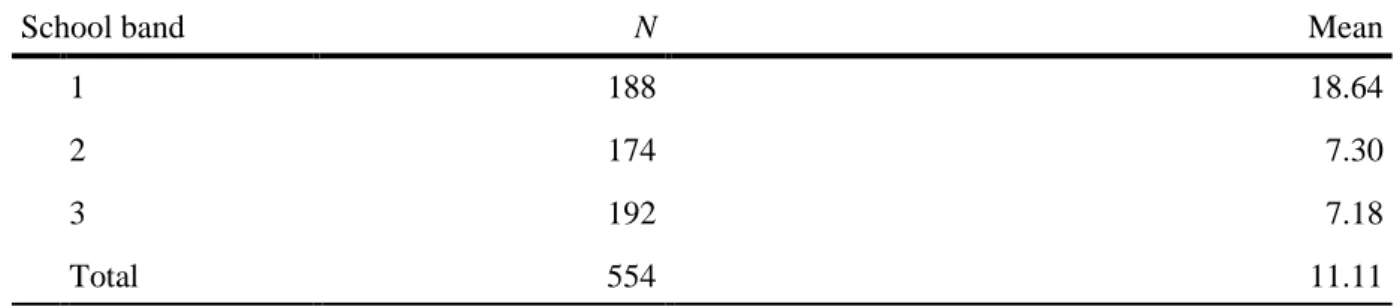
Table 1. Mean geometry test scores across school bands.
School band N Mean
1 188 18.64
2 174 7.30
3 192 7.18
Total 554 11.11
Table 1 shows the geometry-test scores across school bands. The students in schools with a higher level of academic attainment were found to obtain better results in the geometry test.
Responses to RQ 1: Attainment in geometry at different banding
As shown in Table 1, the academic attainment of Band 1 students is much higher than those in the two lower bands. Apparently the mean score of Band 2 students is higher than the one for Band 3 students. Nevertheless, the difference is statistically insignificant (p > 0.05).
Responses to RQ 2: Common errors in geometry
Table 2. Error-type statistics.
Number of mistakes by error type
E1 E2 E3 E4 E5 E6 E7 E8 E9 E10 E11
N 554 554 554 554 554 554 554 554 554 554 554
Sum Percentage 0 0 21 3.8 310 55.9 5 0.9 115 20.8 0 0 222 40.1 538 97.1 50 9.0 8 1.4 299 54.0
E12 E13 E14 E15 E16
E17 E18 E19 E20 E21
E22
N 554 554 554 554 554 554 554 554 554 554 554
Sum Percentage 148 26.7 306 55.2 277 50.0 0 0 404 72.9 416 75.1 118 21.3 359 64.8 211 38.1 5 0.9 5 0.9
We focused on the error types exhibited by more than 50% of the students. Errors in the categories E3, E8, E11, E13, E16 and E17 were made most frequently by the students.
Examples of the most common error types are provided below.
E3 (incomplete proof) and E11 (notation errors)
Example: no conclusive proof is provided that BD is a perpendicular bisector of AC (E3), and
the wrong notation is used for the angles (E11).
E8: Failure to understand definitions and/or properties of mathematical concepts
Example 2: Inability to understand the properties of a regular polygon
Example 3: failure to understand the term ‘common side’, which is incorrectly interpreted as a side of the same length.
E16: Confusion of conditions for congruent and similar triangles Example:
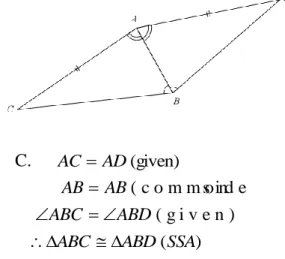
E17: Misuse of the side-side-angle (SSA) condition or the angle-side-side (ASS) condition to prove that triangles are congruent.
Example: option C was chosen by 54% of the students in response to question 9 in the geometry test.
C. AC AD(given)
( g i v e n ) s i d e s ) ( c o m m o n
ABD ABC AB AB ) (SSA ABD ABC
Responses to RQ 3: correlation between geometry-test and logic-test performance
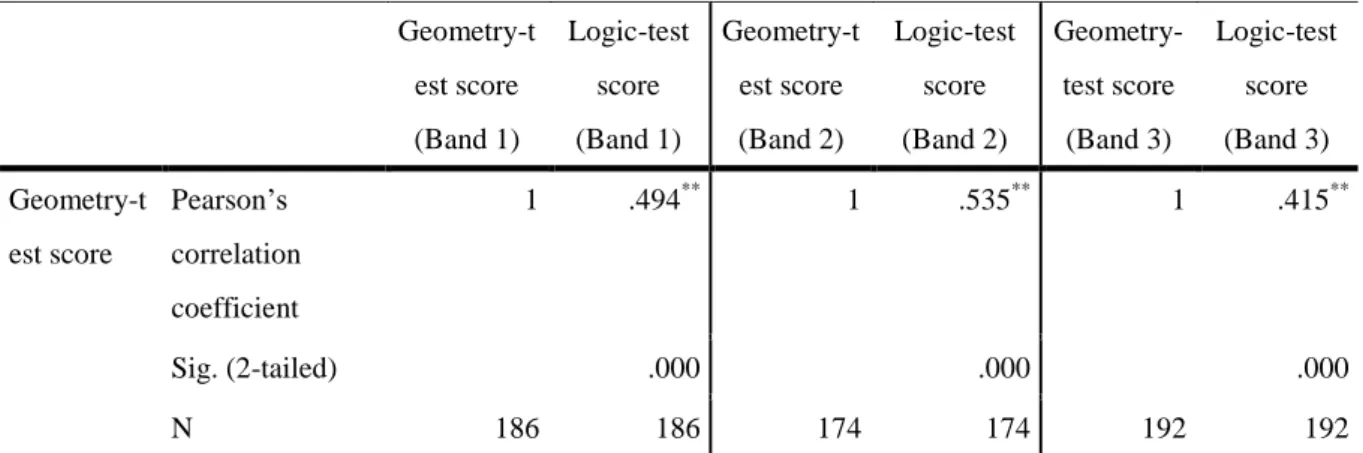
The potential effect of school band on the correlation between geometry-test scores and logic-test scores was investigated. Table 3 shows the Pearson correlation coefficients for the geometry-test and logic-test scores across school bands. The correlation coefficients between these scores across all of the groups were positive, with p-values close to 0. This strong association between the geometry-test and logic-test scores indicates that the students who were good at logic were also good at geometry.
Table 3. Correlation coefficients for geometry-test and logic-test scores across school bands.
Geometry-t est score (Band 1) Logic-test score (Band 1) Geometry-t est score (Band 2) Logic-test score (Band 2) Geometry-test score (Band 3) Logic-test score (Band 3) Geometry-t est score Pearson’s correlation coefficient
1 .494** 1 .535** 1 .415**
Sig. (2-tailed) .000 .000 .000
Table 3. Correlation coefficients for geometry-test and logic-test scores across school bands.
Geometry-t
est score
(Band 1)
Logic-test
score
(Band 1)
Geometry-t
est score
(Band 2)
Logic-test
score
(Band 2)
Geometry-test score
(Band 3)
Logic-test
score
(Band 3)
Geometry-t
est score
Pearson’s
correlation
coefficient
1 .494** 1 .535** 1 .415**
Sig. (2-tailed) .000 .000 .000
N 186 186 174 174 192 192
**. Correlation significant at the 0.01 level (2-tailed).
To further investigate the relationship between the geometry- and logic-test scores, we divided the logic questions into four categories, as shown in Table 4. The questions in the category of deductive reasoning had the highest correlation coefficients (0.451) with the geometry-test scores obtained by the Band 1 students (see Table 5). As the mean score in the geometry test achieved by the Band 1 students was far higher than that of the students in the other bands (as shown in Table 1), this finding indicates that the relationship between performance in geometry and deductive-reasoning ability is particularly strong.
Table 4. Four categories of logic-test items.
Category Items Nature
1 Q1-Q5 Numerical patterns
2 Q6-Q10 Symbolic relations
3 Q11-Q15 Spatial relations
4 Q16-Q20 Deductive reasoning
Discussions and Conclusion
Geometry is an important area of mathematical study. It plays a crucial role in bridging the gap between mathematics and other disciplines such as science. Students’ attainment in geometry is of considerable international interest. In TIMSS 1999 and TIMSS 2007, Secondary students in Hong Kong were reported to perform poorly in comparison to those in nearby countries, namely Japan, Republic of Korea, Singapore and Chinese Taipei. Our research aims to locate and identify the problems faced by students in Hong Kong and make some suggestions to improve the learning of geometry.
Our findings indicate that one of the fundamental learning difficulties in geometry is rooted in students’ weakness in the understanding of the definitions and properties of mathematical concepts (such as E8, E11), for examples, reflex angles, regular polygons, and common side in a figure. These difficulties might be caused by the lack of seamless connection between primary mathematics and secondary mathematics curriculums. In primary schools, students usually learn geometric concepts via informal approaches by means of folding, cutting or measuring exercises, and thus certain key geometric terms are not clearly defined in the primary-school curriculum. For example, no conceptual distinction is made between a line and the mathematical object known as a ‘line segment’. In addition, primary-school pupils are taught only that an angle larger than a right angle is called an obtuse angle; they are not aware of the concept of a reflex angle. These difficulties persist into secondary school, as secondary-school curriculums cover just a little more than the basic definitions of elementary geometric objects. The lack of continuous development through primary and secondary curriculums seems to be one reason for students’ ineffective learning at junior secondary schools. This motivates us to suggest that the junior form curriculum could spend more time on such basic topics and develop more teaching models to help students understand and make good use of geometric properties.
before they begin secondary schooling. This would allow an understanding of students’ general ability before teaching begins and would allow teachers to refer to the test results to design different teaching methods for different types of students, so that students could learn geometry through different paths and achieve common outcomes. Secondly, teachers would also be able to identify the outlier students with high logic test scores but relatively low geometry test scores. These students are likely to return to the normal stream if they are provided with appropriate instruction.
Finally, in order to ensure students’ understanding, teaching shall be based on instruction rather than the memorisation of facts, rules and procedures. Every concept could be comprehensively taught, and teachers could ensure that their students thoroughly understand the content. It would not be easy to learn a new concept. Therefore, conceptual teaching shall be a focus, and every concept shall be taught in a range of modes: verbal and symbolic, for example, as well as visual. As the ability to make connections between geometry and real life is crucial to students’ understanding of geometric concepts, teachers could describe real-world applications of geometric concepts and pose realistic problems in the classroom. In addition, teachers could provide a range of examples of correct and incorrect uses of each concept; explain the critical elements of the concept; take into account students’ existing knowledge of the concept; establish connections between the concept and students’ immediate environment and personal experiences; and construct models to represent the concept. For example, to tackle common errors of E16 and E17, teachers could encourage each student to construct their own figures to illustrate why the conditions of AAA and SSA could not be used in the proof of congruent triangles. With solid individual constructive experience, students would develop better understanding of the use and misuse of geometric concepts and keep the knowledge in long-term memory.
References
Aydin, N. & Halar, E. (2009). The impacts of undergraduate mathematics reasoning stages. The Montana Mathematics Enthusiast, 6(1&2), 151-164.
Berthelot, R. & Salin, M. H. (1998). The role of pupils’ spatial knowledge in the elementary teaching of geometry. In C. Mammana & V. Villani (Eds.), Perspectives on the teaching of geometry for the 21st century. Dordrecht, NL: Kluwer Academic
Publishers.
Clements, D. H. & Battista, M.T. (1992). Geometry and spatial reasoning. In D. A. Grouws (Ed.), Handbook of research on mathematics teaching and learning. NY: Macmillan. Clements, D. H. & Sarama, J. (2011). Early childhood teacher education: the case of
geometry. Journal of Mathematics Teacher Education, 14, 133-148.
Fujita, T. & Jones, K. (2002). The bridge between practical and deductive geometry. In A.D. Cockburn & E. Nardi, (Eds.), Proceedings of PME 26(2), 384- 391.
Fuys, D., Geddes, D. & Tischler, R. (1998). The van Hiele model of thinking in geometry among adolescents. Monograph Number 3. Reston VA: NCTM.
Gal, H. (2011). From another perspective – training teachers to cope with problematic learning situations in geometry. Educational Studies in Mathematics, 78, 183- 203.
Gal, H. Lin, F. & Ying, J. (2009). Listen to the silence: the left-behind phenomenon as seen through classroom videos and teachers’ reflection. International Journal of Science and Mathematics Education, 7, 405-429.
Gal, H. & Linchevski, L. (2010). To see or not to see: analyzing perspectives of visual perception. Educational Studies in Mathematics, 74, 163-183.
Guven, B. (2012). Using dynamic geometry software to improve eighth-grade students’ understanding of transformation geometry. Australasian Journal of Educational Technology, 28(2), 364-382.
Hao-hao, W.(2009). Teaching and learning how to write proofs in concepts of geometry. US- China Review, 6(12), 74-80.
Herbst, P. G. (2002). Engaging students in proving: a double bind on the teacher. Journal for Research in Mathematics Education, 33(3), 176-203.
Hong Kong Examinations and Assessment Authority (2015). Results of Secondary 3 Mathematics in TSA 2015. Hong Kong: HKEAA. Retrieved March 15, 2016. Jensen, A. R. (1998). The G factor: The science of mental ability. Westport, CT: Praeger. Jones, K. (2000). Providing a foundation for deductive reasoning: students’ interpretations
Keating, D. P., & Bobbitt, B. L. (1978). Individual and developmental differences in cognitive-processing components of mental ability. Child Development, 49, 155-167. Kilic, H. (2011). Pre-service secondary teachers’ knowledge of students’. Turkish Online
Journal of Qualitative Inquiry, 2(2), 17-85.
Kuzniak, A & Rauscher, J. (2011). How do teachers’ approach to geometric work relate to geometry students’ learning difficulties? Educational Studies in Mathematics, 77, 129-147.
Mammana, C. & Villani, V. (1998) (Eds.). Perspective on the teaching of geometry for the 21st century. Dordrecht: Kluwer.
Marrades, R. and Gutiérrez, A. (2004). Proofs produced by secondary school students learning geometry in a dynamic computer environment. Educational Studies in Mathematics, 44, 87-125.
Miyazaki, M. Kimiho, C., Katoh, R., Arai, H., Ogihara, F., Oguchi,Y., Morozumi, T., Kon, M & Komatsu, K. (2012). Potentials for spatial geometry curriculum development with three-dimensional dynamic geometry software in lower secondary mathematics. International Journal for Technology in Mathematics Education, 19(2), 73- 79.
Mullis, I. V. S., Martin, M. O., Gonzalez, E. J., Gregory, K. D., Garden, R. A., O’Connor, K. M., Chrostowski, S. J., & Smith, T. A. (2000). TIMSS 1999 International Mathematics Report. Boston: International Study Center.
Mullis, I. V. S., Martin, M. O., & Foy, P. (2008). TIMSS 2007 International Mathematics Report. Boston: TIMSS & PIRLS International Study Center.
Noboru, M. & Vanlehn, K. (2004). GRAMY: A geometry theorem prover capable of construction. Journal of Automated Reasoning, 32(1), 3- 33.
Noboru M. & Vanlehn (2005), Advanced Geometry Tutor: An intelligent tutor that teaches proof-writing with construction. Artificial Intelligence in Education, 443-450.
Patsiomitou, S. & Emvalotis, A. (2010). Students’ movement through Van Hiele levels in a dynamic geometry guided reinvention process. Journal of Mathematics and Technology, 18-48.
Poon, K. K. & Leung, C. K. (2010). Pilot study on algebra learning among junior secondary students. International Journal of Mathematical Education in Science and Technology, 41(1), 49-62.
Reiss, K. Hellmich, F. & Reiss, M. (2002). Reasoning and proof in geometry in secondary school students, PME, 26, 4-114.
Rowlands, S. (2010). A pilot study of a cultural-historical approach to teaching geometry. Science and Education, 19, 55-73.
Senk, S. L. (1985). How well do students write geometry proofs? Mathematics Teacher, 78(6), 448-456.
Ubuz, B. Ustun, I. & Erbas, A. K. (2009). Effect of dynamic geometry environment on immediate and retention level achievement of seventh grade students. Eurasian Journal of Educational Research, 35, 147-164.
Van Hiele, P. M. (1984). A child’s thought and geometry. In D. Fuys, D. Geddes and R. W. Tischler (Eds.) (1959/1985). English translation of selected writings of Dina van Hiele-Geldof and Pierre M. van Hiele. Pp. 242-252. Brooklyn: Brooklyn College.
White, J. M. (1985). Developmental delay and cognitive processes in mathematics. Focus on Learning Problems in Mathematics, 7(2), 11-21.
Wong, W. Yin, S. Yan, H. & Cheng, Y. (2011). Using computer-assisted multiple representations in learning geometry proofs. Educational Technology and Society. 14(3), 43-54.
Appendix 1: Error types in geometry
Error type Description of error
E1 Failure to understand question E2 Incomplete answer
E3 Incomplete proof
E4 Unclear or incorrect logical proof E5 Inability to state reasons
E6 Use of incorrect fact
E7 Inability to demonstrate correct reasoning
E8 Failure to understand definitions and/or properties of mathematical concepts
E9 Reliance on visual representation of a figure E10 Measurement errors
E11 Notation errors
E12 Failure to understand the sum of exterior angles E13 Confusion of concept of a parallel line with its
converse
E14 Confusion of Pythagoras’ theorem with its converse E15 Inability to draw diagram
E16 Confusion of conditions for congruent and similar triangles
E17 Misuse of SSA or ASS to prove that triangles are congruent
congruence of triangles
E19 Failure to understand the properties of parallelograms E20 Failure to understand quadrangle relations
E21 Failure to understand concept of parallel-line angles E22 Error in formula for summing angles of triangles
Appendix 2 Geometry Test
Please write your answers on the answer sheet.
Session A – Multiple Choice (one mark each; choose only one answer to each question)
1. Which of the following definitions describes x in the figure below?
A. An obtuse angle B. A reflex angle C. An acute angle D. A straight angle
A.
(alternate angles are equal) B. AB // CD (corresponding angles, AB // CD) C.
(interior angles, BE // DF)D. AB // CD (interior angles are supplementary) 3. Which of the following statements is incorrect?
A. Every rhombus is a regular polygon
B. All of the sides of a regular polygon are equal in length C. A rectangle is a type of parallelogram
D. A square is a type of rectangle
A. Only triangles A and B are right-angled triangles. (Reason: Pythagoras’ theorem.) B. Only triangles A and B are right-angled triangles. (Reason: the converse of
Pythagoras’ theorem.)
C. Only triangles B and C are right-angled triangles. (Reason: the converse of Pythagoras’ theorem.)
D. Only triangles B and C are right-angled triangles. (Reason: Pythagoras’ theorem.)
5. Which of the following statements about the parallelogram below is correct? (The figure is not drawn to scale)
A. BO = OD B. BD = AC
C. BO is a perpendicular bisector of AC D. BD is an angle bisector ofABC
A. 9 B. 19 C. 29 D. 39
A. (ii) and (iv) only B. (i), (ii) and (iii) only C. (ii), (iii) and (iv) only D. All of the figures
A. (i) and (iv) only B. (i), (ii) and (iii) only C. (ii), (iii) and (iv) only D. All of the pairs
A. ABC ABD(given) ) given ( ) sides common ( AD AC AB AB ) (ASS ABD ABC
B. AB AB(common sides)
(given) given) ( AD AC BAD BAC ) (SAS ABD ABC
C. AC AD(given)
(given) sides) (common ABD ABC AB AB ) (SSA ABD ABC
D. CABDAB(given)
BDA BCA ABD ABC BDA DAB CAB BCA ABD ABC ) of sum ( -180 ) of sum ( 180 (given) ) (AAA ABD ABC
A. EABDCB(given) (given) angles) (common BC AB CBD ABE ) (AAS CBD ABE
B. EABDCB(given)
angles) (common (given) CBD ABE BC AB ) (ASA BCD ABE
C. EABDCB(given)
BDA BEA CBD DCB BDA ABE EAB BEA CBD ABE ) of sum ( -180 ) of sum ( -180 angles) (common ) (
~ CBD AAA
ABE
D. ABBC(given)
BDA BEA CBD DCB BDA ABE EAB BEA CBD ABE ) of sum ( -180 ) of sum ( -180 angles) (common ) (SAA BCD ABE
correct, and why? (The figure is not drawn to scale)
(i) CD = DE
(ii) BD is a perpendicular bisector of AC (iii) BD = AB
(iv) BD = 2 1
AE
A. (i) and (iv) only B. (ii) and (iii) only C. (i), (ii) and (iii) only D. (i), (ii) and (iv) only
12. Which of the following figures must be parallelograms, and why? (The figures are not drawn to scale)
A. Figures A and B only B. Figures A and C only C. Figures B and D only D. Figures C and D only
Explanation: prove that the selected figures are parallelograms and show why the remaining figures are not parallelograms (four marks).
Session B - Long Questions (four marks each)
(Please write down your steps and state the reasons for and/or theorems used at every step where appropriate.)
13. In the figure below, ADC is a straight line, and AB = BD = DC = AD. Find x and y.
14. In the figure below, BAE40, ECD20and AB //CD. Find the unknown angle
a.
Appendix B
Logic Test
Please give your answers in the boxes provided.
1. Which of the following numbers fits in the brackets?
A. -1 B. 0 C. 1 D. 2
E. 3
2. Which of the following numbers is missing from the sequence (indicated by brackets)? 16 18 22 ( ) 36
A. 24 B. 26 C. 28 D. 30
E. 32
3. Which of the following numbers is missing from the sequence (indicated by brackets)? 19 17 ( ) 20 15 23 13 26 A. 18
B. 17 C. 16 D. 15
E. 14
4. Which of the following numbers is missing from the sequence (indicated by brackets)? 10 40 90 ( ) 250 360
A. 100 B. 120 C. 140 D. 160
5. Which of the following numbers is missing from the grid below (indicated by brackets)?
1 2 3 4
3 7 13 21
7 22 53 ( )
15 67 213 531 A. 94
B. 98 C. 102 D. 106
E. 110
6. If 231023, then 2624= ?
A. 10 B. 12 C. 16 D. 18
E. 22
7. If 15 and 20, then A.
B. C.
D. E.
8. Which of the following letters fits in the grid below (indicated by brackets)?
Z 3 ( ) 10
1 X 6 Q
A. S B. U C. V D. W
9. If 25102248, then 31020?
A. 2 B. 5 C. 7 D. 10
E. 20
10. If 15, then ?
A. 5 B. 4
C. 3 D. 2
E. 0
11. Which of the following pictures does the question mark represent?
A. 1 B. 2 C. 3 D. 4
12. How many triangles does the following figure contain?
A. 5 B. 7 C. 8 D. 9
E. 11
13. Which of the following figures is different from the others?
A. 1 B. 2 C. 3 D. 4
E. 1, 2, 3 and 4 are the same
14. Which of the following figures is different from the others?
A. 1 B. 2 C. 3 D. 4
15. Which pair of faces in the following five figures has the same pattern?.
A. 3 and 5 B. 1 and 2 C. 3 and 4 D. 2 and 4
E. None of them are the same
16. If 1 June is a Sunday, what day will it be 10 days later? A. Monday
B. Tuesday C. Wednesday D. Thursday
E. Friday
Use the following information to answer questions 17 and 18.
KK Bookstore sells only mathematics books and music books. There are 100 students in the bookstore. Forty of the students buy only mathematics books; 20 buy only music books; and 10 buy no books.
17 How many students buy both mathematics and music books? A. 10
B. 20 C. 30 D. 40 E. 60
18. How many students buy either mathematics books or music books, but not both? A. 10
Use the following information to answer questions 19 and 20.
Eight motorcyclists (M, N, O, P, Q, R, S and T) took part in a 1500-cc speedway.
Their positions were recorded after finishing a lap. The following statements describe their positions.
1. No drivers occupied the same positions.
2. M was in front of T.
3. Q was first.
4. S was immediately behind O.
5. Both P and S were in front of M.
6. There was a car between N and R.
19. Which of the following describes the ranking of the eight motorcyclists? A. Q O M P S N T R
B. Q O S P M N T R C. Q O S M N P T R D. Q O S T P N M R
E. Q P M N S T O R
20 If S came fourth and R came fifth, which of the following statements is correct? A. M came second
B. M came seventh C. N came third D. P came third
E. T came eighth