INTERNATIONAL JOURNAL FOR MATHEMATICS TEACHING AND LEARNING 2019, Vol. 20.1, 106-130
An Investigation of Eighth Grade Students’ Skills in
Problem-Posing
Kemal Özgen Dicle University [email protected]
Mehmet Aydın Dicle University [email protected]
Mehmet Ertürk Geçici Afyon Kocatepe University
Baran Bayram Dicle University [email protected]
The purpose of this study was to investigate eighth grade students’ skills in different problem-posing situations. Problem-problem-posing situations include free, semi-structured and structured problem-posing situations. The study was conducted using case study methodology, which is within the scope of descriptive research. The study was conducted with 166 eighth grade students (ages 13-15). The Problem-Posing Test was used as a data collection tool. In the analysis of the data, an analytical rubric developed by the researchers was used. The problem-posing assessment criteria were mathematical expression, language, suitability for acquisitions, quantity and quality of data, solvability, originality and presence of the solution. The data were analysed descriptively with a qualitative approach. It was observed that the students had generally low success in different problem-posing activities. In this research, the students were found to be more successful in semi-structured problem-posing situation than free and structured problem-posing situations when each problem-posing situation was examined separately. It was found that the majority of the problems the students posed were routine problems. It was determined that the students mostly used “writing an equation” and “drawing a shape” strategies for the solutions of the problems they posed in different problem-posing situations.
Problem-posing, as one of the concepts that draw attention in mathematics research in recent years, is at the core of mathematics (National Council of Teachers of Mathematics [NCTM], 2000). “Problem-posing and problem-solving” are important components of mathematics teaching and closely tied to each other (Cai, 2003; Cankoy & Darbaz, 2010; Silver & Cai, 1996). In this context, every student should be given the opportunity to identify and pose their own problems (NCTM, 1991). In middle school mathematics curricula applied in Turkey, similar or specific problem-posing processes of students were emphasized in development of problem-solving skills (Ministry of National Education [MoNE], 2013). Problem-posing, in mathematics education programs prepared by the MoNE, is considered as one of the stages of problem-solving and is expressed as “problem-posing” or “expanding problem”. Problem-posing activities take place in the form of “... solve and pose the related problems” in objectives related to each learning area (MoNE, 2009, p. 118, 214, 290).
Silver (1994, p.19) stated that “problem-posing refers to both the generation of new problems and the reformulation of given problem.” In this context, problem-posing can occur before the problem-solving, during problem-solving, or after the problem-solving. Stoyanova and Ellerton (1996) pointed out that problem-posing based on mathematical experience is the process by which students constructing interpretations of concrete situations and expressing those as meaningful mathematical problems.
situations (Akay, Soybaş & Aygün, 2006). Moreover, problem-posing activities are important to provide more permanent learning (Cankoy & Darbaz 2010), develop critical thinking skills (Nixon-Ponder, 1995), reduce anxiety and fears (Brown & Walter, 2005), be able to reveal misconceptions (Tichá & Hošpesová, 2013), and be used as an evaluation tool (English, 1998). Problem-posing and problem-solving were stated by many researchers to have a strong bond between them (Cai, 1998; Christou, Mousoulides, Pittalis, Pitta-Pantazi & Sriraman, 2005; Ellerton, 1986; Kar, Özdemir, İpek & Albayrak, 2010; Kilpatrick, 1987; Silver & Cai, 1996). Silver and Cai (1996) stated that there was a high correlation between problem-solving and problem-posing in the study conducted with more than 500 middle school students. The students who had high problem-solving skills were determined to be able to pose more mathematical problems. In a study with two groups including eight students in each with high success and low success in problem-solving, Ellerton (1986) found that high achieving students used more complex calculations, more complex number systems, and more computations than low-achieving students. Christou et al. (2005) also pointed out that problem-posing is not only related to problem-solving but also with general mathematical achievement. Kar et al. (2010) found that there was a significant relationship between problem-solving and problem-posing skills of participants, problem-solving skills and the number of problems that were posed in their study conducted with mathematics teacher candidates. Therefore, problem-posing and problem-solving can be seen as an integral part of math classes and math activities (Abu-Elwan, 1999; Kılıç, 2013).
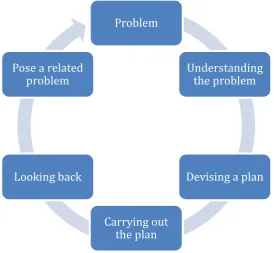
Polya (1973) has suggested a four-stage method to solve a mathematical problem. These stages are: understanding the problem, devising a plan, carrying out the plan, and looking back. Looking back stage requires the solver to check the result, derive it differently, and use it for other problems. This means that after solving the initial problem, the solver should think of related problems that can be solved with the same, or similar, solution or method. While this is clearly problem-posing, Gonzales (1998) has added a fifth stage to Polya’s problem-solving method: posing a related problem.
Figure 1. Problem-solving and problem-posing cycle.
Problem
Understanding the problem
Devising a plan
Carrying out the plan Looking back
In addition to problem-posing activity, it is thought that an evaluation of the posed problems is also important (Katrancı, 2014; Turhan & Güven, 2014). In a study performed by Silver and Cai (2005), the necessity of criteria for the evaluation of the problems that students pose was mentioned, and they determined three basic criteria within the scope of this evaluation. These are the number of posed problems and the originality and the quality of the problems. In a study conducted with pre-service teachers, Gonzales (1994) used a guideline that could be used as a guide to both solve and evaluate the problems. This guide, consisting of 16 items in total, included criteria such as clear expression of the problem; the appropriateness of the language used; the creativity, applicability, and originality of the problem; and the appropriateness of the problem in terms of mathematical level and the concepts. In the study focused on the arithmetic problems posed by the middle school students, Silver and Cai (1996) categorized the problem-posing products as mathematical problems and non-mathematical problems or statements. In the second stage, they classified mathematical problems according to their solvability and complexity. English (1998) applied a 16-week problem-posing program to the participants in a study conducted with third grade students. During this program, students were asked to solve problems that they posed themselves or solve ones posed by their friends. In general, it is seen that the criteria used have been mathematical expression (Gonzales, 1994; Stoyanova, 2005), linguistic knowledge and expression (Arıkan & Ünal, 2013; Cankoy & Özder, 2017; Ekici, 2016; Gonzales, 1994), suitability for acquisition (Gonzales, 1994; Şengül-Akdemir & Türnüklü, 2017), quality (English, 1998; Kaba & Şengül, 2016; Kılıç, 2013), solvability (Cai, 1998; Cankoy & Özder, 2017; Çelik & Özdemir, 2011; Silver & Cai, 1996; Yuan & Sriraman, 2011), originality (Gonzales, 1994; Yuan & Sriraman, 2011), and situation of problem-solving by the student (Cai, Moyer, Wang, Hwang, Nie & Garber, 2013; English, 1998; Şengül-Akdemir & Türnüklü, 2017).
Another purpose of the current study was to determine the types of problems posed by students. Mathematical problems can be classified as routine and non-routine problems. Routine problems are related to situations that are common in real life, and most of the problems that can be solved by one or more of the four operations are routine problems. Most of the non-routine problems are related to the disclosure of relationships, orders, and patterns, and a number of strategies are needed for their solutions (Altun, 2014). A problem that is routine for one student may not be routine for another. Whether a problem is routine or not depends on both the content of the problem and the person who will solve the problem (MoNE, 2013). According to Polya (1973), a problem is a routine problem if it can be solved by taking advantage of previously solved problems. Non-routine problems are those that require more skill than routine problems and the solution method of them is not clear. According to Baki (2008), mathematical questions can be classified as questions in the type of exercise, problem, application, and research. Another classification classifies problems into closed and open-ended problems (Akay et al., 2006). In the current study, the problems posed by the students were examined in terms of whether they were routine or non-routine problems.
possible relation between problems posed and problem-solving strategies used by students (Cai, 1998; 2003).
When the related literature is examined, it is seen that there are various situations used in problem-posing activities (Christou et al., 2005; English, 1998; Silver, 1994; Silver & Cai, 1996; Stoyanova & Ellerton, 1996). In a theoretical framework presented by Stoyanova and Ellerton (1996), problem-posing situations have been classified into three groups as free, semi-structured, and structured problem-posing. In free problem-posing situations, students are asked to produce problems from an artificial or natural situation given to the students. Semi-structured problem-posing situations require investigating and identification of an open-ended situation with knowledge, skills, and past experiences. In structured problem-posing situations, students are required to pose problems based on an existing problem (Stoyanova & Ellerton, 1996). The problem-posing activities used in this study consisted of free, semi-structured, and structured problem-posing situations as in the classification of Stoyanova and Ellerton (1996). There are some research studies that have used this classification (Abu-Elwan, 2002; Kırnap-Dönmez, 2014). However, there are only a limited number of studies on different problem-posing situations in the literature (Kırnap-Dönmez, 2014; Ngah, Ismail, Tasir & Mohamad Said, 2016; Silber & Cai, 2017). Furthermore, the relationship between posing and solving also suggests that problem-posing activities may be related to problem-solving strategies and problem types (Akay et al., 2006; Cai, 1998). In the current research, it was aimed to investigate the skills of the eighth grade students in different problem-posing situations. For this purpose, the following are the sub-problems of the present research:
What are the skills of students in different problem-posing situations?
What are the types of problems that students posed in different problem-posing situations?
What are the problem-solving strategies students use to solve the problems they have posed?
Method
In this study, we aimed to examine problem-posing skills of eighth grade students in different problem-posing situations. Alongside the problem-posing skills, we wanted to determine types of problems (routine, non-routine) they posed and strategies they used to solve their own problems. Therefore, the case study method was chosen for the current study.
Case study is an in-depth description and examination of a limited system (Merriam, 2013) and the most important advantage of this method is that it gives the researcher a chance to concentrate on a very specific topic or situation (Çepni, 2010). Also, the case study method is widely used to make judgements (Yin, 2017). Since we aimed to determine the problem-posing skills of eighth grade students in detail and in a short period of time, the case study method was considered suitable for the study.
Participants
Data Collection Tool
The Problem-Posing Test developed by the researchers was used to collect the data required for the study. The developed Problem-Posing Test (PPT) is composed of six open-ended items including two items for each problem-posing situation. The data collection tool was applied to the students in two sessions. The PPT was prepared by considering the Middle School Mathematics Curriculum and selecting different mathematical subjects. When the literature is examined, it is seen that tests used in problem-posing studies are often from a single subject area for a limited number of objectives (English, 1998; Işık & Kar, 2012; Kılıç, 2013; Silver & Cai, 1996). On the other hand, there are also studies using activities for different learning areas (Arıkan & Ünal, 2015; Cai, 2003).
In this study, the items in the PPT were chosen from different learning areas and objectives in the Middle School Mathematics Curriculum. A pilot study was conducted to ensure the validity of the test. After the pilot study, minor language changes were made to eliminate some vague expressions. Final version of the data collection tool was developed by making necessary corrections in the light of pilot study results and expert opinions. There were questions including the Pythagorean Theorem and the square root extraction process for free problem-posing situation in the test. Inequality and number problems were asked for semi-structured problem-posing situation. For structured problem-posing situation, there were problems including the first-degree equations with two unknowns and triangle inequality. As a result, there were six questions in total: two free, two semi-structured, and two structured. The students had two hours to complete the PPT.
Analysis of Data
A graded scoring scale (rubric) developed by the researchers was used to assess the problems posed by the participants (see Appendix-1). The rubric was developed based on evaluation criteria used in some research related to problem-posing in the literature through making the necessary adaptations and additions. In a study with sixth and seventh grade students, Silver and Cai (1996) classified responses of students primarily as mathematical problems and non-mathematical problems or expressions and then evaluated mathematical problems according to their solvability. In the last stage, the posed problems were examined in terms of mathematical and linguistic complexity. Stoyanova (2005) assessed the problems posed by the students as correct answers, partly correct answers, and answers that would not be analysed. Gonzales (1994) developed an assessment guideline to score problems posed by themselves in his study with mathematics teacher candidates. In this guide, participants scored their problems according to criteria such as expression of the problem, appropriateness of the used language, the level of mathematics, originality of the problem, conformity to mathematical concepts, and solvability. Kaba and Şengül (2016) evaluated the problems according to four basic criteria such as problem text, compatibility of the problem with the mathematical principles, type of the problem, and the solvability of the problem. In the light of similar examples, we defined seven criteria to evaluate the problem-posing products: use of mathematical language (symbol, notation), appropriateness of grammar and expression, suitability for acquisitions of the posed problems, quantity and quality of the data, solvability of the posed problem, originality of the problem, and presentation of a solution by a student.
through reconsideration. The students were classified according to each of the evaluation criteria as Level 1 who scored “0” point, Level 2 who scored “1” point, Level 3 who scored “2” point, and Level 4 who scored “3” point.
Descriptive statistics of the students' answers were used to find answers to the research problems. Direct quotations were also made from the responses of students to support the statistical data. Each quote was coded as "S (Student number) - (Code of problem-posing type)" to indicate which activity belonged to which student and problem-posing situation. “1” was used for free posing activities, “2” was used for semi-structured problem-posing activities, and “3” was used for structured problem-problem-posing activities. For example, the code S124-2 means the quotation was a semi-structured problem-posing response from the student number 124.
Findings
Findings About the First Sub-Problem
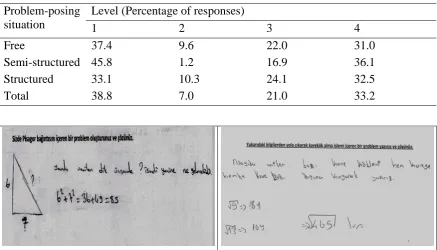
The frequencies and percentages of the scores of the participants in “using mathematical language” criterion are shown in Table 1.
It is seen that the 45.8 % of the problems posed by the students are at the 1st and 2nd levels according to this criterion. It is seen that the ability of students to use the language of mathematics, which is the most basic element that they must possess in order to pose their own problems, seems to be low. Students demonstrated least achievement in using mathematical language is “semi-structured” problem-posing situations. Free problem-posing is another problem-posing situation that is challenging. It is determined that 56.6% of the responses of participants to the structured problem-posing situations appear to be at the 3rd and 4th levels. This demonstrates that participants are more successful in structured problem-posing activities than other problem-problem-posing situations in terms of using mathematics language.
Table 1
Level of ‘Using Mathematical Language’ in Different Problem-Posing Situations
Problem-posing situation
Level (Percentage of responses)
1 2 3 4
Free 37.4 9.6 22.0 31.0
Semi-structured 45.8 1.2 16.9 36.1
Structured 33.1 10.3 24.1 32.5
What should be written in instead of “?” in the given right triangle?
Write the square roots by putting them both in square roots and out of square roots.
Figure 2. S111-1 Coded Activity Figure3. S1-1 Coded Activity
The participant S111 used related expressions such as the Pythagorean relation and right triangle but used question marks instead of hypotenuse, and his/her mathematical expressions were not fully appropriate. This problem was scored as a 2nd Level problem according to the criterion of “using mathematics language” since the lack of some mathematical concepts and terms. The answer given by S1 was evaluated as Level 1 according to the criterion of “using mathematics language”. It can be said that the student could not articulate the square root extraction process clearly and that this student might have a misconception about the concept of the square root. In general, it was seen that students did not clearly form mathematical expressions in their problems, and they used missing or incorrect concepts.
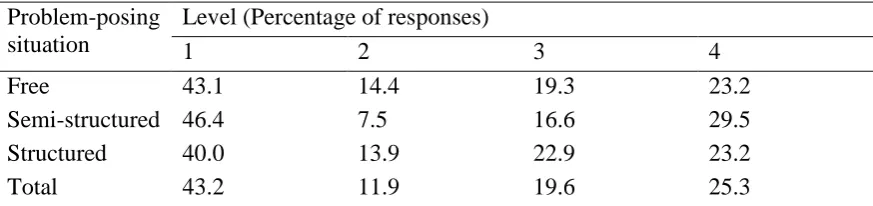
The frequencies and percentages of the scores of the participants in “grammar and expression suitability” criterion are shown in Table 2.
Table 2
Level of Grammar and Expression Suitability in Different Problem-Posing Situations
Problem-posing situation
Level (Percentage of responses)
1 2 3 4
Free 43.1 14.4 19.3 23.2
Semi-structured 46.4 7.5 16.6 29.5
Structured 40.0 13.9 22.9 23.2
Total 43.2 11.9 19.6 25.3
The house length of Ali and Mehmet is 3 cm, and the length between Mehmet and Ayşe is 4 cm, then what is the length between Ali and Ayşe’s house?
If 3 times a number minus 5 is 43 and smaller, x=?
Figure 4. S95-1 Coded Activity Figure 5. S152-2 Coded Activity
S95 used the wrong terms and did not use the expressions needed to be used in some places in the problem-posing activity and it was scored as the 2nd Level. It is seen that the problem sentence posed by S152 has no integrity in the semi-structured problem-posing activity and has formed the question statement with symbols. This response given by the student was evaluated as Level 3. It is seen in quotations that students use wrong expressions against some concepts and cannot express their opinions in written form. Furthermore, the unit misuse and data incompleteness negatively affect the expression suitability of the posed problems.
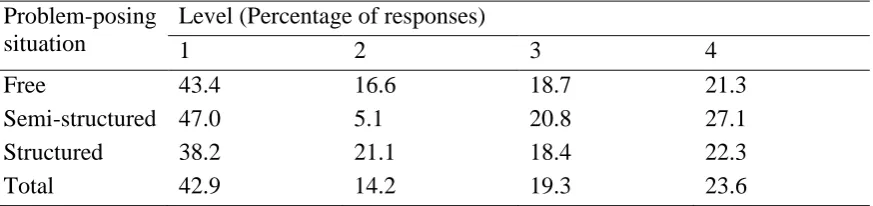
The frequencies and percentages of the scores of the problems posed in terms of “suitability to the acquisitions” criterion are shown in Table 3.
Table 3
Level of Suitability to Acquisitions in Different Problem-Posing Situations
Problem-posing situation
Level (Percentage of responses)
1 2 3 4
Free 43.4 16.6 18.7 21.3
Semi-structured 47.0 5.1 20.8 27.1
Structured 38.2 21.1 18.4 22.3
Total 42.9 14.2 19.3 23.6
posing semi-structured problems than in posing other problem situations according to the suitability criteria for acquisitions.
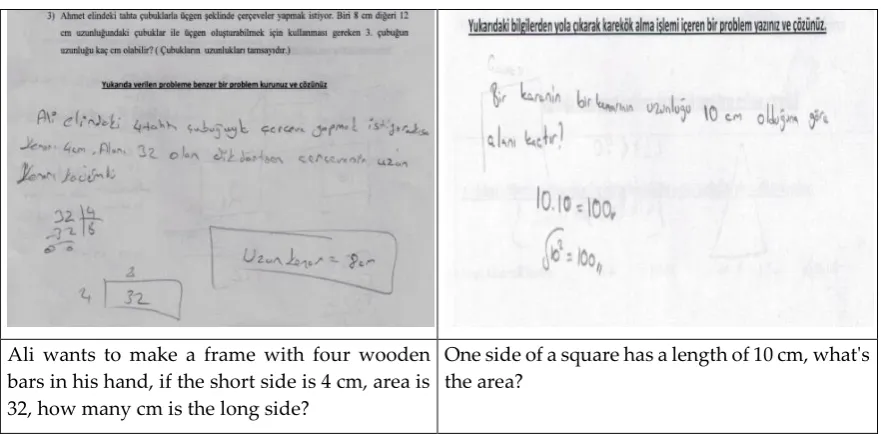
Ali wants to make a frame with four wooden bars in his hand, if the short side is 4 cm, area is 32, how many cm is the long side?
One side of a square has a length of 10 cm, what's the area?
Figure 6. S125-3 Coded Activity Figure 7. S117-1 Coded Activity
S125 posed a problem about the area of the rectangle in the structured problem-posing situation for the triangle inequality objective. Although the posed problem was a correct mathematical problem, the response of the students was evaluated as Level 3 according to the criterion of “suitability to acquisitions”. S117 posed a problem about area calculation instead of the square root extraction objective in free problem-posing activity. This answer of the student was scored as Level 2 according to the criteria of “suitability to acquisitions”. It was seen that these posed problems were not fully compatible with the acquisitions.
The frequencies and percentages of scores of the problems posed in terms of “quantity and quality of data” criterion are shown in Table 4.
Table 4
Level of Quality and Quantity of Data in Different Problem-Posing Situations
Problem-posing situation
Level (Percentage of responses)
1 2 3 4
Free 48.2 14.5 18.9 18.4
Semi-structured 49.1 6.6 19.9 24.4
Structured 42.2 18.9 18.1 20.8
Total 46.5 13.3 19.0 21.2
better in structured and semi-structured problem-posing situations in terms of “quantity and quality of data” criterion where they were more challenged in free problem-posing situations.
The distance between Batuhan and tree is 14 cm. Since the height of Batuhan is 45 cm, what is the length to the tree?
Figure 8. S129-1 Coded Activity Figure 9. S92-1 Coded Activity
S129 did not write a problem sentence and gave incorrect information about a right triangle thus this response was coded as Level 2. S92 presented unreasonable data and some data were unnecessary. In the above examples, it was seen that the students do not fully acquire the mentioned objectives and as a result of this they created unsolvable problems. Students ignored that the hypotenuse should be the longest side in a right triangle. Moreover, it was seen that they were used wrong concepts and units. In addition to the wrong expressions in the problems, the abundance of missing data was obvious.
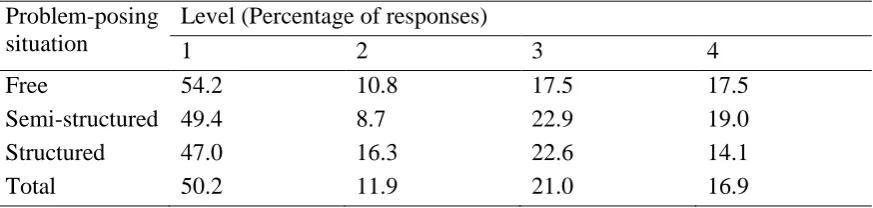
The frequencies and percentages of scores of the problems posed in terms of “solvability” criterion are shown in Table 5.
Table 5
Level of Solvability in Different Problem-Posing Situations
Problem-posing situation
Level (Percentage of responses)
1 2 3 4
Free 54.2 10.8 17.5 17.5
Semi-structured 49.4 8.7 22.9 19.0
Structured 47.0 16.3 22.6 14.1
Total 50.2 11.9 21.0 16.9
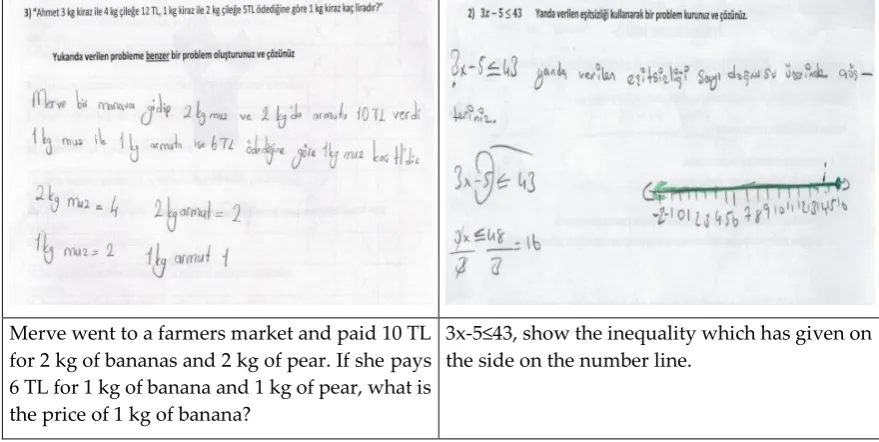
Merve went to a farmers market and paid 10 TL for 2 kg of bananas and 2 kg of pear. If she pays 6 TL for 1 kg of banana and 1 kg of pear, what is the price of 1 kg of banana?
3x-5≤43, show the inequality which has given on the side on the number line.
Figure 10. S96-3 Coded Activity Figure 11. S122-2 Coded Activity
S96 coded student’s response to the structured problem-posing activity was shown in figure 10. It was clear that the solution is not possible in the inequality system posed by this student. For this reason, the response of the student was evaluated as Level 1. It was also seen that the student tried to solve the problem and failed. The response given by the S122 coded student to the semi-structured problem-posing activity was evaluated as Level 4. In this quotation, the student written a solvable problem about showing the given inequality over the number line. It was seen that the student has posed a problem that can be solved easily.
The frequencies and percentages of scores for the problems posed by the participants in terms of “originality” criterion are shown in Table 6.
Table 6
Level of Originality in Different Problem-Posing Situations
Problem-posing
situation
Level (Percentage of responses)
1 2 3 4
Free 57.2 24.1 17.2 1.5
Semi-structured 50.3 32.5 16.6 0.6
Structured 50.6 33.7 14.2 1.5
Total 52.7 30.1 16.0 1.2
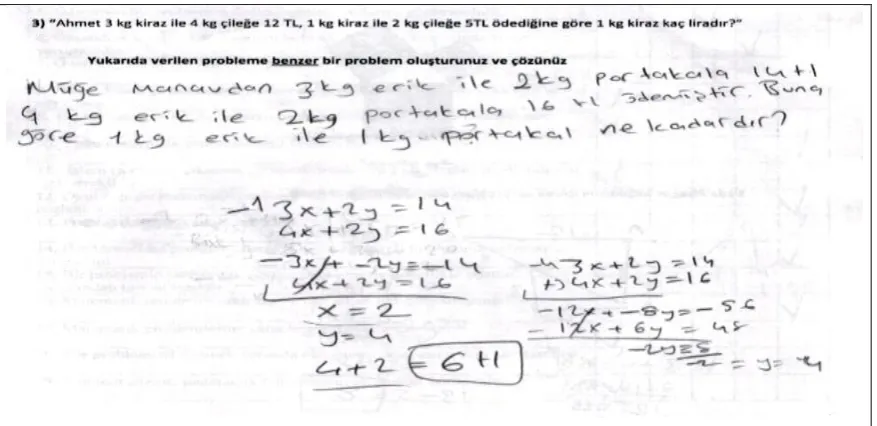
Müge has paid 14 TL for 3 kg of plums and 2 kg of oranges, 16 TL for 4 kg of plums and 2 kg of oranges. So how much is 1 kg of oranges and 1 kg of plums?
Figure 12. S138-3 Coded Activity
It was found that the participant with the code S138 posed a clear and solvable problem. There was evidence that the student posed the problem by thinking or trying to solve it. The student also showed the solution to the posed problem. Although the posed problem was accepted as correct, it was very similar to the problem presented as an example in the activity, and therefore, it was far from originality. This answer of the participant was evaluated as Level 2.
The frequencies and percentages of scores of the problems posed in terms of “presenting a solution” criterion are shown in Table 7.
Table 7
Level of Presenting a Solution in Different Problem-Posing Situations
Problem-posing situation
Level (Percentage of responses)
1 2 3 4
Free 63.9 9.0 18.7 8.4
Semi-structured 54.2 9.9 21.1 14.8
Structured 61.4 12.1 16.9 9.6
Total 59.8 10.3 18.9 11.0
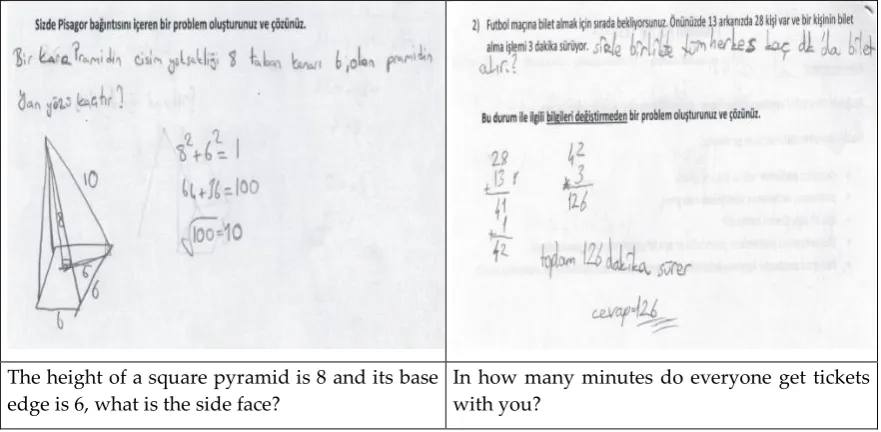
The height of a square pyramid is 8 and its base edge is 6, what is the side face?
In how many minutes do everyone get tickets with you?
Figure 13. S117-1 Coded Activity Figure 14. S151-2 Coded Activity
Findings About the Second Sub-Problem
The types of problems posed by the participants in different problem-posing situations are shown in Table 8.
Table 8
Types of Problems Posed in Different Problem-Posing situations
Routine problem Non-Routine
problem
Problem-posing situation % %
Free 87.9
95.2 91.5 91.7
12.1 4.8 8.5 8.3 Semi-structured
Structured Total
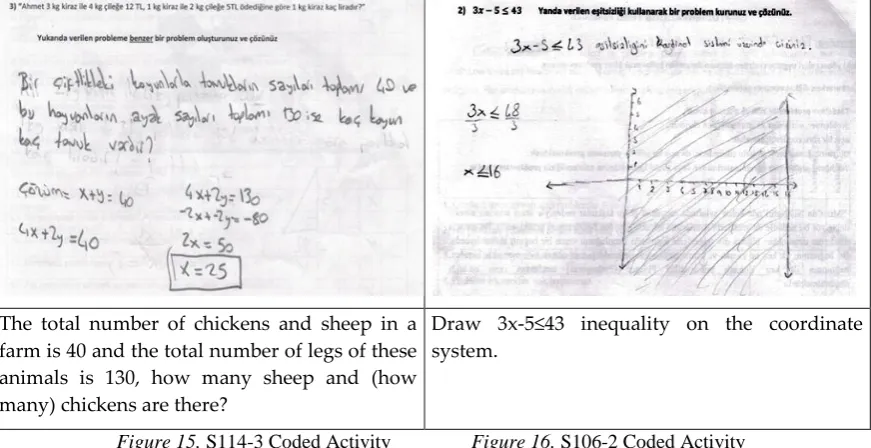
The total number of chickens and sheep in a farm is 40 and the total number of legs of these animals is 130, how many sheep and (how many) chickens are there?
Draw 3x-5≤43 inequality on the coordinate system.
Figure 15. S114-3 Coded Activity Figure 16. S106-2 Coded Activity
In the quotations given in the figures, it was seen that the problems posed by the students were far from original as they were similar to the problems in the textbooks. In Figure 15, the student was asked to pose a problem similar to the problem in example, it is seen that the student replaced the scenario of the problem in the response. In Figure 16, the response of the S106 coded student appears which can be considered as an exercise rather than a routine problem.
Find the area of the largest field when the different angles contact each other and form a right triangle in the middle, one edge of the smallest of three squares is 6 m long and one edge of a large one is 8 m.
Figure 17. S32-1 Coded Activity
In Figure 17, the problem created by the S32 coded student was considered as a non-routine problem since the student executed a different product from ordinary problems by taking the advantage of the guidelines in the problem-posing activities.
Findings About the Third Sub-Problem
Table 9
Problem-Solving Strategies Used by Students to Solve their own Problems
Problem-solving strategies Free
Semi-Structured Structured Total
% % % %
Prediction and control 0 37.5 3.1 6.3 3.1 40.6 9.4 0 0 0 0 0 6 0 2 4 68 20 0 0 0 0 9.1 18.2 0 0 0 72.7 0 0 0 0 0 2.6 18.3 0.9 2.6 2.6 61.7 11.3 0 0 0 0 Drawing a shape
Seeking a relation Working backwards Problem Simplification Writing an equation Logic Execution Animation Elimination Making a table
Making systematic list
It has seen that students used strategies “writing an equation” and “drawing a shape” at most when solving their own problems. Students use more strategies when solving problems in free problem-posing situations while the least number of strategies used is related to structured problem-posing situations.
How much money does Murat have if its 3 times minus 5 is equal or less than 43?
Hakan has paid 7 tl for 4 pencils and 6 erasers, 4 tl for 2 pencils and 4 erasers so how much do 1 pencil and 1 eraser cost?
Figure 18. S136-2 Coded Activity Figure 19. S125-3 Coded Activity
Discussion, Conclusion and Suggestions
In the present study, the problems posed by the eighth-grade students were investigated in terms of skills in different problem-posing situations, types of the problems posed, and the strategies used when solving posed problems. As a result of the analysis conducted, it has been determined that students generally have difficulty in posing problems. Likewise, Gökkurt, Örnek, Hayat, and Soylu (2015) stated that eighth grade students could not perform the expected performance in problem-solving and problem-posing stages. Korkmaz and Gür (2006) carried out research to determine the problem-posing skills of primary and mathematics teacher candidates. They reported that the vast majority of teacher candidates were unable to fulfil the expressions they thought should be in problem-posing in their own problem-solving attempts and in the implementation process. In contrast to these situations, some studies have also reached the conclusion that students are successful in problem-posing activities (Cai, 2003; Lin & Leng, 2008). It can be said that the problem-solving and posing experiences of the participants are effective in the formation of these differences. It is thought that the students who participated in the study had low success in problem posing activities since they have no previous experience in problem posing.
In the present research, the students were found to be more successful in semi-structured problem-posing situation than free and structured problem-posing situations when each problem-posing situation was examined separately. Although the results were close to each other, it can be said that students were more challenged in free problem-posing situations. A similar result was seen at the research performed by (Ngah et al., 2016) examining the problem-posing skills of middle school students according to different problem-posing situations. Kırnap-Dönmez (2014) reached a similar result pointing out that the teacher candidates were very successful in the structured problem-posing situation, but the same proficiency was not seen in semi-structured and free problem-posing situations.
In the current study, when the written responses of the students to the problems were examined, it was seen that the skills of “using the mathematical language” that is the most basic items that they have to possess in order to pose their problems were low. The least achieving problem-posing situation for the students in terms of using mathematical language was semi-structured problem-posing activities. Free problem-posing situations were another situation of problem-posing that students have difficulty in terms of this criterion. Presentation of the ready-made problems in structured problem-posing activities and having the approaches of students to write problems seen in class or textbooks as free problem-posing activities made it easier for students to use mathematics language. Kar and Işık (2015) stated that teachers should pay greater attention to the use of mathematical terminology and relevant verbal expressions to improve mathematical communication skills of students. Students should be encouraged to use the language of mathematics. In order to overcome this problem, problem-posing activities should be carried out in different situations and students should be aware of their mistakes.
candidates achieved a medium Level of achievement in problem-posing studies in terms of grammar. In another study, Arıkan and Ünal (2013) stated that second grade elementary school students did not pose appropriate problems and they had misconceptions and could not use Turkish well. Ekici (2016) stated that middle school students were not able to pose problems since they had difficulty to make sentences and question sentences. All these results are in line with the results of in the present study. The inadequacy of students in terms of expressing and writing down what they think is greatly influences the problem-posing successes. This situation can be explained by the achievements of the students in the language and expression courses as well as derived by the educational environment. It is thought that these problems will be reduced in constructive learning environments where learners are active, participatory, and responsible for their learning.
In the current study, when the scores of the problems posed by the students are examined in terms of “suitability to acquisitions” criterion, it can be said that approximately half of them are fully or partially appropriate to acquisitions. There are studies in which similar results have been obtained. Şengül-Akdemir and Türnüklü (2017) determined that 54.5% of the posed problems were curriculum dependent problems in their study performed with sixth graders. It can be said that students are more unsuccessful in free problem-posing situation than in other problem-posing situations in terms of suitability to acquisitions. The lack of information that can be clue to desired acquisitions in free problem-posing situation can lead to this result. It is also possible to make an interpretation that students are not aware of the acquisitions they have learned or that they cannot grasp the relations between the acquisitions.
In terms of “quantity and quality of data in the problem” criterion, nearly half of the posed problems were at Level 1 in the present study. The participants were more successful in semi-structured problem-posing situations in terms of this criterion. The problem-posing situation with the lowest evaluation percentage was the structured problem-posing situation. Kılıç (2013) examined the difficulties of the classroom teacher candidates experienced during problem-posing in different problem-posing situations. She defined difficulties such as lack of problem state for the posed problem, having difficulties about the structure of problem-posing case, using missing data during problem-posing, and incomplete consideration of the problem-posing case. Ekici (2016) stated that the middle school students misused the units in most (majorities) of their responses to problem-posing activities. The cases in this study also revealed that the students misused the units. Most of the students may not be able to write problems including adequate and qualified data in problem-posing activities because of being inadequate in terms of mathematical content and conceptual knowledge. It can also be said that being not familiar with problem-posing activities and having insufficient experience of the participants in this issue lead to this result.
Özdemir (2011) investigated the relationship between the proportional reasoning ability and the ability to pose proportion-ratio problem of the seventh and eighth graders in primary education. It has been seen that about one quarter of the posed problems by students were insolvable quality or did not include the type of proportion presented in problem instruction. Silber and Cai (2017) found that most of the participants posed problems were solvable problems in their study with elementary school teacher candidates. In this study, the failure of students to pose a solvable problem can be attributed to their inadequate problem-solving skills.
Silver and Cai (1996) examined the problems in terms of solvability, language, and mathematical complexity in their study in which they carried out the analysis of the posed problems by middle school students. They found that a large majority of the students posed solvable problems, certain part posed complex problems, and nearly half of the students posed related problems. There can be many reasons of students having difficulty in posing solvable problems. According to Yuan and Sriraman (2011), the content knowledge of students has a great influence on the problem-posing successes. Moreover, it can be said that the academic proficiencies of the students influence the success of posing problems (Ekici, 2016). From this point of view, the failure of students about posing solvable problems can be attributed to lack of mathematical content knowledge and academic proficiency levels in this study. Failure of students about grammar and suitability of expression can also obstruct posing solvable problems. Furthermore, it can also be interpreted that problem-solving skills of students are effective on the success of posing solvable problems.
The very few of the problems posed in this study were original problems when evaluated in terms of originality. Approximately 80% of the posed problems were at Levels 1 and 2 Tertemiz and Sulak (2013) examined problem-posing skills of fifth grade students according to the techniques they used. At the end of the study, they reached the result that most of the students changed the value of data given without changing the technical conditions and the subject used to pose problem. Korkmaz and Gür (2006) stated that classroom teacher candidates predominantly used verbal four arithmetical operations problems in their problem-posing and adhere to problems in textbooks. As can be seen in the performed studies, the students generally try to pose problems that they consider easy for them. This case leads them to grow out of creativity, and therefore, original problems do not arise since original problems come with creative thinking. In order to solve this problem, students should be faced with interesting or daily life related problems.
According to the criterion “solving the problem by the student” in the current study, the students left the solution blank or made it completely wrong in most of the posed problems. The solutions nearly for a tenth part of the posed problems were totally made true by the students. It was seen that students were more successful in solving the posed problems in the semi-structured problem situation. In other words, every student who can pose problems cannot show the same success to solve the problem. It has been reported in the literature that the problem-solving success will be increased through teaching with problem-posing approach (Akay, 2006; Dickerson, 1999; Lavy & Shriki, 2007; Turhan & Güven, 2014). Taking the studies done into consideration, it can be said that appropriate teaching according to problem-posing approach will increase the problem-solving performance of students.
proportion of all posed problems. Moreover, most of the posed problems were in the form of routine exercise problems without creativity. Akay et al. (2006) investigated the effect of using short open-ended questions and the problem-posing approach in mathematics teaching to understand and learn mathematical concepts. At the end of the research, it was identified that most of the students posed problems were in the form of routine exercise problems without creativity. The problems in the textbooks or problems without real life context solved by teachers during the class period might have caused this result. In the present research, the majority of the problems posed by the students are usually the problems that they have faced before. In this sense, it is clear that skills of the students to pose non-routine problems are quite low. The primary way to change this is to encounter students with non-routine problems. The participants were found to be relatively more successful in free problem-posing situation. It is thought that there is lack of limitations in free problem-posing situation so that the student can use the imagination and cognitive skills more effectively.
Finally, problem-solving strategies that the students used in solving their own posed problems were determined in the present research. It was found that the students mostly used equations and shape-drawing strategies during problem-solving. The most frequent different strategies used in problem-posing activity were free problem-posing situation while the least number of the strategies used in the activities were structured problem-posing situation. Some of the strategies were never used. Cai (2003) determined that fourth-, fifth-, and sixth-grade students at different achievement level schools in Singapore can choose appropriate solution strategies when solving problems and that many students can pose problems using shapes and patterns. Students who succeed in problem-posing and solving the problem can choose the appropriate ones from the strategies they have learned, but they often tend to specific strategies in problem-solving.
In the current study, it was seen that most of the students were not at the desired level of problem-posing skills. Moreover, it was determined that they also had difficulty in solving the posed problems. According to these results, it is suggested that teachers should have activities in the courses for the students to develop both solving skills and problem-posing skills and to create discussion environments about the student made mistakes through defining these mistakes done during the problem-solving and problem building process. Furthermore, problem-posing activities in mathematics classes should be adapted to daily life situations in order to obtain original problem-posing products. Different solution strategies should be included in solving activities. In the courses, different problem-posing situations should be used according to different purposes. In future research, the skills of students in different situations of problem-posing should be examined in other mathematical concepts and on the same concept. Moreover, the reasons for the difficulty of the students' skills in different situations of problem-posing skills examined in this study should be addressed through experimental and comprehensive research.
References
Abu-Elwan, R. (1999). The development of mathematical problem posing skills for prospective middle school teachers. In F. Mina & A. Rogerson (Eds.), Proceedings of the International Conference on Mathematical Education into the 21st Century: Social Challenges, Issues and Approaches (Vol. 2, pp. 1-8). Cairo, Egypt. Retrieved April 05, 2017, from http://dipmat.math.unipa.it/~grim/EAbu-elwan8.pdf.
Abu-Elwan, R. E. (2002). Effectiveness of problem-posing strategies on prospective teachers’ problem-solving performance. Journal of Science and Mathematics Education in S. E. Asia, 1, 56-69.
Akay, H. (2006). Problem kurma yaklaşımıyla yapılan matematik öğretiminin öğrencilerin akademik başarısı, problem çözme becerisi ve yaratıcılığı üzerindeki etkisinin incelenmesi. Unpublished doctoral dissertation. University of Gazi, Ankara.
Akay, H., Soybaş, D., & Argün, Z. (2006). Problem kurma deneyimleri ve matematik öğretiminde açık-uçlu soruların kullanımı [Problem-posing experiences and using open-ended questions in mathematics teaching]. Kastamonu Education Journal, 14(1), 129-146.
Altun, M. (2014). Matematik öğretimi [Teaching mathematics] (10. Ed.). Bursa: Aktüel.
Altun M., & Arslan Ç. (2006). İlköğretim öğrencilerinin problem çözme stratejilerini öğrenmeleri üzerine bir çalışma [A study on learning of the problem-solving strategies by secondary school students]. Uludağ University Faculty of Education Journal, 1, 1-21.
Arıkan, E. E., & Ünal, H. (2013). İlköğretim 2. sınıf öğrencilerinin matematiksel problem kurma becerilerinin incelenmesi [The analysis of mathematical problem-posing skill of elementary second grade students]. Amasya University Faculty of Education Journal, 2(2), 305-325.
Arıkan, E. E., & Unal, H. (2015). An investigation of eighth grade students’ problem-posing skills (Turkey sample). International Journal of Research in Education and Science, 1(1), 23-30.
Baki, A. (2008). Kuramdan uygulamaya matematik eğitimi [Mathematics education from theory to practice] (4thEd.). Ankara: Harf Yayınları.
Brown, S. I., & Walter, M. I. (2005). The art of problem-posing (3rd ed.). New York: Psychology Press. Cai, J. (1998). An investigation of US and Chinese students' mathematical posing and
problem-solving. Mathematics Education Research Journal, 10(1), 37-50.
Cai, J. (2003). Singaporean students‟ mathematical thinking in problem-solving and problem-posing: An exploratory study. International Journal of Mathematical Education in Science and Technology, 34(5), 719-737.
Cai, J., & Hwang, S. (2002). Generalized and generative thinking in US and Chinese students’ mathematical problem-solving and problem-posing. Journal of Mathematical Behavior, 21, 401–421.
Cai, J., Moyer, J. C., Wang, N., Hwang, S., Nie, B., & Garber, T. (2013). Mathematical problem-posing as a measure of curricular effect on students' learning. Educational Studies in Mathematics, 83(1), 57-69. Cankoy, O., & Darbaz, S. (2010). Problem kurma temelli problem çözme öğretiminin problemi anlama
başarısına etkisi [Effect of a problem-posing based problem-solving instruction on understanding problem]. Hacettepe University Journal of Education, 38, 11-24.
Cankoy, O., & Özder, H. (2017). Generalizability theory research on developing a scoring rubric to assess primary school students' problem-posing skills. EURASIA Journal of Mathematics Science and Technology Education, 13(6), 2423-2439.
Christou, C., Mousoulides, N., Pittalis, M., Pitta-Pantazi, D., & Sriraman, B. (2005). An empirical taxonomy of problem-posing processes. Zdm, 37(3), 149–158.
Cifarelli, V. V., & Cai, J. (2006). The role of self-generated problem posing in mathematics exploration. In Novotná, J., Moraová, H., Krátká, M. & Stehlíková, N. (Eds.), Proceedings 30th Conference of the International Group for the Psychology of Mathematics Education, (Vol.2 pp. 321-328). Prague: PME. Çelik, A., & Özdemir, E. Y. (2011). İlköğretim öğrencilerinin orantısal akıl yürütme becerileri ile oran-orantı
problemi kurma becerileri arasındaki ilişki [The relationship between elementary school students’ proportional reasoning skills and problem-posing skills involving ratio and proportion]. Pamukkale University Faculty of Education Journal, 30, 1-11.
Çepni, S. (2010). Araştırma ve proje çalışmalarına giriş [Introduction to research and project studies] (5. Ed.). Trabzon: Celepler Matbaacılık.
Dickerson, V. M. (1999). The impact of problem-posing instruction on the mathematical problem-solving achievement of seventh graders. Unpublished doctoral dissertation. University of Emory, Atlanta. Ekici, D. (2016). Ortaokul öğrencilerinin matematiksel problem kurma stratejilerinin incelenmesi.
Unpublished master dissertation. University of Dokuz Eylül, İzmir.
English, L. D. (1998). Children's problem-posing within formal and informal contexts. Journal for Research in Mathematics Education, 29(1), 83-106.
Gonzales, N. A. (1994). Problem-posing: A neglected component in mathematics courses for prospective elementary and middle school teachers. School Science and Mathematics, 94(2), 78-84.
Gonzales, N. A. (1998). A blueprint for problem posing. School Science and Mathematics, 98(8), 448-456. Gökkurt, B., Örnek, T., Hayat, F., & Soylu, Y. (2015). Öğrencilerin problem çözme ve problem kurma
becerilerinin değerlendirilmesi [Assessing students’ problem-solving and problem-posing skills]. Bartın University Faculty of Education Journal, 4(2), 751-774.
Işık, C., & Kar, T. (2012). Sınıf öğretmeni adaylarının problem kurma becerileri [Pre-service elementary teachers’ problem-posing skills]. Mehmet Akif Ersoy University Faculty of Education Journal, 23, 190-214.
Kaba, Y., & Şengül, S. (2016). Developing the rubric for evaluating problem-posing (REPP). International Online Journal of Educational Sciences, 8(1), 8-25.
Kar, T. (2014). Ortaokul matematik öğretmenlerinin öğretim için matematiksel bilgisinin problem kurma bağlamında incelenmesi: Kesirlerle toplama işlemi örneği. Unpublished doctoral dissertation. University of Atatürk, Erzurum.
Kar, T., & Işık, C. (2015). İlköğretim matematik öğretmenlerinin öğrencilerin kurdukları problemlere yönelik görüşlerinin incelenmesi: Kesirlerle toplama işlemi [The investigation of elementary mathematics teachers’ views about problems posed by students: addition operation with fractions]. Hacettepe University Journal of Education, 30(1), 122-136.
Kar, T., Özdemir, E., İpek, A. S., & Albayrak, M. (2010). The relation between the problem-posing and problem-solving skills of prospective elementary mathematics teachers. Procedia-Social and Behavioral Sciences, 2(2), 1577-1583.
Katrancı, Y. (2014). İşbirliğine dayalı öğrenme ortamlarında problem oluşturma çalışmalarının matematiksel anlamaya ve problem çözme başarısına etkisi. Unpublished doctoral dissertation. University of Marmara, İstanbul.
Kılıç, Ç. (2013). Sınıf öğretmeni adaylarının farklı problem kurma durumlarında sergilemiş oldukları performansın belirlenmesi [Determining the performances of pre-service primary school teachers in problem-posing situations]. Educational Sciences: Theory & Practice, 13(2), 1195-1211.
Kırnap-Dönmez, M.S. (2014). İlköğretim matematik öğretmen adaylarının problem kurma becerilerinin incelenmesi. Unpublished master dissertation. University of Erciyes, Kayseri.
Kilpatrick, J. (1987). Problem formulating: Where do good problems come from? In Schoenfeld, Alan H. (Ed.), Cognitive Science and Mathematics Education (pp. 123-147). New Jersey: Lawrence Erlbaum Associates, Inc.
Korkmaz, E., & Gür, H. (2006). Öğretmen adaylarının problem kurma becerilerinin belirlenmesi [Determining of prospective teachers’ problem-posing skills]. Balıkesir University Science Institute Journal, 8(1), 64-74.
Lavy, I., & Shriki, A. (2007). Problem-posing as a means for developing mathematical knowledge of prospective teachers. In Proceedings of the 31st Conference of the International Group for the Psychology of Mathematics Education (Vol. 3, pp. 129-136).
Lin, K. M., & Leng, L. W. (2008, July). Using problem-posing as an assessment tool. Paper presented at 10th Asia-Pacific Conference on Giftedness, Singapore.
Merriam, S. B. (2013). Qualitative Research: A Guide to Design and Implementation. Nobel, Ankara. Ministry of National Education [MoNE], (2009). İlköğretim matematik dersi öğretim programı ve kılavuzu
[Elementary mathematics curriculum and guide]. Ankara: MEB Basımevi.
Ministry of National Education [MoNE], (2013). Ortaokul matematikdersi (5, 6, 7 ve 8. Sınıflar) öğretim programı [Secondary school mathematics curriculum (5th, 6th, 7th and 8th grade) curriculum]. Ankara: MEB Basımevi.
Muyo, M. (2015). Prizren eğitim fakültesi öğrencilerinin matematik okuryazarlığı problemlerini çözme becerilerinin geliştirilmesi. Unpublished doctoral dissertation. University of Balıkesir, Balıkesir.
National Council of Teachers of Mathematics (NTCM), (1991). Professional standards for teaching mathematics. Reston, VA: Author.
National Council of Teachers of Mathematics [NTCM], (2000). Principles and standard for school mathematics. Reston, VA: National Council of Teachers of Mathematics.
Ngah, N., Ismail, Z., Tasir, Z., Said, M., & Haruzuan, M. N. (2016). Students’ ability in free, semi-structured and structured problem-posing situations. Advanced Science Letters, 22(12), 4205-4208.
10-Polya, G. (1973). How to solve it: A new aspect of mathematical method (2nd Ed.). New Jersey: Princeton University Press.
Silber, S., & Cai, J. (2017). Pre-service teachers' free and structured mathematical problem-posing. International Journal of Mathematical Education in Science and Technology, 48(2), 163-184.
Silver, E. A. (1994). On mathematical problem-posing. For the Learning of Mathematics, 14(1), 19-28. Silver, E. A. (1997). Fostering creativity through instruction rich in mathematical problem-solving and
problem-posing. Zdm, 29(3), 75-80.
Silver, E. A., & Cai, J. (1996). An analysis of arithmetic problem-posing by middle school. Journal For Research in Mathematics Education, 27, 521-539.
Silver, E. A., & Cai, J. (2005). Assessing students’ mathematical problem-posing. Teaching Children Mathematics, 12(3), 129-135.
Stoyanova, E. (1998). Problem-posing in mathematics classrooms. In A. McIntosh, & N. Ellerton (Eds.), Research in mathematics education: A contemporary perspective (pp.164-185). Perth: MASTEC Publication
Stoyanova, E. (2005). Problem-posing strategies used by years 8 and 9 students. Australian Mathematics Teacher, 61(3), 6-11.
Stoyanova, E., & Ellerton, N. F. (1996). A framework for research into students’ problem-posing in school mathematics technology in mathematics education (pp.518–525). Melbourne: Mathematics Education Research Group of Australasia.
Şengül-Akdemir, T., & Türnüklü, E. (2017). Ortaokul 6. sınıf öğrencilerinin açılar ile ilgili problem kurma süreçlerinin incelenmesi [The investigation of 6th grade students’ problem-posing processes on angles]. International Journal of New Trends in Arts, Sports & Science Education, 6(2), 17-39.
Tertemiz, N., & Sulak, S. E. (2013). İlköğretim beşinci sınıf öğrencilerinin problem kurma becerilerinin incelenmesi [The examination of the fifth-grade students' problem-posing skill]. Elementary Education Online, 12(3), 713‐729.
Tichá, M., & Hošpesová, A. (2013). Developing teachers’ subject didactic competence through problem-posing. Educational Studies in Mathematics, 83(1), 133–143.
Toluk-Uçar, Z. (2009). Developing pre-service teachers understanding of fractions through problem posing. Teaching and Teacher Education, 25(1), 166-175.
Turhan, B., & Güven, M. (2014). Problem kurma yaklaşımıyla gerçekleştirilen matematik öğretiminin problem çözme başarısı, problem kurma becerisi ve matematiğe yönelik görüşlere etkisi [The effect of mathematics instruction with problem-posing approach on problem-solving success, problem-posing ability and views towards mathematics]. Çukurova University Faculty of Education Journal, 43(2), 217-234.
Yazgan, Y. (2007). Observations about fourth and fifth grade students’ strategies to solve non-routine problems. Elementary Education Online, 6(2), 249-263.
Yazgan, Y., & Bintaş, J. (2005). Fourth and fifth grade students’ level of problem-solving strategies: A teaching experiment. Hacettepe University Journal of Education Faculty, 28, 210-218.
Yıldız, Z. (2014). Matematikte problem kurma çalışmalarının öğretmen adaylarının problem kurma becerilerine ve üstbilişsel farkındalık düzeylerine etkisi. Unpublished doctoral dissertation. University of Marmara, İstanbul.
Yin, R. K. (2017). Applications of Case Study Research. Nobel, Ankara.
Yuan, X., & Sriraman, B. (2011). An exploratory study of relationships between students' creativity and mathematical problem-posing abilities: Comparing Chinese and U.S students. In B. Sriraman & K. Lee (Eds.), The elements of creativity and giftedness in mathematics (pp. 5–28). Rotterdam: Sense Publishers.
Appendix-1.
Rubric towards Evaluation of Problem-Posing Skills
0 Point 1 Point 2 Points 3 Points
Ability to use
mathematical language (symbol, notation, and so on) correctly
Null There is an error in the use of the mathematical language (or concepts).
The mathematical language is/ (or concepts are) used correctly but incompletely.
The mathematical language is/ (or concepts are) used precisely and correctly.
Compliance of the text of the question with grammar rules, whether it contains an incoherency or spelling mistake
Empty, no text, or incoherency or misspelling.
There is no mistake in writing, but there is incoherency.
There is no incoherency, but the writing is wrong.
There are no incoherency and spelling mistakes.
The suitability of instructions used while referring to the operations to be done in problem or stating the problem to the acquisitions
Empty or unclear how the problem will be solved.
The operation to be done for the solution of the problem is suitable for the acquisitions but it is incomplete/wrong.
The operation to be done for the solution of the problem is not suitable for the acquisitions but it is complete/error free.
The operation to be done for the solution of the problem is suitable for the acquisitions and it is complete/error free.
In order for the problem to be solved, the amount of data and expressions contained in the problem, the logical/operational suitability, and the significance of the result
Empty, cannot be understood because it is not clear how to solve it, or there is no data available because there is no shape-text transfer.
There are both invalid and missing data or too much data-expression.
The data is incompatible or there is
missing/more data-expression.
The data are adequate and appropriate.
Accessibility of the problem to the desired result (Solvability)
Empty or not be solved because data in the figure cannot be mathematically expressed in text form
Cannot be solved because it is not appropriate or sufficient data, or lack of expression
Although the data are appropriate and sufficient, they cannot be solved because of writing errors and incoherency.
Solvable.
The scenario of the problem text, the originality in terms of the operation steps in order to reach a solution
Empty or cannot be detected
The problem is pretty ordinary (Type of always been to).
The problem is partly original (so unique that it can be distinguished from the
ordinary/classical question type).
The problem is largely original (a type of question whose originality is kept on the front line when it is produced, but not in textbooks or other sources).
Case of solving student posed problem
Empty Could not apply the givens and desired to the solution
The problem is understood correctly and solved but there is an operation error.
Appendix-2.
Problem-Posing Test
Problem-Posing Test -1
Implement the below guidelines and write down a problem for each one through using the desired cases.
Things to take care while posing the problems!
• Problems you will write should be clear and understandable. • Problems should consist of given and desired statements. • They must contain an open question sentence.
• Problems you will pose must also clearly describe solutions.
• The written problems may be the problems inspired by your teachers or other sources.
1) “In Egypt, the land boundaries are constantly changing due to the floods in the Nile River during spring, so the boundaries of the land have to be re-determined frequently. For this purpose, a correlation has been used which gives the length of the hypotenuse of the right triangles whose vertical edge lengths are known. Although it is not known exactly when and how this connection was first used, it is thought that this correlation was first proved by the Greek mathematician Pythagoras (Pythagoras).”
𝑐2+ 𝑏2= 𝑎2
2) Pose and solve a problem involving the Pythagorean correlation.
(Free Problem-posing Activity)
3) Pose and solve a problem through using the given inequality .
(Semi-structured Problem-posing Activity)
4) “Ahmet has paid 12 TL for 3 kg cherry and 4 kg strawberry, 5 TL for 1 kg cherry and 2 kg strawberry, what is the price for 1 kg cherry?”
Problem-Posing Test - 2
Implement the below guidelines and write down a problem for each one through using the desired cases.
Things to take care while posing problems!
• Problems you will write should be clear and understandable. • Problems should consist of given and desired statements. • They must contain an open question sentence.
• Problems you will pose must also clearly describe solutions.
• The written problems may be the problems inspired by your teachers or other sources.
1. “The operation of square root extraction is used to find the side length of square if its area is known.” If the area of a square is a2 unit-square, the side lengths of a square are found to be as a √𝑎2= 𝑎 unit.
Pose and solve a problem including extraction of a square root through the above information. (Free Problem-posing Activity)
2. You are waiting in order to get tickets for a football match. You have 13 people in front of you and 28 people behind, and it takes 3 minutes for one person to get a ticket.
Pose and solve a problem without changing the information about this case. (Semi-structured Problem-posing Activity)
3. Ahmet wants to make triangular frames with wooden bars. If one bar is 8 cm long and the other is 12 cm long to make a triangle, what is the length of the third bar? (The lengths of the bars are integers.) Pose and solve a problem similar to the above given problem.