Web Ecology 8: 1–13.
The current environmental crisis is one of the main chal-lenges faced by humankind, because many goods and serv-ices that contribute to social welfare are inextricably linked to the naturalness or semi-naturalness of ecosystems (Costanza et al. 1997). This crisis is particularly difficult to face for developing countries because they typically have valuable natural and environmental resources, but scarce economic means to preserve them. Two key means to face this challenge have been the creation of effective networks
of protected natural areas, and the design of management strategies of natural and socio-economic systems that may make management compatible with the preservation of natural resources. Although several of these management strategies have been devised and implemented, the studies that have analyzed their effectiveness show unequal results (Hering 2003, Dichmont et al. 2006). In the case of pro-tected areas, there is a wide agreement in that their delimi-tation, management and funding are frequently
inappro-What do we call Adaptive Management? A general
characterization from a global sample
Tiscar Espigares, Noelia Zafra-Calvo and Miguel Á. Rodríguez
Espigares, T., Zafra-Calvo, N. and Rodgríguez, M. Á. 2008. What do we call Adaptive Management? A general characterization from a global sample. – Web Ecology 8: 1–13.
This study presents a characterisation of the implementation of Adaptive Management (AM) from the analysis of 35 projects around the world. Our results reveal that AM projects are usually aimed at ecosystem management, conservation and restoration. Also, they mainly act upon forest or epicontinental water ecosystems and their goal is generally species exploitation and in most cases these projects act at a local scale. From a methodological point of view, most AM cases use an active approach and monitoring programs and were at the phase of problem identification. We found differences in the implementation of AM between developed and developing countries that were present in our samples in the following way: AM projects in developed countries were typically carried out by state agencies, and focused on solving problems concerning epicontinen-tal waters and the public use of ecosystems. They had the support of national funds and used modelling techniques. In contrast, the AM projects from developing countries were mainly aimed at the conservation of natural protected areas and at the mitigation of environmental impacts derived from mining activities. The financial support of these projects was frequently provided by international organizations, and the use of model-ling techniques was uncommon. For a better exploitation of all the possibilities of AM, we suggest the use of criteria to be customized to the specific needs of the socio-econom-ic reality of every country and to monitor the results at a global scale to continuously improve this practice.
priate in several parts of the world, including Europe (Oldfield et al. 2004), Latin America (Powell et al. 2000, Armenteras et al. 2003, Cantú et al. 2004), Asia (Latif Khan 1997, Jepson et al. 2002), and Africa (Wilkie et al. 2001, Blom et al. 2004, De Klerk et al. 2004, Struhsaker et al. 2005, Burgess et al. 2005). In fact, this situation em-phasizes the need to continue developing and improving conservation and management strategies that are suited to each socio-economic reality within the context of sustain-able development.
The growing sophistication of the methodologies used for the management of ecosystems in recent years has crys-tallized in the new paradigm of Adaptive Management (AM) (Holling 1978). The most remarkable feature of this approach is its ability to learn from the enormous uncer-tainties that management is usually confronted with, in a process in which management is designed to gain informa-tion from ecosystems, in what has usually been called ‘learning by doing’ (Walters and Holling 1990). These un-certainties derive from our scant knowledge and under-standing of the complexities of most ecosystems and their interactions with socio-economic systems. As defined by Nyberg (1999), AM “is a systematic process for continual-ly improving management policies and practices by learn-ing from the outcomes of operational programs (...). It em-ploys management programs that are designed to experi-mentally compare selected policies or practices, by evaluat-ing alternative hypotheses about the system beevaluat-ing man-aged”. In short, AM incorporates research and experimen-tation in the conservation actions, emphasizes social par-ticipation and the institutional framework within the so-cio-economic context, and enables, in a systematic and rig-orous way, to learn from the results of management and to incorporate this knowledge to devise future actions (Brit-ish Columbia Forest Service 1997).
The broadly accepted methodological procedure of AM involves five steps, with the desirable incorporation of social participation: (1) identification of managing prob-lems usually carried out by modelling the functioning of the system under several feasible scenarios of management, (2) design and (3) implementation of the Management Plan and Monitoring Program, the latter being a core ele-ment in the AM since it allows for a permanent adjustele-ment of the management strategy based on its results, (4) man-agement assessment, and (5) manman-agement adjustment.
Nowadays, AM is widely used to manage natural re-sources, ecological and social systems, and protected natu-ral areas. However, despite the promising expectations generated at the beginning, recent studies have shown some weaknesses in the actual implementation of AM which confirm that the harvested results are far from those initially expected (McLain and Lee 1996, Lee 1999, Gre-gory et al. 2006). Besides the complexity to combine scien-tists, policy makers and developers needs, another weak point of AM application is the multiple interpretations of this strategy. Indeed, far from being a straight forward
unique way of making management, it includes a whole array of practices that emphasize different aspects of the methodological process. In fact, although monitoring is the distinctive feature of AM for most authors (Allen et al. 2001, Campbell et al. 2002), some others stress the impor-tance of other aspects of the methodology such as the proc-ess of generating and assproc-essing scenarios throughout mod-elling (Carpenter et al. 1999, Walters et al. 2000), or social participation (Shindler and Cheek 1999).
Bearing this in mind, it is not surprising to find a scarci-ty of works that analyze the effectiveness of AM imple-mentation in the world. Most of the antecedents are stud-ies that evaluate the efficiency and limitations (Walters 1997) of AM in individual cases (Pinkerton 1999, Gray 2000) or, at most, three cases together (McLain and Lee 1996, Gilmour et al. 1999). In any case, the lack of a global perspective to tackle the AM situation worldwide is re-markable. The present work contributes to the discussion with a diagnosis of the kind of practices that are carried out in the world labelled as AM, without aiming at any evalu-ation of their effectiveness. The objective of our study is to make a general characterization of the management prac-tices whose implementers call AM, paying special atten-tion to geographic, ecological, socioeconomic and meth-odological features. Therefore, the aim of the present paper is twofold: firstly, to identify the main applications of the strategy of Adaptive Management in use, and secondly, to establish whether ecological and socio-economic factors have some effect in determining the kind of management that is applied. This will offer a description of the state of the art of AM in the world.
Material and methods
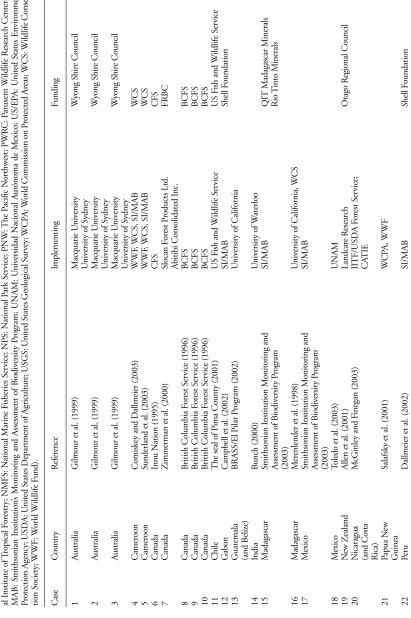
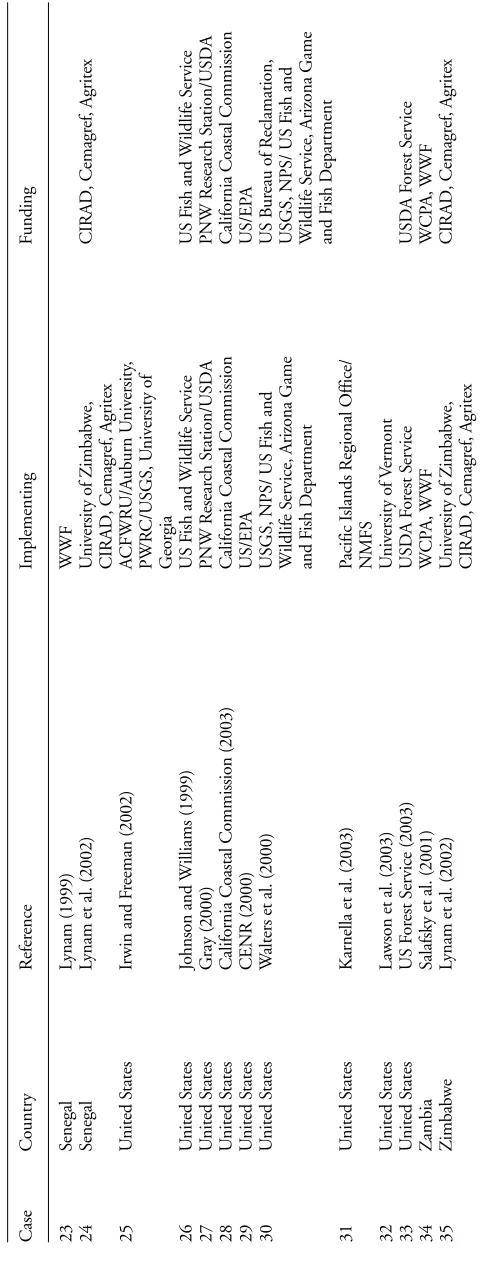
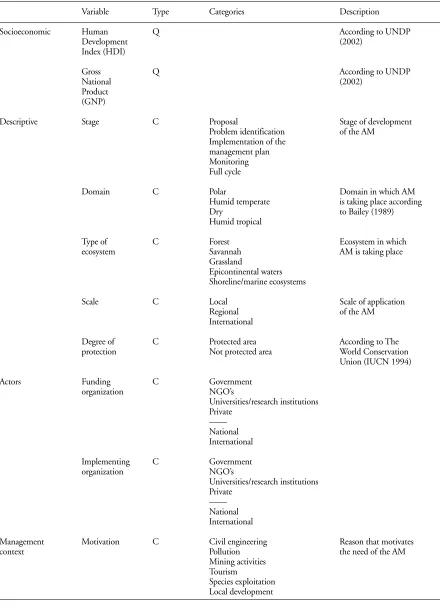
The study involved 35 study cases of AM, which were ob-tained by reviewing the scientific literature during 1994– 2004 as well as other documents (e.g. project reports) backed up by well-known institutions (Table 1). Only the cases in which the authors explicitly used the term “Adap-tive Management” to describe their activities were selected. Each case was examined to obtain 16 variables that re-flected its geographical, ecological, and socio-economic contexts, the actors supporting and undertaking the AM (funding and implementing organizations), and also the major methodological features of the practices it involved (Table 2). In those cases in which the bibliography did not supply all the data required for the study, we contacted the authors and asked for additional information.
re-sults. For both analyses, distances were measured on the basis of Sorensen index. The results of the two analyses clearly differentiated two groups of AM study cases (Re-sults), which prompted us to further investigate their rela-tionships with each of the categorical variables using χ2 -tests of bivariate association. NMDS analyses were per-formed with PC-Ord for Windows Multivariate Analysis of Ecological Data ver. 4.0. (McCune and Mefford 1999), and for χ2 tests we used Statistica Software ver. 6.0. (StatSoft 2003).
Results
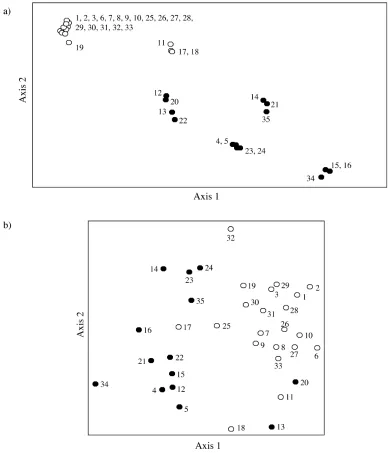
Among the 35 study cases analysed, 21 belonged to devel-oped countries while 14 took place in developing ones. As there is no established convention for the designation of ‘developed’ and ‘developing’ countries in the United Na-tions system, we considered as developed those countries within the upper third in the ranking of countries accord-ing with HDI (UNDP 2002). Figure 1a shows the two axes solution of the NMDS performed including all
T
able 1. A
uthors, countries of implementation and r
eferences of the cases of A
daptiv
e M
anagement used for the study
. F
unding and implementing organizations ar
e also indicated
(A
CFWR
U: Alabama Cooperativ
e F
ish and
W
ildlife R
esearch U
nit; BCFS: B
ritish Columbia F
or
est Ser
vice; CA
TIE: Centro Agr
onómico
T
ropical de I
n vestigación y E nseñanza; CFS: Canadian F or est S er
vice; CIRAD: Centr
e de coopération I
nternationale en R
echer
che Agr
onomique pour le Dév
eloppement; FRBC: F
or
est R
enewal B
ritish Columbia; IITF: I
nternation-al I nstitute of T ropical F or estr
y; NMFS: N
ational M
arine F
isheries S
er
vice; NPS: N
ational P
ark S
er
vice; PNW
: The P
acific N or thw est; PWR C: P atux ent W ildlife R esear
ch Center; SI/
MAB: S
mithsonian I
nstitution
’s M
onitoring and Assessment of B
iodiv
ersity P
rogram; UNAM: U
niv
ersidad N
acional A
utónoma de M
exico; US/EP A: U nited S tates E nvir onmental Pr
otection Agency; USDA: U
nited S
tates Department of Agricultur
e; USGS: U
nited S tates G eological S u rv ey; W C P A: W
orld Commission on P
rotected Ar eas; W CS: W ildlife Conser va -tion S ociety; WWF: W orld W ildlife F und). Case Countr y R efer ence Implementing F unding 1A ustralia G
ilmour et al. (1999)
M acquarie U niversity W yong S hir e Council U niv
ersity of S
ydney
2A
ustralia
G
ilmour et al. (1999)
M acquarie U niversity W yong S hir e Council U niv
ersity of S
ydney
3A
ustralia
G
ilmour et al. (1999)
M acquarie U niversity W yong S hir e Council U niv
ersity of S
ydney
4
Camer
oon
Comiskey and D
allmeier (2003) WWF , W CS, SI/MAB W C S 5 Camer oon
Sunderland et al. (2003)
WWF , W CS, SI/MAB W C S 6C anada Innu N ation (1995) CFS CFS 7C anada Z
immerman et al. (2000)
Slocan F or est P roducts Ltd. FRBC A
bitibi Consolidated I
nc.
8C
anada
B
ritish Columbia F
or est S er vice (1996) BCFS BCFS 9C anada B
ritish Columbia F
or est S er vice (1996) BCFS BCFS 10 Canada B
ritish Columbia F
or est S er vice (1996) BCFS BCFS 11 Chile
The seal of P
ima County (2001)
US F ish and W ildlife S er vice US F ish and W ildlife S er vice 12 G abon
Campbell et al. (2002)
SI/MAB Shell F oundation 13 G uatemala BRASS/E l P ilar P rogram (2002) U niv
ersity of California
(and Beliz e) 14 India B unch (2000) U niv ersity of W aterloo 15 M adagascar Smithsonian I nstitution M onitoring and SI/MAB QIT M adagascar M inerals
Assessment of B
iodiv ersity P rogram Rio T into M inerals (2003) 16 M adagascar M er
enlender et al. (1998)
U
niv
ersity of California,
WC S 17 M exico Smithsonian I nstitution M onitoring and SI/MAB
Assessment of B
iodiv ersity P rogram (2003) 18 M exico T
oledo et al. (2003)
UNAM
19
N
ew Zealand
Allen et al. (2001)
Landcar e R esearch Otago R egional Council 20 N icaragua M cG
inley and F
inegan (2003) IITF/USDA F or est S er vice; (and Costa CA TIE Rica) 21 Papua N ew
Salafsky et al. (2001)
WC P A, WWF G uinea 22 Pe ru D
allmeier et al. (2002)
SI/MAB
Shell F
T able 1. Continued. Case
Countr y R efer ence Implementing F unding 23 Senegal Lynam (1999) WWF 24 Senegal
Lynam et al. (2002)
U
niv
ersity of Z
imbab we, CIRAD, Cemagr ef , Agritex CIRAD, Cemagr ef , Agritex 25 U nited S tates Ir
win and F
reeman (2002) A CFWR U/A uburn U niv ersity , PWR C/USGS, U niversity of G eorgia 26 U nited S tates Johnson and W illiams (1999) US F ish and W ildlife S er vice US F ish and W ildlife S er vice 27 U nited S tates G ray (2000) PNW R esear ch S tation/USDA PNW R esearch S tation/USDA 28 U nited S tates
California Coastal Commission (2003)
California Coastal Commission
California Coastal Commission
29 U nited S tates CENR (2000) US/EP A US/EP A 30 U nited S tates W
alters et al. (2000)
USGS, NPS/ US F
ish and
US B
u
reau of R
eclamation, W ildlife S er vice, Ariz ona Game
USGS, NPS/ US F
ish and and F ish Department W ildlife S er
vice, Arizona Game
and F ish Department 31 U nited S tates
Karnella et al. (2003)
Pacific I slands R egional Office/ NMFS 32 U nited S tates
Lawson et al. (2003)
U niv ersity of V ermont 33 U nited S tates US F or est S er vice (2003) USDA F or est S er vice USDA F or est S er vice 34 Z ambia
Salafsky et al. (2001)
WC P A, WWF W C P A, WWF 35 Z imbab w e
Lynam et al. (2002)
U
niv
ersity of Z
Table 2. Variables used for the study of characterization of adaptive management (Q: quantitative variable, C: categorical variable).
Variable Type Categories Description
Socioeconomic Human Q According to UNDP
Development (2002)
Index (HDI)
Gross Q According to UNDP
National (2002)
Product (GNP)
Descriptive Stage C Proposal Stage of development
Problem identification of the AM
Implementation of the management plan Monitoring Full cycle
Domain C Polar Domain in which AM
Humid temperate is taking place according
Dry to Bailey (1989)
Humid tropical
Type of C Forest Ecosystem in which
ecosystem Savannah AM is taking place
Grassland
Epicontinental waters Shoreline/marine ecosystems
Scale C Local Scale of application
Regional of the AM
International
Degree of C Protected area According to The
protection Not protected area World Conservation
Union (IUCN 1994)
Actors Funding C Government
organization NGO’s
Universities/research institutions Private
—— National International
Implementing C Government
organization NGO’s
Universities/research institutions Private
—— National International
Management Motivation C Civil engineering Reason that motivates
context Pollution the need of the AM
Mining activities Tourism
ables. This ordination exhibits a very low stress (0.06), which indicates that the overall differences among the study cases are reasonable depicted by the two axes. The first axis is strongly correlated with the HDI and GNP of the countries (r = –0.98 and –0.92, respectively; p < 0.05 in both cases), suggesting that the main differences among the AM study cases are conditioned by the socio-economic statuses of the countries in which it is applied. There is, however, a caveat with regard to these results. Since the only two quantitative variables included in the data where precisely HDI and GNP, the ordination result could be reflecting the likely stronger weight of these variables on the analysis, and not real management differences among study cases. Accordingly, we repeated this analysis with the exclusion of HDI and GNP from the data, but again the results clearly supported the previous findings. Albeit the new ordination plane exhibited a slightly poorer fit (stress value = 0.27), it reflected the same overall trends (Fig. 1b). In other words, the study cases from developed and devel-oping countries appeared clearly separated in the
ordina-tion plane, and the correlaordina-tions of the first ordinaordina-tion axis with HDI and GNP were also high (r = 0.82 and 0.73, respectively; p < 0.05). Thus, the data indicate that devel-oped and developing countries differ with regard to the characteristics of the AM being performed in each case. To delve into this result, several χ2 tests were performed to explore the existence of significant differences between both groups of cases for each of the variables under analy-sis.
Regarding the stage of development of the AM we found that most of the study cases (53%) were at the phase of problem identification, and only 9% of them finished the full cycle. Although we did not observe significant dif-ferences between developed and developing countries, the higher number of cases found at the implementation or monitoring stages in developed countries may reflect the general delay that developing countries experienced in the use of this management practice.
Regarding the geography, we found that AM is being applied in all the ecological domains, with a clear
prefer-Table 2. Continued.
Variable Type Categories Description
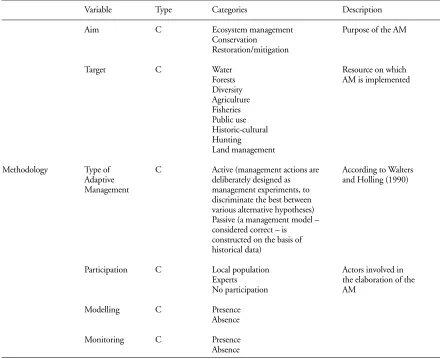
Aim C Ecosystem management Purpose of the AM
Conservation Restoration/mitigation
Target C Water Resource on which
Forests AM is implemented
Diversity Agriculture Fisheries Public use Historic-cultural Hunting
Land management
Methodology Type of C Active (management actions are According to Walters
Adaptive deliberately designed as and Holling (1990)
Management management experiments, to
discriminate the best between various alternative hypotheses) Passive (a management model – considered correct – is constructed on the basis of historical data)
Participation C Local population Actors involved in
Experts the elaboration of the
No participation AM
Modelling C Presence
Absence
Monitoring C Presence
ence for those with higher human population (humid– temperate and humid–tropical) which covered 74% of the cases. Obvious differences (χ2 = 27.58, DF = 3, p < 0.001) were found in the ecological domain between developed and developing countries, thus reflecting their unequal ge-ography: developed countries mainly concentrate in tem-perate areas while developing countries broadly coincide with the tropics.
When we focus on the type of ecosystems subjected to AM in the world, we find that forests and epicontinental waters are the most common, covering together 73% of all cases. Then, savannahs and grasslands represent 10% of the cases each, and, finally, the less represented are shore-line and marine ecosystems, with only 7% of the cases. No significant differences between developed and developing countries were found when we did the analysis with the five categories indicated in Table 2. However, when we grouped these categories in only two, aquatic (including epicontinental waters and shoreline/marine ecosystems) and terrestrial (including forest, savannah and grasslands), we found significant differences between developed and developing countries (χ2 = 6.56, DF = 1, p < 0.02). Most of the cases of AM in developing countries act upon terrestri-al ecosystems (87%) while in developed countries AM projects involved terrestrial and aquatic ecosystems in a very similar proportion (46% vs 54% respectively)., The scale of application of the AM projects was local (80%) in most of the cases, and this pattern applied to both devel-oped and developing countries.
Although most of AM cases took place in non protected areas (69% of all cases), the percentage of AM cases acting in protected areas was higher in developing countries than in developed ones (46.6% vs 19.0%), though this differ-ence was only marginally significant (χ2 = 3.15, DF = 1, p < 0.1).
When we focus on the actors involved in the AM, we find clear differences between developed and developing countries. While in developed countries 94.74% of the AM cases are funded by national institutions, only 16.67% are in developing ones (χ2= 15.24, DF = 1, p < 0.001). A more detailed analysis of the nature of funding institutions revealed that Governments are the funding entities par excellence in developed countries (χ2 = 4.44, DF = 1, p < 0.03), while in developing countries, other institutions as NGO’s sponsor almost half of the AM cas-es.
The profile of the institutions that implement AM fol-lowed a similar pattern to funding organizations. In this case, national organizations implement most of the AM projects in both developed and developing countries (90% and 62% respectively), although a conspicuous part of the projects (38%) in developing countries is still implement-ed by international institutions (χ2 = 3.18, DF = 1, p < 0.1). Significant differences were found in the kind of im-plementing institutions between developed and develop-ing countries (χ2 = 10.82, DF = 3, p < 0.02): while in de-veloped countries, again, Governments are the main im-plementers (78% of the cases); in developing countries NGO’s and research institutions are responsible for the implementation of 75% of the AM projects.
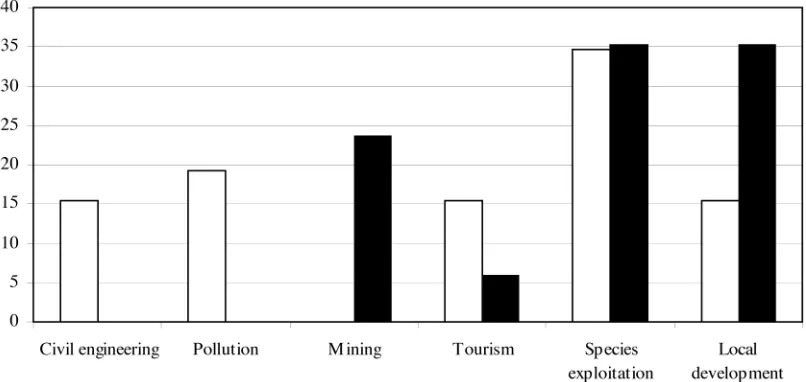
In terms of the context of the AM, we find different motivations for AM projects, being the most frequent the species exploitation, that motivates 35% of the AM cases in both developed and developing countries (Fig. 2). How-ever, distinct differences between developed and develop-ing countries were observed (χ2 = 14.55, DF = 5, p < 0.02). Among the six categories of motivation we identified in Table 2 (civil engineering, pollution, mining, tourism, spe-cies exploitation and local development), the first three show the highest differences between developed and
oping countries. Civil engineering and pollution motivat-ed one third of the AM projects in developmotivat-ed countries and did not motivate any in less developed ones. As a contrast, mining activities originated the fourth part of the AM projects carried out in developing countries and did not originate any in developed ones (Fig. 2).
Regarding the principal aim of the AM, we observed that, at a global scale, a third of the projects were directed to ecosystem management, another third to conservation practices and the final third to restoration/mitigation is-sues. No significant differences were found between devel-oped and developing countries. When we looked at the target of the AM, that is, the resource on which AM projects are implemented, we observed that 28% of the study cases deal with diversity questions, which constitute the more frequent target. Anyway, AM cases implemented in the world involved a wide variety of situations, with projects focusing not only on diversity, but also on water, forests, agriculture, fisheries, etc (Table 2). When we ana-lysed each category in detail, we only found significant dif-ferences between developed and developing countries when the target is public use (χ2 = 4.83, DF = 1, p < 0.02). While in developed countries public use was the target of 12% of the AM cases, in developing countries this target did not exist.
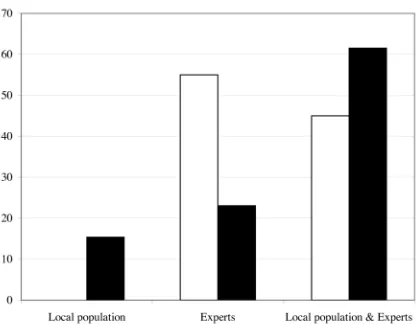
Finally, we analysed the characteristics of AM projects in the world according to general aspects of their method-ology. Most of the AM projects (70%) use active manage-ment, and the same pattern was found in both developed and developing countries. Also, monitoring processes were used in more than 90% of the AM cases in all countries. Modelling techniques were used in 65% of the AM projects, but preferably in developed countries (χ2 = 5.72, DF = 1, p < 0.02), where the percentage of their use reached 83% of the cases. When we analysed the participa-tion of local populaparticipa-tion and experts in the AM process, we found that in 51% of the study cases, both local popula-tion and experts intervened. Marginal differences between developed and developing countries were found (χ2 = 5.39, DF = 2, p < 0.1), as local population intervention was higher in developing countries while experts intervention was more frequent in developed ones (Fig. 3).
Discussion
The analysis of a series of AM cases from a global sample allowed us to obtain a general picture of what it is being performed in the world under the denomination of Adap-tive Management. In general terms, we can state that when we speak of AM we are referring to management models broadly used all over the world, covering all ecological do-mains but more frequently in the more populated areas. Also, AM projects are usually aimed at ecosystem manage-ment, conservation and restoration/mitigation practices. They mainly act upon forest or epicontinental water
eco-systems, and are motivated by a wide variety of circum-stances in which species exploitation stand out. In most cases these projects act at a local scale. Within our sample, most of the AM projects executed in developed countries take place in non-protected areas, while in developing countries many AM projects manage the diversity of pro-tected areas. From a methodological point of view, most AM cases use an active approach and monitoring pro-grams; the joint intervention of local population and ex-perts is widely used, but local population intervention alone is more frequent in the developing countries of our sample. Finally, modelling techniques are widely present, especially in the AM cases from developed countries. Most of the analysed cases were at the phase of problem identifi-cation, what may reflect the early stage in which AM prac-tices are at a global scale. Although some authors as Gregory (2006) have highlighted the multiple interpreta-tions of AM, our results show that implemented practices labelled as AM share a common methodological scheme, at least in the essential issues like monitoring, active man-agement approach, local population and experts participa-tion and modelling techniques.
The multivariate analyses of the cases under study also allowed us to identify the factors that most condition the type of AM that is being carried out. As Fig. 1 shows, the level of economic development of the countries seems to determine the profile of the AM implemented, so we can distinguish two major trends in the practice of AM in our global sample: whether applied in developed or in develop-ing countries. Anyway, these differences do not cancel the many similarities that, especially in the methodological as-pects, we have found in all AM cases, independently of the country where they were implemented.
The similarities found in the methodological features of AM applied all over the world are very important as they
guarantee a unique general scheme of application of this practice, no matter the geographical factor. For example, monitoring is considered an essential component in AM as it reduces the uncertainty in the management and permits to adjust it within an adaptive process. Also, participation of both local population and experts is well represented (Fig. 3), although the unique participation of experts is more common in developed countries and only local pop-ulation participation is more frequent in developing ones. Local participation is a crucial element in the practice of AM (Allen 1997, Allen et al. 2001, Shindler and Cheek 1999), and, as McLain and Lee (1996) state, the fluency of communication between scientific knowledge, politi-cians and management professionals should be promoted to design feasible management plans. The fact that the participation of the local population prevails in develop-ing countries may be due to the fact that AM in developed countries basically relies upon experts from State institu-tions, whereas in developing countries it is usually per-formed by foreign organizations that need to count on the local population to implement their projects. The only methodological feature in which we found significant dif-ferences between developed and developing countries in our sample was the use of modelling and potential scenar-ios techniques, significantly more widespread in devel-oped countries. The fewer financial and technological re-sources in developing countries, and the usually reduced knowledge of the environment where management is ap-plied to, may be the main reason for this difference. At this point, it is not easy to interpret the influence that this methodological difference may have on AM practice in both types of countries, especially if we consider the de-bate on the importance of modelling techniques in AM. In fact, some authors believe that modelling is a key ele-ment of AM that could be regarded as a methodological stage in itself (Horsfield 1998, Walters et al. 2000, Salaf-sky 2001).
Although we have observed a general application of AM in all the ecological domains as well as in developed and developing countries, we want to highlight the fact that no AM cases were found in Europe. This is probably due to the deeply-rooted tradition of land management in Europe (EUROPARC 2002), and to the need of managers to count on local populations due to the many natural sys-tems of high value inextricably linked to traditional uses (e.g. cereal steppe lands, or the open woodlands of south-ern European countries called ‘dehesas’ in Spain and ‘mon-tados’ in Portugal).
The greatest differences in the practice of AM between developed and developing countries of our global sample were obtained in the general context, the type of actors involved and some descriptive variables as referred in Table 2. In developed countries, AM is mainly directed to man-age natural and socio-economic systems, such as epiconti-nental waters (Gilmour et al. 1999, Walters et al. 2000, Irwin and Freeman 2002), public use in protected areas
(Lawson et al. 2003), and civil engineering works. Also, the reduction of pollution is another common reason for AM in developed countries, while in developing ones the practice is mainly motivated by the mitigation of environ-mental impacts associated with mining activities and by protected natural areas management (Fig. 2). These results may be the consequence of a complexity of factors related to the level of economic development of the countries, and also to the criteria used by those who fund and implement AM.
For developed countries, mainly placed in temperate latitudes, the quality and supply of water is of major scien-tific concern since the 1970s (Ongley 1996). Besides, peo-ple in developed countries usually have a high environ-mental awareness, love to visit protected areas and enjoy natural landscapes, so the issues related to the management of public use, pollution or environmental impacts of civil engineering are of foremost attention. In contrast, in coun-tries with fewer economic resources, mainly belonging to tropical areas, the management is primarily directed to the conservation of their extraordinary biodiversity (very often through the establishment of protected areas in forest eco-systems) and to the restoration of the environmental dam-age caused by the extractive activities of natural resources. In fact, we found that AM in protected natural areas is more frequent in developing countries than in developed ones. One striking issue is the practical absence of AM cas-es on aquatic ecosystems in developing countricas-es, consid-ering that the scarcity of drinking water is a major problem for the population in these countries, as the Millennium Development Goals pointed out (UN 2005). This shows that the implementation criteria of AM in developing countries are influenced by a vision in which conservation of the exuberant nature and the mitigation of environmen-tal impact derived from the exploitation of natural resourc-es are the prevalent criteria. This could be related to the kind of institutions that fund and implement AM projects in both types of countries.
countries the massive extraction of natural resources, es-pecially by mining activities, is mainly carried out by mul-tinationals, usually located in places of high ecological val-ue. In general, these multinationals are lobbied by conser-vational organizations from their own countries to carry out restoration and mitigation actions, or at least to fund them. This is not the case in developed countries, where the State is responsible for the management of the envi-ronment, the natural resources and the natural protected areas, and where most activities target public services (i.e. water supply and civil engineering works) rely on State funding.
Although we cannot extrapolate the results obtained from our global sample to the situation in all countries, we do notice an asymmetry between the AM objectives in de-veloping countries and their compelling environmental needs, especially with reference to water resources. In this sense, we suggest the use of criteria that are customized to the specific needs of the socio-economic reality of each country. This goal could be achieved through a greater col-laboration between scientists and managers of both types of countries that would allow the use of sophisticated eco-system management tools, bearing in mind the true needs of the local population.
The analysis of the present context in AM practice at a global scale has allowed us to identify its main trends and also some gaps that should be faced, mainly related to the management of some natural resources in developing countries. In spite of these “gaps”, we agree with Lee (1999) about the enormous possibilities that AM could offer to the sustainable development in developing coun-tries, providing them better life conditions for their people as well as efficient tools to combine development with eco-system conservation. It should not be forgotten that AM has been identified as a key tool for the Ecosystem Ap-proach strategy, adopted by the Convention on Biological Diversity for the correct management of natural resources (UNEP 2004). Nevertheless, if we consider that most AM cases were at the problem identification stage, we may con-clude that it is very important to monitor the results of this management practice at a global scale. This follow-up would tell us about the applicability and efficiency of AM to promote biodiversity conservation and sustainable de-velopment, as well as guarantee that AM is more appropri-ate to solve real problems in developing countries (includ-ing types of ecosystem or situations usually considered in developed countries, e.g. water management). All this would render Adaptive Management an even more adap-tive process.
Acknowledgements – NZC wants to thank the Spanish Agency for Development and Cooperation for providing financial support to this study through the MAE/AECI Grant entitled “Applica-tion of Adaptive Management to Protected Areas of Bioko, Equa-torial Guinea”. This study was also supported by the Spanish CICYT (grant REN2003-03989/GLO to MAR).
References
Allen, W. 1997. Improving the role of evaluation within natural resource management R&D programmes: the case for “learning by doing”. – Can. J. Dev. Stud. 18: 629–643. Allen, W. et al. 2001. Monitoring and adaptive management:
addressing social and organisational issues to improve infor-mation sharing. – Nat. Resour. Forum 25: 225–233. Armenteras, D. et al. 2003. Andean forest fragmentation and the
representativeness of protected natural areas in the eastern Andes, Colombia. – Biol. Conserv. 113: 245–256. Bailey, R. 1989. Ecoregions of the continents. – USDA Forest
Service.
Blom, A. et al. 2004. Status of the protected areas of the Central African Republic. – Biol. Conserv. 118: 479–487. BRASS/El Pilar Program 2002. Adaptive management in the
Maya forest, field report. – (<http://marc.ucsb.edu/elpilar/ brass/chron/fieldr/report02.pdf>).
British Columbia Forest Service 1996. Definitions of adaptive management. – (<http://www.for.gov.bc.ca/hfp/amhome/ AMDEFS.HTM>).
British Columbia Forest Service 1997. Introductory guide to adaptive management. – (<http://www.for.gov.bc.ca/hfp/ amhome/introgd/intro.htm>).
Bunch, M. 2000. An adaptative ecosystem management ap-proach to rehabilitation and management of the Coocum River environmental system of Chennai, India. PhD thesis. – Univ. of Waterloo, Canada.
Burgess, N. et al. 2005. Major gaps in the distribution of protect-ed areas for threatenprotect-ed and narrow range Afrotropical plants. – Biodiv. Conserv. 14: 1877–1894.
California Coastal Commission 2003. Procedural guidance for evaluating wetland mitigation projects in California´s coastal zone. – (<http://www.coastal.ca.gov/weteval/wetc.html>). Campbell, P. et al. 2002. Gabon Biodiversity Program:
Biodiver-sity research, monitoring and training in the Gamba com-plex, Gabon. – SI/MAB Ser. no. 3; Washington, DC, USA. Cantú, C. et al. 2004. Assessment of current and proposed nature reserves of Mexico based on their capacity to protect geo-physical features and biodiversity. – Biol. Conserv.115:411– 417.
Carpenter, S. et al. 1999. Ecological and social dynamics in sim-ple models of ecosystem management. – Conserv. Ecol. 3: 4 (<http://www.consecol.org/vol3/iss2/art4/>).
Comiskey, J. and Dallmeier, F. 2003. Adaptive management: a framework for biodiversity conservation in Takamanda For-est Reserve, Cameroon. – SI/MAB Ser. no. 8; Washington, DC, USA.
Committee on environmental and natural resources (CENR) 2000. Integrated assessment of hypoxia in the Northern Gulf of Mexico. – Natl Sci. Tech. Council Committee on Envi-ron. Natural Resour., Washington.
Costanza, R. et al. 1997. The value of the world’s ecosystem serv-ices and natural capital. – Nature 387: 253–260.
Dallmeier, F. et al. 2002. Planning an adaptive management process for biodiversity conservation and resource develop-ment in the Camisea River Basin. – Environ. Monit. Assess. 76: 1–17.
Dichmont, C. M. et al. 2006. Management strategies for short-lived species: the case of Australia’s northern prawn fishery: 1. Accounting for multiple species, spatial structure and imple-mentation uncertainty when evaluating risk. – Fish. Res. 82: 204–220.
EUROPARC-España 2002. Plan de Acción para los espacios nat-urales protegidos del Estado Español. – (<http:// www.europarc-es.org/intranet/EUROPARC/publicado/ publicaciones_Europarc-Espana/planaccion.pdf>). Gilmour, A. et al. 1999. Adaptive management of the water cycle
on the urban fringe: three Australian case studies. – Conserv. Ecol. 3: 11 (<http://www.consecol.org/vol3/iss1/art11/>). Gray, A. N. 2000. Adaptive ecosystem management in the Pacific
Northwest: a case study from coastal Oregon. – Conserv. Ecol. 4: 6 (<http://www.consecol.org/vol4/iss2/art6/>). Gregory, R. et al. 2006. Desconstructing adaptive management:
criteria for applications to environmental management. – Ecol. Appl. 16: 2411–2425.
Hering, K. 2003. A scientific formulation of tropical forest man-agement. – Ecol. Modell. 166: 211–238.
Holling, C. S. 1978. Adaptive environmental assessment and management. – Wiley.
Horsfield, R. 1998. Benchmarks for assessing environmental management practices against an “ideal” Adaptive Environ-mental Assessment and Management Protocol. – (<http:// www.gse.mq.edu.au/Research/adaptive/report1.htm>). Innu Nation 1995. Adaptive mismanagement proposed for
nitassi-nan forests. – (<http://www.innu.ca/adaptivemm.html>). Irwin, E. and Freeman, M. 2002. Proposal for Adaptive
Manage-ment to conserve biotic integrity in a regulated segManage-ment of the Tallapoosa River, Alabama, USA. – Conserv. Biol. 16:1212–1222.
Jepson, P. et al. 2002. A review of the efficacy of the protected area system of east Kalimantan Province, Indonesia. – Nat. Areas J. 22: 28–42.
Johnson, F. and Williams, K. 1999. Protocol and practice in the adaptive management of waterfowl harvests. – Conserv. Ecol. 3: 8 (<http://www.consecol.org/vol3/iss1/art8/>). Karnella, C. et al. 2003. Adaptive management of monk seals in
the main Hawaiian Islands. Workshop on the management of Hawaiian monk seals on beaches in the main Hawaiian Islands. Final report. – Mar. Mamm. Commission Natl Mar. Fish. Service Hawaii Div. Aquat. Resour. USA, pp. 1–22. Latif Khan, M. et al. 1997. Effectiveness of the protected area
network in biodiversity conservation: a case-study of Megha-laya state. – Biodiv. Conserv. 6: 853–868.
Lawson, S. et al. 2003. Proactive monitoring and adaptive man-agement of social carrying capacity in Arches National Park: an application of computer simulation modelling. – J. Envi-ron. Manage. 68: 305–313.
Lee, K. N. 1999. Appraising adaptive management. – Conserv. Ecol. 3: 3 (<http://www.consecol.org/vol3/iss2/art3/>). Lynam, T. 1999. Adaptive analysis of locally complex systems in a
globally complex world. – Conserv. Ecol. 3: 13 (<http:// www.consecol.org/vol3/iss2/art13/>).
Lynam, T. et al. 2002. Adapting science to adaptive managers: spidergrams, belief models, and multi-agent systems model-ling. – Conserv. Ecol. 5: 24 (<http://www.consecol.org/vol5/ iss2/art24/>).
McCune, B. and Mefford, M. J. 1999. PC-ORD multivariate analysis of ecological data, ver. 4.25. – MjM Software, Gleneden Beach, Oregon, USA.
McGinley, K. and Finegan, B. 2003. The ecological sustainability of tropical forest management: evaluation of the national for-est management standards of Costa Rica and Nicaragua, with emphasis on the need for adaptive management. – For. Policy Econ. 5: 421–431.
McLain, R. J. and Lee, R. G. 1996. Adaptive management: promises and pitfalls. – Environ. Manage. 20: 437–448. Merenlender, A. et al. 1998. Monitoring impacts of natural
re-source extraction on lemurs of the Masoala Peninsula, Mada-gascar. – Conserv. Ecol. 2: 5 (<http://www.consecol.org/ vol2/iss2/art5/>).
Nyberg, B. 1999. An introductory guide to adaptive manage-ment for project leaders and participants. – BC Forest Serv-ice, Canada.
Oldfield, T. et al. 2004. A gap analysis of terrestrial protected areas in England and its implications for conservation policy. – Biol. Conserv.120: 303–309.
Ongley, E. D. 1996. Control of water pollution from agriculture. FAO irrigation and drainage paper 55. – FAO, UN, Rome ( < h t t p : / / w w w . f a o . o r g / d o c r e p / W 2 5 9 8 E / w2598e00.htm#Contents>).
Pinkerton, E. 1999. Factors in overcoming barriers to imple-menting co-management in British Columbia salmon fisher-ies. – Conserv. Ecol. 3: 2 (<http://www.consecol.org/vol3/ iss2/art2/>).
Powell, G. et al. 2000. Assessing representativeness of protected natural areas in Costa Rica for conserving biodiversity: a pre-liminary gap analysis. – Biol. Conserv. 93: 35–41. Salafsky, N. et al. 2001. Management effectiveness initiative.
Adap-tive management: a tool for conservation practitioners. – WCPA-Marine/WWF MPA (<http://effectivempa.noaa.gov/ docs/adaptive.pdf>).
Shindler, B. and Cheek, K. A. 1999. Integrating citizens in adap-tive management: a propositional analysis. – Conserv. Ecol. 3: 9 (<http://www.consecol.org/vol3/iss1/art9/>).
Smithsonian Institution 2003. Monitoring and assessment of bi-odiversity program. – (<http://nationalzoo.si.edu/Conserva-tionAndScience/MAB/>).
Statsoft. Inc. 2003. STATISTICA (data analysis software system) ver. 6. – (<http://www.statsoft.com>).
Struhsaker, T. et al. 2005. Conserving Africa‘s rain forests: prob-lems in protected areas and possible solutions. – Biol. Con-serv. 123: 45–54.
Sunderland, T. et al. 2003. Future conservation and management of the Takamanda Forest Reserve, Cameroon. – SI/MAB Ser. no 8; Washington, DC, USA.
The Seal of Pima County 2001. The role of adaptive manage-ment in the Sonoran Desert Conservation Plan. – (<http:// www.pima.gov/cmo/sdcp/reports/d9/011ROL.PDF>). IUCN 1994. Guidelines for protected areas management
catego-ries. – IUCN, Cambridge, UK.
Toledo, V. M. et al. 2003. The multiple use of tropical forests by indigenous peoples in Mexico: a case of adaptive manage-ment. – Conserv. Ecol. 7: 9 (<http://www.consecol.org/vol7/ iss3/art9>).
UN 2005. The millennium development goals report. – UN Dept of Public Inf. DPI/2390, New York.
UNDP 2002. Human development report 2002. – Oxford Univ. Press.
US Forest Service 2003. – FEIS Adaptive Management Strategy 4, Appendix E-i.
Walters, C. J. and Holling, C. S. 1990. Large-scale management experiments and learning by doing. – Ecology 71: 2060– 2068.
Walters, C. 1997. Challenges in adaptive management of ripari-an ripari-and coastal ecosystems. – Conserv. Ecol. 1: 1 (<http:// www.consecol.org/vol1/iss2/art1/>).
Walters, C. et al. 2000. Ecosystem modelling for evaluation of adaptive management policies in the Grand Canyon. –
Conserv. Ecol. 4: 1 (<http://www.consecol.org/vol4/iss2/ art1/>).
Wilkie, D. et al. 2001. The under-financing of protected areas in the Congo Basin: so many parks and so little willingness-to-pay. – Biodiv. Conserv. 10: 691–709.