Vol.8 (2018) No. 4
ISSN: 2088-5334
Extending Interactive Electronic Maintenance Manual with
Web3D Technologies
Agus Sutanto
#, Muhammad Ihsan
#, Ismet Hari Mulyadi
# #Mechanical Engineering Department, Faculty of Engineering, Andalas University Email: [email protected], [email protected], [email protected]
Abstract— Rapid developments in Information and Communication Technology have revealed some opportunities for supporting a complete product lifecycle of the fabrication facilities, particularly for maintenance purposes. The complexity of mechanical procedures, as well as their perceptions, has challenged engineers to create more effective and interactive maintenance manual. Therefore, this paper proposes an advanced electronic maintenance manual with the interactive 3D visualization by using the latest Web3D technologies. The advantage of this method is the visual and three-dimensional explanations delivered in the maintenance manuals. This method will extend the traditional work instructions into an interactive electronic maintenance manual. The standard module which involves Cortona3D software is processed by preparation of 3D CAD data format from fabrication facilities. Then this process continues with the addition 3D animation with related texts through the maintenance operations and converting the modified 3D data into VRML format which enables accessible through the Web. The result is an interactive and on-demand electronic maintenance manual which allows users to communicate maintenance problems. The assessment concludes that the 3D maintenance manual will improve an intuitive interface and information retention, encourage visual knowledge and minimize ambiguity.
Keywords—interactive electronic maintenance manual; 3D CAD; Web3D; VRML
I. INTRODUCTION
In the product lifecycle beginning with research till the end of product life, several technical manuals such as product maintenance and repair manual, troubleshooting manual, work instruction, operating manual are unavoidable. This manual is used by a relating participant in research and development, manufacturing, and assembly as well as operational and service. The clarity and no ambiguity is one of the essential features of the technical manual in order to
get a better understanding between corresponding
stakeholders. Presently, the traditional technical manual and work instruction is performed mostly in textual descriptions and hard copies. Most of the textual manuals are becoming uninteresting, monotonous and tedious for users to understand, particularly the difficulties in communicating the complicated procedures. To improve the deficit in the traditional technical manual, visualization and digitization incorporated with exploitative documents in electronic form are one of the effective and efficient solutions [1] – [3]. Albert Einstein said, “If I cannot pictures it, I cannot understand it.” At the moment, there is no technological constraint to create such as the Interactive Electronic Technical Manual (IETM). Most of the latest technology for IETM is supportable and available. To improve the maintenance process of modern equipment, Gao [4] has designed and implemented the IETMs based on CAD.
Artamonov [5] applies virtual reality to design IETM and another training system. Worldwide leading providers of product lifecycle management such as PLM Software by Siemens, Dassault Systemes, and Simatic PTC also provide
product documentation and technical information
incorporated with 3D interactive visualization by using their data format [6], [7].
At the present times, the accelerating growth of automation and the disadvantage of excessive downtimes in mechanical equipment have prompted the importance of interactive electronic maintenance manual. 3D CAD plus internet capabilities, also called Web3D is an advanced Web technology which delivers a next-generation revolution in technical documents and manual. IETM can be created more visual and more effective with collaborative character while it is used. The three-dimensional models that have been created in the design stage can be further utilized for operational and maintenance purposes in the product lifecycle, especially in the form of an interactive maintenance manual [8], [9].
This paper proposes an extending IETM for maintenance purposes by using latest Web3D technologies. Utilizing this advanced technology, the interaction between the user and the maintenance manual becomes more interactive and intuitive (in computer software means easy to use and understand). As a result, many engineers are challenged to be updated with the latest development of Web-based 3D
technologies and take advantage of these enhanced techniques. Thus it can be expected that maintenance activity by using 3D interactive electronic manual become a solution for more effective and efficient maintenance processes.
Ensuring of the maintenance is as cost-effective and efficient as possible, Aha [10] suggested that detailed information concerning breakdowns in a particular part of fabrication facilities must be obtained, including other supporting information. Once this information is collected, savings in maintenance processes can be realized. Applying of advance Web3D technologies is also designed to support engineers engaging in a collaborative virtual environment over the Internet. This virtual space enables participants or maintenance practitioners to collaborate, share and retrieve on-demand maintenance manual for a rapidly accessible decision-support of the maintenance activities. It also facilitates access that can be done whenever and wherever, thus allow the mechanical maintainer is learning the maintenance problems more effectively.
Extending the IETM with animated 3D simulations and other features combined with maintenance instructions will communicate complex mechanical procedures for the user. The knowledge transformation by using extending 3D manual becomes better than reading the textual manual. The users can navigate the product three-dimensionally, view it from different angles, and play through simulation to obtain an intuitive understanding of the maintenance processes. The manual is expected to minimize the ambiguity or not to open more than one interpretation. The manual with animated 3D visualization also can help users to memorize the sequences in the short time and able to recall the sequences after a few moments later (retention of information). Therefore, an interactive technical maintenance manual based on Web3D technologies is undoubtedly required for maintenance purposes.
II. MATERIAL AND METHOD
A. Web3D and Software
The trend in the maintenance manual has been escalating from an offline and book manual to an interactive electronic maintenance manual [11]. It happens due to the advanced development in computer graphic, software and multimedia contents such as audio, video, and images. In addition, advanced 3D content over the Internet also called Web3D
(http://www.web3d.org) can change the technical
instructions more interactive and useful as stated by Ottoson [12], Kaiyu [13] and also Kamsa [14] for the case of a distance learning system. Web3D describes all standard forms of the Internet 3D currently VRML and X3D. These technologies, in cooperation with other embedded 3D technology such as 3D streaming, MPEG-4/BIFS, and Java 3D, comprise the subject matter of the Web-based 3D technologies, which enable collaborative engineering over the Internet [15]. The Web3D Consortium in conjunction with other organizations is working towards Web3D technologies which are interoperable with other existing Web infrastructure technologies.
The Virtual Reality Modelling Language (VRML) which promoted by the Web3D Consortium contains the readable
source codes written in plain ASCII text files. They are save in the .wrl extension (.wrl is short for the world). The source codes in the VRML files consists of many structured nodes which will create the complex 3D objects. VRML worlds can be loaded directly into a Web browser (e.g., Internet Explorer). Alternately, VRML worlds can be woven into HTML Web pages by using the OBJECT elements [16]. X3D, which stands for "Extensible 3D", is the next generation of VRML and an open standard for 3D content on the Web. In essence, X3D is intended to be the new format or language that is used for 3D interactive worlds on the Web as an extending of the VRML standard [17]. It will be the ISO standard for 3D graphics. This language is very robust, powerful and supports generalized 3D content for visual effect and interactive Web. Most important, the X3D file is encoded in Extended Markup Language (XML), so that it has been extended to make X3D more flexible than its predecessors. Another important feature, X3D is to become the standard for 3D content in other multimedia technologies.
There is some software, such as BS Contact, Octaga, and Cortona3D, which support Web3D technologies to visualize interactive 3D CAD models using VRML or X3D format.
Bitmanagement Software develops BS Contact
(www.bitmanagement.com) as the core product of a visualization platform. This software has a capable online viewer offering full 3D interactivity. BS Contact supports both of VRML and X3D format and embeds in a web browser on DirectX or OpenGL. Octaga (www.octaga.com) is another Web3D software developed by Octaga Visual Solutions. Octaga supports only X3D format for interactive 3D presentations. It has broad support for integration of other multimedia content such as audio, video, and images. Cortona3D (www.cortona3d.com) which developed by Parallel Graphics supports only VRML format to visualize an interactive 3D models over the Web.
In this work, it is used Cortona3D software to produce 3D Interactive Electronic Technical Manuals (IETMs) for operations, service, and maintenance or repair purposes. By using the authoring toolkits called Rapid Author and Rapid Manual, the user can develop animated 3D simulations through the maintenance processes such as loosen/ tighten or disconnect/connect operations.
B. Method
1) Preparation of 3D CAD model: Availability of the 3D CAD model from fabrication facilities is the primary
requirement for creating an interactive electronic
maintenance manual. 3D CAD model could come from the enterprise which is generated at the design stage as reuse of existing resources or the new created 3D CAD models. These fabrication facilities models should be in assembly data format, which is composed of several single part data format. The primary consideration to prepare the 3D CAD model is the format compatibility. The available formats listed in the supporting data should be checked to ensure the compatibility of 3D CAD import formats. The 3D CAD models can originate from several 3D CAD providers, which possess difference data format and file extension such as.IAM for Inventor, ASM for Pro/Engineer, JT for Siemen and.SLDASM for SolidWorks.
Fig. 1 Conversion of 3D CAD data from the different format
In case of 3D CAD assembly data generated using Autodesk Inventor software, then the data must be exported into .product file extension, which is a file format of CATIA
(Computer Aided Three-dimensional Interactive
Application) software. Data conversion from the 3D model in Inventor to the data which can be worked in Cortona3D software is shown in Fig. 1.
2) Generating Interactive Features and Documents: At this stage, the imported 3D CAD data is modified on Rapid Manual (3D Cortona software). The steps will be carried out as follow: (1) to set the scenes effect and (2) to create 3D procedural information and animation. All modifications on 3D items can be done by applying corresponding commands to the selected 3D items. It is aimed for enhancing the attractiveness and procedural information of the animated 3D maintenance manual. At the end of this step is the creation of the 3D CAD data with interactive features and documents into VRML format by using Cortona3D Rapid Manual. In this stage, the files of animated 3D CAD data will be converted in VRML file format (.wrl). Viewing the converted file on a Web browser should be clicked on the selected folder. When it is already opened on the Web browser, there will be player control and some navigational tools enabling users to operate the 3D manual and view it from different viewing angles interactively.
3) Testing and Assessment: Once the program (a package of the specific maintenance manual) has been completed, then it should go through a functionality test in order to find out the weakness or lack of the manual, and repair them if any. It is expected that the result obtained by the existing maintenance procedures in the company. The program should be run by using a Web browser (e.g., IE) to view the functionality of the virtual manual. If the test of the 3D maintenance manual contains specific errors, then the editing process on the software should be carefully readjusted. The finishing process is the final step for generating an interactive 3D maintenance manual.
In order to evaluate whether an extending electronic maintenance manual with Web3D content delivers more effective and efficient understanding than the traditional one, an assessment process should be performed on the users. The assessment is conducted by using a rubric with some criteria. Specific questions with different rating score were specified based on the information provided in the maintenance manual.
III. RESULT AND DISCUSSION
In this chapter, the results of an interactive and 3D maintenance manual are presented and discussed. A case example for oil filling machine is given. The assessment of the 3D maintenance manual then is performed.
A. Manual Result
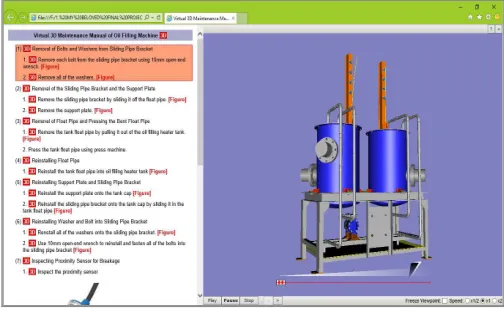
Web3D maintenance manual provides two distinctive features, which enable users to find maintenance procedures in a text document and 3D visualization all at once. The user can navigate the fabrication facilities by rotating, zooming, and viewing them from different angles. Another possibility is the 3D manual procedure can be played, paused and skipped through simulation as the textual description of the procedure step is highlighted. It can deliver an intuitive understanding for the user. It also allows users to open any steps what they want to see by clicking on the red 3D option in each step. When the users open this program, there will only be text document section on the left side. To view 3D visualization, the user has to click on the red 3D option right next to the title of this program as shown in Fig. 2. Additionally, if the users want to find this machine’s part description, they can just click on the figure on the left side of the screen depending on where the position of the part they try to search for.
Fig. 2 Result of the web-based 3D maintenance manual
B. A case example
The mechanical equipment selected as a case example for interactive maintenance manual is an oil filling machine. This machine consists of multiple components used for filling oil into car’s engine. Principally, this machine stores the oil in the logistic tank, which is connected to an air-operated double diaphragm pump. This pump function is to pressure the oil up into the tank heater. When the oil enters the tank heater, it will be heated and stored until it is ready to use. This tank heater is equipped with a proximity sensor, which is mounted on top of the tank heater. The sensor is used to detect whether the oil in tank heater is full or not. In this case, when the user of this machine is filling the oil into the engine tank, but he found that the hose supply is empty and the proximity sensor shows that the tank float pipe is still in proper position; it indicates that the oil filling machine needs maintenance. Based on this condition, a
maintenance division should investigate to find out the problem. A technician should remove the proximity bracket and tank float pipe as well as inspect the proximity sensor. When it is found that the proximity sensor still does not show any sign, it signifies that the sensor is failing or defective, which requires a replacement. The maintenance process which will be carried out to resolve the breakdown problem is demonstrated in the following three-dimensional interactive electronic maintenance manual by the following steps.
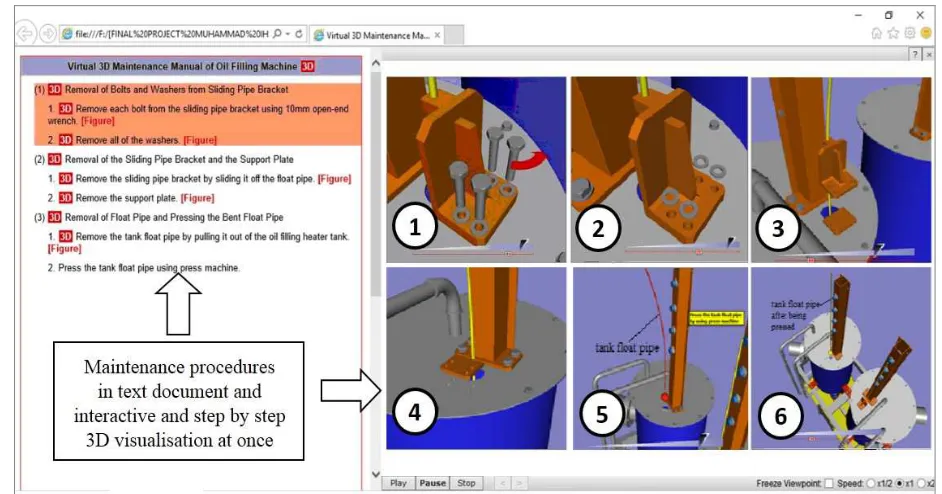
a) removal of proximity bracket and tank float pipe. This maintenance procedure which is shown in Fig. 3 are visualized interactively with animated motions and other features as following steps:
1. Rotate the bolts out by using 10 mm open-end wrench (No.1), and remove 4 washers from sliding pipe bracket (No. 2)
2. Disconnect the sliding pipe bracket by sliding it off the float pipe (No. 3) as well as remove the support plate (No. 4)
3. Remove of tank float pipe and press the bent tank float pipe. Once the bent tank float pipe is pulled out of the oil filling heater tank, then use press machine to straighten the bent tank float pipe. The illustration of the tank float pipe before and after being pressed is shown in Fig. 3 No. 5 and 6 respectively.
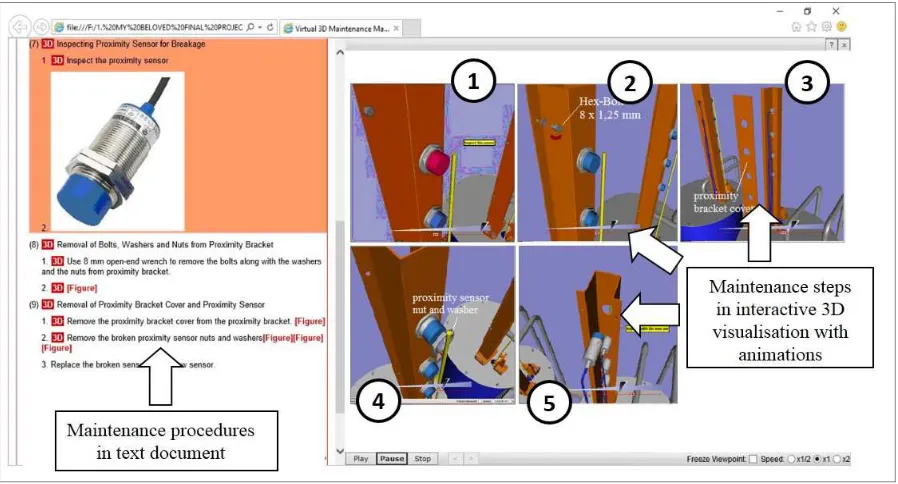
b) removal of the proximity sensor. This maintenance procedure is shown in Fig. 4 is played interactively through simulation as follow:
1. Inspect the proximity sensor. Before refilling oil into the tank, it should be ensured that the equipment installed in the machine works correctly. After the tank float pipe pressed and reinstalled, the sensor may be still unable to detect it. Consequently, an inspection should be performed on the proximity sensor to find out whether the device is working correctly. If the sensor output is existence (on), when the tank float pipe is placed in front of the sensor, then it indicates that the sensor works correctly. Otherwise, it is considered that the sensor is defective. The solution is the replacement of the proximity sensor with a new one. The inspection process is shown in Fig. 4 No.1.
2. When the failure on proximity sensor is confirmed, use 8 mm open-end wrench to remove the bolts along with washers and nuts from proximity bracket (No. 2)
3. It is now possible to remove the proximity bracket cover from the proximity bracket (No.3)
4. Remove the sensor nuts and washers and replace the broken proximity sensor (No. 4)
5. Install the new sensor and its harness into the proximity bracket (No.5)
Fig. 3 Removal of proximity bracket and tank float pipe
C. Assessment
An assessment is performed to evaluate whether the extending maintenance manual with Web3D technologies is an efficient and practical manual for training or learning purposes. The assessment process involves an assessment rubric (Table 1) with the following criteria: (1) visual know-how, (2) accurate and unambiguous technical translation,
and (3) information retention. The first criterion means that the manual provides interaction technically with 3D images and navigation ability (rotate, zoom, view from different angles) to gain an intuitive understanding of the procedures. The second criterion means that the manual brings an accurate understanding and technically not open to more than one interpretation
.
Fig. 4 Removal of the proximity sensor
TABLE I ASSESSMENT RUBRIC
Criteria Score : 4 Score : 3 Score : 2 Score : 1
Criterion 1: Visual know-how
The user can adequately describe the procedure with similar motions or tools, how to remove and install a simple mechanical facility sequentially.
User mostly describes the procedure with similar motions or tools, how to remove and install a simple mechanical facility in sequences.
User partially describes the procedure with related motions or tools, how to remove and install a simple mechanical facility.
The user cannot describe the procedure with similar motions or tools, how to remove and install a simple mechanical facility in sequences.
Criterion 2: Accurate and unambiguous
technical translation
The user can clearly explain maintenance procedures accurately and not open more than one interpretation.
The user can explain maintenance procedures with enough accuracy and not open more than one interpretation.
The user can explain maintenance procedures with less accuracy but relatively ambiguous.
The user cannot explain maintenance procedures accurately and open more than one interpretation.
Criterion 3: Information retention
The user can retain all about product information and can recall the maintenance sequences entirely after a few days later.
The user can retain most of the product information and can recall the maintenance sequences partially after a few days later.
The user can retain a part of product information and can recall the maintenance sequences generally after a few days later.
The user cannot retain most of the product information and is not able to recall the maintenance sequences generally after a few days later.
Overall Rating Excellent Good Fair Poor
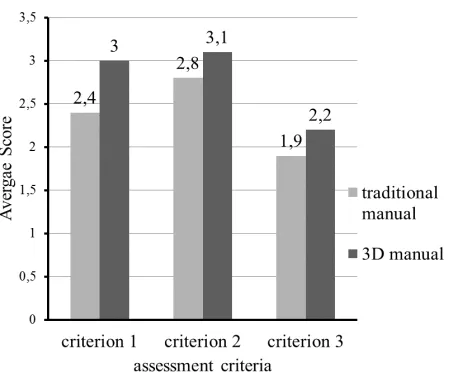
The third criterion examines whether the information received from the manual can maintain or retain in the user’s memory during the duration of time. The three criteria are tested by using two different groups often mechanical engineering students which is at the same level. The first group uses traditional manual (with figures) and the second group practices the 3D interactive manual. The assessment result is shown in Fig. 5.
The result indicates that the average score of the interactive maintenance manual with Web3D technologies (called 3D manual) is higher than the traditional one, for all
assessment criteria. A significant difference is found in criterion 1 visual know-how. This finding correlates with Setchi [18] and Ahmad [19] who states that hypermedia for maintenance manual will improve visual knowledge that impacts on a better understanding. Colaso [20] had compared the effect of visualization, text and mixed method toward information retention. He found the similar effect with this result, where visualization with animations and texts will improve information retention.
Fig. 5 Assessment result
The result indicates that the average score of the interactive maintenance manual with Web3D technologies (called 3D manual) is higher than the traditional one, for all assessment criteria. A significant difference is found in criterion 1 visual know-how. This finding correlates with Setchi [18] and Ahmad [19] who states that hypermedia for maintenance manual will improve visual knowledge that impacts on a better understanding. Colaso [20] had compared the effect of visualization, text and mixed method toward information retention. He found the similar effect with this result, where visualization with animations and texts will improve information retention.
IV.CONCLUSIONS
3D CAD models of fabrication facilities which have been produced in the design stage can be optimally used for other purposes in Product Lifecycle Management (PLM), especially for maintenance purposes. This work reuses of those 3D CAD data of oiling filling machine and then modifies them into an interactive electronic maintenance manual by using the latest Web3D technology. Cortona3D and its VRML authoring toolkit will transform the data into a standard module which provides maintenance operations in two distinctive features described in texts and animated 3D visualizations all at once. The combined method will bring an intuitive understanding for the user. The assessment result shows that the 3D manual will improve the visual know-how better than the traditional one. By using interactive and 3D animated manual, the user can explain maintenance procedure with more accuracy and not open more than one interpretation. In addition, the assessment also states that the interactive 3D maintenance manual will improve the information retention rather than a traditional module.
ACKNOWLEDGMENT
The authors gratefully acknowledge the financial support by the Engineering Faculty, Andalas University by using
PNBP Research Publication Funding Scheme with the contract No. 022/UN.16.09.D/PL/2017.
REFERENCES
[1] V. R. Tuktamyshev, D.A. Glukhov, and Y. Kataev, “About the use of interactive electronic technical manuals for the machine builder,” In Procedia Engineering 129, pp. 380 – 384, 2015.
[2] A.K. Verma, A. Srividya, and P.G. Ramesh, “A systems approach to integrated E-maintenance of large engineering plants,” International Journal of Systems Assurance Engineering and Management, 1(3), 239-245, 2010.
[3] E. Levrat, B. Iung, and A.C. Marquez, “E-maintenance: Review and conceptual framework,” Production Planning and Control, Vol. 19 No.4, pp. 408-429, 2008.
[4] Z, Gao, and Y. Zhang, “Design and implementation of the interactive electronic technical manual of class 4 based on CAD,” Journal of Computer Applications, 2009.
[5] E.I. Artamonov, A.V. Balabanov, and V.A. Romakin, “Structured design of interactive electronic technical manuals based on virtual reality means,” In Proceeding of 7th IFAC Conference on Manufacturing Modelling, Management, and Control, pp 1115-1119, 2013.
[6] K. Alexopoulos, S. Makris, V. Xanthakis, and G. Chryssolouris, “A web-services oriented workflow management system for integrated digital production engineering,” CIRP Journal of Manufacturing Science and Technology, Vol. 4 Issue 3, pp. 290-295, 2011. [7] A. Sutanto, Solution Approaches for Planning of Assembly Systems
in Three-Dimensional Virtual Environments. Bamberg: Meisenbach, 2005.
[8] L. Chittaro and R. Ranon, “Web3D technologies in learning, education, and training: motivation, issues, opportunities,” Computer & Education, Vol. 49 Issue 1, pp. 3-18, 2007.
[9] F. Di Cerbo, G. Dodero, L. Papaleo. “Integrating a Web3D interface into an e-learning platform,” In Proceeding of the 15th International Conference on Web 3D Technology, pp. 83-92, 2010.
[10] U. Aha, A. Findeisen, and H. Krautz, “Maintenance optimization for large coal-fired power plants,” In Proceeding of the 1st International Congress on e-Maintenance, pp. 1-4, 2010.
[11] R.M. Greenough, and B. Tjahjono, “An interactive electronic technical manual for an advanced aerospace assembly machine,” The International Journal of Advanced Manufacturing Technology, Vol. 33, No. 9, pp. 1045–1055, 2007.
[12] P. Ottoson, “Three-dimensional visualization on the internet,” In M.P. Peterson (ed.) Maps and the Internet, Amsterdam, Cambridge: Elsevier Press, pp. 247-270, 2003.
[13] D. Kaiyu, L. Yinsheng, J. Han, L. Xiaohua, and Z. Shensheng, “An interactive web system for integrated 3D customization,” Computers in Industry Vol. 57, Issues 8–9, pp. 827-837, 2006.
[14] I. Kamsa, R. Elouahbi, and F.E. Khoukhi, “Using the intelligent agents for planning the planning the learning time in a distance learning system,” International Journal on Advanced Science, Engineering and Information Technology, Vol.7 No. 3, pp. 754-760, 2017.
[15] H. Xiong and S. Sun, “ A distributed collaborative product customization system based on Web3D,” In Proceeding of 11th International Conference on Computer Supported Cooperative Work in Design, 2007.
[16] H.J. Jung, “Virtual Reality Modelling Language,” Teaching English with Technology, Vol. 2 No. 5 pp.54-61, 2002.
[17] D. Brutzman and L. Daly, X3D: Extensible 3D graphics for web author, Morgan Kaufman Publisher, 2007.
[18] R. Setchi and D. White, “The development of hypermedia maintenance manual for an advanced manufacturing company,” International Journal of Advanced Manufacturing Technology, Vol. 22 Issue 5, pp. 456-464.
[19] K.B. Ahmad, M. Ahmad, and M.M. Rejab, “ The influence of knowledge visualization on externalizing tacit knowledge,” International Journal on Advanced Science, Engineering and Information Technology, Vol.1 No. 2, pp. 124-128, 2011
[20] V. Colaso, A. Kamal, P. Saraiya and C. North, “Learning and retention in data structures: A comparison of visualization, text and combined methods,” In Proceeding of World Conference on Educational Media and Technology, 2002.