R E S E A R C H
Open Access
PCR-based specific techniques used for detecting
the most important pathogens on strawberry:
a systematic review
Seyed Mahyar Mirmajlessi
1*, Marialaura Destefanis
2, Richard Alexander Gottsberger
3, Marika Mänd
4and Evelin Loit
1Abstract
Background:Strawberry diseases are a major limiting factor that severely impact plant agronomic performance. Regarding limitations of traditional techniques for detection of pathogens, researchers have developed specific DNA-based tests as sensitive and specific techniques. The aim of this review is to provide an overview of polymerase chain reaction (PCR)-based methods used for detection or quantification of the most widespread strawberry pathogens, such asFusarium oxysporumf.sp.fragariae,Phytophthora fragariae,Colletotrichum acutatum,Verticillium dahliae,Botrytis cinerea,Macrophomina phaseolina, andXanthomonas fragariae. An updated and detailed list of published PCR protocols is presented and discussed, aimed at facilitating access to information that could be particularly useful for diagnostic laboratories in order to develop a rapid, cost-effective, and reliable monitoring technique.
Methods:The study design was a systematic review of PCR-based techniques used for detection and quantification of strawberry pathogens. Using appropriate subject headings, AGRICOLA, AGRIS, BASE, Biological Abstracts, CAB Abstracts, Google Scholar, Scopus, Web of Knowledge, and SpringerLink databases were searched from their inception up to April 2014. Two assessors independently reviewed the titles, abstracts, and full articles of all identified citations. Selected articles were included if one of the mentioned strawberry pathogens was investigated based on PCR methods, and a summary of pre-analytical requirements for PCR was provided.
Results:A total of 259 titles and abstracts were reviewed, of which 22 full texts met all the inclusion criteria. Our systematic review identified ten different protocols forX. fragariae, eight forP. fragariae, four forB. cinerea, six forC. acutatum, three forV. dahlia, and only one forF. oxysporum. The accuracy and sensitivity of PCR diagnostic methods is the focus of most studies included in this review. However, a large proportion of errors in laboratories occur in the pre-analytical phase of the testing process. Due to heterogeneity, results could not be meta-analyzed.
Conclusions:From a systematic review of the currently available published literature, effective detection assays to detect the major strawberry pathogens have been developed. These assays can function as a basis for clinical labs, regulatory personnel, and other diagnosticians to adapt or implement for detection of these six important strawberry pathogens.
Keywords:Molecular diagnostic methods, PCR-based techniques, Strawberry pathogen detection, Systematic review
* Correspondence:[email protected]
1Department of Field Crops and Grassland Husbandry, Institute of
Agricultural and Environmental Sciences, Estonian University of Life Sciences, Tartu, Estonia
Full list of author information is available at the end of the article
Background
Strawberry (Fragaria×ananassa) is one of the world’s most commercially important fruit crops [1]. It was estimated that the global strawberry production in 2012 was 4,516,810 tons, according to Food and Agriculture Organization (FAO) statistics [2]. Strawberry diseases are a major limiting factor that severely impact the plant agronomic performance and lead to economic losses. Moreover, most strawberry cultivars are highly susceptible to several destructive and economically im-portant pathogenic fungi and bacteria such asFusarium oxysporum f.sp. fragariae, Phytophthora fragariae, Colletotrichum acutatum,Verticillium dahliae, Botrytis cinerea, Macrophomina phaseolina, and Xanthomonas fragariae[3,4].
Early, rapid, and specific detection and identification of plant pathogens is essential for effective plant disease man-agement [5]. Without specific disease diagnosis, proper control measures cannot be used at the appropriate time [6]. Conventional methods to detect and identify pathogens have often relied on isolating the pathogen onto selective media or through biochemical, chemical, and immuno-logical analyses [7]. These methods are fundamental to diagnose the presence of plant pathogens, but they rely on time-consuming and labor-intensive lab techniques and on skilled taxonomical expertise [8]. Molecular-based tech-niques can overcome many of the shortcomings of the conventional assays, especially if they rely on polymerase chain reaction (PCR) assays. PCR-based assays are gener-ally more specific and much faster than conventional techniques [5,9]. Moreover, these techniques can also be applied on non-culturable microorganisms, as the or-ganism does not need to be isolated to be identified by PCR [10]. An increasing amount of diagnostic methods recommended by the European and Mediterranean Plant Protection Organization (EPPO) are based on PCR assays [11,12]. This technique is nowadays considered a routine technique in molecular diagnosis.
Plant disease management necessitates the need to re-duce the spread of the pathogen. The extent in the optimum implementation of control strategies depends not only on the presence of a pathogen but also on the pathogen inoculum load. Thus, the capability of quantify-ing the pathogen load represents an important aspect of plant disease management [13]. Quantification based on culturing techniques is considered relatively nonspecific, while quantification using PCR techniques, in particular real-time PCR (rtPCR), provides a reliable estimation of the pathogen load. Unlike end-point PCRs, rtPCRs allow the detection of amplification products while the reaction is taking place, i.e., during each PCR cycle. Template quantification is highly specific because it as-sesses during the exponential phase of the reaction [9,14]. Nowadays, a wide range of plant pathogens can
be detected and quantified by PCR-based methods in numerous hosts or environmental samples [11,15].
The necessity of fast, sensitive, and specific methods to detect pathogen is important to improve decision making in disease control. So, the primary objective of this review is to provide an exhaustive overview of the existing scientific literature available on PCR-based diag-nostic techniques that is restricted to the detection and quantification of the seven most abundant strawberry pathogens: F. oxysporum f.sp. fragariae, P. fragariae, C. acutatum,V. dahliae, B. cinerea, M. phaseolina, andX. fragariae. A secondary objective is to determine the pre-analytical requirements of PCR assays (such as sample preparation of target pathogens and treatments prior to amplification). Finally, this compilation intends to pro-vide an updated list of published PCR protocols for de-tection and quantification of strawberry pathogens with the aim of establishing a common diagnostic PCR based-method for routine testing by looking at the factors that affect the efficiency of the different test formats and com-paring their performance in pathogen detection in plant material and soil.
Methods
Search strategy
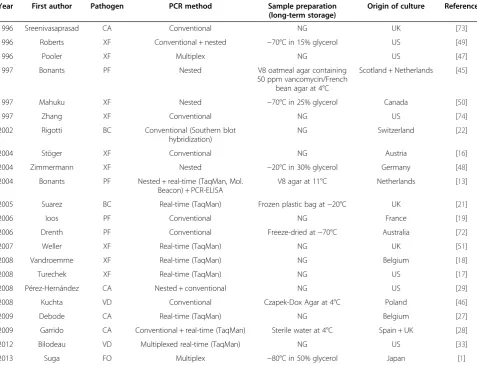
In line with our experimental design, only relevant scien-tific papers published any time before 1 April 2014 and in the English language in a peer-reviewed journal were taken into consideration. The search was extended to li-braries, such as AGRICOLA, AGRIS, BASE, Biological Abstracts, CAB Abstracts, Google Scholar, Scopus, Web of Knowledge, Science Direct, and SpringerLink, using the following identifiers: “PCR”, “molecular diagnostic”, “F. oxysporum f.sp. fragariae”, “P. fragaria”, “C. acutatum”, “V. dahliae”,“B. cinerea”,“M. phaseolina”, and“X. fragar-iae”. All associated terms were combined using“OR”and then“AND” to yield a total number of abstracts for each database (see Additional file 1). Two assessors (SMM, EL) independently reviewed the titles and abstracts of all iden-tified citations. Results were limited to strawberry patho-gens. Searches were carried out in all fields by default, and, where possible, searches were not restricted to titles or abstracts, but extended to the full text of the article. Both reviewers independently evaluated each full-text art-icle. Disagreements were resolved by consensus. Table 1 lists all selected references that were included in the sys-tematic review.
Selection criteria and data extraction
a summary of pre-analytical requirements for PCR and (2) the investigation included PCR methods applied on either of the following pathogens:X. fragariae,P. fragar-iae, M. phaseolina, F. oxysporum,V. dahliae, B. cinerea, and C. acutatum. Studies that described PCR-based diagnostic methods but did not investigate strawberry pathogens were excluded from the systematic review.
In addition to this, all references of the selected arti-cles were scanned if the title of the article mentioned the use of molecular diagnostic methods on strawberry pathogens. The newly selected article underwent the same selection criteria outlined above. Four experts on the subject were identified from relevant publications and were contacted by email in order to receive advice on relevant literature on the molecular diagnostic methods in strawberry pathogens. Two responses were received. These included three articles, one was consid-ered not relevant (based on the criteria outlined above) and the remaining two articles had been already identified in the preliminary search. Gray literature (conference
abstracts and unpublished studies) and duplicate publica-tions of the same data were disregarded.
Study design and quality
The full text of all selected articles was read, and rele-vant information was extracted, summarized, and sche-matically outlined in tables. All methods described in the included articles were summarized in six tables (see supplemental information: Additional file 2: Tables S1, S2, S3, S4, S5, and S6) based on the aforementioned pathogens. They were referred to in the text by number (S#). Moreover, each method included in the supplemen-tary tables was assessed for quality on the basis of three criteria that were defined a priori as essential to answer the research questions: used PCR-based methods for de-tection and quantification of important pathogens on strawberry and soil samples, compared available methods through detection sensitivity and specificity of each method, and presented pre-analytical requirements (i.e., sample preparation) related to the accuracy of each Table 1 Studies included in the systematic review of PCR techniques used for detecting of strawberry pathogens
Year First author Pathogen PCR method Sample preparation
(long-term storage)
Origin of culture Reference
1996 Sreenivasaprasad CA Conventional NG UK [73]
1996 Roberts XF Conventional + nested −70°C in 15% glycerol US [49]
1996 Pooler XF Multiplex NG US [47]
1997 Bonants PF Nested V8 oatmeal agar containing
50 ppm vancomycin/French bean agar at 4°C
Scotland + Netherlands [45]
1997 Mahuku XF Nested −70°C in 25% glycerol Canada [50]
1997 Zhang XF Conventional NG US [74]
2002 Rigotti BC Conventional (Southern blot
hybridization)
NG Switzerland [22]
2004 Stöger XF Conventional NG Austria [16]
2004 Zimmermann XF Nested −20°C in 30% glycerol Germany [48]
2004 Bonants PF Nested + real-time (TaqMan, Mol.
Beacon) + PCR-ELISA
V8 agar at 11°C Netherlands [13]
2005 Suarez BC Real-time (TaqMan) Frozen plastic bag at−20°C UK [21]
2006 Ioos PF Conventional NG France [19]
2006 Drenth PF Conventional Freeze-dried at−70°C Australia [72]
2007 Weller XF Real-time (TaqMan) NG UK [51]
2008 Vandroemme XF Real-time (TaqMan) NG Belgium [18]
2008 Turechek XF Real-time (TaqMan) NG US [17]
2008 Pérez-Hernández CA Nested + conventional NG US [29]
2008 Kuchta VD Conventional Czapek-Dox Agar at 4°C Poland [46]
2009 Debode CA Real-time (TaqMan) NG Belgium [27]
2009 Garrido CA Conventional + real-time (TaqMan) Sterile water at 4°C Spain + UK [28]
2012 Bilodeau VD Multiplexed real-time (TaqMan) NG US [33]
2013 Suga FO Multiplex −80°C in 50% glycerol Japan [1]
method. Studies were defined satisfactory if they met all three criteria.
Data analyses
The Results section focuses on important strawberry pathogens found in this review. The molecular methods used and main outcomes in each study were investi-gated. However, a statistical meta-analysis was not justi-fied because of the heterogeneity of the included studies in detecting strawberry pathogens based on PCR-based assays. We synthesized the results (in the supplementary tables) according to PCR protocol, primer sets and target DNA employed in each study, pathogen treatment, and sensitivity of detection.
Results
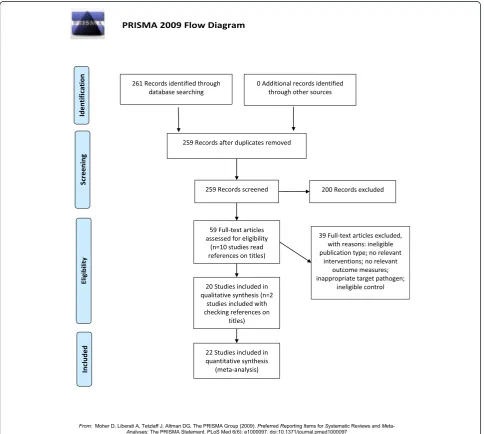
The articles originated from 1996 to 2013, with a rapid increase in the number of publications on the topic since 2004. The original systematic search strategy identified 259 unique citations, of which 200 articles were ex-cluded based on the content of the title and/or abstract (Figure 1).
The initial search resulted in 259 hits. Fifty-nine were selected based on the title and abstract. Full text was read and references were checked for additional hits. This resulted in ten additional hits. Twenty-two papers were included based on the full text.
Fifty-nine articles were read and evaluated for inclu-sion criteria. This resulted in the incluinclu-sion of 20 articles.
Ten articles were read based on references, of which two were included, bringing the sum of included rele-vant articles to 22 (Table 1). Several PCR-based tech-niques were investigated in the 22 selected articles: Nested PCR (nPCR) was investigated in six studies, real-time PCR (rtPCR) was adopted in 12 articles, con-ventional PCR (cPCR) was reported in ten articles, and four studies focused with other techniques.
The findings are reported as essential data in Table 1 as well as Additional file 2: Tables S1 to S6, which com-prised the following information: name of the pathogen in the original article, name of the primer(s) and target DNA, variants utilized in the PCR protocol, type of sam-ple, and treatment prior to amplification, and summa-rized below according to each pathogen.
Xanthomonas fragariae
The bacteriumX. fragariaeKennedyetKing (Additional file 2: Table S1), the causal agent of angular leaf spot, is a pathogen that spreads in all major areas of strawberry cultivation [16]. It is a very slow-growing bacterium in culture and is easily overgrown by saprophytic bacteria; selective media are not yet available. Therefore, isolation plating is not recommended for the detection of low X. fragariae numbers in symptomless plants [11]. Several PCR detection methods each targeting different loci in the X. fragariae genome have been developed. Conven-tional PCR using species-specific primers is known to differentiate close species and used for detection of X. fragariae[S#1,5,6]. Nested PCR [S#2,4,7] is also another main technique used for X. fragariae, while multiplex PCR (mPCR) [S#3] is found just in one study for detec-tion ofX. fragariaein plant tissue. Notably, rtPCR assays are used for many bacteria including the species on which we focused in this review, although TaqMan chemistry is prominently used for detection and quantification of X. fragariae [S#8–10] that could even detect ten bacterial cells in strawberry crown tissue. The detection ofX. fra-gariaein crown tissue extract was possible with real-time PCR but not with standard PCR, which is a significant im-provement over standard PCR [17]. The assay offers a new tool for epidemiological research and for sanitary control of plant material with low level or latent infections of pathogen [18].
Phytophthora fragariae
Conventional PCR [S#16–18] assays have been developed forP. fragariae(Additional file 2: Table S2) targeting dif-ferent single-copy genes and rDNA spacer region, al-though studies show contradicting results on detection sensitivity. In this respect, species-specific polymorphisms were exploited in RAS-like andTRP1 genes to develop a set of two P. fragariae-specific PCR primer pairs [19]. Thus, it seems to be equally or even more sensitive than
other published single-round PCR tests. Real-time PCR and nested rtPCR (nrtPCR) methods using fluorescent-labeled probes (TaqMan™ and Molecular Beacon™) have the necessary properties to fulfill the requirements of an effective detection system and are the other studied proce-dures for P. fragariae diagnostic [S#13–15]. The nested PCR-based method is described to be 1,000–10,000 times more sensitive compared to single-round PCR [13]. With Molecular Beacon™probes, the pathogen is detected in a quantitative order similarly to TaqMan™ probes, which are able to detect 0.1 fg DNA of the pathogen. In a comparative study, the sensitivity of Molecular Beacon™ and TaqMan™probes against a dilution series ofP. fra-gariae genomic DNA was equivalent [13]. Nested PCR is also reported to successfully detectP. fragariae [S#11] in naturally infected strawberry tissues. Another less in-vestigated test, like PCR-ELISA [S#12], has been advised for use in pathogen detection. However, this test cannot be recommended for critical diagnosis, since the sensitiv-ity is comparable to gel electrophoresis and ethidium bromide gel staining [13].
Botrytis cinerea
B. cinerea Pers. Fr. (Additional file 2: Table S3), the causal agent of gray mold or Botrytis blight, establishes symptomless infections, where the pathogen remains la-tent until the strawberry ripens [20]. TaqMan chemistry [S#20–22] based on primers and probes designed to the b-tubulingene, the intergenic spacer (IGS) region of the rDNA, and the species-specific sequence-characterized amplified region (SCAR) as the main genomic regions used to design rtPCR assay was applied for the detection and quantification of the fungus in infected strawberry plant tissue before and after symptom expression [20]. Based on Suarez et al. [21] results, the IGS assay gave a Ctvalue <40 of pureB. cinereaDNA that was 100 times
more sensitive than the SCAR assay and 1,000 times more sensitive than the b-tubulinassay. Random ampli-fied polymorphic DNA (RAPD) with Southern blot hybridization [S#19] is also an applicable and powerful tool for diagnosis of B. cinerea in symptomless straw-berry under field conditions [22]. In other words, hybridization of southern blots with RAPD and EcoRI-digested DNA confirmed the specificity of the marker for detection and quantification of the pathogen during the latency period. The procedure was able to amplify the 0.7-kb B. cinerea fragment from mixed samples of DNA as low as 2 pgB. cinerea genomic DNA and 1 μg plant DNA.
Fusarium oxysporum
has dramatically decreased the commercial production of strawberry [23]. Multiplex PCR [S#23] was used as the main detection technique to determine the pathogen based on DNA fragments. Although mPCR is becoming a rapid and convenient screening assay for most Fusar-iumspp., it has been used for detection ofF. oxysporum in strawberry in just one study. Suga et al. [1] charac-terized and used some transposable elements (sequence-characterized amplified regions) in the pathogen to design a specific set of PCR primers, as shown in Additional file 2: Table S4. The genomic region betweenHan and Skippy (as transposable elements) was amplified by an inter-retrotransposon-amplified polymorphism technique (IRAP-PCR), and specific primers were designed from this region. The developed PCR primers discriminatedF. oxy-sporumf.sp.fragariaestrains from nonpathogenicF. oxy-sporumstrains and five otherformae speciales[1]. Use of other PCR-based techniques could not be found for strawberry fusarium wilt diagnosis, while the molecular detection of F. oxysporum on other hosts has been reported [24,25].
Colletotrichum acutatum
C. acutatum (Additional file 2: Table S5) is one of the most frequently reported species of the genus and causes anthracnose disease which is especially destructive on strawberry [26]. For rapid and specific assessment of the pathogen in strawberry, TaqMan rtPCR [S#27,28] using primers designed to the rDNA ITS is used and strongly recommended. Development of the b-tubulin-based rtPCR primers is less complicated, but the single copy nature of this target leads to primers that are less sensi-tive and therefore less suitable for detection ofC. acuta-tum than the multi-copy ITS regions [27]. In a similar study, Garrido et al. [28] demonstrated that TaqMan rtPCR is 10–100 times more sensitive than cPCR [S#29] for diagnosis of the strawberry anthracnose agent. More-over, nPCR [S#25] is another technique which can be successfully used to detectC. acutatumon symptomless strawberry leaves. Because of strong detection sensitivity, this method can be applied as a powerful tool for a reli-able diagnosis of the pathogen in the field [29]. Since rtPCR is usually less affected by inhibitors such as chlorogenic acid than cPCR [30], detection of C. acuta-tum in necrotic leaf tissue may be more difficult with conventional or nested PCR than with rtPCR.
Verticillium dahlia
Verticillium wilt, caused by the soilborne fungusV. dah-liae (Additional file 2: Table S6), is an economically im-portant disease worldwide, which can cause significant crop loss on strawberry even with low soil inoculum densities [31,32]. Nested amplification [S#30] assay and cPCR [S#31], using modified DNA extraction methods
for amplification improvement, are described as poten-tial assays for detection of V. dahliae in the strawberry plant and soil. A multiplexed TaqMan rtPCR [S#32] based on the rDNA IGS provides a more specific quanti-fication of the pathogen at low inoculum densities with a higher level of sensitivity. According to Bilodeau et al. [33], the sensitivity of the method allows specific detec-tion of one to two microsclerotia/g ofV. dahliae in soil, which represents a higher sensitivity compared to other methods for this pathogen.
Macrophomina phaseolina
M. phaseolina(Tassi) Goid., the cause of charcoal rot on strawberry, has a wide geographic distribution because it infects the roots and lower stem of over 500 plant spe-cies [34,35]. Many PCR-based detection methods are able to detect M. phaseolina on plant tissues and soil [36-38], but no study has been found for detection and quantification of the pathogen on strawberry. However, published protocols may provide useful information about application of available detection methods on strawberry. Recently, a rtPCR using TaqMan and SYBR Green was published which enables a specific quantification of M. phaseolina abundance in rhizosphere and plant tissues [39]. Thus, this method seems to be a strong diagnostic tool forM. phaseolina.
Discussion
A variety of molecular methods have been described for specific detection and identification of phytopathogenic fungi and bacteria. However, the present compilation fo-cused solely on the PCR-based protocols available for routine diagnosis including detection or quantification of strawberry pathogens. Our systematic review identi-fied ten different protocols for X. fragariae, eight forP. fragariae, four forB. cinerea, six for C. acutatum, three for V. dahliae, and only one forF. oxysporum. No PCR-based detection method forM. phaseolinain strawberry could be identified in the literature yet. The strawberry pathogens included above were chosen due to their eco-nomic impact on crop losses, their distribution, and their status as quarantine organisms. Specificity and sen-sitivity of methods were identified by systematically summarizing the available literature (Additional file 2: Tables S1 to S6).
sequences, and multiple strategies are therefore being developed to design primers for specific detection and disease diagnosis [41-44]. The rDNA operon has fre-quently been used to design primers that allow highly sensitive detection, but due to its universal nature, the level of discrimination lies at the species levels [15]. The ITS region within prokaryotic and eukaryotic rDNA op-erons has been described as a stable genetic marker and was used to design primers by Bonants et al. [13,45], Vandroemme et al. [18], Turechek et al. [17], Kuchta et al. [46], Debode et al. [27], and Garrido et al. [28], among others. Thus, the ITS region is the most widely sequenced for strawberry pathogens. Another genomic portion of the rDNA cistron is the spacer between IGS or the non-transcribed spacer (NTS) that was used to design primers by Suarez et al. [21] and Bilodeau et al. [33]. IGS sequences are more difficult for amplification and sequencing, but they can be more variable than the ITS sequences. Thus, they are exploited to design diag-nostic assays when there are not enough differences available across the ITS [9]. Moreover, among conserved genes, theb-tubulinhas been used to develop diagnostic PCR assay forB. cinereaandC. acutatum. The sequence of this gene can be useful when the ITS sequence does not allow to fulfill specificity requirements of a diagnos-tic test [9]. A few loci suitable for the design of species-specific primers for X. fragariae have been identified: RAPD-specific regions [47,48], within thehrp [16,49,50] andgyrB[18,51] genes.
There is a discussion between results of studies that can be described by four variables. Firstly, in the primers reported here, sequences from pathogenicity-related genes of different species have been employed, although pathogenicity genes are not known in most cases. But, there is an example of the need to design new primers after the discovery of forma specialis that lack some pathogenicity genes, previously considered universal. Many types of transposable elements such asHop, Hor-net1, Foxy, Fofra, and Skippy were considered as excel-lent targets for F. oxysporum f.sp. fragariae detection, and several sets of primers were designed on its se-quence [1,52-54]. However, the discovery of nonpatho-genic F. oxysporumshowed that these primers were not as specific as expected [1]. Secondly, the frequent pres-ence of PCR inhibitors in the plant tissues or soil can considerably reduce the sensitivity of the reaction. Thus, a low copy number of initial target DNA sequences makes the first amplification cycles critical, because it may result in false-negative results caused by PCR inhib-itors [14]. This could have a major impact on the result of diagnostic tests and therefore is a confounding, but important, variable. In this context, sample preparation is critical, and target DNA should be made as available as possible for amplification. So, an increasing number
of commercial kits and DNA extraction protocols for DNA purification and removal of PCR inhibitors from plant materials and soils are available and reported in Additional file 2: Tables S1 to S6. Also, in two included studies [33,51], internal PCR controls were employed in order to improve sensitivity and avoid false negatives. Thirdly, some results were obtained from nucleic acids present in the soil rather than living cells. Hence, there is a risk of detecting target DNA from dead sources; DNA can persist in soil for long periods of time by forming complexes with soil components and may lead to positive PCR results [55,56]. Lastly, the majority of the included studies in the literature review investigated PCR methods based on agarose gels for detection/identi-fication of strawberry pathogens. However, some studies focused on quantification of the pathogen using the rtPCR technique, in which sensitivity was increased. Conventional and real-time PCRs are difficult to com-pare because of the different throughput, sensitivity, and resolution levels [57].
Several methods have been developed to improve sen-sitivity of cPCR with regard to the goal of this study. Nested PCR with both internal and external primers to the target sequence was reported to increase detection sensitivity and reduce the effect of PCR inhibitors [46,48,50]. In fact, when the pathogen is present in very low levels, a higher level of specificity is needed, or the infestations need to be detected in complex environmen-tal samples [50], affecting the reaction. However, the risk of false positives due to cross-contamination of reaction mixtures in routine analysis of large numbers of samples is increased by the introduction of a second round of amplification and the simultaneous manipulation of the previously amplified products [49]. To avoid these prob-lems, nPCR in a single closed tube has been developed [58,59].
reported a rapid and specific determination of soil inocu-lum densities ofV. dahliaein strawberry fields without re-duction of sensitivity against single amplifications using multiplexed TaqMan rtPCR. Another powerful and prac-tical technique for simultaneous detection of multiple plant pathogens in a wide range of environmental samples is the macro- and micro-array [8,64,65], but is not found for the aforementioned pathogens during our literature survey.
In plant disease management, the assumption that rtPCR is more sensitive than cPCR is widely accepted. The higher sensitivity of rtPCR compared to cPCR is de-termined by two main features: firstly, data are available in real time, are on-screen, do not require time-consuming post-PCR processing, and can be quantitative. Secondly, rtPCR assays commonly amplify very short DNA frag-ments (70–100 bp) which favors a higher level of PCR effi-ciency and sensitivity compared to cPCR [28,66]. In this regard, many different systems have been developed, in-cluding probe-based methods, such as TaqMan probes [9,13,15] and molecular beacons [13]. In general, the pro-tocols developed are based on hybridization of the probe to the target amplicon, thus achieving maximum sensitiv-ity and confirming the identsensitiv-ity of the amplified product [14,15,28]. Only 12 kinds of rtPCR protocols are referred to here for detection and quantification of strawberry pathogens. But one should bear in mind that their number has increased from only one in 2004 [13] to six between 2007 and 2012 [17,18,27,28,33,51]. It seems that, since amplicon detection through the specific fluorescent signal removes the requirements for post-amplification phases needed in cPCR, it reduces time and considerably pro-motes the throughput of rtPCR assays, making it suitable for large-scale analyses of the mentioned pathogens. Be-sides, primers designed for cPCR can be utilized in rtPCR assays if amplicon size criteria are met [57]. Hence, exist-ing cPCR protocols for the detection of plant pathogens can be adapted to be used in real-time detection (rtPCR assays), which can result in a higher level of sensitivity.
In this compilation, all of the rtPCR protocols have uti-lized probe-based methods, which provide greater sensitiv-ity and specificsensitiv-ity than other PCR techniques for detection of strawberry pathogens. However, DNA-intercalating dyes can offer a valid alternative to probe-based methods that bind to double-stranded DNA. SYBR Green is one of the most widely used intercalating DNA dyes for rtPCR appli-cations because of cost efficiency, generic detection of amplified DNA, and its ability to differentiate PCR prod-ucts by melting curve analysis [67]. Nevertheless, the draw-back of using SYBR Green for melting curve analysis is that the melting temperature is highly dependent on the concentration of the dye [68] and DNA [69]. TaqMan™and SYBR™green techniques are most widely used for diagnos-tic purposes, but several considerations must be taken into
account. First of all, the TaqMan technique tends to be more specific than SYBR Green due to the use of the se-quence specific probe; however, this leads to higher initial costs [70]. Secondly, the SYBR Green method is cheaper to establish since fluorescent-labeled probes are not used; however, SYBR Green fluorophores can also associate with non-specific reaction products such as primer-dimers which may result in poor specificity and false-positive re-sults [57]. Thirdly, availability of instrumentation, the de-gree of diversity among target and non-target sequences, and the need for multiplexing are primary factors in the choice of real-time platforms [70,71]. In fact, SYBR Green™ does not allow to multiplex different amplification prod-ucts. In this scenario, no SYBR Green protocol has been published for detection of studied strawberry pathogens yet. In this review, we also included studies using PCR-ELISA [13] and cPCR using PCR kit [16] that allow detec-tion of P. fragariaeand X. fragariaein strawberry plants, respectively. These techniques are not as powerful as rtPCR in detecting and quantifying pathogens but were nevertheless included in this review since they still did allow a reliable detection of strawberry pathogens.
Limitations
making direct comparison between studies extremely problematic. Therefore, in order to compare detection sensitivity from different environmental samples, it must first be ensured that the same extraction procedure is used for each sample. Indeed, the absence of common pre-analytical procedures might affect final results. Generally, real-time PCR was mostly used in the studies under inves-tigations but not with the same primer and probe, result-ing in a restricted comparability. However, while keepresult-ing the limitations of the used PCR-based methods in mind, rtPCR remains the gold standard technique for detection and quantification of strawberry pathogens.
Conclusions
From a systematic review of the currently available pub-lished literature, rtPCR is shown to be a particularly promising technique for diagnosing and quantifying pathogen populations in strawberry, whereas some other techniques are suitable for the identification/detection of the aforementioned pathogens. The technique rtPCR al-lows a specific, reliable, and high-throughput detection of target DNA in symptomless strawberry leaves and various environmental samples in real time. However, we hypothesize that a large proportion, possibly a major-ity, of errors in laboratories occurs in the pre-analytical phase of the testing process. Therefore, pre-analytical factors need to be considered when applying a diagnostic test. As more PCR-based methods for detection of plant pathogenic fungi and bacteria become available, their use will progressively increase not only for identification purposes but also for different applications, such as studies on pathogen population in their ecosystem in order to facilitate reliable detection. These studies are fundamental to obtain a comprehensive understanding of the pathogen biology with the final intent of optimiz-ing plant disease management strategies.
Additional files
Additional file 1:Search strategy.The file contains a sample search strategy.
Additional file 2:Supporting information.Summaries of the included studies are reported along with the quantitative measurements undertaken by the original articles that assessed detection sensitivity in each protocol. Table S1: PCR-based techniques applied for detection ofX. fragariaein strawberry.Table S2: PCR-based techniques applied for detection ofP. fragariaein strawberry.Table S3: PCR-based techniques applied for detection ofB. cinereain strawberry.Table S4: PCR-based techniques applied for detection ofF. oxysporumf.sp.fragariaein strawberry.Table S5: PCR-based techniques applied for detection ofC. acutatumin strawberry. Table S6: PCR-based techniques applied for detection ofV. dahliaein strawberry.
Competing interests
The authors declare that they have no competing interests.
Authors’contributions
SMM conceptualized and designed the study and conducted the search strategy, drafted the initial manuscript, and approved the final manuscript as submitted. EL supervised the search strategy and the methods, critically reviewed and revised the manuscript, and approved the final manuscript as submitted. MM contributed to the concept and design of the study, reviewed the manuscript, and approved the final manuscript as submitted. MD and RAG critically reviewed and revised the manuscript and approved the final manuscript as submitted. All authors read and approved the final manuscript.
Acknowledgements
This work was funded by EUPHRESCO (European Phytosanitary Research Coordination) Phytosanitary ERA-Net project SPAT (Strawberry Pathogens Assessment and Testing). The authors especially thank Prof. Peter Harley (National Center for Atmospheric Research, Colorado, USA) for his critical reviewing of the manuscript. We also thank Inmaculada Larena (Agricultural National Research Institute, Department of Plant Protection, Madrid, Spain) and Maria Bergsma-Vlami (National Reference Centre, Plant Protection Service, Wageningen, The Netherlands) for giving valuable comments and suggestions for improving the quality of this work.
Author details
1Department of Field Crops and Grassland Husbandry, Institute of
Agricultural and Environmental Sciences, Estonian University of Life Sciences, Tartu, Estonia.2Pesticides, Plant Health and Seed Testing Laboratories, Department of Agriculture, Food and the Marine, Backweston Campus, Celbridge, Co. Kildare, Ireland.3Department for Molecular Diagnostics of Plant Diseases, Institute for Sustainable Plant Production, Austrian Agency for Health and Food Safety (AGES), Vienna, Austria.4Department of Plant Protection, Institute of Agricultural and Environmental Sciences, Estonian University of Life Sciences, Tartu, Estonia.
Received: 8 July 2014 Accepted: 2 January 2015 Published: 15 January 2015
References
1. Suga H, Hirayama Y, Suzuki T, Kageyama K, Hyakumachi M. Development of PCR primers to identify Fusarium oxysporum f. sp. fragariae. Plant Dis. 2013;97(5):619–25.
2. Faostat (Food and Agriculture Organization Corporate Statistical Database). World strawberry production. 2013. [http://faostat.fao.org/site/567/ DesktopDefault.aspx?PageID = 567#ancor. Accessed 9 Mar 2013. 3. Maas JL. Compendium of strawberry diseases. St Paul, MN: APS Press; 1998. 4. Redondo C, De-Cal A, Martinez-Treceño A, Becerril M, López-Aranda JM,
Melgarejo P. Evaluation of resistance of several strawberry selections against main fungal pathogens. In: López-Medina J, editor. Proceedings of the VI International Strawberry Symposium: 3–7 March 2009; Huelva (Spain). Acta Horticulturae 842. 2009. p. 211–4.
5. Sankarana S, Mishraa A, Ehsania R, Davis C. A review of advanced techniques for detecting plant diseases. Comput Electron Agr. 2010;72:1–13. 6. McCartney HA, Foster SJ, Fraaije BA, Ward E. Molecular diagnostics for
fungal plant pathogens. Pest Manag Sci. 2003;59:129–42.
7. Singleton LL, Mihail JD, Rush CM. Methods for research on soil-borne phytopathogenic fungi. St Paul, MN: APS Press; 1992.
8. Lievens B, Brouwer M, Vanachter ACRC, Levesque CA, Cammue BPA, Thomma BPHJ. Quantitative assessment of phytopathogenic fungi in various substrates using a DNA macroarray. Environ Microbiol. 2005;7(11):1698–710.
9. Schena L, Nigro F, Ippolito A. Real-time PCR detection and quantification of soilborne fungal pathogens: the case ofRosellinia necatrix,Phytophthora nicotianae,P. citrophthora, andVerticillium dahliae. Phytopathol Mediterr. 2004;43:273–80.
10. Lievens B, Grauwet TJMA, Thomma CBPA, BPHJ. Recent developments in diagnostics of plant pathogens: a review. Recent Res Develop Microbiol. 2005;9:57–79.
11. OEPP/EPPO (European and Mediterranean Plant Protection Organization). Diagnostics;Xanthomonas fragariae. Bull OEPP/EPPO. 2006;36:135–44. 12. López MM, Llop P, Olmos A, Marco-Noales E, Cambra M, Bertolini E. Are
13. Bonants P, van Gent-Pelzer MPE, Hooftman R, Cooke D, Guy DC, Duncan JM. A combination of baiting and different PCR formats, including measurement of real-time quantitative fluorescence, for the detection ofPhytophthora fragariae
in strawberry plants. Eur J Plant Pathol. 2004;110:689–702.
14. Schena L, Li Destri Nicosia MG, Sanzani SM, Faedda R, Ippolito A, Cacciola SO. Development of quantitative PCR detection methods for
phytopathogenic fungi and oomycets. J Plant Pathol. 2013;95(1):7–24. 15. Schaad NW, Frederick RD, Shaw J, Schneider WL, Hickson R, Petrillo MD,
et al. Advances in molecular-based diagnostics in meeting crop biosecurity and phytosanitary issues. Annu Rev Phytopathol. 2003;41:305–24. 16. Stöger A, Ruppitsch W. A rapid and sensitive method for the detection of
Xanthomonas fragariae, causal agent of angular leafspot disease in strawberry plants. J Microbiol Meth. 2004;58:281–4.
17. Turechek WW, Hartung JS, McCallister J. Development and optimization of a real-time detection assay forXanthomonas fragariaein strawberry crown tissue with receiver operating characteristic curve analysis. Phytopathol. 2008;98(3):359–68.
18. Vandroemme J, Baeyen S, Van Vaerenbergh J, De Vos P, Maes M. Sensitive real-time PCR detection ofXanthomonas fragariaein strawberry plants. Plant Pathol. 2008;57:438–44.
19. Ioos R, Laugustin L, Schenck N, Rose S, Husson C, Frey P. Usefulness of single copy genes containing introns in Phytophthora for the development of detection tools for the regulated speciesP. ramorumandP. fragariae. Eur J Plant Pathol. 2006;116:171–6.
20. Guinebretiere MH, Morrison C, Reich M, Nicot P. Isolation and characterization of antagonists for the biocontrol of the postharvest wound pathogenBotrytis cinereaon strawberry fruits. J Food Protect. 2000;63:386–94.
21. Suarez MB, Walsh K, Boonham N, O’Neill T, Pearson S, Barker I. Development of real-time PCR (TaqMan®) assays for the detection and quantification of
Botrytis cinereain planta. Plant Physiol Bioch. 2005;43:890–9.
22. Rigotti S, Gindro K, Richter H, Viret O. Characterization of molecular markers for specific and sensitive detection ofBotrytis cinereaPers.: Fr. in strawberry (Fragaria × ananassaDuch.) using PCR. FEMS Microbiol Lett. 2002;209:169–74. 23. Arroyo FT, Llergo Y, Aguado A, Romero F. First report of fusarium wilt
caused byFusarium oxysporumon strawberry in Spain. Plant Dis. 2009;93:323–3.
24. Abd-Elsalam KA, Asran-Amal A, Schnieder F, Migheli Q, Verreet JA. Molecular detection of Fusarium oxysporum f. sp. vasinfectum in cotton roots by PCR and real-time PCR assay. J Plant Dis Protect. 2006;113(1):14–9.
25. Li Y, Garibaldi A, Gullino ML. Molecular detection ofFusarium oxysporumf. sp.chrysanthemion three host plants:Gerbera jamesonii,Osteospermumsp. andArgyranthemum frutescens. J. Plant Pathol. 2010;92(2):525–30. 26. Damm U, Cannon PF, Woudenberg JHC, Crous PW. TheColletotrichum
acutatumspecies complex. Stud Mycol. 2012;73:37–113.
27. Debode J, Van Hemelrijck W, Baeyen S, Creemers P, Heungens K, Maes M. Quantitative detection and monitoring ofColletotrichum acutatumin strawberry leaves using real-time PCR. Plant Pathol. 2009;58:504–14. 28. Garrido C, Carbú M, Fernández-Acero FJ, Boonham N, Colyer A, Cantoral JM,
et al. Development of protocols for detection ofColletotrichum acutatum
and monitoring of strawberry anthracnose using real-time PCR. Plant Pathol. 2009;58:43–51.
29. Pérez-Hernández O, Nam MH, Gleason ML, Kim HG. Development of a nested polymerase chain reaction assay for detection ofColletotrichum acutatumon symptomless strawberry leaves. Plant Dis. 2008;92(12):1655–61. 30. Mumford RA, Walsh K, Barker I, Boonham N. Detection of potato mop top
virus and tobacco rattle virus using a multiplex real-time fluorescent reverse transcription polymerase chain reaction assay. Phytopathol. 2000;90:448–53. 31. Bhat RG, Subbarao KV. Host range specificity inVerticillium dahliae.
Phytopathol. 1999;89:1218–25.
32. Pegg B, Brady G. Verticillium wilts. New York: CABI Publishing; 2002. 33. Bilodeau GJ, Koike ST, Uribe P, Martin FN. Development of an assay for rapid
detection and quantification ofVerticillium dahliaein soil. Phytopathol. 2012;102(3):331–43.
34. Mihail JD, Taylor SJ. Interpreting variability among isolates ofMacrophomina phaseolinain pathogenicity, pycnidium production and chlorate utilization. Can J Bot. 1995;10:1596–603.
35. Su G, Suh SO, Schneider RW, Russin JS. Host specialization in the charcoal rot fungus,Macrophomina phaseolina. Phytopathol. 2001;91:120–6. 36. Babu BK, Saxena AK, Srivastava AK, Arora DK. Identification and detection of
Macrophomina phaseolinaby using species specific oligonucleotide primers and probe. Mycologia. 2007;99(6):797–803.
37. Chakraborty BN, Chakraborty U, Dey PL, Rai K. rDNA sequence and phylogenetic analysis ofMacrophomina phaseolina, root rot pathogen of
Citrus reticulata(Blanco). Global J Mol Sci. 2011;6:26–34.
38. Almomani F, Alhawatema M, Hameed K. Detection, identification and morphological characteristic ofMacrophomina phaseolina: the charcoal rot disease pathogens isolated from infected plants in Northern Jordan. Arch Phytopathol Plant Protect. 2013;46(9):1005–14.
39. Babu BK, Mesapogu S, Sharma A, Somasani SR, Arora DK. Quantitative real-time PCR assay for rapid detection of plant and human pathogenic
Macrophomina phaseolinafrom field and environmental samples. Mycologia. 2011;103(3):466–73.
40. Henson JM, French R. The polymerase chain reaction and plant disease diagnosis. Annu Rev Phytopathol. 1993;31:81–109.
41. Williams JGK, Kubelik AR, Livak KJ, Rafalski JA, Tingey SV. DNA
polymorphisms amplified by arbitrary primers are useful as genetic markers. Nucleic Acids Res. 1990;18:6531–5.
42. Fraaije BA, Lovell DJ, Coelho JM, Baldwin S, Hollomon DW. PCR-based assays to assess wheat varietal resistance to blotch (Septoria triticiandStagonospora nodorum) and rust (Puccinia striiformisandPuccinia recondita) diseases. Eur J Plant Pathol. 2001;107:905–17.
43. Schmittgen TD. Real-time quantitative PCR. Methods. 2001;25:383–5. 44. Lees AK, Cullen DW, Sullivan L, Nicolson MJ. Development of conventional
and quantitative real-time PCR assays for the detection and identification of
Rhizoctonia solaniAG-3 in potato and soil. Plant Pathol. 2002;51:293–302. 45. Bonants P, Weerdt MH, van Gent-Pelzer M, Lacourt I, Cooke D, Duncan J. Detection and identification ofPhytophthora fragariaeHickman by the polymerase chain reaction. Eur J Plant Pathol. 1997;103:345–55. 46. Kuchta P, Jecz T, Korbin M. The suitability of PCR-based techniques for
detectingVerticillium dahliaein strawberry plants and soil. J Fruit Ornamental Plant Res. 2008;16:295–304.
47. Pooler MR, Ritchie DF, Hartung JS. Genetic relationships among strains of
Xanthomonas fragariaebased on random amplified polymorphic DNA PCR, repetitive extragenic palindromic PCR, and enterobacterial repetitive intergenic consensus PCR data and generation of multiplexed PCR primers useful for the identification of this phytopathogen. Appl Environ Microbiol. 1996;62(9):3121–7.
48. Zimmermann C, Hinrichs-Berger J, Moltmann E, Buchenauer H. Nested PCR (polymerase chain reaction) for detection ofXanthomonas fragariaein symptomless strawberry plants. J Plant Dis Protect. 2004;111(1):39–51. 49. Roberts PD, Jones JB, Chandler CK, Stall RE, Roberts PD, Jones JB, et al.
Survival of X. fragariae on strawberry in summer nurseries in Florida detected by specific primers and nested PCR. Plant Dis. 1996;80(11):1283–8. 50. Mahuku GS, Goodwin PH. Presence ofXanthomonas fragariaein
symptomless strawberry crowns in Ontario detected using a nested polymerase chain reaction (PCR). Can J Plant Pathol. 1997;19(4):366–70. 51. Weller SA, Beresford-Jones NJ, Hall J, Thwaites R, Parkinson N, Elphinstone
JG. Detection ofXanthomonas fragariaeand presumptive detection of
Xanthomonas arboricolapv.fragariae, from strawberry leaves, by real-time PCR. J Microbiol Methods. 2007;70:379–83.
52. Hua-Van A, Daviere JM, Kaper F, Langin T, Daboussi MJ. Genome organization inFusarium oxysporum: clusters of class II transposons. Curr Genet. 2000;37:339–47.
53. Anaya N, Roncero MIG. Skippy, a retrotransposon from the fungal plant pathogenFusarium oxysporum. Mol Gen Genet. 1995;249:637–47. 54. Chalvet F, Grimaldi C, Kaper F, Langin T, Daboussi MJ. Hop, an active
mutator-like element in the genome of the fungusFusarium oxysporum. Mol Biol Evol. 2003;20:1362–75.
55. England LS, Lee H, Trevors JT. Persistence ofPseudomonas aureofaciens
strains and DNA in soil. Soil Biol Biochem. 1997;29:1521–7.
56. Wolffs P, Norling B, Rådström P. Risk assessment of false-positive quantitative real-time PCR results in food, due to detection of DNA originating from dead cells. J Microbiol Methods. 2005;60:315–23.
57. Okubara PA, Schroeder KL, Paulitz TC. Real-time polymerase chain reaction: applications to studies on soil borne pathogens. Can J Plant Pathol. 2005;27:300–13.
58. Mercado-Blanco J, Rodríguez-Jurado D, Pérez-Artés E, Jiménez-Díaz RM. Detection of the nondefoliating pathotype ofVerticillium dahliaein infected olive plants by nested PCR. Plant Pathol. 2001;50(5):609–19.
60. Elnifro EM, Ashishi AM, Cooper RJ, Klapper PE, Multiplex PCR. Optimization and application in diagnostic virology. Clin Microbiol Rev. 2000;13:559–70. 61. Bamaga MS, Wright DJ, Zhang H. An assessment of multiplex PCR assays for
differentiating clinically important mycobacteria based onpncA gene variation. Mol Cell Probes. 2003;17:69–75.
62. Tooley PW, Martin FN, Carras MM, Frederick RD. Real-time fluorescent polymerase chain reaction detection ofPhytophthora ramorumand
Phytophthora pseudosyringaeusing mitochondrial gene regions. Phytopathol. 2006;96:336–45.
63. Scauflaire J, Godet M, Gourgue M, Liénard C, Munaut F. A multiplex real-time PCR method using hybridization probes for the detection and the quantificationof Fusarium proliferatum,F. subglutinans,F. temperatum, andF. verticillioides. Fungal Biol. 2012;10:1073–80.
64. Chen W, Seifert KA, Lévesque CA. A high density COX1 barcode oligonucleotide array for identification and detection of species of Penicillium subgenus Penicillium. Mol Ecol Resour. 2009;9:114–29. 65. Call DR. Challenges and opportunities for pathogen detection using DNA
microarrays. Crit Rev Microbiol. 2005;31:91–9.
66. Garrido C, Carbú M, Fernández-Acero FJ, González-Rodríguez VE, Cantoral JM. New insight in the study of strawberry fungal pathogens. Genes Genomes Genomics. 2011;5(1):24–39.
67. Morrison TB, Weis JJ, Wittwer CT. Quantification of low-copy transcripts by continuous SYBR Green I monitoring during amplification. Biotechniques. 1998;24:954–8.
68. Ririe KM, Rasmussen RP, Wittwer CT. Product differentiation by analysis of DNA melting curves during the polymerase chain reaction. Anal Biochem. 1997;245:154–60.
69. Xu HX, Kawamura Y, Li N, Zhao LC, Li TM, Li ZY, et al. A rapid method for determining the G + C content of bacterial chromosomes by monitoring fluorescence intensity during DNA denaturation in a capillary tube. Int J Syst Evol Micr. 2000;50:1463–9.
70. Wittwer CT, Herrmann MG, Moss AA, Rasmussen RP. Continuous fluorescence monitoring of rapid cycle DNA amplification. Biotechniques. 1997;22(1):130–8.
71. Whitcombe D, Theaker J, Guy SP, Brown T, Little S. Detection of PCR products using self-probing amplicons and fluorescence. Nat Biotechnol. 1999;17:804–7.
72. Drenth A, Wagels G, Smith B, Sendall B, O’Dwyer C, Irvine G, et al. Development of a DNA-based method for detection and identification of Phytophthora species. Australas Plant Path. 2006;35:147–59.
73. Sreenivasaprasad S, Sharada K, Brown AE, Mills PR. PCR-based detection of
Colletotrichum acutatumon strawberry. Plant Pathol. 1996;45(4):650–5. 74. Zhang S, Goodwin PH. Rapid and sensitive detection ofXanthomonas fragariaeby simple alkaline DNA extraction and the polymerase chain reaction. J Phytopathol. 1997;145(5–6):267–70.
doi:10.1186/2046-4053-4-9
Cite this article as:Mirmajlessiet al.:PCR-based specific techniques used for detecting the most important pathogens on strawberry:
a systematic review.Systematic Reviews20154:9.
Submit your next manuscript to BioMed Central and take full advantage of:
• Convenient online submission
• Thorough peer review
• No space constraints or color figure charges
• Immediate publication on acceptance
• Inclusion in PubMed, CAS, Scopus and Google Scholar
• Research which is freely available for redistribution