MURDOCH RESEARCH REPOSITORY
Anda, M., Mathew, K. and McGrath, D. (1989) The remote area hygiene facility. In: Workshop on Water Supply, Water Use and
Waste Disposal for Remote Communities, 27 September, Murdoch University, Perth, Australia. In: Ho,G. (ed) Workshop
on Water Supply, Water Use and Waste Disposal for Remote Communities, 27 September, Murdoch University, Perth,
Australia, pp 32-36.
THE
REMOTE AREA HYGIENE FACILITY
Martin Anda,
Kuruvilla Mathew, Debra McGrath, Goen Ho
After you've all had a look at the display facility I'm sure many of you have some ideas on its design. As you've probably gathered from the construction I'm not a building tradesman or an architect.
The design of the Remote Area Hygiene Facility (RAHF) is essentially based on the Appropriate Technology Ablutions Facility (ATAF)
manufactured by the Centre For Appropriate Technology in Alice Springs.
Structurally, the building is the same as the ATAF, with 50x50 RHS being used throughout. Modifications include the addition of a pour-flush toilet, the solar water heater on a redesigned roof, a new
evapotranspiration trench and a solar-powered desalination unit each being developed by the Remote Area Developments Group. All of these additions will be tested in conjunction with the RAHF and can all
combine in a final integrated development. Although the desalination equipment would not normally be supplied as part of the RAHF.
Problems of offensive odours emanating from the toilet in close
proximity to laundry and shower areas are overcome by using a water-seal toilet. The toilet is a pit-type but uses a lower volume of water by having a ladle and tap Ibucket instead of a cistern - which is highly liable to breakage or failure. The pedestal and base are concrete mouldings. The design is based on one used in Fiji. The seat is a white polyethylene moulding similar in appearance to conventional ceramic pedestals with a U-bend. Being polyethylene it is unbreakable, lightweight and can be easily lifted out to be unblocked.
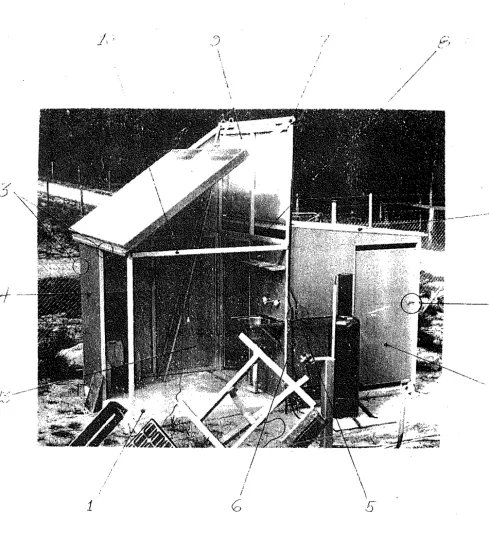
Two prototype units have been fabricated. One has been installed at Murdoch University for display and experimentation on the various devices. The second will be installed at Newman or Port Hedland on the grounds of Hedland College for the same purposes. The ApPl"OP:t:'iate Technology Unit of the College has been collaborating with research of the Remote Area Developments Group. Modifications are envisaged for future facilities - not to mention those which may arise from further consultations and experiences in communities. Refer to Figure 1
regarding each of the following numbered points:
(1) The concrete slab for the first RAHF was poured by using wooden formwork and fixing to this was achieved by means of brackets as used in the ATAF. The RAHF to be installed in Newman will utili,se C-purlin formwork, as in the ATAF, but fixing of the wall panels will be to
locating studs welded to the C-purlin. The C-purlin will also be pre-fabricated in two halves to include the cover to the toilet pit (which will normally be larger than that of the Murdoch facility), reinforcing mesh and a gradient towards the central spoon drain.
(2) The shower and toilet doors were fabricated from 25mm RHS and flat colourbond sheetmetal. It may be more appropriate to C\lt the doors to size from 17mm formply on site to suit the exact door size and avoid the potential problem of the door not fitting if the wall panels have moved.
(3) Rather than tek-screwing the corner securing strips in future these should be welded to the respective wall panels and drilled prior to painting. On site only one side, corner or roof tab will then need to be tek-screwed for ease of assembly. I
(4) The RAHF at Murdoch University was fitted with flat colourpond sheet for wall cladding. This would not be appropriate on a community due to its lack of rigidity. The RAHF at N~wman will be fitted with colourbond low-clad which has a 12mm ribbed profile. Various
colourbond wall claddings cost/m2 are as follows: flat (BHP) $8, low-clad (Monodek) $1(\ panel-rib (BHP) $13, mini-orb (BHP) $17.
(5) The plumbing circuit design will need to be optimised before
I
~
valves on the current display unit should be replaced with a three-way valve or a non-return valve at the SWH valve.
(6) Copper pipework has been used throughout for plumbing to provide ease of fabrication and less likelihood of corrosion due to dissimilar metals. Galvanised mild steel piping offers greater strength and durability and is recommended in the UPK report for all exposed pipe. The alternative would be to use the copper pipework externally and protect it with galvanised, heavy steel, grid mesh. The grid mesh could be secured to the chipheater and the walls offering a rigid installation to the chipheater which is often not the case otherwise. POSSibly even more suitable would be the use of polybutylene piping throughout which is approved for hot and cold water plumbing. There would be no corrosion and less scale build-up than with copper.
(7) The paintwork to the RHS frames will need to be improved for greater durability on site. A heavier enamel, powder-epoxy or galvanising could be used.
(8) Louvres may be necessary on the top of the plumbing wall panel to provide the option of ventilation.
(9) The roof section at 35 degrees to the horizontal for the solar water heater could pOSSibly have its upper section horizontal for the storage tank. This would reduce the overall height of the RAHF and may provide greater structural integrity.
(10) The horizontal beam running along above the toilet door, the
chipheater and the laundry opening is currently fabricated from several lengths of 50mm RHS. For enhanced structural integrity, appearance and locating wall panels during assembly this should be fabricated from a single length.
(11) An additional elevated layer of corrugated metal roofing could be installed above the toilet/shower. This would proVide an insulative air gap and reduce the heat in these two compartments. Alternatively, local tree or plant materials such as spinifex could be effectively used to
provide shade and ventilation simultaneously. The spinifex would be secured to the roof panel by wiring.
(13) Improved shading may be provided to the laundry by applying cladding to the west side and leaving the north side open.
Australian Construction Services (Commonwealth Government) offer an ablutions facility for Aboriginal communities. It comprises a toilet and shower for men, a toilet and shower for women, a common laundry area in the middle and conventional solar water heating. The toilets are the aqua-privy type.The entire facility can typically be supplied anci installed for $40,000.
The Centre For Appropriate Technology will supply the ATAF comprising shower, laundry, concrete base and chipheater for
approximately $2,500. The VIP toilet will be supplied for about $1,300, Installing both these facilities in a remote community will result in a total cost of approximately $9,000.
!
The Remote Area Hygiene Facility with evapotranspiration trench could ') be supplied and installed for approximately $12,000. The solar-powereddesalination eqUipment would not be included in this price. Providing the RAHF alone in kit-form complete with structure, toilet, shower, chipheater, hand-operated washing machine and solar water heater may be around $6,000. A more accurate cost estimate would be given on request.
These three facilities enable a broad comparison to be made on the options available to Aboriginal people living in remote communities when selecting the ablutions facility approriate to their needs. The ATAF has an extensive history of successful application in communities and will continue to be an advantageous option in the future. The larger ablutions facility offered by Australian Construction Services is a step closer to modern urban living patterns while still leaving the community its choices open to shelter or hOUSing. The RAHF may be able to offer some social, technical or economic advantages to remote communities depending on the circumstances.
I
'I
I
~
' /
\.J
-I
'/"<-.... ,. ~.
f ,)
/ ,
i
\
I ,
"
1 G 5
/ /
/
/
J.-~".
, '
1-",11
~---·/2
- ',)