Local Causality, Probability and Explanation
Richard A. Healey
The University of Arizona
November 21, 2014
Abstract
In papers published in the 25 years following his famous 1964 proof John Bell re…ned and reformulated his views on locality and causality. Although his formulations of local causality were in terms of probability, he had little to say about that notion. But assumptions about probability are implicit in his arguments and conclusions. Probability does not con-form to these assumptions when quantum mechanics is applied to account for the particular correlations Bell argues are locally inexplicable. This account involves no superluminal action and there is even a sense in which it is local, but it is in tension with the requirement that the direct causes and e¤ects of events are nearby.
1
Introduction
I never met John Bell, but his writings have supplied me with a continual source of new insights as I read and reread them over 40 years. In working toward a rather di¤erent understanding of quantum mechanics he has been foremost in my mind as a severe but honest critic of such attempts. We all would love to know what Einstein would have made of Bell’s theorem. I confess the deep regret I feel that Bell cannot respond to this paper is sometimes assuaged by a sense of relief.
2
Locality and Local Causality
In his seminal 1964 paper, John Bell expressed locality as the requirement
that the result of a measurement on one system be una¤ected by operations on a distant system with which it has interacted in the past. [2004, p. 14]
if exactly the same operations (if any) had been performed on that distant system. So can no indeterministic theory satisfy the locality requirement? Bell felt no need to address that awkward question in his 1964 paper, since he took the EPR argument to establish that any additional variables needed to restore locality and causality would have to determine a unique result of a measurement. Indeterminism was not an option:
Since we can predict in advance the result of measuring any chosen component of 2 [in the Bohm-EPR scenario], by previously
mea-suring the same component of 1, it follows that the result of any
such measurement must actually be predetermined. (op. cit., p. 15)
Afterwards he repeatedly stressed that any theory proposed as an attempt to complete quantum theory while restoring locality and causality need not be assumed to be deterministic: to recover such perfect (anti)correlations it would have to be deterministic. This argument warrants closer examination, and I’ll come back to it. But in later work Bell o¤ered formulations of locality conditions tailored to theories that were not deterministic.
An initial motivation may have been to facilitate experimental tests of attempted local, causal completions of quantum mechanics by suitable measure-ments of spin or polarization components on pairs of separated systems repre-sented by entangled quantum states. Inevitable apparatus imperfections would make it impossible to con…rm a quantum prediction of perfect (anti)correlation for matched components, so experiment alone could not require a local, causal theory to reproduce them. Einstein himself thought some theory might come to underlie quantum mechanics much as statistical mechanics underlies thermo-dynamics. In each case there would be circumstances in which the more basic theory (correctly) predicts deviations from behavior the less basic theory leads one to expect.
But by 1975 a second motivation had become apparent— the hope that by revising or reformulating quantum mechanics as a theory of local beables one might remove ambiguity and arrive at increased precision. It is in this context that Bell now introduces a requirement of local causality. This di¤ers in two ways from his earlier locality requirement. It is not a requirement on the world, but on theories of local beables: and it applies to theories that are probabilistic, with deterministic theories treated as a special case in which all probabilities are 0 or 1 (and densities are delta functions).1 Bell ([1975], [1985])
designs his requirement of local causality as a generalization of a requirement of local determinism met by Maxwell’s electromagnetic theory. In source-free Maxwellian electromagnetism, the local beables are the values of the electric and magnetic …elds at each point(x; t). This theory is locally deterministic because
1While Bell did not make this explicit in 1975, his 1990 paper also notes the analogy with
source-free Maxwellian electromagnetism, and there he does say:
the …eld values in a space-time region are uniquely determined by their values at an earlier moment in a …nite volume of space that fully closes the backward light cone of that region.
Local causality arises by generalizing to theories in which the assignment of values to some beables implies, not necessarily a particular value, but a probability distributionP r(Aj ), for another beableA. Here is how Bell ([2004, p. 54]) de…nes it (in my notation):
Let N denote a speci…cation of all the beables, of some theory, belonging to the overlap of the backward light cones of space-like separated regions 1 and 2. Let be a speci…cation of some be-ables from the remainder of the backward light cone of 1, and B
of some beables in the region 2. Then in a locally causal theory
P r(Aj ; N; B) =P r(Aj ; N)whenever both probabilities are given by the theory.
IfM is a speci…cation of some beables from the backward light cone of 2 but not of 1, then (assuming the joint probability distribution P r(A; Bj ; M; N)
exists)
P r(A; Bj ; M; N) = P r(Aj ; M; N; B):P r(Bj ; M; N) (1)
= P r(Aj ; N):P r(Bj ; M) (2) where (1) follows from the de…nition of conditional probability, and (2) follows for any locally causal theory. This means that any theory of local beables that is locally causal satis…es the condition
P r(A; Bj ; M; N) =P r(Aj ; N):P r(Bj ; M) (3) In his 1990 presentation Bell modi…ed his formulation of local causality, in part in response to constructive criticisms. He also defended his revised formulation by appeal to anIntuitive Principleof local causality (IP), namely
The direct causes (and e¤ects) of events are near by, and even the indirect causes (and e¤ects) are no further away than permitted by the velocity of light. [2004, p. 239]
Here is Bell’s revised formulation ofLocal Causality (LC):
Bell [1990] then applies this condition to a schematic experimental scenario involving a linear polarization measurement on each photon in an entangled pair in which the polarizer settinga and outcome recordingA for one photon occur in region 1, while those (b; B ) for the other photon occur in region 2. He derives a condition analogous to (3) and uses it to prove a CHSH inequality whose violation is predicted by quantum mechanics for the chosen entangled state for certain sets of choices ofa; b.2
P r(A; Bja; b; c; ) =P r(Aja; c; ):P r(Bjb; c; ) (Factorizability) Not only did this proof not assume the theory of local beables was determinis-tic, even this (Factorizability) condition was not assumed but derived from the reformulated local causality requirement.
Bell’s formulation of local causality (LC) has been carefully analyzed by Norsen [2011], whose analysis has been further improved by Seevinck and U¢ nk [2011]. They have focused in their analyses on what exactly is involved in a su¢ cient speci…cation of what happens in the backward light cone of 1. This speci…cation could fail to be su¢ cient through failing to mention local beables in 3 correlated with local beables in 2 through a joint correlation with local beables in the overlap of the backward light cones of 1 and 2. A violation of a local causality condition that did not require such a su¢ cient speci…cation would pose no threat to the intuitive principle of local causality: speci…cation of beables in 2 could alter the probabilities of beables in 1 ifunspeci…ed beables in 3 were correlated with both through a (factorizable) common cause in the overlap of the backward light cones of 1 and 2. On the other hand, requiring a speci…cation ofalllocal beables in 3, may render the condition (LC) inapplicable in attempting to show how theories meeting it predict correlations di¤erent from those successfully predicted by quantum theory.
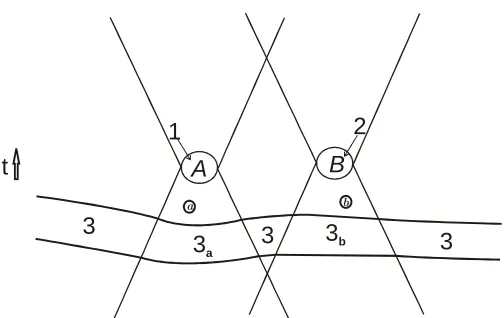
To see the problem, consider the set-up for the intended application depicted in Figure 1. A,B describe macroscopic events3, each usually referred to as the detection of a photon linearly polarized either vertically or horizontally relative to an a- or b-axis respectively: a,b label events at which an axis is selected by rotating through an anglea ; b respectively from some …xed direction in a plane. The region previously labeled 3 has been relabeled as 3a, a matching region 3b has been added in the backward light cone of 2, and ‘3’now labels the entire continuous “stack” of space-like hypersurfaces right across the backward light cones of 1 and 2, shielding o¤ these light cones’overlap from 1,2 themselves. Note that each of 1,ais space-like separated from each of 2, b.
2Both andcare assumed con…ned to region 3 (now symmetrically extended so as also to
close the backward light cone of 2): cstands for the values of magnitudes characterizing the experimental set-up in terms admitted by ordinary quantum mechanics, while speci…es the values of magnitudes introduced by the theory supposed to complete quantum mechanics. It will not be necessary to mentioncin what follows.
3I use each of ‘A’,‘B’to denote a random variable with values {V
A; HA}, {VB; HB}
respec-tively. eA(eA) denotes the event in region 1 of Alice’s photon being registered as vertically
(horizontally) polarized. eB (eB) denotes the event in region 2 of Bob’s photon being
t
A
B
3
a3
3
3
3
ba b
1
2
Figure 1: Space-time diagram for
Local Causality
In some theories, a complete speci…cation of local beables in 3 would con-strain (or even determine) the selection eventsa,b. But in the intended appli-cationa,bmust be treated as free variables in the following sense: in applying a theory to a scenario of the relevant kind each ofa,bis to be speci…able indepen-dently in a theoretical model, and both are taken to be speci…able indepenindepen-dently of a speci…cation of local beables in region 3. Since this may exclude some com-plete theoretical speci…cations of beables in region 3 it is best not to require such completeness. Instead, one should say exactly what it is for a speci…cation to be su¢ cient.
Seevinck and U¢ nk [2011] clarify this notion of su¢ ciency as a combination of functional and statistical su¢ ciency, rendering the labelband random vari-able B (respectively) redundant for predicting P ra;b(AjB; ), the probability
a theory speci…es for beable A representing the outcome recorded in region 1 given beables a,b representing the free choices of what the apparatus settings are in sub-regions of 1,2 respectively, conditional on outcomeBin region 2 and beable speci…cation in region 3. This implies
P ra;b(AjB; ) =P ra(Aj ) (4a)
Notice thata; bare no longer treated as random variables, as be…ts their status as the locus of free choice. It would be unreasonable to require a theory of local beables to predict the probability that the experimenters make one free choice rather than another: but treatinga; b as random variables (as in Bell’s formulation of Factorizability) would imply the existence of probabilities of the formP r(aj ),P r(bj ).
By symmetry, interchanging ‘1’with ‘2’, ‘A’with ‘B’and ‘a’with ‘b’implies
P ra;b(BjA; ) =P rb(Bj ) (4b)
Together, these equations imply the condition
P ra;b(A; Bj ) =P ra(Aj ) P rb(Bj ) (FactorizabilitySU)
used to derive CHSH inequalities. Experimental evidence that these inequalities are violated by the observed correlations in just the way quantum theory leads one to expect may then be taken to discon…rm Bell’s intuitive causality principle. In more detail, Seevinck and U¢ nk [2011] claim that orthodox quantum mechanics violates the statistical su¢ ciency conditions (commonly known as Outcome Independence, following Shimony)
P ra;b(AjB; ) = P ra;b(Aj ) (5a)
P ra;b(BjA; ) = P ra;b(Bj ) (5b)
while conforming to the functional su¢ ciency conditions (commonly known as Parameter Independence, following Shimony)
P ra;b(Aj ) = P ra(Aj ) (6a)
P ra;b(Bj ) = P rb(Bj ) (6b)
Statistical su¢ ciency is a condition employed by statisticians in situations where considerations of locality and causality simply don’t arise. But in this application the failure of quantum theory to provide a speci…cation of beables in region 3 such that the outcome B is always redundant for determining the probability of outcome A (and similarly with ‘A’, ‘B’ interchanged) has clear connections to local causality, as Seevinck and U¢ nk’s [2011] analysis has shown. In the light of Seevinck and U¢ nk’s [2011] analysis, perhaps Bell’s local causality condition (LC) should be reformulated as follows:
(LCSU) A theory is said to be locally causalSU if it acknowledges
a classR of beables in space-time region 3 whose values may be attached independently of the choice of a,b and are then su¢ cient to renderbfunctionally redundant andBstatistically redundant for the task of specifying the probability ofA in region 1.
The notions of statistical and functional redundancy appealed to here are as follows:
For "R ; rendersB statistically redundant for the task of specifying the probability ofAi¤P ra;b(AjB; ) =P ra;b(Aj ).
For "R , rendersbfunctionally redundant for the task of specifying the probability ofAi¤P ra;b(Aj ) =P ra(Aj ).
Though admittedly less general than (LC), (LC)SU seems less problematic
then they surely also count as locally inexplicable in so far as no theory of local beables can explain them consistent with (LC)SU. But Bell himself said we
should regard his step from (IP) to (LC) with the utmost suspicion, and that is what I shall do. My grounds for suspicion are my belief that quantum mechanics itself helps us to explain the particular correlations violating CHSH inequalities that Bell [2004, pp. 151-2] claimed to be locally inexplicable without action at a distance. Moreover, that explanation involves no superluminal action, and there is even a sense in which it is local.
To assess the status of (LC) (or (LC)SU) in quantum mechanics one needs to
say …rst how it is applied to yield probabilities attached to values of local beables in a space-time region 1 and then what it would be for these to be altered by speci…cation of values of local beables in a space-like separated region 2. This is not a straightforward matter. The Born rule may be correctly applied to yield more than one chance for the same event in region 1, and there is more than one way to understand the requirement that these chances be unaltered by what happens in region 2. As we’ll see, the upshot is that while Born rule probabilities do violate (Factorizability) (or (FactorizabilitySU)) here, this
counts as a violation of (LC) (or (LC)SU) only if that condition is applied in a
way that is not motivated by (IP)’s prohibition of space-like causal in‡uences.
3
Probability and chance
Bell credited his formulation of local causality (LC) with avoiding the "rather vague notions" of cause and e¤ect by replacing them with a condition of prob-abilistic independence. The connection to (IP)’s motivating talk of ‘cause’and ‘e¤ect’is provided by the thought that a cause alters (and typically raises) the chance of its e¤ect. But this connection can be made only by using the general probabilities supplied by a theory to supply chances of particular events.
By chance I mean the de…nite, single-case probability of an individual event such as rain tomorrow in Tucson. As in this example, its chance depends on whenthe event occurs— afterwards, it is always 0 or 1: and it may vary up until that time as history unfolds. Chance is important because of its conceptual connections to belief and action. The chance ofeprovides an agent’s best guide to how strongly to believe thateoccurs, when not in a position to be certain that it does.4 And the comparison betweene’s chances according as (s)he does or does not do D are critical in the agent’s decision about whether to do D. These connections explain why the chance of an event defaults to 0 or 1 when the agent is in a position to be certain about it— typically, after it does or doesn’t occur.
Probabilistic theories may be useful guides to the chances of events, but what they directly yield are not chances but general probabilities of the formPrC(E)
for an event of typeE relative to reference class C. To apply such a general probability to yield the chance ofe, you need to specify the typeEofeand also
4I use the “tenseless present” rather than the more idiomatic future tense here for reasons
the reference classC. A probabilistic theory may o¤er alternative speci…cations when applied to determine the chance ofe, in which case it becomes necessary to choose the appropriate speci…cations. Actuarial tables may be helpful when estimating the chance that you will live to be 100, but you di¤er in all kinds of ways from every individual whose death …gures in those tables. What you want is the most complete available speci…cation ofyour situation: this may include much irrelevant information, but it’s not necessary to exclude this since it won’t a¤ect the chance anyway. In Minkowski space-time, the conceptual connection between chance (Ch) and the degree of belief (Cr) it prescribes is captured in this version of David Lewis’s Principal Principle that implicitly de…nes chance:5
The chance ofe at p, conditional on any informationIp about the
contents ofp’s past light cone satis…es: Crp(e=Ip) =df Chp(e).
Now consider an agent who accepts quantum theory and wishes to de-termine the chance of the event eA that the next photon detected by
Al-ice registers as vertically polarized (VA). Assuming that the state j +i =
1
p
2(jHi jHi+jVi jVi) was prepared and the settings a; b chosen long before,
the agent is also in a position to be certain what these were. The agent is then in a position to use the Born rule to determine the chance of eA. But
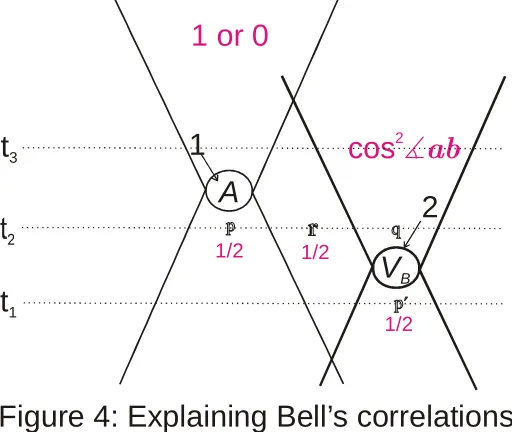
that chance must be relativized not just to a time, but (relativistically) to a space-time point. So consider the following diagram:
t
A
V
B1
2
Figure 2: “The” chance of
V
A1 or 0
1/2
1/2 1/2
cos
2]
ab
5See Ismael [2008]. I have slightly altered her notation to avoid con‡ict with my own.
As this shows, if the outcome in region 2 is of type VB then Chp(eA) =
Chp0(eA) =Chr(eA) =1
2, butChq(eA) = cos
26 ab. These are the chances that
follow from application of the Born rule to statej +i, given settings a; b. In
each case the eventeAof the next photon detected in1’s registering as vertically
polarized has been speci…ed as of typeVA, and the speci…cation of the reference
class at least includes the state and settings. Speci…cally,
Chp(eA) =P r +
a;b(VA) =jjP^A(V) +jj2=
1 2:
Chq(eA) =P r +
a;b(VAjVB)
P ra;b+(VA; VB)
P rb+(VB)
= 1 2cos
26 ab 1 2
= cos26 ab
Note that the reference class used in calculating Chq(eA) is narrower: it is
further restricted by speci…cation of the outcome as of typeVB in region2.
Any agent who accepts quantum theory and is (momentarily) located at space-time point xshould match credence ineA to Chx(eA) because it is
pre-cisely the role of chance to re‡ect the epistemic bearing of all information ac-cessible atxon facts not so accessible, and to accept quantum theory is to treat it as an expert when assessing the chances. This is so whether or not an agent isactually located atx— fortunately, since it is obviously a gross idealization to locate the epistemic deliberations of a physically situated agent at a space-time point! A hypothetical agent located at qin the forward light cone of region 2 (but not1) has access to the additional information that the outcome in 2is of typeVB: so the reference class used to infer the chance ofeA atq from the
Born rule should include that information. That is whyChq(eA)is determined
by the conditional Born probabilityP ra;b+(VAjVB) but Chp(eA)is determined
by the unconditional Born probabilityP ra;b+(VA).
In the special case that the settingsa; bcoincide (the polarizers are perfectly aligned) application of the Born rule yields the chances depicted in Figure 3. Bell ([2004, pp. 240-41]) took this example as a simple demonstration that ordinary quantum mechanics is not locally causal, crediting the argument of EPR [1935]. He begins
Each of the counters considered separately has on each repetition of the experiment a 50% chance of saying ‘yes’.
Each of the chancesChp(eA); Chp0(eB)is 12, as Bell says: butChq(eA) = 1.
After noting that quantum theory here requires a perfect correlation between the outcomes in1;2, he continues
t
A
V
B1
2
Figure 3: EPR-Bohm chances of
V
A1
1
1/2
1/2 1/2
It is true that (Factorizability) and (FactorizabilitySU) fail here, since
P ra;a+(VAjVB) = 1, P r +
a;a(HAjVB) = 0, while P r +
a;a(A) =P r +
a;a(B) = 12. But
does that constitute a violation of local causality? (LC) and (LCSU) are both
conditions straightforwardly applicable to a theory whose general probabilities yield auniquechance for each possible outcome in1prior to its occurrence. In the case of quantum theory, however, the general Born rule probabilities yield multiple chances for each possible outcome in1, each at the same time (in the laboratory frame): Chp(eA) = 21, but Chq(eA) = 1(assuming the outcome in
2is of typeVB). When (LC) speaks of “the probabilities attached to [eA; eA]
in a space-time region1being unaltered by speci…cation of [VB] in a space-like
separated region2” (my italics), which probabilities are these?
Since the connection to (IP)’s motivating talk of ‘cause’ and ‘e¤ect’ is provided by the thought that a cause alters the chance of its e¤ect, (LC) is motivated only if applied to thechancesofeA; eAin region1. ButChp(eA)isnot
altered by speci…cation ofVBin space-like separated region2: its value depends
only on what happens in the backward light cone of1, in conformity to its role in prescribingCrp(eA). Of courseChq(eA)does depend on the outcome in2. If
it did not, it could not ful…ll its constitutive role of prescribingCrq(eA=Iq)no
matter what informationIq provides about the contents ofq’s past light cone.
It follows thatChq(eA)is not altered butspeci…ed by speci…cation of the result
in2.
prediction: for such an agent the result in 1 remains totally uncertain: what happens in2makes no di¤erence to what (s)he should believe, since region2is outside the backward light cone ofp. That is why it isChp(eA), notChq(eA),
that says what is certain atp. Newtonian absolute time fostered the illusion of the occurrence of future events becoming certain for everyone at the same time— when they occur if not sooner. Relativity requires certainty, like chance, to be relativized to space-time points— idealized locations of hypothetical knowers.
So does ordinary quantum mechanics violate local causality? If “the probabilities” (LC) speaks of are P ra;b+(VA); P r
+
a;b(HA), and the condition
that these be unaltered is understood to be that P ra;b+(VA) = P r +
a;a(VAjB);
P ra;b+(HA) = P r +
a;a(HAjB), then ordinary quantum mechanics violates (LC).
But if this is all (LC) means, then it is not motivated by (IP) and its violation does not imply that the quantum world is non-local in that there are super-luminal causal relations between distant events. For (LC) to be motivated by causal considerations such as (IP), “the probabilities” (LC) speaks of must be understood to be chances, includingChp(eA)andChq(eA). But neither of these
would be altered by the speci…cation of the outcome [VB] in a space-like
sepa-rated region, so local causality would then not be violated. Although it remains unclear exactly how (LC) (or (LCSU)) is supposed to be applied to quantum
mechanics, one way of applying it is unmotivated by (IP), while if it is applied in another way quantum mechanics doesnot violate this local causality condition.
4
Chance and Causation
Suppose in the EPR-Bohm scenario that the outcome in region2had been of typeHB instead ofVB: thenChq(eA)would have been 0 instead of 1. Suppose
that the polarization axis for the measurement in region 2 had been rotated through60 : thenChq(eA)would have been 14 or 34, depending on the outcome
in region2. Or suppose that no polarization measurement had been performed in region2: thenChq(eA)would have been12. This shows thatChq(eA)depends
counterfactually on the polarization measurement in2and also on its outcome. Another way to understand talk of “alteration”of “the”probability of an event of typeVAis as the di¤erence between the actual value ofChq(eA)and what its
value would have been had the polarization measurement in2 or its outcome been di¤erent. Don’t such counterfactual “alterations” inChq(eA) amount to
causal dependence between space-like separated events, in violation of (IP)? There are several reasons why they do not.
The …rst reason is that while Chq(eA)would be di¤erent in each of these
counterfactual scenarios, in none of them wouldChp(eA)di¤er from 12, so the
"local" chance ofeA is insensitive to all such counterfactual variations in what
propensity whose actualization may produce an e¤ect—Chp(eA)seems better
quali…ed for the title of “the” chance ofeA thanChq(eA).
The role of chance in decision provides the second reason. Just as the chance ofetells you everything you need to know to …gure out how strongly to believe
e, the causal dependence ofeondtells you everything you need to know about
eanddwhen deciding whether to dod(assuming you are not indi¤erent about
e). As Huw Price [2012] put it, “causal dependence should be regarded as an analyst-expert about the conditional credences required by an evidential decision maker”.
Consider the situation of a hypothetical agent Bob atp0deciding whether to
act by a¤ecting what happens in2to try to get outcomeeAin1. Bob can choose
not to measure anything, or he can choose to measure polarization with respect to any axisb. If he were to measure nothing,Chq(eA)would be 12. If he were
to measure polarization with respect to the same axis as Alice, then Chq(eA)
would be either 0 or 1, with an equal chance (at his momentary locationp0) of either outcome. Since he can neither know nor a¤ect which of these chances it will be, he must base his decision on his best estimate ofChq(eA)in accordance
with Ismael’s [2008] Ignorance Principle:
“Where you’re not sure about the chances, form a mixture of the chances assigned by di¤erent theories of chance with weights deter-mined by your relative con…dence in those theories.”
Following this principle, Bob should assign Chq(eA) the estimated value
1 2:0 +
1 2:1 =
1
2, and base his decision on that. Since measuring polarization
with respect to the same axis as Alice would not raise his estimated chance of securing outcomeeAin1, he should eliminate this optionwhether or not he could
execute it. His estimated value ofChq(eA)were he to measure polarization with
respect to an axis rotated60 from Alice’s is also 12 (12:41+12:34 =12). Similarly for any other angle. This essentially recapitulates part of the content of the no-signalling theorems, going back to Eberhard [1978]. Bell [2004, pp. 237-8] shows why manipulation of external …elds atp0 or in 2would also fail to alter
Bob’s estimated value ofChq(eA).
But what if Bob had simply arranged for the measurement in2to have had the di¤erentoutcomeeB? ThenChq(eA)would have been 0 instead of 1. No-one
who accepts quantum mechanics can countenance this counterfactual scenario. The Born rule implies thatP rb+(HB) = 12, and anyone who accepts quantum
mechanics accepts the implication thatChp0(eB) = 12. So anyone who accepts
quantum mechanics will have credence Crp0(eB=Ip0) = 12 no matter what he
takes to happen in the backward light cone of p0 (as speci…ed by Ip0).6 If he
accepts quantum mechanics, Bob will conclude that there is nothing it makes sense to contemplate doing to alter his estimate ofChp0(eB), and so there is no
conceivable counterfactual scenario in which one in Bob’s position arranges for the measurement in2to have had the di¤erent outcomeeB. In general, there is
causal dependence between events in1and2only if it makes sense to speak of an intervention in one of these regions that would a¤ect a hypothetical agent’s estimated chance of what happens in the other. Anyone who accepts quantum mechanics should deny that makes sense.
Perhaps the most basic reason why counterfactual dependencies between happenings in region 2 and the chance(s) of eA are no sign of causal
depen-dence is that chances are not beables, and are incapable of entering into causal relations. That Bell thought they behaved like beables is suggested by the [1975] paper in which he introduced local causality as a natural generalization of local determinism:
“In Maxwell’s theory, the …elds in any space-time region 1are de-termined by those in any space region V, at some time t, which fully closes the backward light cone of 1. Because the region V is limited, localized, we will say the theory exhibitslocal determinism. We would like to form some no[ta]tion of local causality in theories which are not deterministic, in which the correlations prescribed by the theory, for the beables, are weaker.” [2004, p. 53]
It seems Bell thought the chances prescribed by a theory that is not deter-ministic were analogous to the beables of Maxwell’s electromagnetism, so that while local determinism (locally) speci…ed the local[ized] beables (e.g. …elds), local causality should (locally) specify the local[ized]chances of beables, where those chances (like local beables) are themselves localized physical magnitudes. Others have joined Bell in this view of chances as localized physical mag-nitudes. But quantum mechanics teaches us that chances are not localized physical propensities whose actualization may produce an e¤ect. Maudlin says what he means by calling probabilities objective:
“...there could be probabilities that arise from fundamental physics, probabilities that attach to actual or possible events in virtue solely of their physical description and independent of the existence of cog-nizers. These are what I mean byobjective probabilities.” (Beisbart and Hartmann eds., [2011, p. 294])
Although quantum chances do attach to actual or possible events, they are not objective in this sense. As we saw, the chance of outcomeeAdoes not attach
to it in virtue solely of its physical description: the chances of eA attach also
While they are neither physical entities nor physical magnitudes, quantum chances are objective in a di¤erent sense. They supply an objective prescription for the credences of an agent in any physical situation. Anyone who accepts quantum mechanics is committed to following that prescription.
5
A view of quantum mechanics
As I see it [2012], it is not the function of quantum states, observables, prob-abilities or the Schrödinger equation to represent or describe the condition or behavior of a physical system to which they are associated. These elements function in other ways when a quantum model is applied in predicting or ex-plaining physical phenomena such as non-localized correlations. Assignment of a quantum state may be viewed as merely the …rst step in a procedure that li-censes a user of quantum mechanics to express claims about physical systems in descriptive language and then warrants that user in adopting appropriate epis-temic attitudes toward some of these claims. The language in which such claims are expressed is not the language of quantum states or operators, and the claims are not about probabilities or measurement results: they are about the values of physical magnitudes, and I’ll refer to them asmagnitude claims. Magnitude claims were made by physicists and others before the development of quantum mechanics and continue to be made, some in the same terms, others in terms newly introduced as part of some scienti…c advance. But even though quantum mechanics represents an enormous scienti…c advance, claims about quantum states, operators and probability distributions are not magnitude claims.
The quantum state has two roles. One is in the algorithm provided by the Born Rule for assigning probabilities to signi…cant claims of the form
M (s): The value ofM onslies in , where M is a physical magnitude,sis a physical system and is a Borel set of real numbers. In what follows, I will call a descriptive claim of the form M (s) a canonical magnitude claim. For two such claims the formal algorithm may be stated as follows:
Pr(M (s); N (s)) =T r( ^PM[ ]:P^N[ ]) (Born Rule) Here represents a quantum state as a density operator on a Hilbert space
Hs and P^M[ ]is the value for of the projection-valued measure de…ned by
the unique self-adjoint operator onHs corresponding toM.
quantum mechanics— they are at most beables recognized in its applications.7 The quantum state is not a beable in this view. Indeed, since none of the distinctively quantum elements of a quantum model quali…es as a beable in-troduced by the theory, quantum mechanics has no beables of its own. Viewed this way, a quantum state does not describe or represent some new element of physical reality.8 But nor is it the quantum state’s role to describe or represent
the epistemic state of any actual agent. A quantum state assignment is objec-tively true (or false): in that de‡ationary sense a quantum state is objecobjec-tively real. But its function is not to say what the world is like but to help an agent applying quantum mechanics to predict and explain what happens in it. It is physical conditions in the world that make a quantum state assignment true (or false). True quantum state assignments are backed by true magnitude claims, though some of these are typically about physical systems other than that to which the state is assigned.
Any application of quantum mechanics involves claims describing a physical situation. While it is considered appropriate to make claims about where individual particles are detected contributing to the interference pattern in a contemporary interference experiment, claims about through which slit each particle went are frequently alleged to be “meaningless”. In its second role the quantum state o¤ers guidance on the inferential powers, and hence the content, of canonical magnitude claims.
The key idea here is that even assuming unitary evolution of a joint quantum state of system and environment, delocalization of system state coher-ence into the environment will typically render descriptive claims about experi-mental outcomes and the condition of apparatus and other macroscopic objects appropriate by endowing these claims with enough content to license an agent to adopt epistemic attitudes toward them, and in particular to apply the Born Rule. But an application of quantum mechanics to determine whether this is so will not require referring to any system as “macroscopic”, as an “apparatus”or as an “environment”. All that counts is how a quantum state of a super-system evolves in a model, given a Hamiltonian associated with an interaction between the system of interest and the rest of that super-system.
It is important to note that since the formulation of the Born Rule now involves no explicit or implicit reference to “measurement”, Bell’s ([2004, pp. 213-31]) strictures against the presence of the term ‘measurement’in a precise formulation of quantum mechanics are met. None of the other proscribed terms ‘classical’, ‘macroscopic’, ‘irreversible’, or ‘information’appears in its stead.
Since an agent’s assignment of a quantum state does not serve to rep-resent a system’s properties, her reassignment of a “collapsed” state on gaining new information represents no change in that system’s properties. That is why collapse is not a physical process, in this view of quantum mechanics. Nor does the Schrödinger equation express a fundamental physical law: to assign a quantum state to a system is not to represent its dynamical properties. A
7Compare Bell [2004, p. 55].
8Compare Bell [2004, p. 53]: "...this does not bother us if we do not grant beable status
formulation of quantum mechanics has no need to include a statement distin-guishing the circumstances in which physical processes of Schrödinger evolution and “collapse” occur. An agent can use quantum mechanics to track changes of the dynamical properties of a system by noting what magnitude claims are signi…cant and true of it at various times. But quantum mechanics itself does not imply any such claim, even when an agent would be correct to assign a system a quantum state, appropriately apply the Born Rule, and conclude that the claim has probability 1.
Quantum states are relational on this interpretation. When agents (ac-tually or merely hypothetically) occupy relevantly di¤erent physical situations they should assign di¤erent quantum states to one and the same system, even though these di¤erent quantum state assignments are equally correct. The primary function of Born probabilities is to o¤er a physically situated agent authoritative advice on how to apportion degrees of belief concerning contentful canonical magnitude claims that the agent is not currently in a position to check. That is why the Born rule should be applied by di¤erently situated agents to assign di¤erent chances to a single canonical magnitude claimM (s)about a systemsin a given situation. These di¤erent chance assignments will then be equally objective and equally correct.
The physical situation of a (hypothetical or actual) agent will change with (local) time. The agent may come to be in a position to check the truth-values of previously inaccessible magnitude claims, some of which may be taken truly to describe outcomes of measurements. If a quantum state is to continue to provide the agent with good guidance concerning still inaccessible magnitude claims, it must be updated to re‡ect these newly accessible truths. The required alteration in the quantum state is not a physical process involving the system, in con‡ict with Schrödinger evolution. What has changed is just the physical relation of the agent to events whose occurrence is described by true magnitude claims. This is not represented by a discontinuous change in the quantum state of some model: it corresponds to adoption of anew quantum model that incorporates additional information, newly accessible to the user of quantum mechanics.
6
How to use quantum mechanics to explain
non-localized correlations
In his [1981] Bell argued that
certain particular correlations, realizable according to quantum me-chanics, are locally inexplicable. They cannot be explained, that is to say, without action at a distance. [2004, pp. 151-2]
The particular correlations to which Bell refers arise, for example, in the EPR-Bohm scenario in which pairs of spin 12 "particles" are prepared in a sin-glet spin state, then at widely separated locations each element of a pair is passed through a Stern-Gerlach magnet and detected either in the upper or in the lower part of a screen. By calling them realizable rather than realized he acknowledged the experimental di¢ culties associated with actually produc-ing statistics supportproduc-ing them in the laboratory (or elsewhere). Enormous im-provements in experimental technique since 1981 have overcome most of the di¢ culties associated with performing a “loophole-free” test of CHSH or other so-called Bell inequalities and at the same time provided very strong statistical evidence for quantum mechanical predictions in analogous experiments. Since the improvements have been most dramatic for experiments involving polariza-tion measurements on entangled photons, it is appropriate to refer back to the experimental scenario discussed by Bell in 1990 ([2004, pp. 232-248]).
Suppose photon pairs are prepared at a central source in the entangled polarization state + = 1=p2(jHHi+jV Vi), and the photons in a pair are
both subsequently detected in coincidence at two widely separated locations after each has passed through a polarizing beam splitter (PBS) with axis set at a; b respectively. If a photon is detected with polarization parallel to this axis, a macroscopic record signi…es “yes”: if it is detected with polarization perpendicular to this axis, the record signi…es “no”. Let the record “yes” at one location be the event of a magnitudeAtaking on value+1, “no” the event of A taking on value 1, and similarly for B at the other location. Let a be a locally generated signal that quickly sets the axis of the PBS on theA side to an anglea from some standard direction, and similarly forb on theB side. Assume this is done so that each of a and A’s taking on a value is space-like separated from each ofb andB’s taking on a value. In this scenario quantum mechanics predicts that, fora = 0 ; a0 = 45 ; b = 221
2 ; b0 = 22 1 2
E(a; b) +E(a; b0) +E(a0; b) E(a0; b0) = 2p2 (7) where, for example,E(a; b) Pra;b(+1;+1) + Pra;b( 1; 1) Pra;b(+1; 1)
Pra;b( 1;+1). This is in violation of the CHSH inequality
jE(a; b) +E(a; b0) +E(a0; b) E(a0; b0)j 2 (CHSH) that follows from (FactorizabilitySU). Bell claims these correlations are
action at a distance. While it is generally acknowledged that quantum mechan-ics successfully predicts Bell’s particular correlations, demonstrating this will illustrate the present view of quantum mechanics. To decide whether it also explains them we need to ask what more is required of an explanation.
What we take to be a satisfactory explanation has changed during the development of physics, and we may con…dently expect such change to continue. One who accepts quantum mechanics is able to o¤er a novel kind of explanation. Nevertheless, explanations of phenomena using quantum mechanics may be seen to meet two very general conditions met by many, if not all, good explanations in physics.
(i) They show that the phenomenon to be explained was to be expected, and (ii) they say what it depends on.
Quantum mechanics enables us to give explanations meeting both conditions. Meeting the …rst condition is straightforward. Anyone accepting quan-tum mechanics can use the Born Rule applied to state + to calculate joint probabilities such asPra;b(A; B)and go on to derive (7). So for anyone who
ac-cepts quantum mechanics, violation of the CHSH inequalities is to be expected. But it is worth showing in more detail how quantum mechanics can be applied to derive (7) because this will help to exhibit the relational nature of quan-tum states and probabilities while making it clear that a precise formulation of quantum mechanics need not use the word ‘measurement’or any other term on Bell’s list of proscribed words [2004, p. 215].
t
1t
3A
V
B1
2
Figure 4: Explaining Bell’
s correlations
1 or 0
1/2
1/2 1/2
cos
2]
ab
Figure 4 is a space-time diagram depicting space-like separated polariza-tion measurements by Alice and Bob in regions 1,2 respectively on a photon pair. Time is represented in the laboratory frame. Att1 each takes the polarization
this quantum state assignment is their knowledge of the conditions under which the photon pair was produced— perhaps by parametric down-conversion of laser light by passage through a non-linear crystal. Such knowledge depends on in-formation about the physical systems involved in producing the pair. This state assignment is backed by signi…cant magnitude claims about such systems— if anything counts as a claim about beables recognized by quantum mechanics, these do. Then Alice measures polarization of photon L along axis a , Bob measures polarization of photon R along axis b . Decoherence at the photon detectors licenses both of them to treat the Born rule measure corresponding to state assignment + as a probability distribution over signi…cant canonical
magnitude claims about the values ofA; B.
Att1 Alice and Bob should both assign state + and apply the Born
Rule to calculate the joint probabilityPra;b+(A; B)assigned to claims about the values of magnitudesA; B— claims that we may, but need not, choose to describe as records of polarization measurements along botha ; b axes— and hence the (well-de…ned) conditional probability Pra;b+(A; B)=Pr
+
a;b(B) = jhAjBij2. Each
will then expect the observed non-localized correlations between the outcomes of polarization measurements in regions 1,2 when the detectors are set along the
a ; b axes. They will expect analogous correlations as these axes are varied, and so they will expect (7) (violating the CHSH inequality) in such a scenario. At t2, after recording polarization VB for R, Bob should assign pure
statejVBitoLand use the Born Rule to calculate the probabilitiesPrjaVB>(A) =
jhAjVBij2 for Alice to record polarization of L with respect to thea -axis. At
t2, Alice should assign state ^ = 12^1 to L, and use the Born Rule to calculate
probabilityPra(A) = 12 that she will record either polarization ofLwith respect to thea -axis. In this way each forms expectations as to the outcome of Alice’s measurement on the best information available to him or her at t2. Alice’s
statistics of her outcomes in many repetitions of the experiment are just what her quantum state 12^1 for L led her to expect, thereby helping to explain her results. Bob’s statistics for Alice’s outcomes (in many repetitions in which his outcome isVB) are just what his quantum statejVBiforLled him to expect,
thereby helping him to explain Alice’s results.
There is no question as to which, if either, of the quantum statesjVBi,
1
2^1was therealstate of Alice’s photon att2. Neither of the di¤erent probabilities
jhAjVBij2or 12 represents a unique physical propensity att2of Alice’s outcome—
even though neither its chance at p nor its chance at q is subjective. This discussion applies independent of the time-order in Alice’s frame of the regions 1, 2 in Figure 1: had she been moving away from Bob fast enough, she would have represented 1 as earlier than 2.
symptom of causes speci…ed by the true magnitude claims that back it since it is not an event distinct from the conditions those claims describe. Each event …guring in Bell’s particular correlations is truly described by a canonical mag-nitude claim. We may choose to describe some, but not all, such events as an outcome of a quantum measurement on a system: the probabilities of many of those events depend counterfactually on the particular entangled state assigned at t1— if that state had been di¤erent, so would these probabilities. But this
dependence is not causal. In quantum mechanics, neither states nor probabili-ties are the sorts of things that can bear causal relations: in Bell’s terminology, they are not beables.
When relativized to the physical situation of an actual or hypothetical agent, a quantum state assignment is objectively true or false— which depends on the state of the world. More speci…cally, a quantum state assignment is made true by the true magnitude claims that back it. One true magnitude claim backing the assignment of jVBi to L at q reports the outcome of Bob’s
polarization measurement in region 2 of Figure 1: but there are others, since this would not have been the correct assignment had the correct state assignment atp0 beenjH
AijVBi. We also need to ask for the backing of the entangled state
+.
There are many ways of preparing state +, and this might also be
the right state to assign to some naturally occurring photon pairs that needed no preparation. In each case there is a characterization in terms of some set of true magnitude claims describing the systems and events involved: these back the state assignment +. It may be di¢ cult or even impossible to give
this characterization in a particular case, but that is just an epistemic problem which need not be solved even by experimenters skilled in preparing or otherwise assigning this state. + will be correctly assigned atp0 only if some set of true
magnitude claims backing that assignment is accessible fromp0: events making
them true must lie in the backward light-cone ofp0.
A quantum state counterfactually depends on the true magnitude claims that back it in somewhat the same way that a dispositional property depends on its categorical basis. The state + may be backed by alternative sets of true magnitude claims just as a person may owe his immunity to smallpox to any of a variety of categorical properties. If Walt owes his smallpox immunity to antibodies, his possession of antibodies does not cause his immunity: it is what his immunity consists in. No more is the state + caused by its backing
magnitude claims: a statement assigning state +is true only if backed by some
true magnitude claims of the right kind. A quantum state is counterfactually dependent on whatever magnitude claims back it because backing is a kind of determination or constitution relation, not because it is a causal relation.
In this view, a quantum state causally depends neither on the physical situation of the (hypothetical or actual) agent assigning it nor on any of its backing magnitude claims. The correct statejVBito be assigned to L at q is
Bob sets his polarizer in region 2. But a quantum state assignment is not just a function of the subjective epistemic state of any agent: If Bob or anyone else were to assign a state other thanjVBi to Lat q he or she would be making a
mistake.
The quantum derivation of (7) shows not only that Bell’s particular correlations were to be expected, but also what they depend on. They depend counterfactually but not causally on the quantum state +, and they also
de-pend counterfactually on that state’s backing conditions, as described by true magnitude claims. The status of the quantum state disquali…es it from partici-pation in causal relations, but true magnitude claims may be taken to describe beables recognized by quantum mechanics. To decide which conditions backing any of the states involved in their explanation describe causes of Bell’s particu-lar correlations or the events they correlate we need to return to the connection between causation and chance.
The intuition that, other things being equal, a cause raises (or at least alters) the chance of its e¤ect is best cashed out in terms of an interventionist counterfactual: c is a cause ofe just in casec; eare distinct actual events and there is some conceivable intervention oncwhose occurrence would have altered the chance ofe. Such an intervention need not be the act of an agent: it could involve any modi…cation incof the right kind. Woodward [2003, p. 98] is one in‡uential attempt to say what kind of external in‡uence this would involve. Note that Einstein’s formulation of a principle of local action also appeals to intervention:
The following idea characterizes the relative independence of objects far apart in space (AandB): external in‡uence onAhas no imme-diate("unmittelbar") in‡uence onB; this is known as the ‘principle of local action’(Einstein [1948, pp. 321-2])
I used the idea of intervention to argue against any causal dependence be-tween events in1and 2: anyone who accepts quantum mechanics accepts that it makes no sense to speak of an intervention in one of these regions that would a¤ect a hypothetical agent’s estimated chance of what happens in the other. So even though the outcomeeB in2backs the assignment jVBito Lat q, the
outcome in1does not depend causally oneB: for similar reasons, neither does
the outcome in2depend on that in1. The same idea can now be used to show that both these outcomesdo depend causally on whatever eventoin the overlap of the backward light cones of1and 2warranted assignment of state +— an
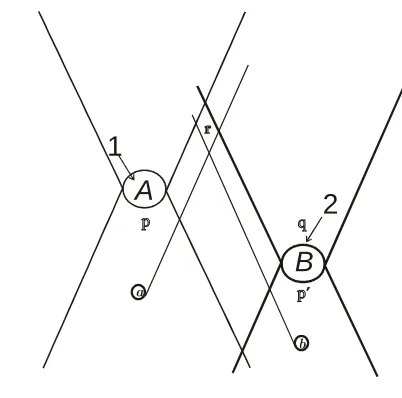
event truly described by magnitude claims that backed this assignment. Assume …rst that the events a; b at which the polarizers are set on a particular occasion occur in the overlap of the backward light cones of1and2: this assumption will later be dropped. Letrbe a point outside the future light cones ofeA; eB but within the future light cone of the evento. LeteA]eB be
the event of the joint occurrence ofeA; eB. This is an event of a type to which
the Born rule is applicable: the application yields its chance Chr(eA]eB) =
P ra;b+(VA; VB) = 12cos26 ab. We already saw thatChr(eA) = Pr +
Pra;b+(VB) =Chr(eB). The event o a¤ects all these chances: had a di¤erent
event o0 occurred backing the assignment of a di¤erent state (e.g. jHAijVBi),
or no event backing any state assignment, then any or all of these chances could have been di¤erent. Since it makes sense to speak of an agent altering the chance of eventoatsin its past light cone, we have
Chr(eA]eBjdo o)6=Chr(eA]eB)
Chr(eAjdo o)6=Chr(eA)
Chr(eBjdo o)6=Chr(eB)
where do o means o is the result of an intervention without which o would not have occurred. It follows thateA; eB; eA]eB are each causally dependent
on o: o is a common cause of eA; eB even though the probabilities of events
of these types do not factorize. The same reasoning applies to each registered photon pair on any occasion at any settingsa; b. So the second requirement on explanation is met: the separate recording events, as well as the event of their joint occurrence, dependcausally on the eventothat serves to back assignment of state + to the photon pairs involved in this scenario.
By rejecting any possibility of an intervention expressed bydo eB or
do eB, anyone accepting quantum mechanics should deny thatChp(q)(eAjdo
eB)6=Chp(q)(eAjdo eB)is true or even meaningful. NeverthelessChq(eAjeB)6=
Chq(eAjeB): in this senseeA depends counterfactually but not causally oneB.
Does such counterfactual dependence provide reason enough to conclude that
eAis part of the explanation ofeB? An obvious objection is that because of the
symmetry of the situation with1and2space-like separated there is an equally strong reason to conclude thateB is part of the explanation ofeA, contrary to
the fundamentally asymmetric nature of the explanation relation. But one can see that this objection is not decisive by paying attention to the contrasting epistemic perspectives associated with the di¤erent physical situations of hy-pothetical agents Alice* and Bob* with world-lines con…ned to interiors of the light cones of1,2respectively.
As his world-line enters the future light cone of 2 Bob* comes into position to know the outcome at2while still physically unable to observe the outcome at1. His epistemic situation is then analogous to that of a hypothetical agent Chris in a world with a Newtonian absolute time, in a position to know the outcome of past events but physically unable to observe any future event. Many have been tempted to elevate the epistemic asymmetry of Chris’s situation into a global metaphysical asymmetry in which the future is open while the past is …xed and settled. It is then a short step to a metaphysical view of explanation as a productive relation in which the …xed past gives rise to the (otherwise) open future, either deterministically or stochastically.9
Such a move from epistemology to metaphysics should always be treated with deep suspicion. But in this case it is clearly inappropriate in a relativistic space-time since the "open futures" of agents like Alice* and Bob* cannot be
uni…ed intotheopen future. This prompts a retreat to a metaphysically drained view of explanation as rooted in cognitive concerns of a physically situated agent, motivated by the need to unify, extend and e¢ ciently deploy the limited information to which it has access.
For many purposes it is appropriate to regard the entire scienti…c com-munity as a (spatially) distributed agent, and to think of the provision of sci-enti…c explanations as aidingour collective epistemic and practical goals. This is appropriate insofar as localized agents share an epistemic perspective, with access to the same information about what has happened. But Alice* and Bob* do not have access to the same information at timet2ort3since they are then
space-like separated. So it is entirely appropriate for Bob* to useeB to explain
eA and for Alice* to use eA to explain eB. This does not make explanation
a subjective matter for two reasons. There is an objective physical di¤erence between the situations of Alice* and Bob* underlying the asymmetry of their epistemic perspectives: and by adopting either perspective in thought (as I have encouraged the reader to do) anyone can come to appreciate how each explana-tion can help make Bell’s correlaexplana-tions seem less puzzling. Admittedly, neither explanation is very deep, and I will end by noting one puzzle that remains.
By meeting both minimal requirements on explanation, the application of quantum theory enables us to explain Bell’s correlations. But is this explana-tion local? Several senses of locality are relevant here. The explanaexplana-tion involves no superluminal causal dependence. As stated, the condition of Local Causality is not applicable to the quantum mechanical explanation since it presupposes the uniqueness of the probability to which it refers. (FactorizabilitySU) (and
presumably also (Factorizability)) are violated, but Bell ([2004, p. 243]) pre-ferred to see (Factorizability) as not a formulation but a consequence of ‘local causality’: I have argued that it is not. To retain its connection to (IP), a version of Local Causality should speak of chances rather than general probabilities. A version that equates the unconditional chance ofeAto its chance conditional
on eB holds, no matter how these chances are relativized to the same
space-time point. But a version that is clearly motivated by the intuitive principle (IP) would rather equate the unconditional chance of eA to its chance
condi-tional onan intervention that produces eB. However this version is inapplicable
since acceptance of quantum mechanics renders senseless talk of interventions producingeB.
The explanation one can give by applying quantum mechanics appeals tochances that are localized, insofar as they are assigned at space-time points that may be thought to o¤er the momentary perspective of a hypothetical ideal-ized agent whose credences they would guide. But these chances are not quan-tum beables and they are not physical propensities capable of manifestation at those locations (or anywhere else). The only causes …guring in the explanation are localized where the physical systems are whose magnitudes back the assign-ment of state +. That chances are not propensities becomes clear when one
t
A
a
b
1
2
Figure 5: A late chance
B
If a; bare set at the last moment, the chance ofeA]eB that …gures in its
explanation may be locatedlaterin the laboratory frame thaneA; eB. If chance
were a physical propensity it should actbefore its manifestation. But chances aren’t propensities— proximate causes of localized events. They are a localized agent’s objective guide to credence about epistemically inaccessible events.
I will conclude by noting one sense in which the explanation one can give using quantum mechanics is not local as it stands. Though it is a (non-factorizable) cause of events of types A; B in regions 1; 2 respectively, the eventois not connected to its e¤ects by any spatiotemporally continuous causal process described by quantum mechanics. This puts the explanation in tension with the…rst conjunct of Bell’s ([2004, p. 239]) intuitive locality principle (IP): "The direct causes (and e¤ ects) of events are near by, and even the indirect causes (and e¤ects) are no further away than permitted by the velocity of light."
References
[1] Bell, J.S. [1964]: On the Einstein-Podolsky-Rosen paradox.Physics 1, 195-200.
[2] Bell, J.S. [1975]: The theory of local beables. TH-2053-CERN, July 28.
[3] Bell, J.S. [1981]: Bertlmann’s socks and the nature of reality. Journal de Physique, Colloque 2, suppl. au numero 3, Tome 42, C2 41-61.
[4] Bell, J.S. [1985]: The theory of local beables.Dialectica 39, 86-96.
[5] Bell, J.S. [1990]: La nouvelle cuisine. In Sarlemijn and Krose, eds.,Between Science and Technology, 97-115.
[6] Bell, J.S. [2004]: Speakable and Unspeakable in Quantum Mechanics. Sec-ond Revised Edition. Cambridge: Cambridge University Press.
[7] Eberhard, P. [1978]: Bell’s theorem and the di¤erent concepts of locality. Nuovo Cimento,B46, 392–419.
[8] Einstein, A. [1948]: Quanten-mechanik und Wirklichkeit.Dialectica2, 320-23.
[9] Einstein, A., Podolsky, B., and Rosen, N. [1935]: Can quantum-mechanical description of physical reality be considered complete.Physical Review 47, 777-80.
[10] Healey, R. [2012]: Quantum theory: a pragmatist approach.British Journal for the Philosophy of Science 63, 729–71.
[11] Ismael, J. [2008]: Raid! Dissolving the big, bad bug.Nous 42, 292-307.
[12] Maudlin, T. [2007]: The Metaphysics within Physics. Oxford: Oxford Uni-versity Press.
[13] Maudlin, T. [2011]: Three roads to objective probability. In Beisbart, C. and Hartmann, S. eds. [2011]. Probabilities in Physics. Oxford: Oxford University Press, 293-319.
[14] Norsen, T. [2011]: John S. Bell’s Concept of Local Causality. American Journal of Physics 79, 1261-75.
[15] Price, H. [2012]: Causation, Chance and the rational signi…cance of super-natural evidence.Philosophical Review 121, 483-538.
[16] Seevinck, M.P., U¢ nk, J. [2011]: Not throwing out the baby with the bathwater: Bell’s condition of local causality mathematically ‘sharp and clean’”, in D. Diekset al.Explanation, Prediction and Con…rmation. Berlin: Springer, 425-50.