R E S E A R C H
Open Access
Electromagnetic waves scattering from a
sphere of complex conjugate medium
Ahsan Illahi
1, M. Bashir
2, Majeed A. S. Alkanhal
3, Sadia Khatoon
1, Abdul Ghaffar
4*and Y. Khan
3Abstract
A boundary value problem involving the scattering of electromagnetic waves from a sphere of complex conjugate medium (CCM) is studied. The sphere is placed in free space. The source of excitation for the sphere in our case is a plane wave. Incident, scattered and transmitted fields are formulated. The unknown coefficients in the scattered and transmitted fields are found using boundary conditions. From these electromagnetic fields, the Mie efficiencies are determined. The technique used in studying the scattering of electromagnetic waves from CCM is analytical and a closed form solution is obtained. It is shown by numerical results that the scattering is enhanced in case of CCM sphere as a target. Results for the limiting cases are also derived to compare the validity of our formulation with the published work.
Keywords:Scattering, Sphere, Complex medium
Introduction
The complex refractive index N=n±ik having real and imaginary parts are very important in dealing with the intrinsic optical properties. Complex conjugate medium is a special type of medium which is lossless medium having real value of refractive index. The concept of complex conjugate medium (CCM) was introduced a few years ago. Dragoman [1] proposed this medium; the reflection and transmission properties of this medium was discussed in detail by him. The CCM has complex value of relative electric permittivity and relative mag-netic permeability and real refractive index i.e.
εr¼m að þibÞ μr ¼ða−ibÞ
and refractive index N¼pffiffiffiffiffiffiffiffiεrμr¼
ffiffiffiffiffiffiffiffiffiffiffiffiffiffiffiffiffiffiffiffiffiffiffi
mða2þb2Þ q
, where‘m’is any positive integer.
The CCM modifies the scattering properties [2,3] and no energy absorption losses occur. The attenuation in the electromagnetic wave through the CCM medium is only due to its refractive index and absorption losses are zero [4]. Absorption is determined by the imaginary
parts of these two parameters (i.e.εrandμr). The attenu-ation of electromagnetic wave is determined or con-trolled by the imaginary part while the real part determines the phase velocity of waves as it traverses through the medium.
CCM is electrically active and magnetically dissipa-tive or electrically dissipadissipa-tive and magnetically acdissipa-tive. The gain coefficient in optical active materials (e.g. in the non-impurified non-magnetic semiconductor nano-sized lasers) is controlled by injection current. It can be tuned to the value required by CCM when Mn is used as dopant. Thus, CCM can be realized using the existing technology [1].
Scattering theory is a very important tool of physics. It provides important information about the particles or ob-stacles [5, 6]. Scattering of electromagnetic waves by spherical objects is very interesting and carry many appli-cations [7, 8]. Sphere is one of the few three-dimensional bounded geometrical shapes that possess a closed form analytical solution [9]. It is commonly used as a reference for any kind of electromagnetic scattering theory and ap-plications. Complete analytical treatment of electromag-netic plane wave scattering by a homogeneous, isotropic, dielectric sphere can be traced back to an 1890 paper by Lorenz, though credit for that achievement is commonly given to 1908 paper by Mie [10] . In this study, the scatter-ing of plane waves from CCM sphere is considered. The
© The Author(s). 2019Open AccessThis article is distributed under the terms of the Creative Commons Attribution 4.0 International License (http://creativecommons.org/licenses/by/4.0/), which permits unrestricted use, distribution, and reproduction in any medium, provided you give appropriate credit to the original author(s) and the source, provide a link to the Creative Commons license, and indicate if changes were made.
* Correspondence:[email protected]
4Department of Physics, University of Agriculture Faisalabad, Faisalabad, Pakistan
Mie efficiencies i.e. extinction, scattered, absorption and backscattered efficiencies have been computed.
This work will demonstrate that the scattering efficien-cies in case of CCM sphere dominates over the conven-tional dielectric sphere. This strong scattering effect can enhance significantly the light absorption in thin films and thus power conversion efficiencies of related solar cells which has already been investigated for dielectric nanospheres by several researchers e. g. [11] and experi-mentally demonstrated by [12]. This study related to the CCM sphere has not yet been reported before to the best of our knowledge.
Methods and formulation
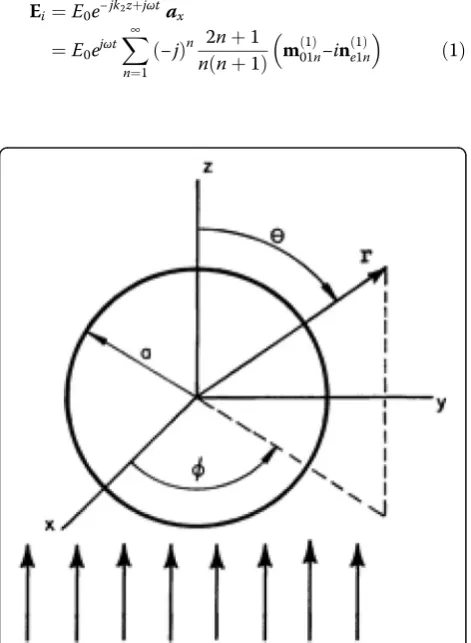
Consider a uniform plane wave with frequencyω propa-gating along positive z axis, from one medium to an-other medium. Let it travels from medium 1 i.e., space which is characterized byε0andμ0to a linear, isotropic and homogenous medium 2 i.e., CCM having relative electric permittivity εr and relative magnetic permeabil-ityμr(Fig.1).
The incident fields can be written as [13]
Ei¼E0e−jk2zþjωtax ¼E0ejωt
X∞
n¼1
−j
ð Þn 2nþ1 n nð þ1Þ m
1 ð Þ 01n−in
1 ð Þ e1n
ð1Þ
Hi¼E0μk2 2ω
e−jk2zþjωt a y
¼− k2 μ2ω
E0ejωt
X∞
n¼1
−j
ð Þn 2nþ1 n nð þ1Þ m
1 ð Þ e1nþin
1 ð Þ 01n
ð2Þ
where,E0is the amplitude of the incident wave, and
mð Þ1 eo1n¼
1
sinθjnðk2RÞP
1 nðcosθÞ
cos
sinφi2−jnðk2RÞ ∂ ∂θP1n
sin cosφi3
ð3Þ
here, subscripts‘o’and‘e’are for odd and even values, respectively, andJnis used for Bessel function.
nð Þ1
eo1n¼
n nð þ1Þ
k2R jnðk2RÞP 1
nðcosθÞ sincosφi1
þ 1
k2R k2Rjnðk2RÞ
0 ∂
∂θP1n sincosφi2
1
k2Rsinθ½k
2Rjnðk2RÞ k2Rjnðk2RÞ
0
P1nðcosθÞ cossinφi3
ð4Þ
The prime sign denotes the differentiation with respect to k2R. There are two parts of the induced secondary fields; first is transmitted field and the other is reflected field. The transmitted field only applies to interior of the sphere while reflected field extends up to infinity. We may write
Er¼E0ejωt
X∞
n¼1
−j
ð Þn 2nþ1 n nð þ1Þ a
r nm
3 ð Þ o1n−ibrnn
3 ð Þ e1n
ð5Þ
Hr¼−ωμk2 2
E0ejωt
X∞
n¼1
−j
ð Þn 2nþ1 n nð þ1Þ b
r nm
3 ð Þ e1n−jarnn
3 ð Þ o1n
ð6Þ
which is valid forR > a, and
Et¼E0ejωt
X∞
n¼1
−j
ð Þn 2nþ1 n nð þ1Þ a
t nm
1 ð Þ o1nþ jbtnn
1 ð Þ e1n
ð7Þ
Ht¼−ωμk1 1
E0ejωt
X∞
n¼1
−j
ð Þn 2nþ1 n nð þ1Þ b
t nm
1 ð Þ e1n−jatnn
1 ð Þ o1n
ð8Þ
which is applicable for R < a. the functions mðe1oÞ1n and nð1Þ
eo1nare deduced by replacingjn(k2R) byh 1
nðk2RÞ
Boundary Conditions
On the surface of CCM sphere, both the electric and magnetic field components are continuous. i.e. atR = a,
i1ðEi−ErÞ ¼i1Et ð9Þ
These B.Cs, leads to two pairs of equations for expan-sion coefficients:
atnjnð ÞNρ −anrhð Þn1ð Þ ¼ρ jnð Þρ μ2atn Nρjnð ÞNρ
0
−μ1arn ρh1nð Þρ
0
¼μ1 ρjnð Þρ
0
μ2Nbtnjnð ÞNρ −μ1brnhð Þn1ð Þ ¼ρ μ1jnð Þρ btn Nρjnð ÞNρ
0−
Nbrn ρhð Þn1ð Þρ
h i0
¼N ρjnð Þρ
0
where,
k1¼Nk2 ρ¼k2a k1a¼Nρ
Now, the coefficients of external field are given by,
arn¼− μ1jnNð Þρ ρjnð Þρ 0−μ
2jnð Þρ Nρjnð ÞNρ
0
μ1jnð ÞNρ ρhð Þn1ð Þρ
h i0
−μ2hð Þn1ð Þρ Nρjnð ÞNρ
0
ð10Þ
brn¼−
μ1jnð Þρ Nρjnð ÞNρ
0
−μ2N2j
nð ÞNρ ρjnð Þρ
0
μ1hð Þn1ð Þρ Nρjnð ÞNρ
0−μ
2N2jnð ÞNρ ρhð Þn1ρ
h i0
ð11Þ
Scattering cross sections
The ratio of total energy scattered per second, to the in-cident energy density on a spherical particle, is termed as scattering cross section.
Qs¼Ws
Pi ð
12Þ
Qs¼ 2π
k22
X∞
n¼1 2nþ1
ð Þ arn
2þ brn
2
ð13Þ
The mean energy density incident on particle is given by;
Pi¼ 1 2E 2 0 ffiffiffiffiffiffiffiε2 μ2 r
ð14Þ
Ws¼πE 2 0 k22
ffiffiffiffiffiε2
μ2
r X∞
n¼1 2nþ1
ð Þ arn
2 þ brn
2
ð15Þ
The scattered energy can also be found by integrating the Poynting vector over the surface of the sphere under study, which is given by;
Wext¼∬Psca:ndS Wext¼∬ Esca:Hsca
:ndS ð16Þ
SCS is calculated using [14];
σsca¼Wext
Pinc ð
17Þ
Extinction /Total cross sections
The beam of electromagnetic wave is attenuated by ab-sorption and scattering of incident wave. From conserva-tion of energy, we may write;
WsþWa ¼Wt
In terms of cross sections, the above equation may be put in the form,
QsþQa ¼Qt
where,
Qt ¼ 2π
k22 ReX
∞
n¼1 2nþ1
ð Þarnþbrn ð18Þ
Absorption cross sections
The amount of energy dissipated inside the particle in the form of heat or other forms, is absorbed by the particle. The ratio of energy absorbed by the sphere, to the energy flux density is known as Absorption cross section (ACS).
Qa ¼Qt−Qs
ACS can also be found by integrating the total heat or energy losses in the particle due to thermal excitations. The rate of energy losses is given by;
Qt ¼ 2π
k22 ReX
∞
n¼1 2nþ1
ð Þ arnþbrn
ð19Þ
Qloss¼ 1
2 Re Jtot:E
þ
jωB:H
½ ð20Þ
where,
Jtot ¼σEþjωD
i.e. the sum of conduction and displacement currents. The amount of absorbed energy is given by;
Wabs ¼∭QlossdV
Finally,
Results and discussion
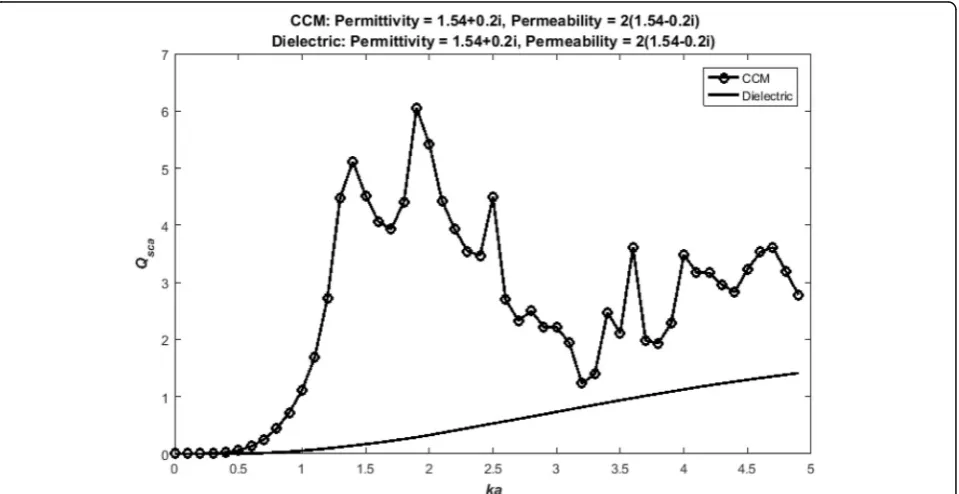
Fig. 2 shows the scattered efficiencies which has been plotted against the size parameter ‘ka’. The complex valued relative permittivity and relative permeability are εr= 1.54 + 0.2i, μr= 2(1.54−0.2i) respectively. The parameters for the dielectric sphere are εr= 1.54 + 0.2i, μr= 1, respectively. Solid line shows behavior of dielectric sphere whereas the line with marker shows the behavior of CCM sphere. It can be seen from the plot that the scattered efficiencies are greater in case of CCM sphere than the dielectric sphere. This is due to the reason that imaginary parts of complex valued relative permittivity and permeability gives real valued refractive index as they satisfy the complex conjugate material condition. Hence the losses due to absorp-tion are zero that boost the scattering.
In Fig. 3 the extinction efficiencies have been plotted against the size parameter ‘ka’. The values of complex permittivity and permeability are εr =1.54 + 0.2i, μr = 2(1.54–0.2i) respectively for CCM sphere whereas rela-tive permittivity and relarela-tive permeability of dielectric sphere are εr= 1.54 + 0.2i, μr= 1, respectively. Solid line shows extinction due to dielectric sphere whereas the line with marker shows the extinction due to CCM. The extinction due CCM is more than the extinction due to dielectric. It is due to the scattering that contributes more to the extinction.
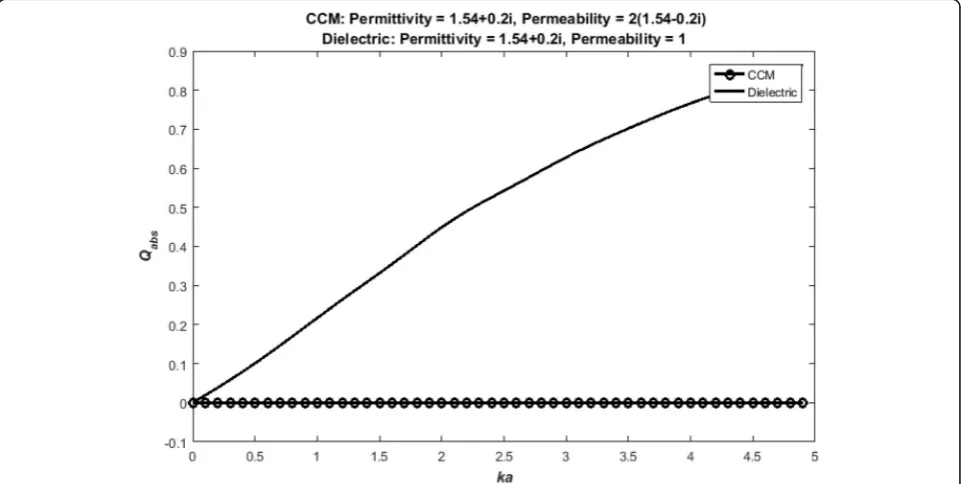
Figure 4 shows absorption efficiency comparison be-tween CCM sphere and dielectric sphere. Due to
complex conjugated values of relative permittivity and permeability, we get real valued refractive index and hence absorption cross section reduced to zero whereas in case of dielectric, the values of relative permittivity and relative permeability are not complex conjugate of each other i.e., εr = 1.54 + 0.2i, μr =1, as a result we get complex value of refractive index and hence absorption cross section increases. This figure shows that the energy loss of the electromagnetic wave is greater in dielectric than CCM due to absorption.
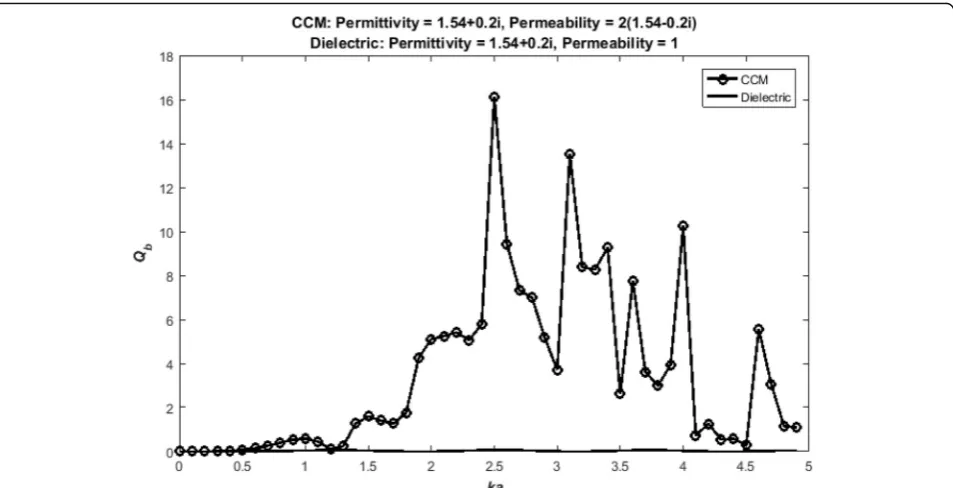
Figure 5 shows the backscattered efficiencies which have been plotted against the size parameter ‘ka’. It can be seen from the graph that the backscattered ef-ficiencies in case of dielectric sphere is almost zero as compared to the CCM sphere. These are the most pronounced and interesting results that can be used in different applications. Taking different values of complex relative permittivity and permeability, we get the same results like in above.
Conclusion
A sphere made up of complex conjugate medium is considered. Complex conjugate medium is a distinct nature of medium which has real refractive index and complex valued relative permittivity and permeability. When these two parameters (μr and εr) become complex conjugate of each other; the refractive index becomes real which makes the medium lossless.
These materials have many applications in optics for example optoelectronics, miniaturized amplifiers and lasers etc.
In the present work, the spherical vector wave func-tions expansion method is used for the analytical result of the problem of the plane wave scattering by CCM sphere. The properties of complex valued constitutive
parameters on the scattering properties of a sphere have been investigated. This medium modifies the scattering properties of the sphere. The refractive index of sphere becomes real because the electric permittivity is complex conjugate of the magnetic permeability. Due to the real value of refractive index of this medium the absorption cross section becomes nearly equal to zero and
extinction will be only due to the scattering. In other words, the scattered field is only due to the impedance mismatch at the boundary of the sphere. Mie efficiencies of dielectric and CCM sphere have been plotted against the size parameter of the sphere and found that the scattering in case of CCM sphere is dominat-ing over that of dielectric case. Arrays of CCM spheres may be used as a promising light trapping schemes for thin film solar cells.
Acknowledgements
Not applicable.
Authors’contributions
AI, MAG, MA derived analytical expressions and numerical analysis. They wrote the main manuscript text. SK and YK developed methodology in the given study. All authors read and approved the final manuscript.
Funding
Deanship of Scientific Research (DSR) at King Saud University for its funding of this research through the Research Group no RG-1436-012.
Availability of data and materials
Detail about data has been provided in the article.
Competing interests
The authors declare that they have no competing interests.
Author details
1Department of Physics, Research in Modeling and Simulation (RIMS) Group, COMSATS University Islamabad, Islamabad, Pakistan.2Department of Electrical Engineering, King Saud University, Riyadh, Saudi Arabia. 3Department of Electrical Engineering, University of Management and Technology, Lahore, Pakistan.4Department of Physics, University of Agriculture Faisalabad, Faisalabad, Pakistan.
Received: 28 December 2018 Accepted: 20 May 2019
References
1. Dragoman, D.: Complex conjugate media: alternative configurations for miniaturized lasers. Opt. Commun.284, 2095–2098 (2011)
2. Rao, S., Wilton, D., Glisson, A.: Electromagnetic scattering by surfaces of arbitrary shape. IEEE Trans. Antennas Propag.30, 409–418 (1982)
3. Bin-Jie, H., Kai-Ning, E.Y., Jun, Z., Serge, T.: Scattering characteristics of conducting cylinder coated with nonuniform magnetized ferrite. Chin. Phys.14, 2305 (2005)
4. Sadrara, M., Miri, M.: Scattering of electromagnetic waves by a cluster of charged spherical nanoparticles. JOSA B.33, 2552–2559 (2016) 5. Xiang, J., He, S., Zhang, Y., Zhu, G.: A spectral domain approach for the
calculation of the scattering of the stratified uniaxial electric anisotropic media under point source excitation with arbitrary orientation. Int. J. Appl. Electromagn. Mech.48, 33–46 (2015)
6. Hamid, A., Cooray, F.: TE scattering by a perfect electromagnetic conducting semi-elliptic-cylindrical boss on a perfectly conducting plane. Int. J. Appl. Electromagn. Mech.38, 1–8 (2012)
7. Zimmermann, E., Dändliker, R., Souli, N., Krattiger, B.: Scattering of an off-axis Gaussian beam by a dielectric cylinder compared with a rigorous electromagnetic approach. JOSA A.12, 398–403 (1995)
8. Lock, J.A.: Scattering of a diagonally incident focused Gaussian beam by an infinitely long homogeneous circular cylinder. JOSA A.14, 640–652 (1997)
9. Tzarouchis, D., Sihvola, A.: Light scattering by a dielectric sphere: perspectives on the Mie resonances. Appl. Sci.8, 184 (2018) 10. Lakhtakia, A., Mackay, T.G.: Electromagnetic scattering by homogeneous,
isotropic, dielectric–magnetic sphere with topologically insulating surface states. JOSA B.33, 603–609 (2016)
11. Yang, Z., Gao, P., Zhang, C., Li, X., Ye, J.: Scattering effect of the high-index dielectric nanospheres for high performance hydrogenated amorphous silicon thin-film solar cells. Sci. Rep.6, 30503 (2016)
12. Spinelli, P., Lenzmann, F., Weeber, A., Polman, A.: Effect of EVA encapsulation on antireflection properties of Mie nanoscatterers for c-Si solar cells. IEEE J. Photovolt.5, 559–564 (2015)
13. Stratton, J.A.: Electromagnetic Theory. McGraw-Hill Comp., New York and London (1941).
14. Yushanov, S., Crompton, J.S., Koppenhoefer, K.C.: Mie Scattering of Electromagnetic Waves, in Proc. COMSOL conf, pp. 1–7 (2013)
Publisher’s Note