Daniel et al. World Journal of Engineering Research and Technology
EFFECT OF PROCESS PARAMETERS ON MATERIAL REMOVAL
RATE (MRR) DURING TURNING OF MILD CARBON STEEL CS 1030
USING TAGUCHI METHOD
Ipilakyaa T. Daniel*, Nwankwo N. Kingsley and Yanshio E. Terngu
Department of Mechanical Engineering, University of Agriculture, Makurdi, Benue
State-Nigeria.
Article Received on 08/05/2017 Article Revised on 29/05/2017 Article Accepted on 18/06/2017
ABSTRACT
An experimental investigation of the effect of process parameters
(cutting speed, feed rate and depth of cut) on Material Removal Rate
(MRR) have been carried out during CNC turning of Mild Carbon steel
CS 1030 using Taguchi experimental design. An Orthogonal array has
been selected and constructed to find the optimal levels and to analyze
the effect of the turning parameters. The signal-to-noise (S/N) ratio has been calculated to
construct the analysis of variance (ANOVA) table to study the performance characteristics in
dry turning operations. The ANOVA shows that, the feed rate has the most significant role
(56.79%) in producing higher MRR, followed by cutting speed (31.95%). Interaction of feed
and speed has a highest significant effect on Material removal rate with 11.18% contribution.
Also maximum material removal rate was achieved at optimal parametric combination of
347mm/min cutting speed, 0.458 mm/rev feed rate and 1.1 mm depth of cut.
KEYWORDS: Taguchi method, CNC Turning, Cutting Parameters, MRR.
INTRODUCTION
High speed machining (HSM) and modern machining technologies are being used to machine
the parts that need significant amount of material removal. Turning has been described as one
of the most important machining process in which a single point cutting tool removes
unwanted material from the surface of a rotating cylindrical work piece (Rao, 2008). The
World Journal of Engineering Research and Technology
WJERT
www.wjert.org
SJIF Impact Factor: 4.326*Corresponding Author Ipilakyaa T. Daniel
process parameters like cutting speed, feed rate, depth of cut, coolant condition and tool
geometry affects the material removal rate in turning. The proper selection of process
parameters is essential to optimize the metal removal rate. The present study considers
application of Taguchi method to optimize the CNC turning operation for maximum material
removal rate. The objective of this paper is to investigate process parameters for turning of
mild carbon steel, CS 1030 work piece on CNC lathe machine. In this study, speed, feed and
depth of cut are evaluated for high material removal rate (MRR).
The choice of CNC manufacturing process is based on cost optimization, improvement of
productivity and quality of the product by precision manufacturing. In manufacturing
industries after optimal selection of cutting conditions and cutting tools, experienced
shop-floor machine tool operators play a vital role in producing high quality product and
improving the productivity of the products. From last few decades, it has been observed that
selecting and implementing optimal machining conditions and most suitable cutting tool
during machining operations. There are many cutting parameters like cutting speed, feed rate
and depth of cut which has been selected to optimize the economics of machining operations,
as assessed by productivity, total manufacturing cost per part or some other criterion.
Regardless of early works on setting up optimum cutting speeds in Computer Numerically
Controlled (CNC) machining, the recent research have detailed that the process parameters
need to be optimized as CNC machining is an essential and costly process for small and
medium type manufacturing industries (Sanjit et al., 2010; Kadirgama et al., 1996; Basim et
al., 2010). Cutting parameters were analyzed based on the cutting characteristics of S45C
steel using Taguchi method and ANOVA analysis for determination of optimal cutting
parameters (Yang and Tamg, 1996). The parameter optimization of machining hardened steel
have been described. The common tendency of process is to reduce the machining cost and
time and increasing the accuracy of the product. By considering this problem, this paper uses
Taguchi Method develop a machining technique with higher cutting speed, feed rate and
depth of cut with better surface finish (Gopalsamy et al., 2009; Sujit, 2014).
Taguchi method is a statistical method developed for the production of robust products.
According to Taguchi, quality of a manufactured product is total loss generated by that
product to society from the time it is shipped. Taguchi stresses the importance of designing
quality into product into processes, rather than depending on the more traditional tools of
which reduced "variance" for the experiment with "optimum settings" of control parameters.
Thus the combination of Design of Experiments (DOE) with optimization of control
parameters to obtain best results is achieved in the Taguchi Method. Signal to noise (S/N),
ratio and orthogonal array are two major tools used in robust design. Signal to noise ratio,
which are log functions of desired output measures quality with emphasis on variation, and
orthogonal arrays, provide a set of well balanced experiments to accommodate many design
factors simultaneously presented (Sujit, 2014; Phadke, 1998). Taguchi’s robust design
method is suitable to analyze the metal cutting problem by considering the optimization in
end milling using S/N ratio approach and Pareto ANOVA method. It has been established
that the conceptual S/N ratio and Pareto ANOVA approaches for data analysis in end milling
uses at high cutting speed of 355 m/min, low feed rate of 0.1mm per tooth and low depth of
cut of 0.5 mm (Ghani et al., 2004). Application of Taguchi’s method for parametric design
was carried out to determine an ideal feed rate and desired force combination although small
interactions exist between a horizontal feed rate and desired force, the experimental results
showed that surface roughness decreases with a slower feed rate and larger grinding force,
respectively presented (Liu et al., 2004). Studies on the performance characteristics in turning
operations of Df2 (1.2510) steel bars using TiN coated tools using three cutting parameters
namely, cutting speed, feed rate, and depth of cut; they were optimized with considerations of
surface roughness (Jafar and Afsari, 2010). Systematic procedure of using Taguchi technique
for optimizing the MRR in Electric Discharge Machine (EDM) was also carried out (Pramod
et al., 2006). Taguchi methodology was also applied to optimize cutting parameters in CNC
turning for surface roughness turning of aluminum with parameters of turning at three levels
and four factors each in order to achieve the optimal material removal rate (Thamizhmanii et
al., 2007).
MATERIALS AND METHODS
The turning tests were carried out to determine the material removal rate under various
turning parameters. The workpiece used was mild carbon steel, CS1030 whose major
chemical compositions and mechanical properties are given in Table 1. Turning experiments
were carried out using tools of grade TP20 carbide flat-top inserts and 8 TiN coating on a
Table 1: Chemical compositions and mechanical properties of carbon steel, CS1030, Source: (eFunda, 2011).
C Mn P S Density,
(Kg/m3)
Tensile strength (MPA)
Hardness (BHN)
0.3% 0.6% 0.04% 0.05% 8.03x10³ 463.7 126
The workpiece were prepared in cylindrical shapes with a wall thickness of 3mm and
diameter of 100mm and length 300mm, and were machined from one. The feed rates to be set
by the lathe will correspond to the cut thickness t in orthogonal cutting and the wall thickness
of the workpiece represents the width of the cut b.
The product / process diagram is as shown in Figure 1 which shows the various influencing
factors of product/process design. The control factors are the factors, which can be controlled
to obtain the desired output, like speed, cutter radius, etc. The noise factors are the
uncontrollable factors, like temperature, humidity, vibration, friction, etc for the deviation of
the output from the desired output. Response is the outcome of the Product/Process after
giving three input variables.
Figure 1: Product/process diagram.
Taguchi Method
Traditional experimental design methods are very complicated and difficult to use.
Additionally, these methods require a large number of experiments when the number of
process parameters increases (Lan et al., 2008; Palanikumar and Karunamoorthy, 2006;
Dhavamani. and Alwarsamy, 2011). In order to minimize the number of tests required,
Taguchi experimental design method, a powerful tool for designing high-quality system, was
developed by Taguchi. This method uses a special design of orthogonal arrays to study the
entire parameter space with small number of experiments only. Taguchi recommends
analyzing the mean response for each run in the inner array, and he also suggests analyzing
Signal-to-1. Smaller-the-better
2. Larger-the-better
3. Nominal-the-best
In practice MRR should be high, thus Taguchi method refers to select the process parameter
having more S/N ratio. Therefore, we would use the larger the better S/N ratio. That is;
Where, is the average of observed data, is the variance of y, n is the number of
observations and y is the observed data.
Regardless of category of the performance characteristics, the lower S/N ratio corresponds to
a better performance. Therefore, the optimal level of the process parameters is the level with
the lowest S/N value. The statistical analysis of the data was performed by analysis of
variance (ANOVA) (Selvaraj and Chandarmohan, 2010; Kamarudin and Rahim, 2007) to
study the contribution of the factor and interactions and to explore the effects of each process
on the observed value.
RESULTS AND DISCUSSION
A series of turning tests was conducted to assess the influence of turning parameters on
material removal rate during turning of CS 1030. Results of the material removal rate for the
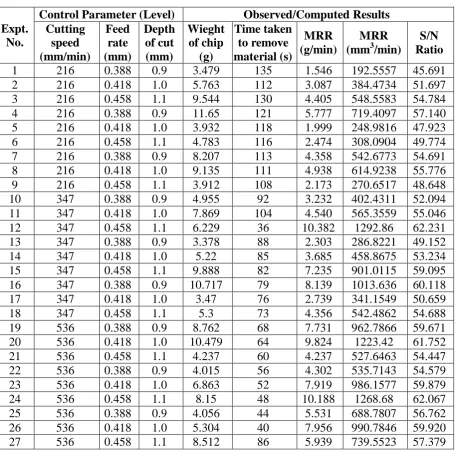
turning process with various turning parameters are shown in Table 2. Table 2 also gives S/N
ratio for material removal rate. The S/N ratios for each experiment of L27 were calculated
(Sahoo et al., 2008). The objective of using the S/N ratio as a performance measurement is to
develop products and processes insensitive to noise factor.
Regardless of the category of the performance characteristics, a greater S/N value
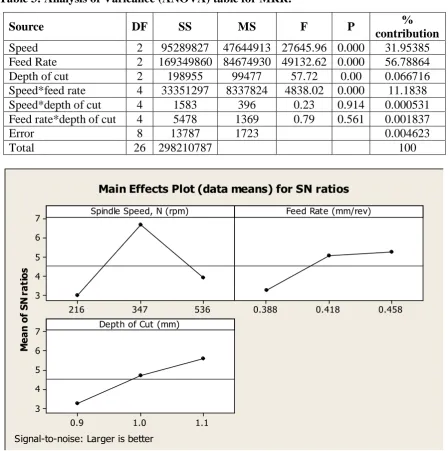
parameters is the level with the greatest value. The effect of spindle speed on the metal
removal rate values is shown in Figure 2 for S/N ratio. Its effect is increasing with increase in
spindle speed up to 347 mm/min, beyond 347 mm/min, the effect begins to decrease.
Therefore, the optimum spindle speed is level 2 i.e. 347 mm/min. Similarly, the effect of feed
rate on the metal removal rate values is also shown in Figure 2 for S/N ratio. Its effect is
increasing with increase in feed rate. So the optimum feed rate is level 3 i.e. 0.458 mm/rev. it
can be seen also that, the effect of the depth of cut on the metal removal rate values for the
S/N ratio is also increasing with increase in depth of cut. So the optimum depth of cut is level
3 i.e. 1.1 mm.
Table 2: Experimental Result and Corresponding S/N Ratio.
Expt. No.
Control Parameter (Level) Observed/Computed Results Cutting speed (mm/min) Feed rate (mm) Depth of cut (mm) Wieght of chip (g) Time taken to remove material (s) MRR (g/min) MRR (mm3/min)
S/N Ratio
1 216 0.388 0.9 3.479 135 1.546 192.5557 45.691
2 216 0.418 1.0 5.763 112 3.087 384.4734 51.697
3 216 0.458 1.1 9.544 130 4.405 548.5583 54.784
4 216 0.388 0.9 11.65 121 5.777 719.4097 57.140
5 216 0.418 1.0 3.932 118 1.999 248.9816 47.923
6 216 0.458 1.1 4.783 116 2.474 308.0904 49.774
7 216 0.388 0.9 8.207 113 4.358 542.6773 54.691
8 216 0.418 1.0 9.135 111 4.938 614.9238 55.776
9 216 0.458 1.1 3.912 108 2.173 270.6517 48.648
10 347 0.388 0.9 4.955 92 3.232 402.4311 52.094
11 347 0.418 1.0 7.869 104 4.540 565.3559 55.046
12 347 0.458 1.1 6.229 36 10.382 1292.86 62.231
13 347 0.388 0.9 3.378 88 2.303 286.8221 49.152
14 347 0.418 1.0 5.22 85 3.685 458.8675 53.234
15 347 0.458 1.1 9.888 82 7.235 901.0115 59.095
16 347 0.388 0.9 10.717 79 8.139 1013.636 60.118
17 347 0.418 1.0 3.47 76 2.739 341.1549 50.659
18 347 0.458 1.1 5.3 73 4.356 542.4862 54.688
19 536 0.388 0.9 8.762 68 7.731 962.7866 59.671
20 536 0.418 1.0 10.479 64 9.824 1223.42 61.752
21 536 0.458 1.1 4.237 60 4.237 527.6463 54.447
22 536 0.388 0.9 4.015 56 4.302 535.7143 54.579
23 536 0.418 1.0 6.863 52 7.919 986.1577 59.879
24 536 0.458 1.1 8.15 48 10.188 1268.68 62.067
25 536 0.388 0.9 4.056 44 5.531 688.7807 56.762
26 536 0.418 1.0 5.304 40 7.956 990.7846 59.920
The following formulae are used to compute Table 2;
The Analysis of Varieance (ANOVA) table for material removal rate is presented in Table 3.
Table 3: Analysis of Varieance (ANOVA) table for MRR.
Source DF SS MS F P %
contribution
Speed 2 95289827 47644913 27645.96 0.000 31.95385
Feed Rate 2 169349860 84674930 49132.62 0.000 56.78864
Depth of cut 2 198955 99477 57.72 0.00 0.066716
Speed*feed rate 4 33351297 8337824 4838.02 0.000 11.1838
Speed*depth of cut 4 1583 396 0.23 0.914 0.000531
Feed rate*depth of cut 4 5478 1369 0.79 0.561 0.001837
Error 8 13787 1723 0.004623
Total 26 298210787 100
M
ea
n
of
S
N
ra
ti
os
536 347
216 7
6
5
4
3
0.458 0.418
0.388
1.1 1.0
0.9 7
6
5
4
3
Spindle Speed, N (rpm) Feed Rate (mm/rev)
Depth of Cut (mm)
Main Effects Plot (data means) for SN ratios
Signal-to-noise: Larger is better
The effect of parameters, that is cutting speed, feed rate and depth of cut and some of their
interactions were also evaluated using ANOVA analysis with the help of MINITAB 17
software as shown in Table 3. The purpose of the ANOVA is to identify the optimum
parameters for maximum material removal rate. From the ANOVA table it is clear that the
most significant factor at 95% confidence is the feed rate, having a percentage contribution
up to 56.79% to material removal rate. After that, the second main contribution is the cutting
speed with a percentage contribution of 31.95%. This means that, the combined effect of feed
rate and speed has the most significant effect on material removal rate with a percentage
contribution of 11.18%. From Table 2 and Figure 2, it is observed that the maximum material
removal rate was achieved during machining of mild carbon steel CS 1030 workpiece at
cutting speed of 347 mm/min, feed rate of 0.458 mm and depth of cut of 1.1 mm/rev.
CONCLUSIONS
The effect of process parameters (cutting speed, feed rate and depth of cut) on material
removal rate (MRR) during turning operation using Taguchi method have been studied using
mild carbon steel CS 1030 as workpiece. With the increase in cutting speed, the material
removal rate is increased and as the feed rate increases the material removal rate also
increases. Results of ANOVA analysis show that, material removal rate (MRR) is mainly
affected by feed rate (56.79%) and cutting speed (31.95%). Interaction of feed and speed has
a highest significant effect on material removal rate with 11.18% contribution. It was also
observed that, for maximum material removal rate, the optimal parametric combination of
347mm/min cutting speed, 0.458 mm/rev feed rate and 1.1 mm depth of cut should be used
when machining mild carbon steel CS 1030.
REFERENCES
1. Rao P N (2008), Manufacturing Technology, Tata McGraw Hill publication, India.
2. Sanjit M, Saurav D, Ashish B and Pradip K. P., “Optimization of CNC milling process
parameters using PCA based Taguchi Method”, International Journal of Engineering
Science and Technology, 2010; 2(1): 92–102.
3. Kadirgama, K, Noor M M, Zuki. N M, Rahman M, Rejab, R, Daud, K., and Park S H,
Robust Design and Analysis for Quality Engineering, Chapman & Hall, London, 1996.
4. Basim A K and Bashir M. “Study of cutting speed on surface roughness and chip
formation when machining nickel-based alloy”, Journal of Mechanical Science and
5. Yang W H and Tarng Y S., “Design Optimization of Cutting Parameters for Turning
Operations based on the Taguchi Method”, Journal of Materials Processing Technology,
1998; 84: 122–129.
6. Gopalsamy B M, Mondal B and Ghosh S., “Taguchi method and ANOVA: An approach
for process parameters optimization of hard machining while machining hardened steel”,
Journal of Scientific and Industrial Research, 2009; 68: 686-695.
7. Sujit K J., Optimization of Process Parameters for optimal MRR during Turning Steel bar
using Taguchi Method and ANOVA, International Journal Mechanical Engineering and
Robotics Research, 2014; 3(2): 231–243.
8. Phadke M S., Quality Engineering Using Design of Experiment, Quality Control, Robust
Design and The Taguchi Method, Wadsworth & Books, California, 1988.
9. Ghani J A, Choudhury I A and Hasan, H H., “Application of Taguchi Method in
Optimization of End Milling Parameters”, Journal of Material Processing Technology,
2004; 145: 84–92.
10.Liu C H, Andrian, C, Chen C A and Wang Y T., “Grinding Force Control in Automatic
Surface Finish System”, Journal of Materials Processing Technology, 2005; 170: 367–
373.
11.Jafar Z and Afsari A., “Application of Taguchi method in the optimization of cutting
parameters for surface roughness in turning”, Proceedings of Academic Journal of
Manufacturing Engineering, 2010; 8(3).
12.Pramod K, Shahabadkar N B, Gurule K P and Nandurkar K N., “Experimental
Investigations on EDM Using Taguchi Technique for Optimization of Process
Parameters”, Proceedings of International Conference and 22nd AIMTDR
“Manufacturing Technologies and Systems for Competitive Manufacturing”
December-2006 organized by IIT Rorkee-India, December-2006; 941-946.
13.Thamizhmanii S, Saparudin S, and Hasan S., “Analysis of surface Roughness by Turning
Process using Taguchi”, Journal of Achievements in Materials and Manufacturing
Engineering, 2007; 20(1-2): 503 –506.
14.eFunda Properties of Carbon Steel AISI 1030, 2011.
http://www.efunda.com/materials/alloys/carbon_steels/show_carbon.cfm?ID=AISI_1030
&drop=all&Page_Title=AISI%201030 (Assessed 15th February, 2017).
15.Lan T S, Lo C Y, Wang M Y and Yen A Y., “Multi Quality Prediction Model of CNC
Turning Using Back Propagation Network”, Information Technology Journal, 2008; 7(6):
16.Palanikumar K and Karunamoorthy L., “Optimization of Machining Parameters in
Turning GFRP Composites Using a Carbide (K10) Tool Based on the Taguchi Method
with Fuzzy Logics”, Metals and Materials International, 2006; 12(6): 483-491.
17.Dhavamani C and Alwarsamy T., “Review on Optimization of Machining”, International
Journal of Academic Research, May2011; 3(3): II Part.
18.Selvaraj D P and Chandarmohan P., “Optimization of Surface Roughness of AISI 304
Austenitic Stainless Steel in Dry Turning Operation Using Taguchi Design Method”,
Journal of Engineering Science and Technology, 2010; 5(3): 293-301.
19.Kamarudin K and Rahim E A., “Optimizing Surface Roughness and Flank Wear on Hard
Turning Process Using Taguchi Parameter Design”, Proceedings of the World
Congress on Engineering, London, U.K., July 2-4; 2007.
20.Sahoo P, Barman T K and Routara B C., “Taguchi Based Practical Dimension Modeling
and Optimization in CNC Turning”, Advance in Production Engineering and