Review on Automated Irrigation System by using
Wire-less Sensor Network
Lakshata Bakade Riyaj Kazi
M.E Student (VLSI & EMBEDED) Professor
Department of Electronics & Communication Engineering Department of Electronics & Communication Engineering Dr.D.Y.PATIL.S.O.E. Lohegoan, Pune University Dr.D.Y.PATIL.S.O.E. Lohegoan , Pune University
Abstract
Automated irrigation system is used to optimize water use for agricultural crops. The aim of farmer is to produce “more crops per drop”, hence there are irrigation techniques which consumes less fresh water. These techniques are helpful in the regions where there is a scarcity of fresh water. Irrigation is the artificial of water to the soil usually for supporting in rising crops. To implement the proposed system uses ARM968E-S processor running at frequencies of up to 125 MHz maximum. Our embedded project is to design and develop a low cost feature which is based on embedded platform foe water irrigation system. This project uses temperature and soil moisture sensor to detect the water quality present in agriculture. The project uses ARM9 LPC2929 combined with 125 MHz ARM968ES CPU core, which is 32-bit controller to process the information. The aim of our embedded project is to monitor status of the sensor which can be monitored on web page through microcontroller. The web-server is connected to internet. This page contains all the information about the status of the sensor or else the owner can also monitor result through mobile. GSM modem is controlled with the help of standard set of AT (Attention) commands. These commands are used to control majority of the functions of GSM modem. Application of this system is use to monitor and control different parameters in agriculture and industrial field and also hazardous area such as chemical or nuclear plant.
Keywords: Irrigation System, ARM9 LPC2929, Wireless Communication. Soil Moisture Sensor, Temperature Sensor, Humidity Sensor, GSM
________________________________________________________________________________________________________
I.
I
NTRODUCTIONIn today’s world, population is increasing day by day. India is one of the most populated countries. Agriculture plays the important role in the economy and development, like India. As per the population growth, the agriculture productivity also needs to be increased. But the population to irrigation productivity is not up to the mark. There is an urgent need to create strategies based on science and technology for sustainable use of water, including technical, managerial, and institutional improvement. Due to lack of water and scarcity of land water result the decreasing volume of water on earth, the Farmer use irrigation. Irrigation may be defined as the science of artificial application of water to the land or soil that means depending on the soil type, plant are to be provided with water. In agriculture, there is two things is very important, first to get information of about fertility of soil and second is to measure moisture content in soil.
Irrigation management is a complex decision making process to determine when and how much water to apply to a growing crop to meet specific management objectives .If the farmer is far from land he will not be noticed of current conditions. So, efficient water management play an important role in the irrigated agriculture cropping system. The main aim of farmer is to produce “more crop per drop”, hence there is need to find the irrigation technique.
Nowadays for irrigation different Techniques are available which is used to reduce the dependency of rain. And mostly this technique is driven by electrical power and on/off scheduling controlled. There is also more technique available which is based on climate data which is irrigated with smart. New technologies coming but they are too expensive for the common farmer. This project offers a cheaper and simpler solution to this problem by developing automated microclimate irrigation controllers with wireless capability assisted with low cost wireless sensor nodes. Like temperature sensor, humidity sensor which senses the level of moisture of the soil. The land or firm is divided into microclimatic regions equipped with smart specified sensors and integrated wirelessly into automated irrigation controller with wireless networking capability.
Wireless Sensor Network play an vital role in this project. The benefits of wireless communication extend beyond simply not using wires. Wireless technology has an overall positive impact on the costs and efficiency of anything from home Internet installations to the operations of large corporations worldwide. Thereby the use of wireless communication for the monitoring and controlling on the agricultural land is highly essential. Applications in agriculture is use to provide data for appropriate management, such as monitoring of environmental conditions like weather, soil moisture content, soil temper-ature, soil fertility, mineral content, and weed disease detection, monitoring leaf temperature, moisture content, and monitoring growth of the crop, automated irrigation facility and storage of agricultural products
which will keep track of the moisture in the soil and as per the moisture content, it provide the correct amount of water to the crops.
II.
L
ITERATURE SURVEYAgriculture is backbone of our economy. It produces food and raw materials, but the production has completely declined in our country due to many natural and manly factors. The development of agriculture provides necessary capital for the enlargement of many sectors and foreign trade. As technology is developing day by day in all fields, technology in agriculture has also been developed. By initiating new technologies in agriculture the crops can be under regular maintenance without any need of manpower which will produce accurate measurement. It also provides surplus production of crops.
The system has a distributed wireless network of soil-moisture and temperature sensors placed in the root zone of the plants. In addition, a gateway unit handles sensor information, triggers actuators, and transmits data to a web application. An algorithm was developed with threshold values of temperature and soil moisture that was programmed into a microcontroller-based gateway to control water quantity.[1]
Soil moisture content has been detected using acoustic based technique was developed. The main propose of this technique is development for measure soil moisture in real time method. The technique based on relationship between two quantities i.e. speed of sound and the degree of saturation with water in soils. This experiment found that the speed of sound decreases with the moisture content following, depending on the kind of soil. [2]
This paper present the design space of wireless sensor net-work. It is salient to study the design of wireless sensor net-work because the construction of the hardware should sup-port a wide range of application which means any hardware should not be application specific. All the hardware used in the sensor nodes should be easily replaceable or should be easily modified. The main aim of their paper is to make an efficient design space with less complexity in hardware and software. A proper modular software and hardware has to be designed in order to form systematic sensor node so that the observed readings being registered in the sensor can be stored and transmitted.[3]
The rapid deployment of sensor nodes during volcanic ejec-tions. It also describes attaining real time outrageous fidelity node, remote configurability and high degree of durability. The design system distribution verifies the working of low cost sensor network, efficiently working in peculiar environ-ments. Meticulous timing is necessary for employing the material and spatial equivalence of signals. It helps to differentiate seismic and volcanic activities through usage of specific sensors.[4]
The proposed system in [5] i.e. automatic irrigation controller is open loop, automatic and adaptive. This system determines the soil moisture and necessity of water to crop in order to supply just the right amount of water just enough to maintain mo isture level. A microcontroller is used to control the operation along with relay switch and pump.
The proposed system in [6] uses the sensor node that include JN5121 module,an IEEE 802.15.4/zigbee wireless microcontroller. The sink node for data aggregating was based on ARM9. GPRS gateway was used for long distance data transmission. The mobile unit was used as monitoring device.
The proposed system in [7], a study of zigbee based wireless sensor network in agriculture was carried out. This paper has reviewed few issues regarding zigbee in agriculture. That how the factors like node spacing, antenna height, crop canopy and density of leaves affects the signal strength.[7]
The energy efficient WSN for agriculture proposed in [8] uses the sensor node equipment with CC1110 system on chip with low power RF Tran’s receiver and 8051 MCU from texas. A CC 1110 evaluation module plugged into smart RF04 evaluation board who’s LCD and LED buttons are readily available for monitoring and control. The hardware allows radio transmission in multiple power levels and also allow user to change receiver sensitivity. To compare the performance of PDMAC with SMAC, the behaviour of two nodes, a sender and a receiver was simulated using TOSSIM.
The proposed design of node system in [9] [10] uses the CC2420 zigbee/RF module as RF Tran receiver core unit of wireless communication system and MSP430 as microcontroller unit. The RF module is connected to SPI through MCU. The system also includes the communication web server, the centre of monitor based on web, expert system of agriculture. So the real time data connected through the sensor node is transferred to the sink node and then the information can be uploaded to the real time data base on the internet by GPRS
For automatic irrigation systems irrigate using cellular phone and for power source used solar power.[11] Arm also used for monitoring the irrigation system in real time based and for irrigation system, system irrigates using GPRS system [12].
Automatic irrigation system control using Zigbee and internet thing[13]. GPRS technique has some disadvantage viz speed, distance factor, reliability, so GPRS is not used in our project. Zigbee also have disadvantage i.e. low transmission rate. It is only use for smaller distance. Maximum papers have problem in networking and also some security issues [14].
III.
P
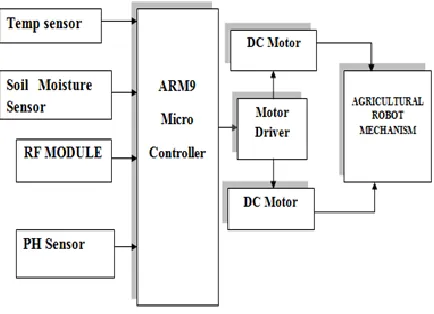
ROPOSED SYSTEMAutomation of the irrigation system is gaining importance as there is need to use water resources efficiently and also to increase the field productivity. The system is used to turn the valves ON or OFF automatically as per the water requirement of the plants. The system is used for sensing, monitoring, controlling and for communication purpose. The System block diagram shown in fig 1.
Different sensors are used to detect the different parameters of the soil like moisture, temperature, humidity, pH of soil. Depending upon the sensors output the ARM9 processor will take the necessary action. The moisture sensor output will help to determine whether to irrigate the land or not depending upon the moisture content. Along with moisture sensor the temperature sensor output can also be taken into consideration while irrigating the land. If the moisture content of soil is very low and the temperature is very high then there is need of irrigation for plants, but the time for which irrigation will be provided is different for different temperature range
Fig. 1: Proposed system Block Diagram.
Because if the temperature is very high then the evaporation rate is also very high and hence we have to provide water for more time in order to attain the proper moisture level in the soil. Hence for different temperature range and moisture content level in the soil the land will be irrigated for different time interval. Soil pH is also detected and measured. pH of the soil is also important factor which will affect the plant growth. Acidic or basic nature of the soil will affect the nutrient availability in the soil.
Sensors are the device which converts the physical parameter into the electric signal. The system consists of temperature, humidity, moisture, soil pH and soil nitrogen sensor. The output of sensor is analog signal; the signal is converted into digital signal and then fed to the processor. The temperature sensor is used to measure the temperature of the soil. Here LM35 temperature sensor is used. The output voltage of sensor is linearly proportional to the Celsius (Centigrade) temperature. The humidity sensor is used to measure the environment humidity. SY-HS-220 is used as a humidity sensor module. The relative humidity is converted to the output voltage which is the required output. The moisture sensor is used to measure the moisture content of the soil. Copper electrodes are used to sense the moisture content of soil. The conductivity between the electrodes helps to measure the moisture content level. The pH sensor helps to determine the pH of the soil. Electrode isused to measure the pH.
IV.
A
RM9
LPC2929
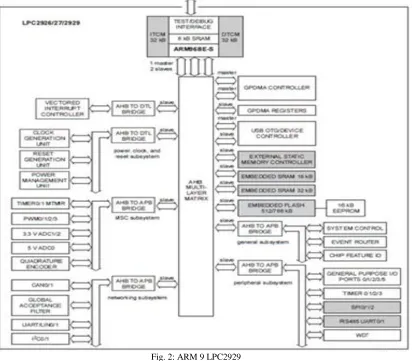
The LPC2929 combine an 125 MHz ARM968ES CPU core, Full Speed USB 2.0 OTG and device, CAN and LIN, up to 56 kB SRAM, up to 768 kB flash memory, external memory interface, two or three 10-bit ADCs, and multiple serial and parallel interfaces in a single chip targeted at consumer, industrial, medical, and communication. To optimize system power consumption, the LPC2929 has a very flexible Clock Generation Unit (CGU) that provides dynamic clock gating and scaling. Pipeline techniques are employed so that all parts of the processing and memory systems can operate continuously. The ARM968E-S is based on the ARMv5TE five-stage pipeline architecture. Typically, in a three-stage pipeline architecture, while one instruction is being executed its successor is being decoded and a third instruction is being fetched from Memory. In the five-stage pipeline additional stages are added for memory access and Write-back cycles. The ARM968E-S processor also employs a unique architectural strategy known as THUMB, which makes it ideally suited to high volume applications with memory Restrictions or to applications where code density is an issue. The key idea behind THUMB is that of a super reduced instruction set. Essentially, the ARM968E-S processor has two instruction sets:
Standard 32-bit ARMv5TE set
The THUMB set's 16-bit instruction length allows it to approach twice the density of Standard ARM code while retaining most of the ARM's performance advantage over a traditional 16-bit controller using 16-bit registers. This is possible because THUMB code operates on the same 32-bit register set as ARM code. THUMB code can provide up to 65 % of the code size of ARM, and 160 % of the performance of an equivalent ARM controller connected to a 16-bit memory system.
Fig. 2: ARM 9 LPC2929
The ARM968E-S processor is described in detail in the ARM968E-S data sheet memory map. This is the address range for which code residing in that area is written. Each memory space remains permanently fixed in the same location, eliminating the need to have portions of the code designed to run in different address ranges. Because of the location of the exception handler vectors on the ARM9 processor (at Addresses 0000 0000h through 0000 001Ch) By default, after reset, the e mbedded flash is mapped at address 0000 0000h to allow initial code to be executed and to perform the required initialization, which starts executing at 00000000h. The LPC2929 generates the appropriate bus-cycle abort exception if an access is attempted for an address that is in a reserved or unused address region or unassigned peripheral spaces. For these areas both attempted data accesses and instruction fetches generate an exception. Note that write-access addresses should be word-aligned in ARM code or half word aligned in Thumb code. Byte-aligned writes are performed as word or half-word aligned writes without error signalling. Within the address space of an existing peripheral a data-abort exception is not generated in response to an access to an undefined address. Address decoding within each peripheral is limited to that needed to distinguish defined registers within the peripheral itself. Details of address aliasing within a peripheral space are not defined in the LPC2929 documentation and are not a sup-ported feature.
V.
C
ONCLUSIONirrigation and accordingly supplied to the farm. The functionality of GSM increases the efficiency of the automated irrigation sys-tem. GSM is responsible for controlling the irrigation on field and sends them to the receiver. The information is send to the user on request in the form of SMS. Thus the system monitor, control and communicate. Using this system, can save manpower, water to improve production and ultimately increase profit.
R
EFERENCES[1] Joaquín Gutiérrez Juan Francisco Villa-Medina, Alejandra Nieto-Garibay, and Miguel Ángel Porta-Gándara “Automated Irrigation System Using a Wireless Sensor Network and GPRS Module”, IEEE Transaction on instrumentation and Measurement, vol. .63,no1, jan 2014
[2] Samy Sadeky, Ayoub Al-Hamadiy, Bernd Michaelisy, Usama Sayedz,“ An Acoustic Method for Soil Moisture Measurement ”, IEEE 2004 [3] K. Romer and F. Mattern, “The design space of wireless sensor networks” IEEE Wireless Commun., vol. 11, no. 6, pp. 54–61, Dec. 2004.
[4] Wen-Zhan Song,Renjie Huang, Mingsen Xu, Behrooz A. Shirazi, and Richard LaHusen,” Design and Deployment of Sensor Network for Real-Time High-Fidelity Volcano Monitoring” IEEE Transactions On Parallel And Distributed Systems, Vol. 21, No. 11, Nov. 2010.
[5] Prakash gaud patil, vidya h2, shreedevi patil, pumakant kulkarni, wireless sensor network for precision agriculture, 2011.
[6] Jianfa Xia, Zhenzhou Tang, *Xiaoqiu Shi, Lei Fan, Huaizhong Li, An environment monitoring system for precise agriculture based on wireless sensor networks, 2011. IEEE
[7] A Survey on Zigbee Based Wireless Sensor Networks in Agriculture Kalaivani, A. Allirani, P.Priya, 2011 IEEE.
[8] Herman Sahota Ratnesh Kumar Ahmed Kamal Jing Huang, an Energy-efficient Wireless Sensor Networkfor Precision Agriculture, 2010 IEEE. [9] Ying Zhang, Design of the node system of wireless sensor network and its application in digital agriculture, 2011 IEEE.
[10] Lei Xiao, Lejiang guo, The Realization of Precision Agriculture Monitoring System Based on Wireless Sensor Network, 2010 IEEE.
[11] Awati J.S., Patil V.S., “Automatic Irrigation Control by using wireless sensor networks”, Journal of Exclusive Management Science - June 2012-Vol 1 Issue 6.
[12] Rashid Hussain, JL Sahgal, Anshulgangwar, Md.Riyaj , “Control of Irrigation Auto-matically By Using Wireless Sensor Network”, International Journal of Soft Computing and Engineering (IJSCE) ISSN: 2231-2307, Volume-3, Issue-1, March 2013.
[13] Shaohua Wan, “Research on the Model for Crop Water Requirements in Wireless Sensor Networks”, 2012 International Conference on Management of e-Commerce and e-Government.
[14] Ejiofor Virginia Ebere (PhD)1, Oladipo Onaolapo Francisca (PhD)2, “Microcontroller based Automatic Water level Control System”, International Journal of Innovative Research in Computer and Communication Engineering Vol. 1, Issue 6, August 2013