• No results found

The Homotopy Perturbation Method for Solving the Kuramoto – Sivashinsky Equation

N/A
N/A
Protected

Academic year: 2020

Share "The Homotopy Perturbation Method for Solving the Kuramoto – Sivashinsky Equation"

Copied!
5
0
0

Loading.... (view fulltext now)

Full text

(1)

IOSR Journal of Engineering (IOSRJEN) e-ISSN: 2250-3021, p-ISSN: 2278-8719

Vol. 3, Issue 12 (December. 2013), ||V3|| PP 22-27

The Homotopy Perturbation Method for Solving the Kuramoto –

Sivashinsky Equation

Fadhil H. Easif

1

, Saad A. Manaa

2

, Majeed A. Yousif

3

1,2,3

Department of Mathematics, Faculty of Science, University of Zakho,Duhok, Kurdistan Region, Iraq

Abstract: - The approximate solutions for the Kuramoto –Sivashinsky Equation are obtained by using the homotopy perturbation method (HPM). The numerical example show that the approximate solution comparing with the exact solution is accurate and effective and suitable for this kind of problem.

Keywords: - Homotopy Perturbation Method (HPM); Kuramoto –Sivashinsky Equation .

I. INTRODUCTION

The homotopy perturbation method (HPM) was first proposed by the Chinese mathematician Ji-Huan He [1-3]. Unlike classical techniques, the homotopy perturbation method leads to an analytical approximate and exact solutions of the nonlinear equations easily and elegantly without transforming the equation or linearizing the problem and with high accuracy, minimal calculation and avoidance of physically unrealistic assumptions. As a numerical tool, the method provide us with numerical solution without discretization of the given equation, and therefore, it is not effected by computation round-off errors and one is not faced with necessity of large computer memory and time. This technique has been employed to solve a large variety of linear and nonlinear problems [4- 10]. In the present study, homotopy perturbation method has been applied to solve the Kuramoto– Sivashinsky equations. The numerical results are compared with the exact solutions. It is shown that the errors are very small.

II. INDENTATIONS AND EQUATIONS

II.1 Mathematical Model

The Kuramoto–Sivashinsky equation is a non-linear evolution equation and has many applications in a variety of physical phenomena such as reaction diffusion systems (Kuramoto and Tsuzuki, 1976)[11], long waves on the interface between two viscous fluids (Hooper and Grimshaw, 1985)[12], and thin hydrodynamics films (Sivashinsky, 1983)[13]. The Kuramoto-Sivashinsky equation has been studied numerically by many authors (Akrivis and Smyrlis, 2004; Manickam et al.,1998; Uddin et al., 2009)[14-16].

Consider the Kuramoto–Sivashinsky equation

𝑢𝑡+ 𝑢𝑢𝑥+ 𝛼 𝑢𝑥𝑥+ 𝛾 𝑢𝑥𝑥𝑥 + 𝛽 𝑢𝑥𝑥𝑥𝑥 = 0 (1)

Subject to the initial condition

𝑢 𝑥, 0 = 𝑓(𝑥) 𝑎 ≤ 𝑥 ≤ 𝑏. 2

And boundary conditions

𝑢 𝑎, 𝑡 = 𝑔1 𝑡 , 𝑢 𝑏, 𝑡 = 𝑔2 𝑡 𝑡 > 0

𝜕2𝑢

𝜕𝑥2= 𝑕1 , at 𝑥 = 𝑎 and 𝑥 = 𝑏 where 𝑕1 ≥ 0.

3

II.2 Basic idea of homotopy perturbation method

To illustrate the basic ideas of this method, we consider the following non-linear differential equation

𝐴(𝑢) − 𝑓(𝑟) = 0, 𝑟 ∈ 𝛿 (4)

with the following boundary conditions

𝐵 𝑢,𝜕𝑢

𝜕𝑛 = 0 , 𝑟 ∈ 𝜏 (5)

where 𝐴 is a general differential operator, 𝐵 a boundary operator, 𝑓 𝑟 is a known analytical function and 𝜏 is the boundary of the domain 𝛿. The operator 𝐴 can be decomposed into two operators, 𝐿 and 𝑁, where 𝐿 is a linear, and 𝑁 a nonlinear operator. 𝐸𝑞. (4) can be, therefore, written as follows:

𝐿 𝑢 + 𝑁 𝑢 − 𝑓 𝑟 = 0. (6)

Using the homotopy technique, we construct a homotopy 𝑣(𝑟, 𝑝) ∶ 𝛿 × [0, 1] → 𝑅, which satisfies:

𝐻 𝑣, 𝑝 = 1 – 𝑝 𝐿 𝑣 − 𝐿 𝑢0 + 𝑝 𝐴 𝑣 − 𝑓 𝑟 = 0,

(2)

Or

𝐻 𝑣, 𝑝 = 𝐿 𝑣 − 𝐿 𝑢0 + 𝑝𝐿 𝑢0 + 𝑝 𝑁 𝑣 − 𝑓 𝑟 = 0, (8)

where 𝑝 ∈ [0, 1] is an embedding parameter, 𝑢0 is an initial approximation for the solution of 𝐸𝑞. (4), which

satisfies the boundary conditions. Obviously, from 𝐸𝑞𝑠. (7) and (8) we will have:

𝐻 𝑣, 0 = 𝐿 𝑣 − 𝐿 𝑢0 = 0, (9)

𝐻 𝑣, 1 = 𝐴 𝑣 − 𝑓 𝑟 = 0. (10)

The changing process of 𝑝 form zero to unity is just that of 𝑣(𝑟, 𝑝) from 𝑢0(𝑟) to 𝑢(𝑟). In topology, this is

called homotopy. According to the (HPM), we can first use the embedding parameter 𝑝 as a small parameter, and assume that the solution of 𝐸𝑞𝑠. (7) and (8) can be written as a power series in 𝑝:

𝑣 = 𝑣0 + 𝑝𝑣1 + 𝑝2𝑣2 + · · · (11)

Setting 𝑝 = 1, results in the approximate solution of 𝐸𝑞. (1) 𝑢 = lim

𝑝→1𝑣 = 𝑣0 + 𝑣1 + 𝑣2 + · · · (12)

The combination of the perturbation method and the homotopy method is called the homotopy perturbation method (HPM), which has eliminated the limitations of the traditional perturbation methods. On the other hand, this technique can have full advantage of the traditional perturbation techniques.

The series (11) is convergent for most cases. Some criteria is suggested for convergence of the series (11), in our equation , in[1].

II.3 Derivative of HPM for Kuramoto-Sivashinsky equation

consider Kuramoto-Sivashinsky equation when

𝑢𝑡+ 𝑢𝑢𝑥+ 𝛼 𝑢𝑥𝑥+ 𝛾 𝑢𝑥𝑥𝑥 + 𝛽 𝑢𝑥𝑥𝑥𝑥 = 0, 13

with the initial condition of

𝑢 𝑥, 0 = 𝑓(𝑥) 14

To solve Eq. (13) by means of HPM, we construct the following homotopy for this equation: 𝐻 𝑣, 𝑝 = 1 – 𝑝 𝐿 𝑣 − 𝐿 𝑢0 + 𝑝 𝐴 𝑣 − 𝑓 𝑟 = 0, 15

where 𝐿 𝑣 =𝜕𝑣

𝜕𝑡 , 𝐿 𝑢0 = 𝜕𝑢0

𝜕𝑡 ,

that is

𝐻 𝑣, 𝑝 = 1 – 𝑝 𝜕𝑣

𝜕𝑡 − 𝜕𝑢0 𝜕𝑡 + 𝑝 𝜕𝑣 𝜕𝑡+ 𝑣 𝜕𝑣 𝜕𝑥+ 𝛼

𝜕2𝑣 𝜕𝑥2+ 𝛾

𝜕3𝑣 𝜕𝑥3+ 𝛽

𝜕4𝑣

𝜕𝑥4 = 0, 16 Substituting v from Eq. (8) into Eq. (13) and equating the terms with identical powers of p, we have

𝑝0𝜕𝑣0

𝜕𝑡 − 𝜕𝑢0

𝜕𝑡 = 0 , 𝑣0 𝑥, 0 = 𝑓(𝑥); 17

𝑝1 𝜕𝑣1

𝜕𝑡 +

𝜕𝑣0

𝜕𝑡 + 𝑣0 𝜕𝑣0

𝜕𝑥 + 𝛼

𝜕2𝑣0

𝜕𝑥2 + 𝛾

𝜕3𝑣0

𝜕𝑥3 + 𝛽

𝜕4𝑣0

𝜕𝑥4 = 0 , 𝑣1 𝑥, 0 = 0; 18 𝑝2𝜕𝑣2

𝜕𝑡 + 𝑣0

𝜕𝑣1

𝜕𝑥 + 𝑣1 𝜕𝑣0

𝜕𝑥 + 𝛼

𝜕2𝑣1

𝜕𝑥2 + 𝛾

𝜕3𝑣1

𝜕𝑥3 + 𝛽

𝜕4𝑣1

𝜕𝑥4 = 0 , 𝑣2 𝑥, 0 = 0; 19

𝑝3 𝜕𝑣3

𝜕𝑡 + 𝑣0 𝜕𝑣2

𝜕𝑥 + 𝑣2

𝜕𝑣0

𝜕𝑥 + 𝑣1

𝜕 𝑣1

𝜕𝑥 + 𝛼

𝜕2𝑣2

𝜕𝑥2 + 𝛾 𝜕3𝑣2

𝜕𝑥3 + 𝛽

𝜕4𝑣2

𝜕𝑥4 = 0 , 𝑣3 𝑥, 0 = 0; 20

Solving these equations yields 𝑣0 , 𝑣1 , 𝑣2 , 𝑣3and so on.

Thus, we can obtain

𝑢 = 𝑣𝑖= 𝑛

𝑖=0

𝑣0 + 𝑣1+ 𝑣2+ ⋯ + 𝑣𝑛 (21)

III. FIGURES AND TABLES

III.1 Numerical Example

In this section, we apply the technique discussed in the previous section to find numerical solution of the Kuramoto–Sivashinsky equations and compare our results with exact solutions.

Example: [17]

𝑢𝑡+ 𝑢𝑢𝑥+ 𝑢𝑥𝑥 + 𝑢𝑥𝑥𝑥𝑥 = 0 , 𝑥 ∈ 0,32𝜋 , 𝑡 ∈ 0,001 ; 22

with the initial condition of 𝑢 𝑥, 0 = cos 𝑥

16 1 + sin 𝑥

16 ; 23

Exact solution of problem is given by

(3)

𝑝1 𝜕𝑣1

𝜕𝑡 +

𝜕𝑣0

𝜕𝑡 + 𝑣0 𝜕𝑣0

𝜕𝑥 +

𝜕2𝑣 0

𝜕𝑥2 +

𝜕4𝑣 0

𝜕𝑥4 = 0 , 𝑣1 𝑥, 0 = 0; 26

𝑝2𝜕𝑣2

𝜕𝑡 + 𝑣0

𝜕𝑣1

𝜕𝑥 + 𝑣1 𝜕𝑣0

𝜕𝑥 +

𝜕2𝑣1

𝜕𝑥2 +

𝜕4𝑣1

𝜕𝑥4 = 0 , 𝑣2 𝑥, 0 = 0; 27 𝑝3 𝜕𝑣3

𝜕𝑡 + 𝑣0 𝜕𝑣2

𝜕𝑥 + 𝑣2

𝜕𝑣0

𝜕𝑥 + 𝑣1

𝜕 𝑣1

𝜕𝑥 +

𝜕2𝑣2

𝜕𝑥2 +

𝜕4𝑣2

𝜕𝑥4 = 0 , 𝑣3 𝑥, 0 = 0; 28 …

Then , we only find third-order term approximate solution for Eq.(22) 𝑣0 𝑥, 𝑡 = cos

𝑥

16 1 + sin 𝑥

16 ; 29

𝑣1 𝑥, 𝑡 = 𝑡 cos

𝑥 16

9200 sin 16𝑥 − 8192 cos2 𝑥

16 sin 𝑥

16 − 12288 cos2 𝑥

16 + 8447

65536 (30)

𝑣2 𝑥, 𝑡 = 𝑡2cos

𝑥 16

165437696 sin 16𝑥 − 517734400 cos2 𝑥

16 sin 𝑥

16 + 201326592 cos4 𝑥 16 sin

𝑥 16 8589934592

+−579706880 cos

2 𝑥

16 + 419430400 cos4 𝑥

16 + 164855297

8589934592 (31)

𝑣3 𝑥, 𝑡 = 𝑡3 cos

𝑥 16

( 4859359014912 sin 𝑥

16 − 30758081134592 cos2 𝑥 16 sin

𝑥 16 1688849860263936

+38638599536640 cos

4 𝑥

16 sin 𝑥

16 − 8796093022208 cos6 𝑥 16 sin

𝑥

16 − 33071821131776 cos2 𝑥 16

1688849860263936

+52566188621824 cos

4 𝑥

16 − 23570780520448 cos6 𝑥

16 + 4826353967871

1688849860263936 ) (32)

(4)

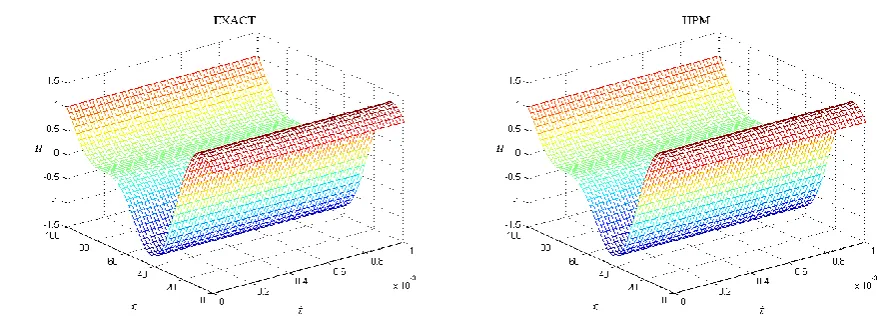
Now we compare exact solution with homotopy perturbation method (HPM) solution in Fig.1,Fig.2.

Table (1) comparison exact with homotopy perturbation method (HPM)

𝑥 ∗ 𝜋 𝑡 𝑢𝐸𝑥𝑎𝑐𝑡 𝑢𝐻𝑃𝑀 𝑢𝐸𝑥𝑎𝑐𝑡− 𝑢𝐻𝑃𝑀

0 0 1.000000000000000 1.000000000000000 0

0.0002 0.999799980005333 0.999988278219568 1.882982142341616e-004

0.0004 0.999599920042668 0.999976556481800 3.766364391323274e-004

0.0006 0.999399820144005 0.999964834786718 5.650146427130798e-004

0.0008 0.999199680341350 0.999953113134345 7.534327929941131e-004

0.001 0.998999500666708 0.999941391524700 9.418908579912344e-004

6.4 0 0.602909620521184 0.602909620521184 0

0.0002 0.603261605525986 0.602924029951888 3.375755740976372e-004

0.0004 0.603613531113795 0.602938440031289 6.750910825057410e-004

0.0006 0.603965397251127 0.602952850759426 1.012546491701349e-003

0.0008 0.604317203904505 0.602967262136334 1.349941768170049e-003

0.001 0.604668951040459 0.602981674162053 1.687276878405974e-003

12.8 0 -1.284545252522524 -1.284545252522524 0

0.0002 -1.284489444647476 -1.284551820710811 6.237606333447943e-005

0.0004 -1.284433528322049 -1.284558388250076 1.248599280267992e-004

0.0006 -1.284377503541076 -1.284564955140284 1.874515992073000e-004

0.0008 -1.284321370299405 -1.284571521381397 2.501510819914454e-004

0.001 -1.284265128591897 -1.284578086973377 3.129583814804882e-004

19.2 0 -0.333488736227371 -0.333488736227371 0

0.0002 -0.333668118536193 -0.333484164639820 1.839538963727683e-004

0.0004 -0.333847544554259 -0.333479593175463 3.679513787964717e-004

0.0006 -0.334027014266963 -0.333475021834294 5.519924326690129e-004

0.0008 -0.334206527659685 -0.333470450616308 7.360770433769148e-004

0.001 -0.334386084717798 -0.333465879521502 9.202051962963198e-004

25.6 0 0.015124368228711 0.015124368228711 0

0.0002 0.015095977652350 0.015123677789543 2.770013719346869e-005

0.0004 0.015067621719845 0.015122987353990 5.536563414442614e-005

0.0006 0.015039300412906 0.015122296922050 8.299650914345494e-005

0.0008 0.015011013713235 0.015121606493723 1.105927804877852e-004

0.001 0.014982761602528 0.015120916069009 1.381544664819934e-004

32 0 1.000000000000000 1.000000000000000 0

0.0002 0.999799980005333 0.999988278219567 1.882982142346057e-004

0.0004 0.999599920042668 0.999976556481800 3.766364391322163e-004

0.0006 0.999399820144005 0.999964834786718 5.650146427135239e-004

0.0008 0.999199680341350 0.999953113134344 7.534327929941131e-004

(5)

IV. CONCLUSION

The (HPM) applied to Kuramoto-Sivashinsky equation and by comparing with the exact solution Fig.(1) , Fig.(2) and Table(1) shows that the absolute error is so small and the approximate solution is so closed to the exact solution.

REFERENCES

[1] J.H. He, Homotopy perturbation technique, Computer Methods in Applied Mechanics and Engineering; 178, 1999,257-262

[2] J.H. He, Homotopy perturbation method: a new nonlinear analytical technique, Applied Mathematics and Computation, 135, 2003,73-79

[3] J.H. He,Homotopy perturbation method for solving boundary value problems, Physics Letters A, 30(12), 2003,87-88.

[4] J.H. He, The homotopy perturbation method for nonlinear oscillators with discontinuities, Applied Mathematics and Computation, 151(1) ,2004, 287-292.

[5] J.H. He, A coupling method of a homotopy technique and a perturbation technique for non-linear problems, International Journal of Non-Linear Mechanics, 35(1), 2000, 37-43.

[6] J.H. He, Application of homotopy perturbation method to nonlinear wave equations, Chaos, Solitons & Fractals, 26(3), 2005, 695-700.

[7] J.H. He, An approximate solution technique depending on an artificial parameter,A special example, Communications in Nonlinear Science and Numerical Simulation, 3(2), 1998, 92-97.

[8] J.H. He, 1998. A simple perturbation approach to Blasius equation, Applied Mathematics and Computation, 140(2-3), 1998, 217-222.

[9] S. Q. Wang, J.H. He, Nonlinear oscillator with discontinuity by parameter-expansion method, Chaos, Solitons & Fractals, 35(4), 2008,688-691.

[10] D.D. Ganji, The application of He's homotopy perturbation method to nonlinear equations arising in heat transfer, Physics Letters A, 353(4-5), 2006,337-341.

[11] Kuramoto, Y., Tsuzuki, T., Persistent propagation of concentration waves in dissipative media far from thermal equilibrium,Pron. Theor. Phys. ,55, 1976, 356.

[12] Hooper, A.P., Grimshaw, R., Nonlinear instability at the interface between two viscous fluids. Phys. Fluids ,28, 1985, 37–54.

[13] Sivashinsky, G.L., Instabilities, pattern-formation, and turbulence in flames. Ann. Rev. Fluid Mech. ,15, 1983, 179–199.

[14] Akrivis, Georgios, Smyrlis, Yiorgos-sokratis, Implicit-explicit BDF methods for the Kuramoto-Sivashinsky equation, Appl. Numer. Math. 51, 2004, 151–169.

[15] Manickam, A.V., Moudgalya, K.M., Pani, A.K., Second-order splitting combined with orthogonal cubic spline collocation method for the Kuramoto–Sivashinsky equation, Comput. Math. Appl. 35, 1998, 5–25. [16] Uddin, M., Haq, S., Siraj-ul-Islam, A mesh-free numericalmethod for solution of the family of

Kuramoto–Sivashinsky equations, Appl. Math. Comput. 212, 2009, 458–469.

Figure

Table (1)  comparison exact with homotopy perturbation method (HPM)

References

Related documents

Effective practices and models for older adults with SMI need to consider how services are delivered (e.g., mobile units, transporta- tion support, integrated health care

´ Sniatycki, Differential Geometry of Singular Spaces and Reduction of Symmetry, Cambridge University Press, Cambridge, 2013.

Aim is to understand the phenomenon of the training of teachers of physical education through a survey on the levels of education and measurement of the teachers’

Given the limited amount of undeveloped land in the City of Rutland, and the need to conserve some areas for open space and recreation, the primary potential for development is in

Other reasons given include the provision of education on the effects of drugs, religious beliefs, observation of the effects of drug abuse on past users, personal discipline

So, in patients presented with generalized tonic-clonic seizure also the possibility of ring enhancing lesion should be considered.. This correlates with the Sotelo

Encouraging early signals of clinical activity were also observed in other malignancies including non-small cell lung cancer (NSCLC), glioblastoma (GBM),

In the soil, heterogeneously distributed microbe communities together with dependent rhizobia and different plant growth promoting rhizobacteria perform a dynamic