(DOI: 10.24874/jsscm.2018.12.01.08)
Lie Group Analysis of Soret and Dufour Effects on Radiative Inclined
Magnetic Pressure-Driven Flow Past a Darcy-forchheimer Medium
S.O. Salawu1*, M.S. Dada2
1Department of Mathematics, Landmark University, Omu-aran, Nigeria e-mail: [email protected]
2Department of Mathematics, University of Ilorin, Ilorin, Nigeria. *corresponding author
Abstract
The study examines Soret and Dufour effects on steady convective heat and mass transfer of magnetohydrodynamic (MHD) pressure-driven flow in a Darcy-forchheimer porous medium with inclined uniform magnetic field and thermal radiation. The governing partial differential equations of the model are reduced to a system of coupled non-linear ordinary differential equations by applying a Lie group of transformations. The resulting coupled differential equations are solved using weighted residual method (WRM). The results obtained are presented graphically to illustrate the influence of various fluid parameters on the dimensionless velocity, pressure drop, temperature and concentration. Finally, the effects of Skin friction, Nusselt and Sherwood numbers results are presented and discussed accordingly.
Keyword: Soret; Dufour; radiation; Darcy-forchheimer; weighted residual method
1. Introduction
The study of the effects of Soret and Dufour on heat and mass transfer flow of an inclined magnetic field stimulated by the instantaneous actions of buoyancy forces consequential from mass and thermal diffusion with radiation in a non-Darcy permeable medium is significant from a practical as well as theoretical points of view due to their broad applications in planetary atmosphere research and others. In recent years, noticeably contribution has been made on the MHD flows as a result of its usefulness in devices such as hall accelerator, power engineering, MHD power generator and underground spreading of chemical wastes where the combined diffusion-thermo and thermal-diffusion effects are observed.
The symmetry transformation of heat and mass transfer are well known because its allows the transformation of the modelled partial differential equations into an ordinary differential equations. Follow from (Mansour et al. 2009; Sivasankaran et al. 2006), analysis of heat and mass transfer over an inclined plate invesitgated by applying Lie group method. The exact solution to the problem was obtained for the translational symmetry and it was reported that the velocity increased while heat and species fluid reduces with variational increased in the values of solutant and thermal Grashof parameters. In Dada and Salawu (2017); Mutlag et al. (2012), group transformation of radiative non-Newtonian flow fluid of heat transfer over a vertical moving surface with slip condition was analysed. Also, Reddy (2012) carried out analysis on temperature and species transfer of dissipative fluid flow along an inclined surface in the presence of heat generation by means of Lie group.
There is an improved interest in the study of MHD flow of heat and mass transfer past non-Darcy permeable medium as a result of its effect on the performance of systems and on boundary layer flow control using electrically conducting fluids. This kind of fluid flow is applicable in several engineering processes which includes nuclear reactors, geothermal energy extractions and many more. MHD heat and species transfer through a non-Darcy near drenched permeable medium was examined in (Seddeek et al. 2010; Vyas and Srivastava 2012; Salawu and Fatunmbi 2017; Kareem et al. 2018). It was found that a variational rise in the values of Prandtl number reduced the heat of the fluid while an increase in the porosity and Hartmann number decreased the velocity profiles because the magnetic force and the pores of the medium retarded the flow while Fenuga et al. 2018; Srinivasacharya and Reddy (2015) reported on the radiative and chemical reaction effects on heat and mass transfer in power-law flow through stretching surface in a permeable medium. In Kareem and Salawu (2017); Senapati et al. (2013), the effect of MHD on a chemical reaction Kuvshinski flow over a permeable medium in the existence of thermal radiation with constant heat and mass flux across moving plate was reported.
The heat flux can be created by both temperature and composition gradients. The created heat flux is referred to as Dufour while the created mass fluxes represent the Soret. These influences are considerable when density variations takes place in the flow system. The combine effects of Soret and Dufour are important in-between weighted molecular gases in fluid flow environment normally come across in engineering and chemical processes. As a result, Bazid et al. 2012; Bishwa and Animesh 2015) investigated the effects of heat Source, chemical reaction, Dufour and Soret by applying forchheimer model on heat and mass transfer flow entrenched in a permeable medium. It was observed that temperature and concentration was enhanced with a rise in Dufour and Soret parameter values. However, magnetic field, pressure gradient and the effect of radiation was neglected in the studied. Moreover, Srinivasacharya et al. (2015) studied the effects of Soret and Dufour on a vertical wavy surface with variable properties in a permeable medium.
Keeping the above studies in view, most of the researchers neglected the combined influences of Darcy-forchheimer porous medium, thermal-diffusion, diffusion-thermo and radiation on MHD flow. However, it is known that fluid physical properties can change significantly with thermal-diffusion and diffusion-thermo. Therefore, the present study examines the combined effects of Darcy-forchheimer permeable medium, inclined magnetic field, pressure drop, thermal radiation, Dufour and Soret on a steady convective heat and mass transfer of MHD flow.
2. Formulation of the problem
the influence of uniform inclined magnetic field and pressure gradient. The fluid motion is maintained by both gravity and pressure gradient, and the flow is considered to be in the direction of
X
withY
-axis normal to it. Uniform magnetic field strength0
B is introduced at angle
lying in the range 0 < < 2
in the fluid flow direction because of the interaction of the two fields, namely, velocity and magnetic fields, an electric field vector denoted E is induced at right angles to both V and B. This electric field is given byE V B while the density of the current induced in the conducting fluid denoted J is given by J E and simultaneously occurring with the induced current is the Lorentz force F given byF J B. This force occurs because, as an electric generator, the conducting fluid cuts the lines of the magnetic field. The vector F is the vector cross product of both J and B and is a vector perpendicular to the plane of both J and B. This induced force is parallel to V but in opposite direction.The Navier-Stokes equation is defined as:
2 [(V V V)] f p V
B
(1)
where ρ is the fluid density, 2 0
f B U
B is body force per unit mass of the fluid which define the magnetic force, μ is the fluid viscosity and p is the pressure acting on the fluid.
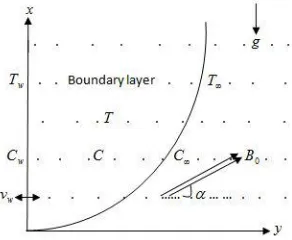
The geometry and equations governing the steady radiative heat and mass transfer of two-dimensional magnetohydrodynamics pressure-driven fluid flow in Darcy-forchheimer porous medium with inclined magnetic field are given below:
Fig. 1. The geometry of the model
Continuity equation
= 0
U V
X Y
(2)
2 2
1 2 2 1 2
=
0 2 2 * *
,
U U P U U b
U V B Usin U U
X Y X X Y K K
g T T g C C
T C (3)
Momentum equation in V-component
2 2
1
= ,
2 2
V V P V V
U V
X Y Y X Y
(4)
Energy equation
2 2 1
= 2 2 2 2 0 , 2 2 q q
T T k T T X Y
U V
X Y C X Y C X Y
p p
Q
DK C C
T T T
C C X Y C
s p p
(5) Concentration equation
2 2 2 2
= ,
2 2 2 2
DK
C C C C T T T
U V D C C
X Y X Y T X Y
m
(6)
The corresponding initial and boundary conditions are follows:
= 0, = , = 0, = ( ) , = ( ) = 0
= 0, = , =
U V v P T T T T AX C C C C BX at Y
w w w
U T T C C as Y
(7)
where U , V ,
P
, C , andT
are the velocity component in theX
direction, velocity component in theY
direction, pressure, concentration of species in the fluid and temperature of the fluid respectively.A
andB
are constants defined as A=B=1l , l is the characteristic
length, 0
B is the magnetic field strength, is the angle of inclination of the magnet, v
w is the
permeability of the porous surface respectively. The physical quantities , b, K*,
, , D, k,0
Q and
are the fluid kinematics viscosity, Forchheimer parameter, permeability of the porous medium, density, electric conductivity of the fluid, mass diffusion coefficient, thermal conductivity, rate of specific internal heat generation or absorption and reaction rate coefficient respectively. Cp, Tm, KT , Cs ,
g
are the specific heat at constant pressure, mean fluidtemperature, thermal diffusion ratio, concentration susceptibility and gravitational acceleration respectively, while
T and
C
are the thermal and concentration expansion coefficients respectively. q4 4 4 4 0 0 = = , 3 3 T T
q and q
X X Y Y
(8)
where 0
and are the Stefan-Boltzmann and the mean absorption coefficient respectively.Assume the temperature difference within the flow are sufficiently small such that T4 expressed as a linear function of temperature, using Taylor series to expand T4 about the free stream T and neglecting higher order terms, gives the approximation
4 4 3 3 4,
T T T T (9)
Using equation (8) and (9) leads to
3 2 3 2
16 16
0 0
= and = ,
2 2
3 3
T T
q T q T
X Y
X X Y Y
(10)
Introducing the following non-dimensional quantities 2
= , = , = , = , = , = , = ,
2
T T C C
X Y Ul Vl Pl
x y u v p
l l T T C C
w w
(11)
Substituting (10) and (11) into equation (2)-(7), to obtain
= 0,
u v
x y
(12)
2 2
2 2 2
= ,
2 2
u u p u u
u v H sin u D u F u G G
a a s r c
x y x x y
(13)
2 2
= ,
2 2
v v p v v
u v
x y y x y
(14)
2 2 2 2
1 4
= 1 ,
2 2 2 2
3
u v R D Q
u
x y P x y x y
r
(15)
2 2 2 2
1
= ,
2 2 2 2
u v S
r
x y S x y x y
c
(16)
The corresponding initial and boundary conditions are follows: = 0, = , = 0, = , = = 0
= 0, = 0, = 0 ,
u v f p x x at y
w
u as y
where = 0 H lB
a
is the Hartmann, =
C p P
r k
is the Prandtl, S =
c D
is the Schmidt,
3 =
2
l g T T
T w G
r
is the thermal Grashof, 3
=2
l g C C
C w
G c
is the solutal Grashof,
2 =l
is the concentration parameter, 2 0 = l Q Q C p
is the heat source,( )
=
( )
DKT C C w D
u C C T T
s p w
is the Dufour,
( )
=
( )
DK T T
T w S
r T C C
m w
is the Soret, =
v l w f
w
is the wall mass transfercoefficient, 3 4 0 = T R k
is the Radiation parameter, = *
lb F
s K
is the Forchheimer inertia term, 2 = * l D a K
is the Darcy parameter
Using the stream function u=
y
, v= x
on equations (12) to (17), continuity equation is automatically. Also, introducing simplified form of Lie-group transformation on the equations, this is equivalent to determining the invariant solutions of these equations under a continuous one-parameter group Bhattacharyya et al. (2011). One of the methods is to search for a transformation group from an elementary set of one-parameter scaling group of transformations, given as such that
* 1 * 2 * 3 * 4 * 5
: = , = , = , = , = ,
*= 6, *= 7, *= 8
x xe y ye e u ue v ve
p pe e e
(18) where 1 , 2 , 3
, 4 , 5
, 6
, 7
, and8
, are transformation parameters of the group to be determined later and is a small parameters. Equation (18) may be considered as a point-transformation which transforms coordinate ( , , , , , , )x y u v to the coordinate* * * * * * * (x ,y , ,u ,v , , ).
Substituting the transformation (18) into the equations and applying invariant conditions
Pramanik (2013)
to obtain the similarity transformations.In order for the equations to stay unchanged under the transformations, the subsequent relations exist between the parameters, that is
, 0
3 4 7 8 1 2 5 6
(19)1 1 1 1 1
* * , * , * , * , * , * , *
x xe
y y
e
u ue
v v p p
e
e
(20) Applying invariant conditions on equation (20) to obtain the similarity varables as follows
= ,y =xf ,p= p ,.. =x , =xd
(21)Substituting the similarity variables (21) into the transformed equations to obtain the following system of non-linear differential equations:
' ' 1 '2 2 2 ' = 0
f ff F f H sin D f G G
s a a r c
(22)
' = ' ',
p f ff
d
(23)
4 ' ' ' '
1 = 0
3R D Pu r P fr P fr P Qr
(24)
' S S ' S f ' S f' S = 0
r c c c c
(25)
The corresponding initial and boundary conditions take the form: '
= , = 0, = 0, = 1, = 1 = 0 '= 0, = 0, = 0
f f f p at
w d
f as
(26)
Integrating equation (23) with the initial and boundary conditions with f = 1
w , the pressure drop
=
G p
d
becomes
1 1
' 2
=
2 2
G f f (27)
3. Method of solution
The idea of weighted residual method is to look for an approximate result, in the polynomial form to the differential equation given as
= in the domain , ,
= onD v y f R A v R (28)
where D v
represents a differential operator relating non-linear or linear spatial derivatives of the dependent variables v , f is the function of a known position, A
v denotes the approximate number of boundary conditions withR
been the domain and R the boundary. By assuming an approximation to the solution v y
, an expression of the form
, , , ...
1 2 3 v y w y a a a an
which depends on a number of parameters , , ... 1 2 3
a a a a
n and is such that for arbitrary value a si'
the boundary conditions are satisfied and the residual in the differential equation become
, =
,
E y a L w y a f yi i (30)
The aim is to minimize the residual E y a
,
to zero in some average sense over the domain. That is
, = 0 = 1, 2,3,...E y a W dy i n
Y i
(31)
where the number of weight functions W
i is exactly the same with the number of unknown
constants a
i in w. Here, the weighted functions are chosen to be Dirac delta functions. That is,
=
W y y y
i i , such that the error is zero at the chosen nodes yi. That is, integration of
equation (11) with W
y =
y y
i i results in E y a
, i = 0.Weighted residual method (WRM) is applied to equations (22) to (27), by assuming the following trial polynomial functions with unknown coefficients to be determined.
( ) = , ( ) = , ( ) = ,
= 0 = 0 = 0
n i n i n i
f a b c
i i i
i i i
(32)
Imposing the boundary conditions (26) on the trial functions and substituting the functions into equations (22), (24) and (25), the residual is obtained and minimized to zero at some set of collocation points within the domain in order to obtain the unknown coefficients using Maple 2016 software.
Substituting the constant values into the trial functions to obtain the tangential velocity, temperature and concentration equations respectively.
= 1.000000 1.717824 2 2.295306 3 1.799414 45 6 7 8
0.988332 0.382705 0.096954 0.011625
9 10 11 12
0.001435 0.000836 0.000133 0.0000084
f
(33)
= 1.000000 0.516839 0.124909 2 0.288289 34 5 6 7
0.252109 0.165458 0.084259 0.032662
8 9 10 11 12
0.009402 0.001941 0.000271 0.000023 0.000008
(34)
= 1.000000 1.163307 0.595275 2 0.013985 34 5 6 7
0.261476 0.274318 0.180803 0.087308
8 9 10 11 12
0.031275 0.008067 0.001411 0.000149 0.000007
(35)
' = 3.435649 6.885905 2 7.197642 3 4.941652 4
5 6 7 8
2.296239 0.678626 0.092963 0.012832
9 10 11
0.008255 0.001464 0.00010
f
(36)
Also substituting for f and f' in (27) with the corresponding constant values to obtain the pressure drop as
2 3
= 0.500000 3.435649 6.885905 7.197642
4 5 6 7
4.941652 2.296239 0.678626 0.092963
8 9 10 11
0.012832 0.008255 0.001464 0.000097
1 2
1.0000 1.727824562 2
3 4 5
2.295302 1.799411 0.988330 0.382707
G
6 7 8 0.096946 0.011620 29 10 11 12
0.001426 0.000826 0.000133 0.000008
(37)
The process of WRM is repeated for different values of the fluid parameters. The physical quantity of practical interest are the local skin friction C
f , the Nusselt nuber N
u and the local sherwood number Sh defined as:
= , = , =
2 ( ) ( )
q x q x
w w m
C Nu Sh
f k T T D C C
u w w
w
(38)
where k is the thermal conductivity of the fluid,
w
, qw and qm are respectively given by
= , = , = ,
= 0 = 0 = 0
u T T
q k q D
w y w y m y
y y y
(39)
Therefore, the local skin friction coefficient, local Nusselt number and local Sherwood number are
1 1 1
' ' '
2 = (0), 2 = (0), 2 = (0),
C Re f NuRe ShRe
f x x x
(40)
where =
u x w Re
x
is the local Reynolds number.Weighted Residual method
th4
order R-K
PP
values
Nu
Sh
Nu
Sh
s
F
0.02 3.54343 0.52936 1.16808 3.54036 0.52937 1.16780
1.0 3.43565 0.51684 1.16331 3.43595 0.51675 1.16288
2.8 3.28520 0.49801 1.15644 3.28264 0.49775 1.15577
0
30
3.43565 0.51684 1.16331 3.43595 0.51675 1.16288
0
40
3.03472 0.46523 1.14643 3.03210 0.46515 1.14591
0
60
2.50106 0.39557 1.12452 2.49694 0.39421 1.12587
r
S
0.1 3.39251 0.48664 1.24440 3.39292 0.48657 1.24390
1.0 3.43565 0.51684 1.16331 3.43595 0.51675 1.16288
1.5 3.46443 0.53698 1.10451 3.46467 0.53688 1.10415
u
D
0.035 3.39350 0.68792 1.06136 3.39402 0.68770 1.06107
0.5 3.43565 0.51684 1.16331 3.43595 0.51675 1.16288
1.0 3.48804 0.27639 1.30592 3.48846 0.27658 1.30525
Table 1. Comparison of , Nu and
Sh
for various values of Fs, , Sr, Du and
R
4. Results and discussion
The numerical analysis has been investigated for the velocity, temperature, concentration and pressure fields also skin friction coefficient, Nusselt and Sherwood numbers respectively at the plate have been examined for different values of the parameters. All graphs are corresponded to default values unless stated on appropriate graph.
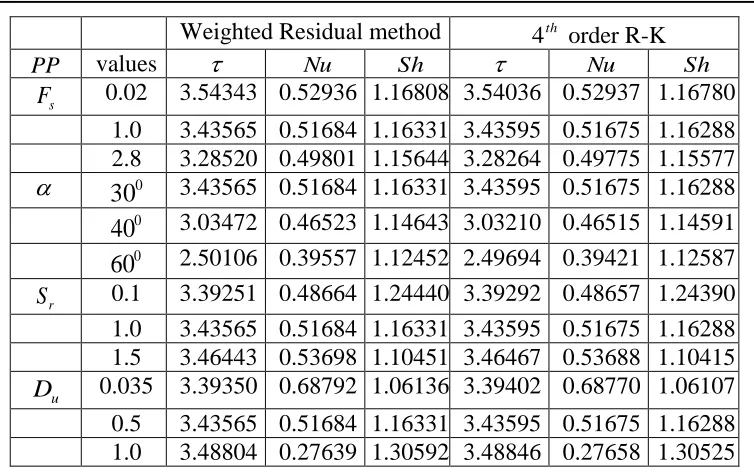
Table 1 illustrates the effect of some physical parameters on skin friction, nusselt and sherwood number. It is clearly seen that an increase in the values of F
s and decreases the skin
friction while a rise in S
r and Du increases skin friction. The temperature gradient decreases as
the values of F
s, and Du increases except for Sr which decreases the temperature boundary layer and causes more heat to diffuse out of the system. Also, the numerical results show that the mass boundary layer increases as the values of D
u increases while Fs, and Sr decrease mass gradient.
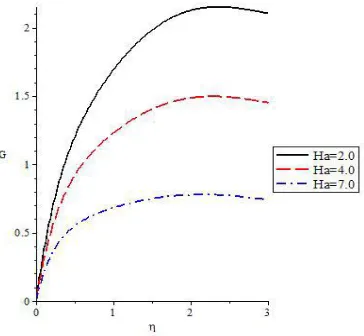
Figures 2 and 3 show the effect of the Hartmann number H
a on the velocity and pressure
boundary layers thickness. Increasing H
a decreases the velocity and pressure distributions,
Fig. 2. Velocity profile for various values of Ha
Fig. 3. Pressure profile for various values of
Ha
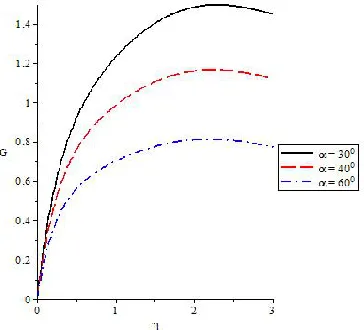
Fig. 4. Velocity profile for various l values of
Fig. 5. Pressure profile for various values of
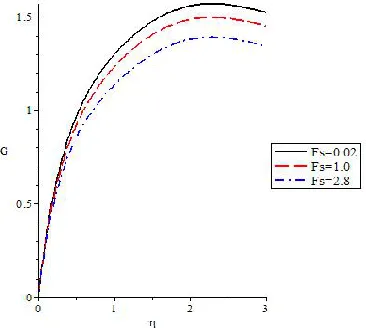
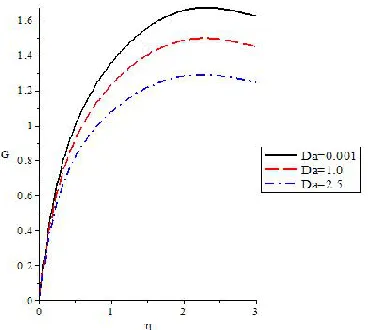
Figures 6, 7, 8 and 9 show the effect of the inertial parameter F
s or porosity parameter Da
Fig. 6. Velocity profile for various values of F s
Fig. 8. Velocity profile for various values of D a
Fig. 9. Pressure profile for various values of D a
Figure 10 show the influence of different values of the Prandtl number P
r on the temperature distribution. It is noticed that an increase in the ratio of momentum diffusivity to thermal diffusivity results in the respectively decrease temperature profile. This is because an increase in the P
r causes a decrease in the boundary layers thickness and decrease the average temperature within the boundary layers. Therefore, a rise in the Prandtl number increases the rate at which heat diffuse away from the heated surface to the environment.
The effect of Schmidt number S
c on the concentration profile are represented in Figure 11.
Schmidt number is defined as the ratio of the momentum diffusivity to the mass diffusivity. An increase in S
c causes reduction in the concentration distribution which is accompanied by
Figure 12 shows the variation in the thermal boundary layer with the Dufour number D u. It
is observed that the thermal boundary layers thickness increases with an increase in the Dufour number. While figure 13 depicts the variation in the mass transfer boundary layer with Soret number. It is found that the mass transfer boundary layers thickness increases with an increase in the Soret number.
Fig. 10. Temperature profile for various values of P r
Fig. 12. Temperature profile for various values of D u
Fig. 13. Concentration profile for various values of S r
5. Conclusion
References
Abel MS and Monayya M (2013). MHD flow and heat transfer of the mixed hydrodynamic thermal slip over a linear vertically stretching sheet, International Journal of Mathematical Archive, 4(5): 156-163.
Ali JC, Sameh EA and Abdulkareem SA (2010). Melting and radiation effects on mixedconvection from a vertical surface embedded in a Newtonian fluid saturated non-Darcy porous medium for aiding and opposing eternal flows, International Journal of the Physical Sciences, 5(7): 1212-1224.
Bazid MAA, Gharsseldien ZM, Seddeek MA and Alharbi M (2012). Soret and Dufour numbers effect on heat and mass transfer in stagnation point flow towards a stretching surface in the presence of buoyancy force and variable thermal conductivity, Journal of Computations & Modelling, 2(4): 25-50.
Bhattacharyya K, Uddin MS and Layek GC (2011). Application of scaling group of transformations to steady boundary layer flow of Newtonian fluid over a stretching sheet in presence of chemical reactive species, Journal of Bangladesh Academy of Sciences, 35(1): 43-50.
Bishwa RS and Animesh A (2015). Influence of chemical reaction, heat source, Soret and Dufour effects on heat and mass transfer in boundary layer flow over a stretching cylinder embedded in a porous medium using Brinkman-Forchheimer extended Darcy model, International Journal of Innovative Research in Science, Engineering and Technology, 4(1): 18635-18644. Dada MS, Salawu SO (2017). Analysis of heat and mass transfer of an inclined magnetic field pressure-driven flow past a permeable plate, Applications and Applied Mathematics: An International Journal (AAM), 12(1), 189 – 200.
Fenuga OJ, Abiala IO, Salawu SO (2018). Analysis of thermal boundary layer flow over a vertical plate with electrical conductivity and convective surface boundary conditions, Physical Science International Journal, 17(2), 1-9.
Kareem RA, Salawu SO, Gbadeyan JA (2018). Numerical analysis of non-uniform heat source/sink in a radiative micropolar variable electric conductivity fluid with dissipation Joule heating, American Journal of Applied Mathematics, 6(2), 34 – 41.
Kareem RA, Salawu SO (2017). Variable viscosity and thermal conductivity effect of Soret and Dufour on inclined magnetic field in non-Darcy permeable medium with dissipation, British Journal of Mathematics & Computer Science, 22(3): 1-12.
Mansour MA, Mohamed RA, Abd-Elaziz MM and Ahmed SE (2009). Lie group analysis of unsteady MHD mixed convection boundary layer flow of a micropolar fluid along a symmetric wedge with variable surface temperature saturated porous medium, Int. J. of Appl. Math and Mech, 5(2): 97-114.
Mutlag AA, Uddin Md J, Ismail AI Md and Hamad MAA (2012). Scaling group transformation under the effect of thermal radiation heat transfer of a non-Newtonian power-law fluid over a vertical stretching sheet with momentum slip boundary condition, Applied Mathematical Sciences, 6(121): 6035-6052.
Pramanik S (2013). Applications of scaling group of transformations to the boundary layer flow of a non-Newtonian power-law fluid. Int. journal of Appl. Math and Mech., 9(6),1-13. Reddy MG (2012). Lie group analysis of heat and mass transfer effects on steady MHD free
convection dissipative fluid flow past an inclined porous surface with heat generation, Theoret. Appl. Mech, 39(3): 233-254.
Salawu SO, Fatunmbi EO (2017). Dissipative heat transfer of micropolar hydromagnetic variable electric conductivity fluid past inclined plate with Joule heating and non-uniform heat generation, Asian Journal of Physical and Chemical Sciences, 2(1), 1-10.
Seddeek MA, Akl MY and Al-Hanaya, AM (2010). Thermal radiation effect on mixed convection and mass transfer flow on vertical porous plate with heat generation and chemical reaction by using scaling group, Journal of Natural Sciences and Mathematics Qassim University, 4(1): 41-60.
Senapati N, Dhal RK and Ray K (2013). Effect of chemical reaction on MHD free convection on Kuvshinshki fluid through porous medium in presence of heat radiation with constant heat and mass flux across moving plate, International Journal of Applied Mathematics & Statistical Sciences, 2(4): 45-52.
Sivasankaran S, Bhuvaneswari M, Kandaswamy P and Ramasami EK (2006). Lie group analysis of natural convection heat and mass transfer in an inclined surface, Nonlinear Analysis Modelling and Control, 11(1): 201-212.
Srinivasacharya D, Mallikarjuna B and Bhuvanavijaya R (2015). Soret and Dufour effects on mixed convection along a vertical wavy surface in a porous medium with variable properties, Ain Shams Engineering Journal, 6(15): 553-564.
Srinivasacharya D and Reddy GS (2015). Chemical reaction and radiation effects on mixed convection heat and mass transfer over a vertical plate in power-law fluid saturated porous medium, Journal of the Egyptian Mathematical Society, 8(15): 1-8.
Umavathi JC, Liu IC and Kumar JP (2010). Magnetohydrodynamics Poiseuille couette flow and heat transfer in an inclined channel, Journal of Mechanics, 26(4): 525-532.