DECOLOURIZATION OF DYE & TEXTILE
EFFLUENT USING ADVANCED OXIDATION
PROCESSES
Smita R. Jadhav
1, Sushma S. Kumbhar
2, Anil C. Ranveer
31,2,3
Department of Technology, Shivaji University, Kolhapur, (India)
ABSTRACT
Increasing urbanization and industrialization have thus resulted in a dramatic increase in the volume of
wastewater. The major industries contributing to water pollution are – textile mills, electroplating industry,
metal processing industry, pulp and paper mill and tannery industry. Major pollution in textile effluent is due to
high suspended solids, chemical oxygen demand, heat, color, acidity and other non-biodegradable substances.
In order to tackle this menace of pollution problem, it is desirable to degrade the dye into non toxic form before
its discharge into the main stream. Advanced Oxidation Processes are the one that offers a highly reactive,
non-specific oxidant namely hydroxyl radicals (HO•), capable of destroying wide range of organic pollutants in
water and wastewater. Fenton’s reagent oxidation is a homogeneous catalytic oxidation process using a mixture of hydrogen peroxide and ferrous ions. The main advantage of the Fenton’s reagent is its simplicity in usage.
Keywords: Advanced Oxidation Process, Fenton & Photo Fenton Process, Hydroxyl radicals,
Malachite Green Dye, Textile effluent.
I. INTRODUCTION
Industrialization is vital to nation’s economy because it serve as a vehicle fordevelopment. Increasing
urbanization and industrialization have thus resulted in a dramaticincrease in the volume of wastewater. Global
water pollution scenario suggests thatnearly 1.5 billion people lack safe drinking water and at least 5 million
deaths areattributed to waterborne diseases such as cholera, hepatitis every year. The majorindustries
contributing to water pollution are textile mills, electroplating industry, metalprocessing industry, pulp and
paper mill and tannery industry.
Major pollution in textile effluent is due to high suspended solids, chemicaloxygen demand, heat, color, acidity
and other non-biodegradable substances. In order totackle this menace of pollution problem, it is desirable to
degrade the dye into nontoxicform before its discharge into the main stream.
The traditional treatment techniques applied in textile wastewaters, such ascoagulation/flocculation, membrane
separation (ultra-filtration, reverse osmosis) orelimination by activated carbon adsorption, only do a phase
transfer of the pollutant, andbiological treatment is also not a complete solution to the problem. So
AdvancedOxidation Processes (AOP´s), like Fenton and Photo-Fenton processes, could be a goodoption to treat
and eliminate textile dyes. Advanced Oxidation Processes are theone thatoffers a highly reactive, non-specific
wastewater. Fenton’s reagentoxidation is a homogeneous catalytic oxidation process using a mixture of
hydrogenperoxide and ferrous ions. The main advantage of the Fenton’s reagent is its simplicity inusage. In an
acidic environment if hydrogen peroxide is added to an aqueous systemcontaining an organic substrate and
ferrous ions, a complex redox reaction will occur.
1.1 Textile Wastewater
The textile industry in India guzzles double the accepted amount for consumption. A major factor is obsolete
technology that permits minimum recycling and reuse of process water. For instance most textile mills in India
do not use counter-washing systems instead they use clean water at every stage of the wash cycle. Discharges of
highly colored dye effluents in natural water constitute one of the most important problems of the surface water
[1]. The color is an evident indicator of water pollution by the dyes. Industrial dye effluents are visible even at
concentrations lower than 1 mg/l. Synthetic organic dyes are generally recalcitrant in nature[2].
Composite textile wastewater is characterized mainly by measurements of biochemical oxygen demand (BOD),
chemical oxygen demand (COD), suspended solids (SS) and dissolved solids (DS). Typical characteristics of
textile industry wastewater are presented in Table 1.
Table 1: Composite Textile Industry Wastewater Characteristics [4]
Parameters Values
pH 7.0 ─ 9.0
Biological Oxygen Demand (mg/L) 80 ─ 6000
Chemical Oxygen Demand (mg/L) 150 ─12000
Total Suspended Solids (mg/L) 15─ 8000
Total dissolved solids (mg/L) 2900 ─3100
Chloride (mg/L) 1000 ─1600
Color 50─2500
1.2 Fenton and Photo Fenton Processes
Fenton’s reagent oxidation is a homogeneous catalytic oxidation process using amixture of hydrogen peroxide and ferrous ions. The main advantage of the Fenton’sreagent is its simplicity. The chemicals are readily
available at moderate cost and there isno need for special equipment. In an acidic environment if hydrogen
peroxide is added toa system containing an organic substrate and ferrous ions, a complex redox reaction
willoccur [5].The overall reaction is:
H2O2 + Fe2+→ Fe3+ + HO−+ HO● (1)
The ferrous ion initiates and catalyses the decomposition of H2O2, resulting in the generation of hydroxyl
radicals, HO●. Hydroxyl radicals are powerful oxidation agents that have an oxidation potential only lower than
fluorine and higher than ozone and H2O2:3.0 V for fluorine, 2.8 V for HO ●
H2O2. Then, hydroxylradicals are capable of rapidly attacking organic substrates (RH) and cause
chemicaldecomposition of these compounds by H- abstraction and addition to C─C unsaturatedbonds.
RH + HO● → R●+ H2O (2)
R●+ Fe3+→ R+ + Fe2+ (3)
R + + H2O → ROH + H+ (4)
Numerous competing reactions which involve Fe2+, Fe3+, H2O2, hydroxylradicals, hydroperoxyl radicals and
radicals derived from the substrate, may also beinvolved. Hydroxyl radicals may be scavenged by reacting with
Fe2+ or hydrogenperoxide:
HO●+ Fe2+→ HO−+ Fe3+ (5)
HO●+ H2O2→ H2O + HO2● (6)
Fe3+ formed through reactions (1) and (5) can react with H2O2 following a radicalmechanism that involves
hydroxyl and hydroperoxyl radicals, with regeneration of Fe2+
Fe3+ + H2O2↔ Fe ─ OOH 2+
+ H+ (7)
Fe ─ OOH2+→ HO2●+ Fe2+ (8)
Fe2+ + HO2● → Fe3+ + HO2− (9)
Fe3+ + HO2● → Fe2+ + H+ + O2 (10)
In photo-Fenton process in addition to the above reactions the formation ofhydroxyl radical also occurs by the
following reactions [1]. Theaddition of UV to Fenton’s process could be an interesting option in dye
decolourizationdue to its capacity to influence the direct formation of OH●radicals [4].
H2O2 + UV → HO
●
+ HO● (11)
Fe3+ + H2O + UV → HO
●
+ Fe2+ + H+ (12)
II. MATERIALS & METHODS
2.1 Materials
2.1.1 Dye
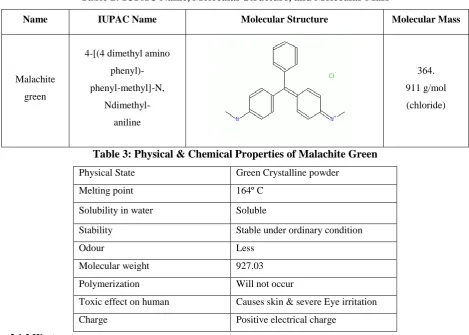
In the present study Malachite Green, one of the most widely used basic dyes has been chosen as a model dye
compound.Molecular structure &Physical and chemical properties of Malachite greenhas been illustrated in
Table 2 & Table 3 respectively. Malachite green, also called analinegreen,basic green 4,diamond green
B,orvictoria green B having IUPAC name 4-[(4-dimethylaminophenyl)-phenyl-methyl]-N,N-dimethyl-aniline is
a toxic chemical primarily used as a dye. It is a green crystalpowder with a metallic luster, very soluble in water,
extremely soluble in ethanol,solutions are blue-green; basic green dyes become yellow in high concentration
sulfuricacid, becomes dark orange when diluted; it becomes orange in high concentration nitricacid, becomes
Table 2: IUPAC Name, Molecular Structure, and Molecular Mass
Name IUPAC Name Molecular Structure Molecular Mass
Malachite
green
4-[(4 dimethyl amino
phenyl)-
phenyl-methyl]-N,
Ndimethyl-
aniline
364.
911 g/mol
(chloride)
Table 3: Physical & Chemical Properties of Malachite Green
Physical State Green Crystalline powder
Melting point 164º C
Solubility in water Soluble
Stability Stable under ordinary condition
Odour Less
Molecular weight 927.03
Polymerization Will not occur
Toxic effect on human Causes skin & severe Eye irritation
Charge Positive electrical charge
2.1.2 Wastewater
Wastewater from the homogenous tank of effluent treatment plant(ETP,s) of textile industry is to be collected.
2.1.3 Chemical and reagents
Hydrogen Peroxide (H2O2) solution was purchased from S.D. fine-chemlimitedhaving 30% W/V AR and was
freshly prepared. Hydrated ferrous sulfate (FeSO4.7H2O)was procured from SISCO Research laboratories,
Mumbai, (extra pure AR) and was usedas such without purification. pH of the solutions was adjusted with 1M
HCl or 1M NaOH.
2.2 Methods
2.2.1 Collection and storage of wastewater and dye sample
Collect sample from homogenous tank of effluent treatment plant of textileindustry. Sampling vessel are cleaned
and rinsed carefully with distilledwater and then wash with sample during sample collection. Then effluent is
stored incold store atatemp.of 4°C within 2 to 3 hrs of collection.Parameter to be studied includes pH, EC, TDS,
BOD5, COD and turbidity.
2.2.2 Preparation of Solution
a) Dye Solutions: The dye solutions is prepared by adding a known amount ofdye into a small amount of
deionized water in a 1-liter Erlenmeyer flask andfilling it to the mark with double distilled water. The flasks are
covered withaluminum foil to avoid degradation by the laboratory fluorescent lights. Beforethe oxidation
experiments could be performed, it is necessary to choose theappropriate concentration of dye solutions. For
water and make the solution quantity to1 L. (If 1 g is present in 1 L thensolution is said to be 1000 ppm and 0.1
g in 100 ml then it becomes 100 ppm)
b) Handling and Storage of Dye
Precautions:
Keep locked up. Keep away from heat. Keep away from sources ofignition. Empty containers pose a fire risk;
evaporate the residue under a fumehood. Ground all equipment containing material. Do not ingest. Do not
breathedust. Wear suitable protective clothing. In case of insufficient ventilation, wearsuitable respiratory
equipment. If ingested, seek medical advice immediately andshow the container or the label. Avoid contact with
skin and eyes. Keep awayfrom incompatibles such as oxidizing agents.
Storage: Keep container tightly closed. Keep container in a cool, wellventilatedarea. Do not store above 25°C
(77°F).
c) Hydrogen Peroxide: Hydrogen peroxide (30% w/v) is obtained from S.D. finechem.Limited having M.W. of
34.01. It implies that 100 ml of solution contains30 g or 1 ml contains 300 mg. If this solution is diluted ten
times then 1 mlcontains 30 mg of H2O2. Hence for adding 300 mg/l of H2O2 in dye or effluent,add 10 ml in 1
L of dye or 1 ml of diluted peroxide solution in 100 ml of dyesolution.
d) Ferrous Sulphate: Ferrous sulphate hydrated (FeSO4.7H2O) is prepared as10% w/v, which implies that the
10g of salt is dissolved in 100 ml of doubledistilled water. In order to dissolve ferrous sulphate completely in
distilled water,few drops of concentrated sulphuric acid are added to shift the equilibrium ofreaction backward.
Hence 1 ml of prepared solution contains 100 mg of salt. If thesolution is diluted ten times, then 1 ml contains
10 mg. For adding 150 mg/l, add15 ml in 1L of dye or 1.5 ml of diluted ferrous sulphate solution in 100 ml of
dyesolution or effluent sample.
e) Calcium Hypochlorite: Sodium Hypochlorite (4 % w/v) is procured fromMerck, which implies 4 g of
NaClO is present in 100 ml of solution or 40 mg in1ml. For adding 40 mg/l of NaClO in dye, add 1ml in 1 L or
0.1 ml in 100 ml.
III. CONCLUSION
Fenton process has proved its superiority to other conventional methods of wastewater treatments, because
of lack of toxicity of the reagents and due to simplicity of process.
This technology leads to completely destruction of hazardous contaminants and avoid transfer of pollutants
from one phase to another.
In terms of commercial application, the main setback is the cost of reagents such as ozone, titania and
hydrogen peroxide or energy light sources.
A potential viable solution proposed is the combination of these processes with biological processing. In
these combined processes, the chemical process would be utilized as pre-treatment step to enhance the
biodegradability and eliminate the toxicity of the effluents, while the total mineralization would be
completed in the conventional biological process.
So it can be concluded that photo-oxidation system employing Fenton and solar light has potential to
decolourize the textile dyes and is recommended as pretreatment step before conventional biological
The future scope of this technology can be the replacement of H2O2 by any other suitable but less
expensive oxidant. The by-products produced during treatments by UV, UV/H2O2/Fe2+, and H2O2/Fe2+
are unknown so more research is necessary to analyze the by-products in the effluent and their potential
toxicity to stream organisms.
REFERENCES
[1]. Venceslau M.C., Tom S. and Simon J.J., (1994), “Characterization of textile wastewaters- a review”,
Environmental Technology, 15, 917-929.
[2]. Dae-Hee A., Won-Seok C. and Tai-Il Y., (1999),“Dyestuff wastewater treatment using chemical oxidation,
physical adsorption and fixed bed bio film process”, Process Biochemistry, 34, 429–439.
[3]. Adel Al-Kdasi, AzniIdris, KatayonSaed, ChuahTeong Guan (2005),” Treatment of textile wastewater by
advanced oxidation processes-A review”, Global Nest, 6, 222-230.
[4]. Marco S. Lucas,JoseA.Peres (2006),” Decolorization of the azo dye Reactive Black 5 by Fenton and
![Table 1: Composite Textile Industry Wastewater Characteristics [4]](https://thumb-us.123doks.com/thumbv2/123dok_us/9247357.1460937/2.595.151.437.362.583/table-composite-textile-industry-wastewater-characteristics.webp)