IJEDR1701044
International Journal of Engineering Development and Research (www.ijedr.org)281
Region Based Hybrid Image Retrieval Algorithm
Using Local Ordinal Features
1
Janarthanam S.,
2Sukumaran S.
1Assistant Professor , 2Associate Professor1Department of Computer Science, Gobi Arts & Science College, Gobichettipalayam, Erode, Tamilnadu, India. 2Department of Computer Science, Erode Arts and Science College, Erode, Tamilnadu, India.
________________________________________________________________________________________________________ Abstract - In modern days the increasing social networking mediums with digital images are uploaded day by day. Image Retrieval using image content is the interesting field in digital image processing improves pictorial information for human interpretation and processing of image data for storage, transmission, and representation for machine perception. Content-Based Image Retrieval (CBIR) and querying access the visual information like color, texture and shape. In order to access the very large image collection the new techniques are very crucial. Content based image retrieval implements retrieval based on the similarity described using extracted features. In this paper, dynamic content-based image search and retrieval is conferred as Hybrid dynamic extraction algorithm. The proposed algorithm associates the advantages of distinct algorithms to improve the performance and accuracy of retrieval. Feature Vector Normalization set to make different feature vectors are united to provide a prosperous feature set for retrieving image.
Index Terms - CBIR, Color, Feature describers, Texture, Shape, Relevance Feedback.
________________________________________________________________________________________________________
I.INTRODUCTION
Comparing to the traditional systems represent image contents only by keyword annotations, the CBIR systems perform retrieval based on the similarity defined in terms of visual features with more objectiveness[1,3]. Although some new methods, such as the relevant feedback, have been developed to improve the performance of CBIR systems, low-level features do an important role and in some sense for the development and application of CBIR techniques. CBIR is also known as Query by Image Content (QBIC) aims at extracting and indexing images using the visual content such as shape, color, textures and other information used for retrieval[4].
Textural features are effective to mathematical symbolization for representing the repeating patterns on the surface of the image. Remarkable analysis methods include directionality, coarseness, line-likeliness, regularity, as well as roughness of texture. Gabor features are mostly used in texture analysis task. Edges are also one of the major features used in the fields of image retrieval. It denotes sudden change of intensities in an image. Edge detection is a process for detecting the boundaries of objects present in an image. There are several methods to implement edge detection. Gradient and Laplacian [11]. Gradient method is done by finding the minimum and maximum values belonging to the first derivative of the image. Zero crossings in the second derivative are used for Laplacian edge detection [5]. Canny, Prewitt, Roberts, Sobel are types of filters used for edge detection. Performance of the application is conditional to the selected edge detection algorithm. Efficient edge detection techniques are required by applications such as data compression, object recognition and tracking, image segmentation and pattern recognition [2].
In this work edge detection include quick edge detection with the help of structured forests. The edge mask so formulated helps in detecting the edges in the image by the method of mask processing. Selection of Image Features and its extraction is the key of successful development of CBIR system [6]. Entire image is taken in to consideration for Global features while small image portion or small group of pixels of image is taken into consideration for local features.
II.RELATEDWORK
Texture classification and texture based image segmentation are the challenging tasks. The texture feature provides vital information for the classification of image because it is useful in describing the contents of numerous real world images such as fruit, skin, bricks, trees, clouds in the sky and fabrics [8]. Texture helps in describing the high level semantics for image retrieval. The main problem in texture retrieval is the scale selection; most of the literature work has neglected the importance of scale selection for the computation of texture. Statistical methods are used for the analysis of image grey level spatial distribution.
In several systems, the image texture feature is extracted on basis of the pixels texture property or small blocks present in a small region. The probability of the co-occurrence of gray values in distinct orientations and at different distances is calculated the mean values of the texture of all the 4*4 blocks and used it as a region feature. Such features suffer from problems because they cannot define the texture property of the whole region. Image retrieval system proposed in [9, 10] relies on texture features only. The texture feature similarity is extracted by using wavelets and gradient vector decomposition.
Texture Feature Extraction using Gabor Filter
IJEDR1701044
International Journal of Engineering Development and Research (www.ijedr.org)282
suitable tool to extract texture features. They have already been used for texture based image retrieval [12] and proved to be very efficient for many applications.Texture features are excerpted using the Gabor filter. It is excellent in terms of deprecating the joint uncertainty in space and frequency, and is often adopted as an orientation and scale tunable edge and line (bar) detector. A two dimensional Gabor function g(x, y) is defined
2 2
2 2
1 1
( , ) exp 2 (1)
2 x y 2 x y x
x y
g x y w
Where σx and σy are the standard deviations of the Gaussian enclosure along the x and y direction. Gabor filters in different orientations and scales are used to detect textures in different orientations and scales, respectively. The energy response of a Gabor filter in a certain scale and orientation indicates the concurrence of the filter with the image texture. The response of a Gabor filter on an image I(x, y) is the convolution of the image I(x, y) and the Gabor filter.
Structured Identification by Linear Binary Pattern
LBP is one of the most powerful descriptors to represent local structures. Due to its advantages like computational simplicity & tolerance to illumination changes LBP has been successfully used for many different image analysis tasks, such as facial image analysis, biomedical image analysis, aerial image analysis, motion analysis, and image and video retrieval [16-18]. The operator assigns a label to every pixel of an image by thresholding the 3 by3 neighborhood of each pixel with the center pixel value. Then, the histogram of the labels or mean value can be used as a texture descriptor [13].
For every pixel of the image, its gray scale value is compared with those of the surrounding pixels. The value of each neighbor is set to 0 if its gray scale value is smaller than the central pixel‘s value and to 1 otherwise. This creates eight digit binary numbers called the local binary pattern. It allows 256 possible values.
A local binary pattern is called uniform if the binary pattern contains at most two bitwise transitions from 0 to 1 or vice versa when the bit pattern is traversed circularly. For example, the patterns 00000000 (0 transitions), 01110000 (2 transitions) and 11001111 (2 transitions) are uniform whereas the patterns 11001001 (4 transitions) and 01010010 (6 transitions) are not. In t he computation of the LBP labels, uniform patterns are used so that there is a separate label for each uniform pattern and all the non-uniform patterns are labeled with a single label. For example, when using (8,R) neighborhood, there are a total of 256 patterns, 58 of which are uniform, which yields in 59 different labels[14]. The histogram of the LBP result is a good measure to classify textures.
The value of the LBP code of a pixel (xc,yc) is given by: 1
, 0
( )2 (2)
p
p
p r p c
p
LBP s g g
Where ( ) 1, 0;
0, if x s x
otherwise
(3)
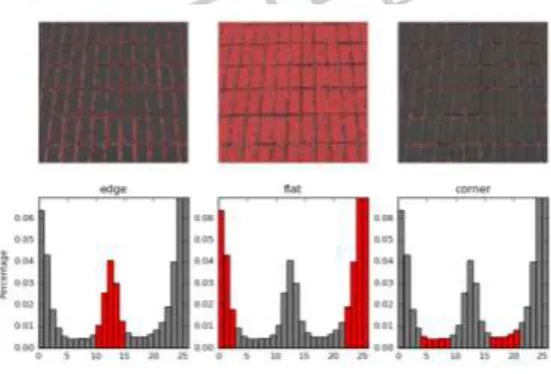
The plot highlights flat, edge-like, and corner-like regions of the image. Local binary patterns (LBP) which describes the neighboring changes around the central point, is a simple yet effective way to represent faces. It is invariant to monotone transformation and is robust to illumination changes to some extent. The combination of Gabor and LBP further improves the image recognition performance.
Figure 1. Histogram of Local binary patterns (LBP)
IJEDR1701044
International Journal of Engineering Development and Research (www.ijedr.org)283
recognition results in many applications. On one hand, there are indications that uniform patterns themselves are more stable, i.e. less prone to noise and on the other hand, considering only uniform patterns makes the number of possible LBP labels significantly lower and reliable estimation of their distribution requires fewer samples. The uniform patterns allow seeing the LBP method as a unifying approach to the traditionally divergent statistical and structural models of texture analysis [19-21]. Each pixel is labeled with the code of the texture primitive that best matches the local neighborhood. On the other hand, the distribution is just a statistic of a non-linearly filtered image, clearly making the method a statistical one. For these reasons, the LBP distribution can be successfully used in recognizing a wide variety of different textures, to which statistical and structural methods have normally been applied separately.Comparative Features of Gabor Filter and Linear Binary Pattern
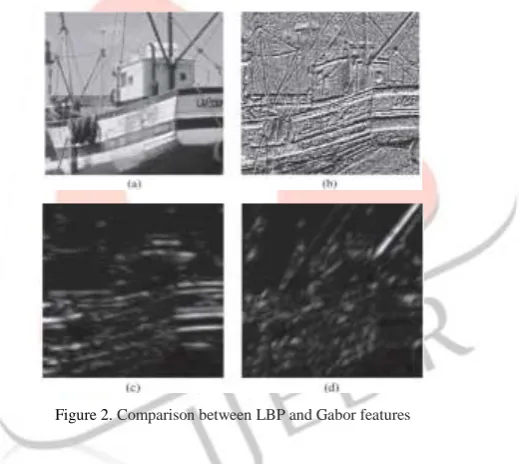
Given the aforementioned brief description of the Gabor filter and LBP, it can be noticed that the former belongs to a global operator while the latter is a local one. As a consequence, Gabor features and LBP represent texture information from different perspectives [22]. Figure.2 illustrates an example of comparison between LBP and Gabor features in a natural image (namely, boat) of size 256 × 256. Fig. 2(b) shows the LBP-coded image obtained using (5) with (m, r) = (8, 1), and Figure. 2(c)–(d) illustrates the filtered images obtained by the Gabor filter with different θ (i.e., 0, π/4, π/2, and 3π/4). In Figure 2, the Gabor features produced by the average magnitude response for each Gabor-filtered image reflect the global signal power, while the LBP-coded image is a better expression of detailed local spatial features, such as edges, corners, and knots. Thus, it is promising to apply the global Gabor filter as a supplement to the local LBP operator that lacks the consideration of distant pixel interactions, which is also the motivation of this work.
The Gabor filter can capture the global texture information of an image, while LBP represents the local texture information. It is known that an HSI data usually contains homogeneous regions where pixels fall into the same class [23]. Gabor features are able to reflect such global texture information because the Gabor filter can effectively capture the orientation and scale of physical structures in the scene. Therefore, combining Gabor and LBP features can achieve better classification performance than using only LBP features.
Figure 2. Comparison between LBP and Gabor features
III.PROPOSED METHOD
Our proposed method is motivated by the fact that in most existing Gabor phase based approaches only the binary relationship between neighboring Gabor phases is used for local pattern coding. Histogram features are extracted from the gradient-encoded Gabor-filtered images to generate the corresponding image signature. This proposed encoded feature is termed as Hybrid Dynamic Gradient Gabor Pattern (HDGGP). The proposed gradient encoding method has the following properties:
Unlike conventional LBP generates a binary string first and then converts this sequence to a decimal value (LBP-like descriptor), the proposed coding method directly utilizes the intensity values to calculate the transformation without producing intermediate binary sequence values.
Contrast information is exploited, the proposed encoding method utilizes the gradient information which has been shown to be more effective against lighting variations.
They form well-established image decomposition with spatial locality and orientation selectivity characteristics. Therefore, they are optimally localized in the space and frequency domains.
IJEDR1701044
International Journal of Engineering Development and Research (www.ijedr.org)284
defined in LBP groups. HDGGP has advantages for representing dynamic textures by extending conventional LBP from 2D image to 3D image sequence. In Ref. [25], Lei et al. further extend LBP to Gabor transform domain. A spatial-temporal local binary pattern is utilized to model dynamic background.The LBP descriptor labels the pixels of an image by determining the gray levels of the P neighbors (with radius R) of the center pixel as shown in Fig. 3. Finally, the histogram of the labels is utilized for texture description.
Figure 3 Rotation Invariant Patterns with sampling pixels
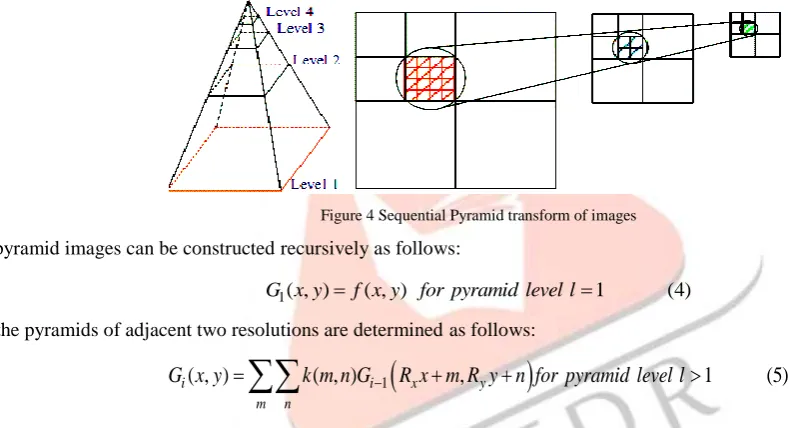
Pyramid transform is an effective multi-resolution analysis approach. In this paper, we represent local binary pattern in spatial pyramid domain. In the low-resolution images, a pixel corresponds to a region in its high-resolutions [28,29]. In Refs. Maenpaa et al. call the region as ‘‘effective area’’. Sequential pyramid images are constructed as shown in Figure 4.Each neighboring two images are with resolution variation rate 2. Pyramid image can be generated by low pass filters of wavelet transform, Gaussian smooth filtering [30], symmetric weighting and block averaging.
Figure 4 Sequential Pyramid transform of images
The pyramid images can be constructed recursively as follows:
1( , ) ( , ) 1 (4)
G x y f x y for pyramid level l
For the pyramids of adjacent two resolutions are determined as follows:
1
( , )
( , )
,
1
(5)
i i x y
m n
G x y
k m n G
R x m R y n for pyramid level l
Where Rx and Ry are the down sampling ratios in x- and y-directions, respectively. Rx,Ry>1 means down sampling is utilized during pyramid image generation, while Rx=Ry=1 means no sampling is utilized. k(x,y) is a low-pass filter. It can be Gaussian filters with various standard deviations and low-pass filters of wavelet bases. To simplify the computations, Gaussian filtering can be approximated by symmetric weighting [31].
Thus Eq. (5) can be rewritten into
1
( , )
( , )
(
,
)
1
(6)
z z
i l x y
m z n z
G x y
m n G
R x m R y n for pyramid level l
Where ω(m,n) is a symmetric weighting function with (2Z+1) taps. ω (m, n) terminates the generating Gaussian kernel k(m,n) in terms of the rules of separable and symmetric. In this case, the weighting function closely approximates the Gaussian function
[29]. Another alternative approach of the Gaussian low-pass filtering is using a local average of the original image. IV.RESULTS AND DISCUSSIONS
Experiments are conducted to show the effectiveness of the proposed HDGPP descriptors. The first experiment carries out comparisons for scene and texture classification performances for original LBP, uniform LBP, rotation-invariant-uniform LBP, MLBP and DLBP and their representations in pyramid domain. The second experiment is related to the comparisons for the DGPP and its representations in pyramid transform domain (HDGGP) are discussed.We evaluate the performances of LBP, MLBP, DLBP and HDGGP on widely used datasets: Sport Event, UIUC texture dataset, and XU texture dataset. Accurate recognition rate (AR) is utilized to evaluate the classification performance which is expressed as follows:
100
(7)
NC
AR
NC
NM
IJEDR1701044
International Journal of Engineering Development and Research (www.ijedr.org)285
Where NC and NM are the correct and missing detections. We also utilize the confusion matrix to show the discriminative performance of each category.Table 1 Scene Categorization performances on Sports Event Dataset (P,R) Feature 5 25 50 AVG
(8,1) DLBP HDGGP LBP MLBP 32.54 38.86 31.91 37.22 37.61 45.75 36.84 44.73 38.76 47.64 37.83 46.55 36.30 44.08 35.53 42.83 (8,2) DLBP HDGGP LBP MLBP 33.03 38.67 30.00 35.54 38.84 46.67 35.23 43.52 40.17 48.42 36.30 45.38 37.53 44.59 33.84 41.48 (8,3) DLBP HDGGP LBP MLBP 34.98 39.49 30.43 35.66 41.32 47.88 36.14 44.02 42.91 49.14 37.27 45.93 39.74 45.50 34.61 41.87
Table 2 Scene Categorization performances on UIUC Texture Dataset (P,R) Feature 5 10 15 AVG
(8,1) LBP MLBP DLBP HDGGP 29.91 35.50 28.28 35.38 32.94 40.01 31.13 39.92 33.77 40.80 31.92 40.47 32.21 38.77 30.44 38.59 (8,2) LBP MLBP DLBP HDGGP 28.27 36.88 26.06 37.41 31.47 14.53 28.69 41.50 32.04 42.81 29.34 42.41 30.59 31.41 28.03 40.44 (8,3) LBP MLBP DLBP HDGGP 27.62 37.66 25.31 38.83 30.98 42.21 28.26 42.80 31.71 43.68 28.71 44.02 30.10 41.18 27.43 41.88
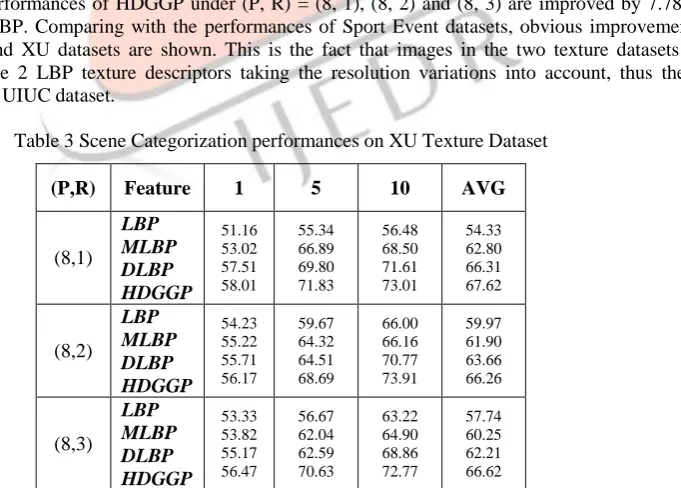
In Table 1 the average performances of HDGGP under (P, R) = (8, 1), (8, 2) and (8, 3) are improved by 7.78%, 7.06%, and 5.76%, respectively, over DLBP. Comparing with the performances of Sport Event datasets, obvious improvements of HDGGP over MLBP for the UIUC and XU datasets are shown. This is the fact that images in the two texture datasets are with large resolution variations. In Table 2 LBP texture descriptors taking the resolution variations into account, thus the performances improvements are obvious for UIUC dataset.
Table 3 Scene Categorization performances on XU Texture Dataset (P,R) Feature 1 5 10 AVG
(8,1) LBP MLBP DLBP HDGGP 51.16 53.02 57.51 58.01 55.34 66.89 69.80 71.83 56.48 68.50 71.61 73.01 54.33 62.80 66.31 67.62 (8,2) LBP MLBP DLBP HDGGP 54.23 55.22 55.71 56.17 59.67 64.32 64.51 68.69 66.00 66.16 70.77 73.91 59.97 61.90 63.66 66.26 (8,3) LBP MLBP DLBP HDGGP 53.33 53.82 55.17 56.47 56.67 62.04 62.59 70.63 63.22 64.90 68.86 72.77 57.74 60.25 62.21 66.62
IJEDR1701044
International Journal of Engineering Development and Research (www.ijedr.org)286
Table 4 Performance Comparison of DLBP and HDGGP on Sports Event DatasetSize Feature 5 30 50 AVG
Global DLBP HDGGP
45.82 46.40
53.26 53.67
54.50 54.68
51.19 +0.39
Grid 3*3 DLBP HDGGP
50.67 50.98
60.31 61.82
61.17 64.00
57.38 +1.55
Table 5 Performance Comparison of DLBP and HDGGP on UIUC Texture Dataset
Size Feature 3 12 20 AVG
Global DLBP HDGGP
42.66 46.94
54.82 57.89
57.74 60.77
51.74 +3.46
Grid 3*3 DLBP HDGGP
42.33 45.24
55.60 58.23
59.73 62.54
52.55 +2.79
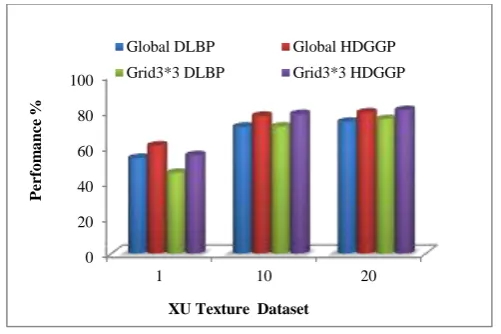
Table 6 Performance Comparison of DLBP and HDGGP on XU Texture Dataset
Size Feature 1 10 20 AVG
Global DLBP HDGGP
53.72 60.78
71.37 77.50
74.13 79.43
66.41 +6.16
Grid 3*3 DLBP HDGGP
45.36 55.31
71.41 78.49
75.63 80.77
64.13 +7.39
Tables 4–6 show the comparisons for DLBP and its representations in pyramid domain (denoted HDGGP) on Sport Event, UIUC, and XU texture datasets. In Table 4–6 to discuss the performance on 5-scale and 8-orientation based Gabor filtering is utilized in DLBP and HDGGP. The Classification Performance on varying training samples is shown in the following Figures.
Figure 5 Retrieval Performances of DLBP and HDGGP on Sport Event Data Set
Figure 6 Retrieval Performances of DLBP and HDGGP on UIUC Texture Data Set 0
20 40 60 80 100
5 30 50
Pe
rf
o
rm
a
n
ce
%
Sport-Event dataset
Global DLBP Global HDGGP
Grid3*3 DLBP Grid3*3 HDGGP
0 20 40 60 80 100
3 12 20
Pe
rf
o
rm
a
n
ce
%
UIUC texture dataset
Global DLBP Global HDGGP
IJEDR1701044
International Journal of Engineering Development and Research (www.ijedr.org)287
Figure 7 Retrieval Performances of DLBP and HDGGP on XU Texture Data SetTo evaluate the performances of the DLBP and HDGGP for the global image (denoted Global) and the equal-sized sub-images with 3*3 grids (denoted Grid 3*3) are also shown. From the comparisons, find the improvements of HDGGP over DLBP under Global are about 0.39%, 3.46%, and 6.16% respectively, for the Sport Event, UIUC and XU texture datasets. Even though good performances are achieved by HDGGP over Grid 3*3 further improvements are made by 1.55%, 2.79% and 7.39% respectively. Figure 5-7 represents the Improvement in the performance of the proposed HDGGP under Global and Grid 3*3. For three different similarity measurement approaches for both DLBP and HDGGP descriptors are compared under various training samples per category. While for Gaussian low pass filters, the standard deviations influence the final performances very much.
V.CONCLUSION
Hybrid Dynamic Gradient Gabor Pattern (HDGGP) further enhances the discriminative power of Gabor features and provides a more compact face representation. The approach is based on the encoding of local ordinal information of the coefficients in Gabor response images. The experimental results demonstrate that, the proposed descriptors provide either better or comparable results than other state-of-the-art descriptors in terms of accuracy. Furthermore, The experiment with the score level to exploit complementary information provided by phase and magnitude parts. The experimental results revealed the further enhancement in the accuracy by combining these two descriptors. It can also be pointed out that the proposed descriptors have shown high robustness to challenges like illumination variation and expression etc. Moreover, they are simple to implement, descriptive, and achieve highly competitive results.
REFERENCES
[1] G. O. Young, “Synthetic structure of industrial plastics (Book style with paper title and editor),” in Plastics, 2nd ed. vol. 3, J. Peters, Ed. New York: McGraw-Hill, 1964, pp. 15–64.
[2] A.B. Enatti a, Eduardo Valle a, “Comparative study of global color and texture descriptors for web image retrieval,” J.VisCommun. Image R, vol. 23, p. 359-380, 2012.
[3] C. Chen et al., “Multi hypothesis prediction for noise-robust hyper spectral image classification,” IEEE J. Sel. Topics Applies Earth Observ. Remote Sens., vol. 7, no. 4, Pp. 1047–1059, Apr. 2014.
[4] D. Levine, “Finding a small number of regions in an image using low-level features,” Pattern Recognition, vol. 35, p. 2323-2339, 2002.
[5] D. T. Anderson, K. E. Stone, J. M. Keller, and C. J. Spain, “Combination of anomaly algorithms and image features for explosive hazard detection in forward looking infrared imagery,” IEEE J. Sel. Topics Appl. Earth Observ. Remote Sens., vol. 5, no. 1, Pp. 313–323, Feb. 2013.
[6] G. B. Huang, H. Zhou, X. Ding, and R. Zhang, “Extreme learning machine for regression and multiclass classification,” IEEE Trans. Syst., Man,Cybern., Part B: Cybern., Vol. 42, No. 2, Pp. 513–529, Apr. 2012.
[7] Guo, Z.H., Zhang, L., Zhang, D.: “Rotation invariant texture classification using LBP variance (LBPV) with global matching”. Pattern Recognition. Vol.43 Issue3,Pp 706–719 ,2010.
[8] Hao Xia, Steven C.H. Hoi, Rong Jin, and Peilin Zhao” Online Multiple Kernel Similarity Learning for Visual Search” IEEE Transactions on Pattern Analysis and Machine Intelligence, Vol. 36, No. 3, March 2014.
[9] He, Y., Sang, N., Gao, C.: Pyramid-based multi-structure local binary pattern for texture classification. In: Proc. Asian Conference on Computer Vision, vol. 3, pp. 1435–1446 ,2010.
[10] J. Li, J. M. Bioucas-Dias, and A. Plaza, “spectral–spatial hyperspectral image segmentation using subspace multinomial logistic regression and Markov random fields,” IEEE Trans. Geosci. Remote Sens., vol. 50, no. 3, Pp. 809–823, Mar. 2012.
[11] Ja-Hwung Su, Wei-Jyun Huang, Philip S. Yu, and Vincent S. Tseng,” Efficient Relevance Feedback for Content-Based Image Retrieval by Mining User Navigation Patterns” IEEE Transactions on Knowledge and Data Engineering, Vol. 23, No. 3, March 2011.
0 20 40 60 80 100
1 10 20
Pe
rf
o
m
a
n
ce
%
XU Texture Dataset
Global DLBP Global HDGGP
IJEDR1701044
International Journal of Engineering Development and Research (www.ijedr.org)288
[12] Ja-Hwung Su, Wei-Jyun Huang, Philip S. Yu, and Vincent S. Tseng,” Efficient Relevance Feedback for Content-BasedImage Retrieval by Mining User Navigation Patterns” IEEE Transactions on Knowledge and Data Engineering, Vol. 23, No. 3, March 2011.
[13] Juan Wang,Jiangshe Zhang,Mingming Zhao” On size invariance texture image retrieval by fuzzy logic classifier and scattering statistical features” Pattern Anal Applic ,Vol. 19,Pp:509–516,2016.
[14] K.-K. M. Ju Han, “Rotation-invariant and scale-invariant Gabour features for texture image retrieval,” Image and Vision Computing, vol. 25, Pp.14741481, 2007.
[15] Licheng Jiao, Senior Xu Tang, Student Biao Hou, and Shuang Wang,“SAR Images Retrieval Based on Semantic Classification and Region-Based Similarity Measure for Earth Observation” IEEE Journal of Selected Topics in Applied Earth Observations and Remote Sensing, Vol. 8, No. 8, August 2015.
[16] Lining Zhang, Hubert P. H. Shum, and Ling Shao, “Discriminative Semantic Subspace Analysis for Relevance Feedback” IEEE Transactions on Image Processing, Vol. 25, No. 3, March 2016.
[17] Mohsen Zand Shyamala Doraisamy, Alfian Abdul Halin, Mas Rina Mustaffa, “Texture classification and discrimination for region-based image Retrieval” J. Vis. Commun. Image R. Vol. 26,Pp: 305–316,2015.
[18] Qianni zhang and Ebroul Izquierdo, “Histology Image Retrieval In Optimized Multifeature Spaces” IEEE journal of biomedical and health informatics, Vol. 17, No. 1, January 2013.
[19] S. Lazebnik, C. Schmid, J. Ponce, “A sparse texture representation using affine invariant regions”, in: Proceedings of the CVPR, Vol. 2, Pp. 319–324, 2003.
[20] S. Liao, M. Law, A. Chung, “Dominant Local Binary Patterns for Texture Classification”, IEEE Transactions on Image Processing” Vol. 18 Issue 5 Pp: 1107–1118, 2009.
[21] S. Liao, M. W. K. Law, and A. C. S. Chung, “Dominant local binary patterns for texture classification,” IEEE Trans. Image Process., Vol. 18, No. 5, Pp. 1107–1118, May 2009.
[22] S. Xie, S. Shan, X. Chen, W. Gao, “V-LGBP: volume based local Gabor binary patterns for face representation and recognition”, in: Proceedings of the ICPR 2008.
[23] T. Ojala, M. Pietikainen, and T. Maenpaa. “Multiresolution gray-scale and rotation invariant texture classification with local binary patterns”, IEEE Trans. Pattern Analysis and Machine Intelligence, Vol 24, Pp:971–987, 2002.
[24] Timo Ahonen, Abdenour Hadid, Matti Pietikainen, “Face Description with Local Binary Patterns: Application to Face Recognition”, IEEE Transactions On Pattern Analysis And Machine Intelligence, Vol. 28, No. 12, Pp-2037-2041, 2006. [25] W. Li and Q. Du, “Gabor-filtering based nearest regularized subspace for hyper spectral image classification,” IEEE J.
Sel. Topics Appl. Earth Observ. Remote Sens., vol. 7, no. 4, Pp. 1012–1022, Apr. 2014.
[26] W. Li, S. Prasad, J. E. Fowler, and L. M. Bruce, “Locality-preserving dimensionality reduction and classification for hyperspectral image analysis,” IEEE Trans. Geosc. Remote Sens., vol. 50, no. 4, Pp. 1185–1198, Apr. 2012.
[27] Xiang-Yang Wang, Jing-Wei Chen, “A new integrated SVM classifiers for relevance feedback content-based image retrieval using em parameter estimation,” Applied Soft Computing, vol. 11, Pp. 2787-2804, 2011.
[28] Y. Bazi et al., “Differential evolution extreme learning machine for the classification of hyper spectral images,” IEEE Geosci. Remote Sens. Lett.,Vol. 11, No. 6, Pp. 1066–1070, Jun. 2014.
[29] Young Deok Chun, Nam Chul Kim and Ick Hoon Jang,”Content-Based Image Retrieval Using Multi resolution Color and Texture Features” IEEE Transactions on Multimedia, Vol. 10, No. 6, October 2008.
[30] Z. Guo, L. Zhang, and D. Zhang, “Rotation invariant texture classification using LBP variance (LBPV) with global matching,” Pattern Recogn.,vol. 43, no. 3, Pp. 706–719, Mar. 2010.
[31] Z. Guo, L. Zhang, D. Zhang, “A completed modeling of local binary pattern operator for texture classification”, IEEE Trans. Image Processing Vol.19Issue 6, Pp: 1657–1663, 2010.
Authors
Mr. S. Janarthanam (S’ 86) received the Bachelor, Master and Philosophy degrees in Mathematics, Computer Science all from
the from the Bharathiar University, Coimbatore in 2006, 2009 and 2013 respectively. At present he is pursuing the Ph.D. degree at Erode Arts and Science College. Now he is working as an assistant professor in Computer Science at Gobi Arts & Science College, Erode, and Tamilnadu, India. He is member in International Association of Engineers from 2013 and student member in the Institute of research engineers and doctors from2015 and also he attained membership in Computer Science teacher Association (ACM), USA from 2015onwards. He published 12 papers in International and National journals and 15 papers in the international and national conferences. His current research interests include Software Testing, Digital Image Processing and Data Mining