3378
Automated Hybrid Gesture Recognition For
Human Body Skeleton Identification Using Feature
Extraction And Classification Techniques
Anuradha Patil, , kalaburagi, Dr. Chandrashekhar M. Tavade,
Abstract: A Human to Human connection can be accomplished through discourse composing, articulations and signals. Be that as it may, to connect with a PC standard interface, a propelled robotization framework is required. The headway in the innovation has enabled musings to ad lib the interface for association between the human and PC. Human PC association (HCI) is an examination zone which characterizes inventive interfaces for human PC communication. The ongoing works around there is centered on the utilization of human signals for PC collaboration particularly hand motions. The hand signals permit cooperation in an augmented experience condition and furthermore can give an advantageous method to physically handicapped, for example, daze individuals to communicate with a PC. There are dialects for characterizing the importance of a hand motion example, for example, American standard language, British Standard language, Japanese standard language, and so on. A Hand motion acknowledgment (HGR) framework and Human Body Skelton Recognition (HBSR) enables a client to communicate in a Sign Language with the PC a few at HGR frameworks have appeared few of those utilizing equipment sensors, for example, accelerometers and spinner, yet greater part of the frameworks created utilize visual or imaging strategies. The exploration center here lies in the improvement of a visual Hand signal acknowledgment (HGR) framework to build up a viable interface for PC communication. A broad knowledge into the works identified with existing visual HGR and HBSR frameworks uncovered that the HGR framework execution is incredibly influenced by lighting varieties, picture quality got from camera and foundation jumbles. Aside from this current ASL, the HGR frameworks experience the ill effects of goals irregularities, Complex element extraction systems on the arrangement methods utilized couldn't adapt to the intricate situations of acknowledgment. To give a viable answer for the above issues this exploration stresses on three primary destinations; upgrading the caught picture goals for precise signal acknowledgment, building up another model for characterizing the highlights to be separated to expands the acknowledgment exhibitions.
Index Terms: Human skeleton Recognition, hybrid Framework, Kinect Camera, DWT, Bilinear filter, DT-CWT and DT-CWT & EPS.
—————————— ——————————
1
INTRODUCTION
The research study is aim to build a Frame work for a gesture recognition system, which is the significant to the applications where human to machine interaction is core functionality. The study considers gesture of the hand as a gesture because most of the human activities are indicated by hand gesture after the vocal. In this chapter an introduction to hand gesture (HG) detection mechanism is discussed along with various conceptual aspects of the HG recognition (HGR) modelling of a Hand Gesture and challenges in HG. In the respective section, the brief overview of the research, the identified problems and motivation factors for the research are described along with problem statement. The considered aim and objectives for the research are highlighted in section ―Research aim and objectives‖ The implemented methods for the research are explained in section‖ research methodology ―.The general arrangement of the proposed work is given in following segment. The hand motion acknowledgment framework is used for making a characteristic collaboration among individual and PC where the perceived motions can be utilized for controlling a Robot/transmitting/significant data [1]." Human PC association (HCI)" is likewise named as "Man-machine communication (MMI) which alludes the connection among persona and PC or all the more accurately the machine, and since the machine is inconsequential without appropriate used by the human [2][3].
There are two fundamental qualities should be viewed as
when structuring a HCI framework: for example usefulness and ease of use. The usefulness alluded to the capacities or administrations that the framework gives to the client, and the framework ease of use alluded to the dimension and extension that the framework can control and perform explicit client purposes[1][4]. Motions utilized for conveying between an individual and machines additionally between the people utilizing communication via gestures [5][6]. Motions can be static (blurb/certain posture) or dynamic (Series of stances). The static-signal requires less computational multifaceted nature where dynamic-motions are progressively Complex. Different strategies have been created for procuring fundamental data for motions acknowledgment framework [4][6].Some techniques are used for outside equipment - gadgets, for example, information glove gadgets and shading markers which can without much of a stretch concentrate the exhaustive depiction of motion highlights .Other strategies depend on the presence of hand which fragments the hand and concentrates the basic highlights, these techniques are considered as Natural, simple and less savvy than other[7][8]. Motion – acknowledgment, alongside facial, voice, eye following and lip development acknowledgment are the segments of what designers allude to as a "perceptual UI (PUI)" [9].The PUI objective is improve the proficiency . In individualized computing framework, Gestures are most every now and again used for information directions [8][9]. Perceiving signals as information in case the PCs to be progressively available for the physically harmed and makes the normal communication in a gaming or 3D-computer generated reality condition [10].Hand and body motions can be expanded by a controller that contains "Accelerometers" and "Gyrators" to detect tilting, pivot and speeding up of development or the processing – gadget can be equipped with camera so programming in the gadget can be distinguish/perceive and decipher explicit motions [11].
____________________________________
Anuradha Patil, Research Scholar, Godutai engineering college for women, kalaburagi, ECE department. [email protected] Dr. Chandrashekhar M. Tavade, Research Supervisor, Center-BKIT
3379
Gesture based communication is one of the proficient specialized devices for the general population who are not competent to talk/hear anything too accommodating for somebody who can talk however not ready to hear/the other way around [5]. Communication via gestures is a blend diverse Gesture, shapes and development of hand, body and outward appearances. Hard of hearing individuals utilize this sort of motion to speak to their emotions. Every Movement of hand/motion, outward appearances and body development has unique doled out importance. In various nations, distinctive Sign - Languages are utilized [6]. For instance in USA, "American gesture based communication" (ASL) is utilized while in England, "English communication via gestures is utilized " (BSL) . Thus in Japan "Japanese gesture based communication" (JSL). in French" French gesture based communication" (FSL) and in "India Indian Sign Language" ( ISL). Work on ISL has quite recently begun after Indian-Sign Language got an institutionalized [6]. American Sign Language (ASL) is the vernacular of a choice for most almost deaf in the United States. ASL use approximately 6,000 movement for ordinary words and finger spelling for granting dull words or formal individuals, spots or things. Correspondence in ASL consistently depends accessible shapes put in or moved transversely over explicit territories in regard to the endorser's body, despite improvement of the head and arm, and outward appearance [12]. Regardless, suitable names and words with no unitary sign are spelled. Letter by letter, in English, and understudies is of ASL normally begin their investigations by taking in the 26 hand shape that establishes the manual letter set [12] [13].
PROBLEM DESCRIPTION AND STATEMENT
"Hand signals acknowledgment" is the critical research issue in the field of human-PC cooperation, in view of its broad applications in augmented reality, gesture based communication acknowledgment, and PC diversions. Notwithstanding bunches of past work, constructing a hearty hand motion acknowledgment framework that is pertinent for genuine applications remains a difficult issue. Existing vision-based methodologies are significantly constrained by the nature of the info picture from optical cameras. Varieties in lighting and foundation bunches would just intensify the issue. Always, these frameworks have not had the option to give tasteful outcomes to hand signal acknowledgment. The constrained characteristics of the information picture from optical cameras are talked about in [18] [19] [20].
2
HAND
GESTURE
RECOGNITION
ON
CONCERNS
TWO
CHALLENGING
PROBLEMS
Hand location and signal acknowledgment, to be specific how to vigorously identify the hand and how to effectively and precisely perceived the motion of the hand. The design of the proposed Framework for hand motion acknowledgment framework is appeared in Figure 1. By and large for hand location the customary strategies utilizes shading markers. While the proposed system utilizes both the profundity guide and shading picture acquired by a unique camera with sensor in particular "kinect sensor camera" to recognize the hand shapes. it guarantees vigor to jumbled foundation just as the portioned hand shapes are spoken to as time-arrangement bends. Concerning the motion acknowledgment, even with the Kinect sensor it is still extremely testing issue. Since normally,
the goals of a Kinetic sensor is just 640x480. Despite the fact that it functions admirably to follow a substantial article, for example the human body, it is hard to identify and fragment this unequivocally a little item from a picture at the goals, e.g., a human hand that involves extremely little part of the picture. Thusly, a novel shape remove Metric called Finger-Earth mover's Distance (FEMD) is utilized to gauge the dissimilarities between various hand shapes as proposed in crafted by [20]. The proposed work has delineated about fundamentals of hand motion acknowledgment (HGR) framework which primarily stresses on the impediments of conventional hand motion acknowledgment strategies. This section for the most part talks about two-level engineering for the ongoing hand motion acknowledgment framework utilizing just a single camera as the info gadget. The low-dimension of the engineering centers around, first, the hand pose identification and following calculation proposed and is depicted in subtleties beneath, and second portrays the goals improvement issue and system for hand motion pictures utilizing Dual Tree Complex Wavelet Transformation (DTCWT) and Bilateral Filter is utilized so as to acquire upgraded execution.
2.1 Skeleton Identification of Kinect Camera
In this proposed framework, "Kinect camera" assumes the significant job to accumulate the profundity data from the skeleton. The new form of Kinect with its SDK (Software Development Kit) containing the skeleton following apparatus. This exceptional instrument gives the framework to gather the 20 joint data of the human body. For each edge, the places of 20 are evaluated and gathered. The 20 joints which are taken as a reference focuses is as appeared in Fig. 1.
Algorithm : Skeleton identification from Kinect-Sensor Input : one or more people image
Output : 20 joint images a. start
b. capture the image from kinect camera c. segment the image from skeleton viewer
d. for reference points in body portion finds the depth-information
e. segmented moving body portion is mapped to the skeletal co-ordinates
f. if more than one moving body portion presents g. calculate skeleton connection map for x,y coordinate h. display the multiple skeleton moving body
i. end of predefined frames j. stop
Fig.1. Human skeleton joints as reference points
3380
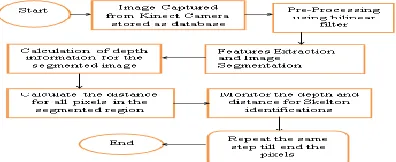
the depth images of human in different sizes, and shapes, and generate the big dataset. The RGB and D-image are the input images of the system for the recognition of different ASL alphabetic symbols. This skeletal tracker device able to track the skeleton image of one or more persons moving within the kinect area view for gesture driven applications i.e. this tool able to collect 20 joint information about the skeleton. From the skeleton tracked by the Kinect first it extracts the feature of joint positions. Since, each joint has 3 values and also 3 coordinates and the detected skeleton has of 20 joints. So, the feature vector has 60 dimensions. The position of 20 points identified by kinect afterwards it will segment the right hand posture to recognize and stored in the database. From this sets can select the wanted joints of images for representing the postures. The step by step process for multiple skeleton identifications from kinect camera is shown in Fig.2.
Fig. 2. Overall block diagram for skeleton identification in the
human body
Fig. 3. Skeleton-image identification from kinect sensor
Fig. 3. shows the outcomes of identifying multiple skeletal signs under different distance using kinect-sensor device which represents the color and depth image.
3.MULTIPLE
DEPTH
RECOGNITION
(i) To calculate centroid:
Here system is considering the three co-ordinates X, Y and Z. Calculating the centroid for each axis independently the mathematical interpretation for centroid is given by
X= sum (x) / length(x)...(1) Y= sum (y) / length (y)………… (2)
Z= sum (z) / length (z)………(3)
(ii) To calculate mean:
The system will calculate the mean for the entire segmented region calculated by the centroid of the body part by pixel basis. The mathematical interpretation for mean for pixels is given by
ki k
i
i
y
k
y
and
i
y
k
x
1
(
)
1
(
)
(
3
)
0
The flow graph in Fig.4 shows for the multiple depth
recognition using Kinect sensor is as follows
Fig.4. the flow graph for the multiple depth recognition
3.1Data Acquisition And Pre-Processing
The raw data obtained from the Kinect sensor via the Natural User Interface (NUI) contained 512×424 depth data, 1920×1080 RGB data, and 26-joint body skeleton data. The hand region in the depth image was described using spatial thresholds in X-axis direction [𝑇𝑥_𝑚𝑖𝑛, 𝑇𝑥_ ], Y-axis direction [𝑇𝑦_𝑚𝑖𝑛, 𝑇𝑦_𝑚𝑎𝑥 ] and Z (depth)-axis direction [𝑇𝐷𝑒𝑝𝑡ℎ_𝑚𝑖𝑛 ,
𝑇𝐷𝑒𝑝𝑡ℎ_𝑚𝑎𝑥]. As illustrated in Figure 3.6, the Kinect depth
sensor located at position 𝑺 has angles of view 𝛼 (horizontal) and 𝛽 (vertical). The resolution of the depth image is 𝑅𝑥𝑏𝑦𝑅𝑦
pixels. The position of the ―hand‖ joint (𝑥, 𝑦, 𝐷) in the depth image can be obtained from the Kinect skeleton data (Figure 3.7a). Thus, the spatial thresholds are described as:
(1)) 2 tan(
2 2 , ) 2 tan(
2 2 max
min,
D Rx dx x D
Rx dx x Tx
Tx
(2)) 2 tan(
2 2 , ) 2 tan(
2 2 max
min,
D Ry dy y D
Ry dy y Ty
Ty
__(
3
)
2
,
2
max
min,
Tdept
D
dx
D
dx
Tdept
where𝑑𝑥 , 𝑑𝑦 and 𝑑𝑧 are constant dimensions (in millimetres) of the hand‘s region. The hand‘s region in the depth image is shown in Fig.5. The hand‘s region in the color image can also be obtained by mapping the hand‘s region on top of the color image is shown in Fig.6.
Fig. 5. Illustration of the hand region segmentation: the𝑑𝑥 × 𝑑𝑦
× 𝑑𝑧hand region at(𝑥, 𝑦, 𝐷) was segmented from the𝑅𝑥 ×
3381 position 𝑺.
Fig. 6. Illustration of data obtained using Kinect. (a) RGBcolor
image of the hand region (b) Depth image of the hand region
The following table illustrates the result analysis of proposed system can measure the recognition accuracy in different distance ranges. As sample we are experimenting skeletal signs as 10 times with different distance like 850mm to 1000mm …3000mm to 3500 mm and evaluating the recognition accuracy with time. The recognition accuracy is calculated in terms of percentage like for first experiment we are considering the (skeletal and camera) distance as 850mm to 1000mm and getting the 70% of recognition accuracy. Like this from the experiment analysis results, we can get the following results, which is shown is following table. 1
Table.1 analysis results for recognition accuracy calculation
Algorithms PSNR RMSE
Nearest [22] 26.24 12.37
Bilinear[21] 28.08 10.01
Bicubic[25] 28.11 10.11
DT-CWT[23] 28.50 13.8
DT-CWT-
Proposed work 29.07 10.006
4.
FRAMEWORK
FOR
RESOLUTION
ENHANCEMENT
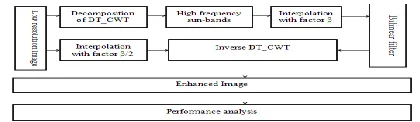
The DT-CWT calculation has been proposed for goals upgrade by deteriorating a picture into various sub groups. The more data has protected in the low recurrence sub groups, the resultant picture is exposed to PNSR, SNR and Edge Preservation Smoothing (EPS) for quantitative investigation as appeared in table.1. what's more, generally square graph is appeared in Fig.7. The yield of DT-CWT is connected to bilinear channel to get an improved picture
Fig.7. Block diagram representing framework for resolution
enhancement
4.1 Dual Tree Complex Wavelet Decomposition
Transformation (DTCWT)
Utilizing the double tree complex wavelet change strategy the picture is deteriorated. This occurs regarding Discrete Continuous Wavelet Transformation (DWT) and Continuous Wavelet Transformation (CWT).In DWT the basis function used is symlet mother wavelet. Image will be decomposed into two parts, the approximation coefficients and detailed coefficients. Only approximation coefficients are considered
and similar mechanism is implemented for CWT is shown in table.2.
Table.2. DT-CWT
Symbol Description
J Level declaring variable Paf, Qaf Analysis Parameter
Psf, Qsf Synthesis Parameter
W Dual tree cell structure parameter Sx Standard deviation of bilateral filter
Wx Component for making the width of filter to half
Cx Frequency component
Cxmin Lower frequency component
Cxmax Higher frequency component
ALGORITHM:
START Input: IInput
Output: Init I
Inew=double (I)
J1 = 1
For tree i
Paf||PsfFSfarras
Qaf|| Qsfdual filter function
W1= cplx dual 2D ( Inew, J , Paf , Qaf)
a2=1, 2
d1=1, 2
d2=1, 2, 3
Wx=5
Sx=[3,0.1]
Computing frequency components Cx=W1 (1, 1) (1, a2) (1, d1) (1, d2) Cx1=Resize(C, 2)
Cxmin=(Cx,2) Cx1=Cx1-Cxmin
Cxmax=maximum (Cx1 (:)) Cx1=Cx1/Cxmax
To apply bilateral filter to each image Cx1=Cx1*Cxmax
Cx1=Cx1*Cxmin
Wx(1,1) (1,a2) (1, d1) (1, d2)=Cx1
To replace low frequency with original image d1=1, 2
d2=1, 2
Cx=W (1, 2) (1, d1) (1, d2) Wx (1, 2) (1, d1) (1, d2)=Iinput To find tree cell structure
Inew=Icplx dual 2D (Wx, J1, Psf, Sx) End
3382
tree cell structure.
4.2 Bilinear Interpolation
An image transformation process used in cases where pixel matching is impossible is called as bilinear interpolation. When compared to other methods of transformation bilinear interpolation considers closet 2x2 neighbourhood of known pixel values surrounding the unknown pixel‘s computed location shown in Table.2.
Table.2. Bilinear interpolation
Symbol Description Inew Resized Image
I ,I
Original file on disk
Mean squared error (MSE)
Root-mean-square error (RMSE)ALGORITHM: Bilinear Interpolation
START Input: IInput, I
Output: InitIinput
Compute Inew
MNZ
Compute I
MNZ
[M1 Row-Wise, N1 Column-Wise, Z1]= Size (Inew)
[M2 Row-Wise, N2 Column-Wise, Z2]= Size (I)
I
Iif (Inew(M) I(M))
IF (Inew(M)>I(M))
Inew= INEW(MROW-WISE)
else
Iα=I(MROW-WISE)
end
end
if (Inew(N) I(N))
IF (Inew(N)>I(N))
Inew= I (NCOLUMN-WISE)
else
Iα=Inew(NCOLUMN-WISE)
end
end
Computation of PSNR
10
log
10255
Computation of RMSE
=MSE
endThe above mentioned is the bilinear interpolation method which considers 2x2 neighboring pixels. The original disk on file (I) is initialized and the size of the resized image is computed (Inew).Now, the size of the original file on disk is
calculated. Further to check a condition that size of I and Inewmatch or not the number of rows and columns are
compared respectively. If the resized image has higher number of rows then its new value will be ranging from 1-to-rows of original image considering first row and first column. If the original image has higher number of rows then its new
value will be ranging from 1-to-rows of resized image considering first row and first column. Same procedure is applied to check the condition for the columns. The value of PSNR is calculated to be 23.591, RMSE is 17.3214.
4.3FEATUREEXTRACTIONUSINGLBP
In image pattern recognition, feature extraction is the unique method for the reduction of dimensionality [1]. Feature extraction (Fext) means transferring the input image into set of
features. Fext is a complicated issue where the transformed
image is considered as input, and those features selected automatically through the classifier. The prime goal of Fextis to
find out the discriminating information from the stored images.In the proposed approach, considering the LBP (Local Binary Pattern)‖ algorithm for feature extraction is implemented to the preparation sets of pictures for compressing and examining the pictures.
Feature Extraction using LBP
Local binary pattern is an effective method for feature extraction. LBP algorithm makes the binary encoding of each pixel in the image, and translates into a decimal number based on a certain order [2]. The LBP algorithm solves the problem about various binary-modes and increases the statistical features. In this algorithm, parameters control how LBP are computed for every pixel in the input image. . The equation for LBP feature extraction is given as: [36].
LBP(x, y) = 2
x ……….. (4)
Where gx gray values of symmetric neighbourhood pixel (x =
0, 1, 2….x-1)
X circularly symmetric neighbour set Y radius of circle
An LBP feature encodes the local texture information, where user can utilize for some important tasks like; classification, and recognition. In this input image are splits into non-overlapping cells. The following LBP algorithm illustrates the procedure about image feature extraction method.
Algorithm: LBP Feature extraction
Input: gesture images
Output: LBP Feature extraction 1. Start
2. map = 8
3. DB-folder = ―DB1‖
4. Create database information 5. Initialize Features [] and
Labels [] 6. For (ii = 1:length (imgset))
a. For (jj = 1: imgset (ii).count) b. Read (imgset (ii), jj)
c. Mapping getmapping (map) // feature extraction
d. H1 = 1bp (I, 1, map, mapping) e. Features [Features H1‘] f. Labels [Labels ii] g. End
7. end
3383
establishment with database analysed with respect to three different entities such as instance, username and password. In (Line-4) the system creating database information where it returns an object specifying the image description, image location along with number of images collected inside the respective information. Then initializing the features and labels with empty vectors.for the feature extraction, calling the mapping function which maps the table for LBP codes and can get the possible values like ‗u2‘ and ‗h1‘ for mapping. Finally append the features and get the extracted features. Image segmentation process is the basic step for any recognition process, where image is split into meaningful segments or regions. In training phase, segmentation is the third step to break the image as meaningful segment. The system considered the hand region from the whole image, which represents the skeletonimage. In segmentation, the algorithms are best suited for image region selection. At the testing phase, the test images are also pre-processed for extraction of ROI.
5. RESULTS AND DISCUSSION
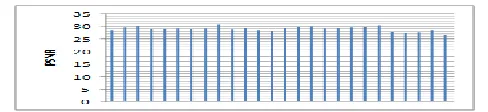
The algorithm of DTCWT is being performed as discussed in above for the resolution enhancement for a hand gesture by splitting the image mainly into real and imaginary parts. To evaluate the analysis and synthesis parameter taken into consideration, the dual filter function is worked on. The dual cell structure is determined via cplx dual 2D function. Frequency values are divided into lower and higher components. The higher frequency components are normalized to nullify the effect of frequencies lying outside the desired range of detection. The lower frequencies have their highest value used in the algorithm among all of them. Further lower frequency image is converted into original image with the inclusion of the new dual tree cell structure and PNSR and RMSE are plotted in Fig. 8 and 9.
Fig .9. Illustration of PSNR values for the algorithm DT-CWT
Fig. 9. Illustration of RMSE, values for the algorithm DT-CWT
5.
CONCLUSION
The Hand motion acknowledgment is of prime significance in the territory of human PC connection (HCI), because of its expansive scale applications in communication via gestures acknowledgment, augmented reality and PC recreations. The present work underscored on the advancement of a hearty "Hand signal acknowledgment system" which tended to two noteworthy angles specifically Hand Detection and Gesture-acknowledgment for example step by step instructions to vigorously distinguish the Hand and how to productively and
precisely perceive the Hand motions. For recognition of hand, utilizing both profundity pictures just as shading picture caught from kinect sensor gadget which distinguish the hand shapes (region). In our examination most testing errand is signal acknowledgment through kinect sensor. In spite of the fact that it functions admirably to follow a vast item for example hard to discover and portion unequivocally a little article from the picture at this goals. A straightforward system was created to offer an upgraded presentation of hand motion and human body signal acknowledgments model in a savvy way utilizing WT-CWT and Bilinear channel. The proposed framework is assurance improvement strategy in perspective on DT-CWT and its used to protect the edges and de-noising the image and to moreover improve the execution of the proposed technique to the extent RMSE, PSNR.
6.
ACKNOWLEDGMENT
I would like to conform that, In this research work there is no conflict related to ethical. The database is used in this research work are collected from the standard database like internet sources and no human relationship or parts are involved directly.
7
REFERENCES
[1]. Fact Sheet No.300, "Deafness and Hearing Loss", World Health Organization (WHO), March 2015, [Online]Available:http://www.who.int/mediacentre/factsh eets/fs300/en/
[2]. "Sign Language", World Federation of the Deaf [Online] Available: http://wfdeaf.org/human-rights/crpd/gesture based communication.
[3]. D. J. Sturman and D. Zeltzer, "An overview of glove-based contribution," in IEEE Computer Graphics and Applications, vol. 14, no. 1, pp. 30-39, Jan. 1994. [4]. S. A. Mehdi and Y. N. Khan, "Gesture based
communication acknowledgment utilizing sensor gloves," Neural Information Processing, 2002. ICONIP '02. Procedures of the ninth International Conference on, 2002, pp. 2204-2206 vol.5.
[5]. Wu Jiangqin, Gao Wen, Song Yibo, Liu Wei and Pang Bo, "A basic communication via gestures acknowledgment framework dependent on information glove," Signal Processing Proceedings, 1998. ICSP '98. 1998 Fourth International Conference on, Beijing, 1998, pp. 1257-1260 vol.2.
[6]. C. Preetham, G. Ramakrishnan, S. Kumar, A. Tamse and N. Krishnapura, "Hand Talk-Implementation of a Gesture Recognizing Glove," India Educators' Conference (TIIEC), 2013 Texas Instruments, Bangalore, 2013, pp. 328-331.
[7]. T. Chouhan, A. Panse, A. K. Voona and S. M. Sameer, "Savvy glove with signal acknowledgment capacity for the meeting and discourse impeded," 2014 IEEE Global Humanitarian Technology Conference - South AsiaSatellite (GHTC-SAS), Trivandrum, 2014, pp. 105-110.
[8]. T. D. Bui and L. Thang Nguyen, "Perceiving Postures in Vietnamese Sign Language With MEMS Accelerometers," in IEEE Sensors Journal, vol. 7, no. 5, pp. 707-712, May 2007.
3384
Vietnamese communication via gestures," 2015 fifteenth International Conference on Control, Automation and Systems (ICCAS), Busan, 2015, pp. 1555-1559.
[10]. M. B. Waldron and Soowon Kim, "Disengaged ASL sign acknowledgment framework for hard of hearing people," in IEEE Transactions on Rehabilitation Engineering, vol. 3, no. 3, pp. 261-271, Sep 1995
[11]. H. Sekar, R. Rajashekar, G. Srinivasan, P. Suresh and V. Vijayaraghavan, "Minimal effort canny static motion recognitionsystem," 2016 Annual IEEE Systems Conference (SysCon), Orlando, FL, 2016, pp. 1-6. [12]. Rishikanth C, H. Sekar, G. Rajagopal, R. Rajesh and V.
Vijayaraghavan, "Minimal effort canny motion acknowledgment motor for sound vocally impeded people," IEEE Global Humanitarian Technology Conference (GHTC 2014), San Jose, CA, 2014, pp. 628-634.
[13]. C. Fehn and R. Pastoor, "Intuitive 3-DTV—Concepts and key technologies,"Proc. IEEE, vol. 94, no. 3, pp. 524– 538, Mar. 2006.
[14]. S. Berman and H. Stern, "Sensors for signal acknowledgment frameworks," IEEE Trans. Syst., Man, Cybern. C, Appl. Rev., vol. 42, no. 3, pp. 277– 290,May 2012.
I. Katsavounidis, C.- C. Kuo, and Z. Zhang, "Quick tree-organized closest neighbor encoding for vector quantization," IEEE Trans. Picture Process.,vol. 5, no. 2, pp. 398– 404, Feb. 1996.
[15]. O. Boiman, E. Shechtman, and M. Irani, "with regards to nearest– neighbor based picture grouping," in Proc. IEEE Conf. Comput. Vis. Example Recognit. (CVPR), Anchorage, AK, USA, 2008, pp. 1– 8.
[16]. T. Ahonen, A. Hadid, and M. Pietikäinen, "Face acknowledgment with neighborhood twofold examples," in Proc. eighth Eur. Conf. Comput. Vis. (ECCV), Prague, Czech Republic, 2004, pp. 469– 481.
[17]. L. Mama, T. Tan, Y. Wang, and D. Zhang, "Proficient iris acknowledgment by portraying key neighborhood varieties," IEEE Trans. Picture Process., vol. 13, no. 6, pp. 739– 750, Jun. 2004
[18]. J. O. Wobbrock, A. D. Wilson, and Y. Li, "Signals without libraries, toolboxs or preparing: A $1 recognizer for UI models," in Proc. twentieth Annu. Symp. Client Interf. Softw. Technol., Newport, RI, USA,2007, pp. 159– 168.
[19]. L. Anthony and J. O. Wobbrock, "A lightweight multistroke recognizer for UI models," in Proc. Chart. Interf., Ottawa, ON, Canada, 2010, pp. 245– 252. [20]. H. Demirel and G. Anbarjafari, "Satellite picture goals
upgrade utilizing complex wavelet change," IEEE Geosci. Remote Sens. Lett.,Vol. 7, no. 1, Jan. 2010; pp. 123– 126.
[21]. M. Z. Iqbal, A. Ghafoor, and A. M. Siddiqui "Satellite Image Resolution Enhancement Using Dual-Tree Complex Wavelet Transform and Nonlocal Means" IEEE Geoscience and Remote Sensing Letters, vol. 10, No. 3, May 2013: pp. 451-455
[22]. H. Demirel and G. Anbarjafari, "Discrete wavelet change based satellite picture goals improvement," IEEE Trans. Geosci. Remote Sens.,Vol. 49, No. 6, Jun. 2011: pp. 1997– 2004.
[23]. H. Demirel and G. Anbarjafari, "Picture goals improvement by utilizing discrete and stationary wavelet