Licensed under Creative Common Page 1
http://ijecm.co.uk/
ISSN 2348 0386
DECISION MAKING BASED ON MANAGEMENT
INFORMATION SYSTEM AND DECISION SUPPORT SYSTEM
Şükrü Ada
Ataturk University, Turkey [email protected]
Mohsen Ghaffarzadeh
Ataturk University, Turkey [email protected]
Abstract
The purpose of this paper is to examine the role of information systems in organizations. Initially
the importance of information systems in today's organizations is explained. Then, each of
these approaches to information systems such as: TPS and MIS and DSS and ES WGSS the
OAS, evaluate from different perspectives. The position of each of these methods are identified
in the organizational hierarchy. A major focus of this study was to identify similarities and
distinction, decision support systems and management information systems. The most
important results are: 1- In Management information system it works on online mode but in
decision support system it works on real time mode. 2- The management support system
supports medium level of data but in decision support system it supports huge volume of data.
3- The management support system uses low supports of graphics but in decision support
system it uses large support of graphics. 4- The management information system focus only on
fully structured task or routine for decision but decision support system focuses on structure as
well as semi-structured data.
Licensed under Creative Common Page 2 INTRODUCTION
Licensed under Creative Common Page 3 web intelligence tools in public education and other policy sectors in Guatemala. Software tools were developed for use in business was adopted for planning and decision making in public institutions. The study summarizes the salient aspects of the experience so far of implementing and expanding what has been called the “Platform for Integrated Social Information,” It discusses the issues this Platform raises as a resource for improved public
decision making, policy analysis and especially, as a promising but challenging tool for democracy in the education sector. However, the world health organization has introduced a report by who study group it was about the role of research and information systems in decision making for the development of human resource for health, the study identified a number of problems and noted causes of these problems such as inefficient data definition and, lack of relevant information and poor coordination of available information on the other hand the study identified a positive factors that prompt decision making such as problem awareness and easy availability of presented information. The study group emphasized that strengthening decision making in the development of human resource of health, by linking information and research to decision making and prompting relevant information requires a coordinated approach.
INFORMATION SYSTEM
Licensed under Creative Common Page 4 Transaction Processing System (TPS)
This is also referred to as data processing system. It performs the essential role of collecting and processing the daily transactions of the organization. They serve at operational levels of the organization. Examples of transactions include purchase payroll, reservation, invoices, payments, shipping, registrations, orders and sales.
Expert System (Specialist) (ES)
This is an extension of the decision support system. It is a programmed decision-making information system that captures and reproduces the knowledge and expertise of expe rts and then simulates the thinking or actions of that expert to help users with less expertise. These applications are implemented with Artificial Intelligence (AI) technology. Artificial intelligence is a computer-based technology that has the ability to behave like humans, learn languages and emulate human expertise and decision-making.
Office Automation System (OAS)
This system supports a wide range of business activities. Office systems are applications designed to improve workflow and communicate among workers regardless of their physical locations. Typical office system handles and manages document (through word processing, desktop publishing, document imaging and digital filings), scheduling (through electronic calendars) and communication (through electronic mail, voice mail and video conferencing).
Personal and Work Group Information Systems (WGSS)
Personal information system is the system designed to meet the needs of a single user while work group system is designed to meet the needs of a workgroup and to increase the productivity of the group.
Management Information System(MIS)
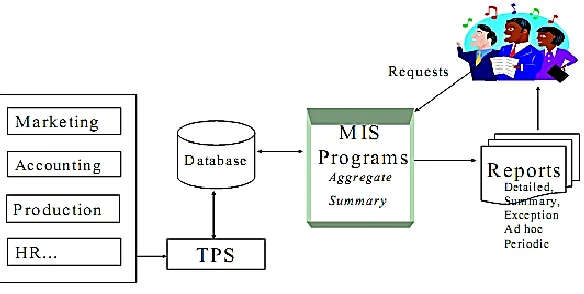
Licensed under Creative Common Page 5 making function in the organization (Bendoly, 2008). The MIS is defined as a system based on the database of the organization evolved for the purpose of providing information to the people in the organization. The MIS is defined as a Computer based Information System (Bresfelean, 2009).
Figure 1: Simple View of MIS
Source: Kumar, 2006,45
Decision Support System(DSS)
Decision-making is an essential component of organizational life. Decision makers receive and analysis information using many different media, including traditional print, group and interpersonal information exchanges and computer-based tools Decision support systems (DSS) is a generic concept that describes information systems that provide analytical modelling and information to support semi-structured and unstructured organizational decision making. Common characteristics of DSS include:
- Problem structure, used in semi-structured and unstructured decision context - Intended to support and augment decision makers not replace them
- Supports most phases of decision-making process - Uses underlying data and model
- Interactive: DSS is designed to be an interactive decision aid
Licensed under Creative Common Page 6 Figure 2: A Simple View of DSS
Source: Kumar, 2006, 75
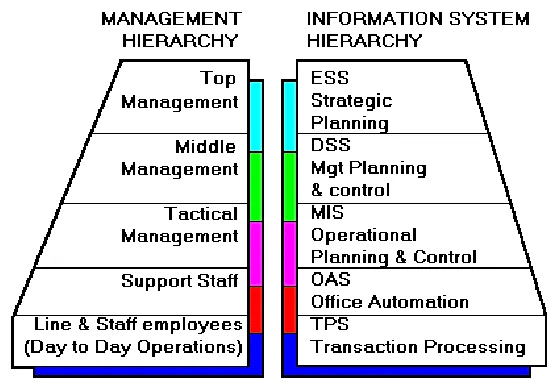
Figure 3: Types of Information systems and organizational hierarchy
Source: Gabriel, 2012, 89
Types of Decision Support System
Licensed under Creative Common Page 7 conferencing are the primary technologies for communication driven decision support. Data driven DSS model puts its emphasis on collected data that is then manipulated to fit the decision maker’s needs. This data can be internal, external and in a variety of formats.
Licensed under Creative Common Page 8 Difference of MIS and DSS
MIS and DSS are two abbreviations that are often heard in the field of Business Management. They differ in a few aspects. It is important to know that MIS stands for Management Information Systems whereas DSS stands for Decision Support Systems. It is interesting to note that MIS is a type of link that assists in the communication between managers of various disciplines in a business firm or an organization. On the whole it plays a very important role in building up communication among the corporate people.DSS on the other hand is an improvement of the concept of MIS. It is true that both of them differ in terms of their focus. DSS focuses more on leadership. It is all about senior management in a firm providing innovative vision. On the other hand MIS focuses more on the information gathered and the information that has poured from different quarters. Experts on managerial behavior say that DSS focuses more on decision making. MIS on the other hand focuses more on planning the report of various topics concerned with the organization that would assist the managers to take vital decisions pertaining to the functioning of the organization. One of the finest differences between MIS and DSS is that MIS focuses on operational efficiency whereas DSS focuses more on making effective decision or in other words helping the company to do the right thing. Flow of information is from both sides, up and down in the case of MIS.
On the other flow of information is only upward in the case of DSS. In the case of DSS the report can be flexible whereas in the case of MIS the report is usually not flexible. MIS is characterized by an input of large volume of data, an output of summary reports and process characterized by a simple model. On the other hand DSS is featured by an input of low volume of data, an output of decision analysis and a process characterized by interactive model. Experts would also say that MIS is a primary level of decision making whereas DSS is the ultimate and the main part of the decision. This is one of the most talked about different between the two. As a matter of fact MIS is all about theory whereas DSS is all about practice and analysis. An organization should employ both the systems effectively (Pride and Ferrell, 2006).
DECISION - MAKING
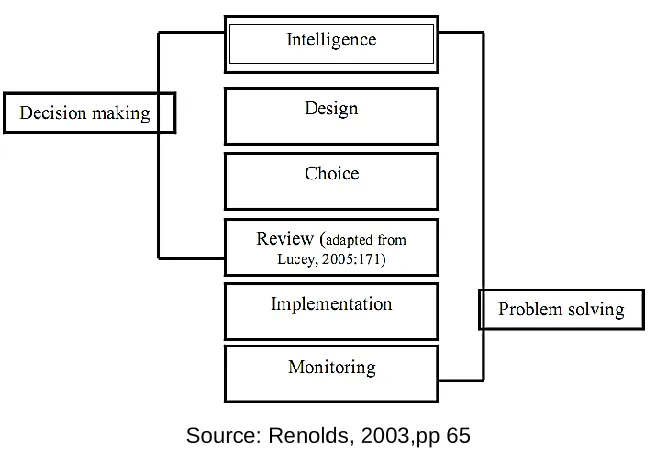
Licensed under Creative Common Page 9 It is members; and decision according to Daft (2001: 399) can be risky and uncertain without any success. Simon (1984), a leading authority in management decision- making considers that decision making comprises four principal phases:
- Intelligence- searching the environment for conditions calling for decision making.
- Design- inventing, developing and analyzing possible courses of actions. This involves processes to understand the problem, to generate solutions and testing of solutions for feasibility.
- Choice- selecting an alternative or course of action from those variables.
- Review - assessing past choices. This model was later incorporated by George Huber into an expanded model of the entire problem-solving process (see figure 4).
Figure 4: process of Decision - Making
Source: Renolds, 2003,pp 65
Types of Decisions
Licensed under Creative Common Page 10 Finally, she may work in a less reactive fashion and view decision problems as opportunities that have to be discovered by studying the operations of her company and its surrounding environment (e.g., how can she make the production process more evident). There is much anecdotal and some empirical evidence that structuring decision problems and identifying creative decision alternatives determine the ultimate quality of decisions. Decision support systems aim mainly at this broadest type of decision making and in addition to supporting choice, they aid in modeling and analyzing systems (such as complete organizations), identifying decision opportunities, and structuring decision problems. Simon (1984) classified decisions into two broad categories according to the extent that the process of decision-making can be pre-planned:
- Programmed Decision: these are decisions made using standard rules, procedures or quantitative methods. To make a programmed decision, the decision maker uses a performance program, a standard sequence of behavior that organizational members follow routinely whenever they encounter a particular type of problem or opportunity (George and Jones :429). For example, inventory control decisions, machine loading decisions, scheduling, etcetera.
- Non-programmed Decisions: this type if decision deals with unusual or exceptional situations. They are decisions made in response to novel problems and opportunities. This type of decision according to Lucey (2005: 171), is associated with high degree of uncertainty, cannot be delegated to low levels, may involve things, but always involves people. Examples: merger, acquisitions, launching of new product, personnel appointments, etcetera. Whether decision is of the programmed or non-programmed type, it depends hugely on inputs from management information systems.
Licensed under Creative Common Page 11 DECISION AND MIS
Development of information and communication technologies as change structures of societies, it also affected task of manager’s making decision. Many organizations prepare them self for
effective and efficient use of new information and communications technologies. Information and communication technology has two benefits for organization. First, it enables organizations and managers to easily acquire data. This will cause further support the decision making process. Second, the use of information and communication technology enables organizations to have better operate in a global competitive environment and make effective decision making. Information and communication technology improve the quality of decision making that is crucial factor for organization. Cause dramatic changes in levels of the organization, including organizational leadership and strategy, and even members behavior. The information and communication technology has become an essential component in the process of decision making in organization and managers at all levels increasingly get help from information and communication technologies (Feizi&Moghadassi, 2012). No doubt modern information and communication technologies provide the field of information management system. Information and communication technology enables collect, analyze and evaluate data and transferring them from one point to another and cause instant access to information, Reduce costs, Produce better, Carefully, Coordination, Leading time, improved control and will lead to better services. No doubt, management has been a necessity for human since past, If you consider different management activities can be clearly seen that the essence of all the management activities is making decision. Decision making is an integral component of management In each task, the management is so smart. In determine organization's policies, development objectives. Organization design, Choice, Assessment and management practices in all forms, Decision-making are one of the main fundamental pillars. In a simple definition, decision making is choose a way between different paths (Alvani,2012).
MIS and Decision Making Process
Licensed under Creative Common Page 12 MIS is an organization – wide effort to provide decision making process information. The system
is a formal commitment by executive to make the computer available to all managers. MIS sets the stage for accomplishments in the other area, which is DSS, the virtual office and knowledge based systems. The main idea behind MIS is to keep a continuous supply of information flowing to the management. Afterwards, by data and information gathered from MIS, decisions are made (Asemi&Safari, 2011).
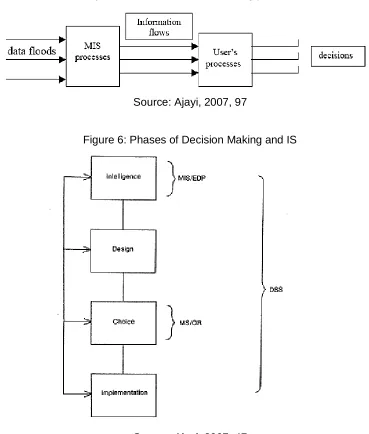
MIS may be viewed as a mean for transformation of data, which are used as information in decision-making processes (Lucey, 1997).
Figure 5: MIS and decision making process
Source: Ajayi, 2007, 97
Figure 6: Phases of Decision Making and IS
Source: Ajayi, 2007, 47
Licensed under Creative Common Page 13 CONCLUSION
The role of information in decision making cannot be overemphasized. Effective decision making demands accurate, timely and relevant information. MIS provides accurate and timely information necessary to facilitate the decision-making process and enable the organizations planning, control, and operational functions to be carried out effectively. MIS also plays the crucial role of providing a wide range of streamlined options from which decision-makers are able to make their preferred choices and this ensures that whatever choices are made by decision makers, the outcome, more often than not, becomes positive. This, as a matter of fact, is the reason why many decision makers tend to prefer using MIS tools when making tough business choices. MIS as renowned concept, having good decision choices guarantees viable decisions in our businesses. From the above discussion we can say that decision support system focus on decision making whereas management information system (MIS) focus on information. In Management information system it works on online mode but in decision support system it works on real time mode. The management support system supports medium level of data but in decision support system it supports huge volume of data. The management support system uses low supports of graphics but in decision support system it uses large support of graphics. The management information system focus only on fully structured task or routine for decision but decision support system focuses on structure as well as semi-structured data. Beside the above differences both MIS and DSS are core of an information system satisfying the requirement of different levels of management.
REFERENCES
Alvani, S.M. (2012). Public Management (Edition 23) Tehran: Nashodani.
Ajayi, I. A. and Omirin F. F. (2007): The use of Management Information Systems (MIS) in Decision-making in South-West Nigerian Universities.
AsefehAsemi, Ali Safari, AdelehAsemiZavareh, the Role of Management Information System (MIS) and Decision Support System (DSS) for Manager’s Decision Making Process, International Journal of Business and Management Vol. 6, No. 7; July 2011.
Barton J., Parolin B., Weiley V., A Spatial Decision Support System for the Management Of PublicHousing, in Recent Advances in Design and Decision Support Systems in Architecture and Urban Planning, Springer Science and Business Media, 2005, p. 69&84
Bendoly E., Excel Basics toBlackbelt. An Accelerated Guide to Decision Support Designs, Cambridge University Press 2008
Bresfelean V.P., Ghisoiu N., Lacurezeanu R., Sitar&Taut D.&A., Towards the Development of Decision Support in Academic Environments, Proceedings of ITI 2009, Cavtat, Croatia, 2009, p. 343&348.
C.W. Holsapple, A.B.Whinston, Decision support systems: A knowledge-based approach, St. Paul: West Publishing, 2006.
Licensed under Creative Common Page 14 Feizi, K&Moghadassi, A. (2012). Application of Decision Support Systems (45) Management Studies in Management Decision.
Gabriel, J. M. O. (2013): The Systems Concept: An unpublished Lecture note giving to B.sc Year 3 Students of Facultyof Management Sciences, Rivers State University of Science and Technology, Port Harcourt.
George, J. M. and Jones G. R. (1996): Understanding and managing Organizational behavior. 1sted., Addison- Wesley Publishing Company Inc. USA.
G.Satyanarayana Reddy, RallabandiSrinivasu, Spikanth Reddy Rikkula, VudaSreenivasa Rao, Management information system to help managers for providing decision making in an Organization, International Journal of Reviews in Computing, 2009. IJRIC.
Jaboe, K.P. (2005): Reporting intangibles: a hard look at improving business information in The U.S.
Athena Alliance. Retrieved October, 2, 2010 from
http://www.athenaalliance.Org/apapers/ReportingIntangibles.htm.
Jessup, Leonard M.; Joseph S. Valacich (2008). Information Systems Today Pearson Publishing. Pages 56&Glossary (3rd Ed.). p. 416.
Kumar, P. K. (2006): Information Systems Decision-Making, IndianMBA. Retrieved October 2, 2010 fromhttp://www..indianmba.com/Faculty column/FC307/fc307.html.
Laudon, K. and J. Laudon, 2009. Management Information Systems. 11th End,PrenticeHall, Upper Saddle River, New Jersey, ISBN: 13: 978-0136078463, pp: 627.
Lucey, T., 1997. Management Information Systems, London.
Lucey, T. (2005): Management Information Systems. London: Book Power.
Manian, A. (2011). "Factors affecting the satisfaction of end users and providing satisfaction Model", PhD thesis, School of Management degree (Major systems), Tehran University
Pride W. M. And O.C. Ferrell, (2006). Marketing concepts and Strategy, 13thend, Houghton Mifflin Company, Boston, New York.
Power, D. J. (2002). Decision support system: concepts and resources for managers. Westport Conn., Quorum Books.
Rachhpal Singh, Manik Sharma, Sandeep Sharma, Sanjeev Kumar kaushal, “Management Information System”, Published by Kalyani Publishers, Edition (2012).