3532
The Application Of Problem-Based Learning
Model To Improve Students' Mathematical
Reasoning Skills
Linda Andalia, Usman, Muhammad Subianto
Abstract: This study aimed to improve students' mathematical reasoning skills through the Problem-Based Learning model (PBL). This study employed classroom action research consisting of two cycles, and each cycle involved planning, implementation, observation, and reflection. The research subjects were 29 Year 8 students in one of the Islamic private junior high school in Aceh Besar. The research instrument used for data collection was a mathematical reasoning test. The data was then analyzed qualitatively and described descriptively. The results showed that out of 29 students, 57.89% and 73.68% reached classical mastery learning of mathematical reasoning skills in the first cycle and the second cycle, respectively. Therefore, students’ mathematical reasoning skills increased through the Problem-Based Learning model.
Index Terms: Mathematical reasoning skill, Problem-Based Learning
————————————————————
1
INTRODUCTION
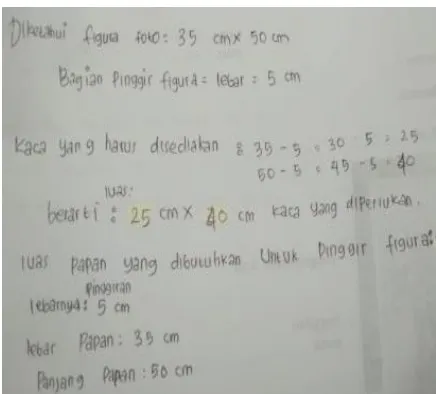
The objective of mathematics learning can be achieved by applying a scientific approach, i.e. observing, asking, trying, reasoning, presenting, and creating so that learning becomes meaningful. In addition, the scientific approach will train students’ reasoning skills that help them in learning and solving daily life problems Curriculum 2013 in Hosnan ( 2014). Mathematical reasoning is necessary to use flexible mathematical ideas and procedures and reconstruct the existing understanding [Bieda et., al, 2014]. Besides, reasoning skill is a sufficient condition in mastering mathematics because mathematics is a process of concluding [Sadiq, 2009 and Mikrayanti, 2016]. Thus, mathematical reasoning skill is students’ ability to draw conclusions from the facts, images and patterns that are appropriate to contextual problems.[Sumarmo and Hendriana, 2017] presented seven indicators of mathematical reasoning, namely (1) drawing logical conclusions; (2) explaining using the existing pictures, facts, nature, and relationships; (3) estimating the solution and its process; (4) using relationship patterns to analyze, make analogies, generalize, construct, and test conjectures; (5) submitting the opposite of the example; (6) submitting rules of inference, checking the validity of arguments, and preparing valid arguments; (7) arranging the direct proof, indirect proof, and proof by mathematical induction. However, this study used the first four indicators of mathematical reasoning skills, namely: (1) drawing logical conclusions; (2) explaining using the existing pictures, facts, nature, and relationships; (3) estimating the solution and its process; (4) using relationship patterns to analyze, make analogies, generalize, construct, and test conjectures. The four indicators are in line with Piaget's theory, stating that the reasoning skills at the age of 9-14 years old are limited. Hence, the four indicators are sufficient to represent the mathematical reasoning skills of junior secondary students. Based on the researchers’ teaching experience at the school studied, it showed that students' mathematical reasoning skills were unsatisfactory, as indicated by the test problems requiring mathematical reasoning. Students have not been able to link fact and concepts, make patterns, formulas, or algorithms (procedures), making it difficult for them to draw conclusions. Figure 1 presents one of the students' solutions for the indicator of using relationship patterns to analyze, make analogies, generalize, and arrange the conjecture.
Figure 1. One of the students' solutions for the mathematical reasoning problem
students to gain essential knowledge, and it can develop students’ higher-order thinking skills. It is a learning model that challenges the students to reason in addressing real-world problems. [Duch, Groh, and Allen 2001] also believed that the PBL model is one of the strategies that help students to improve their reasoning skills. [Sumartini, 2015 and Mikrayanti, 2016] research findings concluded that the mathematical reasoning skills of the students were enhanced using the PBL model.Teachers need to apply the PBL model, but they found it challenging to implement PBL to improve mathematical reasoning. Tyas's study (2017) concluded that the teachers had difficulty in finding the right problem, and they also found it challenging to position themselves as a facilitator. So, teachers need to continue to train their sensitivity to be able to place themselves in the right position for the inquiry process to run well [Rahayu, Mardiyana, and Saputro, 2015]. This study examined the improvement of mathematical reasoning skills through the PBL model. The research problem was "How to improve the mathematical reasoning skills through the PBL model on the topic of the circle?"
2. RESEARCH METHOD
This classroom action research involved 29 Year 8 students as the subjects of the study. The study was conducted in one of the Islamic private junior high school in Aceh Besar, Aceh, Indonesia. According to Kemmis & Mc.Taggart in [Arikunto ,2012], the procedures classroom action research focus on (1) planning, (2) acting and observation, and (3) reflection. Planning was to identify the problems in mathematics learning, especially those related to students' mathematical reasoning skills, and to formulate these problems. Based on the existing planning, PBL model was implemented in mathematics learning. Finally, an observation was undertaken to obtain an overview of students' mathematics learning activities in the classroom. Data were analyzed using a qualitative and comparative descriptive method. The descriptive qualitative method was used to analyze the verbal data, the observation data of mathematics learning using the PBL model. The comparative descriptive method was used for analyzing the quantitative data, comparing results between cycles. Each cycle in this study consisted of four stages: planning, implementing, observing, and reflecting. The reflection results on the first cycle determined the continuation to the second cycle, and it was carried out following the similar steps in cycle I, and so on. The indicator of the implementation success in improving the student learning outcomes using the PBL model is the number of students achieving mastery learning (a minimum score of 72) of at least 75% of the total students in the classroom.
3
.
RESULTS
AND
DISCUSSION
THE LEARNING IN CYCLE I
The learning stages of cycle I started with the planning stage, developing the lesson plan based on the PBL steps for the topic of area and perimeter; student worksheet I, and mathematical reasoning test problems for cycle I and II. At the implementation and observation stage, the teacher started by giving apperception through questions related to the elements of the circle previously studied. The teacher motivated the students by providing examples of the circular edge of the pool. The teacher posed a question, such as "how do you determine the area of the pool edge? How do you calculate
the cost?". Then, the teacher informed the students the learning objective that students would be able to correctly solve problems related to the circumference and area of the circle, and the teacher explained the learning stages of the PBL model. During the core activities, the teacher grouped students into four groups of 4-5 people. Each group consisted of mixed-ability students to enable the cooperative atmosphere during the learning. The teacher directed students to join the pre-determined groups, and the atmosphere was a bit noisy when students started finding their groups. Next, each group was given three copies of student worksheet I, consisting of mathematical reasoning problems related to the area and circumference of a circle. Student worksheet I was administered so that students used their reasoning to solve the given problems. The teacher instructed the students to read the instructions and information carefully in student worksheet I and encouraged all groups to solve the problems by facilitating the discussion, such as responding to the problems that the students did not understand. The other problems in the student worksheet I was about the distance of the wheel. Students determined the circumference of the wheel in advance as the distance was related to the distance travelled by the wheel, students estimate the distance by multiplying the circumference of the wheel by the number of turns on the wheel. The teacher rechecked the discussion results of each group before they presented them. The groups who completed the student worksheet I the fastest and most accurate were rewarded with additional scores for each member of the group. The reward was the effort of the teacher to engage students in completing the student worksheet I in a group. At the end of the lesson, all groups displayed their group discussion results. The teacher then invited all students to examine each group’s work. Next, the teacher asked the first group to present the results, followed by the other groups. Each group paid attention to the results presented by other groups. During the presentation, students asked some questions, such as how to obtain the solution and which formulas to use. Besides, the teacher posed questions to draw the conclusion, such as the relationship between the area and circumference of a circle and its application in daily life.Based on the results of the student worksheet I, it was found that three out of four groups fulfill the mathematical reasoning indicators. So, it is concluded that the indicators of estimating the solution and drawing conclusions at the first lesson were needed to improve in the second cycle. In the reflection stage, some findings of the first cycle were analyzed, including that the teacher did not cover all questions posed by students. Thus, in the second cycle, the teacher needed to coordinate the students’ questions so that similar questions were only addressed once.
The Learning in Cycle II
3534 daily life, such as the area in a circle. Next, the teacher
conveyed the objectives of learning the length of the chord and the area of the sector.
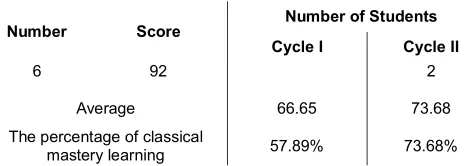
During the core activity, the teacher distributed student worksheet II to all groups. Students started to determine the ratio between the angles formed by the sector and the one full circle, between the length of the arc and the circumference of the circle, and between the area of the secant and the area of the circle. Next, students analyzed the relationship between these ratios to the length and area of the sector. Each group gathered information by discussing and identifying the elements of a circle, namely the radius, the center and the sector. In addition, students also connected the relationship between the elements of the circle and the given problem. All members started their investigation by reading the student worksheet first and consulted the mathematics textbook to work on the student worksheet. Students started reading and trying to understand the student worksheet II by discussing ideas with the group members. Some of them consulted the teacher concerning things they did not understand. Students reasoned the form of the command about the costs involved with the material being studied. Students needed to use the existing facts and images to connect the circumference and area of the sector with the ratio made. The teacher tried to respond to the questions of the students so they can reason adequately. The classroom atmosphere was conducive because students were getting used to working in groups. The teacher strolled around the classroom to ensure that the group discussions run well, and direct students who ask questions related to the student worksheet II. Some students asked about the problem in the student worksheet II, namely the comparison between the angle formed by sector and the central angle of the circle. The comparison was then made between the ratio of the length of the arc and the circumference of the circle, and between the area of the sector and the circumference of the circle. At the end of the lesson, each group presented the results of their group discussion of the completed student worksheet II. The teacher asked all students to re-examine their works. Overall, the results of student worksheet II were good, and it can be inferred that students' mathematical reasoning was improved through PBL learning. In the reflection stage, it was identified that the teacher made better efforts. The teacher coordinated the student questions so that representative questions could be addressed. The student reasoning skills in the second cycle have met the performance indicators, and therefore it was unnecessary to repeat the next cycle. Once the learning of cycle I and II were completed, a test was administered at the end of each cycle to determine students' mathematical reasoning skills. The results of the first and second cycle are presented in Table 1.
Table 1. The results of mathematical reasoning test of cycle I and II
Number Score Number of Students Cycle I Cycle II
1 50 5 2
2 58 2 2
3 67 1 2
4 75 10 6
5 83 1 5
Number Score Number of Students Cycle I Cycle II
6 92 2
Average 66.65 73.68
The percentage of classical
mastery learning 57.89% 73.68%
In cycle I, eight students did not achieve the classical mastery learning score, while in the second cycle, six students were scored below the minimum mastery learning criteria (<72). The mathematical reasoning skills of the students had increased. The average of the test in the second cycle was 73.68, increased by 7.03 from 66.65 in the first cycle. The percentage of classical mastery learning was also increased from 57.89% in the first cycle to 73.68% in the second cycle. These results indicate that the PBL learning model can improve students' mathematical reasoning.
4 DISCUSSION
model, orientating the students to the problem. This effort enabled students to reason so as to achieve the learning objectives. Furthermore, the teacher also motivated students by displaying images of events related to the topic studied in everyday life.The second stage in the PBL model was organizing the students to learn. The teacher organized the students in the classroom, such as posing questions concerning student’s daily activities related to the material, providing opportunities for them to express their opinions about the importance of the material. The students were given time to discuss the student worksheet provided. These efforts were useful to trigger students' reasoning to be able to link some ideas or concepts that have been learned. The third stage in the PBL model was guiding the individual and group investigations, where the teacher gave problems to discuss in groups and provided opportunities for students to discover the right solution to the problems. The fourth stage was developing and presenting the works; the teacher posed questions to encourage students to reason to find the solution to problems. Besides, the teacher facilitated the students who experienced difficulty in mathematical reasoning. Finally, the last stage was analyzing and evaluating the problem-solving process; the teacher asked students to present their works and draw a conclusion based on logical reasons.The teacher provided examples related to students’ daily life to help them reasoned about real problems more easily and improve their mathematical reasoning skills. It is in line with the results of Ario's research (2015), which concluded that the PBL model made students think by linking the problems with facts and properties.The indicators of mathematical reasoning that was enhanced were the indicator of using relationship patterns to analyze, make analogies, generalize, construct, and test conjectures. The improvement was due to the teacher's efforts to provide questions through real problems or contexts so that students could reason more easily in solving problems. [Rizqi and Surya, 2017] argued that the PBL model could make students imagine to reason about facts in their environment. Furthermore, Wadono, Waluya, Mariani, and Candra (2016) research found that the PBL model can create a framework for connecting facts and images.There was an improvement in the first and second cycles. Learning conditions were illustrated better in cycle II, while students' mathematical reasoning was not apparent in cycle I. In cycle II, students were also more independent in solving the problems in the student worksheet 2, while students were kind of hesitant to solve problems in student worksheet I.The learning circumstances significantly changed in cycle II. Students were more familiar with the PBL model and their dependence on the help of teacher and peers decreased. Group unity in working on the worksheet also seemed to be better. The interview results also revealed that students felt better with the PBL model application. They were more enthusiastic about the materials taught and the PBL model. Thus, PBL learning improved mathematical reasoning, as proven in cycle II, where the mathematical reasoning skills reached the classical mastery learning above 80%. These results are consistent with [Mulyana and Sumarmo, 2015 and Sumartini, 2015], who concluded that the PBL model could improve students' mathematical reasoning abilities.
5 CONCLUSION
Based on the research results and discussion on improving students' mathematical reasoning skills through the PBL model
for the topic of circle in one of the Islamic private junior high schools in Aceh Besar, Aceh, Indonesia, it is concluded that the students’ mathematical reasoning on the topic of circle can be improved by the PBL. This conclusion is indicated by the increase in classical mastery learning from 57.89% in the first cycle to 73.68% in the second cycle.
6
REFERENCES
[1].
Abdurrahman, M. (2013). Pendidikan bagi anak
berkesulitan belajar. Jakarta: Rineka Cipta.
[2].
Arikunto, S. (2012).. Penelitian Tindakan Kelas.
Jakarta: Bumi Aksara.
[3].
Ario, M. (2015). Penalara Matematis dan
Mathematical
Habits
Of
Mind
Melalui
Pembelajaran Berbasis Masalah dan Penemuan
Terbimbing. Edusentris, Jurnal Ilmu Pendidikan
dan Pengajara, 2(1), 34-46.
[4].
Bieda, K. N., Ji, X., Drwencke, J., & Picard,
(2014). Reasoning-and-proving opportunities
in elementary mathematics textbooks.
International Journal of Educational Research,
64(1), 71-80.
[5].
Duch, B. J., Groh, S. E., & Allen, D. E.
(2001). The power of problem-based learning: a
practical" how to" for teaching undergraduate
courses in any discipline. Virginia. Stylus
Publishing, LLC.
[6].
Hosnan, M. (2014) Pendekatan saintifik dan
kontekstual dalam pembelajaran abad 21.
Ghalia Indonesia: Bogor.
[7].
Johar, R., Patahuddin, S. M., & Widjaja, W.
(2017).
Linking
pre-service
teachers’
questioning and students’ strategies in solving
contextual problems: A case study in Indonesia
and
the
Netherlands. The
Mathematics
Enthusiast, 14(1), 101-128.
[8].
Kemendikbud, (2013). Materi pelatihan guru
implementasi kurikulum 2013 SMP/MTS
matematika. Jakarta : Kemdikbud..
[9].
Mikrayanti. (2016). Meningkatkan kemampuan
penalaran matematis melalui pembelajaran
berbasis masalah. Journal of Mathematics
Education, 2(2), 97– 102.
[10].
Mulyana,
A.,
&
Sumarmo,
U.
(2015).
Meningkatkan
kemampuan
Penalaran
Matematika dan Kemandirian Belajar Siswa
SMP Melalui Pembelajaran Berbasis Masalah.
DIDAKTIK, 9(1), 40-51.
[11].
Rahayu, P., Mardiyana, Saputro, D.R.S. (2015).
Eksperimentasi model Problem Based Learning
dan
Discovery
Learning
pada
materi
3536