O R I G I N A L R E S E A R C H
Proximate Determinants of Under-Five Mortality
in Ethiopia: Using 2016 Nationwide Survey Data
This article was published in the following Dove Press journal: Pediatric Health, Medicine and Therapeutics
Chaltu Fikru1
Masrie Getnet2
Tamrat Shaweno 1
1Department of Epidemiology, Faculty of Public Health, Jimma University Institute of Health, Jimma, Ethiopia;2Biostatistics Unit, Department of Epidemiology, Faculty of Public Health, Jimma University Institute of Health, Jimma, Ethiopia
Introduction:Although there has been a remarkable decline in under-five mortality through the decades, it is still highest in socio-economically disadvantaged countries, including Ethiopia. The benefits of reducing under-five mortality have been highly emphasized in the ambitious target of Sustainable Development Goals. The risk factors of under-five mortality have not been exhaustively researched in Ethiopia using recent nationwide survey data.
Objective:This study aimed to determine the risk factors of under-five mortality using the recent nationwide survey data.
Method: The data source for this study was the 2016 Ethiopian Demographic and Health Survey. Bivariate and multivariable logistic regression analysis was conducted and statistical significance was declared at p value < 0.05.
Results:The data for a total of 10,641 under-five children were analyzed and the under-five mortality rate was 67 per 1000 live births in this study. In the final model, rural residence (AOR=2.0, [1.20, 3.30],P=0.008), mothers who gave birth with preceding birth intervals of shorter than 24 months (AOR=2.12, CI=[1.72, 2.61],P<0.000), multiple births (AOR=4.74, CI=[3.34, 6.69], P<0.000), very small size of child at birth (AOR=1.43, CI= [1.10, 1.85],
P=0.007), and being male (AOR=1.30, CI=[1.07, 1.57],P<0.008) showed significant asso-ciation with under-five mortality compared to their counterparts.
Conclusion: Under-five mortality was significantly associated with place of residence, preceding birth interval, plurality, size of child at birth, and sex of the child. Thus, special emphasis should be placed on children with rural residence, preceding birth interval of shorter than 24 months, very small size of the child at birth, and male children.
Keywords:under-five mortality, EDHS 2016, determinants, Ethiopia
Introduction
Despite the global progress in reducing child mortality over the past few decades,
an estimated 5.4 million children under the age offive died in 2017–roughly half
of those deaths occurred in sub-Saharan Africa.1In 2017, the under-five mortality
rate in low-income countries was 69 deaths per 1000 live births–around 14 times
the average rate in high-income countries (5 deaths per 1000 live births).2
The sustainable development goal's target is to reduce under-five mortality rate
to below 25 under-five deaths per 1000 live births at the end of 2030.3To reach this
target, much effort would be needed in Africa.4,5 Even though there has been
a global decline in the death rates of under-five children, the probability of
a child dying before reaching their 5th birthday remains the highest in
sub-Saharan Africa, including Ethiopia.6Although various measures have been taken
to decrease under-five mortalities, most of the sub-Saharan countries show very
Correspondence: Tamrat Shaweno Email [email protected]
Pediatric Health, Medicine and Therapeutics
Dove
press
open access to scientific and medical research Open Access Full Text Article
Pediatric Health, Medicine and Therapeutics downloaded from https://www.dovepress.com/ by 118.70.13.36 on 26-Aug-2020
high under-five mortality rates.5 Nonetheless, under-five
mortality rate in Ethiopia is still highest.7
Different studies have been conducted to identify the
factors influencing under-five mortality. Risk factors that
predicted under-five mortality included maternal
educa-tion, maternal age, wealth index, educational status, birth
order, preceding birth interval, and birth weight.8–10
Furthermore, sex of the child, place of delivery and geo-graphical region had an association with increased risk of
under-five mortality.9–11 Following the publications of
EDHS 2016findings, Ethiopia developed afive-year
strat-egy. The strategy identified and prioritized 39 high impact
and cost effective newborn and child survival interventions with key guiding principles for implementation of the strategy including equity and accessibility; community engagement, empowerment and ownership; integration;
partnership; efficient use of resources; innovation and use
of technology; evidence based decision making; and pro-vision of quality MNCH services. A sustained government
and partner’s commitment, the Primary Health Care Unit
with its home grown innovative Health Extension Program that utilizes the Health Development Army as platform for social mobilization, and strengthened referral and linkage will continue to be the basis for continued gains in
new-born and child health.12 Even though the impact of the
intervention reduced under-five mortalities from 67 per
1000 live births to 55 per 1000 live births in 2019, the
figure is still very high and needs adjustment.13
Although different studies have been conducted in
Ethiopia with regard to factors associated with under-five
mortality, there are shortcomings in the use of all of the
nationwide representative data for under-five mortality and
consideration of relevant theoretical frameworks devel-oped for developing countries to analyze determinants of
under-five mortality.7 Knowledge of important predictors
of under-five mortality by using relevant theoretical
framework14 and nationwide representative data is an
important indicator and guide for decision makers to develop relevant intervention strategies. Therefore, this study aimed at exploring the proximate determinants of
under-five mortality in Ethiopia using EDHS 2016 data.
Methods
Study Design and Dataset
The dataset used for this study was obtained from 2016 Ethiopian Demographic Health Surveys conducted from January 18, 2016 to June 27, 2016, across the country. The
survey was a population-based cross-sectional study and it
is available from the MEASURE DHS database athttps://
dhsprogram.com/data/available-datasets.cfm. For the
sur-veys, there were two stages. In the first stage, a total of
645 clusters (202 in urban and 443 in rural) were randomly selected proportional to the household size from the sam-pling strata and in the second stage, 28 households per cluster were selected using systematic random sampling.
During the surveys, a total of 16,650 households were interviewed from 18,008 selected representative house-holds. For individual interview, 16, 583 eligible women
were identified from the interviewed households and
inter-views with 15,683 women aged 15–49 were completed.7
In this survey, 10,641 children aged 0–5 from women who
had given birth during thefive years preceding the survey
were also interviewed. Thus, for this study 10,641
under-five children were included.
Study Variables
Outcome VariableThe outcome variable for this study was the death of
under-five children. Thus, all children born within the
five years preceding the survey were included in the
analysis.
Predictor Variables
The predictor variables for under-five mortality were
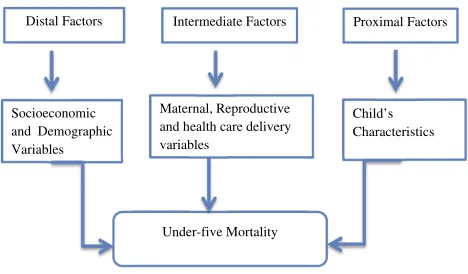
cate-gorized into three categories based on Mosley and Chen's (1984) theoretical framework as distal
factors/socioeco-nomic characteristics, intermediate factors/mother’s
char-acteristics and proximal factors/child’s characteristics, as
shown inFigure 1.14
Distal factors: educational status of mothers (no educa-tion, primary, secondary, higher), household wealth (poor-est, poorer, middle, richer, richest), sex of head of
Socioeconomic and Demographic Variables
Maternal, Reproductive and health care delivery variables
Child’s Characteristics
Under-five Mortality
Distal Factors Intermediate Factors Proximal Factors
Figure 1Conceptual framework for under-five mortality in Ethiopia.
Pediatric Health, Medicine and Therapeutics downloaded from https://www.dovepress.com/ by 118.70.13.36 on 26-Aug-2020
household (male, female), place of residence (urban, rural) and region (Tigray, Afar, Amhara, Oromia, Somalia, Benishangul, SNNPR, Gambela, Harari, Diredawa, Addis Ababa); intermediate factors: preceding birth interval in
months (<24, 24–47, >47), mother’s age at first birth
(<15,15–25, >25), birth order (<3, 3–4, >4), place of
delivery (home, health institutions), number of antenatal
care visits during pregnancy (<4,≥4) and proximal factors:
plurality (single, multiple), size of child at birth (large, larger than average, average, smaller than average, very small) and sex of child (male, female) were considered as
predictor variables of under-five mortality in Ethiopia.
Statistical Analysis
Bivariate analysis was conducted to assess the association between predictor variables and outcome variable of the
study usingχ2tests. Those predictor variables significantly
associated with outcome variable were included in the multivariable logistic regression model in which the odds
ratio with 95% confidence intervals was estimated to
identify the predictors of under-five mortality in Ethiopia.
A p-value less than 0.05 was employed to declare
statis-tical significance.
Results
Distal/Socio-Economic Characteristics of
the Study Participants
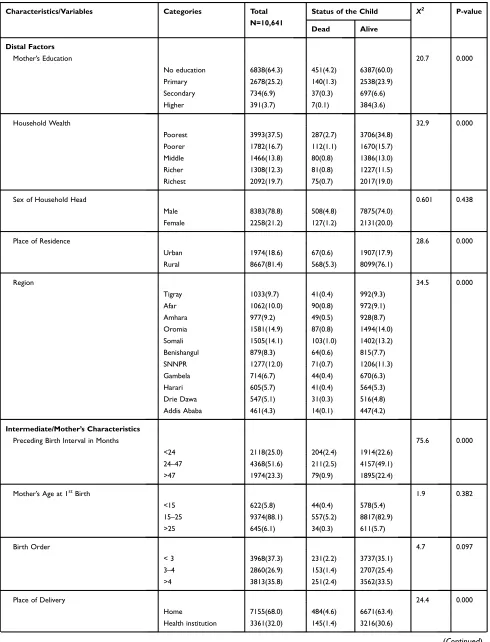
In this study, approximately two-thirds of children (64.3%) were born to mothers with no education. Concerning the household wealth index, 7241 (68%) children were from households with wealth index of middle income and below.
In this study, in approximately four-fifths (78.8%) of
house-holds, the head of the household was male. Similarly, four
fromfive children were from rural residence. With respect
to the regional distribution of the study participants, Oromia and Somali bore the lion's share (14.9% and 14.1%
respec-tively), whereas, the lowest (4.3%) number of under-five
children was recorded in the main capital, Addis Ababa (Table 1).
Intermediate/Mother
’
s Characteristics
With regard to the birth interval, approximately half
(51.6%) of mothers’gave birth with preceding birth
inter-vals of 24–47 months. The remaining 2118 (25%) and
1974 (23.3%) gave birth to child with preceding birth intervals of <24 months and > 47 months, respectively.
In this study, close to 90% (9374) of mothers’age atfirst
birth was 15–25 years. With respect to the order of
chil-dren born into the family, about 37% (3967) of mothers gave birth with the birth order of less than three. In this study, home delivery was predominant in which about 68% (7155) of mothers delivered at home. With regard to ANC follow up, for the great majority of mothers,
number of ANC visits was less than four (Table 1).
Proximal/Child
’
s Characteristics
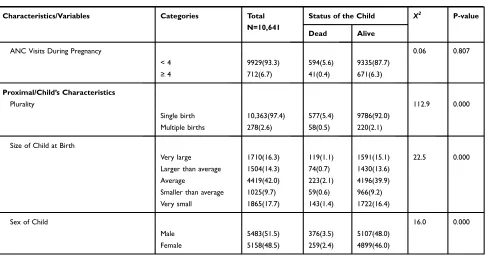
From a total of 10,461 under-five children, the great
majority 97.4% (10, 363) were singletons. With regard to size of child at birth, 9.7% (1025) were smaller than average size and 17.7% (1865) were very small sized children at birth. In this study, male to female child sex
ratio was approximately 1:1(Table 1).
Prevalence of Under-Five Mortality in
Ethiopia
From a total of 10,641 under-five children included in this
study, 635 (6%) died before celebrating their first five
years of life. This is approximated to under-five mortality
rate of 67 per 1000 live births. Majority of under-five
deaths (4.2% and 5.3%) were attributable to uneducated status of mothers and rural residence, respectively (Table 1). Additionally, significantly higher under-five mortality was recorded among home delivery, frequency
of ANC visits < four times, and singleton births (Table 1).
Determinants of Under-Five Mortality in
Ethiopia
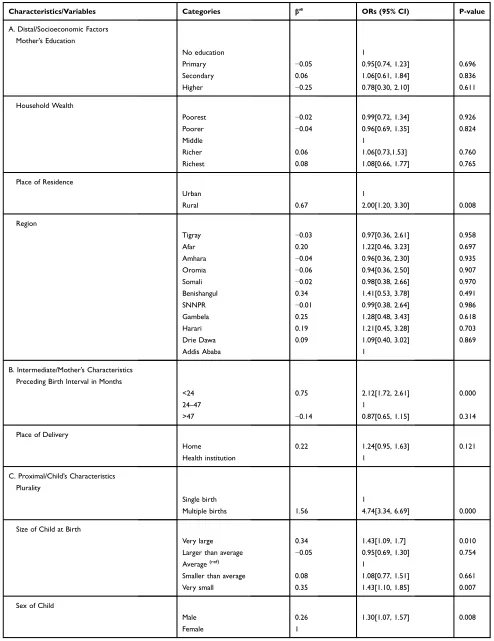
During bivariate regression analysis, four variables from distal, two variables from intermediate, and three variables from proximal characteristics of the study participants were included into multivariate binary logistic regression analysis. These included: maternal education, household wealth index, place of residence, geographical region, preceding birth interval, place of delivery, plurality, size
of child at birth and sex of the child. In thefinal model,
place of residence, preceding birth interval, plurality, size
of the child at birth, and sex of child showed significant
association with under-five mortality.
The odds of under-five mortality were higher among
children with rural residence compared to children with
urban residence (AOR=2.0, [1.20, 3.30], P=0.008).
Similarly, the odds of under-five mortality were higher
among mothers’who gave birth withpreceding birth
inter-vals of less than 24 months (AOR=2.12, CI= [1.72, 2.61],
Pediatric Health, Medicine and Therapeutics downloaded from https://www.dovepress.com/ by 118.70.13.36 on 26-Aug-2020
Table 1Characteristics and Prevalence for Under-Five Mortality in Ethiopia, 2016 EDHS
Characteristics/Variables Categories Total
N=10,641
Status of the Child X2 P-value
Dead Alive
Distal Factors
Mother’s Education 20.7 0.000
No education 6838(64.3) 451(4.2) 6387(60.0)
Primary 2678(25.2) 140(1.3) 2538(23.9)
Secondary 734(6.9) 37(0.3) 697(6.6)
Higher 391(3.7) 7(0.1) 384(3.6)
Household Wealth 32.9 0.000
Poorest 3993(37.5) 287(2.7) 3706(34.8)
Poorer 1782(16.7) 112(1.1) 1670(15.7)
Middle 1466(13.8) 80(0.8) 1386(13.0)
Richer 1308(12.3) 81(0.8) 1227(11.5)
Richest 2092(19.7) 75(0.7) 2017(19.0)
Sex of Household Head 0.601 0.438
Male 8383(78.8) 508(4.8) 7875(74.0)
Female 2258(21.2) 127(1.2) 2131(20.0)
Place of Residence 28.6 0.000
Urban 1974(18.6) 67(0.6) 1907(17.9)
Rural 8667(81.4) 568(5.3) 8099(76.1)
Region 34.5 0.000
Tigray 1033(9.7) 41(0.4) 992(9.3)
Afar 1062(10.0) 90(0.8) 972(9.1)
Amhara 977(9.2) 49(0.5) 928(8.7)
Oromia 1581(14.9) 87(0.8) 1494(14.0)
Somali 1505(14.1) 103(1.0) 1402(13.2)
Benishangul 879(8.3) 64(0.6) 815(7.7)
SNNPR 1277(12.0) 71(0.7) 1206(11.3)
Gambela 714(6.7) 44(0.4) 670(6.3)
Harari 605(5.7) 41(0.4) 564(5.3)
Drie Dawa 547(5.1) 31(0.3) 516(4.8)
Addis Ababa 461(4.3) 14(0.1) 447(4.2)
Intermediate/Mother’s Characteristics
Preceding Birth Interval in Months 75.6 0.000
<24 2118(25.0) 204(2.4) 1914(22.6)
24–47 4368(51.6) 211(2.5) 4157(49.1)
>47 1974(23.3) 79(0.9) 1895(22.4)
Mother’s Age at 1stBirth 1.9 0.382
<15 622(5.8) 44(0.4) 578(5.4)
15–25 9374(88.1) 557(5.2) 8817(82.9)
>25 645(6.1) 34(0.3) 611(5.7)
Birth Order 4.7 0.097
< 3 3968(37.3) 231(2.2) 3737(35.1)
3–4 2860(26.9) 153(1.4) 2707(25.4)
>4 3813(35.8) 251(2.4) 3562(33.5)
Place of Delivery 24.4 0.000
Home 7155(68.0) 484(4.6) 6671(63.4)
Health institution 3361(32.0) 145(1.4) 3216(30.6)
(Continued)
Pediatric Health, Medicine and Therapeutics downloaded from https://www.dovepress.com/ by 118.70.13.36 on 26-Aug-2020
P<0.000). The odds of under-five mortality were higher
for multiple births (AOR=4.74, CI= [3.34, 6.69],P<0.000)
compared to singletons. In a similar fashion, the odds of
under-five mortality were higher for very small size
chil-dren at birth (AOR=1.43, CI= [1.10, 1.85],P=0.007). The
odds of under-five death were also higher for male
chil-dren (AOR=1.30, CI= [1.07, 1.57],P<0.008) compared to
females (Table 2). The rest of the variables including
maternal education, region and place of delivery did not
show any significant association with under-five mortality
(Table 2).
Discussion
Currently, reducing under-five mortality and promotion of
child health care in low income and resource limited
set-tings is emphasized.8 With the end of the MDG era, the
international community agreed on a new framework–the
Sustainable Development Goals (SDGs) where the target is to end preventable deaths of newborns and children
under five years of age. The goal is for all countries to
aim to reduce under-five mortality to at least as low as
25 per 1000 live births.2 In this study, we assessed
pre-valence and determinants of under-five mortality in
Ethiopia, using EDHS 2016 data.
The prevalence rate of under-five mortality in this
study was approximately 67 per 1000 live births. When
compared to other similar studies, thisfinding is higher by
eight under-five deaths per 1000 live births8and lower by
approximately 17 mortalities per 1000 live births.2,9,15The
explanation for this difference might be due to difference
in sample size, study setting and definitions. In this study
our sample size was relatively large compared to others and socioeconomic status of the participants in Ethiopia was relatively low.
The most significant predictors identified were, place
of residence, preceding birth interval, plurality, size of child at birth and sex of the child. This study found that
the odds of under-five mortality were significantly higher
for children living in rural setting. This study was
consis-tent with thefinding from Nigeria9and inconsistent with
otherfindings.10,11,16The differences can be explained by
difference in study design and sample size. In our study we used only one country's data, but the previous studies used
larger sample size by including five African countries'
survey data in their study.
Similarly, in this study the odds of under-five mortality
were significantly higher among children born from mothers
with preceding birth interval of less than 24 months.
Compared to other similar studies, thisfinding was consistent
with findings from Ethiopia.17–19 With regard to plurality,
children born as multiple births had higher risk of under-five
mortality as compared to singletons. This finding is
Table 1(Continued).
Characteristics/Variables Categories Total
N=10,641
Status of the Child X2 P-value
Dead Alive
ANC Visits During Pregnancy 0.06 0.807
< 4 9929(93.3) 594(5.6) 9335(87.7)
≥4 712(6.7) 41(0.4) 671(6.3)
Proximal/Child’s Characteristics
Plurality 112.9 0.000
Single birth 10,363(97.4) 577(5.4) 9786(92.0)
Multiple births 278(2.6) 58(0.5) 220(2.1)
Size of Child at Birth
Very large 1710(16.3) 119(1.1) 1591(15.1) 22.5 0.000
Larger than average 1504(14.3) 74(0.7) 1430(13.6)
Average 4419(42.0) 223(2.1) 4196(39.9)
Smaller than average 1025(9.7) 59(0.6) 966(9.2)
Very small 1865(17.7) 143(1.4) 1722(16.4)
Sex of Child 16.0 0.000
Male 5483(51.5) 376(3.5) 5107(48.0)
Female 5158(48.5) 259(2.4) 4899(46.0)
Note:Data are presented as number (percentages).
Abbreviations:SNNPR, Southern Nation Nationalities and Peoples’Region; ANC, antenatal care.
Pediatric Health, Medicine and Therapeutics downloaded from https://www.dovepress.com/ by 118.70.13.36 on 26-Aug-2020
Table 2Multivariate Binary Logistic Regression Analysis for Under-Five Mortality in Ethiopia, 2016 EDHS
Characteristics/Variables Categories β’s ORs (95% CI) P-value
A. Distal/Socioeconomic Factors
Mother’s Education
No education 1
Primary −0.05 0.95[0.74, 1.23] 0.696
Secondary 0.06 1.06[0.61, 1.84] 0.836
Higher −0.25 0.78[0.30, 2.10] 0.611
Household Wealth
Poorest −0.02 0.99[0.72, 1.34] 0.926
Poorer −0.04 0.96[0.69, 1.35] 0.824
Middle 1
Richer 0.06 1.06[0.73,1.53] 0.760
Richest 0.08 1.08[0.66, 1.77] 0.765
Place of Residence
Urban 1
Rural 0.67 2.00[1.20, 3.30] 0.008
Region
Tigray −0.03 0.97[0.36, 2.61] 0.958
Afar 0.20 1.22[0.46, 3.23] 0.697
Amhara −0.04 0.96[0.36, 2.30] 0.935
Oromia −0.06 0.94[0.36, 2.50] 0.907
Somali −0.02 0.98[0.38, 2.66] 0.970
Benishangul 0.34 1.41[0.53, 3.78] 0.491
SNNPR −0.01 0.99[0.38, 2.64] 0.986
Gambela 0.25 1.28[0.48, 3.43] 0.618
Harari 0.19 1.21[0.45, 3.28] 0.703
Drie Dawa 0.09 1.09[0.40, 3.02] 0.869
Addis Ababa 1
B. Intermediate/Mother’s Characteristics
Preceding Birth Interval in Months
<24 0.75 2.12[1.72, 2.61] 0.000
24–47 1
>47 −0.14 0.87[0.65, 1.15] 0.314
Place of Delivery
Home 0.22 1.24[0.95, 1.63] 0.121
Health institution 1
C. Proximal/Child’s Characteristics
Plurality
Single birth 1
Multiple births 1.56 4.74[3.34, 6.69] 0.000
Size of Child at Birth
Very large 0.34 1.43[1.09, 1.7] 0.010
Larger than average −0.05 0.95[0.69, 1.30] 0.754
Average(ref) 1
Smaller than average 0.08 1.08[0.77, 1.51] 0.661
Very small 0.35 1.43[1.10, 1.85] 0.007
Sex of Child
Male 0.26 1.30[1.07, 1.57] 0.008
Female 1
Abbreviations:β’s
, the amount of effect of the independent variables; OR, odds ratios; CI, confidence interval.
Pediatric Health, Medicine and Therapeutics downloaded from https://www.dovepress.com/ by 118.70.13.36 on 26-Aug-2020
consistent with otherfindings using 2011 EDHS data.19,20In
relation to size of child at birth, the odds of under-five
mortality were higher for very small sized child at birth
compared to average sized child at birth. Compared tofi
nd-ings from other settnd-ings, this study'sfindings are consistent
with those of a study conducted in India10,21in which the risk
of death was higher for small-sized than average-sized babies at birth. With regard to the sex of the child, the odds of
under-five mortality were higher for male children compared to
female children, in this study. This finding is consistent
with studies from other settings.10,17,19
Unlike other studies done so far,9,19,21,22maternal
edu-cation, household wealth index, region and place of
deliv-ery were not independently associated with under-five
mortality in this study.
Strengths and Weaknesses of the Study
Our study is strong and representative since it used the
nationwide survey data with large sample size.
Additionally, use of appropriate theoretical framework
rele-vant to developing countries to assess under-five mortality
also makes this study strong. Although, this study is not free from limitation since some important variables, as per
differ-ent literatures, believed to predict under-five mortality are
missing. Additionally, the cross-sectional nature of the study design might have introduced recall bias into this study.
Conclusion
The prevalence of under-five mortality is still highest in
Ethiopia and it was significantly associated with place of
residence, preceding birth interval, plurality, size of child at birth and sex of the child. Thus, special emphasis should be placed on children with rural residence, preceding birth interval of less than 24 months, very small size of the child at birth and male children.
Abbreviations
CI, confidence interval; EDHS, Ethiopian Demographic
Health Survey; AOR, adjusted hazard ratio; MEASURE DHS, monitoring and evaluation to assess and use results demographic and health surveys; SNNPR, Southern
Nations, Nationalities, and Peoples’Region.
Paper Context
Under-five mortality is a global concern in general and in
particular in developing nations. It is highest in Ethiopia and the determinant factors have not been exhaustively researched using relevant theoretical frameworks. Better
understanding of the determinant factors of under-five
mortality is important to develop relevant interventions.
We analyzed data of 10,641 under-five children and found
that under-five mortality was significantly associated with
place of residence, birth interval, plurality, size of child at birth, and sex of the child.
Ethical Approval and Consent to
Participate
Ethical clearance for the 2016 EDHS was provided by the Ethiopian Health and Nutrition Research Institute (EHNRI) Review Board, the National Research Ethics Review Committee (NRERC) at the Ministry of Science and
Technology, the Institutional Review Board of ICF
International, and the communicable disease control (CDC). Additionally, written consent for participation was obtained from each respondent. However, the dataset of the 2016 EDHS is not available as a public domain survey dataset. The authors requested access to the data from demographic, health survey program team and access was granted to use the data for this research.
Availability of Data and Material
The datasets used and/or analyzed during the current study are available from the Ethiopian statistical agency and ministry of health.
Acknowledgment
The authors would like to acknowledge that the Ethiopian Demographic and Health Survey 2016 data used in this
study were obtained from the DHS office, they have given
permission to access the data, after we have prepared the proposal on the title.
Author Contributions
All authors contributed to data analysis, drafting and
revis-ing the article, gave final approval of the version to be
published, and agree to be accountable for all aspects of the work.
Disclosure
The authors report no conflicts of interest in this work.
References
1. UNICEF. Levels and Trends in child mortality. Accessed and cited on September 15, 2019. Available from: https://www.unicef.org/media/ 60561/file/UN-IGME-child-mortality-report-2019.pdf.
Pediatric Health, Medicine and Therapeutics downloaded from https://www.dovepress.com/ by 118.70.13.36 on 26-Aug-2020
2. WHO. Global Health Observatory (GHO) data 2017;2017. Available from: https://www.who.int/gho/child_health/mortality/mortality_ under_five_text/en/.Accessed December 3, 2019.
3. United Nations General Assembly, Transforming our world: the 2030 Agenda for Sustainable Development, New York, NY, USA: UnitedNations;2015. Available from:https://sustainabledevelopment. un.org/post2015/transformingourworld. Accessed October 21, 2019 4. Kalipeni E, Iwelunmor J, Grigsby-Toussaint D. Maternal and child health
in Africa for sustainable development goals beyond 2015.Global Public Health.2017;12(6):643–647. doi:10.1080/17441692.2017.1304622 5. UNICEF, WHO, and World Bank and UN Population Division,
Levels & Trends in Child Mortality: report 2015, Estimates Developed by the UN Inter-Agency Group for Child Mortality Estimation, New York, NY, USA: United Nations Children’s Fund; 2015. Available from: https://childmortality.org/flesv20/download/ IGMEreport2015. Accessed December 3, 2019
6. UNICEF.The State of the World’s Children 2016: A Fair Chance for Every Child.2016.
7. Central Statistical Agency (CSA) [Ethiopia] and ICF. Ethiopia Demographic and Health Survey 2016. Addis Ababa, Ethiopia, and Rockville, Maryland, USA: CSA and ICF;2016.
8. Dendup T, Zhao Y, Dema D. Factors associated with under-five mortality in Bhutan: an analysis of the Bhutan National Health Survey 2012.BMC Public Health.2018;18:1375. doi:10.1186/s12889-018-6308-6 9. Yaya S, Ekholuenetale M, Tudeme G, Vaibhav S, Bishwajit G, Kadio B.
Prevalence and determinants of childhood mortality in Nigeria.BMC Public Health.2017;17:485. doi:10.1186/s12889-017-4420-7 10. Yaya S, Bishwajit G, Okonofua F, Uthman OA. Underfive mortality
patterns and associated maternal risk factors in sub-Saharan Africa: amulti-country analysis. PLoSONE. 2018;13(10):e0205977. doi:10. 1371/journal.pone.0205977
11. Tlou B, Sartorius B, Tanser F. Space-time variations in child mortality in a rural South African population with high HIV prevalence (2000±2014). PLoSONE.2017;12(8):e0182478. doi:10.1371/journal.pone.0182478 12. FMOH (Ethiopia). National strategy for new born and child survival
in Ethiopia2015/16-2019/20; maternal and child health directorate federal ministry of health. June 2015, Addis Ababa, Ethiopia. Available from: https://www.healthynewbornnetwork.org/hnn- content/uploads/nationalstrategy-for-newborn-and-child-survival-in-ethiopia-201516-201920.pdf. Accessed December 3, 2019.
13. Ethiopian Public Health Institute (EPHI) [Ethiopia] and ICF. Ethiopia Mini Demographic and Health Survey 2019: key Indicators. Rockville, Maryland, USA: EPHI and ICF; 2019. Available from: https://www.unicef.org/ethiopia/reports/2019-ethiopia-mini-demographic-and-health-survey.Accessed December 3, 2019. 14. Mosley WH, Chen LC. An analytical framework for the study of
child survival in developing countries. Popul Dev Rev. 1984;10: 25–45. doi:10.2307/2807954
15. World Bank. Estimates developed by the UN inter-agency group for child mortality estimation (UNICEF, WHO, World Bank, UN DESA population division) 2017;2017. Accessed August 2019.
16. Abu IN, Madu IA, Ajaero CK. The prevalence and determinants of under-five mortality in Benue State, Nigeria.SAGE Open.2015;1–11. doi:10.1177/2158244015611938
17. Getachew Y, Bekele S. Survival analysis of under-five mortality of children and its associated risk factors in Ethiopia. J Biosens Bioelectron.2016;7:3. doi:10.4172/2155-6210.1000213
18. Woldeamanuel BT. Socioeconomic, demographic, and environmental determinants of under-5 mortality in Ethiopia: evidence from Ethiopian demographic and health survey, 2016. Child Dev Res. 2019;2019, 15. Article ID 1073782. doi:10.1155/2019/1073782 19. Gebretsadik S, Gabreyohannes E. Determinants of under-five
mortal-ity in high mortalmortal-ity regions of Ethiopia: an analysis of the 2011 Ethiopia demographic and health survey data. Int J Popul Res. 2016;2016:7. Article ID 1602761. doi:10.1155/2016/1602761 20. Dwomoh D, Amuasi S, Agyabeng K, et al. Understanding the
deter-minants of infant and under-five mortality rates: a multivariate decomposition analysis of Demographic and Health Surveys in Ghana, 2003, 2008 and 2014.BMJ Global Health.2019;4:e001658. doi:10.1136/bmjgh-2019-001658
21. Mani K, Sada WN, Ravindra PM. Determinants of Under-five mor-tality in rural empowered action group states in India: an application of cox frailty model.Int MCH AIDS.2012;1(1):60–72. doi:10.21106/ ijma.9
22. Aheto JMK. Predictive model and determinants of under-five child mortality: evidence from the 2014 Ghana demographic and health survey. BMC Public Health. 2019;19:64. doi:10.1186/s12889-019-6390-4
Pediatric Health, Medicine and Therapeutics
Dove
press
Publish your work in this journal
Pediatric Health, Medicine and Therapeutics is an international, peer-reviewed, open access journal publishing original research, reports, editorials, reviews and commentaries. All aspects of health mainte-nance, preventative measures and disease treatment interventions are addressed within the journal. Practitioners from all disciplines are
invited to submit their work as well as healthcare researchers and patient support groups. The manuscript management system is completely online and includes a very quick and fair peer-review system. Visit http://www.dovepress.com/testimonials.php to read real quotes from published authors.
Submit your manuscript here:http://www.dovepress.com/pediatric-health-medicine-and-therapeutics-journal
Pediatric Health, Medicine and Therapeutics downloaded from https://www.dovepress.com/ by 118.70.13.36 on 26-Aug-2020