Article
Exploiting Past Users’ Interests and Predictions in an
Active Learning Method for Dealing with Cold Start
in Recommender Systems
Manuel Pozo1, Raja Chiky1, Farid Meziane2and ELisabeth Métais3
1 ISEP-LISITE 1; [email protected]
2 University of Salford; [email protected] 3 CNAM-CEDRIC; [email protected]
* Correspondence: [email protected]; Tel.: +33-1-49-54-52-34
Abstract: This paper focuses on the new users cold-start issue in the context of recommender systems. New users who do not receive pertinent recommendations may abandon the system. In order to cope with this issue, we use active learning techniques. These methods engage the new users to interact with the system by presenting them with a questionnaire that aim to understand their preferences to the related items. Example of questions may include "do you like this book?" and the users answer,"yes", "no", "I have not read it (unknown)", will reflect the degree of interest for the item by the users. As a consequence, the system can learn the users’ preferences from these answers. The goal of active learning is to correctly choose the questions (items) for users. Thus it is necessary to personalize the questionnaires to retrieve the maximum information by avoiding "unknown" answers. In this paper, we propose an active learning technique that exploits past users’ interests and past users’ predictions in order to identify the best questions to ask.
Keywords:Cold start, Recommender systems, Active learning, Collaborative filtering.
1. Introduction
Recommender Systems aim at pre-selecting and presenting first the information in which users might be interested. This has raised the attention of e-commerce applications, where the interests of users are analyzed to predict future purchases and to personalize the offers (a.k.a. items)presented to customers. Recommender systems exploit the current preferences of users and the features of items/users in order to predict their future preference in items. They have demonstrated a great accuracy while predicting the interests of "warm-users", i.e. those users whose interests are known. However, they still suffer from cold-start problems, such as the new user cold-start and new item cold-start, also referred to in the litterature as "cold-user" and "cold-item" respectively.
Cold-start is the situation in which the recommender system has no or not enough information about the (new) users/items, i.e. their ratings/feedback; hence, the recommendation to users (or of items) are not well performed. On one hand, the item cold-start problem can be alleviated by using the item’s attributes in content-based and hybrid recommendation techniques as this information is easily available; On the other hand, the user cold start is more difficult to deal with since the new user needs to provide his attributes (e.g. age, genre, studies, etc.) and/or expresses his interests in items (i.e. ratings/feedback). However, users are not willing to give much information and/or evaluate many items [1,2].
This issue is commonly encountered in collaborative filtering recommendations as they rely mainly on users’ feedback to predict future users’ interests [3]. Moreover, the recommendations’ accuracy is directly related to the users’ satisfaction and fidelity [1]. New users start evaluating the system from their first usage and this makes the recommendation process a challenge for both
academia and industry [4]. Users may not trust the recommendations given to them and may leave before the system learns and returns proper recommendations.
The current techniques to cope with the new users cold-start are categorized into passive learning and active learning where:
• Passive collaborative filtering techniques learn from sporadic users’ ratings; hence learning new users preferences is slow [5]. Other techniques propose correlations between users and/or items by using the users/items attributes [6], such as content-based [7] and hybrid methods [8]. However, dealing with such features slows down the process and adds complexity and domain dependency.
• Active techniques interact with the new users in order to retrieve small set of ratings that allows to learn the users’ preferences. A naive but extended approach is to question users about their interests and get their answers [9]. Such questions may include: ’Do you like this movie?’, with possible answers such as: ’Yes, I do’; ’No, I do not’; ’I have not seen it’. In fact, this process can be applied for cold-users in a sign-up process (a.k.a. Standard Interaction Model) or for warm-users (a.k.a. Conversational and Collaborative Model) where users can provided new preferences to the system; hence the system can better learn all users preferences [1].
In this paper we focus on active learning to cope with the new user cold-start issue. Specifically, we study the collaborative filtering based techniques as they (1) have already demonstrated great accuracy for warm users recommendations, (2) allow a fast generation of personalized recommendations to new users, and (3) only require users’ ratings. In fact, it has been demonstrated that few ratings from (new) users are more informative than using users’ attributes making it possible to obtain more accurate recommendations in cold-start situations [10]. As a consequence, we face a very challenging problem based on the advantages and drawbacks of the proposed techniques.
Active learning techniques propose a set of questions and answers to users in the form of a questionnaire. In our context, we refer to the questions as items and to the answers as the users’ preferences to these items. The questionnaires could be batch-oriented (several questions at once) or sequential (the questions are presented one after the other). In addition, the questions can be non-personalized (the same questions are asked to all users, e.g. most sold items), or personalized (the next questions depend on the users’ past answers). However, it was noted that users are not willing to answer many questions [1,2]. Therefore, the main challenge in active learning is to present short but very informative questionnaires with a maximum of 5-7 questions [4]). This maximizes the information retrieved from users and minimizes users’ efforts [11].
The personalization of the questionnaires lead to a progressive understanding of the user’s preferences. In fact, the personalization of the questionnaires is close to a recommender system concept, although the latter seeks the items the user likes and the former seeks the items the user recognizes. In this context, we specifically focus on an optimization of the prediction accuracy, since it is directly linked to users’ satisfaction [1].
Current techniques for personalizing questionnaires in active learning collaborative filtering are based on decision trees. These techniques analyze the available warm users’ ratings in order to find out which items to propose to users. However, their effectiveness in small datasets has not been probed. Moreover, we believe that taking into account warm users’ predictions may enhance these techniques. In this paper, we suggest to exploit both available warm users’ ratings and warm users’ ratings predictions in order to improve the questionnaire. The experimentation shows that our approach enhances previously suggested ones in terms of accuracy and in using a smaller number of questions.
Figure 1.Example of candidate items and close-form show to users.
2. Related Work in Active Learning
Active learning is a data acquisition method that not only helps the system to learn cold users preferences, but also lets warm users clarify and better express their preferences. Thus, the user is more self-conscious about his own preferences while the system continuously presents and discovers new items for the user. This represents a large exploration/exploitation challenge in recommender systems [6] and this will not be discussed further in this paper.
Active learning proposes to the (new) user to fill-out a questionnaire that will retrieve the first user’s preferences. The questions are simple and possible answers are limited. For instance a simple answers to the question ’Do you like this movie?’ could be ’Yes, I do like’; ’No, I do not like’; ’I have not seen it’. Furthermore, a ’Rating Stars’ for the question ’Can you rate this book?’ could be ’I hate it (1 star)’; ’I do not like it (2 stars)’; ’It is acceptable (3 stars)’; ’I like it (4 stars)’; ’I love it (5 stars)’; ’I have not read it’. Figure1represents a similar example.
As it can be noticed, the type of questions and answers represent a cost for the user. Therefore, there is a qualitative/quantitative trade-off in questionnaires: short number of questions and short number of answer’s choices lead into a quick filling of questionnaires, but the information retrieved could be not enough to understand new users’ preferences, whereas large questionnaires with multiple answer’s choices may challenge users’ willingness to fill (e.g. boring, too much rating debate, etc.). The personalization of the active learning aims to reduce the users’ effort and to maximize the system’s learning process for the effectiveness of the questionnaire [12].
In this research, we give a global related work of active learning, and we focus on active learning techniques in the domain of collaborative filtering recommendations, particularly those using decision trees as: (1) the sequential question paradigm allows a good personalization of the questionnaire [2], and (2) they aim to well profile a new user by asking as less questions as possible [4].
2.1. Personalization of questionnaires and strategies in active learning
The personalization of the questionnaire increases the information retrieved from users. Randomly selected candidate items (questions) are possibly not recognized by the new users. The static non personalized questionnaires show always the same candidate items regardless the user (eg. most sold items), and hence the evolution of her tastes is not well captured. Personalized questionnaires alleviate these drawbacks. On the contrary, they may carry out a waiting time between questions [13], and the users are not willing to wait. Thus, the ideal questionnaire may intelligently present personalized candidate items and be fast to react to answers.
Active learning techniques have one or many strategies to pick up adequate candidate items. Some of them are given below and for a more detailed classification of these criterion strategies please refer to [2,9]:
of candidate items in order to obtain a larger number of feedbacks, although very particular interests of new user preferences, out of popular items, are not captured. In addition, items with low rating variances are less informative. Thus, variance-based questionnaires show the uncertainty of the system about the prediction of an item [15]. In addition, the item’s coverage (i.e. number of users related to this item) can lead to creating interesting ratings’ correlation patterns between users.
• Entropy. This strategy uses information theories, such as the Shannon’s Theory [16], to measure the dispersion of items ratings and hence to evaluate items informativeness. This technique tends to select rarely known items. In addition, entropy and popularity are correlated, and they are very influenced by the users’ ratability (capacity of users to know/rate the proposed items) [9].
• Optimization. The system selects the items from those new feedbacks that may improve the prediction error rate, such as MAE or RMSE. Indeed, this is a very important aspect in recommender systems since error reduction is directly related to users’ satisfaction [1]. Other strategies may focus on the influence of queried item evaluations (influence based [17]), the user partitioning generated by these evaluations (user clustering [18], decision trees [19]) or simply analyze the impact of the given rating for future predictions (impact analysis [20]).
Three very well known non-personalized and batch-oriented strategies are: (1) Entropy0 relaxes the entropy constraints by supposing that unknown ratings are ratings equal to ’0’ (changing a 1-5 rating scale to 0-5 rating scale), hence a high frequency of ’0’ tends to decrease the entropy, (2) "LPE" (Logarithmic Popularity Entropy) chooses candidate items regarding their popularity and rating entropy [9], and (3) "HELF" (Harmonic Entropy Logarithmic Frequency) balances the entropy of candidate items against the frequency of rating repetitions [18]. However, the need of personalization in questionnaires has changed batch-oriented into sequential-oriented based questionnaires. This evolution is shown in [13] [21] [22] [23] [24]. In these papers, the authors have explained the importance of rapid online questionnaires and the ratability factor over candidate items in order to capture the users preferences. In the next section we focus on personalized questionnaires only.
2.2. Active Learning for Collaborative Filtering
The first appearance of active learning for new users cold-start was in [25], although the first step for creating sequential personalized questionnaires was suggested in [11]. In this paper, the authors enhance a similar approach in [26] by assuming that users may not be able to rate presented items and thus relaxing the initial assumptions. They suggested a probabilistic collaborative filtering that uses bayesian networks to learn the candidate items entropy. The candidate items are presented sequentially and the whole model is re-adjusted according to past answers. However, these models do not perform well in on-line questionnaires because questions’ answers lead into a time-consuming model update. In [13] this idea was extended by questioning only the most popular items. This reduces the number of items to focus on and results in faster models. In [21] they applied active learning for matrix factorization. They argue that solving the new user cold-start is an optimization problem, which explores the latent space given by the matrix factorization to get new users parameters, then it exploits and adjusts these users parameters. Recomputing the whole matrix with each new rating is not tractable, and hence they propose a fast-online updating [27] after each answer. One technique that is very meaningful in active learning is user partitioning. It allows to group users of similar tastes into clusters or nodes, and then tries to find out to which group the new user belongs to. In [18] the authors assumed that finding the correct users neighbors will improve the information gain of the questions presented to users. They presented the Information Gain through Clustered Neighbors (IGCN) algorithm to adjust the entropy of the items by taking into account only those users who match with the new user’s profile.
sequentially. To move to a new question they answer the current one by clicking on one of the three possible answers (’like’, ’hate’ and ’unknown’). The users’ answers lead to a different child node of the ternary decision trees. This creates a personalized tree path that depends on the past users’ answers. On the other hand, this technique uses a collaborative filtering approach to build the decision trees. Using available users’ ratings, they seek the best discriminative item in order to split the population of users into three nodes (users who liked, those who hated and those who do not know this item). The best item is the one which minimizes a statistical error within the users’ ratings of the node. In order to evaluate the performance of the tree, the authors add labels to the candidate items by using the item average prediction method and demonstrated that their technique improves the accuracy of the system.
More recent research seems to focus on decision trees to handle questionnaires and on matrix factorization as a prediction model. The authors in [12] suggest to integrate decision trees construction into the matrix factorization model. They call it "Functional Matrix Factorization". The first step is to learn about the underlying item feature vectors. In the second step, the users are defined as ratings’ vectors and one function maps these users into an underlying users features vector. This function is responsible for creating a ternary decision tree (’like’, ’dislike’, ’unknown’). Hence, matrix factorization is applied to learn both function and items-features through an iterative alternating minimization process, which is performed in each node of the three. In [28], the authors claim that [12] is computationally too expensive. On the contrary, they suggested incorporating the matrix factorization into decision trees. They first build the decision tree as in [4]. Each node represents an item with an associated rating prediction label. The goal of the matrix factorization is to improve this label. Indeed, they train one matrix factorization model for each level of the tree, and aggregate users within the nodes into a pseudo-user for whom a prediction about the candidate item in the node is performed. This new predicted label replaces the last one.
Very recently, in [29] the authors assume that warm users can be thought as new users from whom some ratings are known. Thus, this is seen as a supervised decision trees which internally reduces the accuracy of the technique by picking the best discriminative items. Moreover, they split the tree nodes into six, a 1-5 natural scale rating and an unknown node. This technique improves [4], and is later enhanced by (1) taking into account the most popular items only [13], and (2) using matrix factorization to improve the prediction labels assigned to the tree nodes [28].
The approaches in [4,29] use the big but not available Netflix dataset [30]. However, these approaches are not tested on smaller datasets, especially in terms of the number of users/ratings. In fact, a low number of users and ratings may produce an early pruning of some brunches of the tree. Moreover, early nodes with less data reduce the accuracy of the item’s average method and the discriminative items choice.
3. Background and Notation
The goal of decision trees in active learning is to split the users’ population in groups of users’ preferences. Thus, the users within the same tree’s node tend to share similar preferences. By going deeper inside the tree, these groups are refined and preferences are better detected. These techniques in a collaborative filtering context have only access to the available users/items feedback, i.e. ratings. As a consequence, they aim to find out the discriminative items that, in each node of the tree, efficiently split the users’ population depending on the users’ feedback to these items.
This idea is very useful to use with the new users cold start. One node is represented by one question about the discriminative item, e.g. ’Do you like this movie?’. The answers are the possible feedback of the new user to this item, e.g. ’like’, ’dislike’ and ’unknown’. Every answer leads to a different question. Therefore, when new users fill-out the questionnaire, they are indeed following a personalized path which tries to detect to which group of users’ preferences they match the best.
Table 1.Notation used in decision trees.
Notation Description
R Set of ratings
P Set of predictions
u User
i Item
ru,i Rating of useruin itemi
pu,i Predicted rating of useruin itemi t Current node of the tree
Rt Set of ratings in nodet Pt Set of predictions in nodet Ut Set of users in nodet
It Set of items in nodet
Rt(u) Set of user’s ratings in nodet Rt(i) Set of item’s ratings in nodet Pt(u) Set of user’s predictions in nodet
Pt(i) Set of item’s predictions in nodet
byru,i ∈ R. In addition, lettbe a node in the decision trees. We defineUt,It, and Rtas the set of
(warm) users, items and ratings currently in the nodet. Furthermore,Rt(u)andRt(i)are ratings of the useruand itemiin the nodet. In addition, our main contribution exploits the predictions over the existingR. Thus, we definePas the predicted set ofR, so that for eachru,i∈Rthere is a prediction pu,i ∈P. The setPis computed by using collaborative filtering techniques, e.g matrix factorization.
Highlight that the number of users, items, and entries inRandPare the same. Particularly, we do not aim to predict sparse values or not known ratings from all possibles entry combinations ofUt,It. Finally,Ptis the set of predictions currently in the nodet, andPt(u)andPt(i)are the set of users and items predictions in the nodet. Table1resumes these notations.
4. Active Learning Decision Trees
This section introduces our contribution. We suggest exploiting not only the available ratings from warm users, but also the predictions made by collaborative filtering algorithms over these available ratings. We first give some considerations to decision trees for small datasets as long as the current state of the art has not been tested in these environments. Second, we illustrate our core idea using a real use-case for a better discussion and understanding. We use two datasets from MovieLens1. Besides, we show the properties of the Netflix dataset [30] for datasets’ size comparisons. These datasets are later used in Section5to evaluate our approach and their properties are given in Table 3. Third, we present the techniques and algorithms for decision trees in non supervised and supervised techniques. In addition, a complexity analysis of our algorithms is provided.
4.1. Decision Trees in small datasets
The active learning in collaborative filtering is more challenging in small datasets since there is less data to make correlations with. Particularly, we discuss the concentration of ratings and users in the nodes of the tree in three co-related aspects: (1) the number of child nodes in a tree, (2) the number of ratings in a node, and (3) the number of users in a node. We do not strictly address this, although as it will be shown in the experimentation phase, we improve the current approaches under this context as well.
Figure 2.Illustration of our approach and comparison to the state of the art.
The number of child nodes in which the current nodetis split plays an important role in small datasets. In big datasets, using a large scale of answers may yield to a better accuracy while classifying users’ preferences. The large number of users in the dataset is split among all child nodes. Moreover, the less informative node, the group for ’unknown’ is always the most populated due to the sparnse nature of datasets [4]. As a consequence, the tree child nodes containing small number of users tend to be pruned faster. In addition, less populated nodes may result in an unstable performance since there is not much data to correlate. In datasets with less number of users we suggest using short scale answers, such as ’like’, ’dislike’ and ’unknown’. This allows to aggregate users into the same node to ensure the usefulness of the tree.
Moreover, the number of ratings in a tree node helps the system to analyse current items, to find out the best discriminative items and to assign a prediction label to them. This factor is used in [4] as a stopping criteria. The authors claim that there is a very little gain in going further in analyzing nodes with few ratings. Nevertheless, we consider that the number of users should be taken into considerations as well. The number of ratings in a node is directly related to the number of users in this node. This is important in the field of recommender systems since users’ preferences with higher number of ratings are better detected. On the contrary, having less number of ratings per user may lead to a bad understanding of users’ preferences. In decision trees, nodes containing few users but many ratings perform better in preference detection than nodes containing many users with fewer ratings. As a result, taking into account ratings only may yield to unstable performances in small datasets.
4.2. Warm users predictions in decision trees
Users are not willing to rate too many items. Hence, the main challenge of active learning is to learn the (new) users’ preferences as soon as possible by creating a short but informative questionnaire. In this section we explain the core of our contribution which is to use the prediction of available ratings to enhance active learning using decision trees.
Current decision trees techniques exploit only the available ratings in R in order to (1) find the discriminative items, (2) split the users’ population, and (3) compute predictions over the candidate items. For instance, let us fix the decision trees analysis into the node t. These techniques iterate among items inItand analyze their impact inRt. This impact is typically measured by associating an error when splitting users using their preferences to these candidate items. The goal is to find out, for each node of the tree, the best discriminative item that optimizes this error.
Table 2. Statistics for available ratings and matrix factorization predictions. MF1 and MF2 denote predictions over Movielens 1M and Movielens 10M, respectively.
Statistic MovieLens 1M MF1 MovieLens 10M MF2
1st Quartile 3.00 3.18 3.00 3.13
Median 4.00 3.66 4.00 3.58
Mean 3.58 3.58 3.51 3.51
3rd Quartile 4.00 4.05 4.00 3.96
items. Note that this technique is adequate for large datasets, which allows a quick and acceptable generation of predictions from the available ratings in Rt. furthermore, using more accurate prediction techniques is possible but (1) it is very expensive and time consuming to do it for every node of the tree, and (2) the predictions needed in decision trees are item-oriented regardless of the user (the same item prediction value to any user) rather than user-item oriented (items’ predictions depend on users’ interests).
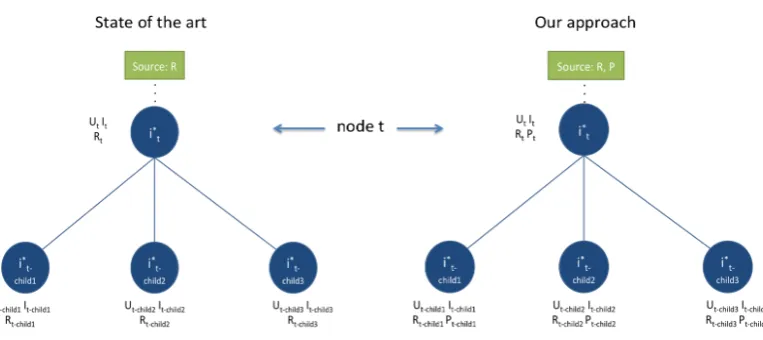
We propose to change this paradigm by using more accurate predictions over the available ratings R. The main idea is to introduce the prediction Pas a new source of useful data. Hence,
RandPare available from the root node of the tree. Then, when the node is split into child nodes,Rt
is split intoRt−child. As long as we want to preserve that for every ratingru,i∈Rtthere is an associated
predictionpu,i∈ Pt, for every nodetwe splitPtintoPt−childas well. This idea is illustrated in Figure2.
In addition, we propose to use the available ratings inRonly to split the users population, andPto find out the best discriminative items to enhance the prediction label of candidate items.
This makes sense since finding discriminative items and label predictions are associated with computing an error. As long as P is built by using more accurate methods than the "item rating average", this error is minimized efficiently. We propose using efficient algorithms, such as matrix factorization [31]. The main drawback of using matrix factorization is that it computes different item predictions for different users. The decision trees require a unique item prediction value to be applied to any user. In [4,29] the authors use the "item rating average" withinRt. We suggest using a similar method, with a major difference that is computing the "item prediction average", which is indeed the average of the predictions withinPt.
Collaborative filtering methods are very accurate for recommending items to users by replicating the users’ rating behavior. As a consequence, they are good as well in guessing the average prediction of users, items, and in general the average rating value of the dataset. We illustrate this by using a real use-case. We perform the matrix factorization (MF) predictions over the Movielens 1M dataset in Table3to obtain the predicted valuesPforR. Table2summarizes statistics overRandP. One can see how close the statistic values such as the mean and quartiles between the available ratings and the predicted ratings are.
In addition, we want to go further by considering different users’ populations. We compare the performance of three different predictors: (1) the item rating average (Item-Avg), (2) the matrix factorization (MF), and (3) the matrix factorization average (MF-Avg). The first sets the item’s rating average as the item’s prediction. The second decomposes a matrixRinto two random matrices in such a way that the multiplication of both matrices gives approximately the original R [31]. The third uses a matrix of predictions over available ratings given by the matrix factorization to set the item’s prediction average as the item’s prediction. Our goal is to show that (1) as demonstrated, the matrix factorization performs better in terms of accuracy than the item rating average method, and (2) the item prediction average predictions are close to the item rating average predictions.
(a) Accuracy of predictors. (b) Zoom over Figure3(a). The average predictors.
Figure 3.Prediction techniques and average comparisons regarding the RMSE.
the users’ ratings and the corresponding users’ predictions are taken from Rand Pinto separated setsR0 andP0. Third, we evaluate the performance of predictions inP0 by computing the root mean square error (RMSE). Moreover, we perform the item rating average over R0, and item prediction average (MF-Avg) over P0, in order to observe their performance as well. The results are given in Figures3(a)and3(b). As expected, MF outperforms the item rating average method. In addition, we observed that MF-Avg attempts to imitate the behavior of the item rating average method. Hence, the item prediction average is also an acceptable predictor regarding the item rating average. In fact, one can observe that item rating average and item prediction average are closer while dealing with more users and ratings. This behavior is perfect in decision trees since the top of the tree is more populated by users and ratings. On they contrary, they diverge while dealing with less users and ratings. This means the accuracy in larger decision trees will decrease. As long as active learning aims to create short questionnaires, this will not a great impact on our approach.
4.3. The decision trees algorithms
This sections presents the algorithms used to develop our approaches for decision trees. We can apply our contribution to non supervised and supervised decision trees techniques. Their main drawback is the heavy analysis needed to find out the best discriminative item. For instance, given the current nodet, these techniques iterate over all candidate itemsi∈ Itby analyzing users’ ratings oni. The users populations are then grouped into users’ who rated itemi and users who did not. Typically, the latter is more populated due to the sparse nature of the available dataset. Furthermore, the users who rated itemican be grouped into further categorizations, e.g. users who liked/hated, or who rated ’1, 2, 3, 4, 5’. Then, the population of users in these nodes, and their ratings, are used to evaluate the performance of choosingias one discriminative item ofRt.
a consequence, the statistical error is mandatory in this case. Our approach uses similar statistics as [4].
4.3.1. Non Supervised Decision Trees for Active Learning
In [4], the authors define a set of statistics and an internal error using these statistics to find out the best discriminative item. In this approach, the best item is the one which reduces this error. In addition, as long as the tree nodes contain many ratings, they use the item rating average method to compute item label predictions for items.
We suggest to use the predictions P over the available ratings in R in order to enhance this technique. Formally, given the nodet, there are ratingsru,i∈Rtso thatu∈Utandi∈It. In addition,
for each rating ru,i there is an associated prediction pu,i ∈ Pt. The goal is to find out, among all
candidate itemsj∈It, the best discriminative itemi∗. To do that, we compare the current state of the nodetto the impact of pickingjas discriminative item, as explained below.
The current status of the node jis given by all the items’ ratings in Pt. The properties of this status are given by the statistics presented in1, which consider separately all items in the node. This allows to glimpse a current state error as2, which is indeed the error contribution of every item jin the nodet:e2(t)
j =sum2(t)j−(sum(t)j)2/n(t)j.
∀j∈I−i: sum(t)j=
∑
u∈Ut∩P(j)
pu,j (1)
sum2(t)j=
∑
u∈Ut∩P(j)p2u,j
n(t)j =|u∈Ut∩P(j)|
e2(t) =
∑
jsum2(t)j−(sum(t)j)2/n(t)j (2)
We then look for the best candidate item that minimizes this current error. Thus, we analyze the impact of every itemjwithin this nodetand the child nodes. We first suppose thatjis a discriminative item and we splitUtinto 3 childs: tLfor users who likedj(ru,j ≥4),tDfor users who did not like
(ru,j≤4)) andtUfor users who do not know the item (absence of rating). Highlight that we useRt
to split the users’ population. In addition, we delete the presence of discriminative item ratings in child nodes. As a consequence, one has 3 rating subsetsRtL,RtDandRtUin child nodesUtL,UtDand
UtU, respectively. The impact of pickingjas candidate item is given by the error of these three nodes:
Errt(j) =e2(tL) +e2(tD) +e2(tU). This means that one evaluates the status of the given child nodes by using the Equation2and associated subsetsPtL,PtD and PtU. However, the number of users in
the unknown nodetUis normally much larger than in other groups, and hence, the computation is heavier in this node. To avoid this, it is possible to deduce statistics fortUfrom the nodetand the other child nodestLandtD, as follows:
sum(tu)j=sum(t)j−sum(tL)j−sum(tD)j (3) sum2(tu)j =sum2(t)j−sum2(tL)j−sum2(tD)j
n(tu)j =n(t)j−n(tL)j−n(tD)j
Algorithm 1Non-supervised decision tree algorithm
1: functionBUILDDECISIONTREE(Rt,Pt,currentTreeLevel) 2: forratingru,iinRtdo
3: accumulate statistics foriin nodetusingpu,i
4: end for
5: forcandidate itemjinItdo 6: forru,jinRt(j)do
7: obtainPt(u)
8: splitUtinto 3 child nodes based onj
9: find the child node whereuhas moved into
10: forratingpu,iinPt(u)do
11: accumulate statistics foriin nodet−childusingpu,i
12: end for
13: end for
14: derive statistics forjin nodetUfrom thetLandtDstatistics 15: candidate error:et(j)=etL(j)+etD(j)+etU(j)
16: end for
17: discriminative itemi∗=argminiet(i)
18: computepi∗by using item prediction average 19: ifcurrentTreeLevel < maxTreeLevelthen
20: create 3 child nodesUt−childbased oni∗ratings
21: forchildin child nodesdo 22: excludei∗fromRt−child
23: BuildDecisionTree(Rt−child,Pt−child,currentTreeLevel +1)
24: end for
25: end if 26: returni∗
27: end function
Finally, once the discriminative item is chosen, the prediction label associated to the tree is given by the item prediction average, i.e. average value ofPt(i∗).
This approach is similar to [4], with two major differences. First, the available ratings are only used to split the population of users. As a consequence, the statistics and the items predictions are computed by using the proposed set of predictionsP. Second, once a discriminative item is chosen in a parent node it does not pass to the child nodes. This is done for two reasons: (1) to avoid choosing the same item, and hence, to avoid to pose twice the same question to the same user, and (2) to delete the influence of the items’ ratings in the child nodes. In fact, one can avoid choosing an item without deleting their ratings as done in [4]. Algorithm1shows this approach.
4.3.2. Supervised Decision Trees for Active Learning
In [29], the authors suggested using warm-users as cold-users from whom some interests are known. This assumption allows to create a supervised decision trees where some labels are known for validation purposes.
We again suggest to use the predictionsP over the available ratings in Rin order to enhance this technique. Given the current node t, there are warm users in Ut who have ratings in Rt
and predictions in Pt. This technique considers warm users as cold-users from who some ratings are known. Thus, we split the users ratings into training ratings Rt−train and validation ratings Rt−validation. The former represents the interests of the warm users. The latter are the items labels
given when considered as cold-users. Note that we consider the perfect case where a useruand and itemjand inUt−train,Ut−validationand It−train,It−validationrespectively. As long as for each ratingru,i
there is an associated predictionpu,i∈Pt, it is possible to obtainPt−trainas well.
As a result, the current nodetcontains ratings inRt−train, predictions inPt−train, and ratings for
validation purposes inRt−validation. The goal is to find out, among all candidate itemsj∈It, the best
discriminative itemi∗. To do that, we compare the current state of the nodetto the impact of picking
jas discriminative item as explained below.
On the one hand, the state of the nodetis given by the Root Mean Square Error (RMSE), which computes the squared difference between current predictions and real observed ratings. Predictions are computed by using the "item predicion average" method overPt−train. Observed ratings are taken
fromRt−validation. Therefore, each useru∈Utis associated to one errorRMSE1u. The current error
Algorithm 2Supervised decision tree algorithm
1: functionBUILDDECISIONTREE(Ut,Rt−train,Rt−validation,Pt,currentTreeLevel)
2: foruseru∈Utdo
3: computeRMSE1uonRt−validation(u)andPt(u)
4: end for
5: forcandidate itemjfromRt−traindo
6: splitUtinto 3 child nodes based onj
7: foruseru∈Utdo
8: find the child node whereuhas moved into
9: computeRMSE2uonRt−validation(u)andPt(u)
10: Mu,i=RMSE1u−RMSE2u
11: end for
12: end for
13: δ=aggregate allMu,i
14: discriminative itemi∗=argmaxiδi
15: computepi∗by using item prediction average 16: ifcurrentTreeLevel < maxTreeLevel andMi∗≥0then 17: create 3 child nodesUt−childbased on based oni∗ratings
18: forchildin child nodesdo 19: excludei∗fromRt−child
20: BuildDecisionTree(Ut−child,Rt−child−train,Rt−child−validation,Pt−child,currentTreeLevel +1
)
21: end for
22: end if 23: returni∗
24: end function
who likedj(ru,j≥4),tDfor users who did not like (ru,j≤4)) andtUfor users who do not know the
item (absence of rating). Highlight that we useRt−trainto split the users’ population. In addition, we
delete the presence of discriminative item ratings in child nodes. As a consequence, one has 3 rating subsets Rt−train−L, Rt−train−D and Rt−train−U in child nodesUt−train−L,Ut−train−D and Ut−train−U,
respectively. Hence, it is possible to compute the state of the child nodes as it was performed before. This creates a second user error,RMSE2u. The impact of pickingjas candidate item for the useruis Mu,i=RMSE1u−RMSE2u. Thus the impact of pickingjas candidate item for the nodetis given by
the sum aggregation of all impacts ofj.
The number of candidate items to analyze can be very large. We take into account only the 200 most popular items, as done in [29]. This yields in very acceptable accuracy and a great reduction in the time analysis.
Therefore, after the analysis of all users and candidate items, the item inRt−trainassociated to
a higher overall impact is picked as discriminative itemi∗, since the maximum value here means a higher error difference. Finally, the predicted label for this discriminative items is given by the item prediction average over current nodePt.
This approach is similar to [29], with two major differences: (1)Pis used to validate the approach, and to obtain items label for the chosen discriminative items, and (2) we split the nodes into 3 child nodes (’like’, ’dislike’, ’unknown’) rather than 6. This warrants a minimum number of users in child nodes to avoid fast pruning in small datasets. Algorithm2shows this approach.
4.4. Complexity of the algorithm and Time analysis
The complexity of our approaches for non-supervised decision trees and supervised decision trees is very similar to [4,29]. In fact, despite some differences in the way of computing the error that needs to be improved, these algorithms follow a similar procedure. The complexity of splitting the users in node t is O(∑u∈Ut|Rt(u)|
2), and thus, for all the nodes in the same level
we use O(∑u∈U|R(u)|2). As a consequence, the complexity to build a tree of N questions
is O(N∑u∈U|R(u)|2). In fact, adding the prediction set P does not affect the complexity of
the algorithms, although, it does affect the memory footprint of the approaches. Considering that ratingsRand predictionsP sets are coded equally, our approach consumes double of the memory size to store the setP. In addition, extra runtime is required to split bothRandPaccordingly.
Table 3.Properties of different movie datasets.
Property MovieLens1M MovieLens10M Netflix
Users 6040 71567 480000
Items 3900 10681 17000
Ratings 1 million 10 millions 100 millions
Sparsity 0,042% 1,308% 1,225%
Scale Integer 1-5 1-5 by 0.5 Integer 1-5
5. Experimentation
The goal of our experimentation is two-fold (i) to present the behaviour of current techniques in smaller datasets and (ii) to show the performance of our presented approach. Recent techniques have presented their results using Netflix dataset. However, this dataset is no longer available for research. Hence, we use two versions of the Movielens dataset. Table3describes the properties of these datasets.
Since our approach considers external techniques prediction as a new source, in order to build our decision trees we use matrix factorization [31] due to its accuracy. We compare our approach in non supervised decision trees, as in [4], and in supervised decision trees, as in [29]. The latter will not be largely explained due to a lack of space.
The technique in [4], denoted "Golbandi", uses two parameters: bias overfittingλ1and rating overfittingλ2. We set empirically these parameters toλ1 = 7 andλ2 = 200. The technique in [29], denoted "Karimi", uses a rating overfitting parameter λ2. Our approaches are identified as "Pozo
Non Supervised" and "Pozo Supervised", and they do not contain any parameters, which represents an advantage in comparison to the state of the art.
As long as non supervised decision trees and supervised decision trees require different settings, we explain these experimentations separately. In order to compare the approaches we use the RMSE metric oriented to users, which measures the squared difference between the real ratings and the predicted ratings:
RMSEu = r
1
N
∑
(ru,i−pi)2
WhereNis the number of ratings of the useru,piis the predicted label value of the candidate item in the question node andru,iis the real rating of the userufor the itemi. Hence, the evaluation of
the error in one question is the average of the users error in this question number. As a consequence, for this metric the lower is the better.
Knowing that the experimentation may depend on the split of the dataset, we run it 50 times and then used the mean value of the RMSE. We use this process to evaluate the performance for the MovieLens 1M and MovieLens 10M.
5.1. Non supervised decision trees
The experimentation carried out in [4] splits the datasets into 90% training set,Dtrain and 10%
test set,Dtest. However, this is not a real cold-start context since the same user may appear in both training and test set. We suggest a real cold-start situation. We split the set of users in the datasets into 90% training set,Utrainand 10% test set,Utest. Hence, the users in the training set help to build
the decision trees and the users in the test set are considered as new user to evaluate the performance of the approach.
(a) MovieLens 1M dataset. (b) MovieLens 10M dataset.
Figure 4.Questionnaire performance in RMSE.
usingUtrain. Our approach is trained by using both ratings in training set Rand the prediction of
the training setP. Finally, the performance of the decision trees is evaluated by using the test setUtest. The users in this set are used to answer the questions. If the item is known, we compute the RMSE associated to this answer and this question. Then, the user answers a new question. At the end, we compute the average of the accumulated nodes RMSE.
Figures 4(a) and 4(b) show the results (the mean point values and tendency curves) of this experimentation for MovieLens 1M dataset and MovieLens 10M dataset respectively.
Our approach achieves a lower error with less number of questions. This matches with the needs of active learning; short but very informative questionnaires. This is possible due to the higher accuracy of the matrix factorization. In addition, we notice that the approaches tend to an asymptotic behavior in both Movielens datasets. This corresponds to a case in which users are very profiled, and further knowledge is complicate to extract.
Furthermore, it is interesting to comment the particularity in Figure 4(b). "Golbandi" slowly decreases the error and starts finding the asymptote behavior at question 11. Our approach gives very informative questions at the beginning, making the error to decrease very fast. Further than question 4, our approach proposes less informative questions and thus the error slightly increases between the questions 6 and 8. The algorithm is looking for new more informative questions than before, what makes the error decreases again from questions 9, and to slowly meet the asymptote.
5.2. Supervised decision trees
The experimentation carried out in [29] use a 4-fold set to evaluate their dataset. The Netflix dataset is already split into 90% training set, Dtrain, 10% test set, Dtest. In order to evaluate their technique in cold-start situations, they merge both sets and split the result into 75% user training set, Utrain and 25% user test set Utest, where users in one set are not present in the other. Then,
they cross these 4 sets to create their own settings environment. To train the decision trees they intersect Dtrain and Utrain to get a training set Rtrain. They use the intersection ofDtest and Utrain
to obtain the validation setRvalidation. To evaluate the technique, they use the intersection ofDtrain
andUtestas the answer setRanswer, whereas the intersection ofDtestandUtestis the performance set
(a) MovieLens 1M dataset. (b) MovieLens 10M dataset.
Figure 5.Questionnaire performance in RMSE.
"Karimi" chose these experimentation settings in order to publish and compare results using the pre-definedDtrainandDtestNetflix dataset. In addition, we consider that picking up 25% of users the
for test set,Utestis concerned with the posteriori search ofRanswerandRper f ormance. The more users in the test set the more probability to pick up ratings fromDtrain andDtestforRanswer andRper f ormance,
respectively. Thus, more test points are possible possible to use.
We simplify the setting above. The process we have followed in the Movielens datasets is as follows. We split the dataset into 90% user training set,Utrain and 10% user test setUtest, where users in one set are not present in the other. Then, the ratings inUtrain are split into 90% rating training set,Rtrain, and 10% ratings validation set Rvalidation. TheUtestis not split into "answer" and
"performance" and it is completely used for probing the approach.
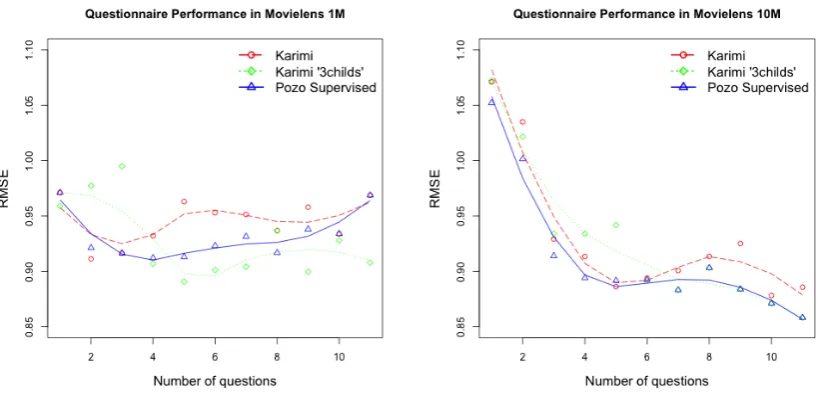
We train "Karimi" by using these settings. In addition, we train a modification of "Karimi" to take into account only 3 child nodes, denoted "Karimi 3 childs". Figures5(a)and5(b)show the results (the mean values and tendency curves) of this experimentation for both MovieLens datasets.
On the one hand, one may observe that our approach achieves a lower error (around 1%) in less number of questions; hence we better capture the preferences of new users. Therefore, our approach still matches with the needs of active learning: short but very informative questionnaires. This is possible due to the higher accuracy of the matrix factorization based predictions. In addition, it is expected to have an asymptotic behavior in large number of questions for both Movielens datasets.
On the other hand, we highlight the non-stability of "Karimi" in Figure 5(a). Karimi splits parent nodes into 6 child nodes per level; hence the Movielens 1M dataset has not enough users and ratings in deeper nodes of the tree, and thus it causes this dysfunction. The Karimi "3 childs" implementation enhances this issue by aggregating users into 3 child nodes ("like", "dislike" and "unknown"). However, our approach overcomes both approaches above. Highlight that the Karimi modification and our approach show close results. In fact, the difference is too small to be perceived in Figure 5(b). In addition, one may observe an increase of the error after 6 questions due to the smaller number of users and, again, the fast previously found informative questions.
5.3. Time analysis
2.00GHz and 14 Gb RAM. The techniques are implemented using a Java multi-threading approach, which distributes the analysis inside the tree nodes. Our non supervised approach increases the time consumption of Golbandi by around 1%, which might be considered as insignificant. On the contrary, the supervised approach reduces the time consumtion of Karimi by around 50% due to the reduced number of child taken into consideration.
6. Conclusion
Recommender Systems suffers from new user cold-start. This issue is more acute in collaborative filtering techniques since they only rely on users’ ratings to generate recommendations. In order to learn the (new) users’ preferences, passive recommender systems wait for sporadic ratings from users. On the contrary, active learning is proposed as a data acquisition method that gathers users’ ratings by presenting a simple questionnaire to users. For instance, ’Do you like this movie?’: ’Yes, I do like’; ’No, I do not like’; ’I have not seen it’. However, users are not willing to answer many questions or to rate many items. Therefore, the main goal of active learning is to create a short but efficient and informative questionnaire.
The state of the art has evolved from non personalized batch-oriented techniques (giving many questions at once and the same questions to any user) to personalized sequential-oriented questionnaires (giving questions one by one taking into account the past current users’ answers). In our point of view, the personalization of the active learning technique is crucial to better learn the new users preferences and current methods based on decision trees are interesting techniques to model questionnaires. Indeed, the personalization of decision trees allows to predict with which items the new user has been in contact, and present them to the users.
However, active learning techniques based on decision trees have not been applied to small datasets. Less number of users and ratings affect the performance of these algorithms. In addition, we consider that recent approaches do not properly consider the prediction of candidate items. On the one hand, they use very simple prediction methods to make the decision trees tractable. On the other hand, they only exploit the users’ ratings.
In this paper we proposed using two sources in the decision trees active learning technique. The main idea is to train an accurate collaborative filtering techniques with a ratings dataset to generate a prediction dataset. Both ratings and predictions dataset are used inside the decision trees. The former properly split the users’ population while building the tree. The latter enhances the seek of the best discriminative items (questions) and better predict the associated labels. We have tested this approach in non supervised decision trees and supervised decision trees techniques.
The experimentation uses two publicly available datasets: Movielens 1 million ratings and Movielens 10 million ratings. We show that our approach enhances the state of the art in terms of RMSE and the related number of questions. In fact, we find better questions and better predictions that make it quicker reduce the error. This is especially useful in small dataset contexts, where the low number of users and ratings do not allow to create big decision trees.
Finally, the approach suggested in this paper allows to alleviate the new user cold start, issue that, together with the scalability and large items/users representations, is a big challenge in the domain of recommender systems.
to the current users’ answers. As a result, the challenge is to create accurate, scalable recommendation models that evolves in real-time to cope with cold-start issues.
References
1. Rubens, N.; Kaplan, D.; Sugiyama, M. Active learning in recommender systems. InRecommender Systems Handbook; Springer, 2011; pp. 735–767.
2. Elahi, M.; Ricci, F.; Rubens, N. Active Learning in Collaborative Filtering Recommender Systems. In E-Commerce and Web Technologies; Springer, 2014; pp. 113–124.
3. Su, X.; Khoshgoftaar, T.M. A survey of collaborative filtering techniques. Advances in artificial intelligence 2009,2009, 4.
4. Golbandi, N.; Koren, Y.; Lempel, R. Adaptive bootstrapping of recommender systems using decision trees. Proceedings of the fourth ACM international conference on Web search and data mining. ACM, 2011, pp. 595–604.
5. Karimi, R.; Freudenthaler, C.; Nanopoulos, A.; Schmidt-Thieme, L. Comparing prediction models for active learning in recommender systems. Proceedings of the LWA 2015 Workshops: KDML, FGWM, IR, and FGDB. October 2015. http://ceur-ws.org, 2015.
6. Kantor, P.B.; Ricci, F.; Rokach, L.; Shapira, B. Recommender systems handbook. Recommender systems handbook. Springer, Springer US, 2011, p. 848.
7. Peis, E.; del Castillo, J.M.; Delgado-López, J. Semantic recommender systems. analysis of the state of the topic. Hipertext. net2008,6, 1–5.
8. Karim, J. Hybrid system for personalized recommendations. Research Challenges in Information Science (RCIS), 2014 IEEE Eighth International Conference on. IEEE, 2014, pp. 1–6.
9. Rashid, A.M.; Albert, I.; Cosley, D.; Lam, S.K.; McNee, S.M.; Konstan, J.A.; Riedl, J. Getting to know you: learning new user preferences in recommender systems. Proceedings of the 7th international conference on Intelligent user interfaces. ACM, 2002, pp. 127–134.
10. Pilászy, I.; Tikk, D. Recommending new movies: even a few ratings are more valuable than metadata. Proceedings of the third ACM conference on Recommender systems. ACM, 2009, pp. 93–100.
11. Harpale, A.S.; Yang, Y. Personalized active learning for collaborative filtering. Proceedings of the 31st annual international ACM SIGIR conference on Research and development in information retrieval. ACM, 2008, pp. 91–98.
12. Zhou, K.; Yang, S.H.; Zha, H. Functional matrix factorizations for cold-start recommendation. Proceedings of the 34th international ACM SIGIR conference on Research and development in Information Retrieval. ACM, 2011, pp. 315–324.
13. Karimi, R.; Freudenthaler, C.; Nanopoulos, A.; Schmidt-Thieme, L. Active learning for aspect model in recommender systems. Computational Intelligence and Data Mining (CIDM), 2011 IEEE Symposium on. IEEE, 2011, pp. 162–167.
14. Carenini, G.; Smith, J.; Poole, D. Towards more conversational and collaborative recommender systems. Proceedings of the 8th international conference on Intelligent user interfaces. ACM, 2003, pp. 12–18. 15. Boutilier, C.; Zemel, R.S.; Marlin, B. Active collaborative filtering. Proceedings of the Nineteenth
conference on Uncertainty in Artificial Intelligence. Morgan Kaufmann Publishers Inc., 2002, pp. 98–106. 16. Shannon, C.E. A mathematical theory of communication. ACM SIGMOBILE Mobile Computing and
Communications Review2001,5, 3–55.
17. Rubens, N.; Sugiyama, M. Influence-based collaborative active learning. Proceedings of the 2007 ACM conference on Recommender systems. ACM, 2007, pp. 145–148.
18. Rashid, A.M.; Karypis, G.; Riedl, J. Learning preferences of new users in recommender systems: an information theoretic approach.ACM SIGKDD Explorations Newsletter2008,10, 90–100.
19. Golbandi, N.; Koren, Y.; Lempel, R. On bootstrapping recommender systems. Proceedings of the 19th ACM international conference on Information and knowledge management. ACM, 2010, pp. 1805–1808. 20. Mello, C.E.; Aufaure, M.A.; Zimbrao, G. Active learning driven by rating impact analysis. Proceedings
21. Karimi, R.; Freudenthaler, C.; Nanopoulos, A.; Schmidt-Thieme, L. Non-myopic active learning for recommender systems based on matrix factorization. Information Reuse and Integration (IRI), 2011 IEEE International Conference on. IEEE, 2011, pp. 299–303.
22. Karimi, R.; Freudenthaler, C.; Nanopoulos, A.; Schmidt-Thieme, L. Towards optimal active learning for matrix factorization in recommender systems. Tools with Artificial Intelligence (ICTAI), 2011 23rd IEEE International Conference on. IEEE, 2011, pp. 1069–1076.
23. Karimi, R.; Freudenthaler, C.; Nanopoulos, A.; Schmidt-Thieme, L. Exploiting the characteristics of matrix factorization for active learning in recommender systems. Proceedings of the sixth ACM conference on Recommender systems. ACM, 2012, pp. 317–320.
24. Karimi, R. Active learning for recommender systems.KI-Künstliche Intelligenz2014,28, 329–332.
25. Kohrs, A.; Merialdo, B. Improving collaborative filtering for new users by smart object selection. Proceedings of International Conference on Media Features (ICMF), 2001.
26. Jin, R.; Si, L. A bayesian approach toward active learning for collaborative filtering. Proceedings of the 20th conference on Uncertainty in artificial intelligence. AUAI Press, 2004, pp. 278–285.
27. Rendle, S.; Schmidt-Thieme, L. Online-updating regularized kernel matrix factorization models for large-scale recommender systems. Proceedings of the 2008 ACM conference on Recommender systems. ACM, 2008, pp. 251–258.
28. Karimi, R.; Wistuba, M.; Nanopoulos, A.; Schmidt-Thieme, L. Factorized decision trees for active learning in recommender systems. Tools with Artificial Intelligence (ICTAI), 2013 IEEE 25th International Conference on. IEEE, 2014, pp. 404–411.
29. Karimi, R.; Nanopoulos, A.; Schmidt-Thieme, L. A supervised active learning framework for recommender systems based on decision trees.User Modeling and User-Adapted Interaction2015,25, 39–64. 30. Narayanan, A.; Shmatikov, V. Robust de-anonymization of large sparse datasets. Security and Privacy,
2008. SP 2008. IEEE Symposium on. IEEE, 2008, pp. 111–125.
31. Zhou, Y.; Wilkinson, D.; Schreiber, R.; Pan, R. Large-scale parallel collaborative filtering for the netflix prize. InAlgorithmic Aspects in Information and Management; Springer, 2008; pp. 337–348.
32. Lemire, D.; Maclachlan, A. Slope One Predictors for Online Rating-Based Collaborative Filtering. SDM. SIAM, 2005, Vol. 5, pp. 1–5.
33. Koren, Y.; Bell, R. Advances in collaborative filtering. InRecommender Systems Handbook; Springer, 2011; pp. 145–186.