Article
Winter pruning: effect on root density, root distribution and root/canopy ratio in Vitis vinifera cv. Pinot Gris
Diego Tomasi1, Federica Gaiotti1, Despoina Petoumenou2, Lorenzo Lovat1, Nicola Belfiore1, Giovanni Mian3*
1 Council for Agricultural Research and Economics-Research Centre for Viticulture and Enology, Viale 28 Aprile, 26, 31015 Conegliano (TV), Italy; [email protected] (D.T.); [email protected] (F.G.); [email protected] (L.L.); [email protected] (N.B.)
2 Department of Agriculture Crop Production and Rural Environment, Laboratory of Viticulture, University of Thessaly, 38446 Volos, Greece; [email protected] (D.P.)
3 Department of Agricultural, Food, Environmental and Animal Sciences, University of Udine, via delle Scienze 208, 33100 Udine, Italy. giovanni,[email protected] (G.M.)
- The authors contributed equally to this work
* Correspondence: [email protected] or [email protected] Tel.: +39 3478890182
Abstract: As in any other plant, in the grapevine roots play a vital role in terms of anchorage, uptake of water and nutrients, as well as storage and production of chemicals. Their behaviour and development depend on various factors, namely rootstock genetics, soil physical and chemical features, field agronomic practices. Canopy management, involving techniques such as defoliation and pruning, could greatly influence root growth. To date, most of the studies on grapevine winter pruning have focused on the effects on yield and quality of grapes, achievable by using different pruning systems and techniques, while the knowledge of root distribution, development, and growth in relation to winter pruning is still not well understood. In this contest, the purpose of this study was to investigate the effect of winter pruning on the root system of field-grown Vitis vinifera cv. Pinot Gris grafted onto rootstock SO4. We compared two pruning treatments (pruning-P and no pruning-NP) and analysed the effect on root distribution and density, root index and on the root sugar reserves. Root data were analysed in relation to canopy growth and yield, to elucidate the effect of winter pruning on the root/yield ratio. Our data indicated that winter pruning stimulated the root growth and distribution without compromising canopy development, while no-pruning treatment produced less growth of roots but a larger canopy. Information regarding root growth and root canopy ratio is important as it gives us an understanding of the relationship between the aerial and subterranean parts of the plant, how they compete, and finally, offers us the possibility to ponder on cultural practices.
Keywords: grapevine; winter pruning; root distribution; root density; root growth; root/canopy ratio; root/yield ratio
1. Introduction
Understanding the relationship between the above-ground vine growth and root system dynamics, their competition, and in general recognize the grapevine response to agronomic practices that affect the above or below-ground structures is very important to understand root/canopy balance and to optimize vineyard management.
The root system plays vital roles in the whole plant development, determining the anchorage, the exploration of the soil in search of minerals, water, the production of regulatory hormones and the storage of nutrients and carbohydrates [1] [2].
Aerial and subterranean environmental conditions, along with cultural practices, influence root growth and, therefore, the root/canopy ratio [3] [4].
Root density and distribution can be affected by several factors, first of them being genetics: rootstock can influence root growth and distribution [5]. Due to the specific origin of their genotypes the various rootstock species and hybrids have different root system sizes, in terms of its horizontal and vertical distribution: this means that every rootstock has its own ability to adapt to soil condition [6]. Among the environmental factors, soil physical characteristics plays a crucial role on root development. Soil depth is directly related to the volume of soil explorable by the root system [7] [8] and, generally, deeper soils have more roots than superficial soils [9]. Soil layering and texture also affect root distribution: in soils with high clay content roots are concentrated in the upper soil layer, whereas in soils with low clay content vines roots are more evenly distributed all along the soil profile [10] [5] [3] [11]. Soil physical properties also influence soil water availability and, consequently, vine root density and distribution, due to the stimulus that water exerts on the root growth. It has been demonstrated that drip irrigation can stimulate the root density immediately under the dripper outlet [12]. In this wet area the production of new roots and the expansion of root diameter and length is greater than that in other soil areas [13]. Organic matter and nutrient availability in the soil can effect root growth as well [14] [15] [16]. Compost amendment showed a noticeable effect on root density and distribution; for example, the application under the vine row of compost derived from vine wood pruning, showed a great stimulating effect on root growth, leading to improve horizontal and vertical root development [17].
Also the presence of cover crops affects vine root distribution: under cover grass the amount of vine roots was found to be larger close to the vines (under row) where there were no cover crops [18] [19], and also in general in the upper soil layers [20]. This confirms the plasticity of grapevine root systems and their high sensitivity to the soil conditions.
Along with vineyard management, cultural techniques could affect root distribution. High planting densities can reduce the root system size because of plant competition: specifically, with higher vine density per unit area, roots tend to explore soil more in depth than in the case of lower vine density [25] [26]. Grapevine roots were also reported to be affected directly by both root pruning and soil tillage: because of these practices, changes in terms of vegetative growth, crop yield, and grape composition were found [27].
The existing balance between subterranean and aerial growth of grapevines is very important to better understand how canopy management practices can influence the root system [12] [28] [22] [24] [29]. Up to date, most of the research on pruning methods and/or minimal pruning of grapevines has focused on the effects on canopy growth, yield, grape, and wine composition [30] [31] [32] [33], while still limited information has been gathered regarding the effects of pruning techniques on the root system and development.
Studying the root system allows us to obtain information on the vegetative-productive behaviour of the vine; in fact, the roots can fully be considered an interface between the plant and the soil and their number and biochemical functions are always determined by the behaviour of the canopy [34]. Canopy and roots are related, hence, in this study, we compared the effect of winter pruning and no pruning applied on Pinot Gris vines, to understand the modification in terms of canopy and root development, and root/canopy ratio.The introduction should briefly place the study in a broad context and highlight why it is important. It should define the purpose of the work and its significance. The current state of the research field should be reviewed carefully and key publications cited. Please highlight controversial and diverging hypotheses when necessary. Finally, briefly mention the main aim of the work and highlight the principal conclusions. As far as possible, please keep the introduction comprehensible to scientists outside your particular field of research. References should be numbered in order of appearance and indicated by a numeral or numerals in square brackets, e.g., [1] or [2,3], or [4–6]. See the end of the document for further details on references.
2. Materials and Methods
2.1 Plant material and experimental setup
The trial was conducted in the period 2011-2012 in Ponte di Piave (Treviso, Italy) (45°42'26.45"N, 12°27'49.31"E), in a vineyard of Vitis vinifera cv. Pinot Gris (clone R6) grafted onto SO4 rootstock. The vines were established in 2000 and trained to a free-cordon trellis set 1.50 m above ground with one support wire. Vine spacing was 0.9 m × 2.5 m (intra and inter row) for a density of 4,400 vines/ha. The vine rows were approximately 150 m long and east-west oriented.
From the third year of planting, once the vines were completely trained to a free cordon system, 6 adjacent rows were selected for this study and two treatments - P and NP - were applied (three adjacent rows for P and three for NP) and performed in the same way every year. The P was performed using a tractor-mounted cutter bar unit with a cut profile applied at about 20 cm from the cordon; hand clean-up was performed by two field workers with pneumatic shears, leaving approximately 50 buds per vine. In the NP vines no winter pruning was performed.
conditions for the machines and prevent disease and pests that could attack the grapevines. Local standard practices were followed for pest management and fertilization. The vines were irrigated by a drip subsoil irrigation system, considering the weather conditions. Vine measurements were carried out in three random blocks (each block consisting of 15 contiguous vines) each block was placed in one of the three internal row of each treatment (P, NP), except for the defoliated vine selected randomly along the internal row.
Pinot Gris was selected for this study, as it currently ranks fourth among Vitis vinifera cultivars grown in Italy, with 15,907 ha in the Veneto region (north-east of Italy) with a production of 1,225,000
q , used for the production of “DOC delle Venezie wines” (Avepa, 2020http://dati.istat.it).
2.2 Pedological and climatic characterization of the study site
The soil of the experimental vineyard was characterized at the beginning of the experiment: 9 soil samples (3 samples taken at 0-0.30 m, 3 samples taken at 0.30-0.60 and 3 at 0.6-0.9) were randomly collected along the 6 experimental rows. Analysis of the samples confirmed the homogeneity of the soil within the plot selected for this experiment. Climatic data were taken by the ARPAV meteorological station of Ponte di Piave (Treviso, Italy).
2.3 Grapevine root studies
As grapevines are capable of reaching a large volume of exploration and are characterized by a low root density compared to other perennial plants, the profile wall method suggested by Böhm 1979 [35] was deemed the most appropriate one to determine root distribution (vertical and horizontal) and density. In January 2013, during the dormant period, four vines per treatment with similar scion circumferences were selected within the measuring blocks. For each vine, a trench of approximately 1.20 m deep was dug parallel to the vine row, first at a distance of 1.00 m and then at 0.40 m from the vine trunk. At each distance, roots were counted by using a 1.0 m high and 1.0 m wide grid system positioned against the profile wall keeping the grapevine trunk central. The grid was divided in 0.2 x 0.2 inner frame enabling us to plot the roots position. Roots were plotted in five depths (0-20 cm, 20-40 cm, 40-60cm, 60-80 cm, 80-100 cm) and were classified into three thickness categories according to size: Ø < 2.0 mm = fine roots; Ø 2.0-5.0 mm = medium roots and Ø > 5.0 mm = permanent roots. Processed data are expressed as root number /m2.
2.4 Leaf area development and canopy characteristics
In 2011 and 2012, at maximum canopy development (typically mid-July that means around the veraison), six vines per treatment, selected randomly within the internal rows, were completely defoliated. For each vine, the number of shoots was counted, and all the leaves collected were positioned on a 1.0 m × 1.0 m panel and photographed with a digital camera. Photos were processed with the Image program (National Institutes of Health, USA) and the following parameters were recorded: number of leaves, leaf size, and total leaf area per vine.
and representative data. Percent gaps, leaf layer number (LLN), percent interior leaves, and percent interior clusters were recorded as follows: % gaps = total gap to total insertions ratio × 100, LLN = total leaf contacts to total insertions ratio, % interior leaves = interior leaves to total recorded leaf ratio × 100, % interior clusters = interior clusters to total recorded cluster ratio × 100.
2.5 Yield, yield components and grape composition
Both treatments were harvested at the same technological maturity but on different dates and about one week apart for the NP vines compared to P vines. All the 15 vines from each block (total 45 vines per treatment) were individually hand-picked, yield and total clusters per vine were recorded, average cluster weight were calculated. Fruit composition at harvest was measured on a sample of 1.0 kg of grapes collected randomly from all vines of each block. Soluble solids were measured by refractometer (Atago PR32) at 20°C, pH and titratable acidity (expressed as g/L of tartaric acid) were measured using an automatic titrator (Crison Micro TT 2022) by titration with 0.1n NaOH. Winter pruning wood from the 15 vines of each block (total 45 vines) was weighed in winter for P vines, as an indicator of vine canopy growth.
2.6 Root to canopy ratios
To evaluate the relation between the above-ground and subterranean growth, two ratios were calculated; the first was the root to canopy ratio, obtained by dividing roots number which resulted in each treatment in 2013 by the respective leaf area of both precedent years (2011, 2012). The second was root to yield ratio, obtained in the same way, by dividing root number (2013) of each treatment by the respective vine yield in 2011 and 2012.
2.7 Carbohydrates storage in cane wood and roots
Carbohydrates stored in the roots play a fundamental role in grapevines, as for all trees: they are important for winter survival and for plant activity in the following season (budburst and early shoot growth) [37].
For their importance, in January 2013, at the same time of root counting, samples of thick roots and cane (between node 4 and 5) were collected and the carbohydrate concentration was determined on three replicates per organ and per treatment according to a colorimetric method [38] using anthrone reagent (Merck, Darmstadt, Germany). Absorbance readings at 620 nm were performed using a Shimadzu UV Mini-1240 spectrophotometer (Kyoto, Japan).
2.8 Statistical Analysis
One-way analysis of variance was performed using STATISTICA version 8 (StatSoft, Inc.). Statistical analyse for the determination of significant differences between treatments means was carried out using Student-Newman-Keuls test (p ≤ 0.05).
3. Results
3.1 Characterization of the study site
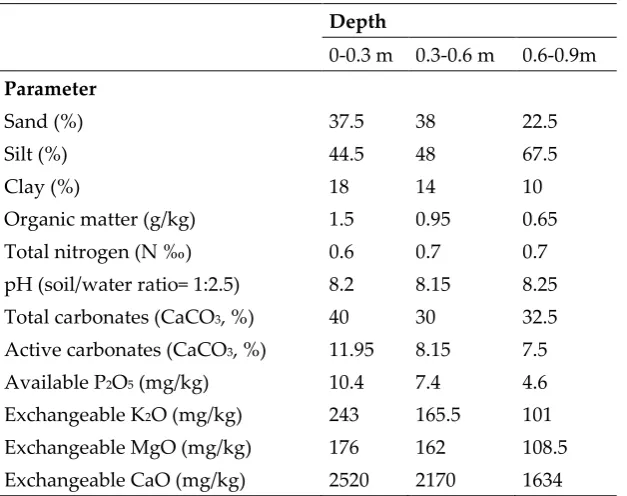
maximum levels found in the first layer and the minor percentage in the lower one. pH resulted alkaline, but in an optimum range for nutrient uptake [39].
The study area has a typical Mediterranean climate, with warm summers and cool winters. Annual rainfall was approximately 800 mm, falling mainly in spring and autumn. Growing degree days (GDD, base 10°C), rainfall (mm), mean temperature of the years of study; mean temperature and rainfall from 1st April to 30th September and per every month are reported in Table 2. Data were measured by the ARPAV meteorological station of Ponte di Piave (TV).
Experimental site
Depth
0-0.3 m 0.3-0.6 m 0.6-0.9m
Parameter
Sand (%) 37.5 38 22.5
Silt (%) 44.5 48 67.5
Clay (%) 18 14 10
Organic matter (g/kg) 1.5 0.95 0.65
Total nitrogen (N ‰) 0.6 0.7 0.7
pH (soil/water ratio= 1:2.5) 8.2 8.15 8.25 Total carbonates (CaCO3, %) 40 30 32.5 Active carbonates (CaCO3, %) 11.95 8.15 7.5 Available P2O5 (mg/kg) 10.4 7.4 4.6 Exchangeable K2O (mg/kg) 243 165.5 101
Exchangeable MgO (mg/kg) 176 162 108.5
Exchangeable CaO (mg/kg) 2520 2170 1634
Table 1. Physical and chemical soil characteristics at three soil depths (0-0.3 m, 0.3-0.6 m, 0.6-0.9 m) in the experimental site.
April May June July August September
Year GDD per year Total rainfall (mm) per year T mean per year (°C) Total rainfall (mm)
in the period
(April -
September)
T mean in
the period
(April
-September) T
mean Rainfall
T
mean Rainfall
T
mean Rainfall
T
mean Rainfall
T
mean Rainfall
T
mean Rainfall
2011 1929 749,2 13,3 329,4 16,6 7,1 7,4 10,6 35,6 15,5 78,2 22 127,4 23,5 10,8 21 70
2012 2010 836 13,3 450,8 17 7,4 126,6 10,8 101 15,7 19,8 24,5 13,6 24,4 57,8 19,2 132
Table 2. Growing degree days (GDD, base 10°C), rainfall (mm), mean temperature of the years of study; mean temperature and rainfall from 1st April to 30th September; April-September monthly mean temperature and rainfall, at the experimental site in 2011 and 2012. Data from ARPAV (Agenzia Regionale per la Prevenzione e Protezione dell’Ambiente in Veneto).
Table 3 reports the root density at two different distances from the vine trunk (0.40 and 1.00 m) and the average number of roots/m2 for the two treatments. After thirteen years from the planting, the root system could be considered well established in those conditions we found that the total root number of the P vines was ~ 2 fold higher compared to NP vines at a 0.40 m distance from vine trunk, while this difference increased significantly to ~ 10 fold higher at a 1.00 m distance from vine trunk (Table 3, root density/m2 profile wall). In both treatments at the two distances from trunk, fine roots (< 2 mm diameter) were the most abundant. In P, there were more fine (< 2 mm) and intermediate roots (2-5 mm) than NP, both at the two distances from the trunk. Indeed, the thickest roots (> 5 mm diameter class) of NP vines were almost two fold more than those of P vines at 0.40 m, while at a 1.0 m distance there were thicker roots in P than in NP (Table 3).
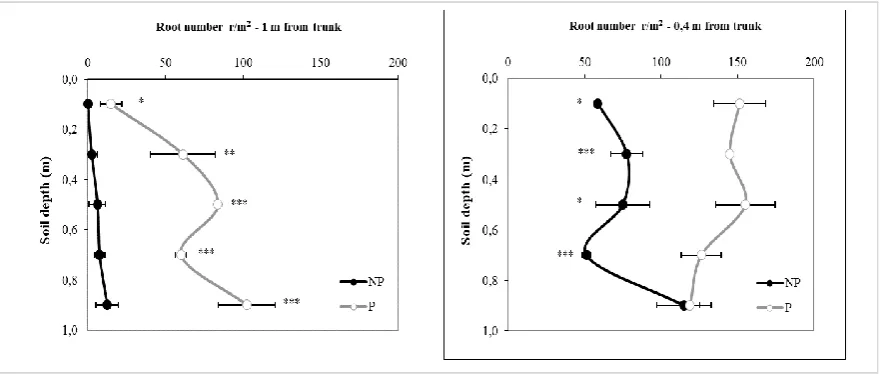
To examine the root vertical distribution in the soil, the number of roots calculated at each distance from the vine trunk (0.40 and 1.00 m) in different soil layers was compared and presented as grapevine vertical root profiles (Figure 1). The root distribution differed between the treatments and for both distances from the vine trunk. More precisely, at 0.40 m from the vine trunk the maximum root density distribution of P was found in soil depths from 0 to 0.60 m with about 150 roots/m2. In the deeper layers (0.80-1.0 m), the density decreased but nevertheless remained high (~120 root/m2). On the other hand, at the same vine trunk distance of 0.40 m, the NP vines presented 2 fold lower root density (~ 70 roots/m2) than P vines and for the same soil depths (0-0.60 m), while at 0.80-1.0 m of soil depth the NP vines registered the higher value of root density and similar to the P vines. At a 1.00 m distance from the vine trunk roots density was evidently different when the two treatments were compared, with NP vines registering a constant and very low root density (0-13 root/m2) throughout all the soil layers compared to P vines; the latter registered increasing root number at increasing soil depth up to almost 100 roots/m2 at 0.80-1.0 m soil depth (Figure 1).
Investigating the maximum root distribution in P and NP vines, in P the highest number of roots (almost 150 root/m2) were located at between 0 and 0.60 m soil depth and at 0.40 m distance from the vine trunk. Indeed, NP concentrated the majority of the roots at 0.80-1.0 cm of soil depth at 0.40 m distance from the vine trunk. The scenario was totally the opposite at 1.00 m distance from the vine trunk, where P treatment registered the higher root density at 0.80-1.0 m of depth (~ 100 roots/m2), while the NP treatment roots were evenly distributed in all soil layers but with very low, almost irrelevant, root density (Figure 1).
The ratio between fine (< 2 mm diameter) and thick (> 5 mm diameter) roots, at a 0.4 and 1 m distance from the vine trunk was analysed (data not shown). We found an average ratio of 4.6 and 3.1 at 0.4 m from the vine trunk, for P and NP, respectively. At 1.0 m distance from the vine trunk, values were lower, equal to 3.6 and 0.3 for P and NP, respectively.
Distance from vine trunk (m)
(number of roots/m2 profile wall/root size)
(number of roots/m2 profile wall)
Treatment Ø < 2 mm Ø 2 - 5 mm Ø > 5 mm
NP 60.8 ba 10.5 b 11.0 a 82.3 b
0.4 P 100.8 a 25.8 a 6.3 a 132.8 a
Significance * * ** **
NP 1.0 b 2.5 b 2.0 a 6.0 b
1 P 50.3 a 10.0 a 4.0 a 64.3 a
Significance ** ** * **
Table 3. Root density at two different distances from the vine trunk (0.40 and 1.00 m), for Ø < 2.0 mm = fine roots; Ø 2.0-5.0 mm = medium roots and Ø > 5.0 mm = permanent roots and for the total number of roots per profile wall. Data were recorded in January 2013, in non-pruned (NP) and pruned (P) Pinot gris vines, and are expressed as roots/m2.
a For each distance from the vine trunk, and for each column, values which are assigned by different letters, are significantly different; *,**, and ns indicate significance at p ≤ 0.05, 0.01 and not significance, respectively, within the columns.
Figure 1. Root production (root number/m2) by soil depth in non-pruned (filled circles) and pruned (open circles) Pinot gris vines, at 0,4 m and 1 m from vine trunk. *,**,***: significance at α = 0.1, 0.01, 0.001 % of root observation (n=8). Bars denote 0.95 confidence intervals.
3.3 Vine growth, leaf area development, canopy characteristics at veraison, and yield and grape composition
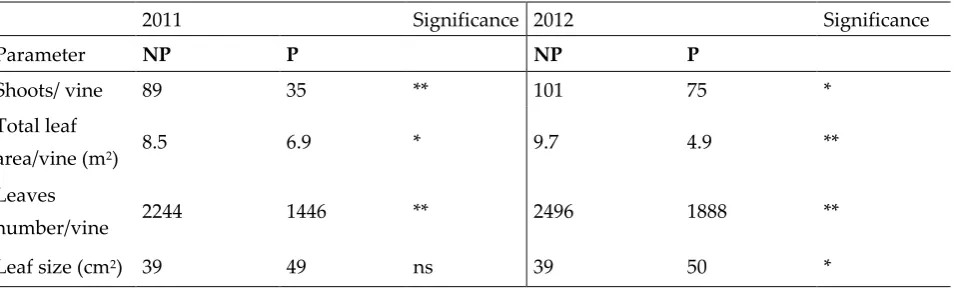
leaf size of the non-pruned vines was smaller than the pruned vines, in both years of experiment (Table 4).
Point Quadrat Analysis performed at the veraison stage, showed a significant difference between the treatments for the gap percentage during the experimental year 2011, while a not significant difference was found between the treatments in 2012 (Table 5). Leaf layer number was significantly lower for pruned vines in 2011, while values were similar between the two treatments in 2012. In terms of the percentage of interior leaves, there was a significant difference between treatments only in 2011, with a high value in NP. The percentage of interior clusters was similar between treatments in both experimental years (Table 5).
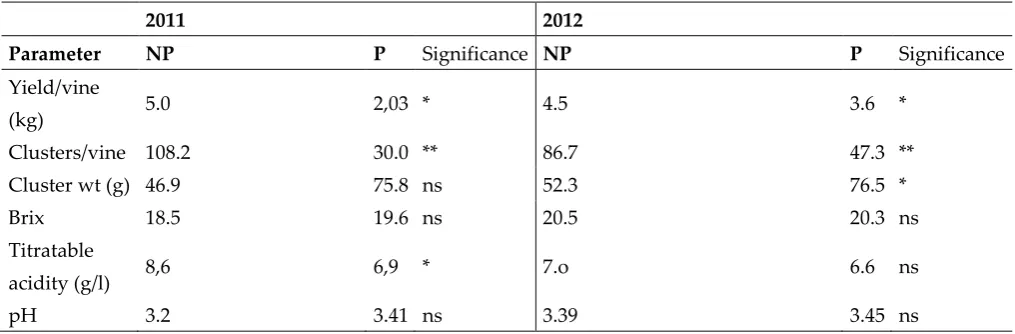
Finally, table 6 reports the yield components. Yield/vine was higher in NP, in 2011 and 2012, and more clusters/vine were observed in NP than P. In both years the cluster weight (g) was higher in P. No significant differences were observed for berry chemical composition, except for acidity in 2011.
2011 Significance 2012 Significance
Parameter NP P NP P
Shoots/ vine 89 35 ** 101 75 *
Total leaf
area/vine (m2) 8.5 6.9 * 9.7 4.9 **
Leaves
number/vine 2244 1446 ** 2496 1888 **
Leaf size (cm2) 39 49 ns 39 50 *
Table 4. Canopy parameters, recorded at veraison over 2011-2012, in pruned (P) and non-pruned (NP) Pinot gris vines. a Within rows: *,**, and ns indicate significance at p ≤ 0.05, 0.01 and not significance, respectively.
2011 Significance 2012 Significance
Parameter NP P NP P
Gaps (%) 1 5 ** 0 0 ns
Leaf layer
(number) 7.1 4.5 ** 5.8 5.6 ns
Interior
leaves (%) 71 55 * 70 64 ns
Interior clusters (%)
100 97 ns 97 93 ns
2011 2012
Parameter NP P Significance NP P Significance
Yield/vine
(kg) 5.0 2,03 * 4.5 3.6 *
Clusters/vine 108.2 30.0 ** 86.7 47.3 **
Cluster wt (g) 46.9 75.8 ns 52.3 76.5 *
Brix 18.5 19.6 ns 20.5 20.3 ns
Titratable
acidity (g/l) 8,6 6,9 * 7.o 6.6 ns
pH 3.2 3.41 ns 3.39 3.45 ns
Table 6. Yield and yield components, recorded at harvest over 2011-2012, in pruned (P) and non-pruned (NP) Pinot gris vines. a Within rows; *,** and ns indicate significance at p ≤ 0.05, 0.01 and not significance, respectively.
3.4 Root canopy ratios
In Table 7 we report root ratios between root-above ground growth. Regarding root number/leaf area ratio, we observed a higher value in the P vines than in the NP ones in both years of measurement (2011, 2012). The same trend was also seen in the root number/yield ratio, where we found a higher ratio for the P treatment than the NP, for both years of the study.
Parameters
Treatment Root number/leaf area Root number/yield
2011 2012 2011 2012
NP 10 ba 9 b 15 b 20 b
P 19 a 29 a 58 a 34 a
Significance * ** ** **
Table 7. Growth ratios, obtained from the root data recorded in January 2013 and the average leaf area and yield data recorded over 2011-2012, in pruned (P) and non-pruned (NP) Pinot gris vines. a For the treatments, values which are assigned by different letters, are significantly different; *,**, indicate significance at p ≤ 0.05, 0.01 respectively within the columns.
3.5 Starch and alcohol soluble sugars in roots and canes
Figure 2. Cane starch + alcohol - soluble sugars (mg/g dry weight) (A), and root starch + alcohol-soluble sugars (mg/g dry weight) (B), in pruned (P) and non-pruned (NP) Pinot gris vines, with standard error.
4. Discussion
Vine pruning is a normal practice adopted to control production and quality of the grapes. Many studies on the effects of pruning on yield and yield composition are reported in literature [42] [43] but the knowledge of root development in relation to winter pruning is not yet well understood. Hence, the purpose of this study was to compare two treatments, pruning and non-pruning, to analyse the effect of pruning on root distribution, density, and on the root sugar reserves. Root data were also analysed in relation to canopy growth and yield, to elucidate the effect of winter pruning on the root/canopy ratio.
As reported by Smart et al., 2006, [6] root system architecture and rooting depth distribution depends on different factors, such as training systems, cultural practices, soil properties and preparation. This confirms that vine pruning may influence roots distribution, density and ratio among roots size. Similar results regarding root density and growth have been found by Hunter & Le Roux, 1992 [45]. Having a more extensive root system is important for water and nutrient uptake, exploration of soil, anchorage and a better soil plant relations. In this contest, it is important to achieve the stimulating effect of total roots, as well as the amount of fine sized roots. In fact, the fine and medium sized roots are responsible for water and nutrients uptake while the main functions of the thick roots are anchorage and reserve [46] [47].
Considering the competition between canopy and roots system, higher root densities were expected to be found in pruned vines, and so it was. In fact, P has shown having less shoots/vine, less leaves/vine, less grapes number and consequently less yield, compared to NP. We can conclude that the increased yield and canopy have led to lower root density in NP. Perhaps with a more efficient root system, grapevines would be able to guarantee growth and production over the years, an information which has to be taken into consideration not only for the better uptake and use of the soil resources but also in case of abiotic and/or biotic stress [22] [48].
As for the canopy structure, and to explain the bigger vegetative volume in NP than P, we also performed the Point Quadrat Analysis. Differences regarded gaps, leaf layer numbers, and interior leaves. In 2011 there were more gaps in P than in NP and this was expected due to the increased leaf layers, while in 2012 the lack of differences could be explained with the higher amount of rainfall between April and May, which promoted the vegetative growth mostly in the P vines. In regards to leaf layer, in 2011, there were more layers in NP than in P. This could be explained with a more well set up canopy in P than in NP, as an effect of the pruning. Furthermore, Viticare on farm trials-manual 3.3 (awri.com.au), reports that leaf layers should be less than 1,5 while the gap percentage should be 20-40 %, but we found a higher number of leaf layer and lower in gaps. This must be explained as the training system adopted was a free cordon, meaning the canopy was less tall but thicker than a vertical canopy with 2 or 3 pairs of catch wire and upward shoots, which is the basic form suggested by the manual. In fact, a free cordon develops a canopy which is richer in terms of downward shoots/vine and leaves and consequently more leaf layers. Similar results, for both measures, were found by De Bei (2008) [49]. Similar considerations can be extended also to the extremely high percentage of interior leaves and clusters in both treatments, values that nevertheless did not compromise the health conditions of the grapes (data not shown).
Examining the reserve substances in canes and roots, indicated in starch plus alcohol soluble sugar total content, we found a higher concentration in the roots than in the canes, as is reported in literature [37]. This, as known, is due to the fact that roots are the favourite organs of accumulation of reserve substances [46]. In the experiment, specifically, the concentration was higher in the NP treatment than in P. This could be explained by considering that: i) the total amount of roots was higher in P and probably for this reason the reserves were more diluted, and ii) the NP treatment produced more thick roots where starch is preferably accumulated [52]. The allocation of carbohydrates is partitioned among aerial vegetative growth, the reproductive organs and roots, but the total amount of dry matter remains more or less the same [53]. In the experiment, the P treatment promoted root system growth at the expense of canopy and clusters, while the NP mostly effected the vegetative and reproductive parts rather than the roots.
This is also confirmed by qualitative measures: Brix degree was higher in 2011 in P than NP, due to the higher yield in NP; but similar Brix values was surveyed in 2012 in both treatments where yields was less different.
5. Conclusion
Pruning had a clear effect on canopy structure, composed of leaf number and total leaf area, which resulted in a tidier canopy with a better shape [54] [55] [56], however, the results of the experiment, led to understand that as a consequence of the pruning, vines have a more developed root system due to less competition between the roots and the canopy, or in other terms, a different portioning of photosynthesis products. This is in accordance with Hunter and Le Rox 1992 [45] where removal of 33% of leaves over the period berry set – veraison significantly increased the number of roots per m2 profile wall. Thus, in modern viticulture, having a balanced number of clusters per vine, a well-developed root system, and a good canopy development, is necessary to achieve good agronomic and oenological goals. Our findings underline, as other researches have already done, that different canopy and/or soil management can affect root growth, density, and distribution [45] [21]. In the actual contest, it is important to know how the modification of the canopy (i.e. the pruning) can modify the root system. By having an optimal root system and a good canopy management may allow to achieve a high structured vineyard through a good uptake of nutrients and water from the soil. As for the last consideration, the non-pruning treatment has shown a sort of natural behaviour in terms of: i) more reproductive organs (grapes and consequently seeds) and ii) less roots in benefit of the aerial green mass (leaves).
Author Contributions: “Conceptualization, G.M.; methodology, N.B., F.G., L.L., D.P.; software, G,M,; validation, D.T. and F.G.; formal analysis, F.G..; data curation, G.M.; writing—original draft preparation, G,M,.; writing—review and editing, G.M., F.G. and D.T. All authors have read and agreed to the published version of the manuscript.”
Funding: This research received funding from the “OIGA - VINSALUT” project, MIIPAF
Acknowledgments: The authors thank “Le Rive” winery for their kind support offered during the experimental years
References
1. Conradie, W.J. Seasonal Uptake of Nutrients by Chenin blanc in Sand Culture : I. Nitrogen. South African J. Enol. Vitic. 1980, 1, 59–65.
2. Porro, D.; Ramponi, M.; Rolle, L.; Tomasi, T.; Poni, S. Nutritional implications of water stress in grapevine and modifications of mechanical properties of berries. In Proceedings of the Acta Horticulturae; International Society for Horticultural Science, 2010; Vol. 868, pp. 73–80. 3. Morlat, R.; Jacquet, A. Grapevine root system and soil characteristics in a vineyard maintained
long-term with or without interrow sward. Am. J. Enol. Vitic. 2003, 54, 1–7.
4. Hunter, J.J.; Volschenk, C.G. Effect of altered canopy: root volume ratio on grapevine growth compensation. S. Afr. J. Enol. Vitic. 22, 27–30.
5. Morano, L.; Kliewer, W.M. Root Distribution of Three Grapevine Rootstocks Grafted to Cabernet Sauvignon Grown on a Very Gravelly Clay Loam Soil in Oakville, California. Am. J. Enol. Vitic. 1994, 45.
6. Smart, D.R.; Schwass, E.; Lakso, A.; Morano, L. Grapevine rooting patterns: A comprehensive analysis and a review. Am. J. Enol. Vitic. 2006, 57, 89–104.
7. Archer, E.; Strauss, H.C. The Effect of Plant Spacing on the Water Status of Soil and Grape-vines*; Vol. 7600;.
8. Korboulewsky, N.; Robles, C.; Garzino, S. Effects of sewage sludge compost on volatile organic compounds of wine from Vitis vinifera cv. red grenache. Am. J. Enol. Vitic. 2004, 55, 412–416.
9. Morlat, R.; Jacquet, A. The soil effects on the grapevine root system in several vineyards of the Loire vane· y (France); 1993; Vol. 32;.
10. BENGOUGH, A.G.; MULLINS, C.E. Penetrometer resistance, root penetration resistance and root elongation rate in two sandy loam soils. Plant Soil 1991, 131, 59–66.
11. Tomasi, D.; Battista, F.; Gaiotti, F.; Mosetti, D.; Bragato, G. Influence of soil on root distribution: Implications for quality of tocai friulano berries and wine. Am. J. Enol. Vitic. 2015, 66, 363–372, doi:10.5344/ajev.2015.14077.
12. Van Zyl, J.L.; Van Huyssteen, L. Comparative Studies on Wine Grapes on Different Trellising Systems: II. Micro-climatic Studies, Grape Composition and Wine Quality;
13. Mapfumo, E.; Aspinall, D. Anatomical changes of grapevine (Vitis vinifera L. cv. Shiraz) roots related to radial resistance to water movement. Aust. J. Plant Physiol. 1994, 21, 437–447, doi:10.1071/PP9940437.
14. Freeman, B.M.; Smart, R.E. A Root Observation Laboratory for Studies with Grapevines. Am. J. Enol. Vitic. 1976, 27.
16. Comas, L.H.; Bauerle, T.L.; Eissenstat, D.M. Biological and environmental factors controlling root dynamics and function: Effects of root ageing and soil moisture. Aust. J. Grape Wine Res. 2010, 16, 131–137, doi:10.1111/j.1755-0238.2009.00078.x.
17. Gaiotti, F.; Marcuzzo, P.; Belfiore, N.; Lovat, L.; Fornasier, F.; Tomasi, D. Influence of compost addition on soil properties, root growth and vine performances of Vitis vinifera cv Cabernet sauvignon. Sci. Hortic. (Amsterdam). 2017, 225, 88–95, doi:10.1016/j.scienta.2017.06.052. 18. Morlat, R.; Jacquet, A. Grapevine Root System and Soil Characteristics in a Vineyard
Maintained Long-term with or without Interrow Sward. Am. J. Enol. Vitic. 2003, 54.
19. Celette, F.; Gaudin, R.; Gary, C. Spatial and temporal changes to the water regime of a Mediterranean vineyard due to the adoption of cover cropping. Eur. J. Agron. 2008, 29, 153– 162, doi:10.1016/j.eja.2008.04.007.
20. Linares Torres, R.; De La Fuente Lloreda, M.; Junquera Gonzalez, P.; Lissarrague García-Gutierrez, J.R.; Baeza Trujillo, P. Effect of soil management strategies on the characteristics of the grapevine root system in irrigated vineyards under semi-arid conditions. Aust. J. Grape Wine Res. 2018, 24, 439–449, doi:10.1111/ajgw.12359.
21. Hunter, J.J.; Ruffner, H.P.; Volschenk, C.G.; Le Roux, D.J. Partial Defoliation of Vitis vinifera L. cv. Cabernet Sauvignon/99 Richter: Effect on Root Growth, Canopy Efficiency; Grape Composition, and Wine Quality. Am. J. Enol. Vitic. 1995, 46.
22. Comas, L.H.; Anderson, L.J.; Dunst, R.M.; Lakso, A.N.; Eissenstat, D.M. Canopy and environmental control of root dynamics in a long-term study of Concord grape. New Phytol. 2005, 167, 829–840, doi:10.1111/j.1469-8137.2005.01456.x.
23. Anderson, L.J.; Comas, L.H.; Lakso, A.N.; Eissenstat, D.M. Multiple risk factors in root survivorship: A 4-year study in Concord grape. New Phytol. 2003, 158, 489–501, doi:10.1046/j.1469-8137.2003.00757.x.
24. Hunter, J.J.; Archer, E.; Van Schalkwyk, D.; Strever, A.E.; Volschenk, C.G. Grapevine roots: Interaction with natural factors and agronomic practices. In Proceedings of the Acta Horticulturae; International Society for Horticultural Science, 2016; Vol. 1136, pp. 63–80. 25. Buttrose, M.; Mullins, M. Proportional Reduction in Shoot Growth of Grapevines With Root
Systems Maintained at Constant Relative Volumes By Repeated Pruning. Aust. J. Biol. Sci. 1968, 21, 1095, doi:10.1071/bi9681095.
26. Kliewer, W.M.; Fuller, R.D. Effect of Time and Severity of Defoliation on Growth of Roots,
Trunk, and Shoots of “Thompson Seedless” Grapevines. Am. J. Enol. Vitic. 1973, 24.
27. Giese, G.; Wolf, T.K.; Velasco-Cruz, C.; Roberts, L.; Heitman, J. Cover crop and root pruning impacts on vegetative growth, crop yield components, and grape composition of cabernet sauvignon. Am. J. Enol. Vitic. 2015, 66, 212–226, doi:10.5344/ajev.2014.14100.
29. Volschenk, C.G.; Hunter, J.J. Effect of Seasonal Canopy Management on the Performance of Chenin blanc/99 Richter Grapevines. South African J. Enol. Vitic. 2017, 22, 36–40, doi:10.21548/22-1-2165.
30. Bates, T. Pruning Level Affects Growth and Yield of New York Concord on Two Training Systems. Am. J. Enol. Vitic. 2008, 59.
31. Gatti, M.; Civardi, S.; Bernizzoni, F.; Poni, S. Long-Term Effects of Mechanical Winter Pruning on Growth, Yield, and Grape Composition of Barbera Grapevines. Am. J. Enol. Vitic. 2011, 62. 32. Intrieri, C.; Filippetti, I.; Allegro, G.; Valentini, G.; Pastore, C.; Colucci, E. The Semi-Minimal-Pruned Hedge: A Novel Mechanized Grapevine Training System. Am. J. Enol. Vitic. 2011, 62. 33. Morris, J.R.; Main, G.L.; Oswald, O.L. Flower cluster and shoot thinning for crop control in
French-American hybrid grapes. Am. J. Enol. Vitic. 2004, 55, 423–426. 34. Richards, D. The grape root system. Hortic. Rev. 5, 127–168.
35. Böhm, W. Methods of Studying Root Systems; Springer Berlin Heidelberg, 1979; ISBN 9783642672842.
36. Smart, R.E. and Robinson, M. (1991) Sunlight into Wine A Handbook for Winegrape Canopy Management. Winetitles, Adelaide. - References - Scientific Research Publishing Available online:
https://www.scirp.org/(S(lz5mqp453edsnp55rrgjct55))/reference/ReferencesPapers.aspx?Ref erenceID=1464824 (accessed on Mar 4, 2020).
37. Loescher, W.H.; Mccamant, T.; Keller, J.D. Carbohydrate Reserves , Translocation , and Storage in Woody Plant Roots. HortScience 1990, 25, 274–281.
38. Loewus, F.A. Improvement in Anthrone Method for Determination of Carbohydrates. Anal. Chem. 1952, 24, 219, doi:10.1021/ac60061a050.
39. Proffitt, T. and Campbell-Clause, J. Managing grapevine nutrition and vineyard soil health Available online: www.winewa.asn.au (accessed on Mar 3, 2020).
40. Jackson, D.I.; Lombard, P.B.; Kabinett, L.Q. Environmental and Management Practices Affecting Grape Composition and Wine Quality - A Review. Am. J. Enol. Vitic. 1993, 44, 409– 430.
41. Possingham, J. V. New Concepts in Pruning Grapevines. In Horticultural Reviews; John Wiley & Sons, Inc.: Oxford, UK, 2010; pp. 235–254.
42. Wessner, L.F.; Kurtural, S.K. Pruning systems and canopy management practice interact on the yield and fruit composition of Syrah. Am. J. Enol. Vitic. 2013, 64, 134–138, doi:10.5344/ajev.2012.12056.
43. Mann, G. V.; Newton, P. THE MEMBRANE TRANSPORT OF ASCORBIC ACID. Ann. N. Y. Acad. Sci. 1975, 258, 243–252, doi:10.1111/j.1749-6632.1975.tb29285.x.
45. Hunter, J.J.; Le Roux, D.J. The Effect of Partial Defoliation on Development and Distribution of Roots of Vitis vinifera L. cv. Cabernet Sauvignon Grafted onto Rootstock 99 Richter. Am. J. Enol. Vitic. 1992, 43.
46. Corso, O.D.E.L. Arboricoltura Generale per la laurea triennale in Scienze Agrarie; 2015; ISBN 9788855531894.
47. Comas, L.H.; Bauerle, T.L.; Eissenstat, D.M. Biological and environmental factors controlling root dynamics and function: Effects of root ageing and soil moisture. Aust. J. Grape Wine Res. 2010, 16, 131–137, doi:10.1111/j.1755-0238.2009.00078.x.
48. Comas, L.H.; Eissenstat, D.M.; Lakso, A.N. Assessing root death and root system dynamics in a study of grape canopy pruning. New Phytol. 2000, 147, 171–178, doi:10.1046/j.1469-8137.2000.00679.x.
49. De Bei, R. Evidenze viticole ed enologiche indotte dalla disposizione della vegetazione e dalla lunghezza del capo a frutto nelle varietà Cabernet sauvignon , Merlot e Pinot grigio. 2008, 1– 287.
50. Soppelsa, S.; Kelderer, M.; Casera, C.; Bassi, M.; Robatscher, P.; Matteazzi, A.; Andreotti, C. Foliar Applications of Biostimulants Promote Growth, Yield and Fruit Quality of Strawberry Plants Grown under Nutrient Limitation. Agronomy 2019, 9, 483, doi:10.3390/agronomy9090483.
51. Edson, C.E.; Howell, G.S.; Flore, J.A. Influence of Crop Load on Photosynthesis and Dry Matter Partitioning of Seyval Grapevines I. Single Leaf and Whole Vine Response Pre- and Post-harvest. Am. J. Enol. Vitic. 1993, 44.
52. Savè, R., Sabatè, S., De Herralde, F., Biel, C., Miguel, C., Alsina, MM., Fortea, G., Grau, B., Vilanova, A., Tomas, E., Aletà, N., Aranda, X. Could be the root system of cultured plants an important carbon sink under global change conditions?; 2009;
53. Petrie, P.R.; Trought, M.C.T.; Howell, G.S. Growth and dry matter partitioning of Pinot Noir (Vitis vinifera L.) in relation to leaf area and crop load. Aust. J. Grape Wine Res. 2000, 6, 40–45, doi:10.1111/j.1755-0238.2000.tb00160.x.
54. Winkler, A.J. (Albert J. General viticulture; University of California Press, 1974; ISBN 9780520025912.
55. Bates, T.R.; Dunst, R.M.; Joy, P. Seasonal dry matter, starch, and nutrient distribution in
“Concord” grapevine roots. HortScience 2002, 37, 313–316.