Article
1
An Approximation Method of Fuzzy Numbers Based on Extended Fuzzy Transforms
2
Ferdinando Di Martino 1,2*, Salvatore, Sessa 1,2
3
1 Università degli Studi di Napoli Federico II, Dipartimento di Architettura, Via Toledo 402,
4
80134 Napoli, Italy
5
2 Università degli Studi di Napoli Federico II, Centro Interdipartimentale di ricerca A. Calza Bini,
6
Via Toledo 402, 80134 Napoli, Italy
7
8
*
Correspondence: [email protected]; Tel.: +39-081-253-8904
9
10
11
12
Abstract: We propose a new Mamdani fuzzy rule-based system in which the fuzzy sets in the
13
antecedents and consequents are assigned in a discrete set of points and approximated by using the extended
14
inverse fuzzy transforms, whose components are calculated by verifying that the dataset is sufficiently dense
15
with respect to the uniform fuzzy partition. We test our system in the problem of spatial analysis consisting in
16
the evaluation of the liveability of residential housings in all the municipalities of the district of Naples (Italy).
17
Comparisons are done with the results obtained by using trapezoidal fuzzy numbers in the fuzzy rules.
18
Keywords: Extended fuzzy transform, fuzzy number, rule management system, spatial
19
analysis20
21
1. Introduction22
The A fuzzy number (FN) is a fuzzy set with membership function A: Reals →[0,1] defined as
23
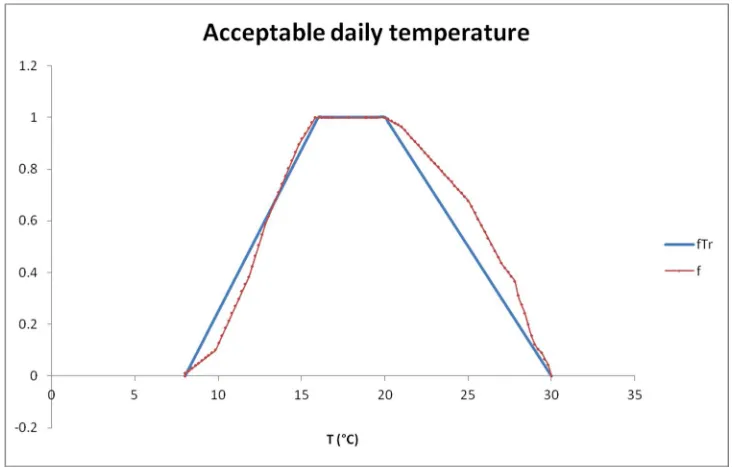
0 IF x a
A (x) IF a
A( ) 1 IF
A (x) IF d
0 IF x b x c
x c x d
x b (1)
where a ≤ c ≤ d ≤ b, A- : [a,c] →[0,1] is a not decreasing continuous function with
24
A-(a) = 0, A-c) = 1 and A+ : [b,d] →[0,1] is a not increasing continuous function with A+(d) = 1,
25
A+(b) = 0. A- and A+ are called left-side and right side of A, respectively.
26
Complicated left-side and right-side functions can generate serious computational difficulties
27
when imprecise information is modeled by FNs. In order to overcome this problem, the original FN
28
can be approximated with other easier functions. The simplest FNs used in fuzzy modeling,
29
fuzzy control and fuzzy decision making are the trapezoidal and triangular FNs. In a trapezoidal FN
30
the functions A- and A+ are linear: for instance,
31
A-(x) = (x-a)/(c-a) and A+(x) = (b-x)/(b-d) with a≤b≤c≤d, a≠c, b≠d. In a triangular FN it is assumed
32
d=c. Other simple FNs widely used is the degenerated left (resp., right) size semi-trapezoidal FNs
33
with a = c < d < b (resp., a < c < d = b). In many problems trapezoidal, triangular or semi-trapezoidal
34
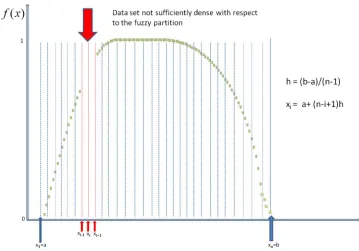
approximations of FNs could give a loss of information not negligible and this can significantly
35
affect the reliability of the results.
36
Furthermore, the membership functions of FNs used in applications are not generally known:
37
for example, when they are obtained as relative frequencies of measured occurrences in in a discrete
38
set of points, or in collaborative applications in which a set of stakeholders evaluate separately the
39
membership degrees of a FN and the function is assigned as an average of these membership
40
degrees. For making understandable this idea, in the example of Fig 1 the membership degree f(T) of
41
the fuzzy set “daily temperature T” (measured in °C) for a discrete set of 100 points is the average of
42
the membership degrees evaluated separately by many stakeholders.
43
44
45
Fig. 1. Example of FN constructed for a discrete set of points and approximated with a trapezoidal
46
membership function
47
Recently many methods are proposed in order to approximate FNs with easier FNs using a
48
suitable metric (see, e.g. [1, 6, 23, 29, 30, 31]). Some authors investigate approximations by adding
49
some restrictions to preserve properties of a FN as core [2], ambiguity [3, 4, 5], expected interval,
50
translation invariance and scale invariance [19, 20]. As pointed out in [8], by using a trapezoidal
51
FN as approximation function by, only a limited number of characteristics can be preserved since a
52
trapezoidal FN depends only by four parameters, and the best approach to preserve multiple
53
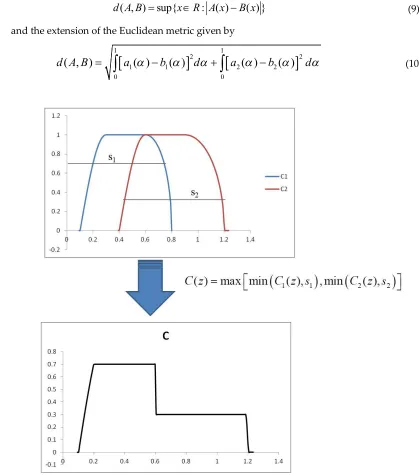
characteristics is to use sequences of FNs. In [7] a new method is proposed based on the inverse
54
fuzzy transform (iF-transform) [24] in order to construct sequence of FNs which converge uniformly
55
to a FN, preserving properties as its support, core, ambiguity, quasi-concavity and expected interval.
56
The F-transform method was already used image analysis (see, e.g. [10, 13, 14, 26, 27]), data
57
analysis applications (see, e.g. [11, 12, 15, 25]). In [28] the bi-dimensional F-transform is used to
58
approximate type-2 FNs. In [7] the extended iF-transform method, proposed in [27], is applied to
59
approximate FNs preserving the support and the quasi-concavity property. The main advantage of
60
this method is to reach the desired approximation with a linear rate of uniform convergence.
61
However, when the membership function is given in a discrete set of point, it is necessary to verify
62
that this dataset is sufficiently dense with respect to the uniform fuzzy partition of the support of the
63
FN. More specifically, the F-transform method divides the interval [a,b] in n sub-intervals of width
64
h = (n-1)/(b-a). The points x1= a, x2= a+h,..., xi= a+(i-1)h,..., xn= b are called nodes: an uniform fuzzy
65
partition of [a,b] is created by assigning n fuzzy sets with continuous membership functions A1,…,An
66
: [a,b] → [0,1], called basic functions, where Ai(x) = 0 if x(xi-1,xi+1), i = 1,....,n. When the input
67
data form a dataset of points in [a,b], it is necessary to control that this set is dense with respect to
68
the uniform fuzzy partition, namely we must verify that at least one data point with non-zero
69
membership degree falls within a sub-interval (xi-1,xi+1) for i=1,...,n. In Fig. 2 we show an example
70
of dataset not sufficiently dense with respect to the fuzzy partition: no data is included in (xi-1,xi+1).
71
74
Fig. 2. Example of input dataset non sufficiently dense with respect to the fuzzy partition.
75
The paper is organized as follows: Section 2 contains the basic notions of fuzzy number and
76
F-transform, in Section 3 we introduce the extended iF-transform method which in Section 4 is
77
applied to a Fuzzy Rule Based Systems (FRBS). In Section 5 we give the results of our tests and final
78
considerations are reported in Section 6.
79
80
1.1 Preliminaries
81
As already shown in [11, 12], the extended iF-transform method, proposed in [7], approximates
82
a function assigned on a discrete set of points by means of an iterative process. Strictly speaking,
83
we set initially the dimension n of the fuzzy partition to a value n0, afterwards it is necessary to
84
verify at any step that the dataset is sufficiently dense with respect to the fuzzy partition and that the
85
approximation error is less or equal to a prefixed threshold: in this case the process stops and the
86
direct F-transform components are stored, otherwise n is set to n + 1 and the process is iterated by
87
considering a finer fuzzy partition. Below we schematize the pseudocode of this process.
88
We propose a new Mamdani FRBS in which we use the extended iF-transform to approximate
89
FNs and we apply the above process for constructing the input fuzzy sets in the antecedent and the
90
output fuzzy sets.
91
92
Approximation of a set of data by using the extended inverse F-transform 1 n:=n0
2 Create the fuzzy partition
3 Calculate the direct F-transform components
4 WHILE the dataset is sufficiently dense with respect to the fuzzy partition 5 Calculate the approximation error
9 END IF
10 n:=n+1
11 Calculate the extended direct F-transform components
12 END WHILE
13 RETURN “ERROR: Dataset not sufficiently dense”
14 END
93
The extended iF-transform method for approximation of the FNs is used to fuzzify the crisp
94
input data. The min and max operators are applied as AND and OR connectives in the
95
antecedent of the fuzzy rules to calculate the strength of any rule. The defuzzification process of the
96
output fuzzy set is carried out via the discrete Center of Gravity (CoG) method. For example, we
97
consider a system formed by two rules in the form:
98
1 1 1 1
2 2 2 2
: is A OR is B is C
: is A AND is B is C
r x y z
r x y z
(2)
where A1 and A2 are two FNs for the linguistic input variable x, B1 and B2 are two FNs for the
99
input linguistic variable y, C1 and C2 are two FNs for the output variable z. Applying the extended
100
iF-transforms to evaluate each fuzzy set, we suppose thatA1
x 0.4,A1
x 0.7,B1
x 0.7,101
2 0.3.
B x With max (resp., min) operator as connective OR (resp., AND), we obtain the value of
102
the two rules: r1 = max(0.4, 0.7) = 0.7 and r2 = min(0.7, 0,3) = 0.3. In the defuzzification process we
103
reconstruct the output fuzzy set as
104
1 1
2 2
( ) max min ( ), , min ( ),
C
f z C z s C z s (3)
The CoG method is useful for obtaining the final crisp value
z
ˆ
of the output variable as105
1 1
ˆ ( ) ( )
Nc Nc
i i i
i i
z C z z C z
(4)where Nc is the number of rules and z1< z2 <…< zNc are points of the support of C. In Fig. 3 we
106
give an example.
107
108
2. Fuzzy Numbers and F-transforms
109
2. 1 Fuzzy Numbers and F-transforms
110
Given a value α ∈ [0,1], we denote with A, called α-cut of a FN A, the crisp set containing the
111
elements xR with a membership degree greater or equal to α. We also use the interval
112
1 2
[ ]A [a ( ), a ( )]
(5)Where
113
1( ) inf : ( )
a xR A x (6)
2( ) sup : ( )
a xR A x (7)
For α = 1, [A] =[a (1),a (1)]1 1 2 is called the core of the FN and denoted by core(A).
114
supp( )
A
x
R A x
| ( )
0
(8)Given two arbitrary FNs A and B, two metrics are considered in [17, 18]:
116
the Chebyshev distance
117
( , ) sup{ : ( ) ( ) }
d A B xR A x B x (9)
and the extension of the Euclidean metric given by
118
1 1
2 2
1 1 2 2
0 0
( , )
( )
( )
( )
( )
d A B
a
b
d
a
b
d
(10)119
120
Fig. 3. Defuzzification of the output fuzzy set
121
122
Two properties of A are given in [9] called Ambiguity and Value defined as
123
1
2 1
0
( ) ( ) ( ) ( )
r
Amb A
r
a
a
d
(11)
1
2 1
0
( ) ( ) ( ) ( )
r
Val A
r
a
a
d
(12)respectively, where r: [0,1]→[0,1] is a not decreasing function called reducing function with
125
with r(0) = 0 and r(1) = 1. Another important propriety is the Expected Interval of A, introduced in
126
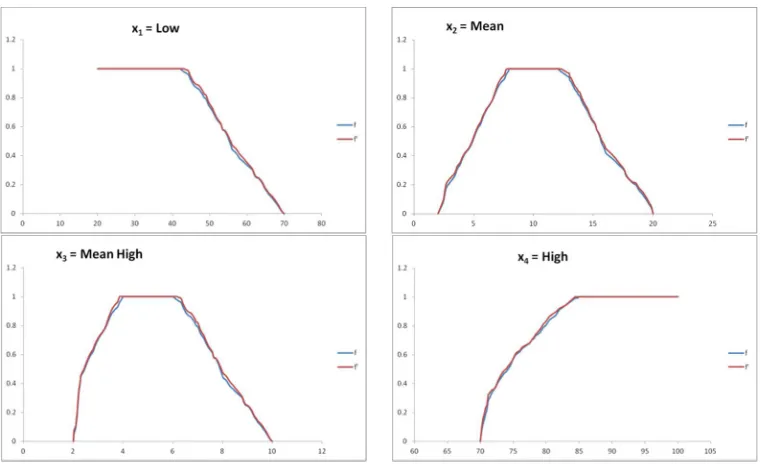
[16, 21], defined as follows
127
1 1
1 2
0 0
( ) ( ) , ( )
EI A a
d a
d
(13)
We have EI(A) = [(a+c)/2, (d+b)/2] for a trapezoidal FN A.
128
2. 2 Direct and Inverse F-transforms
129
Following the definitions and notations of [24], let n ≥ 2 and P = {x1, x2, …, xn} be a set of
130
points of [a,b], called nodes, such that x1 = a < x2 <…< xn = b. Let {A1,…,An} be an assigned family of
131
fuzzy sets with membership functions A1(x),…,An(x): [a,b] → [0,1], called basic functions. We say
132
that it constitutes a fuzzy partition of [a,b] if the following properties hold:
133
134
(1) Ai(xi) =1 for every i =1,2,…,n;
135
136
(2) Ai(x) = 0 if x (xi-1,xi+1) for i=2,…,n;
137
138
(3) Ai(x) is a continuous function on [a,b];
139
140
(4) Ai(x) strictly increases on [xi-1,xi] for i = 2, …, n and strictly decreases on [xi,xi+1]
141
for i = 1,…, n-1;
142
(5)
n
i i=1
A(x)=1
for every x[a,b].143
144
Furthermore, we say that the fuzzy sets {A1,…,An} form an h-uniform fuzzy partition of [a,b] if
145
146
(6) n ≥ 3 and xi = a + h∙(i-1), where h = (b-a)/(n-1) and i = 1, 2, …, n (that is the nodes are
147
equidistant);
148
149
(7) Ai(xi – x) = Ai(xi + x) for every x[0,h] and i = 2,…, n-1;
150
151
(8) Ai+1(x) = Ai(x- h) for every x[xi,xi+1] and i = 1,2,…, n-1.
152
153
Let f(x) be a continuous function on [a,b]. The following quantity
154
( ) ( ) ( )
b b
i i i
a a
F f x A x A x (14)
for i = 1, …, n, is the ith component of the direct F-transform [F1, F2, …, Fn] of f with respect
155
to the family of basic functions {A1, A2, …, An}. If this fuzzy partition is h-uniform, the
156
2 1 1 1 1 1 1 1
2 ( ) ( ) 1
( ) ( ) 2,..., 1
2 ( ) ( )
x x xi i i xi xn n xn
h f x A x dx if i
F h f x A x dx if i n
h f x A x dx if i n
(15)
The following function
158
,
1
( ) ( )
n F n i i
i
f x F A x
(16)
where x[a,b], is defined the iF-transform of f with respect to {A1, A2, …, An} and it
159
approximates f in the sense of the following theorem [24]:
160
161
Theorem 1. Let f(x) be a continuous function on [a,b]. For every ε > 0, then there exist an
162
integer n(ε) and a fuzzy partition {A1, A2, …, An(ε)} of [a,b] such that |f(x) - fF,n(ε)| < ε with respect to
163
the existing fuzzy partition.
164
165
In the discrete case we know that the function f assumes assigned values in the points
166
p1,...,pm of [a,b],. If the set {p1,...,pm} is sufficiently dense with respect to the fixed partition {A1, A2,
167
…, An}, that is for each i = 1,…,n there exists an index j{1,…,m} such that Ai(pj) > 0, we can
168
define the n-tuple {F1, F2,…, Fn} as the discrete direct F-transform of f with respect to {A1, A2, …,
169
An }, where each Fi is given by
170
1 1
( ) ( ) ( )
m m
i j i j i j
j j
F f p A p A p
(17)
for i=1,…,n. Similarly we define the discrete iF-transform of f with respect to the {A1, A2,
171
…, An} by setting
172
,
1
( ) n ( )
F n j i i j i
f p F A p
(18)
for every j{1,…,m}. We have the following theorem [24]:
173
174
Theorem 2. Let f(x) be a function assigned on a set of points {p1,..., pm}[a,b]. Then for every
175
ε > 0, there exist an integer n(ε) and a related fuzzy partition {A1, A2, …, An(ε)} of [a,b] such that
176
{p1,...,pm} is sufficiently dense with respect to the existing fuzzy partition and for every pj[a, b], j =
177
1,…,m, the following inequality
178
|f(pj) - fF,n(ε) (pj) | < ε (19)
remains true.
179
3. The extended iF-transform and fuzzy numbers
180
In [27] the extended iF-transform of a continuous function f is introduced in order to preserve
181
the monotonicity as follows. For an h-uniform fuzzy partition {A1, A2, …, An}, the function f is
182
extended to [a-h,b+h] as follows:
183
2 ( ) (2 ) if x [a-h,a] ( ) ( ) if x [a,b]
2 ( ) (2 ) if x [b,b h]
f a f a x
f x f x
f b f b x
(20)
1 1
1
(2 ) if x [a-h,a]
( )
( ) if x [a,a h]
( ) ( ) for i = 2,...,n-1
( ) if x [b-h,b] ( ) (2 ) i i n n n
A a x
A x
A x
A x A x
A x A x
A b x
if x [b,b h]
(21)
Then the ith component Fi of the extended direct F-transform of f with respect to the family of
185
basic functions {A1, A2, …, An} is given by
186
1 1
1
f ( ) ( ) , h
( ) ( ) 2,.., 1
1 ( ) ( ) h a h a h i i b h n n b h
F x A x dx
F x F x i n
F f x A x dx
(22)Hence the extended iF-transform of f is given by
187
1 , 1 1
2
fF n( ) ( ) n i i( ) nA ( ) xn a-h, b
i
x F A x F A x F x h
(23)
By [8, Lemma 9], we obtain that
188
1 , , ( ) ( ) ( ) ( ) F n n F nf a F f a
f b F f b
(24)
Let S be a fuzzy number with a continuous membership function and supp(S) = [a,b]. We
189
consider an h-uniform fuzzy partition {A1, A2, …, An} of [a,b] with n ≥ 3 and let SF n, ( )x be the
190
extended iF-transform of S. We obtain that [8, Prop. 11]:
191
, ,
SF n(a)SF n( )b 0
,
SF n( )x 0 x ( , )a b 1
,
2 SF n( ) n i i( )
i
x S A x
(25)
where Si is the ith component of the direct F-transform of S (cfr., formulae (15)). Theorem 13 of
192
[8] provides the approximation property of the extended iF-transform as follows.
193
194
Theorem 3. Let S be a FN having a continuous membership function and supp(S) = [a,b]. Let a
195
fuzzy partition {A1, A2, …, An} of [a,b] be h-uniform with n ≥ 3 and SF n, ( )x be the extended
196
iF-transform of S calculated by (23). Then the following inequality holds:
197
, [ , ]
sup SF n( ) ( ) 2 ( , )
x a b
x S x
S h
(26)
where ω(S,h) is the modulus of continuity of S given by
198
, [ , ]:
2 ( , )
S h
sup
x ya b a b h S x
( )
S y
( )
(27)Another important theorem [8, Th. 14] proves that the extended iF-transform preserves the
199
shape and the approximation properties of a FN as follows.
200
Theorem 4. Let S be a FN having a continuous membership function, supp(S) = [a,b] and
202
core(S) = [c,d], a < c < d < b. Let a fuzzy partition {A1, A2, …, An} of [a,b] be h-uniform with n ≥ 3 and
203
a fuzzy set T such that T(x) = SF n, ( )x calculated by (23) in [a,b] and T(x)=0 if x[a,b]. If h =
204
(b-a)/(n-1) is such that h ≤ min{(d-c)/4, c-a, b-d}, then T is a FN for which the following hold:
205
206
supp(T) = supp(S);
207
If core(T) = [c’,d’], then c ≤ c’ ≤ d’ ≤ d, |c-c’| ≤ 2h, |d-d’| ≤ 2h;
208
[ , ]
sup ( ) ( ) 4 ( , )
x a b
T x S x S h
;
209
If S- strictly increases on [a,c], then T strictly increases on [a,c’];
210
If S+ strictly decreases on [d,b], then T strictly decreases on [d’,b].
211
212
The preservation of the properties “Ambiguity” and “Value” of a FN and its approximation
213
with an extended iF-transform is given by the following theorem in [8,Theorem 27]:
214
215
Theorem 5. Let S be a FN having a continuous membership function with supp(S) = [a,b] and
216
core(S) = [c,d], a < c < d < b. Let a fuzzy partition {A1, A2, …, An} of [a,b] be h-uniform with n ≥ 3
217
and a fuzzy set T such that T(x) = SF n, ( )x given by (23) in [a,b] and T(x)=0 if x[a,b]. Let core(T) =
218
[c’,d’] with c’ ≤ d’ . By putting h2 ( , ) f h , we obtain that
219
,1 ,2
( )
( )
( )
( )
r r h h h
Amb S
Amb T
K
S
K
S
(28)
,1 ,2
( )
( )
( )
( )
r r h h h
Val S
Val T
K
S
K
S
(29)where K (S)=c-a+ c +4hh,1 and Kh,2(S)=b-d+ b +4h.
220
221
In order to apply the extended iF-transform to approximate a FN S with one-element core, in
222
[8] the concept of regular h-uniform partition of [a,b] is introduced as an h-uniform partition of [a,b]
223
such that A1 is differentiable in [a,x2], Ai is differentiable in
224
[xi-1,xi+1] for i = 2,…,n-1 and An is differentiable in [xn-1,b]. Thus we can define the normalized
225
extended iF-transform given as
226
, F,n , [ , ]S
( )
( )
[
,
]
max S
( )
F n F n x a b
x
S
x
x
a h b h
x
(30)A theorem similar to Theorem 5 is given in [8, Theorem 29] as follows.
227
228
Theorem 6. Let S be a FN having a continuous membership function with supp(S) = [a,b] and
229
core(S) = {c}, a < c < b. Let be a regular h-uniform partition {A1, A2, …, An} of [a,b] and a fuzzy set
230
T(x) = SF n, ( )x given by (30) in [a,b] and T(x)=0 if x[a,b]. Let core(T) = [c’,d’] with c’ ≤ d’ and
231
h 8
δ = ω(f,h)
1-4ω(f,h) . Then the following properties hold:
232
1 2
( )
( )
( )
( )
r r h
Amb S
Amb T
K S
K S
(31)
1 2
( )
( )
( )
( )
r r h
Val S
Val T
K S
K S
(32)234
Now we suppose that the membership values of a FN S in the form (1) are assigned on a
235
discrete set of m points a = p1 < p2 <…< pm-1 < pm = b. We consider an h-uniform fuzzy partition {A1,
236
A2, …, An} of [a,b]. If the set of points are sufficiently dense with respect to the fuzzy partition, i.e.
237
if
238
1
(
)
0
2,..., n 1
m
i j
j
A p
i
(33)then the extended iF-transform of S is defined for any x[a,b] as [8]:
239
1
, 1 1
2
( ) ( ) ( ) ( )
n
F n i i n n
i
S x S A x S A x S A x
(34)
240
where S =S(a),S =S(b)1 n and Si is the ith component of the direct F-transform of S in [a,b] for
241
i=1,…,n. Similarly it can be proved that all the above properties of the extended iF-transform of a FN
242
with continuous membership function apply in the discrete case as well.
243
4. Extended iF-transform and Fuzzy Rule Based System
244
Let the expert knowledge be formed by a set of fuzzy rules in a linguistic fuzzy model:
245
Rk: IF (x1 = X1k) Δ (x2 = X2k) Δ … Δ (xn = Xnk) THEN (y = Yi) (35)
where x1, x2,…, xn are input variables, y is the output variable, X1i, X2i,…, Xni, Yi are fuzzy
246
sets and the operator Δ is an AND or an OR operator. We construct a fuzzy rule set considering
247
only AND connectives, splitting rules in which there are OR connectives in the antecedent.
248
We propose a FRBS in which the FNs of the fuzzy rule set are approximated by using extended
249
iF-transforms. We suppose that the fuzzy sets in the antecedent and consequent of each rule are
250
given by FNs whose membership functions are assigned in a discrete set of points p1 =a < p2 <…<
251
pm-1 < pm = b. An example of this case occurs when, in a collaborative project, the membership values
252
of a fuzzy set are given over a discrete set of points by means of averages of membership values
253
assigned by different stakeholders.
254
Let [a,b] be the core and [c,d] be the support of this FN. We approximate the membership
255
function of it by the extended iF-transform calculated with (34). As already said above in Section 3,
256
we find a fuzzy partition such that the set of points is sufficiently dense with respect to it and we
257
apply the iterative process given in Section 1.2. For each FN in the antecedents and in the
258
consequents of the fuzzy rules, we calculate the discrete extended direct F-transform storing them in
259
the fuzzy rule set. The crisp input data are fuzzified via (34) by using the stored direct F-transform
260
components of the FNs. The inference engine applies to the max-min Mamdani inference model to
261
calculate the strength of each rule and to obtain the final fuzzy set aggregating the output fuzzy sets.
262
The crisp output value is obtained by applying the CoG method. The FRBS is schematized in Fig. 4.
263
The extended iF-transform approximation function approximates each fuzzy number by
264
considering the set of points in which is assigned its membership function. This function creates an
265
h-uniform fuzzy partition of the support of the fuzzy set and verify that the set of points is
266
sufficiently dense with respect to the fuzzy partition. Initially n is set to a value n0 (for example, n0 =
267
3). If the set of points is not sufficiently dense with respect to the fuzzy partition, the F-transform
268
approximation method cannot be applied, otherwise the extended direct F-transform components
269
and the approximation error are calculated.
270
If this error is less than a defined threshold, the process stops and the extended direct
271
F-transform components are stored, otherwise n is increased by 1 and the process is iterated.
272
If the set of points is not sufficiently dense with respect to the fuzzy partition, the process stops
273
275
276
Fig. 4. Schema of the proposed FRBS
277
278
In this last case, the best possible approximation of the FN is obtained, even if the
279
approximation error is higher than the threshold. In order to create an h-uniform fuzzy partition of
280
[a,b], the following basic functions are used:
281
2 1
i-1 1
0.5(cos ( ) 1) if [ , ] ( )
0 otherwise
0.5(cos ( ) 1) if [x ,x ] ( )
0
i i
i
x a x a x
A x h
x x i
A x h
1 1
2,..., 1 otherwise
0.5(cos ( ) 1) if [ , ]
( )
0 otherwise
n n
n
i n
x x i x b
A x h
(36)
The approximation error is given by the Root Mean Square Error (RMSE) defined as
282
2 ,
1
(S ( ) ( ))
n
F n j j j
RMSE p S p n
(37)
The threshold for the RMSE is set as a positive value much smaller than 1. The extended
283
iF-transform method is schematized in the following pseudocode.
284
285
Algorithm: Extended F-transform approximation
Description: Approximate a fuzzy number with an extended iF-transform
Input: Initial fuzzy partition size n0
Threshold parameter
A set of m points and their membership function value (p1,
f(p1)),..., (pn, f(pn))
Output: RMSE error
1 n:= n0
2 Read the dataset of points
3 Create a h-uniform fuzzy partition by using the basic functions (36)
4 Calculate the extended direct F-transform components
5 WHILE the dataset is sufficiently dense with respect to the fuzzy partition
6 Calculate the RMSE approximation error (37)
7 IF (RMSE approximation error ≤ threshold) THEN
8 Store the extended direct F-transform components and the RSME error 9 RETURN “Success”
10 END IF 11 n:=n+1
12 Create a h-uniform fuzzy partition by using the basic functions (36)
13 Calculate the extended direct F-transform components
14 END WHILE
15 Store the extended direct previous F-transform components (n = n-1) and the RMSE error
16 RETURN “ERROR: Dataset non sufficiently dense
17 END
286
The fuzzification reads the input data and calculates the membership degree of each fuzzy set
287
related to the input variable using (34). The strength of each rule is obtained via the min
288
connective. If X' ( k)
hk
f x is the approximated membership degree of the input variable xk, the
289
strength of the kth rule is the following:
290
1 2
' ' '
1 2
( ) max ( ), ( ),..., ( )
h h hk
B X X X k
f y f x f x f x (38)
The output fuzzy set is constructed as follows:
291
1 2
' ' '
1 2
( ) max min ( ), , min ( ), ,..., min ( ),
Y Y Yr
B r
f y f y s f y s f y s (39)
where
f
B'( )
y
is the approximated membership function of the output variable to the fuzzy set292
in the consequent of the kth rule. The defuzzification function implements the CoG algorithm for
293
converting the fuzzy output in a crisp number. We partition the support of the output fuzzy set in NB
294
intervals with equal width. Let yi be the value of the midpoint of the ith interval. The output crisp
295
value
y
ˆ
is as follows:296
1 1
ˆ ( ) ( )
B
N NB
B i i B i
i i
y f y y f y
(40)We test our FRBS to a spatial decision problem in Section 5.
297
298
5. Experimental results: the liveability in residential housings
299
We apply the extended F-transform in a FRBS based on a set of census data of the 92
300
municipalities of the district of Naples (Italy), related to the residential housing. Our aim is to
301
evaluate their liveability whose crisp output variable is evaluated in percentage on the basis of a set
302
of fuzzy rules extracted by experts in which the following six linguistic input variables are
303
considered: x1 = average surface of the housings in m2, x2 = percentage of housings with six or more
304
rooms, x3 = percentage of residential buildings built since 2000, x4 = percentage of housings with
305
centralized or autonomous heating system, x5 = percentage of housings with two or more showers
306
or bathtubs, x6 = percentage of housings with two or more restrooms. The crisp input data are
307
the housings in the municipality dividing by the number of housings. The crisp values of the
309
variables x2, …, x6 are obtained dividing the corresponding absolute value recorded in the dataset
310
by the total number of housings in the municipality. The domain of any variable is partitioned in 5
311
fuzzy sets labeled as “Low”, Mean Low”, “Mean”, “Mean High”, “High”. The fuzzy rule set
312
contains the following 62 fuzzy rules constructed by a set of twenty experts.
313
314
Table 1. The fuzzy rule set used for evaluating the liveability in residential housings
315
ID Rule
r1 IF (x1 = High) AND (x2 = High) AND (x3 = High) THEN y = High
r2 IF (x1 = High) AND (x2 = Mean High) AND (x4 = Mean High) THEN y = Mean High
r3 IF (x1 = High) AND (x3 = High) THEN y = High
r4 IF (x1 = High) AND (x4 = High) THEN y = High
r5 IF (x1 = High) AND (x3 = Mean High) AND (x5 = High) THEN y = High
r6 IF (x1 = High) AND (x3 = Mean High) AND (x6 = High) THEN y = High
r7 IF (x1 = High) AND (x3 = Mean High) AND (x5 = Mean High) THEN y = Mean High
r8 IF (x1 = High) AND (x3 = Mean High) AND (x6 = Mean High) THEN y = Mean High
r9 IF (x1 = High) AND (x4 = Mean High) AND (x5 = High) THEN y = High
r10 IF (x1 = High) AND (x4 = Mean High) AND (x6 = High) THEN y = High
r11 IF (x1 = High) AND (x4 = Mean High) AND (x5 = Mean High) THEN y = Mean High
r12 IF (x1 = High) AND (x4 = Mean High) AND (x6 = Mean High) THEN y = Mean High
r13 IF (x2 = High) AND (x3 = High) THEN y = High
r14 IF (x2 = High) AND (x4 = High) THEN y = High
r15 IF (x3 = High) AND (x4 = High) THEN y = High
r16 IF (x3 = High) AND (x4 = Mean High) AND (x5 = High) THEN y = High
r17 IF (x3 = High) AND (x4 = Mean High) AND (x5 = Mean High) THEN y = Mean High
r18 IF (x3 = High) AND (x4 = Mean High) AND (x5 = Mean) THEN y = Mean High
r19 IF (x3 = High) AND (x4 = Mean High) AND (x6 = High) THEN y = High
r20 IF (x3 = High) AND (x4 = Mean High) AND (x6 = Mean High) THEN y = Mean High
r21 IF (x4 = High) AND (x5 = High) THEN y = High
r22 IF (x1 = Mean High ) AND (x3 = Mean High) THEN y = Mean High
r23 IF (x1 = Mean High ) AND (x3 = Mean) THEN y = Mean High
r24 IF (x1 = Mean High ) AND (x4 = Mean High) THEN y = Mean High
r25 IF (x1 = Mean High ) AND (x4 = Mean) THEN y = Mean High
r26 IF (x2 = Mean High) AND (x3 = High) THEN y = Mean High
r27 IF (x2 = Mean High) AND (x3 = Mean High) THEN y = Mean High
r28 IF (x2 = Mean High) AND (x4 = High) THEN y = Mean High
r29 IF (x2 = Mean High) AND (x4 = Mean High) THEN y = Mean High
r30 IF (x1 = Mean) AND (x3 = Mean High) THEN y = Mean
r32 IF (x1 = Mean) AND (x4 = Mean High) THEN y = Mean
r33 IF (x1 = Mean ) AND (x4 = Mean) THEN y = Mean
r36 IF (x2 = Mean) AND (x3 = Mean) THEN y = Mean
r37 IF (x2 = Mean) AND (x4 = Mean) THEN y = Mean
r38 IF (x3 = Mean) AND (x5 = Mean) THEN y = Mean
r39 IF (x3 = Mean) AND (x6 = Mean) THEN y = Mean
r40 IF (x4 = Mean) AND (x5 = Mean) THEN y = Mean
r41 IF (x4 = Mean) AND (x6 = Mean) THEN y = Mean
r42 IF (x1 = Mean) AND (x3 = Mean Low) THEN y = Mean Low
r43 IF (x1 = Mean) AND (x4 = Mean Low) THEN y = Mean Low
r44 IF (x1 = Mean Low) AND (x3 = Mean) THEN y = Mean Low
r45 IF (x1 = Mean Low) AND (x4 = Mean) THEN y = Mean Low
r46 IF (x2 = Mean Low) AND (x3 = Mean) THEN y = Mean Low
r47 IF (x2 = Mean Low) AND (x4 = Mean) THEN y = Mean Low
r48 IF (x3 = Mean Low) AND (x5 = Mean Low) THEN y = Mean Low
r49 IF (x3 = Mean Low) AND (x6 = Mean Low) THEN y = Mean Low
r50 IF (x4 = Mean Low) AND (x5 = Mean Low) THEN y = Mean Low
r51 IF (x4 = Mean Low) AND (x6 = Mean Low) THEN y = Mean Low
r52 IF (x3 = Mean Low) AND (x5 = Mean Low) THEN y = Mean Low
r53 IF (x1 = Low) AND (x4 = Mean Low) THEN y = Low
r54 IF (x1 = Low) AND (x4 = Low) THEN y = Low
r55 IF (x2 = Low) AND (x4 = Mean Low) THEN y = Low
r56 IF (x2 = Low) AND (x4 = Low) THEN y = Low
r57 IF (x2 = Low) AND (x5 = Low) THEN y = Low
r58 IF (x2 = Low) AND (x6 = Low) THEN y = Low
r59 IF (x3 = Low) AND (x5= Low) THEN y = Low
r60 IF (x3 = Low) AND (x6= Low) THEN y = Low
r61 IF (x4 = Low) AND (x5= Low) THEN y = Low
r62 IF (x4 = Low) AND (x6= Low) THEN y = Low
316
In the pre-processing phase we apply the extended F-transform based algorithm to
317
approximate the five FNs associated to each variable. Each FN is obtained as average of the
318
membership values assigned by the experts in 200 points.
319
In Fig. 5 we show some FNs and their approximations obtained by applying the extended
320
F-transform. We set the threshold to 0.01, so having a RMSE less than 0.01 for every FN.
321
Fig. 5. Fuzzy numbers x1 = Low, x2 = Mean, x3 = Mean High and x4 = High (in blue) and their extended
323
iF-transform approximations (in red).
324
The FNs (x1 = Low) and (x4 = High) have a degenerated side. In Table 2.i we show the
325
parameters a, c, d, b of each FN xi (i = 1, 2, 3, 4, 5, 6 and the RMSE, respectively.
326
327
Table 2.1. Parameters and RMSE of the approximation for fuzzy sets of x1
328
x1 (m2)
Fuzzy number
a c d b RMSE
Low 20 20 45 70 9.11×10⁻³
Mean Low 45 70 75 90 9.91×10⁻³
Mean 75 90 95 100 9.17×10⁻³
Mean High 95 100 115 125 9.76×10⁻³
High 110 120 150 150 9.34×10⁻³
329
Table 2.2. Parameters and RMSE of the approximation for fuzzy sets of x2
330
x2
Fuzzy number a c d b RMSE
Low 0 0 1 4 9.18×10⁻³
Mean Low 0.5 3 6 8 9.43×10⁻³
Mean 2 7 12 20 9.19×10⁻³
Mean High 8 12 15 25 9.57×10⁻³
High 15 25 50 50 9.15×10⁻³
331
Table 2.3. Parameters and RMSE of the approximation for fuzzy sets of x3
x3
Fuzzy number a c d b RMSE
Low 0 0 0.5 1 9.21×10⁻³
Mean Low 0.4 0.6 1 1.5 9.35×10⁻³
Mean 1 2 4 6 9.33×10⁻³
Mean High 2 4 7 10 9.02×10⁻³
High 6 10 30 30 9.26×10⁻³
333
Table 2.4. Parameters and RMSE of the approximation for fuzzy sets of x4
334
x4
Fuzzy number a c d b RMSE
Low 0 0 30 40 9.24×10⁻³
Mean Low 30 50 60 70 9.29×10⁻³
Mean 60 65 70 80 9.49×10⁻³
Mean High 75 80 85 90 9.35×10⁻³
High 85 95 100 100 9.08×10⁻³
Table 2.5. Parameters and RMSE of the approximation for fuzzy sets of x5
335
x5
Fuzzy number a c d b RMSE
Low 0 0 10 15 9.30×10⁻³
Mean Low 7 15 20 25 9.52×10⁻³
Mean 20 25 30 35 9.25×10⁻³
Mean High 30 35 40 50 9.31×10⁻³
High 40 50 100 100 9.37×10⁻³
336
Table 2.6. Parameters and RMSE of the approximation for fuzzy sets of x6
337
x6
Fuzzy number a c d b RMSE
Low 0 0 10 15 9.32×10⁻³
Mean Low 7 15 25 30 9.19×10⁻³
Mean 22 28 32 35 9.24×10⁻³
Mean High 30 40 45 55 9.48×10⁻³
High 50 60 100 100 9.28×10⁻³
338
In Table 3 we show the parameter a, c, d, b of the FNs used for the output variable y and the
339
RMSE obtained applying the extended F-transform.
340
Table 3. Parameters and RMSE of the approximation for fuzzy sets of output y
342
y
Fuzzy number a c d b RMSE
Low 0 0 10 20 9.67×10⁻³
Mean Low 10 20 30 40 9.32×10⁻³
Mean 30 40 60 70 9.46×10⁻³
Mean High 50 70 80 85 9.78×10⁻³
High 80 90 100 100 9.31×10⁻³
343
At the end of the preprocessing phase, the fuzzification of the input data is performed as well.
344
In Figures 6i we show the thematic maps (in a Geographic Information System environment) of the
345
six input variables xi (i = 1,2, 3, 4, 5, 6), respectively, in the municipalities of the district of Naples. In
346
each map the municipality is classified with the linguistic label of the fuzzy set with the highest
347
approximated membership value.
348
349
Fig. 6.1. Thematic map for the input variable x1
350
351
Fig. 6.2. Thematic map for input variable x2
353
354
Fig. 6.3. Thematic map for input variable x3
355
356
357
Fig. 6.4. Thematic map for input variable x4
360
Fig. 6.5. Thematic map for input variable x5
361
362
363
Fig. 6.6. Thematic map for input variable x6
364
365
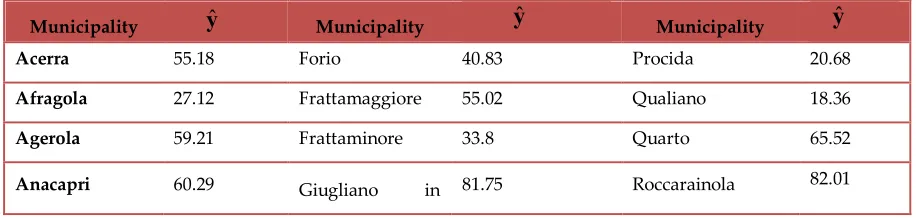
The defuzzified final values of liveability in the residential housings (calculated in percentage)
366
for every municipality are in Table 4.
367
368
Table 4. Defuzzified values obtained for liveability of residential housings
369
Municipality Municipality Municipality
Acerra 55.18 Forio 40.83 Procida 20.68
Afragola 27.12 Frattamaggiore 55.02 Qualiano 18.36
Agerola 59.21 Frattaminore 33.8 Quarto 65.52
Anacapri 60.29 Giugliano in 81.75 Roccarainola 82.01
ˆ
Campania
Arzano 23.34 Gragnano 29.64 SanGennaro Vesuviano
76.18
Bacoli 24.65 Grumo Nevano 55 SanGiorgio a Cremano
23.14
Barano d'Ischia 58.36 Ischia 27.13 SanGiuseppe Vesuviano
51.03
Boscoreale 32.23 Lacco Ameno 26.69 San Paolo BelSito 63.46
Boscotrecase 48.7 Lettere 42.57 San Sebastiano al Vesuvio
82.37
Brusciano 63.37 Liveri 81.39 San Vitaliano 66.52
Caivano 44.85 Marano di
Napoli 24.93
Santa Maria la Carità
56.94
Calvizzano 52.06 Mariglianella 82.39 Sant'Agnello 33.85 Camposano 50.84 Marigliano 53.68 Sant'Anastasia 64.19 Capri 47.32 Massa di Somma 36.15 Sant'Antimo 47.82 Carbonara di
Nola 73.29 MassaLubrense 71.5
Sant'Antonio Abate
58.19
Cardito 47.68 Melito di Napoli 26.87 Saviano 76.84 Casalnuovo di
Napoli 23.45 Meta 56.38 Scisciano
88.93
Casamarciano 92.74 Monte di Procida 32.69 Serrara Fontana 54.08 Casamicciola
Terme 34.61
Mugnano di
Napoli 29.14 Somma Vesuviana
52.11
Casandrino 39.26 Napoli 53.82 Sorrento 20.18
Casavatore 33.15 Nola 75.35 Striano 73.69
Casola di
Napoli 38.77 Ottaviano 52.94 Terzigno
52.01
Casoria 34.02 Palma Campania 62.9 Torre Annunziata 25.12 Castellammare
di Stabia 44.26 Piano di Sorrento 60.67 Torre del Greco
26.36
Castello di
Cisterna 73.89 Pimonte 27 Trecase
55.8
Cercola 49.67 Poggiomarino 75 Tufino 96.44
Cicciano 67.16 Pollena Trocchia 25.13 Vico Equense 20.37
Cimitile 87.38 Pomigliano
d'Arco 19.75 Villaricca
78.36
Crispano 39.07 Portici 22.51 Volla 55.83
Ercolano 28.14 Pozzuoli 39.43
370
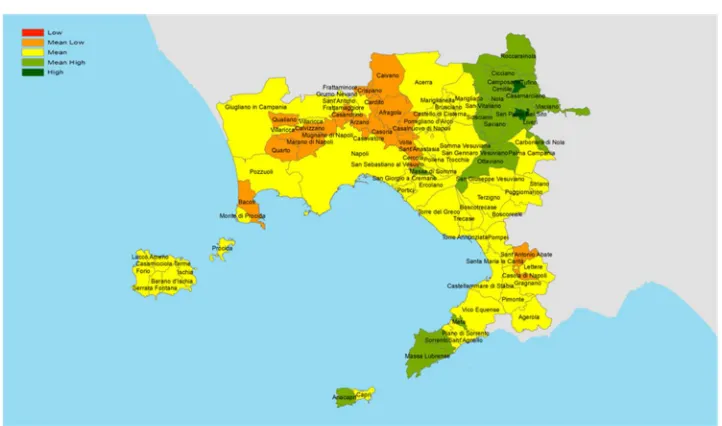
In Fig. 7 we show a thematic map of the index of liveability in the residential housings: the label
371
of output variable fuzzy set with the greatest membership degree is assigned for every municipality.
372
373
374
Fig. 7. Thematic map of index of liveability in residential housings
375
376
We compare these results with the ones obtained by approximating the input and output
377
variables fuzzy sets with trapezoidal FNs, by using the approximation method of [20]. We apply the
378
inference system to the residential housing dataset again, by using the approximated trapezoidal
379
FNs as fuzzy sets in the antecedents and consequents of the rule set. Then we calculate the RMSE
380
and we calculate the number and the percentage of municipalities classified with a liveability
381
linguistic label different by the one contained in Fig.7.
382
383
Table 5. Comparisons obtained approximating input and output FN with trapezoidal FN
384
Comparison parameter Value
Mean RMSE index for the fuzzy sets approximation with
trapezoidal FNs
6.3×10⁻²
Mean difference of the final crisp liveability values compared with the ones obtained by using the extended iF-transform method
5.58%
Number of municipalities classified
with different linguistic labels 7
Percentage of municipalities classified with different linguistic
labels
385
The mean RMSE index obtained by using the trapezoidal FN is 6.3×10⁻²: this value is greater
386
than the threshold 1×10⁻² set by applying the extended F-transform. The mean difference in absolute
387
value between the crisp liveability obtained by using the trapezoidal approximation of the input
388
and output FNs with respect to the ones obtained by using the extended IF-transform approximation
389
overcomes 5%: this difference is generated by the greater error obtained by the approximation with
390
trapezoidal FNs. The percentage 7.61% of the municipalities are classified differently in the final
391
map of liveability underlines the effective improvement of the final results obtained with the
392
extended F-transform method. The seven municipalities with different liveability class are given in
393
Table 6.
394
395
Table 6. Municipalities with different liveability class
396
Municipality Extended IFtr liveability class
Trapezoidal liveability class
Casola di Napoli Mean Mean Low
Casoria Mean Low Mean
Crispano Mean Mean Low
Massa di Somma Mean Mean Low
Pozzuoli Mean Mean Low
Sant’Agnello Mean Low Mean
Scisciano Mean High High
397
We can appropriately select the RMSE threshold in order to increase the reliability of the final
398
results, however we point out that that the choice of a very small threshold can lead to a fuzzy
399
uniform partition too finer for which the dataset of the corresponding values is not sufficiently
400
dense.
401
6. Conclusions
402
We present a new method based on the extended F-transform to approximate FNs. We apply
403
this method in a fuzzy rule-based system related to a spatial analysis problem consisting in the
404
evaluation of the liveability of residential housings in the municipality of the district of Naples. In
405
many spatial analysis problems, decision-making systems based on expert rules are used in order to
406
extract thematic maps of a final index. A finer approximation of the membership functions of the
407
fuzzy sets in the antecedents and in the consequents of the fuzzy rules is necessary to guarantee a
408
good reliability of the final thematic maps. In many cases, for example in participatory contexts in
409
which knowledge is provided by different experts, these FNs are assigned on a discrete set of points.
410
In future we propose to apply the extended F-transform method to the approximation of FNs in
411
multi-criteria fuzzy decision making problems.
412
413
Acknowledgments: This work is performed under the auspices of INDAM-GNCS (Gruppo Nazionale per il
414
Calcolo Scientifico), Italy.
415
416
Conflicts of Interest: The authors declare no conflict of interest with this research.
417
References
421
1. S. Abbasbandy, B. Asady, The nearest trapezoidal fuzzy number to a fuzzy quantity, Applied Mathematics and
422
Computation 156 (2) (2004) 381–386. Doi: 10.1016/j.amc.2003.07.025
423
2. S. Abbasbandy, T. Hjjari, Weighted trapezoidal approximation–preserving cores of a fuzzy number, Computer
424
and Mathematics with Applications 59 (2010) 3066–3077. Doi: 10.1016/j.camwa.2010.02.026
425
3. A.I. Ban, L. Coroianu, Nearest interval, triangular and trapezoidal approximation of fuzzy number preserving
426
ambiguity, International journal of Approximate Reasoning 53 (2012) 805–836.
427
Doi:10.1016/j.ijar.2012.02.001
428
4. A.I. Ban, Approximation of fuzzy numbers by trapezoidal fuzzy numbers preserving the expected interval, Fuzzy
429
Sets and Systems 159 (2008) 1327–1344. Doi:10.1016/j.fss.2007.09.008
430
5. L. Coroianu, Lipschitz functions and fuzzy number approximations, Fuzzy Sets and Systems 200 (2012)
431
113–135. Doi: 10.1016/j.fss.2012.01.001
432
6. L. Coroianu, M. Gagolewski, P. Grzegorzewski, Nearest piecewise linear approximation of fuzzy numbers,
433
Fuzzy Sets and Systems 233 (2013) 26–51. Doi:10.1016/j.fss.2013.02.005
434
7. L. Coroianu, S. G. Gal, B. Bede, Approximation of fuzzy numbers by Bernstein operators of max–min product
435
kind, Fuzzy Sets and Systems 257 (2014) 41–66. Doi: 10.1016/j.fss.2013.04.010
436
8. L. Coroianu, L. Stefanini, General approximation of fuzzy numbers by F–transform, Fuzzy Sets and Systems 288
437
(2016) 46–74. Doi: 10.1016/j.fss.2015.03.015
438
9. M. Delgado, M.A.Vila, W.Voxman, On a Canonical Representation of a Fuzzy number, Fuzzy Sets and Systems
439
93 (1998) 125–135.Doi: 10.1016/S01650114(96)001443
440
10. F. Di Martino, V. Loia, I. Perfilieva, S. Sessa, An image coding/decoding method based on direct and inverse fuzzy
441
transforms, International Journal of Approximate Reasoning 48 (1) (2008) 110–131.
442
Doi:10.1016/j.ijar.2007.06.008
443
11. F. Di Martino, V. Loia, S. Sessa, Fuzzy transforms method and attribute dependency in data analysis, Information
444
Sciences 180 (4) (2010) 493–505. Doi: 10.1016/j.ins.2009.10.012
445
12. F. Di Martino, V. Loia, S. Sessa, Fuzzy transforms method in prediction data analysis, Fuzzy Sets and Systems
446
180 (1) (2011) 146–163. Doi:10.1016/j.fss.2010.11.009
447
13. F. Di Martino, P. Hurtik, I. Perfilieva, S. Sessa, A color image reduction based on fuzzy transforms, Information
448
Sciences 266 (4) (2014) 101–111. Doi:10.1016/j.ins.2014.01.014
449
14. F. Di Martino, S. Sessa, Complete image fusion method based on fuzzy transforms, Soft Computing (2017) 1–11.
450
Doi: 10.1007/s00500.
451
15. F. Di Martino, S. Sessa, Fuzzy transforms prediction in spatial analysis and its application to demographic balance
452
data, Soft Computing 21 (13) (2017) 3537–3550. Doi:10.1007/s0050001726218
453
16. D. Dubois, H. Prade, Operations on fuzzy numbers, Ins. J. Systems Sci. 9 (1978) 613–626. Doi:
454
10.1080/00207727808941724
455
17. P.Grzegorzewski, Metrics and Orders in Space of Fuzzy Numbers, Fuzzy Sets and Systems 97 (1998) 83–94.
456
Doi: 10.1016/S01650114(96)003223
457
18. P. Grzegorzewski, Nearest interval approximation of a fuzzy number, Fuzzy Sets and Systems 130 (2002)
458
321–330. Doi:10.1016/S01650114(02)000982
459
19. P. Grzegorzewski, E. Mrówka, Trapezoidal approximations of fuzzy numbers, Fuzzy Sets and Systems 153
460
(2005) 115–135. Doi: 10.1016/j.fss.2004.02.015
461
20. P. Grzegorzewski, Trapezoidal approximations of fuzzy numbers preserving the expected interval—Algorithms and
462
properties, Fuzzy Sets and Systems 159 (2008) 1354–1364. Doi: 10.1016/j.fss.2007.12.001
463
21. S. Heilpern, The expected value of a fuzzy number, Fuzzy Sets and Systems 47 (1992) 81–86. Doi:
464
10.1016/01650114(92)900629
465
22. E. H. Mamdani, Application of fuzzy logic to approximate reasoning using linguistic synthesis. IEEE Transactions
466
on Computers 26 (12) (1977) 1182–1191.Doi: 10.1109/TC.1977.1674779
467
23. E. N. Nasibov, S. Peker, On the nearest parametric approximation of a fuzzy number,Fuzzy Sets and Systems
468
159 (11) (2008) 1365–1375. Doi:10.1016/j.fss.2007.08.005
469
24. I. Perfilieva, Fuzzy transforms: theory and applications, Fuzzy Sets and Systems 157 (2006) 993–1023. Doi:
470
10.1016/j.fss.2005.11.012
471
25. I. Perfilieva, V. Novak, A. Dvorak, Fuzzy transforms in the analysis of data, International Journal of
472
26. I. . Perfilieva, P. Hurtík, F. Di Martino, S. Sessa, Image reduction method based on the F–transform, Soft
474
Computing 21(7) (2017) 1847–1861.Doi: 10.1007/s0050
475
27. I. Perfilieva, B. De Baets, Fuzzy transforms of monotone functions with application to image compression,
476
Information Sciences 180 (17) (2010) 3304–3315. Doi: 10.1016/j.ins.2010.04.029
477
28. L. Stefanini, L. Sorini, Type–2 fuzzy numbers and operations by F–transform, IFSA World Congress and
478
NAFIPS Annual Meeting (IFSA/NAFIPS), 24–28/06/2013, pp. 1050–1055. Doi:
479
10.1109/IFSA–NAFIPS.2013.6608545
480
29. C-T. Yeh, Weighted semi–trapezoidal approximations of fuzzy numbers, Fuzzy Sets and Systems, 165 (2011)
481
61–80. Doi: 10.1016/j.fss.2010.11.001
482
30. C-T. Yeh, Existence of interval, triangular, and trapezoidal approximations of fuzzy numbers under a general
483
condition, Fuzzy Sets and Systems 310 (2017) 1–13. Doi: 10.1016/j.fss.2016.03.013
484
31. W. Zeng, H. Li, Weighted triangular approximation of fuzzy numbers, International Journal of Approximate
485
Reasoning 46 (2007) 137–150. Doi: 10.1016/j.ijar.2006.11.001