B
IOENERGY
S
UPPORT
P
ROGRAM
-
DAF
T
RANSITION
Project 4C-116
Final Report prepared for the
Co-operative Research Centre for High Integrity Australian
Pork
By Alan Skerman
1and Stephan Tait
21
Department of Agriculture and Fisheries
PO Box 102, 203 Tor Street, Toowoomba Queensland 4350.
Phone: (07) 4529 4247; Mobile: 0407 462 529
Email: [email protected]
2
Advanced Water Management Centre, University of Queensland
Level 4 Gehrmann Bldg, Research Road, The University of Queensland,
Brisbane Queensland 4072
Phone: (07) 33467 208; Mobile: 0466 699 817
Email: [email protected]
Executive Summary
The project described in this report provided funding for Mr Alan Skerman, Department of Agriculture and Fisheries (DAF) to deliver the technical extension role of the Bioenergy Support Program (BSP) from July 2015 to June 2018. Dr Stephan Tait, Advanced Water Management Centre (AWMC), University of Queensland (UQ) continued to deliver and coordinate the research component of the program during this period, in addition to supporting Mr Skerman with the delivery of the extension service.
Biogas systems are currently operating at 21 piggery units across Australia, representing 15 separate businesses. Approximately 15% of the total Australian pig herd (42,700 sows ≈ 427,000 SPU) is currently housed in piggeries where the effluent is directed to a biogas system. This is equivalent to 29% of the national herd housed in accommodation currently considered ‘suitable’ for biogas system adoption (excluding deep litter housing, outdoor production and piggery units with capacities less than 500 sows farrow to finish). The existing piggery biogas systems include 14 covered anaerobic ponds (CAPs), 4
heated/stirred in-ground hybrid CAPs and 3 above-ground engineered vessel digesters.
Producers with existing biogas systems have reported significant financial benefits resulting from a combination of energy cost savings, additional income from the sale of surplus electricity to the grid, and returns from the sale of Australian Carbon Credit Units (ACCUs) and renewable energy certificates (RECs). In several cases, farm energy costs for the supply of electricity, LPG and diesel (for electricity generation) have been eliminated. Capital expenditure payback periods less than three years have been reported, however, returns from biogas systems do vary, depending on a range of site-specific factors.
Since the commencement of the emission reduction fund (ERF) in 2012/13, 372,143 ACCUs have been issued to 8 of the 14 registered piggery operators, indicating substantial
abatement of greenhouse gas emissions by the piggery biogas installations. Based on average prices recorded at twice-yearly auctions, the total value of these ACCUs is approximately $4 M, providing noteworthy financial benefits to the participating producers.
The BSP has assisted producers, industry service providers and consultants by addressing numerous ad hoc enquiries regarding planning, design, and even construction,
commissioning and operation of piggery biogas systems. Ten site-specific, preliminary piggery biogas feasibility reports were also prepared for producers. While only one of these piggeries has proceeded to install an on-farm biogas system, it is anticipated that other producers may proceed with biogas developments within the next few years, depending on industry profitability.
A national biogas survey indicated a substantial lack of awareness of on-farm biogas system adoption, particularly by producers operating smaller piggeries. The survey respondents indicated that further information regarding topics such as system costs and benefits, site-specific viability (particularly for smaller piggeries), funding options, compatibility with deep litter systems and ongoing operation and maintenance costs, would assist them in deciding whether or not to proceed with the installation of a biogas system. The greatest concerns identified by producers with existing biogas systems were depleted biogas
supporting the development and adoption of biogas systems technically and financially feasible for smaller piggeries.
The publications produced by the BSP (4 Talking Topics booklets, 8 Australian Pork Newspaper ‘It’s a gas’ articles, a YouTube video, 5 peer-reviewed journal papers, 3 conference papers and several industry talks) have contributed substantially to the reference/extension material available to support the ongoing safe and technically-sound development of on-farm biogas systems. Scientific publications also evidenced the rigor of Pork CRC research in biogas.
There is considerable interest in smart strategies to maximise the financial benefits from biogas systems. Examples of such strategies include (1) co-digesting piggery effluent with various off-farm waste or by-products supplied by nearby industries, (2) upgrading excess biogas to bio-methane, to mobilize the biogas energy for higher value applications, and (3) employing sophisticated electricity spot price monitoring technology to control on-farm generator operation and the sale of biogas-derived electricity during higher demand/spot price periods. Each of these options are worthy of further investigation to assess technical and economic feasibility.
Regulatory issues and the cost of compliance continue to disincentivise adoption of biogas systems. For example, in at least one Australian State, the treated manure residue from anaerobic digesters is not permitted to be applied to land as a bio-fertiliser, despite its widely recognised beneficial attributes. This makes it difficult to manage manure volumes at a piggery. In another state, the burden of an annual safety and health fee and the cost of engaging suitably qualified gas fitters, has caused a piggery to demolish their on-site biogas system and return to an uncovered pond arrangement. Other concerns include onerous gas safety standards and legislation, which do not realistically reflect the risks associated with operating relatively small-scale, on-farm biogas systems, at low pressure. Inconsistencies between state gas safety legislation and standards also continue to impede the adoption of standard and modular biogas system components nationally.
Notwithstanding the above compliance issues, it is of vital importance for workers at piggeries with operating biogas systems to understand the significant health and safety risks associated with the biogas systems and how these risks can be safely managed.
The benefits of piggery biogas to date have been clear, and the Pork CRC Bioenergy Support Program played an instrumental role in facilitating uptake and benefits.
Table of Contents
Executive Summary ... i
Table of Contents ... iii
Table of Figures ... iv
Table of Tables ... iv
Glossary ... v
1. Introduction ... 1
2. Methodology ... 2
Addressing ad hoc enquiries ... 2
Preparing preliminary piggery biogas feasibility reports ... 2
Preparing and maintaining a listing of biogas equipment suppliers and service providers ... 3
Preparing standard drawings ... 3
Compiling biogas system uptake data ... 4
Preparing and publishing ‘Talking Topic’ booklets ... 4
Preparing Australian Pork Newspaper ‘It’s a gas’ articles ... 4
Preparing a ‘Biogas Benefits for your piggery’ video ... 4
Preparing conference and journal papers and industry talks ... 5
On-farm R&D ... 5
Remote monitoring of biogas systems ... 8
Laboratory analysis capability ... 8
Workplace Health and Safety ... 10
Project and report reviews ... 10
National piggery biogas survey ... 10
BSP Steering Committee meeting ... 11
3. Outcomes ... 12
Preliminary piggery biogas feasibility reports ... 12
Biogas system uptake data ... 13
Publications ... 19
Laboratory analysis capability ... 21
Biogas survey results ... 23
4. Application of Research ... 25
5. Conclusions ... 28
6. Limitations/Risks ... 30
7. Recommendations ... 31
8. References ... 32
Appendix 1 ... 34
Biogas equipment suppliers and service providers ... 34
Appendix 2 ... 45
Standard drawings ... 45
Appendix 3 ... 49
Piggery biogas survey ... 49
Appendix 4 ... 62
Table of Figures
Figure 1. An example of a schematic CAP drawing included in preliminary piggery biogas feasibility reports. . 2
Figure 2. The opening screen of the ‘Biogas Benefits for your Piggery’ video published on YouTube. ... 5
Figure 3. The experimental floating pontoon deployed on the heavily loaded anaerobic (HLA) pond. ... 6
Figure 4. The experimental floating pontoon deployed on the secondary pond. ... 6
Figure 5. The experimental biogas chemisorption treatment column installed at the Grantham piggery. ... 7
Figure 6. AMPTSII system operating in the DAF Toowoomba laboratory. ... 9
Figure 7. The chemisorption test rig fabricated for use in Pork CRC Project 4C-104 was used to assess biogas treatment media at the DAF Toowoomba laboratory. ... 10
Figure 8. Rate of adoption of biogas systems at Australian piggeries expressed in terms of total standard pig units accommodated in units contributing effluent to biogas systems. ... 13
Figure 9. Locations of existing piggery biogas systems (Image from Google Earth). ... 14
Figure 10. Australian Carbon Credit Units (ACCUs) issued under the Carbon Credits (Carbon Farming Initiative) (Destruction of Methane Generated from Manure in Piggeries-1.1) Methodology Determination 2013. ... 15
Figure 11. Biochemical methane potential curves for four piggery effluent samples (A to D) containing increasing levels of simulated feed wastage (0% to 15%) produced for APL Project 2015/010 using the AMPTS II system in the DAF Toowoomba laboratory. ... 21
Figure 12. Breakthrough curve produced using the chemisorption testing rig at the DAF Toowoomba laboratory for the granulated activated carbon (GAC) media used to treat biogas at a central Queensland piggery. ... 22
Figure 13. Comparison of S sorption capacities of various granulated activated carbon (GAC) media determined using the chemisorption testing rig at the DAF Toowoomba laboratory. ... 22
Table of Tables
Table 1. Summary of preliminary piggery biogas feasibility reports issued. ... 12Table 2. Current and terminated piggery biogas system summary data... 16
Glossary
ACCU Australian carbon credit unit
AM2MA Australian methane to markets in Agriculture AMPTS Automated methane potential test system APL Australian Pork Limited
AWMC Advanced water management centre BMP Biochemical Methane Potential BSP Bioenergy support program CAP Covered anaerobic pond CHP Combined heat and power CNG Compressed natural gas
DAF Department of Agriculture and Fisheries ERF Emissions reduction fund
GAC Granulated activated carbon HDPE High density polyethylene HLA Heavily loaded anaerobic (pond) HRT Hydraulic retention time
Hybrid CAP Mixed, heated, in-ground covered anaerobic pond IEA International energy agency
kWe Kilowatt – electric: Electrical output of a generator. LNG Liquefied natural gas
LPG Liquefied petroleum gas MJth Megajoule thermal
PCAP Partially covered anaerobic pond PPE Personal protective equipment REC Renewable energy certificate SPU Standard pig unit
t CO2-e Tonnes of carbon dioxide equivalents UQ University of Queensland
1. Introduction
2. Methodology
In part, the project activities were dictated by requests for assistance from producers, consultants and biogas service providers. Consequently, the types of assistance provided evolved over the course of the project in response to the needs identified by these main client groups. This flexibility in project delivery ensured that outputs were relevant to industry needs. The main methods of project delivery are described in the following section of this report.
Addressing ad hoc enquiries
Both Mr Alan Skerman and Dr Stephan Tait spent considerable time addressing ad hoc enquiries from producers, service providers and consultants. These enquiries were generally received via email or telephone calls and were addressed by:
Telephone discussions.
Emailing existing extension material or references to the client.
Carrying out further investigation of the issue before responding by phone or email.
Preparing preliminary piggery biogas feasibility reports
Preliminary biogas feasibility reports were prepared in response to pork producer enquiries seeking information regarding the practical and economic feasibility of establishing on-farm biogas systems.
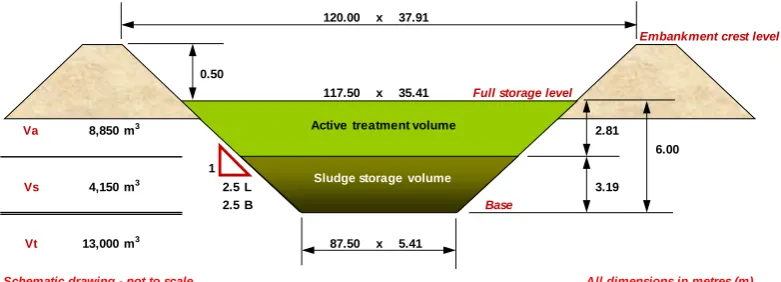
In all cases, the PigBal 4 model was run to estimate the volatile solids (VS) loading entering a potential covered anaerobic pond (CAP), based on site-specific pig herd, diet, feed consumption and shed flushing/cleaning data, provided by the producer, whenever possible. When site-specific data were not available, more generalised data or typical industry values were entered into the model, which was used to produce a schematic design for a possible CAP, based on a selected VS loading rate and hydraulic retention time (HRT). PigBal also includes provision for a nominal sludge storage period within the CAP.
An example of a CAP schematic drawing produced by the PigBal model is provided in Figure 1, below.
Figure 1. An example of a schematic CAP drawing included in preliminary piggery biogas feasibility reports.
120.00 x 37.91
Embankment crest level 0.50
117.50 x 35.41 Full storage level
Va 8,850 m3 2.81
6.00 1
Vs 4,150 m3 2.5 L 3.19
2.5 B Base
Vt 13,000 m3 87.50 x 5.41
Schematic drawing - not to scale All dimensions in metres (m)
Active treatment volume
An internal Department of Agriculture and Fisheries (DAF) spreadsheet, Piggery Biogas Energy Calculator (Skerman, 2016), was then used to estimate the CAP biogas yield and the resulting electrical and thermal energy which could be produced from using the available biogas to run an on-farm boiler or combined heat and power (CHP) system. The potential economic value of the resulting energy was also estimated based on replacing existing grid electricity and LPG consumption.
A standard reporting template, which included the following section headings, was developed for consistency and efficiency of reporting:
Introduction Piggery details
Effluent and biogas production Covered anaerobic pond Odour emission mitigation Flaring
Hot water boiler option
Combined heat and power (CHP) system option Carbon emission abatement
Estimated biogas system cost
A summary of the completed biogas feasibility reports is provided in Section 3 of this report.
Preparing and maintaining a listing of biogas equipment suppliers
and service providers
A listing of businesses supplying equipment or services to the biogas industry was compiled and maintained as a service to pig producers interested in developing, operating or maintaining on-farm biogas systems. This list, which is provided in Appendix 1, was not intended to be exhaustive and the majority of businesses included in this list had proactively requested that their details be made available to prospective customers in the pork industry. Also, inclusion in this list did not imply any warranty or recommendation with regard to the quality or suitability of the products or services provided by these businesses, neither were there any stated preferences. Lastly, while this listing provided some initial contacts, it was recommended that producers make their own enquiries before selecting
businesses providing particular products or services. A disclaimer clause was inserted into the supplier list to highlight these limitations and assertions.
This supplier listing was commonly forwarded to producers who requested preliminary biogas feasibility reports, to assist in obtaining quotations for the supply of equipment or services.
prepared to assist producers planning new CAP developments and were generally provided to producers on request and/or attached to preliminary biogas feasibility reports. Copies of these drawings are included in Appendix 2 of this report. Again, a disclaimer was inserted to assert that these drawings were of a general nature, and to recommend separate detailed investigations by the producers themselves.
Compiling biogas system uptake data
A listing of Australian piggery biogas projects was prepared providing data on the status of existing and proposed biogas projects, including details of the piggeries and estimates of the potential biogas and energy production. This listing was updated as we became aware of new biogas projects or major changes to existing developments. The collection of all uptake data relied on the goodwill and cooperation of producers, and so may not necessarily be entirely complete. A summary of the current biogas uptake data is provided in Section 3 of this report.
Preparing and publishing ‘Talking Topic’ booklets
Four ‘Talking Topic’ extension booklets were prepared by Dr Stephan Tait and Mr Alan Skerman and published on the Pork CRC website. These booklets were intended to provide producers and industry service providers with an overview of principles involved in safely establishing and operating on-farm biogas systems. Hard copies of the Talking Topic booklets were also produced for distribution at industry forums. Further details of the completed ‘Talking Topic’ booklets are provided in Section 3 of this report.
Preparing Australian Pork Newspaper ‘It’s a gas’ articles
Several articles were prepared for publication in the monthly Australian Pork Newspaper (APN) which is distributed free of charge to anyone involved in the Australian pork industry. It has a very wide readership of both producers and industry service providers. These articles provided an effective means for raising awareness of biogas technology and developments across a wide cross-section of the pork industry. Further details of the completed ‘It’s a gas’ articles are provided in Section 3 of this report.
Preparing a ‘Biogas Benefits for your piggery’ video
Dr Stephan Tait coordinated the production of a YouTube video entitled ‘Biogas Benefits for your piggery’ (Figure 2) during 2016. The text for this video was prepared by Dr Tait and Mr Skerman and the video was produced by a commercial media production company, Range Media, based in Toowoomba, Queensland. This video highlighted the benefits of using biogas in Australian piggeries and showed real life examples of biogas technologies, systems, equipment and uses at BSP demonstration piggeries, including interviews with a producer and a Pork CRC researcher. This video was published on YouTube on 19 August 2016 with a link hosted on the Pork CRC website.
Figure 2. The opening screen of the ‘Biogas Benefits for your Piggery’ video published on YouTube.
Preparing conference and journal papers and industry talks
Several conference papers, journal papers and industry talks were prepared, presented and published. Publication of research papers ensures that the valuable research outcomes are made available to a wide audience, while the peer review process enhances the credibility and value of the completed work. These papers and talks also publicised the valuable work completed under Pork CRC and related APL research and development projects. Further details and references for these publications are provided in Section 3 of this report.
On-farm R&D
Experimental floating pontoon on a heavily loaded anaerobic pond
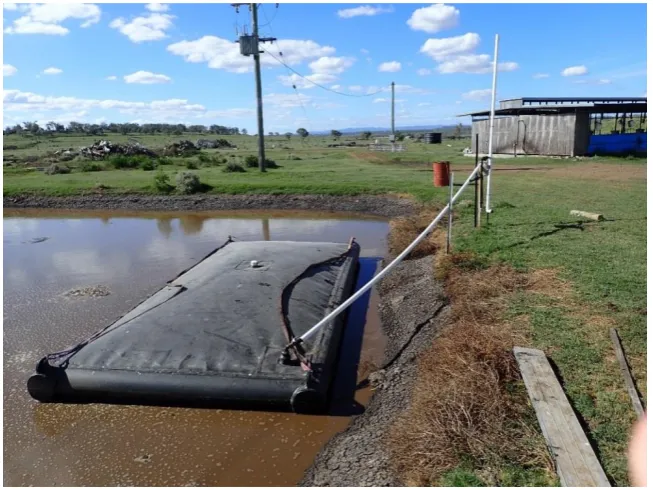
Volume and composition of biogas collected by a small, experimental floating cover (pontoon) deployed on a highly loaded anaerobic (HLA) pond, at a 530-sow farrow to finish piggery near Dalby (Queensland), was monitored during 2017. The HLA pond operating at this piggery was previously described by Skerman et al. (2008). The rectangular pontoon, which covered a pond surface area of 2.7 m x 5.7 m = 15.4 m2, was fabricated using 300 mm diameter high density polyethylene
(HDPE) pipes (ex-mines) installed around the perimeter to provide flotation, with 1.5 mm thick HDPE sheeting heat welded onto the perimeter pipes to provide a continuous floating cover. The HLA pond at this piggery is not typical of CAPs designed specifically for biogas capture because of the higher VS loading rate and the presence of a thick crust over the pond surface most of the time.
Consequently, this trial was intended to assess whether the crust inhibited methane emission sufficiently to compromise the feasibility of installing a larger cover on the existing HLA pond at the piggery. If economically and practically feasible, the producer was primarily interested in using biogas to offset current grid electricity usage of approximately 900 kWh/month, supplying the piggery and associated on-farm feed mill. Meter readings indicated an average biogas
collection rate of 4.5 m3 biogas/day from the cover deployed on the HLA pond.
Because considerable anaerobic activity had been observed visually in the
secondary pond, the experimental pontoon was later moved from the HLA pond to the secondary pond during April 2017. The second phase of the trial was intended to meter biogas collection from the secondary pond for comparison with the data recorded for the HLA pond. The average daily biogas collection rate (4.6 m3/day)
Figure 3. The experimental floating pontoon deployed on the heavily loaded anaerobic (HLA) pond.
Figure 4. The experimental floating pontoon deployed on the secondary pond.
The producer is still considering various biogas options; with the current industry downturn likely delaying plans to proceed with the system installation.
Experimental biogas chemisorption treatment column
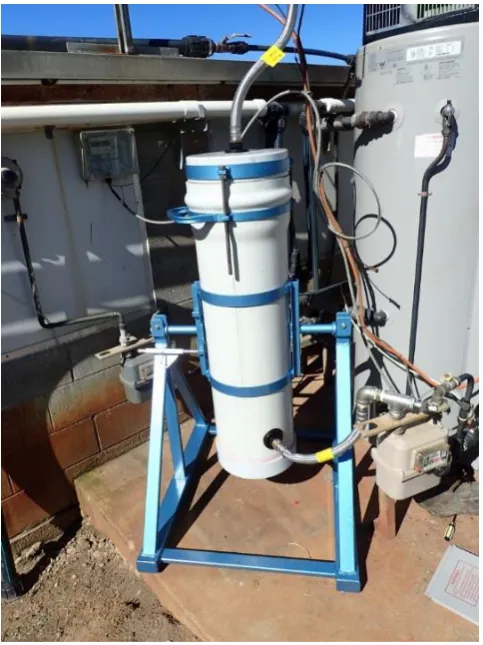
An experimental biogas treatment column was fabricated at the DAF Toowoomba workshop and installed at a 700-sow breeder piggery, located near Grantham (Queensland) during June 2017. The column was designed to reduce the time and labour required to change the iron oxide pellets used to remove hydrogen sulphide from biogas by chemisorption (See Talking Topic 4). The new column was
installed on a tipping frame to enable the spent pellets to be easily removed from the column. Piggery employees were trained in safe use of the improved
treatment column, which is shown in Figure 5.
Figure 5. The experimental biogas chemisorption treatment column installed at the Grantham piggery.
Potential use of ex-coal seam gas engines for piggery biogas applications
Remote monitoring of biogas systems
A need was identified for the installation of instrumentation and communication equipment to allow real-time, remote monitoring of biogas composition and other operational data at on-farm piggery biogas plants. This resulted in the submission of an application to the Pork CRC for funding to provide incentives for producers to install the required monitoring instrumentation at up to three commercial piggeries with existing on-farm biogas systems. An agreement between the Pork CRC, DAF and UQ was subsequently signed on 17 July 2017 for the delivery of Pork CRC Project 4C-122 Installation of instrumentation for remote monitoring of biogas composition and operational data at commercial piggeries.
Following an expression of interest process, three producers were invited to submit detailed quotations for the supply and installation of the relevant instrumentation. Due to unforeseen circumstances outside the control of the project team, only one of these producers was able to successfully source quotes, sign contracts and, with grant assistance, install the intended monitoring
instrumentation within the project timeframe. The current difficult financial circumstances being experienced in the Australian pork sector may have contributed to the disappointing producer participation in this project.
The high quality data available through this installation could potentially be used for:
a better quantification of the risks of hydrogen sulphide and flammable methane in piggery biogas;
Early diagnosis of operational irregularities or system faults. Evaluation of a range of operating strategies and biogas treatment
methods.
Managing changes in biogas composition resulting from co-digestion feed stock variations.
Validating the energy and economic value of the biogas systems.
Assessing short and long-term seasonal variations in biogas production and quality.
Managing biogas use options to maximise economic benefit.
This data is readily accessible to the piggery managers for daily biogas system management purposes and was made available to Pork CRC BSP researchers to enable the evaluation of system performance and for carrying out strategic applied research. This initial installation will also provide a pilot resource for long-term evaluation and possible modification prior to more widespread adoption of similar instrumentation across the industry. Detailed monitoring results will be provided in the Final Report for Project 4C-122.
Laboratory analysis capability
Automated Methane Potential Test System
Project funds were used to purchase an Automated Methane Potential Test System (AMPTSII – Bioprocess Control, Sweden) which was supplied by Royce Water
waste streams (APL Project 2015-010). It has also been used to determine the Biochemical Methane Potential (BMP) of a range of sludge samples collected from a covered and several uncovered piggery anaerobic ponds under APL Project 2016-085.
This apparatus was predominantly set up to support on-going biogas research activities of the Pork CRC and will now become available for broader testing to support the pork industry, likely on a fee-for-service basis. It is anticipated that this apparatus could be used for further evaluation of the energy potential from proposed co-digestion feedstocks (i.e. other waste products added for digestion together with pig manure).
Figure 6. AMPTSII system operating in the DAF Toowoomba laboratory.
Laboratory chemisorption testing apparatus
The laboratory chemisorption test rig (Figure 7), previously fabricated for use in Pork CRC Project 4C-104, was used to carry out a series of laboratory trials to assess the hydrogen sulphide (H2S) removal performance of two types of
Figure 7. The chemisorption test rig fabricated for use in Pork CRC Project 4C-104 was used to assess biogas treatment media at the DAF Toowoomba laboratory.
Workplace Health and Safety
Respiratory personal protective equipment (PPE) requirements were researched to assist a commercial piggery that was experiencing OHS difficulties when carrying out changeovers of commercial iron oxide pellets used to remove hydrogen sulphide from biogas at the piggery. This research responded to an enquiry from the producer and recommendations were forwarded in confidence to the
producer.
Project and report reviews
Reviews of the following reports and methodologies were carried out to support a range of industry initiatives:
Mr Alan Skerman carried out a peer review on the pig manure and deep litter estimation method used by Dr Stephan Tait for preparing data for the Australian Biomass for Bioenergy Assessment (ABBA) initiative.
Dr Stephan Tait and Mr Alan Skerman contributed to the International Energy Agency (IEA) Bioenergy Task 37 – ‘Australian Success Story’ document that was prepared by National Team Leader, Dr Bernadette McCabe (USQ). This document, which outlined the successful adoption of biogas systems by the Australian pork industry, was published on-line during February 2018. http://task37.ieabioenergy.com/case-studies.html Mr Alan Skerman peer reviewed the Final Report for Pork CRC Project
4C-109 (Tait et al., 2017) entitled ‘Enhanced methane production from pig manure in covered lagoons and digesters’.
National piggery biogas survey
With the approaching conclusion of the Pork CRC and the BSP, Mr Alan Skerman used SurveyMonkey to prepare a survey to evaluate ongoing producer interest in, and attitudes relating to, on-farm biogas, and to help compile more accurate estimates of current adoption. Requests to participate in the survey were
on 5 April 2018. The survey was anonymous by default, and where producers chose to disclose their own names and locations, these details were kept strictly confidential.
Ninety-one responses were received during the period from 15 March 2018 to 13 April 2018. This represents an approximate response rate of 9%. The survey results are summarised in Section 3 of this report and results that are more detailed are provided in Appendix 3, WITHOUT any piggery names or locations.
The survey results will allow better planning of future research and technical support to facilitate ongoing adoption of biogas systems across the pork industry.
BSP Steering Committee meeting
3. Outcomes
This section of the report summarises the project outcomes.
Preliminary piggery biogas feasibility reports
Table 1 provides a summary of the ten preliminary biogas feasibility reports prepared for pork producers as part of this project. While only one of these producers has proceeded to install an on-farm biogas system, based on the advice provided in the report, it is anticipated that some of the other producers may proceed with biogas developments within the next few years, depending on industry profitability. Unfortunately, the industry has been facing severely depressed economic conditions, particularly over the past 12 months, due to low pig prices and high feed prices. Consequently, many producers are struggling to survive the current downturn and are unable to commit to major capital
expenditure.
Table 1. Summary of preliminary piggery biogas feasibility reports issued.
Piggery size Locality State Est biogas
production
Carbon emission abatement
Status
(SPU) (m3 biogas/d) (t CO
2-e/yr)
546 sows f to f (6,121 SPU)
Trafalgar Vic 477 1613 Operating
300 sows f to f (3,294 SPU) + broilers
Riverton SA 235 (conv)
122 (dl)
1990 Feasibility
1200 sows f to f (13,130 SPU)
Munyabla NSW 560 (conv) 2741 Feasibility
2250 sows f to f
(14,183 SPU) Grong Grong NSW 1811 8874 Feasibility
533 sows f to f (5,011 SPU)
Dalby Qld 491 1660 Onsite R&D
3100 sow breeder 11,000 pig grower (18,546 SPU)
Warwick Qld 1576 5331 Feasibility
11,846 pig grower (13,170 SPU)
Warwick Qld 1067 3607 Feasibility
960 sows f to f
(4,655 SPU conv) Lake Bolac Vic 366 (conv) 1795 Feasibility
2500 sow breeder 4,500 pig grower
Dublin SA 999 (conv) 3381 Feasibility
1244 sow f to f
(12,755 SPU) Tiaro Qld 1392 4708 Feasibility
Biogas system uptake data
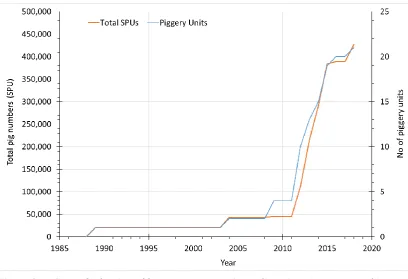
On-farm biogas systems are currently operating at 21 piggery units, representing 15 separate businesses. At least three additional producers are currently seriously considering or planning new biogas projects. There is currently approximately 427,000 SPU housed in piggeries where the effluent is directed to a biogas system. This represents approximately 15% of the total Australian pig herd and 29% of the ‘suitable’ component of the national herd. (The ‘suitable’ component of the herd excludes the estimated 30% housed in deep litter sheds and outdoor production systems, and pigs housed in piggeries having capacities less than 500 sows farrow to finish, (5000 SPU) which are currently considered economically unviable for biogas system development). These estimates are based on an assumed total pig population of 279,085 sows ≈ 2,790,850 SPU.)
Figure 8 shows the rate of biogas system development since the construction of the first biogas system at Berribank Farms in Victoria in 1989. This graph clearly shows the rapid adoption of biogas systems between 2011 and 2015 when several larger piggeries recognised the potential benefits of biogas systems. Up until relatively recently, there has been considerable producer interest in the installation of on-farm biogas systems. As noted previously, there has been a noticeable decline in producer requests for information regarding the technical and economic feasibility of biogas systems over the past year, as the profitability of the industry has been adversely affected by depressed pig prices and high feed prices.
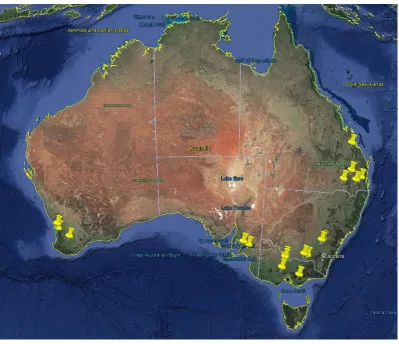
The existing piggery biogas systems include 14 simple CAPs, which are neither heated nor stirred, four in-ground hybrid CAPs, which are heated/stirred, and 3 aboveground stirred-tank (engineered) digesters. Approximate locations of existing piggery biogas systems are shown in Figure 9.
Figure 9. Locations of existing piggery biogas systems (Image from Google Earth).
Table 2 provides data showing the status of existing Australian piggery biogas projects, including piggery details and estimates of the potential biogas and energy production. This table also includes details of two piggery biogas systems, which have now been terminated. One of these was located at a state
government research facility in Western Australia while the other one was
installed at a commercial breeder piggery in southern Queensland, which was used extensively for some of the early biogas research projects funded under the
Australian Methane to Markets in Agriculture (AM2MA) program.
Table 3 lists the Australian Carbon Credit Units (ACCUs) issued to pig producers up to June 2018, under the Carbon Credits (Carbon Farming Initiative) (Destruction of Methane Generated from Manure in Piggeries-1.1) Methodology Determination 2013. Since the commencement of the emissions reduction fund (ERF) in 2012/13, 372,143 ACCUs have been issued to eight of the 14 registered piggery operators indicating substantial avoidance of greenhouse gas emissions (1 ACCU = 1 t CO2-e
Figure 10. Australian Carbon Credit Units (ACCUs) issued under the Carbon Credits (Carbon Farming Initiative) (Destruction of Methane Generated from Manure in Piggeries-1.1) Methodology Determination 2013.
Table 2. Current and terminated piggery biogas system summary data.
Piggery Locality State Year
estab Status System type Piggery type capacity Piggery
(sows SPU)
Est biogas prodn
(m3/year)
Est CH4
prodn
(m3/year)
Biogas
use Est elec gen capacity (kWe)
Est CHP elec energy (kWh/year) Est CHP thermal energy (MJt/year) GHG emissions avoided (t CO2
-e/year)
ERF ACCUs issued (ACCU)
A Windemere Vic 1989 Operating Mixed
tank to finish Farrow 20,000 2,000 580,500 377,325 Flare CHP 128 1,125,686 6,754,118 6,399 0 B Bears Lagoon Vic 2004 CAP Grower 0
23,000 667,575 433,924 Flare 148 1,294,539 7,767,235 7,359 0 C Grantham Qld 2009 Terminated PCAP Breeder 700
1,400 54,180 35,217 Boiler Flare 12 105,064 630,384 597 0 D Young NSW 2012 Operating CAP Breeder 2,138
4,529 175,272 113,927 Flare CHP 39 339,882 2,039,293 1,932 65,830 E Young NSW 2012 Operating CAP Grower 0
20,817 805,618 523,652 Flare CHP 178 1,562,227 9,373,364 8,881 F Young NSW 2012 Operating CAP Breeder 2,800
18,000 696,600 452,790 Flare CHP 154 1,350,824 8,104,941 7,679 41,852 G Young NSW 2012 Operating CAP Grower 1,200
12,000 464,400 301,860 Flare CHP 103 900,549 5,403,294 5,120 0 H Corowa NSW 2013 Operating CAP Farrow
to finish 55,000 5,500 2,128,500 1,383,525 Genset Flare 471 4,127,516 24,765,098 23,465 75,812 I Bungowannah NSW 2012 Operating CAP Breeder 6,000
12,000 464,400 301,860 Flare 103 900,549 5,403,294 5,120 8,593 J Yarrawalla Vic 2013 Operating CAP Grower 0
15,000 580,500 377,325 Flare CHP 128 1,125,686 6,754,118 6,399 69,641 K Yarrawalla Vic 2015 Operating CAP Breeder 2,000
6,000 232,200 150,930 Flare CHP 51 450,275 2,701,647 2,560 L Yarrawalla Vic 2016 Operating CAP Grower 0
5,000 193,500 125,775 Flare CHP 43 375,229 2,251,373 2,133 M Lundavra Qld 2014 Operating Hybrid
CAP Breeder 15,000 0 391,838 254,694 Flare CHP 87 759,838 4,559,029 4,320 58,933 N Lundavra Qld 2013 Operating Hybrid
Piggery Locality State Year
estab Status System type Piggery type capacity Piggery
(sows SPU)
Est biogas prodn
(m3/year)
Est CH4
prodn
(m3/year)
Biogas
use Est elec gen capacity (kWe)
Est CHP elec energy (kWh/year) Est CHP thermal energy (MJt/year) GHG emissions avoided (t CO2
-e/year)
ERF ACCUs issued (ACCU)
O Warra Qld 2014 Operating Hybrid
CAP Grower 60,000 0 1,741,500 1,131,975 Flare CHP 385 3,377,059 20,262,353 19,198 21,790 P Biloela Qld 2015 Operating Mixed
tank to finish Farrow 20,000 2,000 580,500 377,325 Flare CHP 128 1,125,686 6,754,118 6,399 0 Q Ellangowan Qld 2015 Operating Hybrid
CAP Grower 42,000 0 1,625,400 1,056,510 Flare CHP 360 3,151,922 18,911,529 17,918 29,692 R Medina WA 2009 Terminated CAP Research
station 780 78 22,640 14,716 Flare 5 43,902 263,411 250 0 S Netherby SA CAP Educate
facility 35 8 1,016 660 Flare 0 1,970 11,820 11 0 T West Pinjarra WA 2018 Operating CAP Breeder 2,500
6,400 185,760 120,744 Flare 41 360,220 2,161,318 2,048 0 U Brinkley SA 2015 Operating CAP Grower 2,440
26,503 768,690 500,049 Flare 195 1,711,280 8,800,871 7,124 0 V Trafalgar Vic 2018 Operating CAP Farrow
to finish 6,100 550 193,500 125,775 43 375,229 2,251,373 2,133 0 W Boscabel WA 2018
Commission-ing Mixed tank Grower 28,000 0 1,083,600 704,340 Genset Flare 240 2,101,281 12,607,686 11,946 0
CAP – covered anaerobic pond; PCAP – partially covered anaerobic pond; Hybrid CAP – mixed, heated, in-ground covered anaerobic pond;
Table 3. Australian Carbon Credit Units (ACCUs) issued to June 2018, under the Carbon Credits (Carbon Farming Initiative) (Destruction of Methane Generated from Manure in Piggeries-1.1) Methodology Determination 2013.
http://www.cleanenergyregulator.gov.au/ERF/project-and-contracts-registers/project-register
Year Rivalea
Corowa Kia Ora Blantyre Enviropower Templemore Wonga Cefn Tong Park Rivalea Bungo ACCUs/year Total ACCUs issued
Piggery: H* J, K & L D & E M & N F & G Q O I
2012/13 0 0 8,169 0 0 0 0 0 8,169 8,169
2013/14 15,989 0 11,176 0 8,679 0 0 3,224 39,068 47,237
2014/15 20,441 9,590 7,885 9,761 6,298 0 0 0 53,975 101,212
2015/16 22,372 9,000 11,416 17,516 12,610 0 21,790 2,728 97,432 198,644
2016/17 17,010 26,521 13,508 16,311 14,265 21,395 0 2,641 111,651 310,295
2017/18 0 24,530 13,676 15,345 0 8,297 0 0 61,848 372,143
Totals: 75,812 69,641 65,830 58,933 41,852 29,692 21,790 8,593 372,143
Publications
As described in Section 2 of this report, the following publications were produced.
‘Talking Topic’ extension booklets
The following ‘Talking Topic’ extension booklets were published on the Pork CRC website:
http://porkcrc.com.au/research/program-4/bio-energy-support-program/ Talking Topic 1 – Collecting the biogas benefits of pig manure
– provides a good introduction/overview. Talking Topic 2 – Biogas Safety – the essentials
– talks about compliance with biogas safety. Talking Topic 3 – Covered lagoons
– looks at designing a covered lagoon for biogas. Talking Topic 4 – Cleaning piggery biogas
– the why and how of cleaning biogas before using it.
Australian Pork Newspaper ‘It’s a gas’ articles
The following ‘It’s a gas’ articles were published in the Australian Pork Newspaper and may be accessed at the following website:
http://porknews.com.au/index.php/past-editions/ December 2016: Cleaning Piggery Biogas
March 2017 Co-digestion – waste not, want not
April 2017: Is biogas a viable option for smaller piggeries? June 2017: Anaerobic digestion – keeping bugs in the system September 2017: Taking biogas system monitoring for granted November 2017: Avoiding the big biogas bang
December 2017: Pork CRC boosts biogas systems across Australia March 2018: Biogas survey time
Video - ‘Biogas Benefits for your piggery’
This video was published on YouTube on 19 August, 2016 with a link hosted on the Pork CRC website. Up until June 2018, it had received 637 views.
https://www.youtube.com/watch?v=4BASwiMclJE
Peer-reviewed journal papers
The following peer-reviewed journal papers were published based on research carried out under Pork CRC Program 4 and related APL funded research projects:
Skerman, A.G., Willis, S., Batstone, D.J., Yap S.D. and Tait S. (2017) Effect of feed wastage on piggery effluent characteristics. Animal Production Science 57(12) 2481-2481. APSA abstract.
https://doi.org/10.1071/ANv57n12Ab024.
Skerman, A.G., Heubeck, S., Batstone, D.J. and Tait, S. (2017) Low-cost filter media for removal of hydrogen sulphide from piggery biogas, Process Safety and Environmental Protection, 105, 117-126.
http://dx.doi.org/10.1016/j.psep.2016.11.001.
Skerman, A.G., Willis, S., McGahan, E.J., Borgognone, M.G., and Batstone, D.J. (2016) Validation of PigBal model predictions for pig manure
production, Animal Production Science, 56, 1081–1090. http://dx.doi.org/10.1071/AN14702.
Skerman, A.G., Heubeck, S., Batstone, D.J. and Tait, S. (2015) Alternative low-cost solid media for scrubbing of hydrogen sulphide from piggery biogas, Animal Production Science, 2015, 55, 1461, CSIRO publishing. APSA abstract. http://dx.doi.org/10.1071/ANv55n12Ab051.
Conference Papers
The following peer-reviewed conference papers were published based on research carried out under Pork CRC Program 4 funded research projects:
Skerman, A.G. and Tait, S. (2016) Update on biogas use at Australian piggeries and recent research and development, Bioenergy Australia 2016 Conference – Regional growth in a sustainable biofuture, Brisbane Qld, 14 – 16 Nov 2016.
Skerman, A.G., Heubeck, S., Tait, S. (2014a) Poster presentation:
Alternative biogas purification media for farm installations, International Conference: Progress in Biogas III – Biogas production from agricultural biomass and organic residues, Stuttgart, Germany, 10-11 September 2014. Skerman, A.G., Heubeck, S., Tait, S. (2014b) Developing low cost options
for on-farm biogas cleaning at piggeries, Bioenergy Australia 2014 Conference – Developing the economy through sustainable biomass, Glenelg, Adelaide, SA, 1-3 Dec 2014.
Industry / educational talks
A talk highlighting Bioenergy Support Program progress was prepared and
presented at the APL Researchers’ Forum, held in Canberra during February 2017.
In March 2018, Mr Alan Skerman prepared and delivered a guest lecture to final year vet students at the University of Queensland (Gatton), providing an overview of intensive livestock environmental management, including a segment on
anaerobic effluent treatment and biogas production and use in Australian piggeries.
From 2016 to 2018, Dr Stephan Tait prepared and presented talks on piggery effluent management at the annual ‘Science and Practice of Pig Production’ course held at the University of Adelaide's Roseworthy Campus in South Australia. This course is attended by pork industry employees, and by undergraduate and post-graduate students undertaking industry research projects.
Laboratory analysis capability
Automated Methane Potential Test System
Figure 11 is an example of the data outputs from the AMPTSII system at the DAF Toowoomba laboratory. This figure shows the cumulative methane volumes produced over time from four piggery effluent samples containing various levels of simulated feed wastage. These results were used in APL Project 2015-010 which investigated the effect of feed wastage on biochemical methane potential and other effluent characteristics.
Laboratory chemisorption testing apparatus
Examples of the output from the laboratory chemisorption test rig are provided in Figures 12 and 13. Figure 11 shows the H2S breakthrough curve for a commercial
Granulated Activated Carbon (GAC) medium used to remove H2S from the biogas
stream produced at a central Queensland piggery. Figure 12 compares the S sorption performance of various samples of granulated activated carbon.
Figure 12. Breakthrough curve produced using the chemisorption testing rig at the DAF Toowoomba laboratory for the granulated activated carbon (GAC) media used to treat biogas at a central Queensland piggery.
Biogas survey results
Survey responses were received from 91 producers, representing approximately 6% of producers nationally. NSW producers had the highest response rate compared to the other states. 76% of respondents had farrow to finish piggeries.
69% of the respondents operated some combination of conventional flushed, pull plug or static pit sheds, which could potentially supply liquid effluent to a CAP. The remaining 31% of respondents were operating a combination of deep litter, outdoor rotational or outdoor (fixed or non-rotational) piggeries. This latter group of piggeries would not be suitable for operating a conventional CAP and there are currently no anaerobic digestion technologies proven to be economically viable for deep litter or solid piggery waste in Australia.
Survey responses were received for a wide range of piggery capacities, from 14 SPU to 90,000 SPU. 76% of the 74 responses were received for relatively small piggeries, having capacities up to 5000 SPU, to some extent highlighting an on-going interest from smaller producers in biogas. Unfortunately, piggeries having capacities in this range have previously been considered marginal in terms of their economic viability for biogas system establishment.
59% of the respondents indicated that they were aware of the progressive adoption of on-farm biogas systems by Australian pig producers over the past decade. The most common information sources were Australian Pork Newspaper articles, industry workshops and word-of-mouth.
Seven of the 74 respondents indicated that they were operating existing on-farm biogas systems while 5 respondents were planning to install a system. A further 31 producers indicated that they were not planning to install any on-farm biogas systems, while a similar number indicated that they were undecided.
The most common reasons given for not installing an on-farm biogas system were that the piggery was either too small or an outdoor or deep litter operation, or that biogas systems were too costly.
Two producers indicated that they were planning to install biogas systems within two years, while two additional producers indicated that they were planning to install biogas systems within two to five years. Most notably, these responses were received in the midst of an industry downturn. One further producer indicated that the decision to install a biogas system would depend on system costs / returns and industry profitability.
The capacities of the six piggeries with existing biogas systems ranged from 2,000 to 90,000 SPU. All of these systems were CAPs, with volumetric capacities from 4 ML to 48 ML.
Of the four respondents that answered the biogas treatment question, all
employed biological scrubbers to remove hydrogen sulphide (H2S), and chillers to
systems supply engines driving electrical generators, and one system supplies a boiler.
Annual biogas production ranges from 175,000 to 1,900,000 m3/year. The
electricity generation capacity ranges from 50 to 500 kWe. One of the respondents also exports 788,568 kWh/year of electricity to the supply grid.
The respondents with existing biogas systems identified recovering energy, reducing or eliminating power costs, reducing odour emissions, generating carbon credits, and ‘saving the world’ (greenhouse gas reduction) as the greatest benefits resulting from their systems.
The greatest issues and concerns that they identified were minimal biogas production, red tape, sludge management in their covered lagoons, lack of industry support personnel, and expensive generator maintenance.
The survey respondents indicated that the following information or support would assist in deciding whether or not to install a biogas system:
Costs and expected benefits. Site specific viability.
Funding options and possible assistance. Economic viability for smaller piggeries. Design information and plans.
Compatibility with solids composting.
Pig numbers for viability and long term gains from the system. Availability of viable systems for smaller piggeries.
Systems for both deep litter and conventional slurry effluent. Time commitment and cost of system operation and maintenance. The respondents also provided a range of general comments regarding on-farm biogas systems. Many of these comments were consistent with the information requirements listed above.
4. Application of Research
Benefits of biogas systems
Producers who have adopted biogas systems have reported significant financial benefits resulting from a combination of energy cost savings, additional income from the sale of surplus electricity to the grid, and returns from the sale of ACCUs and renewable energy certificates (RECs). In several cases, farm energy costs for the supply of electricity, LPG and diesel (for electricity) have been completely eliminated. Capital expenditure payback periods less than three years have been reported. However, returns from biogas systems will vary substantially depending on a range of site-specific factors. These include the type of piggery (e.g. farrow to finish, breeder, grower), local climate (heating and cooling requirements), shed design (naturally ventilated vs. climate controlled), existing energy use (e.g. the presence of an on-site feed mill), current energy tariffs, and the proximity of the piggery to grid electricity infrastructure suitable for receiving exported
electricity.
Biogas system adoption
As noted in Section 3, the majority of piggeries currently benefiting from the adoption of biogas systems have capacities greater than 10,000 SPU. While approximately 60% of the national herd is housed in piggeries within this size range, it will be important to support the development and adoption of biogas systems which are technically and economically viable at smaller piggeries. Provided the recent installation of a biogas system at a 550 sow farrow to finish unit in Victoria proves to be successful, further similar-sized developments may follow, subject to improved industry profitability.
A number of producers have taken a ‘hands on’ approach to biogas system development. While they have utilised the knowledge of industry-funded BSP personnel and have employed contractors and/or consultants to carry out some of the more specialised system design and installation tasks, they have personally managed the overall project implementation, making use of on-farm labour resources wherever possible. This approach has proved to be successful for some of producers; however, a major investment of time and practical business and entrepreneurial skills is typically required.
Other producers have opted to employ professional service providers to coordinate the entire planning, design, construction and commissioning of the biogas project. These producers generally prefer to concentrate on their core business (producing pigs) and have insufficient time (and money) available for managing development projects, securing the required statutory approvals and gaining specialised
technical knowledge regarding biogas systems.
Biogas system types
Industry service providers
Industry experience over the past decade suggests that there may be a market failure in terms of the capability of single companies to provide the whole range of services required for planning, design, construction and commissioning of a piggery biogas project (i.e. a one-stop-shop for turn-key style project delivery). In some cases, companies which specialise in supporting large-scale biogas developments for other industries (e.g. municipal waste treatment, food processing, landfill or abattoirs) may also not have sufficient knowledge or
experience with piggery operations and typical piggery waste treatment methods. It is also typically difficult to estimate anticipated biogas yield for a particular piggery effluent, to design a biogas project, resulting in inappropriate designs.
Co-digestion
Recent enquiries have highlighted producer interest in maximising returns from biogas systems. More specifically, producers have requested support with co-digestion of piggery effluent along with various off-farm waste or by-products from nearby industries, e.g. whey from dairy processing, paunch from abattoirs and a range of food waste products. In many cases, the additional co-substrates have a higher methane potential than the piggery effluent, resulting in higher biogas production and more efficient use of the on-farm anaerobic digestion infrastructure. Furthermore, the diversion of otherwise waste materials away from landfill may attract the payment of gate or tipping fees to the pig producer, resulting in an additional income stream and improved environmental outcomes. Further information regarding co-digestion is provided in the Final Reports
prepared for Pork CRC Projects 4C-109 (Tait et. al., 2017) and 4C-113 (Tait et al., 2018), available on the Pork CRC website. The former report includes a
comprehensive evaluation and guidance on various waste products typically co-digested with pig manure.
There are some additional costs involved in setting up and operating co-digestion facilities, including the provision of facilities for receiving and stockpiling the co-substrates, and in some cases, for pre-mixing, homogenising and/or pre-treating the combined digester influent stream. The specific requirements will vary
depending on the type of co-substrate (e.g. liquid slurry or solid materials). Again, see the Final Report for Pork CRC Projects 4C-109 (Tait et. al., 2017).
Other potential issues which should be considered with co-digestion, include potential inconsistencies of the co-substrate supply and composition, odour control during co-substrate delivery, storage and handling, and satisfying
biosecurity protocols to protect the health of the pigs accommodated on the farm. Again, see the Final Report for Pork CRC Projects 4C-109 (Tait et. al., 2017).
Providing co-digestion systems are carefully planned, designed and operated, there is considerable potential to make more effective use of the on-farm AD infrastructure, turning otherwise waste products into additional valuable energy, while improving environmental outcomes.
Biogas upgrading
on-farm transport or on-farming applications, (e.g. pig transport trucks, tractors, on-farm vehicles) it may have significant value for off-farm sale as a portable fuel source. The viability of biogas upgrading will be investigated more thoroughly in a
proposed APL research project commencing later in 2018.
Spot price electricity sales
Other options for maximising returns from biogas systems include employing sophisticated monitoring technology to sell electricity, generated on-farm, onto the wholesale electricity market, when it is most profitable to do so. This option would involve maximising returns by managing biogas generator output based on electricity spot prices, which vary widely on a daily basis.
Regulatory standards
Inconsistencies between state gas safety legislation and standards also result in difficulties for service providers working across multiple states. Gas train components and operating systems, which comply with the legislation in a
particular state, may not be acceptable in other states. This makes it difficult to develop standard or modular systems for deployment across the industry,
nationally. The Code of Practice for on-farm biogas production and use at piggeries (APL, 2015) has addressed this anomaly in part. However, in some states, the gas safety standards applied to relatively small-scale on-farm biogas systems operating at low pressure in rural areas, are identical to those applied to much larger-scale industrial plants storing significantly larger quantities of gas at much higher pressure, despite the disparity between the resulting risks.
This issue highlights the need to maintain constructive communications with relevant regulatory authorities and to ensure that the officers responsible for regulating piggery biogas projects are aware of the relevant risks and industry initiatives to address those risks in a practical, cost-effective manner.
Biogas safety
5. Conclusions
Biogas systems are currently operating at 21 piggery units across Australia, representing 15 separate businesses, with at least three additional producers currently seriously considering or planning new on-farm biogas projects. There is currently approximately 427,000 SPU housed in piggeries where the effluent is directed to a biogas system. This represents approximately 15% of the total Australian pig herd and 29% of the national herd housed in accommodation currently considered ‘suitable’ for biogas system adoption. The existing piggery biogas systems include 14 CAPs, 4 heated and stirred in-ground hybrid CAPs and 3 above-ground stirred-tank (engineered) digesters.
Producers who have adopted biogas systems have reported significant financial benefits resulting from a combination of energy cost savings, additional income from the sale of surplus electricity to the grid, and returns from the sale of ACCUs and renewable energy certificates (RECs). In several cases, farm energy costs for the supply of electricity, LPG and diesel (for electricity generation) have been eliminated. Capital expenditure payback periods less than three years have been reported. However, returns from biogas systems vary substantially, depending on a range of site-specific factors, including on-site energy demands.
Since the ERF program commenced in 2012/13, 372,143 ACCUs have been issued to eight of the 14 registered piggery operators. This indicates that piggery biogas projects have avoided total emissions of 372,143 t CO2-e. Based on average ACCU
prices from $10.23 to $13.95 recorded at twice-yearly auctions, the total value of these ACCUs is approximately $4 M, indicating some significant returns to
individual producers.
The BSP has assisted producers, industry service providers and consultants by addressing numerous ad hoc enquiries regarding piggery biogas system planning, design, construction, commissioning and operation. Ten site-specific preliminary biogas feasibility reports were also prepared for pork producers. While only one of these piggeries has proceeded to install an on-farm biogas system, it is
anticipated that other producers may proceed with biogas developments within the next few years, depending on industry profitability.
The publications produced by the BSP (4 Talking Topics, 8 APN ‘It’s a gas’ articles, a YouTube video, 5 peer-reviewed journal papers, 3 conference papers and
several industry talks) have contributed substantially to the reference/extension material and scientific literature available to support the ongoing safe and technically sound development of on-farm biogas systems.
A national biogas survey indicated that there were a substantial number of smaller producers (>40%) who were unaware of the progressive adoption of on-farm biogas systems by Australian producers. The survey respondents indicated that further information regarding the following topics would assist them in deciding whether to install a biogas system: system costs and benefits, site-specific viability
(particularly for smaller piggeries), funding options, compatibility with deep litter systems and ongoing operation and maintenance costs. The greatest concerns identified by producers with existing biogas systems were depleted gas
The majority of piggeries currently benefiting from biogas systems have capacities greater than 10,000 SPU highlighting the need to continue supporting the
development and adoption of systems, which are technically and economically viable at smaller piggeries.
Other issues identified during the course of the BSP, which should be addressed in ongoing research and development projects include:
The relative long-term economic viability of the various biogas system options (CAP vs hybrid-CAP vs engineered digester), with regard to biogas yield, capital and operating costs, and the expected life of the
infrastructure.
Apparent market failure in terms of the capability of service providers to deliver the whole range of services required for planning, designing, constructing, commissioning, and operating piggery biogas projects. The viability of employing co-digestion of piggery effluent with various
off-farm waste or by-products supplied by nearby industries to maximise returns from biogas systems.
Upgrading excess biogas to bio-methane, most likely in compressed (CNG) form, for on-farm transport or farming use (e.g. pig transport trucks, tractors, farm vehicles), or export off-farm for more profitable uses. Employing sophisticated monitoring technology to sell electricity,
generated on-farm, through the wholesale electricity market, to maximise returns by managing biogas generator output, based on electricity spot prices.
Inconsistencies between state gas safety legislation and standards creating difficulties for developing standard or modular systems for deployment across the industry, nationally.
Onerous gas safety standards and legislation which do not realistically reflect the risks associated with operating relatively small-scale, on-farm biogas systems, at low pressure in rural areas.
The regulatory status of digestate with regard to land application as a bio-fertiliser.
The vital importance for all piggery employees to understand the significant risks to the health and safety of humans and livestock associated with biogas systems. These risks must be addressed by
6. Limitations/Risks
The following factors are potential risks/limitations to further uptake of biogas systems by the Australian pork industry:
Industry profitability:
Further biogas system development is likely to be curtailed, particularly at smaller piggeries, until the profitability of the industry improves.
Compliance costs:
Compliance costs have resulted in the termination of one piggery biogas project in Queensland where the Petroleum and Gas (Production and Safety) Regulation 2004 Schedule 9, Part 8 prescribes an annual safety and health fee of $4,429 per site. This is a significant disincentive for the installation of small-scale, on-farm biogas systems. Other compliance costs include costs associated with engaging suitably qualified gas fitters to carry out system servicing and maintenance in rural areas.
Inconsistent and onerous regulatory standards:
Issues regarding gas safety standards were discussed in the previous section. Another regulatory issue facing Western Australian producers is the status of digestate (produced by anaerobic digestion of piggery effluent) which is not permitted to be directly applied to land, despite being widely recognised as a highly valuable bio-fertiliser (Lukehurst et al., 2010).
Service provider market failure:
There is an apparent scarcity of experienced and competent service providers, with sufficient knowledge of the industry, to successfully provide the whole range of services required for planning, designing, constructing and commissioning a piggery biogas project. Continuity of service has also been an issue, as companies appear to enter and exit the industry at regular intervals.
Availability of small-scale biogas infrastructure:
There is a need to develop and promote the adoption of biogas systems which are robust, simple to operate, cost effective and suitable for deployment at relatively small-scale piggeries (< 500 sows farrow to finish or 5,000 SPU).
Failure to adequately address biogas safety issues:
7. Recommendations
Based on the outcomes in this study, the following actions are recommended: Investigate options for funding the provision of ongoing, independent
technical support to assist producers with evaluating the site-specific feasibility of biogas projects, and to assist with the detailed planning, design, construction, commissioning and operation of on-farm biogas systems.
Continue investigating options for maximising returns from biogas systems, including: (1) co-digesting piggery effluent with various off-farm waste or by-products supplied by nearby industries, (2) upgrading excess biogas to bio-methane, for on-farm transport or farming use, or export off-farm as CNG, and (3) employing sophisticated electricity spot price monitoring technology to control on-farm generator operation and the sale of electricity through the wholesale market
Continue communicating with regulatory agencies to encourage the adoption of more consistent standards across Australian states which realistically reflect the risks associated with operating relatively small-scale, on-farm biogas systems, at low pressure in rural areas.
8. References
Australian Pork Limited (2015). Code of practice for on-farm biogas production and use at piggeries. APL Project 2011/1013.423.
Lukehurst, C.T., Frost, P. and Al Seadi, T. (2010). Utilisation of digestate from biogas plants as bio-fertiliser, IEA Bioenergy Task 37.
McCabe, B. (2018). Biogas in society - A Case Story: Profitable on-farm biogas in the Australian pork sector, IEA Bioenergy: Task 37.
Skerman, A.G. (2016). Piggery Biogas Energy Calculator, unpublished spreadsheet calculator, Department of Agriculture and Fisheries, Toowoomba, Qld.
Skerman A.G., Collman G., Duperouzel D., Sohn J., Atzeni M. and Kelly A. (2008). Improved Piggery Effluent Management Systems Incorporating Highly Loaded Primary Ponds. Final Report of APL Project No. 2108. Australian Pork Limited, Canberra.
Skerman, A.G., Heubeck, S., Batstone, D.J. and Tait, S. (2018). On-farm trials of practical options for hydrogen sulphide removal from piggery biogas, Process Safety and Environmental Protection, 117, 675–683.
https://doi.org/10.1016/j.psep.2018.06.014.
Skerman, A.G., Heubeck, S., Batstone, D.J. and Tait, S. (2017). Low-cost filter media for removal of hydrogen sulphide from piggery biogas, Process Safety and Environmental Protection, 105, 117-126.
http://dx.doi.org/10.1016/j.psep.2016.11.001.
Skerman, A.G., Willis, S., Batstone, D.J., Yap S.D. and Tait S. (2017). Effect of feed wastage on piggery effluent characteristics. Animal Production Science 57(12) 2481-2481.
https://doi.org/10.1071/ANv57n12Ab024.
Skerman, A.G., Willis, S., McGahan, E.J., Borgognone, M.G., and Batstone, D.J. (2016). Validation of PigBal model predictions for pig manure production, Animal Production Science, 56, 1081–1090.
http://dx.doi.org/10.1071/AN14702.
Skerman, A.G. and Tait, S. (2016). Update on biogas use at Australian piggeries and recent research and development, Bioenergy Australia 2016 Conference – Regional growth in a sustainable biofuture, Brisbane Qld, 14 – 16 Nov 2016.
Skerman, A.G., Heubeck, S., Batstone, D.J. and Tait, S. (2015). Alternative low-cost solid media for scrubbing of hydrogen sulphide from piggery biogas, Animal Production Science, 2015, 55, 1461, CSIRO publishing.
http://dx.doi.org/10.1071/ANv55n12Ab051.
Skerman, A.G., Heubeck, S., Tait, S. (2014b). Developing low cost options for on-farm biogas cleaning at piggeries, Bioenergy Australia 2014 Conference –
Developing the economy through sustainable biomass, Glenelg, Adelaide, SA, 1-3 Dec 2014.
Appendix 1
Biogas equipment suppliers and service providers
Note: The following list of businesses has been compiled as a service to Australian pig
producers interested in developing, operating or maintaining on-farm biogas systems. It is not intended to be an exhaustive listing of all businesses that supply equipment or services to the biogas industry. The majority of businesses included in this listing have proactively requested that their details be made available to prospective customers in the pork industry. Consequently, inclusion in this listing does not imply any warranty or
recommendation with regard to the quality of the products or services provided by these businesses. Furthermore, in compiling this listing, the businesses are not listed in any particular order and the Pork CRC is not endorsing any individual business or product over any other business providing similar products or services. While this listing provides some initial contacts, it is recommended that producers make their own enquiries before selecting businesses providing particular products or services.
__________________________________________________________________________
Shepelec Instrumentation
Henk Büchner
Technical Manager
Shepelec Instrumentation
Phone: (03) 5831 8181
Fax: (03) 5831 3540
Email: [email protected]
Website: www.shepelecinstrumentation.com
Biogas metering, Sage and other brands
Biogas flare temperature and flowrate monitoring.
__________________________________________________________________________
Thermo Fisher Scientific
Tim Brewer, Sales Specialist
Environmental Assessment Technologies
Thermo Fisher Scientific
Unit 2, 5 Ross Street | Newstead, QLD 4006
Mobile: 0403 222 557 | Customer Service: 1300 735 295