R E S E A R C H
Open Access
Integrated knowledge translation in
population health intervention research: a
case study of implementation and
outcomes from a school-based project
Jessie-Lee D. McIsaac
1,2*, Tarra L. Penney
3, Kate E. Storey
4, Lori Sigfridson
5, Jane Cunningham
6, Stefan Kuhle
7,8and Sara F. L. Kirk
1Abstract
Background:Integrated knowledge translation (IKT) is encouraged in population health intervention research (PHIR) to ensure the co-production of policy-relevant research, yet there is little published literature that reports its implementation and outcomes. The purpose of this study was to describe and evaluate the IKT approach used in a school-based PHIR project to understand how the research informed policy and practice and identify what influenced the IKT process.
Methods:A case study approach was used to provide an in-depth description of the IKT process and understand
the co-production and application of research evidence. Data were collected through document review, a survey with all elementary school principals in the school board (n= 18) following dissemination of School Reports and interviews with the IKT research team (including two researchers and three knowledge users).
Results:Approximately half of the principals reported reading their School Report (52%) and almost all of these principals attributed the partial or full adoption, or implementation, of a new practice as a result of using the information (89%). Key themes related to the IKT process emerged across the interviews, including supportive relationships, role clarity, competing priorities and the complexities of population health interventions.
Conclusions:The findings suggest that, while IKT can support policy and practice, it can be challenging to maintain engagement due to differing priorities and role ambiguity. Additional recognition, investment and research would enable better implementation of the approach, thereby bridging the gap between research, policy and practice.
Keywords:Integrated knowledge translation, Research partnership, Population health intervention, Evaluation, School health, Well-being, Children
Background
Population health intervention research (PHIR) aims to contribute relevant, credible and timely evidence for decision-makers to improve policies and programmes that reduce the burden of illness at the population level [1]. Population health interventions are policies or pro-grammes that are not led by researchers, often designed
and implemented outside of the health sector, with the po-tential to shift the distribution of disease risk by addressing the underlying social, economic and environmental condi-tions in which people live [1, 2]. Although randomised controlled trials are commonplace in clinical settings, proponents of PHIR suggest that randomisation may not always be possible or ethical in certain real-world settings [3,4]. Pragmatic trials, quasi-experimental designs or obser-vational studies may provide better ways to understand under what circumstances an intervention might work to inform decision-making [3].
* Correspondence:[email protected]
1
Healthy Populations Institute, Dalhousie University, PO BOX 15000, Halifax, NS B3H 4R2, Canada
2Faculty of Education and Department of Child and Youth Study, Mount
Saint Vincent University, 166 Bedford Highway, Halifax, NS B3M 2J6, Canada Full list of author information is available at the end of the article
Although there has been increased investment in PHIR over the last decade, there are challenges that hinder the application of evidence relevant to policy and practice de-cisions to improve risk of disease at the population level (e.g. action often precedes research, outcomes take a long time to achieve) [5–7]. The Canadian Institutes of Health Research (CIHR) defines knowledge translation as “a dynamic and iterative process that includes synthesis, dissemination, exchange and ethically-sound application of knowledge to improve the health of Canadians” [8]. Integrated knowledge translation (IKT) is an approach sug-gested by the CIHR focusing on engagement of knowledge users (KUs) throughout the research process to co-produce research directly relevant to policy and practice change [8]. KUs can include stakeholders involved with policy and practice as well as the end recipients, such as families, that are influenced by the intervention. If successfully imple-mented, the IKT approach is expected to improve the likeli-hood that the research evidence produced will be used in policy and practice decisions [9]. IKT is often a requirement of research funding agencies like CIHR and studies are be-ginning to describe its implementation [10–14]. However, research is limited and few studies have evaluated the IKT approach to assess if the process has helped the achieve-ment of expected outcomes [15]. The purpose of this study was to describe and evaluate an IKT approach used in a school-based PHIR project.
Although a traditional scientific paradigm may perceive the ‘knowledge-to-action gap’ [16] as the result of ina-dequate transfer or dissemination to KUs, there is increas-ing evidence that the application of research evidence may be less about how it is shared and more about how it is produced [9, 16]. This perspective suggests that research is not addressing the priority issues of KUs and that greater collaborative inquiry is needed between academics and KUs to leverage diverse perspectives and generate ac-tionable evidence [9]. IKT offers an approach that focuses on the dynamic and collaborative exchange of information that crosses disciplinary boundaries, while functioning through two-way interactions between researchers and KUs to produce research relevant to the specific KU context [8, 17]. The assumption is that an emphasis on IKT will bridge the‘knowledge-to-action gap’by fostering frequent interactions between researchers and KU and building partnerships to ensure there is a clear under-standing of the needs and context in which the research is conducted [9].
Collaboration and partnership between researchers and KUs is required for well-implemented IKT to ensure both parties are actively engaged in producing and applying knowledge [8, 17, 18]. Such partnerships can help to bridge the gap between research and practice to generate research that will help address complex population health problems [10]. Critical features for IKT include early
involvement of all relevant stakeholders (researchers, practitioners, decision-makers), fostering open communi-cation and realistic allowances for time, and aligning dis-semination strategies with professional activities, educational resources and local expertise [10, 19, 20]. Thoughtful preparation and ongoing planning and problem-solving are also needed to sustain collaboration between researchers and KUs, considering the many ob-stacles that will inevitably arise (e.g. professional differ-ences, competing agendas, divergent perceptions, and issues of power, trust and communication) [10, 21, 22]. Through working collaboratively, IKT partnerships sup-port the development of research questions and data collection methods, analysis of data, interpretation and contextualisation of findings for policy and practice, and dissemination of results [9]. However, there is little research that has studied how the collaborative pro-cesses of IKT are implemented or might influence ap-plication of research evidence to inform policy and practice [11,15,23,24].
Research context
environmental assessment was conducted through a school audit and surveys with the principal and teachers [27].
Purpose
The purpose of this study was to describe and evaluate the IKT approach used in the School Health and Well-Being project to support the co-production and ap-plication of research evidence. As well as understanding how the research was applied to inform policy and prac-tice, this research also sought to identify what influenced the IKT process. It was expected that the findings from this research will help to inform future collaborative re-search opportunities for the local team and provide insight to understand how IKT should be supported to facilitate other PHIR projects.
Methods
A case study approach was used to provide an in-depth description of the IKT process and evaluate the co-production and application of research evidence. Consistent with case study research, multiple sources of data were collected, including document review, inter-views with the IKT research team (including researchers and KUs) and a survey with school principals [28].
Sample and data collection Document review
Minutes and notes from meetings and other interactions (e.g. presentations/workshops) between the researchers and KUs (n= 34) were reviewed to describe the interac-tions among the team throughout the project. Description of these meetings focused on who was involved, what was discussed, and where and when it took place.
Principal survey
Principals from all participating schools (n= 18) were in-vited to complete a short online survey about the use and usefulness of evidence produced from the research 1 year after receiving their individual school report. The survey focused on identifying conceptual (change in thinking) and instrumental knowledge use (change in policy/practice) adapted from a previously developed tool [29]. For example, participants were asked about their awareness, reception and thoughts related to the research evidence as well as its use for the adoption and implementation of school practices.
Interviews
A purposive sampling strategy [30] was used to collect in-formation through interviews with research team members that used a guide developed to evaluate key dimensions of IKT partnerships (e.g. engagement in research process, communication, rapport, negotiation, commitment) [10]. A
conversational style was used during the interviews to en-able clarification and refinement of participant perspectives [31]. Key KUs representing the local HPS operation team from the school board and health authority and the princi-pal researchers were invited to take part approximately 1 year following the delivery of the final report (n= 6). These individuals were the most engaged members of the research process and therefore the most likely to be able to provide a rich description of the IKT process. The interviews were conducted by the primary author, who was responsible for liaisons among the research team. It was important for this individual to conduct the interviews to ensure relevant probing and to maintain the integrity of relationships with KUs for future research projects.
Data analysis
Documents from meetings were summarised in a spreadsheet to describe how IKT was implemented through meetings and interactions between researchers and KUs. Summary statistics were calculated for the sur-vey questions to determine the percentage of schools reporting usefulness and use of the research evidence. With permission from participants, interviews were audio-recorded and transcribed verbatim. All identifying information was removed prior to analysis. The primary author used open coding strategies to identify codes and definitions were created to enable constant comparison when coding subsequent transcripts [32, 33]. Emerging themes and results were reviewed by all authors (which includes researchers and KUs) to ensure the results in-cluded a balanced representation of perspectives.
Results
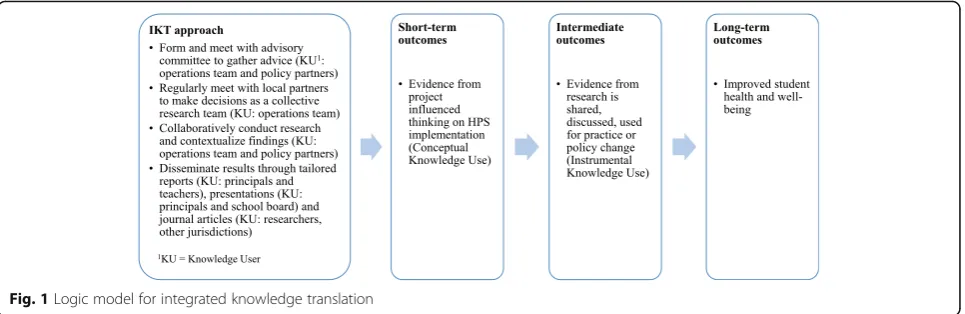
Document review: description of the IKT approach IKT was used throughout this project to ensure the re-search was co-produced to help inform policy and prac-tice. Figure 1provides an overview of a logic model that describes how the hypothesised IKT approach would support the co-production and application of research evidence to inform policy and practice. It was assumed that short-term outcomes of the IKT approach would lead to conceptual knowledge use or changes in thinking and that immediate outcomes would be observed regarding instrumental use where evidence was used to inform policy or practice [34,35].
departments responsible for health and education). All ad-visory committee members were asked to provide advice and recommendations and act as key liaisons within their representative organisations. Membership was flexible so that additional committee members from the operations team and policy partners could attend depending on the is-sues being discussed. In total, the advisory committee met a total of six times between August 2013 and November 2014 with high participation by all partners (ranging from four to six policy/practice partners per meeting). Due to the rural location of the health promotion project studied, most advisory committee meetings were conducted via telecon-ference for members of the local operation team due to budget and time constraints.
The researchers also engaged local school principals and the elected school board prior to data collection to gather information on issues of importance to guide the research methods. To foster relationships and identify priority research actions, additional meetings were held with the researchers and local operation team members to make further decisions on the research process (34 in total). While the majority of these meetings took place by tele-conference, the researchers travelled to visit with local partners as often as possible (seven local visits). Local evaluation assistants were trained to complete the data collection based on recommendations from the advisory committee. Findings were contextualised with KUs, and the results were shared through a variety of dissemination strategies with schools and the school board, including a confidential School Report with school-specific results on healthy eating, physical activity, mental well-being, and family engagement and presentations/workshops with school champions from HPS committees. A similar School Board Report was also co-developed with KUs for elected school board officials and a final presentation was delivered by the researchers. The results of the research have also been presented at a variety of academic and practitioner-based conferences, including one that was co-presented by researchers and KUs. Finally,
corresponding with the publication of each peer-reviewed publication, a summary infographic is being disseminated to KUs to highlight key messages in an engaging format.
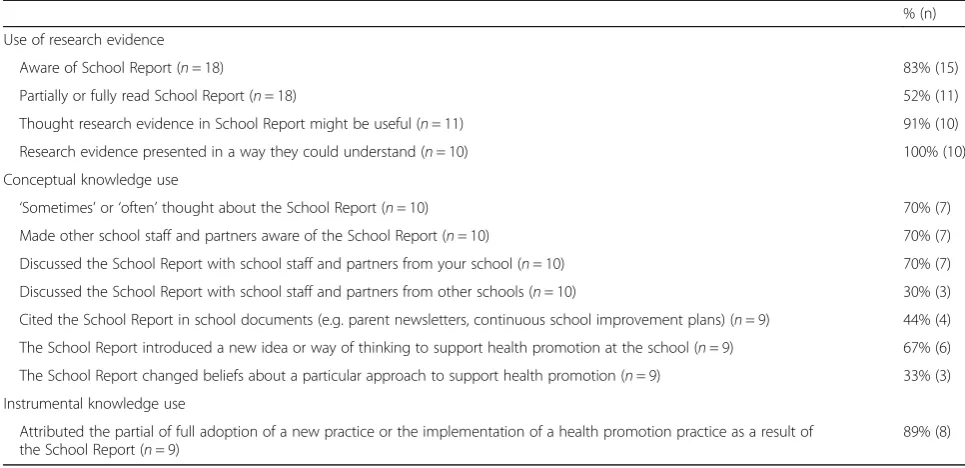
Principal survey: use of research evidence by schools All 18 school principals completed the online survey (100% response rate) on the use of results that were dis-seminated in the form of a School Report. A total of 83% of school principals were aware of their School Re-port (15 of 18) and 52% had either partially or fully read it (11 of 18). A range of uses was reported by those that read the report (Table1). In terms of conceptual know-ledge use, most principals that read their report felt re-search evidence in the School Report might be useful (91%) and was presented in a way they could understand (100%). Many of the principals that read their School Report also thought about the results and discussed it with others at their school (70%); however, fewer dis-cussed it with other schools (30%). Many principals that read their School Report felt that it offered a new idea or way of thinking for how their support could encourage health promotion (67%). For instrumental knowledge use, almost all principals that read their School Report attri-buted the partial of full adoption of a new practice or the implementation of a health promotion practice as a result of their report (89%). For example, because of the identifi-cation of issues of student loneliness in their report, one school created the ‘Buddy Bench’ and introduced class-room lessons about empathy and friendships. Several schools had identified lower parental and community engagement and were exploring various ways to enhance engagement such as encouraging parents to run with their children or hosting cultural activities at the school.
Interviews with lead research team members: use of research evidence by school board and influences on the IKT process
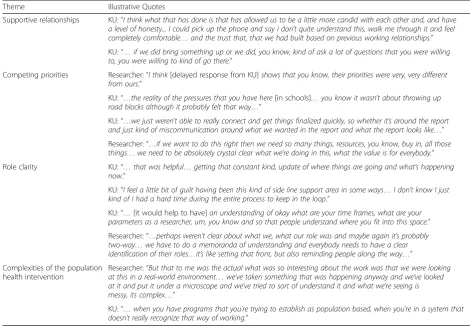
an interview, ranging from 30 to 55 minutes (only one KU did not respond to the interview request). Various positive impacts of the research were discussed by all participating research team members in terms of its support for policy and practice as well as building new evidence to inform HPS initiatives. One KU commented on the specific impact of the research on policy and practice:“…[it has] given us a little more leverage with the board… an opportunity to engage administrators, more schools have come on board since that, since the re-search…”. This KU also provided context on the use of research evidence by schools, which is complementary to the results from the principal survey results from the knowledge use survey, reinforcing that schools were using their school-level data: “So every school has taken it, reviewed it, shared it with their school teams, have chosen priority areas out of it and then have created strategic action plans”. The researchers also spoke about the impacts of the research through its contribution to the academic literature on HPS and population health interventions. Across all interviews, four key themes emerged related to the IKT process, including support-ive relationships, role clarity, competing priorities and the complexities of population health interventions. Table 2 provides an overview of the themes and corre-sponding illustrative quotes.
All research team members commented on the im-portance of supportive relationships between researchers and KUs throughout the research process. Participants commented that positive relationships were facilitated by prior experiences collaborating on research, personal relationships and the efforts by team members to
communicate on a regular basis. Positive relations with the researchers seemed to allow more openness when challenges emerged and built trust in the research process. Both KU and researchers shared the perspective of the need for supportive relationships in the IKT process and identified that it was a priority to establish and maintain trust so KUs felt that they could openly inquire about the results. KUs commented that it was helpful that the researchers encouraged questioning to occur and were flexible to have discussions around par-ticular areas of concern. One KU commented an appre-ciation that the whole team was learning and improving how they were working together as the project evolved.
Role clarity was discussed by both researchers and KUs. The researchers were identified as the leads for the project and were responsible for project implementation. The majority of meetings were organised by the re-searchers, who worked with KUs to engage them in the various phases of the research design and in the inter-pretation and dissemination of results. However, al-though there were terms of reference and organisational structures developed at the beginning of the project, all participants commented that there was sometimes lack of clarity of the roles. It was identified that this may have been worsened by the physical distance between the re-searchers and the KUs (~ 300 km) and that different KUs were more engaged in the data collection process due to their relationship with schools. Two KUs felt that greater clarity was needed on timeframes and parame-ters for different stakeholders involved, but one felt that the process was quite clear. The researchers talked about their responsibility in better clarifying roles but that it
Table 1Outcomes of the integrated knowledge translation process as reported by school principals
% (n)
Use of research evidence
Aware of School Report (n= 18) 83% (15)
Partially or fully read School Report (n= 18) 52% (11)
Thought research evidence in School Report might be useful (n= 11) 91% (10)
Research evidence presented in a way they could understand (n= 10) 100% (10)
Conceptual knowledge use
‘Sometimes’or‘often’thought about the School Report (n= 10) 70% (7)
Made other school staff and partners aware of the School Report (n= 10) 70% (7)
Discussed the School Report with school staff and partners from your school (n= 10) 70% (7)
Discussed the School Report with school staff and partners from other schools (n= 10) 30% (3)
Cited the School Report in school documents (e.g. parent newsletters, continuous school improvement plans) (n= 9) 44% (4)
The School Report introduced a new idea or way of thinking to support health promotion at the school (n= 9) 67% (6)
The School Report changed beliefs about a particular approach to support health promotion (n= 9) 33% (3)
Instrumental knowledge use
Attributed the partial of full adoption of a new practice or the implementation of a health promotion practice as a result of the School Report (n= 9)
was important that KUs were reciprocally engaged in de-fining roles and had the capacity to truly engage and be accountable throughout the research process.
Although positive relationships were reported, it was evident that the researchers and KUs had competing pri-orities that influenced the IKT process. The researchers’ discussed this in relation to the frustration they experi-enced when they felt the research was not a priority for KUs as a result of tardiness or delayed response. Both researchers and KUs commented that the respective ex-pectations, professional roles and priorities of each re-search team member may not have been fully understood. In particular, one KU commented on exter-nal stresses from a role working in the school board. Both researchers and KUs commented on the challenge of conducting research within school environments, es-pecially engaging school stakeholders with competing academic priorities and obtaining consent from parents/ guardians for student participation. Despite the best ef-forts by researchers and KUs, schools struggled with promoting uptake of participation in the research, which resulted in a lower response rate, negatively influencing the statistical power for the primary outcome evaluation. This was disappointing to both researchers and KUs.
Researchers and KUs also commented on the chal-lenges with co-producing dissemination products, which may have been influenced by the differing prior-ities. This was especially discussed by KUs in terms of the dissemination of the final School Board Report and presentation to the board. The researchers commented on the challenge they experienced in balancing the exe-cution of the IKT approach with their obligation to pro-duce scientific publications. Researchers noted that there needs to be greater value in the academic com-munity and financial resources to support the IKT approach.
The complexity of the population health intervention that was studied was noted as a challenge for this project. Both researchers and KUs noted that HPS is an evolving initiative that needs to be adaptable to school circum-stance. As a result, conducting research on the impact of the approach was perceived as difficult due to the varia-bility in how it is implemented across different school contexts. The project tried to overcome the challenges in evaluating the complex population-level intervention with a multi-method design that included various data sources (surveys, school environmental scans, economic assess-ment). KUs commented on their appreciation for the
Table 2Themes emerging from interviews with research team
Theme Illustrative Quotes
Supportive relationships KU:“I think what that has done is that has allowed us to be a little more candid with each other and, and have a level of honesty... I could pick up the phone and say I don’t quite understand this, walk me through it and feel completely comfortable…and the trust that, that we had built based on previous working relationships.”
KU:“…if we did bring something up or we did, you know, kind of ask a lot of questions that you were willing to, you were willing to kind of go there.”
Competing priorities Researcher:“I think[delayed response from KU]shows that you know, their priorities were very, very different from ours.”
KU:“…the reality of the pressures that you have here[in schools]…you know it wasn’t about throwing up road blocks although it probably felt that way…”
KU:“…we just weren’t able to really connect and get things finalized quickly, so whether it’s around the report and just kind of miscommunication around what we wanted in the report and what the report looks like…”
Researcher:“…if we want to do this right then we need so many things, resources, you know, buy in, all those things…we need to be absolutely crystal clear what we’re doing in this, what the value is for everybody.”
Role clarity KU:“…that was helpful…getting that constant kind, update of where things are going and what’s happening now.”
KU:“I feel a little bit of guilt having been this kind of side line support area in some ways…I don’t know I just kind of I had a hard time during the entire process to keep in the loop.”
KU:“…[it would help to have]an understanding of okay what are your time frames, what are your parameters as a researcher, um, you know and so that people understand where you fit into this space.”
Researcher:“…perhaps weren’t clear about what we, what our role was and maybe again it’s probably two-way…we have to do a memoranda of understanding and everybody needs to have a clear identification of their roles…it’s like setting that front, but also reminding people along the way…”
Complexities of the population health intervention
Researcher:“But that to me was the actual what was so interesting about the work was that we were looking at this in a real-world environment…we’ve taken something that was happening anyway and we’ve looked at it and put it under a microscope and we’ve tried to sort of understand it and what we’re seeing is messy, its complex…”
diverse methods used, particularly the use of photos in the environmental scan, as it allowed for an illumination of differences that are more difficult to capture in traditional quantitative research. It is also important to note that KUs voiced interest in working with the researchers again, which suggests an overall positive relationship through this project.
Discussion
This study sought to describe and evaluate the IKT ap-proach used in a PHIR project by understanding how the evidence generated from research was applied to inform policy and practice and to identify what influenced the im-plementation of the IKT process. Overall, experiences from KUs and researchers were encouraging, and positive relationships were developed and fostered through the IKT approach. There were various positive impacts of the research evidence that was generated, including its useful-ness for policy discussions and its application to inform practice changes in schools. Although only half of the schools had read their report, there was a similar number of schools participating in the HPS intervention [27]. Therefore, it could be assumed that those that read the re-port were already in the process of implementing changes as part of the HPS process. Those that did attributed the partial/full adoption, or implementation, of a new practice to using the information. Although this study did not ask schools to identify their HPS status, previous research has found that HPS schools were more likely to share and use research evidence [36]. Successes and challenges were noted by KUs and researchers in the implementation of IKT, including supportive relationships, role clarity, com-peting priorities and the complexities of population health interventions.
The findings of this study add to the findings from previ-ous research on collaborations and partnerships in research [19, 20, 22, 23, 37] and provide a rich description of the process used to facilitate an IKT approach in school-based research. A research advisory committee was established to engage policy partners and the operations team early and throughout the research process and to foster open communication. The operations team also worked along-side the researchers to make key decisions related to the research process. These actions seemed to be helpful in strengthening relationships in this research, which builds on earlier studies that have reported that frequent and early interactions can help to ensure research is relevant and can bridge the gap by leading to increased use of research findings [10, 38, 39]. Kothari et al. [10] further dis-cussed the need for preparation and ongoing planning to keep IKT partnerships moving beyond the obstacles that will inevitably arise. Further, they established indica-tors for partnerships to provide a transparent guide to de-velop and evaluate the success of a partnership from
qualitative interviews with policy-makers and researchers involved with research partnerships, including those iden-tified for ‘early’or ‘mature’partnerships and also specific indicators ‘common’ across research–policy partnerships in general [10]. Encouragingly, both researchers and KUs reported positive relationships, rapport, trust and commit-ment in this study, which is an indicator for a ‘mature’ partnership. Further ‘common’ indicators were evident, such as actions designed to enhance the collaborative re-search process and dissemination of findings (e.g. joint meetings, plans, practical formats and recommendations). However, ‘early’ indicators of partnership enhancement and negotiation of roles may have required more attention [10] as it was suggested that greater clarification of roles and timelines could have enhanced communication and engagement of KUs.
sometimes be difficult when trying to build more sustain-able partnerships, particularly in PHIR, where it may take longer for outcomes to emerge [7]. Further, although valu-ing of IKT may be different across institutions, the need for an academic culture that supports ‘engaged scholarship’ (advancing both theory and practice through authentic col-laboration) has previously been discussed as needing to be integrated into tenure and promotion guidelines and faculty reporting [43–45]. More systematic research on these aca-demic challenges is warranted to provide guidance on the support that is needed to facilitate IKT.
Limitations
This case study provides a rich description of an IKT ap-proach used in a population-level research project in schools. Although the study results are not meant to be generalisable, there are limitations that may influence the transferability to other settings. First, there may have been selection bias and social desirability bias in the self-report survey that assessed knowledge use in schools. Further, although schools reported usage of their reports to inform practice changes, the extent to which the information influenced these practice changes (compared to other information) is not known. However, through triangulation of data collected as part of the in-terviews and through further discussion with KUs, it was acknowledged that the school reports were being used by school principals to inform changes. Second, not all KUs and researchers involved with the project were interviewed as part of the study, with several KUs no longer in the same position as a result of recent reorga-nisations of the health and education systems in the province. Although not all experiences were fully explored, those involved were identified as the primary researchers and KUs involved with the project. There may also be potential bias through self-evaluation, with some of the authors also taking part as participants in the interviews. A balanced perspective from both re-searchers and KUs was assured by the comprehensive authorship team, which includes representation from both. Finally, although it was important for the primary author to lead the interviews to support ongoing part-nership development for research projects, it is possible that participants may not have felt comfortable to dis-close negative experiences with the study. To address this limitation, participants were assured that all per-spectives were valued and all experiences (positive and negative) would support improvements in the research process. Two KUs are also authors on this paper and have verified the interpretation of results presented.
Conclusions
Although an IKT approach is commonly required and advocated for in population health research, there is
little published research that describes its implemen-tation and the resulting impacts on policy and prac-tice. This study provides a description of the process and outcomes of IKT in a school-based research project through a case study that describes the actions influencing partnership development and application of the research evidence that was generated. This study suggests that on-going exchange between researchers and KUs is important to ensure integration of relevant results to inform practice changes in schools, policy development for the school board and transferable knowledge for other jurisdictions. However, although positive outcomes were reported, the findings of this study also suggest that IKT can be challen-ging, and that dedicated resources are needed to maintain engagement and negotiate roles with KUs that have different priorities and expectations from researchers. Additional recognition of the importance of IKT in the academic community and subsequent development of resources would enable better implementation of the approach. Further research is also needed to identify key actions that support IKT, thereby facilitating the potential for impact on policy and practice.
Abbreviations
CIHR:Canadian Institutes of Health Research; HPS: health-promoting schools; IKT: integrated knowledge translation; KU: knowledge user; PHIR: population health intervention research
Acknowledgements
The authors would also like to acknowledge the support from the Tri-County Regional School Board, Nova Scotia Health Authority, the Nova Scotia Department of Education and Early Childhood Development, the Nova Scotia Department of Health and Wellness, and members of the advisory committee from these organi-sations for their contributions to this research. The authors would like to specific-ally recognise the contribution of Racheal Surette (Nova Scotia Health Authority) for her support on this manuscript, school principals for their completion of the survey and members of the Tri-County Regional School Board Health Promoting Schools Steering Committee for their inspiration and commitment to create healthier school environments.
Funding
This work was supported by a Population Health Intervention Research grant from the Canadian Institutes of Health Research to SFLK and SK (CIHR, FRN 127082). JDM acknowledges funding from Knowledge Translation Canada and CIHR (TGF 97068), a Bright Red Graduate Research Award from the Heart and Stroke Foundation of Canada and the Canadian Cancer Society (Grant # 703878). TLP was supported by the Cambridge International Scholarship from the Cambridge Commonwealth, European and International Trust.
Availability of data and materials
The datasets generated and/or analysed during the current study are not publicly available due to their collection, which is specific to this research project; however, they are available from the corresponding author on reasonable request.
Authors’contributions
Ethics approval and consent to participate
All participants voluntarily participated in the research. Principals provided their consent by completing the survey and oral consent was obtained for all interview participants. Ethics approval was waived by the Dalhousie Health Research Ethics Board due to its evaluative nature.
Consent for publication Not applicable.
Competing interests
It is important to note that the primary author (JDM) was responsible for liaisons with KUs and conducted the interviews in this study. Other authors were participants as either KUs (LS, JC) or researchers (SFLK, SK).
Publisher’s Note
Springer Nature remains neutral with regard to jurisdictional claims in published maps and institutional affiliations.
Author details
1
Healthy Populations Institute, Dalhousie University, PO BOX 15000, Halifax, NS B3H 4R2, Canada.2Faculty of Education and Department of Child and
Youth Study, Mount Saint Vincent University, 166 Bedford Highway, Halifax, NS B3M 2J6, Canada.3UKCRC Centre for Diet and Activity Research (CEDAR),
MRC Epidemiology Unit, University of Cambridge School of Clinical Medicine, Box 111 Cambridge Biomedical Campus, Cambridge CB2 0SP, United Kingdom.4School of Public Health, University of Alberta, 3-300 Edmonton
Clinic Health Academy, 11405–87 Ave, Edmonton, AB T6G 1C9, Canada.
5
Tri-County Regional Centre for Education, 79 Water Street, Yarmouth, NS B5A 1L4, Canada.6Western Zone, Nova Scotia Health Authority, 60
Vancouver Street, Yarmouth, NS B5A 2P5, Canada.7Department of Pediatrics,
Dalhousie University, PO BOX 15000, Halifax, NS B3H 4R2, Canada.
8
Department of Obstetrics & Gynaecology, Dalhousie University, PO BOX 15000, Halifax, NS B3H 4R2, Canada.
Received: 17 September 2017 Accepted: 13 July 2018
References
1. Hawe P, Potvin L. What is population health intervention research? Can J Public Health. 2009;100:I8–14.
2. Hawe P, Di RE, Cohen E. Frequently asked questions about population health intervention research. Can J Public Health. 2012;103:e468–e71. 3. Martin J, Cheng D, Stranges S. Population health intervention research:
myths and misconceptions. Int J Public Health. 2018;62(8):845–7. 4. Ruggiero ED, Potvin L, Allegrante JP, Dawson A, de LE, Dunn JR, et al.
Ottawa statement from the sparking solutions summit on population health intervention research. Can J Public Health. 2017;107:492–6.
5. Lifsey S, Cash A, Anthony J, Mathis S, Silva S. Building the evidence base for population-level interventions barriers and opportunities. Health Educ Behav. 2015;42(1 Suppl)):133S–40S.
6. Woolf SH, Purnell JQ, Simon SM, Zimmerman EB, Camberos GJ, Haley A, et al. Translating evidence into population health improvement: strategies and barriers. Annu Rev Public Health. 2015;36:463–82.
7. Hobin EP, Hayward S, Riley B, Di Ruggiero E, Birdsell J. Maximising the use of evidence: exploring the intersection between population health intervention research and knowledge translation from a Canadian perspective. Evid Policy J Res Debate Pract. 2012;8:97–115.
8. Canadian Institutes of Health Research. Guide to Knowledge Translation Planning at CIHR: Integrated and End-of-Grant Approaches. Ottawa: Government of Canada; 2012. http://www.cihr-irsc.gc.ca/e/45321.html. Accessed 16 July 2013.
9. Bowen S, Graham ID. Integrated knowledge translation. In: Knowledge Translation in Health Care: Moving from Evidence to Practice. 2nd ed. West Sussex: John Wiley & Sons, Ltd; 2013.
10. Kothari A, MacLean L, Edwards N, Hobbs A. Indicators at the interface: managing policymaker-researcher collaboration. Knowl Manag Res Pract. 2011;9:203–14.
11. Kothari A, Sibbald SL, Wathen C. Evaluation of partnerships in a transnational family violence prevention network using an integrated knowledge translation and exchange model: a mixed methods study. Health Res Policy Syst. 2014;12:25.
12. Fredericks S, Martorella G, Catallo C. Using knowledge translation as a framework for the design of a research protocol. Int J Nurs Pract. 2015; 21(Suppl 2):157–63.
13. Gagliardi AR, Dobrow MJ. Identifying the conditions needed for integrated knowledge translation (IKT) in health care organizations: qualitative interviews with researchers and research users. BMC Health Serv Res. 2016; 16:256.https://doi.org/10.1186/s12913-016-1533-0.
14. McGrath PJ, Lingley-Pottie P, Emberly DJ, Thurston C, McLean C. Integrated knowledge translation in mental health: family help as an example. J Can Acad Child Adolesc Psychiatry. 2009;18:30–7.
15. Gagliardi AR, Berta W, Kothari A, Boyko J, Urquhart R. Integrated knowledge translation (IKT) in health care: a scoping review. Implement Sci. 2016;11:38.
16. Graham ID, Logan J, Harrison MB, Straus SE, Tetroe J, Caswell W, et al. Lost in knowledge translation: time for a map? J Contin Educ Health Prof. 2006; 26:13–24.
17. Lapaige V.“Integrated knowledge translation”for globally oriented public health practitioners and scientists: framing together a sustainable transfrontier knowledge translation vision. J Multidiscip Healthc. 2010;3:33–47.
18. Jansson SM, Benoit C, Casey L, Phillips R, Burns D. In for the long haul: knowledge translation between academic and nonprofit organizations. Qual Health Res. 2010;20:131–43.
19. Reback CJ, Cohen AJ, Freese TE, Shoptaw S. Making collaboration work: key components of practice/research partnerships. J Drug Issues. 2002;32:837–48. 20. Golden-Biddle K, Reay T, Petz S, Witt C, Casebeer A, Pablo A, et al. Toward a
communicative perspective of collaborating in research: the case of the researcher-decision-maker partnership. J Health Serv Res Policy. 2003; 8(Suppl 2):20–5.
21. Lomas J. Using research to inform healthcare managers’and policy makers’questions: from summative to interpretive synthesis. Healthc Policy. 2005;1:55–71.
22. Otten JJ, Dodson EA, Fleischhacker S, Siddiqi S, Quinn EL. Getting research to the policy table: a qualitative study with public health researchers on engaging with policy makers. Prev Chronic Dis. 2015;12:E56.
23. Thomson AM, Perry JL. Collaboration processes: inside the black box. Public Adm Rev. 2006;66:20–32.
24. Tetroe JM, Graham ID, Foy R, Robinson N, Eccles MP, Wensing M, et al. Health research funding agencies’support and promotion of knowledge translation: an international study. Milbank Q. 2008;86:125–55.
25. World Health Organization. What is a Health Promoting School? In: Global School Health Initiative; 2012.http://www.who.int/school_youth_health/ gshi/hps/en/index.html. Accessed 30 Oct 2012.
26. McIsaac J-LD, Chu YL, Blanchard C, Rossiter MD, Williams PL, Raine KD, et al. The impact of school policies and practices on students’diets, physical activity levels and body weights. A province-wide practice-based evaluation. Can J Public Health. 2015;106:e43–51.
27. McIsaac J-LD, Penney TL, Ata N, Munro-Sigfridson L, Cunningham J, Veugelers PJ, et al. Evaluation of a health promoting schools program in a school board in Nova Scotia, Canada. Prev Med Rep. 2017;5:279–84. 28. Yin RK. Case Study Research: Design and Methods. 4th ed. Thousand Oaks:
Sage Publications; 2009.
29. Skinner K. Developing a tool to measure knowledge exchange outcomes. Can J Program Eval. 2007;22:49–73.
30. Creswell JW, Plano Clark VL. Designing and conducting mixed methods research. 2nd ed. Thousand Oaks: Sage Publications; 2011.
31. Stake RE. Qualitative Research Studying How Things Work. New York: Guilford Press; 2010.
32. Strauss A, Corbin J. Basics of Qualitative Research: Techniques and Procedures for Developing Grounded Theory. 2nd ed. Thousand Oaks: Sage Publications; 1998.
33. Richards L, Morse JM. Readme First for a User’s Guide to Qualitative Methods. 2nd ed. Thousand Oaks: Sage Publications; 2007.
34. Estabrooks CA. The conceptual structure of research utilization. Res Nurs Health. 1999;22:203–16.
35. Beyer JM. Research utilization bridging a cultural gap between communities. J Manag Inq. 1997;6:17–22.
36. Roberts E, Bastian K, Ekwaru JP, Veugelers P, Gleddie D, Storey K. The Role of the CSH School Principal in Knowledge Sharing and Use. 2016.http://ojs. acadiau.ca/index.php/phenex/article/view/1600. Accessed 27 Jun 2017. 37. Sibbald SL, Tetroe J, Graham ID. Research funder required research
38. Lavis JN. Research, public policymaking, and knowledge-translation processes: Canadian efforts to build bridges. J Contin Educ Health Prof. 2006;26:37–45.
39. Orton L, Lloyd-Williams F, Taylor-Robinson D, O’Flaherty M, Capewell S. The use of research evidence in public health decision making processes: systematic review. PloS One. 2011;6:e21704.
40. Veugelers PJ, Schwartz ME. Comprehensive school health in Canada. Can J Public Health. 2010;101(Suppl 2):S5–8.
41. Spence S, White M, Adamson AJ, Matthews JNS. Does the use of passive or active consent affect consent or completion rates, or dietary data quality? Repeat cross-sectional survey among school children aged 11–12 years. BMJ Open. 2015;5:e006457.
42. Walter I, Davies H, Nutley S. Increasing research impact through partnerships: evidence from outside health care. J Health Serv Res Policy. 2003;8(Suppl 2):58–61.
43. Saltmarsh J, Warren M, Krueger-Henney P, Rivera L, Fleming R, Haig Friedman D, et al. Creating an Academic Culture that Supports Community-engaged Scholarship. Association of American Colleges and Universities. 2015.https://www.aacu.org/diversitydemocracy/2015/winter/saltmarsh. Accessed 10 June 2018.
44. Van de Ven AH, Johnson PE. Knowledge for theory and practice. Acad Manage Rev. 2006;31:802–21.