Comparison of SISO & MIMO Techniques in Wireless
Communication
Mitesh Patel Prof. Nirav Patel
PG Student Assistant Professor
Electronics & Communication Department Electrical & Electronics Department Geetanjali Institute of Technical Studies, Udaipur Grow More Faculty of Engineering
Prof. Anurag Paliwal Associate Professor
Electronics & Communication Department Geetanjali Institute of Technical Studies, Udaipur
Abstract
This paper compares MIMO vs SISO and mention difference between SISO and MIMO techniques. These are techniques based on number of antennas used at the transmitter and the receiver. SISO has been in use since the invention of wireless system.MIMO concept has been recently added to the wireless system. There are different MIMO algorithms which have been developed for two main reasons to increase coverage and to increase the data rates. SISO means Single Input Single Output while MIMO means Multiple Input Multiple Output.
Keywords: SISO, MIMO, Wireless Communication, Channel Capacity, OFDM.
_______________________________________________________________________________________________________
I.
INTRODUCTION
In radio, multiple-input and multiple-output, or MIMO (commonly pronounced my-moh or me-moh), is the use of multiple antennas at both the transmitter and receiver to improve communication performance. It is one of several forms of smart antenna technology. Note that the terms input and output refer to the radio channel carrying the signal, not to the devices having antennas. Pre coding is multi-stream beam forming, in the narrowest definition. In more general terms, it is considered to be all spatial processing that occurs at the transmitter. In (single-layer) beam forming, the same signal is emitted from each of the transmit antennas with appropriate phase (and sometimes gain) weighting such that the signal power is maximized at the receiver input. The benefits of beam forming are to increase the received signal gain, by making signals emitted from different antennas add up constructively, and to reduce the multipath fading effect. In the absence of scattering, beam forming results in a well defined directional pattern, but in typical cellular conventional beams are not a good analogy. When the receiver has multiple
antennas, the transmit beam forming cannot simultaneously maximize the signal level at all of the receive antennas, and pre coding with multiple streams is used. Note that pre coding requires knowledge of channel
state information (CSI) at the transmitter. Spatial multiplexing requires MIMO antenna configuration. In spatial multiplexing, a high rate signal is split into multiple lower rate streams and each stream is transmitted from a different transmit antenna in the same frequency channel.[3] If these signals arrive at the receiver antenna array with sufficiently different spatial signatures, the receiver can separate these streams into (almost) parallel channels. Spatial multiplexing is a very powerful technique for increasing channel capacity at higher signal-to-noise ratios (SNR). The maximum number of spatial streams is limited by the lesser in the number of antennas at the transmitter or receiver. Spatial multiplexing can be used with or without transmit channel knowledge. Spatial multiplexing can also be used for simultaneous transmission to multiple receivers, known as space-division multiple accesses. By scheduling receivers with different spatial signatures, good separability can be assured.
II.
DIVERSITY
frequency-division multiplexing (OFDM) or with Orthogonal Frequency Division Multiple Access (OFDMA) modulation, where the problems created by multi-path channel are handled efficiently.[5] The IEEE 802.16e standard incorporates MIMO-OFDMA. The IEEE 802.11n standard, released in October 2009, recommends MIMO-OFDM. Diversity is a powerful communication receiver technique that provides wireless link improvement at a relatively low cost. Diversity techniques are used in wireless communications systems to primarily to improve performance over a fading radio channel. In such a system, the receiver is provided with multiple copies of the same information signal which are transmitted over two or more real or virtual communication channels. Thus the basic idea of diversity is repetition or redundancy of information. In virtually all the applications, the diversity decisions are made by the receiver and are unknown to the transmitter Diversity is the technique used in wireless communications systems to improve the performance over a fading radio channel. Here receiver is provided with multiple copies of the same information signal which are transmitted over two or more real or virtual communication channels. Thus the basic idea of diversity is repetition or redundancy of information. In virtually all the applications, the diversity decisions are made by the receiver and are unknown to the transmitter. Communication through fading channels can be difficult. Special techniques may be required to achieve satisfactory performance. The general time varying fading channel model is too complex for understanding and performance analysis for wireless channels. One approximate channel model is the wide-sense stationary uncorrelated scattering (WSSUS). In WSSUS model, the time-varying fading process is assumed to be wide-sense stationary random process and the signal copies from the scatterings by different objects are assumed to be independent.[1]-[4] If the bandwidth of the transmitted signal is small compared with (∆ƒ)c, then all frequency components of the signal would roughly undergo the same degree of fading. The channel is then classified as frequency non-selective (also called flat fading). We notice that because of the reciprocal relationship between (∆ƒ)c and (∆t)c and the one between bandwidth and symbol duration, in a frequency non-selective channel, the symbol duration is large compared with (∆t)c. In this case, delays between different paths are relatively small with respect to the symbol duration. We can assume that we would receive only one copy of the signal, whose gain and phase are actually determined by the superposition of all those copies that come within (∆t)c. On the other hand, if the bandwidth of the transmitted signal is large compared with (∆ƒ)c, then different frequency components of the signal (that differ by more than (∆ƒ)c would undergo different degrees of fading. The channel is then classified as frequency selective. Due to the reciprocal relationships, the symbol duration is small compared with (∆t)c. Delays between different paths can be relatively large with respect to the symbol duration. We then assume that we would receive multiple copies of the signal. [6] Slow fading channels are very often modelled as time- invariant channels over a number of symbol intervals. Moreover, the channel parameters, which are slow varying, may be estimated with different estimation techniques. On the other hand, if is close to or smaller than the symbol duration, the channel is considered to be fast fading (also known as time selective fading). In general, it is difficult to estimate the channel parameters in a fa st fading channel. If the antenna elements of the receiver are separated by a fraction of the transmitted wavelength, then the various copies of the information signal or generically termed as branches, can be combined suitably or the strongest of them can be chosen as the received signal. Such a diversity technique is termed as Antenna or Space diversity. Large scale fading, caused due to shadowing, can be combated using macroscopic diversity wherein the distances of consideration are of the order of the distances between two base stations. Diversity techniques are effective when the branches considered are assumed to be independently faded or the envelopes are uncorrelated. In Space diversity, there are multiple receiving antennas placed at different spatial locations, resulting in different (possibly independent) received signals. The difference between the diversity schemes lies in the fact that in the first two schemes, there is wastage of bandwidth due to duplication of the information signal to be sent. Thus problem is avoided in the remaining three schemes, but with the cost of increased antenna complexity. Modulation, in general, is the process by which some characteristic of a waveform is varied in accordance with another waveform. A sinusoid has just three features which can be used to distinguish it from other sinusoids - amplitude, phase, and frequency. For the purpose of radio transmission, modulation is defined as the process whereby the amplitude, phase, or frequency of a radio frequency (RF) carrier wave is varied in accordance with the information to be transmitted.
III.
MIMO
BASICS
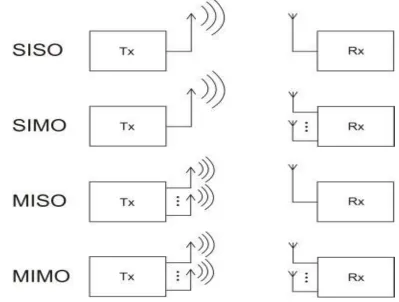
Fig 1. Wireless Communication Techniques
SIMO means single input and multiple outputs. MISO means multiple input and single output. You are already aware of System without multiple antennas which is referred as SISO i.e. Single Input Single Output. It is very important to know terminology for MIMO. If it is written on the device as '2x3 MIMO' means two antennas are used for transmission and 3 are used for reception. There are two main types of MIMO. Spatial multiplexing (SM): in which different set of data are transmitted from the transmitting antennas hence it will double the data rate for 2 transmitting antennas. Space time block coding (STBC): in which copy of the same data which have been transmitted from the two antennas at time instant T1 is transmitted at time instant T2. It will not be the exact copy but it has been manipulated. This will help in recovering the transmitting symbols after the multipath channel. This does not help in increase of data rate but helps in extending the coverage or range. There are systems where both coverage and data rate are required to be good, beam forming is often used in conjunction with MIMO of special multiplexing type. Beam forming multiply transmit signal with vector or matrix to achieve amplification of the transmitting vector. Now-a-days MIMO is used in many next generation and current technologies for example Mobile WiMAX as per 802.16e standard, LTE as per 3GPP standard, 802.16m,
802.20, 802.11n, 802.11-ac etc. Advantages of MIMO are increased coverage with appropriate MIMO technique for example STBC and Increased data rate with SM.
IV.
COMPARISION
OF
SISO
&
MIMO
TECHNIQUES
SISO has been in use since the invention of wireless system. MIMO concept has been recently added to the wireless system. There are different MIMO algorithms which have been developed for two main reasons to increase coverage and to increase the data rates.
SISO means Single Input Single Output while MIMO means Multiple Input Multiple Output. In SISO system only one antenna is used at transmitter and one antenna is used at Receiver while in MIMO case multiple antennas are used. Figure depicts 2x2 MIMO case.
effect, MIMO systems use a combination of multiple antennas and multiple signal paths to gain knowledge of the communications channel.
Fig 2. Operational Difference between SISO & MIMO
V.
SIMULATION
RESULT
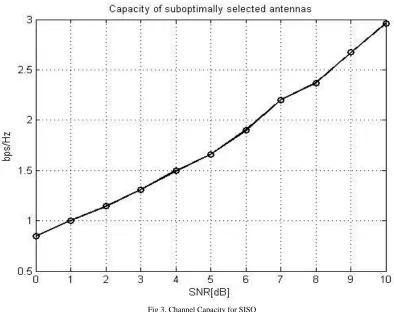
1) Channel Capacity of SISO:
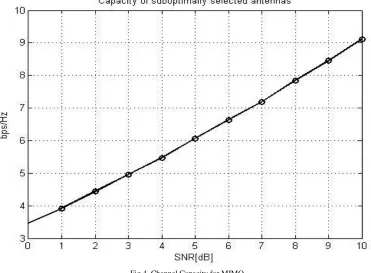
2) Channel capacity of MIMO:
Fig 4. Channel Capacity for MIMO
From the above graph, we can say that, as the SNR increasing then Speed of the data transmission is increase as compare to SISO.
VI.
CONCLUSION
MIMO system delivers higher data rate due to transmission of multiple data symbols simultaneously using multiple antennas. MIMO communications channels gives solution to the multipath challenge by requiring multiple signal paths. MIMO systems use a combination of multiple antennas and multiple signal paths to gain knowledge of the communications channel. In MIMO, a receiver can recover independent streams from each of the transmitter's antennas. It can be observed that the bit rate of a 4 x 4 (four spatial stream) MIMO configuration exceeds that of the Shannon- Hartley limit at all data rates, making MIMO systems attractive for higher data throughput. While MIMO systems provide users with clear benefits at the application level, the design and test of MIMO devices is not without significant challenges. System benefits such as improvements in data rate and resilience to multipath are likely to motivate continued development of MIMO-OFDM communications systems.
R
EFERENCES[1] Switching Between Diversity and Multiplexing in MIMO Systems, Robert W. Heath, Jr. and Arogyaswami J. Paulraj, JUNE 2005.
[2] Effectiveness of Selection and Maximal Ratio Combining Diversity Techniques on a OS-COMA Wireless Communication System Impaired by Fading, Masuda Hossain, Md. Rubaiyat Hossain Mondal, December, 2009
[3] Performance Analysis of Wireless MIMO System by Using Alamouti’s Scheme and Maximum Ratio Combining Technique, Muhammad Sana Ullah, Mohammed Jashim Uddin
[4] Performance Analysis of MIMO-MRC in Double-Correlated Rayleigh Environments, Matthew R. McKay, Alex J. Grant, and Iain B. Collings, November 2005
[5] Performance of MIMO MRC Systems with Co-Channel Interference, Juan M. Romero-Jerez, Juan P. Peña-Martín, Gabriel Aguilera and Andrea J. Goldsmith