ISSN (e): 2250-3021, ISSN (p): 2278-8719
Vol. 07, Issue 12 (December. 2017), ||V1|| PP 10-15
Experimental Studies On Compressive Strength Characteristics
Of High Strength Concrete Using Recycled Aggregate And Ggbs,
Silica Fume
S.Tejaswi
1, .K .Eswaramma
2, G.Suresh
31 P.G student, 2 Assistant professors Department of Civil Engineering,3 Ph.D student
Siddartha Institute of Engineering and Technology::Puttur -517583, Chittor(dt) ,A .p, India
ABSTRACT:
The present investigations are getting considerable attention under sustainable development now-a-days. The use of Recycled Aggregate (RA) from construction and wastes is showing prospective application in construction as alternative to primary (natural) aggregates. It conserves natural resources and decrease the space required for the landfill disposal. The High Strength concrete has become more popular in recent years owing to the extraordinary advantages it offers over the conventional concrete but at the same time strong enough to be used for the structural purpose. The aim of the present work is to study the attitude of coarse aggregate replaced with Recycled Aggregates in volume percentages of 10 , 20 %, 30 % and 40 % cement replaced with the GGBS and silica fume in weight percentages of 10 , 15 , 20 , 25 ,and 30. The conventional mix has been designed for M40 grade concrete. In this research, cubes, cylinders and beams of standard size havebeen cast and tested after 3 days, 7 days 28 days of curing period. The properties of concrete mix proportions were evaluated by measuring workability (using slump test), Compressive Strength. The mixing of GGBS, Silica Fume enhanced workability, compressive strength of the concrete for the types of cement. The Ordinary Portland Cement concrete mixtures including RA had almost the same behaviors.
KEYWORDS: Demolished Aggregate (DA), Portland cement, Mechanical properties of concrete, Silica fume of concrete
--- --- Date of Submission: 23-11-2017 Date of acceptance: 09-12-2017 --- ---
I.
INTRODUCTION
In India, the manufacturing of Portland cement was commenced around the year 1912. The beginning was not very promising and growth of cement industry was very slow. At the time of independence in 1947, the installed capacity of cement plants in India was approximately 4.5 million tons and actual production around 3.2 million tons per year. The large construction activity undertaken during the various 5 years plans necessitated the growth of cement industry. However, until the year 1982, the growth remained stinted due to the complete control exercised by the Government over the cement industry. The partial deep control in 1982 prompted various industrial houses to setup new cement plants in the country. Concrete is the largely used material in different types of construction, from the flooring of a cot to a multi storied high boost structure from pathway to an airport runway, from an underground tunnel and deep sea platform to high-rise chimneys and TV Towers. The last millennium concrete has challenging requirements both in terms of technical performance and economy while greatly varying from architectural masterpieces to the simplest of utilities. Concrete is one of the intelligent heterogeneous materials, civil engineering has always known. The arrival of concrete civil engineering has touched highest peak of technology. Concrete is a material with which any shape can be casting and with any strength. The material of preferred where strength, performance, durability, impermeability, fire resistance and abrasion resistance are required.
II.
LITERATURE REVIEW
will remove dirt and foreign particles. Further clean-up is essential to ensure the recycled concrete product is free of dirt, clay, wood, plastic and organic materials. The more care that is locating into the quality, the better product you will receive. M. Manjunath & K. Prakash (2016), Research work on effect if supplementary cementations materials on strength of recycled aggregates concrete. The study was based on reference concrete mix of grade M20 using natural aggregates and partially replacement of coarse aggregates by recycled aggregates. In this study supplementary materials evaluated are silica fume (SF), metakaolin (MK) and ground granulated blast furnace slag (GGBS) at 10% partial replacement to cement. The maximum compressive strength of 28 days cubes is 28.37 N/mm2 for 0% recycled aggregates used and 10% GGBS replacement of cement. Praveen Mathew, Jeevan Jacob, Leni Stephen, Thomas Paul (2014). In this research work of the behavior of concrete under various percentage
Replacements for natural aggregate (NA) (both fine and coarse) with recycled aggregate (RA) is examined for its structural property. Properties of recycled aggregate concrete (RAC) such as compressive strength, splitting tensile strength, flexural strength and modulus of elasticity were examined. This gives a correct perception of RAC to be used as a structural material in comparison with the natural aggregate concrete (NAC).
III.
MATERIALS USED
3.1 CEMENT: - 53 grade (OPC – Ultra -tech Cement) was used in the experimental investigation. It was tested for its physical properties in accordance with Indian Standard specifications. The fine aggregate used in this investigation was clean river sand, passing through 4.75 mm sieve with specific gravity of 2.6. The grading zone of fine aggregate was zone II as per Indian Standard specifications. Machine crushed granite broken stone angular in shape was used as coarse aggregate. The maximum size of coarse aggregate was 20 mm with specific gravity of 2.60. Ordinary clean portable water free from suspended particles and chemical substances was used for both mixing and curing of concrete.
3.2.FINE AGGREGATE: The fine aggregate obtained from river bed, clear from all sorts of organic impurities was used in this experimental program. The fine aggregate was passing through 4.75 mm sieve and had a specific gravity of 2.44. The grading zone of fine aggregate was zone II as per Indian Standard specifications.
3.3.COARSE AGGREGATE: Coarse aggregate are the crushed stone is used for making concrete. The commercial stone is quarried, crushed, and graded. Much of the crushed stone used is granite, limestone, and trap rock. The last is a term used to designate basalt, gabbro, diorite, and other dark-colored, fine-grained igneous rocks. Graded crushed stone usually consists of only one kind of rock and is broken with sharp edges. The sizes are from 0.25 to 2.5 in (0.64 to 6.35 cm), although larger sizes may be used for massive concrete aggregate. Machine crushed granite broken stone angular in shape was used as coarse aggregate. The maximum size of coarse aggregate was 20 mm and specific gravity of 2.60.
3.4. Water
Water fit for drinking is generally considered fit for making concrete. Water should be free from acids, oils, alkalies, vegetables or other organic Impurities. Soft waters also produce weaker concrete. Water has two functions in a concrete mix. Firstly, it reacts chemically with the cement to form a cement paste in which the inert aggregates are held in suspension until the cement paste has hardened. Secondly, it serves as a vehicle or lubricant in the mixture of fine aggregates and cement.
3.5. Recycled Coarse Aggregate (RCA): The construction and demolition wastes are collected from a regional building that has been demolished and constructed. The aggregates passing over IS sieve 20 mm and retained on 12.6 mm are taken. The specific gravity of tile aggregates is 2.6 and fineness modulus of 7.358. The easy and compacted bulk densities are 1358 kg/m3 and 1512 kg/m3 respectively , and water absorption of 0.50%.The aggregate crushing value (%) and aggregate impact value (%) of coarse aggregate is 36.3% and 35.20% respectively. Demolished waste is collected from residential building near Tirupati. L.C. Nagar and Tirupati. 3.6.Silica Fume: The American Concrete Institute (ACI) defines silica fume as “very fine non-crystalline silica produced in electric arc furnaces as a by-product of the production of elemental silicon or alloys containing silicon”. It is usually a gray colored powder, somewhat similar to Portland cement or some fly ashes
IV.
RESULTS AND DISCUSSIONS
II.1 Compressive Strength Of Demolished Coarse Aggregate and Silica Fume Concrete Compressive Strength Results:
The experimental program was planned to compare the mechanical properties i.e., Compressive Strength of Cubes & Cylinders of high strength concrete with M40 grade of concrete and with different replacement
levels of Ordinary Portland cement (Ultra Tech cement 53 grade) with Recycled Coarse Aggregates and GGBS < Silica Fume Compression testing machine was used to test all the specimens. The series of specimens were cast with M40 grade concrete with different replacement levels of Coarse Aggregates as 10%, 20%, 30% and 40% with Recycled Coarse Aggregates and 10%, 20%, 30%, 40% of GGBS, 0%, 5% & 10% 15% of Silica Fume.
Table No.2.Average Compressive Strength for M40 Grade
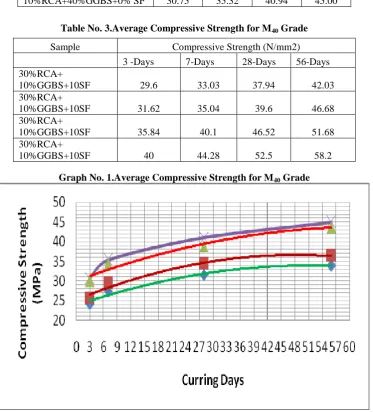
Table No. 3.Average Compressive Strength for M40 Grade
Graph No. 1.Average Compressive Strength for M40 Grade
Mixing of Concrete Sample Compressive Strength (MPa)
3 Days 7 Days 28 Days 56 Days
10%RCA+10%GGBS+0% SF 24.15 27.32 31.56 33.94
10%RCA+20%GGBS+0% SF 25.82 29.46 34.31 36.36
10%RCA+30%GGBS+0% SF 29.98 34.42 38.94 43.66
10%RCA+40%GGBS+0% SF 30.75 35.32 40.94 45.00
Sample Compressive Strength (N/mm2)
3 -Days 7-Days 28-Days 56-Days
30%RCA+
10%GGBS+10SF 29.6 33.03 37.94 42.03
30%RCA+
10%GGBS+10SF 31.62 35.04 39.6 46.68
30%RCA+
10%GGBS+10SF 35.84 40.1 46.52 51.68
30%RCA+
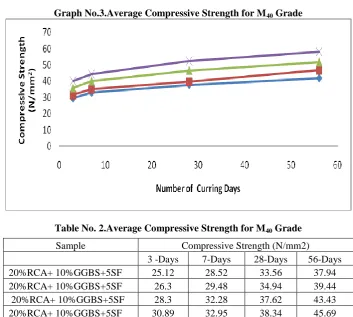
Graph No.3.Average Compressive Strength for M40 Grade
Table No. 2.Average Compressive Strength for M40 Grade
Table No. 3.Average Compressive Strength for M40 Grade
Graph No. 2.Average Compressive Strength for M40 Grade
Sample Compressive Strength (N/mm2)
3 -Days 7-Days 28-Days 56-Days
20%RCA+ 10%GGBS+5SF 25.12 28.52 33.56 37.94
20%RCA+ 10%GGBS+5SF 26.3 29.48 34.94 39.44
20%RCA+ 10%GGBS+5SF 28.3 32.28 37.62 43.43
20%RCA+ 10%GGBS+5SF 30.89 32.95 38.34 45.69
Sample
Compressive Strength (N/mm2)
3 -Days 7-Days 28-Days 56-Days
40%RCA+
10%GGBS+15SF 31.59 35.26 39.94 44.27
40%RCA+
20%GGBS+15SF 36.36 38.25 44.18 49.51
40%RCA+
30%GGBS+15SF 40.93 46.47 51.56 56.22
40%RCA+
Graph No.4.Average Compressive Strength for M40 Grade
V.
CONCLUSION
Based on the present experimental investigation, the following conclusions are drawn
The partial replacement of cement with GGBS in concrete mixes has shown enhanced performance in terms of strength and durability. This is due to the presence of reactive silica in GGBS which offers good compatibility. It is observed that there is an increase in the compressive strength for different concrete mixes made with partial replacement of cement by GGBS. The increase in strength is due to high reactivity of GGBS with Cement
Recycled Aggregate posses relatively lower bulk crushing, density and impact standards and higher water absorption as compared to natural aggregate .Tests conducted on Recycled Aggregates and results compared with natural coarse aggregates are satisfactory as per Indian coda provisions. The compressive strength of Recycled Aggregates concrete is relatively up to 40% than natural aggregate concrete
Cement replacement with 0% SF and 10%,20%, 30%,40% GGBS & Coarse replacement with 10%RCA leads to increase in Compressive Strength IS 20%respectively.
Cement replacement with 5% SF and 10%,20%, 30%,40% GGBS & Coarse replacement with 20%RCA leads to increase in Compressive Strength is 21% respectively. Cement replacement with 10% SF and 10%,20%, 30%,40% GGBS & Coarse replacement with 30%RCA leads to increase in Compressive Strength is 29%respectively. Cement replacement with 15% SF and 10%,20%, 30%,40% GGBS & Coarse replacement with 40%RCA leads to increase in Compressive Strength is 34% respectively. Finally, it can conclude that though the permeability is reducing even up to 40% replacement of cement with GGBS and 15% SF , Keeping the workability and compressive strength in mind ,40% replacement of GGBs is recommended for use in M40 grade concrete.
REFERENCES
[1]. Al-Mabrook, F.A. 2010. Utilization of dust profile path of cement factory in producing low-cost building materials. Civil Department, College of Engineering, Qar Younis, Libya. The 11th Arabic Conference of Mineral Wealth. Trablus
[2]. ASTM C 143-89. 1989. Standard test method for slump of hydraulic cement concrete. Annual Book of ASTM Standards, 04.02: 85-86.
[3]. ASTM C 496-86. 1989. Standard test method for splitting tensile strength of cylindrical concrete specimens. Annual Book of ASTM Standards, 04.02: 259-26
[4]. ASTM C 494-82. 1982. Standard specification for chemical admixtures for concrete. Annual Book of ASTM standards, Philadelphia.
[5]. B.S.1881. Part 116. 1989. Method for determination of compressive strength of concrete cubes. British Standards Institution, 3 pp.
[6]. Daous, M. A. 2004. Utilization of cement kiln dust and fly ash in cement blends in Saudi Arabia. Chemical and Materials Engineering Department, KAAU. Eng. Sci., 15 (1): 33-45 (1425 A.H.).
[8]. Iraqi Organization of Standards IQS No.45. 1984. IraqiNstandard specification for aggregate, ICOSQC, Baghdad, Iraq.
[9]. Maslehuddin, M., Al-Amoudi, O.S.B., Rahman, M.K. and Barry, M.R. 2009. Properties of cement kiln dust concrete. Center for Engineering Research, Research Institute, King Fahd University of Petroleum and Minerals, Dhahran 31261, Saudi Arabia, Construction
[10]. and Building Materials, 23: 2357-2361.
[11]. Rahman, M. K., Rehman, S. and Al-Amoudi, O.S.B. 2011. Literature review on cement kiln dust usage in soil and waste stabilization and experimental investigation.Center for Engineering Research, Research Institute, King Fahd University of Petroleum and Minerals, Dhahran, Saudi Arabia. www.arpapress.com/ Volumes/Vol7Issue1/IJRRAS_7_1_12.pdf.
[12]. Shoaib, M. M., Balaha, M. M. and Abdel-Rahman, A. G. 2000. Influence of cement kiln dust on mechanical properties of concrete. Cement and Concrete Research, 30 (2): 371-377. (Cited by Wang et al., 2002).
[13]. Wang, K., Maria S. Konsta-Gdoutos and Surendra P. Shah. 2002. Hydration, rheology, and strength of ordinary Portland cement (OPC)-cement kiln dust (CKD)-slag binders. ACI Materials Journal/March-April, 99 (2):173-179.
[14]. Abdullahi M. 2005. Compressive Strength of sandcrete Blocks in Bosso and Siroro areas of Minna, Nigeria. Assumption University Journal of Technology. 9(2):126-132.
[15]. Abo-El-Enein S.A, Hekal E.E., Gabi N.A and El-Barbay M.I. 1994. Blended cements containing cement kiln dust.Silicate Industrial. 59(9-10).
[16]. Barry R. 1969. The Construction of Building. Crosby Lockwood, London, England. Vol. 1. pp. 54-55 and 94.