Fuzzy Based Indoor Navigation System for
Physically Disabled
Uma. S. Gnanamani Sapientia. M.
Department of Electronics & Electrical Engineering Department of Electronics & Electrical Engineering College of Engineering, Guindy, Anna University, Chennai,
India
College of Engineering, Guindy, Anna University, Chennai, India
Abstract
This paper develops a system to aid people who are physically challenged with leg impairment to navigate indoor with ease. It also aims to provide the traditional powered wheelchair with added features provided with low cost design. The system is divided into 2 units. First part consists of sensors and direction inputs which are interfaced with motors through microcontroller. The obstacle avoidance scheme is developed based on fuzzy algorithm to prevent accidents. The wheelchair is operated by two DC motors. The direction keys are used to change the direction of the wheelchair. The other part consists of Bluetooth module connected to microcontroller to control domestic electronic devices. An android app is built for user interface. Using Relay, we can switch ON/OFF the electronic devices.
Keywords: Fuzzy, Home Automation, Bluetooth, Zigbee, Control Algorithms
________________________________________________________________________________________________________
I. INTRODUCTION
The people who are suffering with motion impairment problem, chooses an artificial means of locomotion, like wheelchair. The intelligent wheelchair helps the handicapped and elderly people to live independently in home. But the cost of individual health care is more expensive. Considering the people with medium and low income to afford such services with basic features is the main idea of this paper.
The main goal is to develop a wheelchair with autonomous navigation in an unknown environment without hitting any object. In ancient days wheelchair are self-propelled controlled by user’s hand rim and electrical power assisted controlled by electric motors on both wheels. The evolution of technology made the electric powered wheelchair controlled by driving commands (velocity and direction) through joystick and voice [1]. This paper deals with an electric powered assisted wheelchair with joystick to control the direction of the wheels. The wheelchair controlled with two DC motors. The controller operates these DC motors and controls the wheelchair accordingly.
The navigation is performed based on sensor information, behavior based or sensor based approach is analyzed. In which the wheelchair is derived by direct mapping between sensors and motors. The implementation of fuzzy based reactive control for the motion of two wheels in an unknown indoor environment with obstacle is performed. The fuzzy driving direction is determined by the fuzzy rules /algorithm based on the information provided by the joystick and distance to the obstacle measured by the ultrasonic sensor [1].
To avoid the problem of elderly people to approach the switch to ON/OFF the device, a home automation is provided. The home automation is achieved through various technologies. This paper adopts the Bluetooth technology, Zigbee for home automation. The command is given by user from android applications (smart phone) to microcontroller via Bluetooth [2]. The control App to board connectivity is in Bluetooth and the home automation part of the App is done in Zigbee for longer range.
II. RELATED WORKS
Autonomous navigation of the wheelchair in an uncertain situation is difficult task. To discover the optimal path for the navigation, various methodologies like Road map building, artificial field potential, fuzzy logic controller, neural networks, genetic algorithms have been proposed based on both classical and reactive method [3]. They present a free intelligent navigation FIN algorithm which has two main stages. The first stage is the sub-fuzzy set model uses the proper fuzzy set to find the shortest distance. The second stage generates the navigation of the vehicle according to the output of first stage.IR sensor and ultrasonic sensors are used for the obstacle detection and distance measure from the vehicle and obstacle, this measurement is used to find the shortest distance from the obstacle and take desired decision to reach target. The curve fitting method is used to create a map of unknown environment based on sensed data. Fuzzy sensor fusion and curve approximation. The ultrasonic sensor and infrared sensor are used to discover the unknown environment [4].
detected too close wall following method is activated. The angle compensation method is designed to overcome the deadlock problem in Ran Zhao experiment. The experiment was tested in MATLAB [6]. Path planning of autonomous robot using fuzzy logics to avoid obstacle of different shapes in workspace environment as a simulation was done in MATLAB Fuzzy tool box and analyzed by [7]. [8] suggested Goal seeking fuzzy logic controller (GSFLC) and Fuzzy Logic for Obstacle Avoidance(FLOA) both work concurrently for the navigation.
Look up table (LUT) based fuzzy system was addressed by [9] to improve the processing speed of a fuzzy obstacle. P/N rule fuzzy controller, in which positive rule direct the robot to a target and negative rules avoid from colliding with obstacles. The basic idea is to reduce the processing speed, is to store all membership function data in LUTs in advance and search for membership degrees in LUTs. [10] developed a solution based on XScale embedded platform and real-time embedded Linux. For collision free navigation laser range finder and artificial field potential (APF) approach are used. People appreciate the wireless life style. With the help of never ending evolution of technologies we can built various product according the convenience of consumers [11]. Latha and her team developed a home automation system based on cloud server interfaced using ardunio an android app was created for user command[12].
Raspberry-Pi card - Nano computer card with ARM processor was experimented with wed sever by Hayetusing android app as user interface[13] Security system for home main entrance, car door, and domestic appliances was designed using PIC Microcontroller and Bluetooth technology by Sadeque[14]. On analyzing a various methodology this paper deals with the idea to build a wheelchair with obstacle avoidance algorithm based on fuzzy and to create an android app for home automation using zigbee. The microcontroller named NUC140VE3CN, which is a 32-bit microcontroller with embedded ARM cortex with rich communication interfaces is used to implement the proposed system.
III. IMPLEMENTATION
Control System for Navigation
The idea for control system for indoor navigation deals with setup of wheelchair with obstacle avoidance scheme. The relationship between the input and output variable is defined by Fuzzy Inference System(FIS).The input is composed of multiple variable like left senor distance, front sensor distance, right sensor distance. In similar way the output is composed of multiple variables like right motor direction and left motor direction. One of the fundamental necessity in navigation is path planning. The path planning has to be designed with care to overcome the obstacle from starting point to destination point.
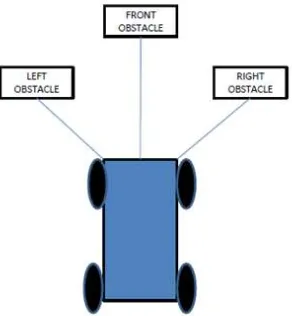
The collision free path planning is achieved by fuzzy logic based obstacle avoidance and navigation scheme. The application of the FIS to the user defined membership functions has been adopted with three inputs and two outputs along with two membership function for each input. The three inputs are the distance from the vehicle and the obstacle provided by ultrasonic sensors placed left, front, right [14] as represented in figure 1. The ultrasonic sensor ranges from 1cm to 4m. Many researchers have taken up fuzzy algorithm in robot navigation. Because for real time application fuzzy controller is more suitable. They provide simpler and more spontaneous method for collision free path planning.
The locomotion of the systems is based on two DC motors positioned at the different sides of the wheels (left and right). The direction of the motors control independently so that they can take a smooth turns in desired direction. The direction changes in order to have collision free path planning depends on the sensor values, which is provided by three ultrasonic sensor placed at left, right and front sides of the vehicle.
Fig. 1: Wheel chair model
Home Automation System
paper the fusion of Bluetooth and Zigbee are applied. The command is given by user from android applications (smart phone) to microcontroller via Bluetooth. The controller then transfers the command from remote unit through Zigbee which enables the user to switch ON/OFF the devices.
Fig. 2: Block diagram for home automation system
Fuzzy logic Implementation
Obstacle avoidance is the main requirement in autonomous navigation. Both the navigation and obstacle avoidance can be handled well with the Fuzzy controller. Fuzzy logic based system has the advantage that it admits the perspective nature of sensor based navigation. The defuzzification is done through Centroid method. Once the obstacle and the distance of the obstacle were encountered a collision free path can be created [1]. In times of obstacles the wheelchair would take its left or right turn based on the set of fuzzy rules. However, the result of these rules would not be the velocities applied to the robot motors, but a set of degrees of membership [14].
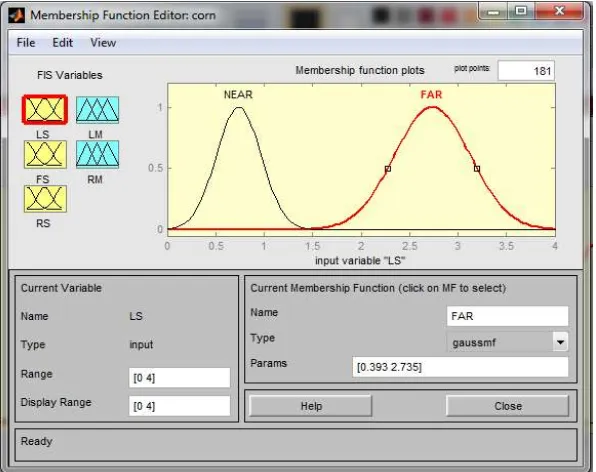
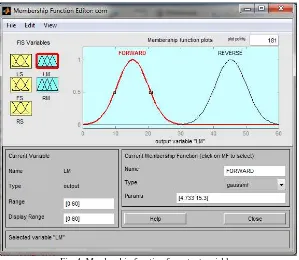
As shown in the figure 3 and figure 4 the type of the plot in the membership function is chosen to be Gaussian because it is essential to achieve smoothness in motion. In order to reduce the complexity only two membership functions are considered for each sensor input. The two membership functions correspond to input is named to be near and far. They are ranged as 0 - 1.5(near)m and 1.5 - 4(far)m. The two membership functions correspond to the output is named as’ Forward’ and ‘Reverse’. To check the output of the simulation the membership function output was verified for the range as 0-30 for forward action of motor and 30-60 for reverse.
Fig. 4: Membership function for output variables
It is quite difficult to control the movement of the wheels independently. Fuzzy commands used to control the left and right wheels are forward, reverse and stop to turn left the left motor should be in reverse direction and right motor should be in forward direction. These fuzzy control rules for avoiding collision are given in the Table 1 as taken from [15].
Table – 1
Fuzzy Rules for Obstacle Avoidance
L.S F.S R.S L.M R.M
FAR FAR FAR FWD REV
FAR FAR NEAR REV FWD
FAR NEAR NEAR REV FWD
FAR NEAR FAR FWD REV
NEAR NEAR FAR FWD REV
NEAR NEAR NEAR REV REV
NEAR FAR NEAR FWD REV
NEAR FAR FAR FWD REV
IV. RESULT AND ANALYSIS
Fig. 5: Simulation block for fuzzy condition
According to the condition the output should be L.M=REVERSE which should range from 30-60 which is displayed in the figure. 6.1 R.M=FORWARD should range from 0-30 which is displayed in figure 6.2.
Fig. 6.1: The simulation output for left motor
Fig. 6.2: The simulation output for right motor
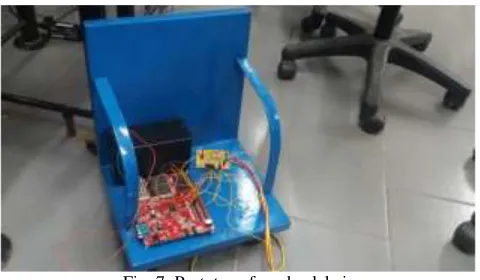
Fig. 7: Prototype for wheelchair
V. CONCLUSION
This paper has attempted to develop a wheelchair operated by joystick with obstacle avoidance algorithm based on fuzzy logic and a home automation system controlled using Bluetooth technology which is yet to be implemented. The proposed control system is capable of achieving collision free and smooth navigation. The experiment is tested using the prototype in an indoor environment to verify the efficiency of the algorithm. Our future work is to increase the efficiency of the algorithm so that it can make the navigation safer and suitable for outdoor.
REFERENCES
[1] Hiroki Murakami and Hirokazu Seki, “Fuzzy Algorithm Based Obstacle Avoidance Control of Electric Powered Wheelchair using Ultrasonic Sensor” International conference on Industrial Electronics IEEE Porto, 2009.
[2] R.A.Ramlee et.al “ Bluetooth Remote Home Automation System Using Android Application” The International Journal of Engineering And Science, Volume 2 ,Issue 01, pp. 149-153, 2013.
[3] Amir Shahzad, Rami Al-Jarrah, and Hubert Roth” Teleportation of AutoMerlin by inculcating FIN algorithm” Journal of Mechanical Engineering and Robotics Research, Volume 5, No. 1, pp. 1-5, 2016.
[4] J.G.Juang, and Y.C.Yang,” Fuzzy sensor fusion and curve approximation for indoor map building” proc. Of International conference on Artificial Intelligence and Industrial Engineering, pp. 554-557, May 2015.
[5] Mouloud IDER, and Boubekeur MENDIL, “Type-2 fuzzy logic control for a mobile robot tracking a moving target” Mediterranean Journal of Modelling and Simulation, pp. 057-065, March2015.
[6] Ran Zhao, Dong Hwan Lee, and Hong Kyu Lee, “Mobile Robot Navigation using Optimized Fuzzy Controller by Genetic Algorithm” International Journal of Fuzzy Logic and Intelligent Systems, Volume 15, No. 1, pp. 12-19, March 2015.
[7] Hedjar Ramdane, Mohammed Faisal, Mohammed Algabri, and Khalid Al-Mutib “Mobile Robot Navigation with Obstacle Avoidance in Unknown Indoor Environment using MATLAB” International Journal of Computer Science and Network, Volume 2, Issue 6, pp. 25-31,2013.
[8] Jinwook Kim, Yoon-Gu Kim, and Jinung An, “A Fuzzy Obstacle Avoidance Controller Using a Lookup-Table Sharing Method and Its Applications for Mobile Robots” International Journal of Advanced Robotic Systems, Vol. 8, No. 5, pp. 39-48,2011.
[9] Chung-Hsien Kuo, Yao-Sheng Syu, Tsung-Chin Tsai and Ting-Shuo Chen, “An Embedded Robotic Wheelchair Control Architecture with Reactive Navigations” IEEE International Conference on Automation Science and Engineering, Italy 2011.
[10] R.Piyare, and M.Tazil, “Bluetooth based Home Automation System using Cell Phone” IEEE International Symposium on Consumer Electronics, Fiji 2011. [11] Latha A.P, Prathik Agarwal, RishadhRAjgarhia, Shashank and Nafiya,” Home Automation Using Android Application and Predictive Behavior
Implementation” International Journal of Engineering and Techniques, Volume 1 Issue 3, pp. 49-53, 2015.
[12] Hayet Lamine and Hafedh Abid, “Remote control of domestic equipment from an Android application based on Raspberry pi card” International conference on Sciences and Techniques of Automatic control & computer engineering IEEE Tunisa December 2014.
[13] Sadeque Reza Khan and Farzana Sultana Dristy,” Arduino based security and home automation system” International Journal for Ambient System and Applications, International Journal of Ambient Systems and Applications, Vol.3, No.1, pp. 15-24, 2015.
[14] Anish Pandey, Rakesh Kumar Sonkar, Krishna Kant Pandey and D. R. Parhi, “Path Planning Navigation of Mobile Robot with Obstacles Avoidance Using Fuzzy Logic Controller” International Conference on Intelligent System Control IEEE, Coimbatore, 2014.
[15] C. G. Rusu and T. Birou,” Obstacle Avoidance Fuzzy System for Mobile Robot with IR Sensors” International Conference on development and Application Systems, Romania, May 27-29,pp. 25-29 2010.
[16] Marwah Almasri , Khaled Elleithy and Abrar Alajlan ,”Sensor Fusion Based Model for Collision Free Mobile Robot Navigation” MDPI Journals, Sensors, pp. 1- 24, 2016.
[17]
[18] Satish Palaniappan et.al,” Home Automation Systems - A Study”,International Journal of Computer Applications,Volume 116 – No. 11, pp. 11-18, April 2015.
[19] Wu Wei, Ma Xiaoning and Gao Xiuyu,” The Application of Fuzzy PID Control in Intelligent Wheelchair System” IEEE of second Global Congress on Intelligent Systems, Wuhan, 2010.