Volume 1, issue1 (2011), 24-33
International Journal of Pharmaceutical Research &
Allied Sciences
24
Review on Microspheres
Imran Abdul Kayyum Tadwee*, Sadhana Shahi, M. Thube, Ankit S.
Department of pharmaceutics Government College of pharmacy, Osmanpura, Aurangabad 431 005 (M.S.) INDIA
*Email: [email protected]
Abstract:
Microspheres can be employed to deliver medication in a rate-controlled and sometimes targeted manner. Medication is released from a microsphere by drug leaching from the polymer or by degradation of the polymer matrix1. The current review provides an in-depth discussion of therapeutic aspects of microsphere drug delivery including consideration of the prerequisite area for micro particulate, types of polymers used, method of preparation, method of release & kinetics, type of microspheres in brief, characterization & targeting of microspheres & practical aspects of microspheres
Keywords: Microspheres, Targeting, Microspheres polymer, Types of Microspheres
Introduction
The dug should be delivered to specific target sites at a rate and concentration that permit optimal therapeutic efficacy while reducing side effect to minimum and patient compliance during therapy. Site specific delivery with absolute accuracy can be achieved by attaching bioactive molecule to liposome, bioerodible polymer, implants monoclonal antibodies and various particulate carriers (Ex. nanoparticles and microspheres etc) the micro particulate delivery system if modified then maintains the desired concentration at the site of interest without side effect.
The term microcapsule is defined as a spherical particle with size varying from 50nm to 2nm containing a core substance. Alternate terminology for the microsphere is microbeads and -beads are used alternatively.
History: between 1940s and 1960s, the concept
of chemical microencapsulation technology began as an alternative means of delivering drugs. In continued quest for the more refined systems' in 1980s polymer/Membrane technology came to be known at forefront.2
Prerequisite areas for ideal micro particulate carrier system
The polymers and other material utilized for the preparation of microsphere should give following characteristics:
Target ability, Polyvalent, Biocompatibility, Longer duration of action, Sterlizability, Relative stability, Water solubility, Control of content release, Bioresobability, Water solubility and dispensability, Reduction of toxicity, Protection of drug2
Types of polymer used in preparation of microspheres 2
Classification:
1] Synthetic polymer A] Non biodegradable:
• Acrolein
• Glycidyl methacrylate • Epoxy polymer
• PMMA
B] Biodegradable: • Polyanhydides
• Lactides and glycolides and their copolymer.
25
A] Proteins• Albumins • Gelatins • Collagens B] Carbohydrates
• Chitosan • Carrageenan • Starch • Agaose
C] Chemically modified carbohydrate • Poly (acryl) dextran
• Poly (acryl) starch • DEAE cellulose
Table 1: Polymer with their bio adhesive property
Polymer Qualitative
bioadhesive property
Carboxymethyl cellulose Excellent
Carbopol Excellent
Polycarbophil Excellent
Tragacanth Excellent
Sodium /alginate Excellent
HPMC Excellent
Gelatin Fair
Pectin Poor
Acacia Poor
Providone Poor
Method of preparation
1) Single emulsion technique: In single
emulsion technique of preparation of microsphere the aqueous solution or solution of polymer is disperse in organic phase of oil or chloroform with constant stirring and sonication.
2) Double emulsion technique: this involves
formation double emulsions or multiple emulsion of type w/o/w and is best situated for water soluble drugs, protein peptides and vaccines the aqueous protein solution is dispersed in lipophillic organic continuous phase. The continuous phase is generally of polymer solution that eventually encapsulation of the protein content in disperse aqueous phase. The primary emulsion is then subjected to homogenization or sonication before addition to aqueous solution of polyvinyl alcohol this result in formation of double emulsion. The emulsion
is then subjected to solvent removal either by solvent evaporation or by solvent extraction process. The solvent evaporation is carried out by maintaining emulsion at reduced pressure or by stirring emulsions so that the organic phase evaporate out. The solid microspheres are subsequently obtained by filtering and washing. 3
3) Other Important methods of preparations
Polymerization technique including normal & interfacial polymerization, phase separation coacervation technique, Spray dying and spray congealing technique, Solvent extraction technique 2
Entrapment of Drug in Microspheres
The active component can be loaded by means of the physical entrapment, chemical linkage and surface absorption the entrapment largely depends on the method of preparation and nature of the drug or polymer. The loading is carried out in pre-formed microspheres by incubating them with high concentration of the drug in a suitable solvent
Drug Release Kinetics from Microspheres
Release of the active constituent is an important consideration in case of microspheres. Many theoretically possible mechanisms may be considered for the release of drug from the micro particulates.
1. Liberation due to polymer erosion or degradation,
2. Self diffusion through the pore, 3. Release from the surface of the polymer, 4. Pulsed delivery initiated by the application of
an oscillating or sonic field.
non-26
biodegradable coating, creating sufficientpressure that ruptures the membrane. The burst effect is mainly controlled by three factors the macromolecule/ polymer ratio, particle size of the dispersed macromolecule and the particle size of the microspheres. The pore diffusion method is named so because as penetrating waterfront continue to diffuse towards the core. The dispersed protein/drug dissolves creating a water filled pore network through which the active principle diffuses out in a controlled manner. In case of the biodegradable polymers, the release is controlled by both the erosion as well as diffusion process4. The polymer erosion, i.e. loss of polymer is accompanied by accumulation of the Monomer in the release medium. The erosion of the polymer begins with the changes in the microstructure of the carrier as water penetrates within it leading to the plasticization of the matrix. This plasticization of the matrix finally leads to the cleavage of the hydrolytic bonds. The cleavage of the bond is also facilitated by the presence of the enzyme (lysozymes) in the surroundings. The erosion of the polymer may be either surfacial or it may be bulk leading to the rapid release of the drug active components. The rate and extent of water uptake therefore determines release profile of the system and depends on type of the polymer, porosity of the polymer matrix, protein ding loading, etc.
Factors affecting the release:
Controlled release is an attainable and desirable characteristic for drug delivery systems. The factors affecting the drug release rate revolve around the structure of the matrix where the drug is contained and the chemical properties associated with both the polymer and the drug. Conventional oral delivery is not rate controlled. A drug encapsulated in a slowly degrading matrix provides the opportunity for slower release effects, but polymer degradation is not the only mechanism for the release of a drug. The drug release is also diffusion controlled as the drug can travel through the pores formed during sphere hardening. In some cases, drugs containing nucleophilic groups can cause increased chain scission of the polymer matrix, which also increases the rate of drug expulsion. Polymer molecular weight, drug distribution, polymer blending, crystallinity, and other factors are important in manipulating release profiles5.
Factors affecting the release from the particulate system :
• Drug
Position in microspheres Molecular weight physicochemical properties Concentration Interaction with matrix
• Microspheres
Type and amount of the matrix polymer Size and density of the microspheres Extent of cross linking, Denaturation or -polymerization Adjuvant
• Environment
• PH
• Polarity
• Presence of enzyme
Suitable
Drug
Candidates
for
Microspheres drug delivery:
Various drugs have their greatest therapeutic effect when released at the targeted area of body particularly when the release is prolonged in a continuous, controlled manner. Drugs delivered in this manner have a lower level of side effects and provide their therapeutic effects without the need for repeated dosages or with a low dosage frequency. Sustained release in the stomach is also useful for therapeutic agents that the stomach does not readily absorb, since sustained release prolongs the contact time of the agent in the stomach or in the other part of the body, which is where absorption occurs and contact time is limited appropriate candidate for microsphere drug delivery system is the drug possesses Narrow absorption window in GI tract, e.g., riboflavin and levodopa Drugs that act locally in the stomach, e.g., antacids and misoprostol. Drug having Poor bioavailability, potent drug so as to incorporate the small amount into the microsphere, and drug should not affect the local area for which is intended to act.
Release type of Microspheres:
A) Reservoir Type System:
27
essentially governed by the fick's first law ofdiffusion
B] Matrix System:
Release profile of the drug from the matrix type of the device critically depends on the state of drug whether it is dissolved or dispersed in the polymer matrix. In the case of the drug dissolved in the polymeric matrix, amount of drug, and the nature of the polymer (whether hydrophobic or hydrophilic) affect the release profile2
Types of Microspheres
Albumin Microspheres: Much of earlier use of
serum albumin microspheres was limited to the diagnostic purpose as the microsphere of different size range locates themselves differentially at selected sites to facilitate the imaging. Because of selected uptake of protein carrier by tumour cells, the microspheres of albumin are being widely used for the targeted drug delivery to the tumour cells5.
Gelatin Microspheres: Gelatin microspheres are
mostly studied because they are prone to strong opsonization Gelatin microspheres is prepared by cross linking gelatin in water in oil emulsion with glutaraldehyde. Opsonic gelatin microsphere are also prepared by similar method by dispersing gelatin in oil followed by cross-linking with glutaraldehyde6.
Starch Microspheres:
Starch is one of the most abundant biodegradable polymers that belong to carbohydrate class. It consists of the principle glucopyranose unit, which undergoes hydrolysis to yield D-glucose. Starch being apolysaccharide, consists of larger number of the free hydroxyl groups. By means of these free hydroxyl groups a large number of the active
ingredients can be incorporated within as well as active on surface of microspheres. The starch microspheres when introduced into the body cavity undergo potential swelling, leading to the development of mucoadhesive character7. Therefore, they are not cleared rapidly from the body cavity. Intra nasally administered insulin starch microspheres are cleared slowly and offer a delivery mode for protein and small molecules12
Dextran Microspheres:
Dextran, a carbohydrate is used to prepare hydrogel type of biodegradable and biocompatible systems. It can be chemically modified that provide higher percentage of drug or proteins incorporation. Simple method of incorporating aldehydes group to dextran is by oxidation using sodium iodate Protein loaded dextran microspheres are prepared by water in water emulsion technique. In this method an aqueous solution of the methacrylated dextran is emulsified in aqueous solution of polyethylene glycol (PEG). The dispersed methacrylated phase is then cross-linked by using radical polymerization of the dextran bound methacrylate groups. This leads to the formation of the dexran microspheres with hydrogel character.
Poly Lactide and poly Glycolide
Microspheres:
Poly (lactic acid) (PLA), poly (glycolic acid) (PGA) and their copolymer poly (lactide co glycolide) (PLGA) represent the group of synthetic biodegradable polymers. They were used earlier as absorbable sutures, implant material and recently as the carrier for the drug. L poly (lactic acid) has been reported as a suitable carrier for sustained release.
narcotic antagonist and anticancer agents such as cisplatin, cyclophosphamide and doxorubicin8
Polyanhydride Microspheres:
Polyanhydride are biodegradable and biocompatible polymers. They were first prepared using aromatic monomers. The Polyanhydride can be manufactured with desired features such as crystallinity, controlled degradation rate, degree cross-linking, water uptake, etc. Polyanhydride microspheres can be prepared % solvent evaporation, solvent extraction, hot mete technique and spray drying techniques. For the bet melt encapsulation procedure
Chitosan microsphere: The effect of Chitosan
has been considered mainly because of its positive charge; however, the adsorption process could also be the result of other forces might exist between molecules, such as hydrogen bonding or Vander Waal's forces. These interactions might have a strong impact on the absorption and bioavailability of pharmaceutical Due to attractive properties and wider applications of Chitosan-based microcapsules and microspheres they are used as a carrier for the applications in controlled drug release9, 10
28
Polyphosphazene polyacids are potent immunestimulating compounds Polyphosphazene polymers have a long chain backbone of alternating nitrogen and phosphorus atom with two side group attached to each phosphorus atom Polyphosphazene polymers form highly swollen ionotropic gel in the presence of the multivalent ions in aqueous media, such as calcium. Because of this property the polyphosphazene microspheres can be prepared under very mild conditions of low temperature and in absence of the organic solvent the microspheres are prepared by using a droplet apparatus, which produces spherical gel particle of size range 0.5-1.5 um. In this method a 2.5% w/v phosphazene solution is added in the form of the droplets to a 7.5% w/v aqueous solution of calcium chloride.8
Other Important types of microspheres:
Polysaccharides or Lipid Cross linked Chitosan Microspheres10, Alginate microsphere, Carrageenan polysachride or lipid cross linked chitosan microsphere10, Poly alkyl cyanoacrylate microsphere, and Poly Acrolein microspheres
Targeting
Using
Micro
particulate
Carriers (Applications):
Floating Microspheres:
Floating microspheres are gastro-retentive drug delivery systems based on non-effervescent approach. Hollow microspheres are in strict sense, spherical empty particles without core4. These microspheres are characteristically free flowing powders consisting of proteins or synthetic polymers, ideally having a size less than 200 micrometer11.
Microspheres in Vaccine Delivery:
Microsphere played vital ole in vaccine delivery for protection against the microorganism or their toxic product Biodegradable delivery system for vaccines is given by parenteral route. The interest in parenteral carrier lies since they offer specific advantages including improved antigenicity by adjuvant action, Modulation of antigen release andStabilization of antigen.
Magnetic Microspheres:
Magnetic monitoring has the advantage of being efficient in allowing high local concentration of therapeutic agents. A variety of magnetically
responsive carriers have been proposed for chemo-therapeutic agents. These include magnetite containing matrices (microspheres or nanoparticles of the starch, albumin, ethyl cellulose, etc.), ethyloleate based emulsion and natural cells such as erythrocyte ghosts. Magnetic targeting is one of the most efficient methods developed for targeting of active agents. Magnetic microspheres are prepared by mixing water soluble drugs and 10 nm magnetite Fe3O4 particles in an aqueous solvent of matrix material. This mixture is then emulsified in the oil. Ultrasonication or shearing is done to produce particle of suitable size range.
Magnetic microspheres are administered via intra-arterial or intravenous injection. Intra-arterial injection is given to achieve high systemic targeting while intravenous administration helps in achieving high pulmonary targeting12, 13.
Monoclonal Antibodies Mediated
Microspheres
Targeting-(Immunomicrospheres):
Monoclonal antibodies mediated targeting is a method used to achieve selective targeting to the specific sites. Monoclonal antibodies are extremely specific molecules. And can be utilized to target microspheres loaded bioactive molecules to selected sites7. The Monoclonal Antibodies can be attached to the microspheres by any of the following methods:
1. Non specific adsorption 2. Specific adsorption 3. Direct coupling 4. Coupling via reagents3
Chemoembolization:
Chemoembolization is an endovascular therapy, which involves the selective arterial Embolization of a tumour together with simultaneous or subsequent local delivery of the chemotherapeutic agent. Chemoembolization is an extension of traditional percutaneous
Embolization techniques. With
Chemoembolization, investigators embolize tumours with micro particles soaked with chemotherapeutic agents. The theoretical advantage is that such embolizations will not only provide vascular occlusion but will bring about sustained therapeutic levels of chemotherapeutics in the areas of tumour2.
Topical porous microspheres (Micro
29
Micro sponges are porous microspheres possesinter connected voids of particle size range 5-300 um. These microsponges having capacity to entrap wide range of active ingredients such as emollients, fragrances, essential oils, sunscreens and anti-infectives, etc these porous microspheres with active ingredients can be incorporated in to formulations such as creams, lotions and powders. Microsponges consist of non collapsible structures with porous surface through which active ingredients are released in a controlled manner. The Micro sponge system can reduce significantly the irritation of effective drugs without reducing their efficacy 15
Route targeting:
Oral
The controlled release systems have been developed for oral administration14. Oral route is also suggested for the delivery of the soluble antigens this as viable alternative can be considered due to the ability of the particles of definite size range. The risk of dose dumping is minimized with this formulation the smaller size of particles and high drug loaded particles show faster release and oral route is also suggested for the delivery of the soluble antigens.
Intranasal
In this type of targeting the microspheres is given at the surface of nasal mucosa by considering the muco cilliary clearance20. The particle size range of microspheres for targeting the respiratory tract is given table no.
Table .2 particle size of the microspheres for targeting of specific area
Respiratory part Required Particle
size (um)
Nose 25-30
Throat 20-28
Pharynx 20-24
Larynx 15-20
Trachea 10-15
Bronchi 8-12
Bronchioles 8-10
Alveolar duct 5-8
Alveoli 4-8
Ocular
The eye and the cornea are easily accessible targets. The washout effect, however, presents difficulties in retention of micro particulate drug carrier in the corneal sac. The rapid conversion of the particulate suspension to gel form reportedly leads to their longer retention in the eye5.
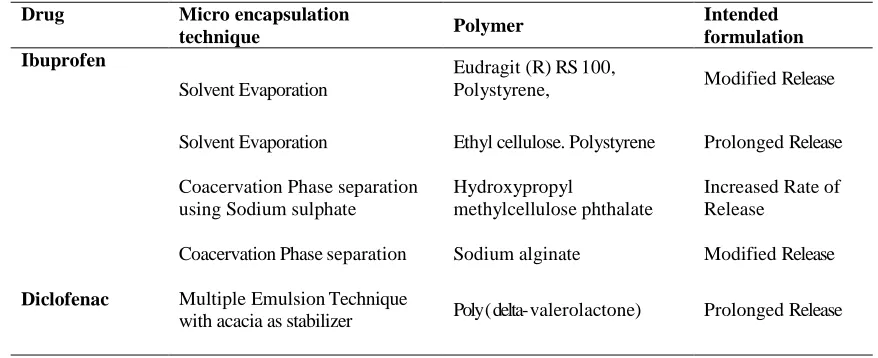
Encapsulation of microspheres its techniques and polymers used:
Table: 3 Microspheres entrapped drugs along with techniques and polymers used of intended formulation
Drug Micro encapsulation
technique Polymer
Intended formulation Ibuprofen
Solvent Evaporation
Eudragit (R) RS 100,
Polystyrene, Modified Release
Solvent Evaporation Ethyl cellulose. Polystyrene Prolonged Release
Coacervation Phase separation using Sodium sulphate
Hydroxypropyl
methylcellulose phthalate
Increased Rate of Release
Coacervation Phase separation Sodium alginate Modified Release
Diclofenac Multiple Emulsion Technique
30
A Non- Aqueous EmulsionMethod Ethylcellulose, oloxamer 188,
HPMC phthalate
Sustained Release
Congealable Disperse Phase
Method Glycerol monostearate
Tween 80
Sustained Release
Ketoprofen Modified W/O/W Complex
Emulsion Technique
Cellulose acetate butyrate.
Polystyrene Controlled Release
Spray- Drying
Eudragit S and L, Cellulose acetate Phthalate, Cellulose acetate Trimellitate, HPMC phthalate
Gastro resistant micro capsules with slow release
Spray- Drying Cellulose Acetate,
Trimellitate, Ethylcellulose Slow release
Emulsion/Solvent Evaporation Eudragit RS Sustained release
Indomethacin Phase Separation-Coacervation Benzalkonium chloride Increase Release
Phase Separation-Coacervation Albumin, Chitosan Slow re lease
Phase Separation-Coacervation Ethyl cellulose Increase Release
Spray Drying Technique
Hydroxypropyl methyl cellulose
Polyvinyl Alcohol, Hydroxypropyl Cellulose
Fast Dissolution
Ketorolac Coacervation Phase Separation
Eudragit s100 Sustained Release
Emulsion solvent evaporation Albumin
Controlled release/IM admmstration
Asprin
Solvent Evaporation Ethyl cellulose Modified Release/
Tablets
Oil -In- Water Emulsification/
So1vent Evaporation Ethylcellulose Modified Release
Spray -Congealed Hydrogenated soybean oil Controlled Release
Naproxen Emulsion cross linking Albumin Intra articular
Emulsion solvent
evaporation PLGA Intra articular
Co-Precipitation Technique EudragitL100-55 Extended
Release/Tablets
Meclofenamate An Emulsion-Solvent
31
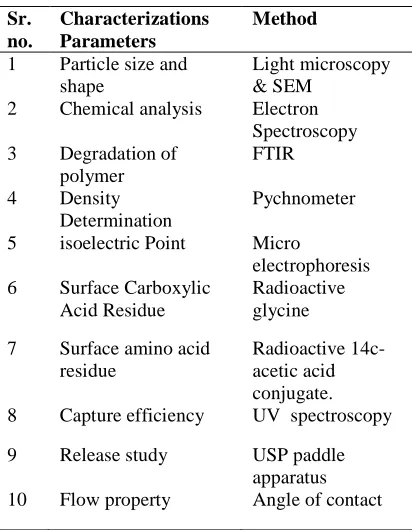
Characterization parameters & methods
:Microspheres are characterized in the following given parameters:
Table 4: Parameters & method for
microspheres characterization
Practical aspects of Microspheres for
Drug delivery
1) Applications:
Microspheres designed for oral treatment target the gastrointestinal (GI) tract, and encapsulation can enhance GI treatments. Toxic drugs, which can cause side effects when administered in large quantities, or insoluble drugs, which may require large doses to promote absorption, can be administered with a lower frequency and smaller
quantity The adhesion properties of biospheres can be exploited so that they stick to the adhesive tissues thus prolonging absorption time at lower doses
2) Commercialization of Microspheres:
Drug delivery is a primary topic in the biopharmaceuticals industry and microspheres do overcome many of the shortcomings of conventional drug delivery routes. To date a
limited number of companies provide commercially available microspheres and/or have active product development programs in the field. For market applications, microspheres systems are expected to undergo phase and clinical testing just as non-encapsulated drug systems. Patents mentioning polymer microspheres systems are also seen which shows their potential commercial importance
3) In vivo administration of Microspheres
The use of microspheres in mammals is not a theoretical issue but an applied reality. It shows how it was possible to obtain reasonable accordance between in vitro and in vivo In examples representative of animal testing Recently, made microspheres from poly (ortho-ester) for the delivery of DNA vaccines and tested them in mice. The polymer can prevent the DNA from degradation and the release takes place inside the cell where the weakly acidic environment degrades the polymer without compromising the biological activity of the DNA13
Conclusion
Overall conclusion is microspheres are good carrier for the drug in case of targeting delivery of the drug, microspheres drug delivery is safe and effective and utilized in various areas like floating, drug targeting, and vaccine delivery etc. procedure for preparation & evaluation for microspheres formulations are widely available with effective reproducibility. Microspheres drug delivery covers large area of drug targeting hence required consistence performance study to correlate the invivo performance.
“Cite this article”
Reference
:1. Neelesh K Varde, Daniel W Pack “Microspheres for controlled release drug delivery” Expert Opinion on Biological Therapy informa world January 2004, Vol. 4, No. 1 , Pages 35-51
Sr. no.
Characterizations Parameters
Method
1 Particle size and shape
Light microscopy & SEM
2 Chemical analysis Electron Spectroscopy 3 Degradation of
polymer
FTIR
4 Density Determination
Pychnometer
5 isoelectric Point Micro
electrophoresis 6 Surface Carboxylic
Acid Residue
Radioactive glycine
7 Surface amino acid residue
Radioactive 14c-acetic acid conjugate. 8 Capture efficiency UV spectroscopy
9 Release study USP paddle
apparatus 10 Flow property Angle of contact
32
2. N.K.Jain, Controlled and Novel drugdelivery, 04 Edition, 236-237, 21.
3. Alagusundaram.M*, Madhu Sudana
Chetty.C, Umashankari.K
MICROSPHERES AS A NOVEL DRUG DELIVERY SYSYTEM - A REVIEW International Journal of ChemTech Research Vol.1, No.3 , pp 526-534,
4. S.P.Vyas and R.K.Khar, Targeted and Controlled drug delivery, 07 Edition, 418
5. J.J. Torrado, L. Illum , S.S. Davis Particle size and size distribution of albumin microspheres produced by heat and chemical stabilization International Journal of Pharmaceutics Volume 51, Issue 1, 1 April 1989, Pages 85-93
6. Kezban Ulubayram, Inci Eroglu, Nesrin Hasirci “Gelatin Microspheres and
Sponges for Delivery of
Macromolecules” J Biomater
Appl January 2002 vol. 16no.3 227-241
7. Chien, Y.W.; Corbo, D.C. and Liv, J.C. (1991) “Mucosal delivery of progestational Steroids from a Controlled release device: in vitro/in
vivo relationship.”Drug
Dev.Ind.pharm., 17(17):2269-2290
8. Alexander K. Andrianov, Jianping Chen Polyphosphazene microspheres: Preparation by ionic complexation of phosphazene polyacids with spermine ournal of Applied Polymer Science Volume 101, Issue 1, pages 414–419, 5 July 2006
9. Lopez, C.R; Portero, A.; Vila-Jato, J.C. and Alonso, M.J. (1998) “Design and Evaluation of Chitosan/Ethylcellulose mucoadhesive bilayered devices for buccal drug delivery.”J.control.Rel., 55: 143-152
10. Rahul Nair, B.Haritha Reddy, C.K.Ashok Kumar, K.Jayraj Kumar
APPLICATION OF CHITOSAN
MICROSPHERES AS DRUG
CARRIERS : A REVIEW /J. Pharm. Sci. & Res. Vol.1(2), 2009,1-12
11. P. Dutta, J. Sruti, Ch. Niranajan Patra and M.E. Bhanoji Rao Floating Microspheres: Recent Trends in the Development of Gastroretentive Floating Drug Delivery System International Journal of Pharmaceutical Sciences and Nanotechnology Volume 4 • Issue 1 • April – June 2011
12. C.Nithya shanthi, Dr.Rakesh Gupta, Arun Kumar Mahato Traditional and emerging applications of microspheres: A Review International Journal of PharmTech Research Vol.2, No.1, pp 675-681
13. Urs O. Ha feli, Gayle J. Pauer In vitro and in vivo toxicity of magnetic microspheres Journal of Magnetism and Magnetic Materials 194 (1999) 76-82
14. S. B. Gholap*, S. K. Banarjee, D. D. Gaikwad, S. L. Jadhav, R. M. Thorat
“HOLLOW MICROSPHERE: A
REVIEW” International Journal of Pharmaceutical Sciences Review and Research Volume 1, Issue 1, March – April 2010; Article 015
15. Viral Shaha, Hitesh Jain, Jethva Krishna, Pramit Patel,”Microsponge drug delivery: A Review” Int. J. Res. Pharm. Sci. Vol-1, Issue-2, 212-218, 2010
16. Xianqiao Liu, Yueping Guan, Yu Yang Preparation of superparamagnetic immunomicrospheres and application for antibody purification journal of applied polymer science Volume 94, Issue 5, pages 2205–2211, 5 December 2004
17. Patricia B. Malafaya, Frank Stappers, Rui L. Reis “Starch-based microspheres produced by emulsion crosslinking with a potential media dependent responsive behavior to be used as drug delivery carriers” J Mater Sci: Mater Med (2006) 17: 371–377
33
19. Parodi, B.; Russo, E.; Caviglioli, G.;Cafaggi, S.and Binardi, G. (1996) “Development & characterization of a buccoadhesive dosage from of Oxydodone hydrochloride”. Drug Dev.Ind.pharm., 22(5):445-450
20. Mr. Amol Chaudhari, Mr. K.R.Jadhav, Dr. Mr. V.J.Kadam “AN OVER VIEW: MICROSPHERES AS A NASAL
DRUG DELIVERY SYSTEM”
International Journal of Pharmaceutical Sciences Review and Research Volume 5, Issue 1, November – December 2010; Article-003
21. Encyclopedia of pharmaceutical technology volume- 10, J.C Sworbrik and J.C.Boylen (Ed), Marcel Dekker, New York (Basel), 1988, page no.1-29.
22. J.H Ratcliff, I.M Hunnyball, A. Smith and C.G Wilson, J.Pharmacol. 1984,431-436.
23. S Fujimoto, M.Miyazaki et.al.
Biodegradable motomycin C
microspheres. Given intra-arterially for hepatic cancer, 1985, page no.2404-2410.
24. S.S Davis, L.Illum, microspheres as drug carrier in “drug carrier system”, F.H Roerdink and A.M.Kron(Eds), John Wiley and sons ltd 1989, page no.1
25. Gu, J.M., Robinson, J.R., and Leung, S.h. Binding of acrylic polymers to mucin/epithelial surface: structure-property relationships. Crit Rev Ther Drug Carrier Syst, 1988, 5:21-67.