Vol. 08, Issue 3 (March. 2018), ||V1|| PP 82-89
Analysis on Reliability Evaluation in Power System
Naresh Kumar Yadav
Electrical Engineering Department, Deenbandhu Chhotu Ram University of Science & Technology Murthal (Sonepat)
Abstract— Assessment of reliability performance in each power systems has to be performed in a cost-benefit structure. The model, yet, a time-consuming task, particularly for the systems which includes a huge count of feasible configurations, so simpler modalities referred to the reliability indices evaluation are utilized. This paper makes a clear survey on fifteen reliability evaluation approaches. Three details like used methodology, performance measures, and best performance is categorized and reviewed under various forms like diagrammatic representation and tables.
Keywords—Reliability Evaluation; power System; performance Measure; Time-Consuming; Electic power Nomenclature
Acronyms Description
CVaR Conditional value-at-risk
DR Demand Response
VOLL Values of Lost Load
PP Polypropylene
MLPVI Multilevel PV Inverter
SAPSs Small Autonomous Power Systems
PWM Pulse-Width Modulation
PLECS Piecewise Linear Electrical Circuit Simulation
SHP Small Hydro-Power
UGF Universal Generating Function
DOOBNs Dynamic Object-Oriented Bayesian networks
OOBNs Object-Oriented Bayesian Networks
EDA Enhanced Assessment of Distribution Algorithm
EPNS Expected Power Not Supplied
OCC Operating Capacity Credit
I.
INTRODUCTION
Nowadays, the generation of ELECTRIC power is professed to be huge contributors of emissions of carbon dioxide, and the nations in the world are determined for obtaining the vital portions of the whole electric requirements from all the substitute sources that minimize the carbon dioxide footprints. Among all the resources, Wind power is observed as the most appropriate substitute for the huge generation of power, and it is being quickly produced all over the world. With the raising of wind power penetration, reliability is considered as rising strategy since because of the added unpredictability in wind power. Most importantly, the generation of wind power is overseen by the various atmospheric circumstances, and the system operator of electric could not dispatch or control the wind power in the similar manner as like the existing generator including hydro or thermal unit. The output power generated from wind farm is ordered through the arbitrary deviations related to the wind regime at the site.
on 15 reliability indices models, their performance measures and the best performance. All those details is clearly described by means of tables. The rest of the paper is organized as follows: Section II reviews the literature work. Section III explains the research gaps and challenges in reliability assessment. Section IV ends the paper.
II.
ANALYTICAL
PART
ON
STATE-OF-THE-ART
RESEARCH
WORKS
A. Related WorksIn 2013, rade and Nikola [1] had performed an evaluation under the effect of DG continuously operation that has the output behavior (non-stochastic) on the supply reliability in industries. They have introduced a set of novel indices that represents the effect of DG under interruption’s frequency, duration of interruption as well as the estimated energy that has not supplied to each single customer. Additionally, a novel composite index accumulating the DG effects on the whole supply reliability, with the inclusion of frequency of interruption, its duration along with the expected energy not supplied, was developed. Finally, the outcomes from various case studies via real time network were analyzed and discussed.
In 2013, Suman et al. [2] have stated that the wind power generation was considerably varied from all the existing thermal as well as hydropower generation, which means the wind power, was managed via the atmosphere and it could not be dispatched as the existing units done for responding the need of the system. Here, the existing system’s operational reliability purely based on the committed unit failures along with the leading time of the consequent available unit. They have governed the wind turbine generators reliability contribution through the unpredictability of wind speed during wind site. Further, the short-term wind approach was introduced to the distinct lead time must be correctly joined with the existing committed units for power system’s operational reliability with the appropriate significant penetration of wind. In the lead time, risk concept was evaluated on the reliability contribution, and also the hot reserve units were dedicated later. This was done for the incorporate of wind power in formulating the reliability of system. Finally, the proposed model was applied on IEEE-RTS for evaluating the operational system.
In 2009, Pavlos and Yiannis [3] had stated that the formulation of reliability performance must be performed in cost-efficient model. The respective model, however, was very time consumption work, particularly for systems that include huge count of feasible configurations. Hence simpler approaches termed to the formulation of reliability indices were utilized. In the SAPSs, utilizes the deterministic criteria. The model, still, could not be practiced in SAPS, which includes only the renewable energy sources, because of the intermittent nature of the granted energy. This research work has implemented a complete reliability cost along with the analysis of worth. Further, it was joined with the formulation of certain fundamental probabilistic indices for discovering the performance. Then they have proposed the regularized energy reliability indices and unavailability’s energy index could be utilized as the sufficient criteria of optimal performance of system. Finally, the model was evaluated via a huge count of sensitivity analysis studies, which were on the basis of various maximum annual loads as well as various load type mixes.
In 2005, Annunzio, and Santoso, [4] have stated that since the intermittent renewable generation was more vital in the power generation portfolio, it becomes largely vital in assessing the effects on power systems’ generation reliability. Hence, it was the aim of this research work on evaluating the reliability effect of wind power penetration through the fundamental load probability loss and expectation process. In order to stop this, reliability effects of different wind power penetration levels were examined and were compared to existing fossil-based units. Finally, the outcomes have revealed that at wind penetration levels < 5%, the effect of reliability of wind farm was compared to conventional unit. Nevertheless, at penetration levels larger than 5%, the wind farm was minimal effective in minimizing the LOLE.
In 2005, Rajesh and Po [6] had stated that the rapid raising of wind power contribution has provoked the requirement on developing more broadly accessible models on assessing the actual advantages of supplementing wind turbines to conventional systems. Here, the reliability as well as the cost assessment needs the simulation of huge wind speed information for particular farm sites. The major phases were the construction of wind speed simulation approach, which was introduced in this research work. It was more vital that the proposed approaches could maintain the vital wind farm locations’ arithmetic characteristics. The Wind speed information from 2 wind sites was utilized for illustrating the approach. The authors have presented the outcomes of wind information simulation, power profile output, and power system risk formulation, which were compared via various wind model types at various wind farm sites. The aim was to gain a common and suitable approach for reliability assessment of power systems including wind sources.
In 2016, Egill et al. [7] have presented the enhanced way of concerned evaluating the capacity deficit risk of the composite power system. With the application of significance sampling of load states along with the generation as well as transmission states in the systematic mode, the developed approach was various orders of magnitude, which was more effective than the crude Monte Carlo simulation, which was significantly more effective than conventional algorithms (Cross-Entropy based), which has applied other manners of assessing the significance sampling distributions. They have applied the efficient system performance measure for finding the optimal significance sampling distributions while pre-simulation, which could vitally minimize the needed investigational effort. They have done the simulation work on IEEE bus system and has finalized the performance of developed approach.
In 2016, Mohammed et al. [8] have investigated the effects of transient instability on the reliability. Conventionally, the evaluation of composite system reliability was done, which was on the basis of steady-state assessment of load curtailments. Moreover, the system dynamics were because of the computational difficulty. The authors have proposed 3 stability indices (probabilistic transient) for the assessment of system robustness over dynamic contingencies. They have also used a direct method to evaluate the transient stability on the basis of formulating the system’s energy margin under fault events. In order to do the update of probabilistic transient stability indices, they have used the energy margins. The reliability dependencies and stability indices on the time of fault clearing were formulated. Finally, the model was applied practically, and the outcomes were indicated the significance of impact of stability in reliability evaluation.
In 2018, Amjad et al. [9] have stated that the Uncertainties in renewable energy resources, as well as demand in electricity, have proposed some novel drawbacks to energy as well as microgrids reserve scheduling, especially in autonomous mode. The authors have developed a risk-constrained stochastic model for maximizing the predictable profit of microgrid operator on various facts like renewable resources uncertainties, demand load as well as electricity price. Here, the trade-off among maximizing the expected profit of operator and the threat of attaining low profits were modeled through the use of CvaR approach. The influence of participation of consumer in DR program and its respective emergency load shedding for various VOLL were examined on the predictable operator profit. Further, the effects of various VOLL, as well as risk aversion parameters, were demonstrated on the reliability of system. They have also presented the simulation outcomes for illustrating the risk aversion effect on issue in system security. Finally, the arithmetical outcomes have demonstrated the performance of proposed model over other methods.
In 2018, YAN et al. [10] have stated that the construction as well as the ultrahigh-voltage power grid process have resolved the issue of optimal energy resources allocation and have played a major role in advancing the social development. For analyzing the ultrahigh voltage AC/DC system reliability that was joined with quasi-Monte Carlo approach, the reliability approach of different components as well as systems were recognized and had enhanced the simulation speed with high accuracy rate. They have also designed the BPA-Matpower data interface for assuring the compatibility as well as the efficacy of software. Subsequently, they have proposed an index system to evaluate the reliability. On the basis of actual regional power grid, they have compared the proposed approach with conventional sequential Monte Carlo approach, and demonstrated the effectiveness of the proposed system.
In 2017, Yeonha et al. [11] have stated that the PP had the exceptional heat resistant and was the eco-friendly insulation material, which could be recycled when compared to polyethylene (cross-linked). In Europe, PP insulated high-voltage class cables were commercialized. Thus, the authors have proposed the PP insulated cables and have done the physical, thermal, as well as electrical tests. The vital process was the verification of design life of proposed cables. Moreover, the authors have proposed the long-term reliability formulation approach via frequency acceleration and have recognized the draft standard.
independent dc-link voltage controller was employed by considering the generated reference value from the utmost power point tracking algorithm of every PV module. They have investigated the loss as well as the thermal distributions of various power devices and has also demonstrated for different PWM controllers. The simulation work was done using MATLAB/Simulink and PLECS blockset, and has validated the theoretical analysis as well. They have formulated the MLPVI’s reliability through parts stress mapproach, which has shown that the MLPVI has effective reliability by the use of phase shift PWM control technique.
In 2017, Lili et al. [13] have stated that the output of electric power from SHP generator was commonly defined by the water flow that slowly fluctuates in short term. Nevertheless, the water flow greatly deviates with seasonal alterations (for long-term mode). This uncertainty would take high effect on reliability of system, particularly for the systems with large penetration (hydro-power). This research work has presented an approach for evaluating the SHP generators’ reliability. The process of producing as well as flow runoff conflux was investigated and has modeled the UGF approaches. The expected generated energy along with generation availability was utilized for evaluating the SHP generators’ reliability. Finally, they have evaluated the performance of proposed model.
In 2018, Yuan et al. [14] have proposed a new reliability evaluation approach of complex systems by a DOOBNs. The proposed approach includes 2 major phases, termed, construction phases for OOBNs as well as for DOOBNs. In the Initial stage, the fragments of network along same structures as well as parameters were separated into classes; subsequently, those were then encapsulated. Then the OOBNs construction was completed as per the relationship between the encapsulated classes. Secondly, each fragment of dynamic Bayesian networks was developed by the initial stage phase, which was proclaimed by the class namely DOOBN. Finally, the accuracy of proposed model was formulated via all-voting, all-series, series-after-voting, voting-after-series, parallel-after-series, as well as series-after-parallel systems. Further, the model was minimizing the modeling complexity and could adopt the effective arithmetic reasoning algorithms.
In 2017, Liu et al. [15] have stated that for improving the computational effectiveness of Simulation (Monte Carlo) in reliability assessment of composite power systems, this examination has presented a model, which was on the basis of enhanced assessment of distribution algorithm (EDA) as well as double cross-linked list. While comparing to the conventional models, the proposed model was comprehensively enhanced in the phases of sampling and state assessment. Here, in the sampling phase, they have developed the learning algorithms based on the population. Similarly, they have introduced the mutation strategy for the probabilities of elements in normal state. This has enhanced the brilliant population characteristics. In the next stage, the state search, as well as match progression, was speed up through the utility of intelligent storage technology that was on the basis of double across linked list. At last, through the evaluation, it was proven that the proposed strategy was better in terms of reliable and effective.
B. Algorithmic Analysis
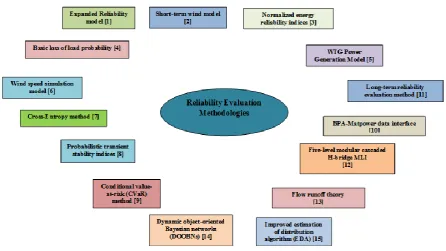
Fig. 1: Diagram of Adopted Methodologies C. Used Performance Measures
Table I summarizes the used performance measures from the reviewed papers. Various measures have been used, and particularly, EENS is a measure that is used by [1] [9] and [10], which is the 20% of the contribution. Then the power output is used as the measure in [5] and [6], which is the 13.33% of contribution. EPNS is the most important measure, which has been used by 26.66% of total contribution. 46.66% of total contributions have been used the LOLO measure. Only 6.66% of contribution has used the total failure rate. Similarly, 6.66% of contribution has used the OCC measure to measure the performance of proposed model. 6.66% of contributions have measured the total cost and turbine efficiency as well. 66.66% of total contributions have used other measures like Failure rate, Reliability measure, and probability, and so on.
TABLE I. ADOPTED PERFORMANCE MEASURES IN REVIEWED PAPERS Citation EENS Power Output EPNS LOLE Total
Failure rate OCC Total cost Turbine efficiency Others
[1]
[2]
[3]
[4]
[5]
[6]
[7]
[8]
[9]
[10]
[11]
[12]
[13]
[14]
D. Attained Maximum Performance
Table II summarizes the best performance measure attained from the reviewed papers. Here, the annual availability is 99.98, which is measured in [1] and [14]. The least EENS is 61.57. The UCR value of [2] is 2703. The best OCC is attained in [2] as 49%. The EIU of [3] is 0.48%. The COE of [3] is 0.393%. The best power output is 27MW, which is evident from [5]. The least LOLP of the contribution is 2.096. The best EPNS is 22.53. Then the best EENS of the whole contribution is 11232.948.
TABLE II. ATTAINED BEST PERFORMANCE MEASURE
Measure Best Performance value Citation
Annual availability 99.98829 [1] [14]
EENS 61.57 [1]
UCR 2703 [2]
OCC 49% [2]
EIU 0.48%, [3]
COE 0.393% [3]
Power Output 27 [5]
Probability 0.0112 [5]
LOLP 2:096 [7] [8] [10] [15]
EPNS 22.53193 [7] [8] [10] [15]
EENS 11232.948 [1] [9] [10]
Total failure of switch 14.96 [12]
E. Types of Load
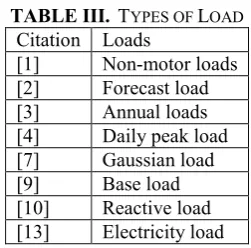
Table III summarizes the different load types that used in reviewed contributions. From this, it is evident that the model in [1] has used the non-motor loads. In [2], Forecast load is used. Annual loads are used in [3]. In [4], Daily peak load is considered. In [7], Gaussian load is used. Base load is considered in [9]. Then the reactive load is used in [10]. Finally, in [13], Electricity load is considered.
TABLE III. TYPES OF LOAD
Citation Loads
[1] Non-motor loads
[2] Forecast load
[3] Annual loads
[4] Daily peak load
[7] Gaussian load
[9] Base load
[10] Reactive load
[13] Electricity load
III.
RESEARCH
GAPS
AND
CHALLENGES
Even though, the tracing can conclusively grant the particular basis of evolving the real-time transmission system state space selection criterion in the aspect of reliability examination in power system; it encompasses the well-being model in the deregulated environment. Nevertheless, the deep examination is warranted to obtain the quantitative indices of restructured power systems via the joining of network equivalents as well as tracing. Further, several issues under load curtailment must be addressed at the time of contingency simulations. The policies that to be developed for the generation of re-dispatch must require to have effective attended. The issue of reserve management should be invariably figured in taking decisions. Then, the adaptability of network equivalents on creating a modeling paradigm to have well-being analysis must be made feasible through the implications embracement of power flow tracing. In future, a wider framework on the research perspectives for holistically addressing the vital issues that can profoundly effect the reliability examinations in the liberalized environs has to be developed.
IV.
CONCLUSION
This paper has reviewed the 15 contributions under reliability evaluation. All the works are viewed on three aspects: Used or developed methodology, the used performance measures, best performance measure. In this, the adopted methodologies were diagrammatically represented, and the other aspects were summarized in tables. More importantly, the challenges and future directions of reliability evaluation were clearly described in the paper.
REFERENCES
[1]. Rade M. Ciric and Nikola L.J. Rajakovic, “A new composite index of reliability of supply in the industrial systems with distributed generation”, Electrical Power and Energy Systems, vol. 44, pp. 824– 831, 2013
[2]. S. Thapa, R. Karki and R. Billinton, “Utilization of the Area Risk Concept for Operational Reliability Evaluation of a Wind-Integrated Power System,” IEEE Transactions on Power Systems, vol. 28, no. 4, pp. 4771-4779, Nov. 2013.
[3]. Pavlos S. Georgilakis and Yiannis A. Katsigiannis, “Reliability and economic evaluation of small autonomous power systems containing only renewable energy sources”, Renewable Energy, vol. 34 pp. 65–70, 2009.
[4]. C. D'Annunzio and S. Santoso, “Wind power generation reliability analysis and modeling”, IEEE Power Engineering Society General Meeting, 2005, San Francisco, CA, USA, vol. 1, pp. 35-39, 2005.
[5]. R. Karki, Po Hu and R. Billinton, “A simplified wind power generation model for reliability evaluation”, IEEE Transactions on Energy Conversion, vol. 21, no. 2, pp. 533-540, June 2006.
[6]. R. Karki and Po Hu, “Wind power simulation model for reliability evaluation”, Canadian Conference on Electrical and Computer Engineering, 2005, Saskatoon, Sask., pp. 541-544, 2005.
[7]. E. Tómasson and L. Söder, “Improved Importance Sampling for Reliability Evaluation of Composite Power Systems”, IEEE Transactions on Power Systems, vol. 32, no. 3, pp. 2426-2434, May 2017. [8]. M. Benidris, J. Mitra and C. Singh, “Integrated Evaluation of Reliability and Stability of Power
Systems”, IEEE Transactions on Power Systems, vol. 32, no. 5, pp. 4131-4139, Sept. 2017.
[9]. M. Vahedipour-Dahraie, A. Anvari-Moghaddam and J. M. Guerrero, “Evaluation of reliability in risk-constrained scheduling of autonomous microgrids with demand response and renewable resources”, IET Renewable Power Generation, vol. 12, no. 6, pp. 657-667, 4 30 2018.
[10]. Li, S. Yuan, W. Liu, G. Zhang, Y. Teng and X. Chen, “A Fast Method for Reliability Evaluation of Ultra High Voltage AC/DC System Based on Hybrid Simulation” IEEE Access, vol. 6, pp. 19151-19160, 2018. [11]. Y. Jung, D. Kim, B. Lee and S. Lee, “Development of long-term reliability evaluation method for polypropylene insulated MV cables”, CIRED - Open Access Proceedings Journal, vol. 2017, no. 1, pp. 120-123, 2017.
[12]. G. Ranjith Kumar, G. R. Zhu, J. Lu, W. Chen and B. Li, “Thermal analysis and reliability evaluation of cascaded H-bridge MLPVI for grid-connected applications”, The Journal of Engineering, vol. 2017, no. 13, pp. 1595-1599, 2017.
[13]. L. Chen, Y. Ding, H. Li and G. Jin, “Long-term reliability evaluation for small hydro-power generations based on flow runoff theory”, The Journal of Engineering, vol. 2017, no. 13, pp. 1708-1712, 2017. [14]. X. Yuan et al., “Reliability Evaluation Methodology of Complex Systems Based on Dynamic
Object-Oriented Bayesian Networks”, IEEE Access, vol. 6, pp. 11289-11300, 2018.
[15]. W. Liu, R. Cheng, Y. Xu and Z. Liu, “Fast reliability evaluation method for composite power system based on the improved EDA and double cross linked list”, IET Generation, Transmission & Distribution, vol. 11, no. 15, pp. 3835-3842, 10 19 2017.
[16]. S. Fu, Y. Mei, X. Li, C. Ma and G. Q. Lu, “Reliability Evaluation of Multichip Phase-Leg IGBT Modules Using Pressureless Sintering of Nanosilver Paste by Power Cycling Tests”, IEEE Transactions on Power Electronics, vol. 32, no. 8, pp. 6049-6058, Aug. 2017.
[17]. S. Babu, P. Hilber, E. Shayesteh and L. E. Enarsson, “Reliability Evaluation of Distribution Structures Considering the Presence of False Trips”, IEEE Transactions on Smart Grid, vol. 9, no. 3, pp. 2268-2275, May 2018.
[18]. O. Dahmani, S. Bourguet, M. Machmoum, P. Guerin, P. Rhein and L. Josse, “Optimization and Reliability Evaluation of an Offshore Wind Farm Architecture”, IEEE Transactions on Sustainable Energy, vol. 8, no. 2, pp. 542-550, April 2017.
[20]. L. F. Rocha, C. L. T. Borges and G. N. Taranto, “Reliability Evaluation of Active Distribution Networks Including Islanding Dynamics”, IEEE Transactions on Power Systems, vol. 32, no. 2, pp. 1545-1552, March 2017.
[21]. Manish Kumar Saini, Naresh Kumar Yadav and Naveen Mehra, “Transient Stability Analysis of Multi machine Power System with FACT Devices using MATLAB/Simulink Environment”, International Journal of Computational Engineering & Management, vol. 16, no. 1, pp. 46-50, 2013.
[22]. Parveen Dabur, Naresh Kumar Yadav and Ram Avtar, “Matlab design and simulation of AGC and AVR for single area power system with fuzzy logic control”, International Journal of Soft Computing and Engineering, vol. 1, no. 6, pp. 44-49, 2012.
[23]. Parveen Dabur, Naresh Kumar Yadav and Vijay Kumar Tayal, “Matlab design and simulation of AGC and AVR for multi area power system and demand side management”, International Journal of Computer and Electrical Engineering, vol. 3, no. 2, pp. 259-264, 2011.