INTERNAL DOCUMENT
Improved digitisation and computer plotting of Mk. II Pop-up Bottom Seismograph (PUBS) Data.
by C.E. Davies
I.O.S. Internal Document No. 54
[This document should not be cited in a published bibliography, and is supplied for the use of the recipient only].
I N S T I T U T E OF O C E A N O G R A P H I C S C I E N C E S
\
I N S T I T U T E O F O C E A N O G R A P H I C SCIENCES
Wormley, Godalming,
Surrey, G U 8 BUB. (042-879-4141)
( D i r e c t o r : Dr. A . S. Laughton)
Bidston Observatory,
Birkenhead,
IVIerseyside, L43 7 R A .
(051 652-2396)
(Assistant Director: Dr. D. E. Cartwright)
Crossway,
T a u n t o n ,
Somerset, T A 1 2DW. (0823-86211)
Improved digitisation and computer plotting of Mk. II Pop-up Bottom
Seismograph (PUBS) Data.
by C.E. Davies
1.
Improved Digitisation and Computer Plotting of MASK II Pop-UP Bottom Seismograph (P.U.B.S.) Data
Introduction
A new replay system was designed to replace the Mk I
replay system for reasons outlined below:
A. To increase the speed of replay. Whereas the old system
replayed data at the same speed at which it was recorded,
the new system replays at four times recording speed.
B. A clock displaying the PUBS time at recording was
incorporated into the design. This enabled rapid and
accurate positioning of the section of tape to be
digitised, instead of the slower operation involved when
listening for the shots with headphones and positioning
the tape by hand.
C. In order to improve the digitising of airgun data, two
thumb-wheel switches were incorporated. One switch is
set to the airgun firing period and the other to the
number of seconds, within that period, which need to be
digitised. There was no such selection in the old
system, airgun data was digitised continuously and the
necessary data "window" selected later by fortran
programming.
Do The MK II replay system was designed to be more compact
and has just the one replay unit in contrast with the
2. Digitisation
The CAMAC PDPII/05 Work Station is used to digitise
analogue PUBS data from magnetic "data" tapes and to
create CAMAC magnetic tapes which can be read b y the Honeywell
computer.
2.1 The Replay System
Six channels are recorded on the PUBS tape - three
orthogonal geophones (X,Y,Z), a hydrophone, a clock and a
flutter compensation channel.
The PUBS tape is replayed on a Sony TC-377 tape deck
with a special Branch and Applebee 6-track replay head. The
tape recorder also houses 6 pre-amplifiers which amplify
signals from the head.
2 .2 The Replay Unit
The amplified P.M. signals from the tape recorder are
de-modulated in the replay unit. This comprises five identical
demodulators for the hydrophone, the three geophones and
flutter compensation channels. The clock channel is demodulated
in a slightly different circuit which gives a Cmos compatible
output.
By inverting and then summing the output of the flutter
compensation channel with the data channels it is possible to
reduce the effects of variations in replay speed of the tape
recorder.
The pulse-width-encoded demodulated clock signal is
decoded in the replay clock to give the number of hrs, mins, and
10 sec pulses. The PUBS number and lay number are also
~ J
-The analogue outputs from the data demodulators may be
filtered and are then level shifted (Fig. 2) i n adjustable
amplifiers (called the d.c. offset) so they a r e compatible
with the input to the CAMAC system which digitises the data.
The demodulated clock signal is used in t h e interrupt
unit to generate pulses for the CAMAC which initiate and
terminate each digitisation sequenceo The lOH^ pulses of
the clock are multiplied by a phase locked loop to separately
produce 100 pulses/second. As replay is four times record
speed, the CAMAC therefore samples at 400 pulses/second.
2 . 3 Setting up Procedure
1. Ensure the replay system is wired up correctly i.e. as
shown in Fig. 3.
2. Set the thumb wheel switches. For airgun data a 120 sec.
"PERIOD" (usually) with a 30 or 40 sec "MARK". For explosion
data a 60 sec "MARK" with any "PERIOD" greater than this e . g .
70 sec.
3. Set the filter: The sampling rate of 100 samples/sec.
requires an anti-aliasing low pass filter of 5 0 H^. However
since replay is four times recording speed, a filter of 200 Hz
is required.
4. For both airgun and explosion data the switch on the
interrupt unit is set to "single shot" (S.S.). During the first
digitising sequence of an airgun series the switch is set to
— Z|.
5. The data tape is positioned on the tape recorder and
the CAMAC tape loaded on the SB data 8000 tape unit with the
write-permit ring fitted. The tape unit is put "ON LINE".
6. Check the following CAMAC modules are present:
ADC 9070
TELETYPEWRITER V24 706l
MAGNETIC TAPE CS0042 ) Station positions must be
DMA EC369 ) specified on the CONFIG tape
2 DUAL INPUT REGISTERS 9069A
Note: Above units correct until August 1979.
7. Switch on CAMAC system
8. Load the system with CATY V2.0 from floppy disc as
follows:
(i) Ensure crate, disc drive and PDP are switched on,
and PDP is switched to HALT
(ii) Place system disc in drive 0
(iii) Set 'I576OO' in BCD on PDP sense switches and press
LOAD ADDRESS
(iv) Lift PDP HALT switch
(v) Set all sense switches down and press START
When bootstrap loads the keyboard prompts for program name.
(vi) Type CT12R0
(vii) Type C2R0P1
(viii) Type NEWBRY
(ix) Enter f6 to continue
9. Enter the following
subroutines:-! SR CONFIG
! SR MAGTV3
! SR BUEBTM
! SR KEYINS
; SR PINDPI
Place disc RB¥ 001 in drive 1 and depending on the data to
be digitised, one of four main programs is loaded.
! RDl EXPl for explosion data (hydrophone channel only)
I RDl EXP3 for explosion data (3 geophone channels)
I RDl AIRl for airgun data (hydrophone channel only)
! RDl AIR3 for airgun data (3 geophone channels)
10. Decimal numbers can be obtained (as the default option
is octal) by typing ! DC.
11. I RUZ will start the program, and if the program was
loaded correctly, ENTER COMMAND S,R,L,P or Z appears.
(if not, the main program is cleared by INE; INS will clear
the main program and the subroutines),
S is the "setting up" command, and when entered, the program
asks for the MAX SIGNAL AMPLITUDE IN MILLIVOLTS. 5000 is
entered. The program uses this to calculate the number of
millivolts per step in the A to D conversion process (2.5 mv).
R is the "run" command, and the program requests
ENTER HEADER INFORMATION, TERMINATING WITH NULL LINE.
L will give a list of the contents of the data files on the
— 6 —*
F is used for locating the required file number. When F is
entered, the CAMAC tape is automatically rewound (or positioned)
to the start and the program asks ENTER FILE NO. The
reply causes the tape to be positioned at the start of this
file and again the system asks for S,R,L,F or Z to be entered.
Z is a command to erase whatever has been written on the
CAMAC tape.
A tape header is written at the start of each new
CAMAC tape, (See Fig. 4 ) and is used for labelling and
identifying purposes only. The next file is called the
"dummy file" and must contain at least one interrupt pulse, it
cannot be left blank as this would mark theend of data,
S, 5000 and R are entered in sequence again, but now a file
header must be written to the tape. For airgun data, only
this one file header is written and it contains the initial
shot number of the series. For explosion data a file header
is written before each shot is digitised. Details of
information contained in the file headers are shown in Fig. 5*
Columns 77-80 are used to specify the "gain" of the hydrophone
(i.e. that signal which after passing through a one tenth
attenuator, gives the maximum undistorted signal at the
modulator input. For the hydrophone, the multiplier in
column 2k is set to "one". When digitising the geophones,
columns 77-80 specify the lowest geophone gain (expressed as
the product of signal amplifier and modulator gains) and
the multipliers in columns 24, 30 and 36 set the correct gain
for the other geophones. For example, if the vertical geophone
(z) had a gain of 1000 and the other two had gains of 500,
"O5OO" would be in columns 77-80, "two" in column 24 and "one"
7
-is pressed twice (i.e. to include the null line) and the
program is "READY TO START".
2.4 Digitising explosions
The PUBS time (to the nearest minute) of the explosion
is located on the tape using the digital clock and the
oscilloscope display is used to obtain the approximate arrival
time of the water wave. The PUBS tape is rewound a few turns
(corresponding to about 10 to 20 seconds of PUBS time as
required) restarted ard then the "START" button on the interrupt
unit is pressed to signal the beginning of the digitising
, period (N). This period may contain the water wave arrival,
and must contain the preceding ground wave arrivals. A
calculation can be done to find the approximate time between
the ground wave and water wave arrivals and if possible the
digitising period will contain both these. The "START" button
should only be pressed when the red 10 sec period dot on the
clock display is not lit. An oscillomink record (paper speed
25 mm/sec) is made of each shot with the exact period of
digitisation marked on the record. When the N sec period is
completed the program will display the number of scans it
received; - this should be 100 x M x N (viz N sees at 100
samples/sec, M = number of channels) and will ask for another
command. The S, V = 5000, R and file header procedure is then .
repeated for each shot to be digitised. The closing down
procedure (see later) is then carried out at the end of the
- 8
-2.5 Digitising airgun data
Each series of airgun shots is digitised automatically,
one after the other. The exact 10 sec mark on which to start
digitising is worked out beforehand from a knowledge of the
initial ground wave to water wave time and from the maximum
value of this parameter in the data to be digitised. If this
time, and consequently the distance from airgun to PUBS,
increases with shot numberthen digitising starts on the 10
sec mark immediately preceding the water wave arrival. On
the other hand, if the time, and also range, decreases with
increasing shot number then digitising must start with the
water wave arrival appearing at the end of the initial digitising
period. The switch on the interrupt unit should be set to
"SS". If digitising is to start on say the second 10 sec mark
after the even minute, then the "START" button is pressed
immediately after the 10 sec period dot goes off during the
first 10 sec period i.e. when 1 is flashing. The switch on
the interrupt unit is set to "N" immediately after this.
An oscillomink record (paper speed 50 mm/sec) is made of
the initial and final digitised periods. Regular checks must
be made to ensure that the correct section is being digitised
(i.e. that the clock has not "jumped") and that the correct
number of samples is being obtained for each digitising period.
If a "jump" has occurred then the analogue tape is rewound to
the PUBS time of the last successful check, "CNTL" and "X"
pressed together to "escape" from the program, !RUZ typed to
use the F command for locating the corresponding file on the
_ 9
-series, this switch is set to single shot "(SS)" during the
digitisation of the last shot, or any subsequent digitising
sequence. To assist with the digitising of a i r g u n data a table
is made up from Precision Echo-Sounder records and the PUBS
log book giving the PUBS time and time of day of the first and
last shot of each airgun shot series.
2 . 6 Closing down
1. Press REWIND on the magnetic tape unit and remove the
CAMAC tape.
2. Rewind the data tape and return to tape store
3. Remove floppy discs from DRIVE 1 and ^ and then switch
off unit
4. Press down ENABLE/HALT switch on PDP 11
5. Power off at both wall sockets
3. Producing a Master Tape
The CAMAC tape is sent by post to Bidston, and a FORTRAN
program is run on the Honeywell 66/20 computer to translate
and copy the data from the CAMAC tape onto a Master Tape in
system standard format which is compatible with the Honeywell
machine.
3.1 CAMAC Tape - Description
The magnetic tapes created on the CAMAC system have
the following general format.
9-track, density of 800 bits per inch, no labels or serial
numbers.
Header files - ASCII, unblocked, fixed length record of 200
Honeywell words (Fig. 4 )
Data files - PDP binary, unblocked, fixed length records of
— 10 —
Explosion data - file header file followed by only one data file
Airgun data - file header file followed by a series of data files.
Each block of a data file contains 800 P D P numbers. For
hydrophone data, each PDP number is a sample from the hydrophone,
so there are 800 samples in each block. For geophone data,
there is a scan counter before each scan of samples from the
three geophones. The scan counter takes one P D P number. There
are 200 scans in each block giving 600 data samples, 200 from
each geophone.
The data on one CAMAC tape is transferred onto one or
several master tapes using one of four programs run on a
HP 264OA terminal (Appendix l). Generally a separate Master
tape is used for each PUBS on a station with airgun data, and
one for each station with explosion data.
The four programs in use
are:-MASTEXPl - for explosion data on the hydrophone channel
MASTEXP3 - for explosion data on the 3 geophone channels
MASTAIRl - for airgun data on the hydrophone channel
MASTAIR3 - for airgun data on the 3 geophone channels
Note: MASTEXPl and MASTAIRl can also be used for MARK % PUBS data.
Ref. C. Leary "MARK II PUBS DATA PROGRAMS", CCiyPUBS/2, 8th May 1979.
3.2 Programs MASTEXPl and MASTEXP3
The tape header is not verified, and is copied directly to
the file. For each pair of file header and data files
The file header is checked to see whether it is for PUBS Mark 11
hydrophone or geophone data i.e. verified for "A" in column 19
and "H" in col. 21 for hydrophone data or verified for A in cols.
- 1 1
-geophone data. The letter "B" in column 19 would, indicate PUBS
Mark I data. The shot number and the number of seconds of data
recorded are read and stored. The file header is copied with
no alteration, to the Master tape.
The PDF numbers in the data files are translated to
Honeywell numbers using subroutine PDPBCN. The data is normalised
using an average calculated from the first 800 samples, and
written to the Master tape.
Programs MASTAIRl and MASTAIR3
The tape header is not verified, and is copied directly
to the Master tape.
For each group of file header and data files
Same checks as above for A with H or X,Y,Z (same columns).
The file header is copied to the Master tape before each
data file, and the shot number field in the header is incremented
by one each time. (Fig. 6).
The PDP numbers in the data files are translated to Honeywell
numbers using subroutine PDPBCN. The data is normalised using
an average calculated from the first 800 samples, and written
to the Master tape.
3.4 Running the master tape programs
The programs are run on the Honeywell computer from a
terminal using the JRN command. The file containing the
Fortran program with its job control cards must be examined
at the terminal before it is run.
The magnetic tape numbers for the "CAMAC" and Master tapes
will probably need to be altered. The sets of adjacent files on
the CAMAC tape that are to be used to create the Master tape
- 1 2
Table showing line numbers to be checked.
Nou of CAMAC tape
MASTEXPl 5 0 IP = first CAMAC file 400 nos. in each set
(always file header nos.) IL = last CAMAC file
nos. in each set
(always data file nos.) 410
ISKIP = number of files initially skipped on 420 CAMAC
usually = 0
ITAPE = 1 to copy header = 0 not to copy 430
header NSETS = no. of pairs
of IP's and IL's 440 RS - rate of
sampling-no. of samples/sec. 450 No. of CAMAC tape 3l60 No. of MASTER tape 3190
MASTEXP3 50 400
410
4 2 0
430 440 450 3370 3400 MASTAIRl 40 550 560 570 580 590 600 3460 3490 MA5TAIR3 40 480 490 500 510 520 530 3570 3600 A line printer output accompanies each program run (Figs. 7 and 8) The reason for an unsuccessful run will be w r i t t e n on the line printer output e.g. a wrong tape number or parity error. A
parity error indicates a probable malfunction of the CAMAC system and the data concerned may have to be redigitised.
13
When either MASTAIRl or MASTAIR3 find a data file on
the CAMAC tape where the number of samples is not within - xuyo
of the expected number, the file is overwritten with zeros and
the program continues. This is indicated by a new page being
started on the line printer output.
When either MASTEXPl or MASTEXP3 find the number of
samples is not within - 1 % , that file, together with its
corresponding header are overwritten with the next header and
data file.
3.5 Master tape - description
9-track, density of 800 bits per inch, no labels.
Variable length, blocked records
Header files - ASCII
Data files - Binary
Apart from having no label and several files on a tape, the
Master tape is in Honeywell System Standard Format.
3. 6 Format
Each record contains 30 Binary numbers.
For hydrophone data, the records are padded with zeros for the
absent channels. There are 10 samples in each record.
WORD: 1 2 3 4 5 6 30
DATA: hydro 0 0 hydro 0 0 etc.
for geophone data, each number is a sample from the geophones.
There are 30 samples in each record, 10 scans of 1 sample from
each geophone.
WORD: 1 2 3 4 5 6 30
— izj. —
4. Computer plotting of PUBS data
h.1 Explosion data
Once a Master Tape has been produced, the Fortran plotting
program ASMAIN2B (Appendix II) reads the tape and produces
the time-distance plots. The job is run by loading the JCL
(job Control Language) and data cards at the Honeywell 707 at
¥ormley. The following JCL cards are
needed:-Column 1 Column 8 Column l6
IDENT IGHf, %niITMAJ&3]E
USERID RBW^RBW
$
MSGl 1, LIMITS OP 0.15HR AND 46K AND - 3 %PZLSTS
PC 0PS/W0RMLEY/CC936/RB¥jg)l, BLOCKS/^O , 9999/
LOWLOAD
$
OPTION RELMEM, PORTRAN, NOMAPLIBRARY BB, AA
USE GTLIT
FORTRAN ASCII, NLSTIN
$
SELECT RBV/ASMAIN2B0 EXECUTE
0 LIMITS 46E, -3K
0 PRMPL BB, R, R, RBV/LIB/ASSEML/Bl
0 PRMFL AA, R, R, LIBRARY/SPI
0 TAPE9 12,X1D,,91234,,RBW,,DEN8
0 PPILE 12,MLTPIL, NLABEL
0 PRMPL 15,V,S,OPS/WORMLEY/CC936/RBW01
0 STSOUT ORG
0 DATA
Data cards
15
Tills is an estimate of the maximum computer time
needed to run the job. Each shot takes approximately O.OO6 HR.
This is the file name of the Calcomp plotter tape and
must be unique i.e. only one job using that file name may be
in the system at any one time.
- - - -This is the number referring to the Master Tape from
which the plot is to be produced.
A preliminary (or stage 1) plot of all shot data is
produced first to check that the water-wave arrivals are
correctly aligned, and that there are no timing errors. If
a water-wave arrival is mis-aligned by an integral number of
10 seconds, then the NBSEC value for that particular trace is
wrong and must be corrected before the next plot. However if
a random timing error has occurred, the shot concerned, has to
be re-digitised.
A typical set of data cards is shown in Figure 9. (Por
a full explanation of parameters see ¥. Davey lOS Internal
Document No. 38, (Pigs. 9-16) July 1978). The parameter NVO
is the number of the channel to be plotted.
NVO = 1 when plotting data from the hydrophone
NVO = 1,2,3 when plotting data from the Z,Y,X geophones
respectively.
The parameter ECH2I us used to set the trace amplitudes.
Once a satisfactory stage 1 plot has been obtained
(Figure lO), a stage 2 plot is produced which is a reduced
travel time plot displaying the ground waves.
The parameter SED is a correction which adjusts the
trace position along the time axis to compensate for the
sea-depth, sediment-thickness (if known), shot depth and the
clock drift. The sea-depth correction is a negative quantity
— l6 —
velocities in the range 6 to 8 km/s. The shot depth and
clock drift corrections are obtained from the BSOUT listing
(the output file of the program BSEIA). The three corrections
are added together to give the SED correction, one for each
shot, which is entered on CARD 8.
2^. 2 Trace amplitude
The trace amplitude on the time distance plots is
controlled by a number of parameters which are taken account
of in the subroutines V0GA31, LECFEN and GPSTR effectively
using the formulae below.
For hydrophone data:
amplitude of = ITAB . GAl . (GA2 + GA3/100) . MLT(l)
trace ECH2 1250
where ITAB is the digitised number on the Master Tape
ECH2 is defined below
GAl is the CAMAC step size ( v ) )
)read
GA2 is PUBS hydrophone "gain" (mV) - columns 77 and 78 Jfrom
)the
GA3 is PUBS hydrophone "gain" (l/lOOmV) — columns 79 and 8o)data
Ifile
MLT(I) is a multiplier, equal to "once" for hydrophone )header
on the Master
tape
For geophone data;
amplitude = ITAB . (GA2/1250) . 1
BCH2 . (lOO X GA2 + GA3) MLT(NVOIE)
ITAB, ECH2, GAl as above
NVOIE = 1, 2, 3
(lOO X GA2) + GA3 = (gain of signal amplifier) x (gain of modulator amplifier)
17
-4 • 3 Shot weight and distance scaling
The parameters IXfT and DISTI are used for scaling the
trace amplitudes on a stage 2 plot to compensate for thevarious
shot sizes and, if required, the varying distance of the shots
from the PUBS.
jEXPOW
For shot size, scaling factor - ( I Q )
ItfT
where
IQ = shot size, as read from file header
I¥T = shot size to be used for scaling
EXPO¥ = 0.67 (from a data statement in subroutine GPSTR
EXPO
For distance, scaling factor = (DIST)
DISTI
where,
DIST = shot distance as read from file header (or DISTC)
DISTI = distance to be used for scaling
EXPO = - 1 usually (entered on card 6). This causes the trace
amplitude scaling factor to increase linearly w i t h distance.
These scaling factors are combined to give,
ECH2 = ECH2I . (DIST) . (ig) 8X^0^
DISTI I¥T
where,
ECH2 (millimicrons/sec/cm) is the value which appears on the plot
h .h Filtering
Traces may be digitally filtered (high-pass and low-pass)
by entering the required values on card h.
Rejection filters can also be used by entering the
required value for the parameter NPPR on card 9 (W. Davey
- 1 8
-4^5 Output from ASMAIN2B
A typical page from the line-printer output of ASMAIN2B
is shown in Pig. 11. This is part of a listing of a final stage
2 plot , where the SED corrections have been added and the
traces filtered and scaled for shot size (I¥T) and distance
(DISTI). The corresponding plot obtained is shown in Figure 12.
4.6 Airgun Data (R.B. ¥hitmarsh, The semi-automatic processing
and plotting of airgun record sections, 4th June 1979).
The same procedure is followed as for explosion data,
but with the following changes
1. In the JCL replace # SELECT ASMAIN2B by,
# SELECT AMAIN2GB
2. For an estimation of computer time - 100 shots take
approximately 0.11 HR. (when digitising period is 30 seconds)
3. The NBSEC value for the whole series of shots is the
start of digitising with respect to the whole second on
which the gun was fired.
4. A preliminary plot is made using data cards as shown in
Figure 13. Cards 1-6 have the same format as for explosion
data. There is now only one card 8 for each plot, and
it has four parametersL- NFC, NBSEC, DISTC and ICARTE.
where,
NFC is the number of the first file required
NBSEC - as above
DISTC is the range (kms) of the shot corresponding to file NFC
— 19 —
Card 9 contains the DELX and IFILE2 values (see range
calculations). DELX is the trace separation (kms) and IFILE2 is
the number of the last file for which the corresponding DELX
value is valid. Therefore, for any one plot, there will
usually be several card 9's.
4.7 Range calculations
Each airgun shot is played out on the Oscillomihk records
and the water-wave arrival time read by eye. T h e program BSEIA
uses these values and a suitable relocity/depth model of the
sea area concerned to calculate the airgun to P U B S range of
each shot. The utility Grafix program LIBRARY/AUTOGRAE
(see DP/US/GRAFIX/5) plots calculated range against shot
number directly from BSOUT (the output file for program BSEIA).
This plot is then approximated by several straight lines and
thus a series of shot to shot separations ( D E L X values) is
obtained.
4.8 Sea-depth and sediment thickness models
After a preliminary plot (Figure 14) has been produced
and examined for clock "jumps" each trace is SED corrected to
compensate for the travel time spent in the sea and in the
sediments. This is achieved by producing a sea-depth and
sediment thickness model along the seismic refraction profile
under consideration.
Firstly the bathymetric profile is drawn w i t h time as the
horizontal axis. The sediment thicknesses are obtained from the
seismic reflection profile (obtained by a 4 0 cubic inch airgun
firing every 12 seconds, in between the 1000 cubic inch airgun
shots). This profile gives the sediment thickness in terms
- 2 0
-by assuming a sediment interval velocity of 1.7 km sec~^.
These thicknesses are added to the bathymetric profile and the
sea-bed and base-of-sediment interfaces are approximated by a number
of straight line segments (Figure 15). The p o i n t s on each
interface (time of day, depth (m)) are entered into files and
plotted using the AUTOGRAF program. This profile is then
checked against the original hand drawn profile. One of two
programs, FTCORRl and FTC0RR2, is then used to calculate the
sea depth and sediment corrections. The output file contains
in the format required by Program ASMAIN2B (i.e. NFC, MBSEC,
SED (total sediment correction), and DISTC (range)). The
explosion plotting program ASMAIN2B is used because now each
APPENDIX I
Use of Terminal (also see lOS Computer User's Guide, section
4, September 1978).
HP 264OA
Note: DUPLEX is set to "HALF"
PARITY is set to "EVEN"
BAUD RATE is set to 1200
Upper case = characters to be typed by user
To Log-on
Press "Return"
If no reply press "CNTL" and "A" together
If no reply press "CNTL" and "C" together then "CNTL and "A" together
program name - TSS (time sharing system)
uaer id - CED#CED;G230
To access a file * OLD filename e.g. OLD MASTEXP^
To alter a file * OLD filename
* LIST (This lists the whole file unless "BREAK"
is pressed to stop).
or e.g. * LIST 10-100 (This lists lines 10 to 100 of
the file)
Put "REMOTE" key up
Type in amendment (to one line at a time)
Put "REMOTE" key down
Press "TRANSMIT"
Repeat last four lines if necessary
*RESA filename (RESA resaves)
To create a new file * SAVE filename
Appendix I (contd)
To run a program file:
* OLD filename
* JRN *:]Sr,ROUT(WA) or
(for a batch program with the output to lineprinter at Wormley (¥A)
FRN for a Fortran time sharing program
To list a file on the lineprinter at ¥ormley
*OLD filename
* *: irMMT (userid, project no.), ASIS, ROUT(WA)
or */PRINT
The job number in both cases will appear as isnumb T
Useful commands
*CATA,S lists names of files and catalogues directly under
master catalogue in alaphabetical order.
*JSTS snumb gives progress of specified batch job
*CMDS snumb gives continued progress of specified batch job in full
*JABT snumb aborts the specified batch job
*JOUT snumb lists batch job output on terminal
Use of (HP 2648A) Graphics Terminal (ref. User's Manual)
This type of terminal can be used in the same way as the
HP264OA terminal but the position of the "BREAK" and "ENTER" keys
are different. It has the facility of screen plotting.
To look at a plot from a file,
*CRUN L]3RARY/SPIT0H,R
3
-Appendix I (contd)
Wlien an equals sign appears, either enter a scaling factor o r press "RETURN" e.g. a scaling factor of 0.5 would halve
the size of the plot. Ifhen the plot is complete it will disappear from the screen. To retain it press "SHIFT" and "A DSP" together then "SHIFT" and "G DSP" together. The plot c a n be enlarged
APPENDIX II
Program Pile CED/ASSMAIN2
This is the source for the B.C.D. versions of the
plotting program RB¥/ASMAIN2B (for explosions). A flow
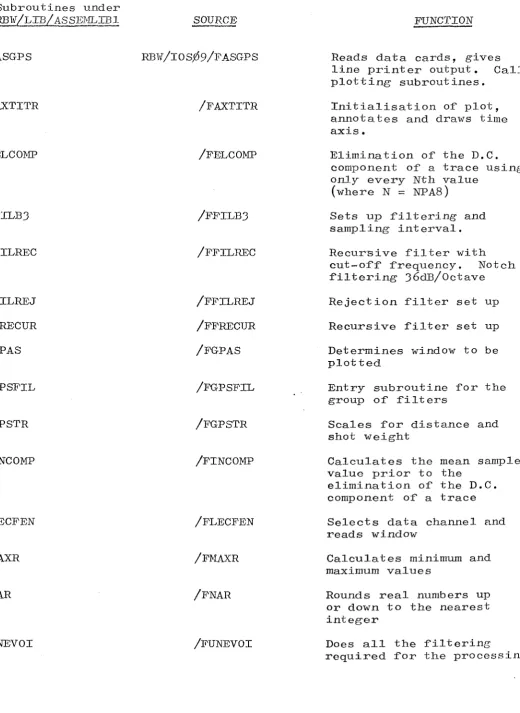
diagram of the subroutines used is shown in Fig. I7.
Different versions of the plotting program stored
separately under the Master catalog use a lot of filespace.
This has been reduced by placing most of the subroutines in
object format in a library, i.e. RBW/LIB/ASSEMLIBl (Pig. 18)
The source of each subroutine is stored in a file such
as
RB¥/lOS09/Fsubroutine name
eg BBW/IOS09/PGPSTR
To change one of the subroutines in the library the program
RB¥/ADDLIB (Fig. 19) is used with ^ SELECT new subroutine name
CED/ASSMAIN2 consists
of:-Main program
Subroutine V0GA31 Calculates amplitudes and gain for
M A R K I, H .
Subroutine GPSET Reads MARK II header information only
In general if a subroutine appears in both CED/ASSMAIN2 and in
library then the former version is used during execution of the
fAINUTE MARK
AUNUTES
!
6 G I T S
HOURS
9 BITS LAY NUMBER 7 BITS
PUBS 4 BITS
u
E x a m p l e
u u
32 16 8 it 2 1
! I
I lO O O I O I lO O I I O I O O l O O O O O I l|0 O I 0 |
I I I
5 mins 116 Hrs Lay 3 PUbS 2
1/. Clock input ( puAscs)
S V
v o l t s
O 8ms
sync L pulse. Less than 2 s r i s e t i m e .
2Y\ S i c n a l inout
5.11V
2 . 5 V '
.20mV
T h e signal sust have a p o s i t i v e v o l t a g e snd lie in
the range 20 mV - 5.12V.
0
s c:\uuoni UKEXTERNAL CONNcCYl ONf
INTeANAL tONNEc^lOA/S
D
r
T(\VE
E
i\
5
—
0
1
. 9xECORT)&R
'0
1
( ^K
Ic
C.LC) Cy.
D ^ T h
cv;nNNZL5 H.X,V,% fUU-TTcft CO!lf», Sf.TT^RV SHyfU; 9&W&R S!.iPi»L3 UNIT
i).c.PLAv i v m '
M -4 m
r
"O
m ) -4 j
^ *
z I
n -n O %) 3. ?
-4 CLOCK
C7 h -i
- 4 m 7» C? m o a < - >
(7 m z o c X -f' c? m 1 o C X f F\L'T^;k iNTCRR'^fT
u C. Off SCT
ENS 0? PlL& MftAfK
C . A M ^ : C
T n p L v . N n
FORTRAN Coding Form
xym'-Tnyr-A u/voso Printed In U.K.
Qi '.h zcTs per |\:'j m;,y v.iry.
GRAPHIC P*G! C
' j DATE Pur^CH
i CAKU cicCikO rJUMw:'
F O R T R A N S T A T E M E N T OlNTlf.C/.ItCN SECL'iNCE
t I
? l 73 21 : A ?? 2,3 ?9 10 i ; 32 33 14 35 M 3 7 J t g 19 ^0 - i l a? ^3 a 45 J4 A? as I ? 5 0 5 ' 5? 53 ,^4 3 ; 36 5 ' 59 5? M) A! 62 A)
I I I ! ! !
P O R M A T
I- : ' 1 i
I All lit!
L : T-afc i l L ^ .
i JjjDkrE.i
I
I T I I I ^ ' I ..L I I I i.STA-TioN
1 !
I '
r%'
r i " i r
Btl nil
Y L T g R
ft!
.jiSlQIAf
. . .
T
chMnc. S'f/ v-s
y o
Figure 4. TAPE HEADER FORMAT AND DESCRIPTION
I I I i I
l>
i 1
,SnNPk.;w6l_!_L -iWcAMLEY: -rAj'fl
t I !
i i i ! I
I
t I
I __ J_
I
I I
I
r o n r n A N Corfing f o r m
[ Pi'ucr' 40 G;K",'!C '"•] 1 OAIE j i'isi»ur rwjfH
— 1 1
! I N UM
FOR IRAN SlAUMFNl
ys ?6 2^ M TO 31 ]Z 11 ]« 35 T IR l* 41 4/ 44 45 46 4? 4)")? 51 sT 53^54 55 56
K.n :KMl
; I " 1
-! , I -! I I (i) I I
I
\
1 J-/'IS") Alz'l
"i?
i 1^)
A':: I f'! 1) 3 1
I Ofv KhS, . ,rfcoKHS CAMHC! _,11(1,3.,3)9u.'sli.fv)% invL^Vcf! ! :..'r an(^%;_iCAiNCvj
I I . ' ' : ; : ! : I i i I ; ! I I u.J,.. _\L n' i : iJ %' .J i* !. ;
I ! I _!...! !_L!J__|..LkLrUA9)i:.W 1 ' : I i I I : I ' I , ; ^ I *
Ey. A y i P L E 5 .1 - • i J I —' : r i '
: VtAv :^tarw^ 0!:(£| wvivi L ^>(^9 _ . ..irZ'goo A U H '
' rauun) : qourv'^ 10 OOJ _.i
! . , L j i : i . U / J J . ! ! l i
^-cWi 11.1,
JT I
U .
Aljx:
I !
r r I I
L I I
\jvtir-' I ^
"1
1 h J
-i!'t
, vn , J
L
b(' 6' t i t ' *«
I
-T r r L i-t - -ji _j6;0{_ ,01
L. . i . _
.KWRl
• t
-I r
I !
L .i..i ( / ' ' ' ' ' ' : - : ^
i T U i n z z i n t z z j .l_i ZS6:1 AMSEd J_%YR_ k5in Qf<3^ I L L IJ_!...U_U._:J2_1.
t li.'K ] !%4i I i%4-: inliz: ! i I I U i i i I i i U : : ; . ;
I ;SECS ; Y^ccs ! ! I I I I 1 I I 1 M : i i i
' ! •
I I b i iirak&^L i L i i I j i i ^ ! 'i _! l I l T i j J I U " ' I T
L ^ :
c m ]
Q;_.
I I I
I I_j
-)! I l_
" 'li t-— -1 - - j - i- ^ 1
t
I 'ol
..uL .1.
I I I
• ' !
' n T i
i i ] I
_LLL.IJ.. L L L
-, ! _ , _ 1 1
jO J._!Jq! ! J. |oJ.J s'l'o op! "(— l- I'
Figure 5. PILE liEADER P'ORMAT AND DESCRIPTION I I i I I i I
I I I i I
A T h P E w c n b E R
^AJLAAlA^ {\LC
t\LE H E A D S A
(FH^
b(\-rn f \ L e M
f \\<L <;
b F
t f
bF
4%%:.
HalXDE. k
F M
T:)f
F V i
bip
F H
b f
Ale 1
f A c %
p\\c 3
f\\ <L G
P,\& (o
P \ L 7
T^Pr Hl'AC'F/? /;;;iTTE;r FILE NU''1^ER .. ^
$ CD C63 12/6/7') E^Pl-:LP5D.M4X-SIG:yV .5TEP-2;':yV.TyO.O"SAMP/SEC .y942 L % Z — 6
CAriAC FILE ^Lr.:r^4-Tn- Hr vSnn %yrxr""":|']5' L^ CA'yACr"FILE\\lUM;teR' U$(\D ^
PUPS MARK II
E^PLn3I0N"iiY!)4uf'!mXE=-0ArA-10
***** FlLEHL;nFH'%:RlTTE\-;riTn-tiASr&'^ lAl^C-- ^ PILE NU^HER ' 2 " -SHOT'NU^mER 1"-*****
^::---12,-D'?6J3 24 1 bO 2 2b_ ;0 ,:A0\%2;33,1978 03 - : /: :^"i2
14
^ g * * * * * D A T A F I L E / W R I T T E N n N T O \ / A S T E n i T A P E : : : : = M A S T E R F I L E r ' ^ ^ N U Y H E R = ' 3 " S H H T - N U M S E R " ' 1 ^ ' 7 * * * * * :^= ' L
E X P E C T E D S ^ ^ ^ L E S = b O n O A C T U A L N U / S E R ' O F S A M P L E S z ' b O O l - - " ' '
i s v : A V E R A G E V A L U E C A L C ' I L A r E O . F K O t ] 6 0 0 1 S A f / t r ^ L E S = 1 0 U 7 . : - - : " y = - - _ - _ _ 2 " " ^ l E
- ' A V E R A G E V A L U F . C r L C n L A T E u r ^ n ! ' " - n O O " n A M P L F b ^NO" USED T D O H T A I N n U T P U T D A T A = " ' 1 0 0 8 . " J
: J- - ; - -. : T . : . r : r ^ . r : . r — .— -J . . . . . . _r — r - . - - r . — . - . -_ _
^ J . - .' _ . . . . ;. - _ - . : . .i. : - - r- r . - - - .. - . y_:^- : z . - . "2C
***'A A A * ^ *AAA AAA " - - — _ _ —
z E A i - ' A C r l L E N U M B E R : T O H P ' J S E P N E X T 4 5 L f b T C A v ^ c F M E N U M B E R . U S E D : : ; . 4 9 ' = ' . " - ' I . " "
-zPUPS MAHK' II'EYPLnSTON'HYDRCiPHO':!: DATA - -- - ' -ccj--- ri.-r/T. Vr:"" " 2;
" 26:***** :FILE Hc^DEW/xRITTEn;0\=TQ ^'aSTER TAPE- - MA5TEH FILE:NUMQER/:".=^.r1 _ "[ ' --SH0T]-NUyBER7%f2^?*'^'***"P' - '' .':"2G
\ 09B03 25 Hl?50dA"'-i I'-- =- -- - 2 60 2 Pb ' 0 ' 0' 3 M 7 8 03 ' ... :z
^ 2S';-. ' " _ / .r.:/:^-.. -. _ ' - _ ^23
***** DATAYlLF'-;.RlfTF:rhY;r[r\1ASTER TAPE "^----"—"MASTER FtLENUMRFR 5 " " SHOT NUyBER'^''"2'-**t**---^ L
= 2 5 E X P E C T E D N U - ? g E R O F . - 5 A \ ' P L E S . : = " D D u O " A C T U A L = : ^ " T - ' - "
" A V E t ^ A u E V A L U E C A L C U L A T E ] F v i - I 6001 C A X P L E S =-'""^1 007 . " ' ' ' .... .:^=.-_r_::.::r_.=:_=.
- > 3 4 ^ A V F R A G E V A L L r r ; C A L C U L A T E : ) ^ ' H l j M - l P J O l S A ' i ^ ' L E S . A N D - ^ T O O R T A I N O U T P U T I D A T A ^ — ^
4 » * * * * * * t * * * * * * * * * * * * * * * t* * * * * * * & ! & * * * k - k * i A -A A * * * * X * i * * * * * * * * * * * 1 * /k * * * l l * * * * * * * * * * * * * * * * * * * * * * * * * * * - — - - — — - - - - 7 ; - ; v : - r
> CAMAC FILE NU>Mirr<- j o "BE 'USII;' r-i'tX f-"—uy-LAO f CAY.AC"' FlLt! NUMHElf USED ^6
^PUBS 11 EXPLnilDN rlYrX^Cr^'HUL DATA _ _ _ _ _ ^
* * * , , F I L E n T . - . ; , E ' : . , R T T T F / ; n r i T n ' V A S T E R T A P I : ' - - " " " " " " " ' M A S T E R F I L E ' ^ U Y H E R 6 S H O T N U M B E R 3 " * * * * * - . "
«L UO603 27. ^SDSDOA'^rt - 3 &0^iF:2\25=?p-.}::0 L-.^^
<4 <4
DATA FILE .{DITTEN ' OMTO--^-lA'STER H ARE=3;%'^:Wi%l:-. M AS T EN ' FI LE^MUYB^R - 7
- EXPFCTFn OF 3A-.iPLrs "::"^n;^0-ACTtlAC';in,^nER^nF SAMPLES ="5991
<B-:AV[KA::E'VAL!ir"c^L:uLATE0TP0'4:599r,,SA!.^PL[s ^:v:^--ioo6;-x-pn
^ AVE^'AUE VALUE C.'.LCULATE.l F:;n-r- H00"5AYPLES Arm'USEn TO nrjTAIN OUTPUT DATA = - 1 006:
A * * * * A A * <r A X A * A A A * > A - > A A * > A * * A Ai A * * A A ^ A * . A A A A A A A A A A * A A * * * A * A A A A A * A A * A * A A * A A * * A * A * A * A * * * * * * * * * * * * * * * * * * * - - -
' T A ^ : : rin A OF? W P I T T E : ; ' l ^ A S f E H ' F I LE^i^lU^IBgP" " 1 . . .
K CD 0 6 2 9 9 0 2 1 1 / 6 / 7 9 A I R I S ' L R S Q Z W A X ^S"! G" 5 VZST EPz 2TS M V .iOO " S A M P / S E C . M 9 4 1 ' - - - - --=
CAXAC F I L E w U y - E : : TO BE U5LD " i E X r " ^ 3 L A S T ' C A M A C ' F I L E ' NUMBER U S E O T - l "
PUGS I I ' A I R n u ^ ' n Y O R O P H O ^ E H f T A ' ' - ' " ' ' " '
* * * * * ' F I L E " H F . A J t i R - . ' f P I T T L T r ' O ' l T r r X A S T E H TAPL ' ' ^ A S T E R ' f t L E ' ' \ u v W E R r ? "SHOT' N U X B E R ' l e " - " ' * * * A
lP9502. /_ 25^04 H' 1 16-\30 \^4\rl _v\O,::\T0;:J;t\0: ..::01978 03 " /.V
3
10
12
14
15
A**.*' DATA FILE v:PIT1E'rhr:TD-VA5TcR-TA L '"='"=^nA5TEP"FTLT"NUMnEP'^^ ""SHOT NUVBEP" 16 **44*
16r "EXPECTED 'NUV3F%'nF"SAYPUF3 '=,\3g00;ACTu\L UMQERiOF SAMPLES "= :3000 "L J "
-" AVFAAGF VALUE CALCUL^iTEO F^hM 300Q'SA'!PLES =-" '-"'' ' '877. -"''^' — ^ - -- _
laif-AVERAGE -VALUE/CALCULATEr)FRGy::=^^^ ' 878.- _ - - . - 4,,
k i i **** ** *^ ** * k * i k-K k * i k *"* ** kk'kkkt* ** kk k* *> * ^ A * * * * * * * * ** A* A * t A ** -k^'-k-k** * * ' ' —
-22*****-. FILE'^iEADc!^.:\PITTKr; ONl'DMASTEM :TAPE^:^.Y"% :nn
D9S02 ' 2ynuA H i ' 0 ' o ' 01978 03 . .._. J.__ . ..._.
2a*****-DATa FTLE-HPITT6:', r/ITq ^ASTER T/.r^E MASTFP FILE-":,I4BEM - 1 5 " SHOT NUMBER :_I7.;*,^*** _ - JrYzs
EXPECTED '•' 'OF' 3AMPLEU' - "300 0 ' 'AC TUAL NKXME W OF 'SAMPLES - 300 1 ' •' - -- -- - -— •• •- — ^ -'-=
23.: AVERAGE VAL'iE CALCtfLATFu Fwnt'- 3001 SArirLF5 = = .: .7^^ 877. - " --- — - - .
""AVERAGE VALUE CALCiJLATE7)'FKn;i- hOO SA,'iPLES AriD-'USED TO OUfAlN OUTPUT'OATA = --gyg^-:^ . . "
k^kkkkkkkkkkkkk^-kkik kit k * » * A * / * A * A A ********** A * * * * A A A ***>,* i ***** A * A A * * * A > A * * * W * * 30
32
***** FILE HFAI^Fr; .VRMTEN OiiTH '.'f,sTER TAPE MA5TEW FILE'UUM^ER "" 6 "
3D9802 ' --'BbOOA^-H--:!- -lY '07^:0 0 .';01978 03"
*^*** DATA' FILE "KTTrE^JnrjT^"'^1tSTER'TA^(: ' 'lASTER FILE^NUMHER"""?' ' SHOT NUMBER " '18 " ***** " - ' ^
33:1 EXPE[TEDr:U".^i:^-OF SA'.iPLii'Sz 3000 ALTIJAL^rMUMBERlOF SAf1PLESl-::300]:: \:f:?:r^ - _ _ .
AVERAGE VALi'E CALCULATED rR[i:i 'lOOl'SA'^lHLES = ' - 877. " . ,
4C :: AVE;(AGE VfLi'E CALCULATEu FROM.y. KOO;,SAMPLES .AND lUSED TO OBTAIN, OUTPUT:\DATA-=-j:-::?:"- 878. " " :/7r.. "zryj.-.:.;- - - . —
A* ****** 71 **•***•«*.«• A » * * * I * * X *V * * *•*> ** *- * t k * k'kA* * A * * A A A * * * A A A A' * A" A W A A A A A * A A A A A A A A A "* * * VA'A A.> A A A A A A A A AA A^A A A *"7,- '"."R" " 7'' . •7; ' "J" • " ...
" F I L E HEAIJER" WRITTEN ONTO"'MASTERS. TAPE-;4".iy:? >7:1 M A S T E N - ' F I L E c N U M H E R - ' - . T ' m - - - -SHOT" N U M B E R " ' - " ' l ? " - * * * * *
0 9 8 0 2 p s o o : H - g-.. ^..._ ^ o i 9 7 H 03 ' ' ' ' ' '
sG
^p-****A DATA FILE XPITTE:! OI^TD .MASTER TAPE. ;"^7^:.:f;.^:=V4 MA5TER^PI^ - .7SH0T.-.NUMBER .1, 19"
EXPECTED r,L'Mp.[i^ nr stvPLET, ='3000 ACTUAL'-Ntr-iBER OF SA^IPLES ='3001 - - - - -- _ ...._.. _
M - AVE-AGE VALUE rALCULATED FPOMllQul SAMHLES.7 = -7^V\:.:- B76. :: - - 77
- AVERAGE VALUE CiLCULATED'FPON "^00"3ArPLE5 A^C^ USED TO OBTAIN'OUTPUT DATA = ' 879. " —
*A**A*:'r**x*AA*A'. **A*****AA**A*AA*AAAAAAAAAAAAK********Ax********A*A**AA*AAAAA*A*AAAAAAAAAAAAAA*AAA**
FORTRAN Ceding Frrm
1
1
!
1
i
: :.,
iF703:tvrJi
j
DATE
INSl SUCTIONS PUNCH j 1~ r ~ !
i
r
-c R
^ ! F O R T R A N S T A T E M E N T
b : ' 1
1 - •) 1 1? nlA
20 •>) 23 P'lih
27 ?5 29 ?0 31 32 J] 34 34.I')
45 66 47 695i
55 616?
l o l
!
s H '
1
i
2 C T
i i
1
ii T h / x l i
1
o !
V
r i 1 H|1 1
! i 1
i i b ' x A x i
i 1
N S C & v c >:
i ' 1
• 1
!
i 1 I
1 1 j
! \i
-1
'l i
1 1i
1l i
. 1j 1 1
11
o !
1 I
0 1a ! G ! i 1 i % i U
i 1
I ' o ! o
1
!; i
1
i 1
i I
1 j
1 !
! I i
;i s
i
i
!1 1
1 i
t 1
1
1
1
t
1
! . i
i ! I
i i i i
i M
! 1 M
i i M
:
w M j
1 :
)v i l
1 1 1
!i
1
t i
1
1
1
i !
1 1
1
1 i
I
Q J
#h
1 d o
.
i
1
j
I 1
( 1
Q J
1
1
1
1
1
1
! i
j
1
;
I
O I L
'i
i \31) i j i j
_
I
! i
i ! i
1 !
!
i O G 3
! i
! 1
1 ; :
i
:1
!
i
1 !
1
i i
y
1 1
( 4 P n S
I
M
M
1
1
1
1
1
!
t
i
i
!1
i
j
I T ^ T R
i T r i k i ^
i
I T ^ T R
i T r i k i ^
1
!1
i
1
K
s T A
%
0
V , s S
!1
1 i !
I N
I I
1
S
!
1
: :
i i
1 N V O
1
!1
1
1
j
1 i
i
1
1 1
! ! i
1
1
1 1
i
i I !
! 1
i 1
1
I
j
i
j
!1
1 1
I
1
!w ;
' N c i : i
A
1
! j! ! !
i
i —
I
i !
i 1
,
1
'1
j 1
i
1 1
i
i
i
'1 1
1
1 1 i
1
!
1
x l ! i s : c
1 1
i
i
I
i 1
1
i s i
! 3 i 1
1
!r-
• »0 . 0
1
ii 1
1
I , .
1 1 ;
1
1 11 4 4 I i 1
I1
\0
1
i
1
1
!
1
i
; i j i
' 1 ' •
i
ii
: W
i
i 1
!r
1
0
! 1 j
i
1 u
i
i
1
1I i - U I* 15 U 17 lb ^ :% ?l 72 M 25 26 2/ 30 jl 2) 33 W 35 3a 37 W 39 4" 42 43 «i J5
36 0. 03/12/79
VR= 933.00KM/S wrAS% 2.
Vl= 999.00KM/S Tl= 0.00 S
V2= 999.00KM/S . T2= 60.00 S
DISCOVERY STA. 9816 P4
3 — RJ W ^ EN O U) *—
SH = r.OO EXPO =
UI M "U . 00 LO O
&CH2I = 0. OISTI = 100
r) pj ra en cn -J CO o cj ra i\) N w w w w
2 2 . - I
•37 4
ZS. ..
2 7 . .
7:3. J
I
99 -I
•30
•3:
23.
33 .
3 1 .
3Z .
13.
4 3 4 •
3S.
4 33.
•33 4
0 !
3 7 .
33.
3 0 . _
' 0 .
<1 .
-I
r-i r n r-i m m m m m M m m m m m r-i m m p
i 4L' 11 s'llX' ) ' I! i I; i'', i U,/''. ':; - '•• Wl ii|'4iiiri,y;|?i.;'''ii,.|rii'|!!i,<i/;r;Y.!|'Y;;i,i/:i.i^^
''Ill i'liH'liV;lH;'iV"
...I, ^ ll'/j ;" 'j J
, S!Uin = iwyoO/ ActiviTT E = 'c6'nr: = . . . .
._r
<5il= 2.00 tCuIS= I.DO f:CrCH= , I TMIN="2 iTHAX = Y#}^:6\in^nN=:- 20' IDMAXZ 50 NSCRUT: . M)0 . VK= 6.0(1 VI = o-Uli 11= -i.tifl V<f= b.il!) 1?= 6.O0
itAriln-"CAL Cii'iH ( ) I) LSI, IN 0
: : : : .=
D : 3 7 - ' ' - ' ' ; Y 24/jV79:::y::.23:[XPl LP MAX SI[G/:5V STEP ,2.5MV 100 SAMP/SFC H913
r IL [ (/) = i2.'o<)"; •upA.s=""ii T'fiFPMs ••"i", ii-i'ii= I i)i:citrj= o Pui ,\,;= o Pi<ci)i= o i.:A\i)L IP 5 7
f.';u--L"u ni) = CD h H ! I 1 ) = '
'Ol ' : 1 ST^A. :96r3 I'/i y jn
.'(V(.= 1 fCiic'i= 2.(it)0') i;; [ I = Ido.uoo [XPli= y. w/-h''/ = SOO No',= 0 11) I N= 0 j k= 0 IALFA= (? Ni\'i)= 0 I.\'T ,2TwT= 23 ia= .V 0 ''
2= 2 J 4" J e VI lE3r>E= 0 DFPLAZ 0 i &
- _ . C^jz'.-rUlO 5
o t •' "
/ FIL[y)= Fir(2) = :: : 6 V - ^ F ™ E = :-<Ty 07?Nd / b r/NHSEIrr,^: _0L -1.')/!' / li'ils • •"• •;•• i)'isr(:=""o". / 'lu'vh H= T , wpii= i , .MPUS " i iiiAM t i= o "" '
-Frr-:
:6r;rri?= if:Fc= V .
u'Mj5 i''i <;u/si'nA H i 0 o o i 60 a 2b iLHu= V, ,1 'o,:rN ;
I;—
-- -- . . : . . 1. V. . .. ::0!:U= 2u.uu 11^= : - 3 ^ . P > 3 l T : ^ 5 % ^ V 2 P ^ K2231Nm)fT)S?g;:NnDED =
l; A IL L'. rh P3 i-E'-iiH l);l -'KL^IU.'^ Pii [N t I X= -5.000
2:v.u ,-unS ciiKKiOrF:; \ N
MM-L ,'w\s - •> - ,rj i i in' p c= o.i^ooot: (is :,FI: T' - c 3^^: (njrT^i^.^iRfirECziA.bO^ci^ipiJ
•M • ^ -i.'i.'W. VAX= 3.SiiS
?cxA.= J
l..l= !':= /S
: T c = f p = ,
— — = — —
izzC
C
IT R C 11 = ii.'Srino rv/fiu/A .
328 ]23C , I f (;= " s V ,""i-1L (1) = h". /" n 'I. (k') = ' 0." / I volt's 0 , 'jijsecs -?o f NMrr>K= o' , 'filisE N u
3:5E:r.= -1.570
1M= u li V. •Vi- 'I 5 bf' tV 1 1/ UVLAf-'=jV7n 0i>0
:30 = 32
ni:\i= 2-).')? n..= s/.i'ic iTi=' ]i;r.'idlr2= 2i)ri'iirN6vi<= '327? NypiN= lu7o rL-Ai! r- iK:.pr kn;:nr'blj:pkr.:iir:i:pnTNTYTX=^
V;.Lr" <s C'ln-^ n:&h s la ^',1)1,1= '" 1" i/iF t'i= wo 1
= 29
=zr-:—. r:rr %rr- jr-z—=z
.- : - . . . " . _ r . . . .
•--• -• =--r: : .'-J — '4' • -<.,Fu T::,i i'Auc.r - nnnR(:_,%FHAtjRn;_.<FC= jU.izpuOF
rill'r S'.'.o.'i! !tf.::i- S \''"i! IU!.'j^<Tli H C= 0 . oOlib vk 01 ::;u ::= -2. h?? /
, ''A;k = i. S ''{!.= -2 .r. :;T..:= 2S
iu=-hCitl= . u.bOiM C'-'/.-iii/S tCn2=
: r:zz:: -•, .-.r• ~z. - • z-. •.
r35 :33
-: 1'^' RI'FR^RY::/
''.R3-2.1)000 ••iil/a/CM
. : :.rz z . : J . . . . _ ' c) ..
I <5;
.P .R . 0 .
1 .
1
-IS.
1 3 .
ZD .
21 .
R= G.OO KM/S Vl= 6.00 KM/S
MFnSz 2. 71= -3.00 S
FHIRACL rnSSE-BRS * 12.00 HZ
HILIRRGE PASSE-HRUT * HZ
DISCOVERY STA. 9R16 P4
2= 6.00 KM/S 5H z I.00 EXPO =
T2= 6.00 S AMPLITUDE NORMALISED N.R.T
U4/02/7U
0. ECH2I = 2.000 DISTI = 100.000
25 LBS, FOR SHOT SIZE 0 LBS
n 4
11 4 •
26 .
nz 4 •
cs.
73 -l 23 •
MRRIITUCCG IN MU/B/CM
77 4 3:.
33.
P»-"W~«>AA''
7S < 3 4 .
33 .
in. ..
j\r^M/V ^ A A A W W '
f . Ab Z.OM 92.
.000 80.
\j
f f'a r.cioo 78 NDXm . W. t
vNV\y\Ar---~-v'y\/y\VAA/\/\/-wwvV' 000 1 6 . '
/\Ay^AW\VWA-/\,-^\A-y\ '^'a / •oo't .'4
• ' \ / \ j \ f ^ — ^ ..•000 72 . '•P-'tCx. -?o.
-~\/V\j\j
'.000 68.510 -l.bW
5LD "1.910
%0 .%.*5S
SIO
510
1,10 -I.*:;
5L0 -I.ITS
510 -l.*2
Lca
FORTRAN Coding Form Printed In U.K. No. of sheets per
— p?i.'! mjY v.lry.
Mf-KIHIMC CPAPllIC 1 PAGE OF
DATE INSMUCMONS MjrfCH zlECTAO NJf.'Bii"
1 —T-r-r
8 : : : M i
k)! .:. . . SL.;
L L _ _ ! J _ L
F O R T R A N S T A T E M E N T
71 rr ?3 ?* 2? ?8 79 II 32 33 ]4 35 14 ]7 33 1, ^ ^ ,? 43
1.: ! ! II. I : 0 !
i&\. i i
M M ;
I : i
0'
I I
11! i^'lls'co
12:
cryf&Li.
SlrA
^ I
' ^ELX; Ljn'LE%
0- ! i i ! :%
0- 1^1! [, : . :3
o-2Ys\_U_LI^A: 0
U !
; o
09l
\ 0
\ o
N%56
lJLg5 a
1?. '5 f ?LJ? "f 50_ 51 52 53 54 55 5* 5' Sa 57 M 6' 67 «1 It 65 66 ',' 'if r}
\ 10 o
! 0 •
Pignre 1]. A TYPICAL SET OP INPUT DATA CARDS POR A STAGE 1 AIRGUN PLOT USING AMAIN2GB
IDE'.TlFiCATi
I I
-L_L
irCA:
! i-M I 1 : ! I
U' 4 J 0/;/! 1/73
VI:. 6.00 KM/S Tl^ O.CO S
V2L' 6.00 KM/S SH = 0.25 EXrO = ECH2I 15.000 o: I'JU
SOI .
'J-IE
S 5 3
570 571 572 573 57« 575 ' 575 577 579 573 553
NPRCZ 2. TL^ 0.00 S T2:: 10.00 6
OLSROVERY OTA. 9923 PUBS 2 1 PT. 2
5.
7.
9.
10.
11. _
12.
13. J
504 14. _
fl lu/S/fM
-^A'WiAAA/^y\AAAAA/— --^V'XN'^MAAA/Wvv^A^
— - - V V ^ ^ ^ ^ A A A A A A A ^ ^ ' '
A/V**!/" ™ — — ~-—^\^^\j\/\f\/\j\r
-— -\jlj\l'\/\A/-r
—: Afs/V^ '-~K^\/\j\/'
- — a / W V ^ — —
•—A/Yv
"'^AJ^ V\A V\^ VXA-'VAV\AVSA
\AAF'LR#'''''NWVVVV-v'v/VV/\/VN/^
/j'y \l\l\tl\I'<V'''v I
's/ V/V\f\/\/'|/]A v^VvAA/V^^rA/VVV/V''--——'
-" V'^ AV\/\A''^^^^AAAAA/^--^-^VARVV^^---W\^
^~'-r-~s!\f\,AAjf I ^Vv''v/yvv^ / v- —
-''\A'\j\l\/A'^A^'f^J\J^\f\j\ l^'J
^ V V"'T AAM/V \F \/\'YV
"—4/"^ ^A/^^'\S'^A^\/\y^^''A^^^\J\J[J\J\l^^
^ rxvwv'^-'VWVv
VV'\/\;A/' /\f\f\^f\t'''^^
•^'AAA'-^ —Y'^^AAAAA/-'^
-"VFIAAFLFIAAA.
HQ 15.000 174 . AG 15.000 175 • AG 15.000 1 78 . Hu 15.000 180. Ag 15-000 162 .
RQ 15.000 184.
AG 15.000 1 86. AG 15.000 1 38. AQ 15.000 1 90. Ag 15.000 1 92. AQ 15.000 1 94'
AG 15.000 195 '
AG 15.000 198 ' R,.j 15.000 200, At, 15.000 202
AN 15.000 204
flu 15.000 206 Rq IS.000 208
AI 3 I S . C O O 2 1 0
AN 15.000 2 12 Rm 15.000 2 1 4 Ro 15.000 2 16 AN 15.000 2 1 8 Rin 15.000 220
ruMO 222 "r.ic. Diarr. NP:,ic. DIlTrL NPLLlL o:srr= WPLLlL DISTCm iPLlCk 0:3TrL :<nLLr-orsTf", HMLLC-0!5Trm WMUL'T OUTr. SALLC. OlSrC, Oisrf, NmLlC: DtSrCm WPulC. DISTC. Disrr, WA^LCk 0I5TC: NB:,lC: OIITC, NBLIC& - ODTC, NKLIC; Oi::C: N5LIC« 0I5TC* HPLLCi 0[3TC^ OfjfCm seciCz OIjTC: NAUC: DiLTr. NRLLC' H3TCm NA:,LC* DFCRC, NBLLC: 4 . 4 . 7 0
4 .
5.01 5.48
4 ,
5. J4 4 .
c . z z
g.so G.ga ").3G
»..
7 . 7 4
4 . b.:* 10.M . -<. It .57 VI .77 12.17 12.M 4 .
If. 37 4 .
13.39
13 75
- 4 .
\p o
TiUE Of lb AS
V O
cP .O
O,-(Cue
ar
e»
s
i/t
SlA&ct
3cco ^(\S5 OF
\cs-x
O o°
c^-icco
MPReiunATLb SiPi^H-r
Un£. SckMcNTS •
10%
Sect)
4gCD
IF 43 05/14/79
J-;. 3
VR= 6 . 0 0 K M / S Vl= 6 . 0 0 K M / S
N P A S : 2 . Tl= - 3 . 0 0 S
F I L T R A C E P A S S E - B A S * 1 2 . 0 0
F I L T R R G E P R S S E - H A U T * 2 . 0 0
V2= 6 . 0 0 K M / S
T2= 6 . 0 0 S
SM = 0 . 2 5 E X P O 1 . 0 0 0 E C H 2 I = 1 5 . 0 0 0 D I S T I 4 . 0 0 0
HzL HZ
0 9 8 2 3 P U E S 2 S E R 1 P T 2 S E O C O G U N S H O T S O E L X T I M E C O R R E C T I O N S
f \ / \ A
I/Vl/ wW/v/x/w /s/W AAA/^
MlM
Anfi:TU0[5 ty Mu/s/CMn z 12 .7GS 174. N P M C : 4 .
n z 1 1 .011 176. 4 4 70 SCO - 2 . 3 4 4
AZ 10 .939 170. nOYCm \<53 3CD -2. 154
n z 10 .274 IBU. 3 1 0 - 2 . 3 ! , )
RZ 9. &4S 182. n ( 3 # c # ^ < 1 4 :io - 2
RZ 9 . D i n 184. gT5(C. 5C0 - 2 . 3s:
n z Q . SOS IMK. MfjfCm 9 4 S 0 3L0 - 2 3S2
RZ Q . ISZ lOH. mOECrn S4 M SCO 2 3S2 RZ 7 . 7S2 19U. 7 4 n 3L0 2 n z 7 , 371 192. 7< 74 510 - 2 . 3 5 7
n z 7 , 013 194. 94 14 5LD - 2 . 3 ? :
n z 6 . 704 19G. BK3(C: 9 4 % ^ '>C0 2 3^S
n z G . 417 1 9 ' . nfjfCt 9 4 jy %0 -2 3 7 0
n z 6 . Ib4 200. GfSEC, 84 3C3 -2 374
n z 5 . 90R 202. 0 4 ? $ 3C3 -2 . 3 ? ?
n z b . nez 204 . ewjlCm 19. S SCO -2 3 7 4 n z S . <74 206. mflfC: l#.%S SCO 2 3 3 )
n z 5 . 2 7 7 • 208. I * . 35 5L0 -2 3 0 9 RZ . 093 210. nfsici U . 3 ? LLO 2 .30^ n z 1 , 930 212. (H5EC: 1 & . 7 7 5LD -2 3G3 nz 4 . 7 6 9 214. BinWCm &%.17 3L0 2 .JSG
nz 4 .GZG 216. 5P5rc= 13.^)0 SCO .153 nz <1 . 431 2in. Df^rC: t : . 3 7 SCO -2 037
n z 4 . 33 4 220. f:P3fC» & 1 . 19 3LD 2 .03&
nz A . 24 3 222. fltjVC* l » . 7 S UO -2 0 2 4 nz 4 , 127 224. O f S I C : 14. (4 510 - 2 .01?
HZ 4 . CI 3 226. B(3(Cc GCO -2 .039 HZ 3 . 91 S 228. 0!5(C% 1 4 . 0 3 OCD -2 .032 nz 3 . . r H 3 230. e,r5(C% 1^.32 SLO -I .gjy nz 3 . . 727 232. Rrsfc* 5C0 -I HZ 3 .33(5 234 . M5TC. 11.10 SLO -I .375 nz 3 • SSZ 236. 5L0 -I .J53
n z 3 .472 238. nE5rc& I*.in 5L3 -I
RZ 3 .335 240. OfuICz ILC -i 9Z 3 .322
i
0C3fC& .57 3Z.0 -t J6? 3 .273
i
1^.56 5L0 .057 1
3 3 .228 .131
i ili
n : ] 3
:;:s) CLO 2 :co 027 1 3 3 .133 .nns i ili 3L0 CCD 2
. 0 1 4
MAIN
PROGRAM
AXDIS ASGP
AXflTR
GPSET GPSTR
LECFEN FILFSP
f
FILREC FILREJ
FILB3 FRECUR
GP£ FIL
1 '
UNEVOI
i
ELCOMP
V0GA31
MAXR
INCOMP
Figure 1?. PLOW DIAGRAM! OP NON-SYSTEM-SUPPLIED SUBROUTINES
Figure 18. Table showing- source and function of subroutines contained
in RBW/LIB/ASSEMLIBl
Subroutines under
RBV/LIB/AS SEMLIB1 SOURCE FUNCTION
ASGPS AXTITR ELCOMP FILB3 PILREC P]3vREJ PRECtm GPAS GPSFIL GPSTR INCOMP LECFEN MAXR NAR UNEVOI RSW/IOS09/FASGP8 /PAXTTTR /FELCOMP /FFILB3 /FFILREC /FFILREJ /FFRECUR /FGPAS /FGPSPIL /FGPSTR /FINCOMP /FLECFEN /FMAXR /FNAR /FUNEVOI
Reads data cards, gives line printer output. Calls plotting subroutines.
Initialisation of plot, annotates and draws time axis.
Elimination of the D.C. component of a trace using only every Nth value
(where N = NPAS)
Sets up filtering and sampling interval.
Recursive filter with cut-off frequency. Notch filtering 36dB/Octave
Rejection filter set up
Recursive filter set up
Determines window to be plotted
Entry subroutine for the group of filters
Scales for distance and shot weight
Calculates the mean sample value prior to the
elimination of the D.C. component of a trace
Selects data channel and reads window
Calculates minimum and maximum values
Rounds real numbers up or down to the nearest integer
Does all the filtering
[image:45.600.44.565.86.800.2]