An Experimental Study on Concrete by using E-
Waste as Partial Replacement for Course
Aggregate
Sunil Ahirwar Pratiksha Malviya
M. Tech. Scholar Professor
Department of Civil Engineering Department of Civil Engineering
Millennium Institute of Technology, Bhopal, India Millennium Institute of Technology, Bhopal, India
Vikash Patidar Vikash Kumar Singh
Professor Professor
Department of Civil Engineering Department of Civil Engineering
Millennium Institute of Technology, Bhopal, India Lakshmi Narain College of Technology (LNCT), Bhopal, India
Abstract
The Waste materials Utilization of construction industry by-products is a sustainable solution to ecological and environmental problems. Use of such waste materials makes their reutilization in cement-concrete, RCC and other construction materials, and also the cost of cement and concrete manufacturing is reduces. Other indirect benefits of e-waste include reduction in landfill cost, saving energy and reduction in solid waste. E-waste consists of discarded refrigerators, TVs radios, Mobile phones, Air conditioners, computers and several other electronic gadgets that have reached end of life their or become a obsolete. Efforts are being made in the construction industries to use non-biodegradable components of Electronic waste as a partial replacement of the fine or coarse aggregates in concrete. The main aim of this study is to investigate the change in mechanical properties of concrete with the addition of Electronic waste in concrete. It is found that the use of Electronic waste aggregates results in the formation of light weight concrete. In this research article Coarse aggregate is partially replaced by E- waste from 0% to 30% Then in these mix 10%, 20% and 30% of fly ash is also added by partial replacement of cement. It is thereby suggested that utilization of this Electronic waste in concrete will reduce the requirement for conventional coarse and fine aggregates thereby resulting in conservation of natural resources.
Keywords: Electronic Waste, Natural Aggregate, Concrete, Slump, Compressive Strength
________________________________________________________________________________________________________
I. INTRODUCTION
Latest innovations in the field of science and technology have changed the very lifestyle of common man. Much electronic equipment that was beyond reached earlier is now available at affordable prices. On one hand this development has made life easy for all but on the other hand it has encouraged use and throws mentality. Nowadays people prefer to buy a new appliance rather than taking the pains to get the older one repaired. Such a trend not only leads to increase in volume of electrical and electronic waste but also poses serious threat to public health and environment. E-waste is growing exponentially in recent years because the markets for these products are also growing rapidly. The US-EPA has estimated an increase of 5 to 10% in the generation of e-waste each year globally of which only 5% is being recovered [1]. Thereby the amount of e-waste that needs to be disposed off in an environmental friendly manner is increasing day by day. The fraction including iron, copper, aluminum, gold and other metals in e-waste is over 60%, while plastics account for about 30% and the hazardous pollutants comprise only about 2.70% [2]. The e-waste inventory based on this obsolescence rate and installed base in India for the year 2005 has been estimated to be 146180.00 tones. This is expected to exceed 8, 00,000 tones by 2012. In India, e-waste is mostly generated in large cities like Delhi, Mumbai and Bangalore. In these cities a complex e-waste handling infrastructure has developed mainly based on a long tradition of waste recycling. Sixty five cities in India generate more than 60% of the total e waste generated in India. Ten states generate 70% of the total e-waste generated in India. Maharashtra ranks first followed by Tamil Nadu, Andhra of e-waste generating states in India. Among top ten cities generating e-waste, Mumbai ranks first followed by Delhi, Bangalore, Chennai, Kolkata, Ahmadabad, Hyderabad, Pune, Surat and Nagpur. There are two small WEEE/E-waste dismantling facilities are functioning in Chennai and Bangalore. There is no large scale organized e-waste recycling facility in India and the entire recycling exists in unorganized sector.
35%. Then in these mix 10%, 20% and 30% of fly ash is also added by partial replacement of cement and all these mixes are checked for its compressive strength.
II. RELATED WORK
According to a Delhi-based non-governmental organization (NGO) Toxics Link, $1.5 billion worth of E-waste is generated domestically in India annually and 8,000 tons a year is generated in Bangaluru, the IT hub of India [3].Tirupati is a cultural and pilgrimage in located in Southern part of India located at the foothills of eastern ghats (13.65°N 79.42°E, 162 meters above sea level), 65 km from Chittoor in Andhra Pradesh province. Here also there is no organized sector for disposing e-waste .Although there are private unorganised peddlers who make money by collecting and transporting e-plastic waste to cities like Delhi, Chennai, Mumbai, it is only some part, rest of it stays in city unprocessed. As Tirupati is a tourist place many people come here daily, government has to take necessary steps to dispose solid waste. E-waste now constitutes a major portion of solid waste stream therefore its well managed treatment and disposal becomes a major concern. Recycling of e-waste includes disassembling and destroying the individual parts to retrieve several materials [4].It has been reported that 95% of a computer’s useful materials and 45% of a cathode ray tubes materials can be retrieved through recycling [5].In case of developed countries possessing appropriate technology Recycling methods have minimum environmental impact [6], whereas in developing countries the final environmental benefit-impact balance for e-waste recycling is not always positive [4]. recycling, in any case, has smaller ecological.
Foot print than e-waste dumping and burning [7] but the adverse environmental impact due to energy consumed for transportation of the waste to be recycled reduces its environmental benefit [8].The Government of India has drafted Ewaste (Management & Handling) Rules 2011and these rules have come into effect from 1st May 2012.This makesSustainable management of e- waste mandatory for all polluters. Acute shortage of construction materials on one hand and increasing volume of e-waste on the other has led to researchers to take up experimentations related to reutilization of recoverable waste materials like plastics and glass from the e-waste stream in concrete mix design. Segregation of recoverable materials and reusing them is a good management option.
III. SCOPE OF RESEARCH
Researchers working with the electronic plastics supply chain have identified more than 30 products that are now considered viable end markets for e-plastics wastes. These include parts and products in market sectors such as telecommunications, automotive, electrical, construction, shipping, traffic control, computers, and household appliances. Recent studies have shown that reuse of very finely grounded plastic e-waste in concrete has economical and technical advantage for solving the disposal of large amount of e-waste [9]. The use of recycled aggregates saves natural resources and dumping spaces, and helps to maintain a clean environment [10]. The work focused on possible conservation of natural resources by substituting with waste material by suggesting a possible reuse option for e-plastic waste.
IV. METHODOLOGY
For the this research project ordinary Portland cement of grade 43, natural sand from narmada is used as fine aggregate, natural crushed aggregate is used as a coarse aggregate and crushed plastic waste of which is passed from 20 mm sieve and retained on 4.75 mm sieve is employed in this research project.As per IS 10262:2009 mix design is done. 28 mix prepared which contain 0% to 30% electronic waste as partial replacement to coarse aggregate along with this 10% to 30%fly ash as a partial replacement of fine aggregate. Once design of mix has been prepared then 150*150*150mm cubes is casted for these mixes, 9 cubes for each mix is casted which is going to tested after 7,14 and 28 days of curing i.e. total 252 cubes is casted.
V. EXPERIMENTAL RESULTS
For the this research project ordinary Portland cement of grade 43, natural sand from narmada is used as fine aggregate, natural crushed aggregate is used as a coarse aggregate and crushed plastic waste of which is passed from 20 mm sieve and retained on 4.75 mm sieve is employed in this research project answered. To determine the property of the material along with their behavior some test is performed on the materials as well as concrete. on various material Specific Gravity Test, fineness modulus, Bulking of Sand, Water absorption Test, Aggregate Crushing Value, Aggregate Impact Test and aggregate abrasion value. On fresh concrete slump cone test is performed to check workability of concrete and on hardened concrete i. e 150mm concrete cubes compressive strength test is performed after 7, 14 and 28 days of curing.
VI. RESULT AND DISCUSSION
Test on Materials
Crushing Value Test
Form the result of crushing value we come to know that the Electronic waste is having more resistance to the wear and tear than the natural aggregate. Result of Crushing value test is givenbelow in table no.1
Table – 1 Aggregate Crushing Value
Aggregate Crushing Value Natural Coarse Aggregate 14.22%
Electronic waste 2.35%
Impact Value Test
Impact test is the good indicator of strength and durability from the test result we can say that natural and Electronic waste are having wide difference of impact and crushing value, which again shows that aggregate of electronic waste is stronger than that of natural aggregate. Result of impact test is given below in table no 2
Table - 2 Aggregate Impact Value
Aggregate Impact Value
Natural Coarse Aggregate 7.90%
Electronic waste 1.95%
Abrasion Value Test
Los angles abrasion test result shows that abrasion value of natural coarse aggregate is much higher than electronic waste. Table 3: Aggregate Abrasion test
Aggregate Impact Value
Natural Coarse Aggregate 11.90%
Electronic waste 3.57%
Specific Gravity Test
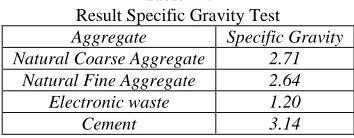
Specific gravity is the ratio of the density of a substance to the density (mass of the same unit volume) of a reference substance. Result given in table no 4.
Table – 4
Result Specific Gravity Test Aggregate Specific Gravity Natural Coarse Aggregate 2.71
Natural Fine Aggregate 2.64
Electronic waste 1.20
Cement 3.14
Fineness Modulus
Sieve analysis test is performed on the aggregate i.e Natural coarse aggregate, Natural fine aggregate and Electronic waste and their result given in table no 5.
Table - 5
Result of sieve Analysis Test Result Aggregate Fineness Modulus Natural Coarse Aggregate 2.70
Natural Fine Aggregate 1.90
Electronic waste 2.50
Cement 4.3
Water Absorption
Water absorption of is performed on the aggregate and it has find that all aggregate have water absorption below 5% and their result given in table 6.
Table – 6
Result of Water Absorption Test Aggregate Water Absorption % Natural Coarse Aggregate 0.60
Natural Fine Aggregate 0.30
Electronic waste 0.04
Combined Test Result
All material test result is combined in a table given below
Table – 7 Combined Test Result
S. No. Test Natural Coarse aggregate Electronic waste Fine Aggregate Cement
1 Water Absorption 0.60% 0.04% 0.30% -
2 Specific gravity 2.71 1.20 2.64 3.14
4 Impact value 7.90% 1.95% - -
5 Abrasion value 11.90% 3.57% - -
6 Fineness Modulus 2.70 2.50 1.90 4.3
7 Bulking of Sand - - 30.21 -
Slump Cone
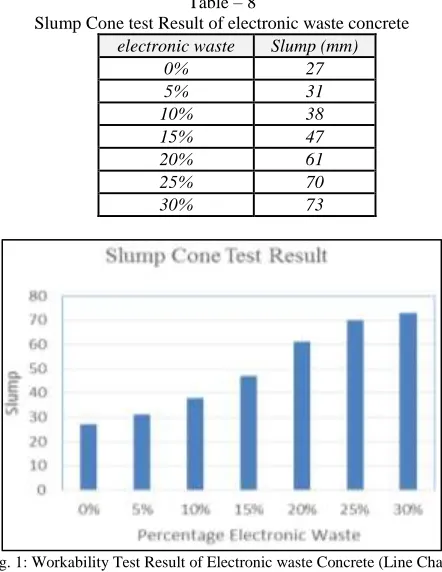
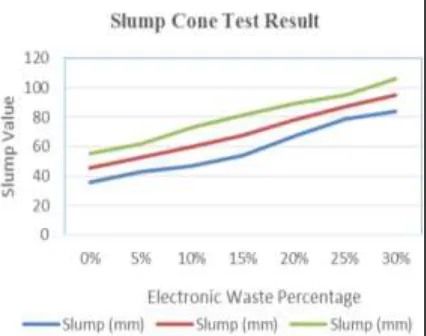
Test The slump test indicates a decreasing trend of workability when the percentage of Electronic waste increased. Table 8 and table 9 below shows the average slump recorded during the test. Graph 1, 2, 3 and 4 below shows a graphical representation of slump height.
Electronic Waste Concrete
Table – 8
Slump Cone test Result of electronic waste concrete
Fig. 1: Workability Test Result of Electronic waste Concrete (Line Chart)
Fig. 2: Workability Test Result of Electronic waste concrete (Bar Chart)
Electronic Waste with Fly Ash Concrete
Table – 9
Workability Test Result of Electronic waste with Fly Ash concrete
percentage electronic waste Slump (mm)
Electronic waste with 10% Fly Ash Electronic waste with 20% Fly Ash Electronic waste with 30% Fly Ash
0% 36 46 55
5% 43 53 62
electronic waste Slump (mm)
0% 27
5% 31
10% 38
15% 47
20% 61
25% 70
10% 47 60 73
15% 54 68 81
20% 67 78 89
25% 79 87 95
30% 84 95 106
Fig. 3: Workability Test Result of Electronic waste concrete with Fly Ash (Bar Chart)
Fig. 4: Workability Test Result of Electronic waste concrete with Fly Ash (Line Chart) Compression Test Result and Analysis
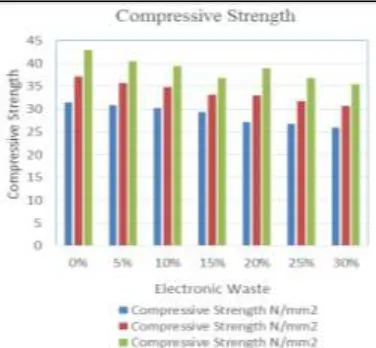
The compression test by CTM (Compressive Testing machine) indicates an increasing trend of compressive strength with age of the concrete specimens. However, it shows that the strength of Electronic waste specimens is lower than natural aggregate specimens
Compressive Strength of Electronic waste Concrete
Table 10 and Fig. 5-6 shows compressive strength test result of concrete containing electronic waste. Table - 10
Compressive Strength Test Result of Electronic waste Concrete Electronic Waste Compressive Strength N/mm2
7 Days 14 Days 28 Days
0% 31.46 37.155 42.85
5% 30.91 35.71 40.51
10% 30.26 34.84 39.42
15% 29.32 33.085 36.85
20% 27.12 32.995 38.87
25% 26.78 31.775 36.77
30% 25.92 30.665 35.41
Compressive Strength of Concrete with Electronic waste and Fly Ash
Fig. 5: Compressive Strength Test Result of Electronic waste Concrete (Bar Chart) Table – 11
Compressive Strength Test Result of Electronic waste Concrete with Fly ash Electronic
Waste
Compressive Strength N/mm2 with
10% Fly Ash
Compressive Strength N/mm2 with
20% Fly Ash
Compressive Strength N/mm2 with
30% Fly Ash
7 Days 14 Days 28 Days 7 Days 14 Days 28 Days 7 Days 14 Days 28 Days
0% 38.91 47.46 49.98 37.02 45.9 48.23 40.03 48.45 51.21
5% 38.78 47.05 48.02 36.89 45.49 46.27 39.9 48.04 49.25
10% 38.67 46.78 47.46 36.78 45.22 45.71 39.79 47.77 48.69
15% 37.76 44.36 47.17 35.87 42.8 45.42 38.88 45.35 48.4
20% 35.72 42.74 45.64 33.83 41.18 43.89 36.84 43.73 46.87
25% 32.24 41.27 42.61 30.35 39.71 40.86 33.36 42.26 43.84
30% 31.56 40.42 41.89 29.67 38.86 40.14 32.68 41.41 43.12
Fig. 6: Compressive Strength Test Result of Electronic waste Concrete (Line Chart)
Fig. 8: Compressive Strength Test Result of Electronic waste Concrete with fly ash (Bar Chart) VII. CONCLUSION
An experimental study has been done on concrete using electronic waste as coarse aggregate and also with fly ash as replacement of cement and following points is observed from the present study.
Workability of the concrete increases when percentage of the electronic waste increases
When fly ash content added to electronic waste concrete, it has been observed that workability increased. Workability of fly ash with electronic waste concrete is even more than conventional and electronic waste concrete.
Compressive strength of electronic waste concrete decreases with increase in the percentage of e-waste.
It has been observed that when we replace cement by fly ash in concrete along with electronic waste as a coarse aggregate compressive strength increases.
Cement replacement of 30% by fly ash along with electronic waste gives best result.
Current study concluded that Electronic waste can replace coarse aggregate upto 10% or 20%.
Current study also concluded that electronic waste can replace coarse aggregate upto 30% in concrete when 30% fly ash is replaced by cement.
REFERENCES
[1] Pramila S., Fulekar M.H., Bhawana P., E-Waste- A Challenge for Tomorrow Research Journal of Recent Sciences ,1(3), 86-93, 2012. [2] Widmer R., Global perspectives on e-waste, Environmental Impact Assessment Review, 25, 436– 458, 2005.
[3] Borthakur A., Singh P., Electronic waste in India: Problems and policies, International Journal of Environmental Sciences, 3(1), 353-362,2012. [4] Gaidajis G., Angelakoglou K., Aktsoglou D., E-waste: Environmental Problems and Current Management, Journal of Engineering Science and [5] Technology Review , 3 (1) , 193-199, 2010.
[6] Hai yong kang, “Electronic waste recycling: A review of U.S. infrastructure and technology [7] options, Resources, Conservation and Recycling vol 45 (2005) pp 368400.
[8] 7. A.S.A Xu “Value added utilization of waste glass in concrete”, Cement and Concrete Research,2004, Vol. 34, pp. 8189.
[9] Lakshmi, R., and S. Nagan. "Investigations On Durability Characteristics of E-plastic Waste Incorporated Concrete." Asian Journal of Civil Engineering (Building And Housing) 12.6 (2011): 773-787.