A
G
ENERALIZED
F
UZZY
J
OHNSON
A
LGORITHM
Praveen KumarAssistant Professor, Department of Mathematics, J. V. Jain College, Saharanpur-247001 (UP), INDIA Email ID- [email protected]
ABSTRACT: Fuzzy numbers are ideally suited to represent uncertainty. In the present paper I have generalized & modified deterministic approach to accept LR - type fuzzy processing time, the sequence performance measurements of make span and job mean flow time are fuzzy in nature. Earlier “McMahon & Lee [17]” proposed an algorithm for managing uncertain scheduling. However they have used trapezoidal fuzzy number to represent the processing time. After that “T.P. Hong & T.N. Chuang [13]” proposed a triangular fuzzy Johnson algorithm for n x 2 job shop scheduling problem they have used half inverse operator to compare fuzzy number as well as to find triangular longer time procedure. In the present work I have applied GRV (Generalized Ranking Value) technique for the generalized LR - type fuzzy number. “McCahon & Lee [17]”, “TP Hong & TN Chuang [13]” algorithm can be special case for our proposed algorithm.
KEY WORDS: Defuzzification, flow shop scheduling, fuzzy ranking, LR-type fuzzy number.
1
INTRODUCTION:
FLOW shop problem concerns the sequence of jobs through a series of machines in predefined exactly the same order with the aim to optimize a number of objectives e.g. make span time, mean flow time, idle time for any job or machine. The most frequent objective is completion time or make span time, that is the time between the start of first job on first machine and last job on the last machine. The research into job shop problem has drawn a great attention in the last two decades with the aim to increase the effectiveness of industrial production & profit. “In 1954 Johnson proposed a heuristic algorithm [15]” to achieve the minimum make span time for 2 x n job shop problem there after extended to m x n job shop problem. However, it is often difficult to apply this approach to real world practical problems where processing time of jobs could be imprecise due to either the incomplete knowledge or unfavorable conditions or by uncertainty in environment, which implies that there exist various external sources and reasons for uncertainty. In the present work we have sorted out uncertainty that comes into play by better representation of fuzziness instead of randomness & probability. It has been shown that fuzzy approaches are used to tackle uncertainty into processing of jobs very effectively. Fuzzy sets are used to describe the processing time in the situation whenever incomplete knowledge or uncertainty in processing time due to environmental conditions. In many situations the decision makers could only estimate the interval that the processing time belongs. A number of approaches to flow shop scheduling problem have been developed and reported in literature. The uncertainty in processing time has been successfully modeled using fuzzy numbers by “many researchers [1,2,7,11,13,14,17,18]”. In those works they have used triangular, trapezoidal membership functions to describe the processing time. The scheduling objectives considered in these works include make span, mean flow time, tardiness etc. In this paper we have considered n x m machine flow shop problem with LR-type fuzzy processing time. The objective is to find a job sequence with minimum make span. In the procedure to obtain completion time, fuzzy ranking technique & defuzzification methods are involved to compare the fuzzy numbers and to facilitate of effective deterministic algorithm to get better solution. “McCahon & Lee [17]” used “Lee & Li [16]”method to compare two fuzzy numbers and also used spread of fuzzy numbers for this purpose. Similarly
“T.P. Hong & T.N. Chuang [13]” have used the same method to compare but they have also used a new technique to find triangular longer time procedure in the process to get completion time of jobs. In the present work we have applied generalized ranking value (GRV) modified by “D. Guha & D. Chakraborty [8]” and “proposed by Y. M. Yang, J. B. Yang, D. L. Xu & K. S. Chin [21]”, to compare LR-type fuzzy numbers and also we have used Defuzzification Function value (DFV) to find crisp value or mean value of LR type fuzzy number.
2
P
RELIMINARIES:
-“Zadeh [23]” first introduced the fuzzy set for dealing with vagueness type of uncertainty. A fuzzy set à define on the universe X which is characterized by a membership function such that
A:
X
[
0
,
1
]
. Then a fuzzy set à on X is a set of ordered pairs :
x
x
x
X
A
~
,
A~(
)
:
Where ~(
x
)
A
is called the membership function or grade of membership function or degree of compatibility or degree of truth that maps to the membership space [0, 1]. When this space contains only two points 0 & 1 then à is said to be non fuzzy and ~(
x
)
A
is identical to the characteristic function of a non fuzzy set. The family of all fuzzy sets in X is denoted F (X).Def 2.1: The support of fuzzy set à is the crisp set of all x
X such that ~(
x
)
0
A
& denoted by S (Ã)Def 2.2: The set of elements that belong to the fuzzy set à at least to the degree
is called the
-level set}
)
(
:
{
~
~
x
X
x
A
ADef. 2.3: Generalized Fuzzy Numbers :-
A generalized fuzzy number Ã, conventionally represented by à = (a, b;
,
) or à = (left normalized point, right normalized point ; left spread, right spread) and is a normalized convex fuzzy subset on the real line R if -(i) S (Ã) is a closed & bounded interval i.e. [a-
, b +
] (ii) ~(
x
)
A
is an upper semi continuous function. (iii) a -
a
b
a +
] + b b, [ for
(x) g
b] [a, for
1
a] , -[a for
(x) f ) ( ~
x x x x
A
Where f (x) and g (x) are the monotone increasing and decreasing functions respectively.
Def. 2.4: LR -Type Fuzzy Numbers:- A generalized Fuzzy Numbers à = (a, b;
,
) is said to be LR type if there exists two reference functions, known as shape function L & R such that
0 , 0
] + b b, [ for ) (
b] [a, for 1
a] , -[a for ) (
) (
~
where
x b
x R
x x x
a L
x A
If the left and right spread functions f(x) & g(x) are linear then
the LR-type fuzzy number is said to be linear LR-type fuzzy
number, triangular and trapezoidal fuzzy numbers are
examples of linear LR-type fuzzy numbers given in fig 3 & 2
respectively.
Def. 2.5: Shape Function:- A function F is said to be shape function if it fulfills the following conditions
1. F is a continuous non-increasing function on the half line [0,
), F (0) =1.2. F is strictly decreasing on this part of the domain on which it is positive.
The following functions are examples of shape function.
Linear F (x) = max { 0, 1 - x }, x R+
{0}. Exponential F (x) = e-p.x , p
1, x R
+
{0}. Power F (x) = max { 0, 1- xp } , p
1, x R +
{0}. Rational F (x) = 1/1 + xp , p
1, y R +
{0}.Some special cases are possible in which the type of one or both of the functions L and R may have no significance i.e.
a = -
: ~(
x
)
A
= 1 for x
a b = +
: ~(
x
)
A
= 1 for x
b
= 0 : ~(
x
)
A
= 0 for x
a
= 0 : ~(
x
)
A
= 1 for x
b(In the present thesis we will consider the case of power shape function on the left as well on right for solving the examples)
Def. 2.6: Triangular Fuzzy Number: An LR - type fuzzy numbers à is said to be triangular fuzzy number if a = b = m
then it can be denoted as à = (m,
,
) TFN whenever its membership function is shown as fig 3.Def. 2.7: Generalized Ranking Value (GRV) of LR-Type Fuzzy Numbers: The generalized ranking value is “proposed by Wang-Yang [21]” and that is the rectangular area between centroid of fuzzy numbers and the origin (0, 0). The centroid point of a fuzzy numbers has been denoted by
x
on the horizontal axis andy
on the vertical axis, the central point)
,
(
x
y
for a LR - type fuzzy numbers à is defined as –
1 0
1 1 1 0
1 1
)}. ( ) ( {
)}. ( ) ( { = (Ã) y
. ). ( )
(
. ) ( . . ) ( . = (Ã) x
dy y f y g
dy y f y g y
dx x g dx dx x f
dx x g x dx x dx x f x
b b b a a
a
b b b a a
a
where f (x) and g (x) are the left and right shape functions of fuzzy numbers à respectively. f -1 (y) & g -1 (y) are the inverse functions of f (x) & g (x) respectively. The rectangular area between the centroid point (
x
,
y
) and the origin point (0, 0) of the fuzzy numbers à is defined as area(Ã) =x
.
y
Therefore, the generalized ranking value will be a crisp valuex
.
y
, and it is used to compare the fuzzy numbers. GRV(Ã) =x
.
y
= area (Ã)andx
is known as Defuzzified Function Value [DFV] or mean value of the fuzzy number Ã.Let à &
~
be two fuzzy numbers then.Ã < ~ if area (Ã) < area (~)
Def. 2.8: Let Ã, ~be two LR - type fuzzy numbers such that:
0 & 0 a b 0 a b 0 & 0 b a 0 b a if ) , ; a b ; b (a = ) , ; b , (a ) , ; b , (a : Difference . 0 ; ) , ; b , a ( = Ã, : tion M ultiplica Scalar ) , ; a , (-b = ) , ; b , (a : Negation ) , ; b b , a (a = ) , ; b , (a ) , ; b , (a : Addition then ) , ; b , (a = B ~ ), , ; b , (a = Ã 2 1 2 1 2 1 2 1 2 1 2 1 LR 2 1 2 1 2 1 2 1 LR 2 2 2 2 LR 1 1 1 1 LR 1 1 1 1 1 1 1 1 LR 1 1 1 1 LR 2 1 2 1 2 1 2 1 LR 2 2 2 2 LR 1 1 1 1 2 2 2 2 1 1 1 1 take then if similarily take then R for LR
Def. 2.9: A fuzzy number à is a convex normalized fuzzy set à on the real line such that
1. there exists exactly one x R such that ~
(
x
)
A
= 12. ~
(
x
)
A
is piecewise continuous. The parametric form can be defined asà = (A (r), A (r)) for 0
r
1 & A (r), A (r) are such that A (r) is monotonically increasing left continuous function
(r) is monotonically decreasing right continuous function
A (r)
(r), A (r) = (r) = 0 for r
0 & r
1McCahon & Lee gives an algorithm for n x m job shop scheduling for trapezoidal fuzzy number, Similarly T.P. Hong & other describe an algorithm for triangular fuzzy number with n x 2 job shop scheduling. In the process to find out the completion time for a fuzzy job shop problem, we face a problem i.e. comparison of fuzzy numbers, since there is not any unique method to rank a fuzzy number as process to compare two fuzzy numbers. T.P. Hong & T.N. Chuang have explained an efficient method to overcome this problem but that technique is limited to triangular fuzzy number. Similarly McCahon & Lee used Generalized Mean Value (GMV) and Average Height Ranking techniques to compare triangular fuzzy numbers. These two cases (Triangular fuzzy number & trapezoidal fuzzy number) are the particular case for the LR- type fuzzy number, in which left & right functions are linear. In the present work we are concentrating on the generalized form of fuzzy numbers & used generalized ranking value (GRV) & Defuzzification Function Value to compare the fuzzy numbers. On the line of McCahon & Lee the proposed algorithm will be generalized on the both front first of all on general type of processing time and on the other side it is applicable for n x m job shop scheduling problem. McCahon & Lee have proposed an algorithm for n x m job shop but they have considered processing time as trapezoidal fuzzy number which is a particular case of our proposed algorithm. “Campbell, Dudek [6] proposed” an algorithm for a flow shop problem. They have divided the n x m problem into (m - 1) auxiliary n x 2 job shop problem to obtain optimality.
“CAMPBELL,DUDEK &SMITH ALGORITHM (CDS ALGORITHM)[6]” :- According to CDS algorithm they have created a series of
(m-1) auxiliary n-job 2 machine problems and then Johnson algorithm is applied to each of these (m-1) auxiliary problem to find the optimal sequence of jobs as well as make span. These (m-1) auxiliary series are generated using the following logic.
Step 1: For each rth auxiliary problem, calculate the pseudo-machine processing time, where r = 1, 2, ..., m -1. Whenever m - machine are in the systems, processing time for the resulted 2-pseudo machine can be defined as
1 r i2 1 r i1
m r m j ij r j ij p P p Pwhere pij is processing time of job i on the machine j(1, 2, ..n) & Pij is the processing time of job i on the pseudo machine j (j
= 1,2)
Step 2: By step 1 we have created (m -1) auxiliary nx2 job shop problem. Now by the help of Johnson Algorithm we determine the optimal sequence as well as make span time for each of the (m -1) auxiliary problems.
Step 3: Compare the make span time of the (m -1) sequences and select the optimal sequence i.e. the sequence with minimum make-span time. The above CDS - algorithm has been proposed on the deterministic theory with crisp processing time, its fuzzy version can be redefined for the fuzzy processing time of the pseudo machines as follows.
ij m r m j r i ij r j r i p P p P ~ ) ( ~ ~ ) ( ~ 1 2 1 1
Where
~
p
ij is the fuzzy processing time for
th job to jth machine and Pi1r and Pir2~ ~
are fuzzy processing time for the rth auxiliary sequence on pseudo machine 1 and 2 respectively where summation is fuzzy summation.
3
P
ROBLEMS
TATEMENT:
-
Consider n-different types of jobs that have to be processed on m- machines. A machine can process one job at a time and we assure that order of jobs cannot be changed as the process start. The processing time required to process each job on each machine is given in the form of LR - type fuzzy numbers. Now our aim is to find the optimal sequence which minimizes the completion or make span time of all the jobs.
4
A
SSUMPTIONS&
N
OTATIONS:-
The following assumptions & notations have been used in the present chapter
4.1 ASSUMPTIONS
:- Jobs are not preemptive.
Each job consists of two tasks to be executed in sequence on two machines.
The execution or processing time is given in the form of finite normalized fuzzy LR-type membership function for each job and is known.
A machine can process one job at a time.
4.2 NOTATIONS:-
à = Fuzzy Number A.
)
(
~
x
A
= Membership function value at point x
Ã. J = Set of jobs to be processed (J1, J2 .. Jn) n = Number of Jobs in J.M1, M2,… Mm= Machine on which jobs have to processed r
Mj = j th
pseudo machine for rth auxiliary problem, r = 1,2,…,(m-1).
ij
p
~
= Fuzzy processing time for the
thjob on machine j (1, 2) i.e.
(
a
ij,
b
ij;
ij,
ij)
LRij
C~ = Fuzzy completion time for the i th job at machine j.
= Fuzzy addition
= Fuzzy Subtraction)
(
1 n
r
= Fuzzy Summation
x a~
m = Fuzzy Maximization
U = Optimal sequence obtained by Johnson Algorithm (T1, T2, ….,Tn) such that for each Ti there exists Jj such that Ti = Tj for all i, j,
(1, 2, ..., n) i.e. (T
1, T2, T3 …. Tn)
(J1, J2, . . Jn).C~ = the fuzzy completion time for all the jobs in the system.
5
P
ROPOSEDA
LGORITHM:-
A generalized fuzzy Johnson algorithm for n x m job shop scheduling problem as follows
INPUT: - A set of n-jobs, each has to be processed on m - machines, each task has an LR-type fuzzy processing time membership function.
OUTPUT: -A fuzzy schedule with minimum fuzzy completion of n-job on each machine.
Step 1: Creates (m-1) auxiliary n-job 2- pseudo machine problems.
Step 2: For each of (m - 1) auxiliary n x 2 problem finds GRV for each task with fuzzy execution time.
Step 3: For each of (m -1) auxiliary n x 2 problem find optimal sequence Ur (r = 1, 2 ... m -1) and evaluate completion time of the original n x m problem for this sequence by using Johnson algorithm as follows
. ~
, ~ } ~ , ~ x{ a ~ m ~
, ~ ~ ~
~ ~ ~ , ~ ~ ~
, ~ ~
1 , , 1 1 1 , 1 1
1 1 , 1 1 12 11 12
11 11
machine j
on job i of
time completion fuzzy
the is C where
p C C C
p C C
p C C p p C
p C
th th
ij
ij j i j i ij
i i i
j j j
Step 4: Select the optimal sequence out of (m -1) optimism sequence U1, U2 ... Um - 1 with minimum GRV as well as minimum Defuzzified Function Value (DFV).
Step 5: Set the final completion time of the sequence obtained from step 4 with fuzzy processing time on the line of Johnson procedure and use GRV to obtain fuzzy longer time.
After step 5 we have obtained an optimal schedule with completion time in the form of fuzzy membership function. In the next section we will explain the method in detail with the help of example.
6 Example:-
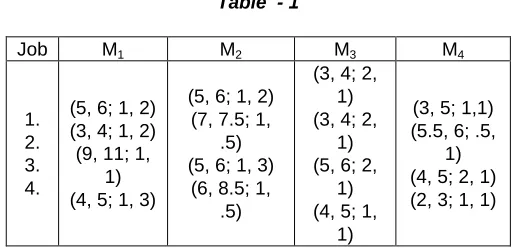
Suppose there are four jobs & four work station in the system. All the jobs have to process on the four machines (work station) in order M1, M2, M3, and M4. The processing time of jobs on these workstations is given in the form of LR-type normalized fuzzy numbers. In which we have considered left & right spread as a power function. Now we have to determine optimal schedule with minimum completion time. In the process to determine GRV & defuzzification function value we have used MATLAB mathematical software. The four job
four machine job sequencing problem is presented in Table 1.
Table - 1
Job M1 M2 M3 M4
1. 2. 3. 4.
(5, 6; 1, 2) (3, 4; 1, 2) (9, 11; 1,
1) (4, 5; 1, 3)
(5, 6; 1, 2) (7, 7.5; 1,
.5) (5, 6; 1, 3)
(6, 8.5; 1, .5)
(3, 4; 2, 1) (3, 4; 2,
1) (5, 6; 2,
1) (4, 5; 1,
1)
(3, 5; 1,1) (5.5, 6; .5,
1) (4, 5; 2, 1) (2, 3; 1, 1)
Using the fuzzified version of Campbell, Dudek & Smith [6]
algorithm finds the resulted auxiliary problem for r = 1 ( 2 3 1 4 ), for r = 2 ( 3 2 1 4 ), for r = 3 ( 2 3 4 1 ).
Now with the help of Johnson Algorithm the fuzzy processing time and completion times for each of the three sequences in support of these evaluators are listed in tables 5, 6 & 7. r Sequence Makespan GRV
DFV
1 ( 2 3 1 4 ) (34,43.5;7,10.5) 19.200 40.0 2 ( 3 2 1 4 ) (38,47;7,9) 21.038 43.2 3 ( 2 3 4 1 ) (34,44.5;8,10.5) 19.489 40.1
Therefore the best sequence is (2 3 1 4) because it has the smallest GRV and DFV of the make-span time with fuzzy make-span time (34, 43.5; 7, 10.5) and defuzzified make-span time 40.0 unit.
7
R
EMARK:
r Sequence Makespan GRV DFV GMV 1. ( 2 3 1 4 ) (34,43.5;6,9.5) 16.915 39.8 39.8
2. ( 3 2 1 4 ) (38,47;6,8) 18.404 43.1 43.1
3. ( 2 3 4 1 ) (34,44.5;7,9.5) 17.08 40.0 40.0
REDUCTION OF FUZZY JOHNSON GENERALIZED ALGORITHM: First McCahon & Lee algorithm is the special case of the proposed algorithm for the case whenever the left and right shape functions are linear i.e. the trapezoidal membership function defined as follows
0 , 0
] + b b, [ for 1
b] [a, for
1
a] , -[a for
1
) (
~
where
x b
x
x x x
a x
A
and its DFV is equivalent to GMV taken by McCahon & Lee i.e.
GMV
(Ã)
= DFV(Ã)
=x
(Ã)
and GRV=x
.
y
1
0 1
0
). 1 ( ( ) ) 1 ( (
). 1 ( ( ) ) 1 ( ( . =
(Ã) y
. . 1
1
. 1
. .
1 . =
(Ã) x
dy y b y a
dy y b y a y
dx b x dx
dx x a
dx b x x dx x dx x a x
b b b a a
a
b b b
a a
a
Similarly the proposed algorithm can be reduce to original Johnson algorithm in deterministic environment taking fuzzy number in the form (a,a; 0,0) and it represents an equivalent crisp number „a‟.
C
ONCLUSION:
In the present work LR-type fuzzy number have been used with Johnson algorithm & CDS algorithm to schedule n-jobs on m-machine with uncertain completion time. The new generalized fuzzy Johnson algorithm yields scheduling results with a membership function for the final completion time. These results can help managers gain a broader overall view of scheduling. In future we will try to apply other characteristics of fuzzy sets to the scheduling fields.
A
CKNOWLEDGEMENTSThe authors would like to thanks the anonymous referees for their very constructive comments.
R
EFERENCES:
[1] Adam Kasperski, (2005), “A possibilistic approach to sequencing problems with fuzzy parameters”, Fuzzy Sets and Systems, 150, 77-86.
[2] Adamopoulos G. I., C.P. Pappis, (1996), “A fuzzy-linguistic approach to a multi-criteria sequencing
problem”, European Journal of Operational Research 92, 628-636.
[3] Alfred L. Guiffrida, Rakesh Nagi, (2000), “Fuzzy Set Theory Application in Production Management Research: A Literature Survey”, Internet Access.
[4] Allahviranloo T., F. Hosseinzadeh Lotfi, M. K. Kiasary, N.A.Kiani and L. Alizadeh (2008) “Solving Fuzzy Linear programming Problem by the Ranking Function”, Applied Mathematical Science Vol.2, no.1, pg. 19-32.
[5] Bellman, R.E., Zadeh, L.A., (1970): “Decision-making in a fuzzy environment”, Management Science, 17, B-141-164.
[6] Campbell, H. G., Dudek, R. A., and Smith, M. L. (1970), “A heuristic algorithm for the n-job m-machine sequencing problem”, Management Science 16, 630-637.
[7] Chanas S., Kasperski A. and Kuchta D. (2000), “Two Approaches to Fuzzy Flow Shop Problem”, in Scheduling Under Fuzziness”, Slowinski R., and Hapke M. (Eds.), Physica-Verlag, Heidelberg, 165-195.
[8] Debashree Guha, Debjani Chakraborty, (2008) “Compromise Ratio Method for Decision Making under Fuzzy Environment using Fuzzy Distance Measure”, International Journal of Mathematical Physical and Engineering Sciences, vol. (1), no.1 pg.1-7.
[9] Dubois D., and Prade H. (1979), “Ranking of fuzzy numbers in the setting of possibility theory”, Information Sciences, 30, 183-224.
[10] Dubois D., H. Prade, (1987), “The mean value of fuzzy number”, Fuzzy Sets and System, 24, pg. 279-300.
[11] Fortemps P.,(1997), “Job-shop scheduling with imprecise durations. A fuzzy approach”, IEEE Transaction on Fuzzy Systems, vol-82, pg. 319-330.
[12] Fortemps, P. and Roubens, M. (1996), “Ranking and defuzzification methods based on area compensation”, Fuzzy Sets and Systems, 82, 319-325.
[13] Hong T. and Chuang T. (1999), “New triangular fuzzy Johnson algorithm”, Computers and Industrial Engineering, 36 (1), 179-200.
[15] Johnson S. M. (1954), “Optimal two- and three-stage production schedules with setup times included”, Naval Research Logistics Quarterly, 1, 61-68.
[16] Lee E. S., Li R. J., (1998), “Comparison of fuzzy numbers based on probability measure of fuzzy events”, Computer and Mathematics with Applications, 15, 887-896.
[17] McCahon C. S. & Lee E. S. (1992), “Fuzzy job sequencing for a flow shop”, European Journal of Operation Research 62, 294-301.
[18] McCahon S., and Lee E. S. (1990), “Job sequencing with fuzzy processing times”, Computers and Mathematics with Applications, 19(7), 31-41.
[19] Panda G., M. Panigrahi, S. Nanda, 2006, “Equivelence class in the set of fuzzy numbers and its application in decision making problems”, International Journal of Mathematics and Mathematical Sciences, Article ID 74165, Pages 1– 19.
[20] Stanislaw Helipern (1995), “Comparison of fuzzy numbers in decisions making”, Tantra Mountains Math. Publ., 6, pg.47-53.
[21] Y-M Wang , J. B. Yang, D. L. Xu, K. S. Chin,(2006), “On the centroids of fuzzy numbers” Fuzzy Sets and Systems, vol-157, pg.919-926.
[22] Yager, R. R. (1981), “A procedure for ordering fuzzy subsets of the unit interval”, Information Sciences, 24, 143-161.
[23] Zadeh, L., (1965), “Fuzzy sets”, Information and Control, 8, 338.