Abstract— The size and distribution of in-cylinder soot
particles affect the sizes of soot particles emitted from exhaust tailpipes as well as the soot in oil. The simulation work reported in this paper focuses on the study of soot formation and movement inside a diesel engine with in-depth analysis of soot particles in the squish region. Soot particles in the squish region have high potential to be deposited onto the cylinder wall, and subsequently penetrate into engine lubrication system and contaminate the oil. The prediction of a soot particle pathline and size distribution was performed using post-processed in-cylinder combustion data from Kiva-3v computational fluid dynamics (CFD) simulations with a series of Matlab routines. Only soot oxidation and soot surface growth process were considered in this study. Coagulation and agglomeration of soot particles were not taken into account. Soot particles were tracked from 8 crank angle (CA) degree after top dead center (ATDC) as soot starts to form in high concentration until 120 CA degree ATDC at exhaust valve opening (EVO). The soot particle size and its distribution were analyzed at different crank angles. In the squish region, the most dominant soot particle size was 20-50 nm at earlier crank angle and in 10-20 nm range at 120 CA ATDC. The percentage of soot loss in the squish region was analyzed to be 23.2 % and the soot loss was higher at earlier crank angle until 10 CA degree ATDC due to high rate of oxidation.
Index Term— soot, particle tracking, squish region,
in-cylinder soot size
I. INTRODUCTION
The study and investigation of combustion and soot inside a diesel engine cylinder had been conducted by researcher via experiment [1], [2] and simulation [3], [4]. This research gains the attention of the researcher due to the rule, restriction and regulation enforcement to reduce the exhaust gas emission produce by diesel engine [5]. The exhaust gases produced can lead the severe health complication to human [6]-[8] and plant
This work was supported in part by the the Ministry of Higher Education of Malaysia and Universiti Kebangsaan Malaysia under FRGS/1/2013/TK01/UKM/02/2 and GGPM-2011-055 research grants.
Muhammad Ahmar Zuber. is with Department of Mechanical and Materials Engineering, National University of Malaysia 43600 Bangi,
Malaysia (e-mail: [email protected]).
Wan Mohd Faizal Wan Mahmood is with Department of Mechanical and Materials Engineering, National University of Malaysia 43600 Bangi,
Malaysia (e-mail: [email protected]).
Zulkhairi Zainol Abidin is with Department of Mechanical and Materials Engineering, National University of Malaysia 43600 Bangi, Malaysia (e-mail:
Zambri Harun is with Department of Mechanical and Materials Engineering, National University of Malaysia 43600 Bangi, Malaysia (e-mail:
[9], sulfation of building stones [10] and damage the engine. Soot damage the engine by increase the engine wear by degrading the oil that reduces the flow ability of the oil and cause the need to change the oil frequently [11]-[14]. Thus it is important to understand soot formation, behavior and movement inside the engine cylinder until emission so counter measure action can be taken to reduce the soot and exhaust gases emission.
Exhaust gas emission from a direct injection diesel engines consist of carbon monoxide (CO), nitrogen oxide (NOx), sulfur dioxide (SO2), unburned hydrocarbons (UHC) [15] and particulate matter (PM) [16], [17]. Particulate matter composed of 10 % of fuel, 16 % of oil, 10 % of combination sulfuric acid and water and, 64 % of soot [18].
A modelling of soot formation with detailed chemistry and physics had been conducted by [1] and a series of model containing the gas-phase reaction, aromatic chemistry, soot particle coagulation, soot particle aggregation and surface growth were produce. According to [19] the soot formation can divided to four major processes: homogeneous nucleation of soot particles, particle coagulation, particle surface reactions and particle agglomeration. On the other hand, some researcher focus on the soot properties [20], soot mechanism [2], [4], in-cylinder soot particle movement [3] and soot size [21]. While [22] characterize the soot formation reaction by four steps: 1.Particle nucleation, 2.Particle surface growth, 3.Particle surface oxidation, 4.Particle coagulation 5.PAH deposition on the particle surface.
Various experimental studies had been conducted by [1], [2], [20], [21], [23]-[25] to understand the formation and behavior of soot inside engine cylinder. An in-cylinder soot formation and oxidation had been carried out by [23] using the two-dimensional Laser-Induced Incandescence (LII) and the result showed that at 2° CA ATDC the soot start to form and soot concentration start to increase at 6° to 12° CA ATDC. But after 12° CA ATDC soot concentration intensity start to decrease. An experiment was conducted to study the hygroscopic properties of carbon and diesel soot particles by [20]. They use diesel engine to produce soot particle and spark discharge between two graphite electrodes to produce carbon particle. The particle size found to be at 20-500 nm and the primary carbon particle at 10 nm and primary soot particle at 25 nm.
Soot particle mass, size and distribution were effected by engine load, operation mode and type of fuel. A study by [21]
In-Cylinder Soot Particle Distribution in Squish
Region of a Direct Injection Diesel Engine
Muhammad A. Zuber, Wan Mohd F. Wan Mahmood, Zulkhairi Zainol Abidin. and Zambri Harun.,
Department of Mechanical and Materials Engineering, Faculty of Engineering and Built Environment, Universiti144105-2929-IJMME-IJENS © October 2014 IJENS
on the particle size distribution during emission concluded that the engine that operate at higher load produce larger soot particle size with wider size distribution. This happened due to the nucleation process, condensation in exhaust emission, coagulation and agglomeration of soot particle with water content in exhaust gases. At higher engine load, more soot were produce because of the increase of sulfur, ash, heavy hydrocarbon and aromatic content. While [24] recorded that soot embedding with hydrocarbon (e.g., Polycyclic Aromatic Hydrocarbon, PAH) can produce soot particle with smaller size. The different in-size of soot particle by different researcher is due to the different type of measurement techniques or machines use. Each measurement technique or machines has its own merit.
As oppose to the experimental method, some of the researcher [1], [3], [4], [22], [25]-[34] study the soot formation and behavior by conducting a simulation with mathematical modeling. Pang et al. [30] conducted a simulation on the soot precursor formation mechanism using CFD software Ansys-Fluent with chemistry solver, Chemkin-CFD. A detailed chemistry soot models for internal combustion engine were used in a CFD simulation using Kiva reported by [1]. As PAH was treated as a soot precursor in the simulation and the soot particle size was 2 nm with 667200 numbers of soot particle were recorded at 60° CA ATDC. Another research by [4] was performed with various injections timing model result shown that the soot concentration is high at 0-30° CA ATDC for all cases and the multidimensional model they used was very helpful. Puduppakkam et al. [28] use moment method with FORTE CFD software to track soot formation and evolution inside a direct injection diesel engine. The findings showed that the density of soot particle was peak at 10° CA ATDC and decrease afterward. While at 30-40° CA ATDC soot with larger size were found and the size decrease afterward. The drop of soot density after 10° CA ATDC is contributed by three factors, firstly lower soot nucleation after CA 10° that decrease soot density, second is the soot coagulation occur that reduce the soot particle number and lastly soot oxidation occur that reduce the soot density.
A simulation on soot formation characteristic using Kiva-3v2 were conducted by [22] and state that soot density and soot particle size significantly increase at earlier engine combustion and drop down until it stabilize at certain number. Soot with smaller size in range 5-40 nm were produce at earlier engine combustion due to the pyrolysis reactions and polymerization of the hydrocarbon fuel. In middle engine combustion the numbers of large size of soot particle increase rapidly due to the coagulation, condensation, surface growth and deposition of PAHs as PAHs contribute to increase of soot particle surface growth. At late engine combustion the size distribution stabilizes at peak of 5-20 nm under the influence of continues oxidation reaction. Rao & Honnery [32] use a multi-step soot model to predict the soot formation and mechanism inside the diesel engine cylinder. They found both soot particle number and diameter increase at earlier crank angle to the peak and start to decrease after that. They also found that average particle diameter is in the range of soot
particle diameter found in the literature and typical diesel engine. At earlier combustion in engine, soot formation in the head of spray can be neglected due to high temperature and soot formation is limited to the beginning of diffusion burn phase but after that oxidation will take place.
Work on the soot formation in the diesel engine and their interest is in the crevice near the cylinder wall were studied by [31], [33], [34]. At start of the ignition the soot and at the end of expansion stroke the soot more likely to be transported to the wall liner and crevice region by the squish motion. The soot transport to the wall liner is depended on the soot density and recirculation of charge this can be reduced by early injection of fuel [34].
The prediction the soot particle size and distribution in this paper was achieved by post processing the result obtained from simulation using CFD software, Kiva-3v. Kiva-3v software was chosen due to its flexibility to be adapted and modified according to the user preference model. The Kiva-3v CFD code has open architecture that allows researchers to understand, investigate and amend the codes [29]. Kiva-3v can be used to simulate air flow, fuel sprays, and combustion in practical combustion devices. Originally, Kiva was intended for three dimensions simulation for modelling flows in gasoline and diesel engine. It was then expanded on other combustion devices such as turbines and furnaces. Kiva features the ability to calculate air flows in complex geometries with fuel spray dynamics and evaporation, mixing of fuel and air, and combustion with resultant heat release and exhaust-product formation [35]. Hong et al. [36] used Kiva-3v to develop soot model using realistic physical and chemical equations as bases with reasonable cost and produced excellent agreement with experiment.
This simulation is in the limit of expansion stroke using a series of algorithm to predict it size and pathline. It is expected from this paper that soot particle size distribution in the squish region at different crank angles can be determined so that further investigated on soot deposition onto the cylinder wall can be performed.
II. METHOD
The simulation of combustion inside the engine cylinder was perform by using Kiva-3v CFD software. The result of the simulation can be found on [29] as this paper is the extended work from [3]. The details on the sub-model, mesh configuration, fuel injector specification and test condition is available at [29]. The specification of engine used in Kiva-3v as shown in Table I and type of bowl use in this simulation is bowl in type as in Fig. 1. All the important parameter from Kiva-3v result such as temperature, pressure, bulk gas velocity, soot, diesel fuel and oxygen concentration were extracted to be used in Matlab routine to calculate soot pathline and size.
A. Soot Pathline
The assumptions made to calculate and predict the soot particle pathline are that the soot particle movement follows the velocity vector of bulk flow field at the point where the particle is located and the soot was massless. Since the soot is assumed to be massless, the effect of gravity or drag forces can neglected. The position of soot is identify by crank angle (CA) were calculated by using the velocity vector solved in Kiva-3v. In the model used to calculate the soot particle pathline, the fourth-order Runge-Kutta method and trilinear technique were employed for better accuracy. Equation for the next time step soot particle position can be described as follows;
(1)
where donated as the current particle position and as the current time step. represents the time interval between the current time and the next time step. Soot particles are counted as deposited at the cylinder wall at their last location if the calculated position to be out of the calculation domain. B. Soot Particle Size In the calculation of soot particle size, the assumptions made are, soot particle to be in spherical shape with uniform density of 2 g/cm3 for the entire time step and the soot mass spread uniformly onto the surface of existing soot particle considered as the surface growth process. The radius of soot particle at a given time step can be obtained by rearranged the density formula as follows; (2)
where is the soot particle radius, is the soot particle mass and is the soot particle density at that time step. The soot particle mass, , at each time step was calculated by using a combination of Hiroyasu’s soot formation and Nagle-Strickland Constable soot oxidation models. The rate for soot formation according to Hiroyasu’s model as below; (3)
where is the concentration of soot formed and is the time step interval. is donated a soot particle formation multiplication factor. represents the concentration of fuel vapor, which was considered the source of soot formation, and is the pressure. Activation energy for soot formation is 12500 cal/mole denoted by , and is the temperature inside the engine cylinder with gas constant, = 1.987 cal/mole-K. The current time step is represented by i. Nagel-Strickland Constable (NSC) soot oxidation process equation can be written as follows; (4)
where, in this NSC formula, assumptions are made based on two types of side on the carbon surface, a more reactive side namely A, and a less reactive side, B. is the fraction of surface covered by A and 1- is the fraction covered by B. The following values are adopted for the constants [29]: (5)
(6)
(7)
(8)
Similarly, mass loss due to surface oxidation was assumed to occur uniformly on the surface of soot particles.
Soot particle size calculated in this paper depended on two parameters. The first parameter is the starting size of soot particle radius and in this paper the value for soot particle size at 8° CA ATDC was taken as 10×10-9 m. This value was chose as in literature it was in the size range [22]. The second parameter is the soot particle formation multiplication factor and the value was set to 2×10-11 similar to the coefficient set by [29]. The value of 2×10-11 is an indication of the inverse value of soot particle density (particle/cm3) as each tracked
Fig. 1. Half side of engine cylinder showing the bowl configuration TABLEI
SPECIFICATION OF THE ENGINE USE
Parameter Specification Engine type 4 valve DI diesel Bore Stroke 86. 0 86. 0 mm Squish height 1. 297140330 mm Compression Ratio 18. 2 : 1
Displacement 500 cm3
144105-2929-IJMME-IJENS © October 2014 IJENS
soot particle was assumed to be a single particle among a cluster of soot particles in a cubic volume.
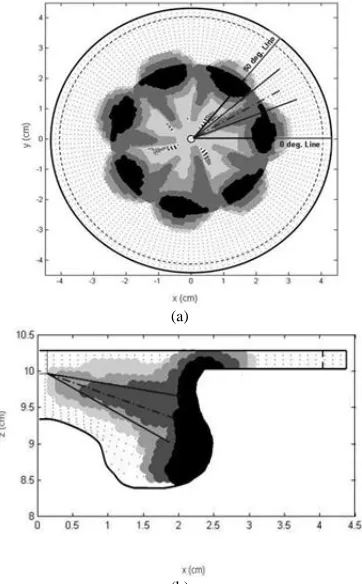
Fig. 2 showed the domains for selected starting point of soot at 8° CA ATDC within the combustion volume engine chamber. The 8° CA was chose based on the high rate of soot formation in the engine cylinder at this time frame [3]. The shaded area with tones of grey to black represents the soot concentration distribution from the result of CFD simulation. The points selected inside the domain were calculated to predict the pathline and size distribution.
III. RESULTS AND DISCUSSION A. Soot Pathlines
Fig. 3 shows the pathlines of soot inside the cylinder and the pathlines were selected at one of the spray location as a representative to all the pathlines. It was too confusing to determine which particle of interest that went to the squish region near cylinder wall by just looking at these pathlines. It is almost impossible to show all the pathlines in one figure as there are too many lines that mix together and become too dense to distinguish from one another. The soot particle pathlines followed the swirl direction in bulk gas motion.
In this paper squish region was defined as the region above and outside of the cylinder bowl near the cylinder wall. The squish region was defined as an area bigger than 3.4 cm radius from the engine cylinder central axis up to cylinder wall. The soot particle pathlines for the particles that travelled into the squish region was shown in Fig. 4. Soot that travelled to the squish region was observed to have originated from the cylinder bowl but most of soot came from the bowl rim area.
B. Soot Particle Size
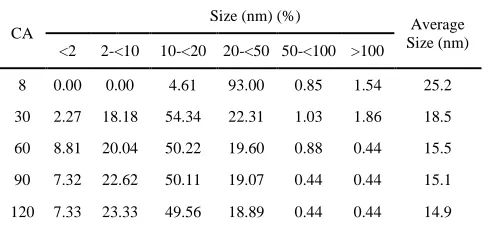
The size of soot particles represents soot diameter in nanometers (nm). Soot particles of different sizes were classified to the respective size ranges with different bin numbers as shown in Table II.
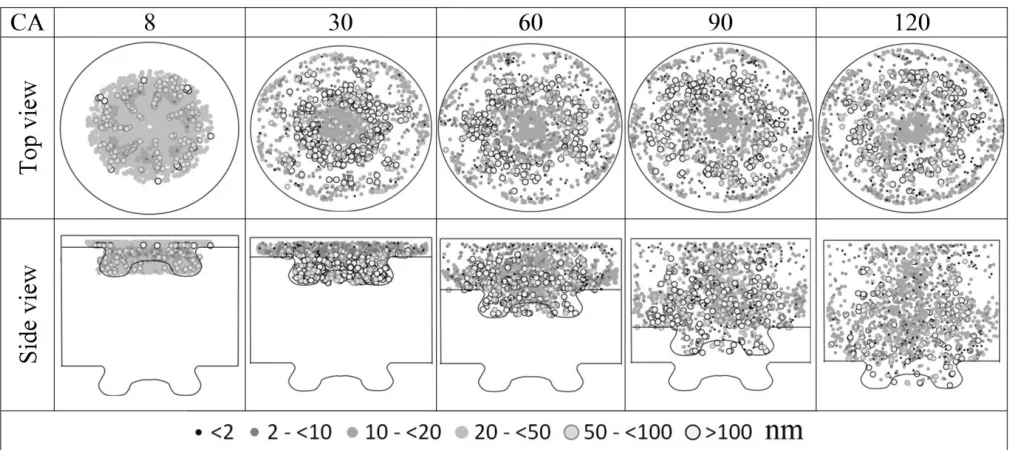
Soot particle size distribution inside the engine cylinder as shown in Fig. 5 and 6. Fig. 5 showed the soot size distribution in the whole cylinder and Fig. 6 showed the soot size distribution in the squish region. From the Fig. 5 and 6, it can be observed that at 8° CA ATDC the concentration of soot is high and packed near the center of the cylinder following the spray profile. In the case of squish region in Fig. 6, the soot particle spread out near the cylinder wall. After that soot concentration start to decrease and the soot dispersed out to the entire area in the cylinder due to the increasing combustion chamber volume. The decrease of soot concentration and particle number was influence by the soot oxidation that occurred afterward [22], [28], [32]. This can be further explained in Fig. 7 and 8. The surface growth in the whole cylinder (Fig. 7) and squish region (Fig. 8) showed that at earlier crank angle, the surface growth was dominant but was taken over by oxidation as early as 10° CA degree ATDC [22].
As earlier as 30 ° CA ATDC it can be seen that smaller soot particles went near to the wall boundary and these particles may be deposited at the cylinder wall boundary layer via soot deposition mechanism [3], [34]. About 59.1 % of soot transported near wall boundary was from bowl rim area and 40.9 % was from the inside the cylinder bowl area but very close to the bowl rim. The comparison between the whole cylinder and squish region size distribution at later crank angle, found that in squish region the soot particles were in smaller size range near cylinder wall and larger soot particle size can be found in the bowl region or farther from cylinder wall. This shows that in squish region the soot surface mass was loss due to the high oxidation as explained before and as in shown in Fig. 8. Table III and IV show the distribution and the percentage of soot particle quantities in each soot size bin with average soot particle size. Soot particle average size at start of the crank angle was 25 nm and increase to 40 nm through the combustion and reached 30 nm just before the exhaust valve opening. Fig. 9 shows the soot particle size distribution at 8° CA ATDC and Fig. 10 shows the
TABLEII SIZE RANGE BIN
Bin number Size range (nm)
1 < 2
2 2 – <10 3 10 – <20 4 20 – <50 5 50 – <100
6 >100
The size range bin used to classified the soot particle into group according to size for easier understanding.
(a)
(b)
start of the crank angle was 25 nm and increased to 40 nm
Fig. 3. Soot particle pathline inside the engine cylinder at selected point and crank angle. The pathline shows soot particle movement through time.
Fig. 4 Soot particle pathline inside the engine cylinder at selected point and crank angle in the squish region. The pathline shows the soot movement inside the squish region
144105-2929-IJMME-IJENS © October 2014 IJENS
distribution at 120° CA ATDC. In the whole cylinder the size distribution at crank angle 8° the soot particle size shows Gaussian distribution characteristic with size peak at 20-50 nm and about 69.29 % of soot particle were in the size range. At the start of combustion, the soot particle size distribution fall near the initial diameter of soot particle set. As the crank angle progress, the soot particle move around and experience oxidation process. Thus at 20° CA ATDC to late crank angle the soot particle size peak shifted to 10-20 nm with second
peak at size higher than 100 nm and shows a bimodal characteristic. About 47.54 % of soot particles were in size range of 10-20 nm at crank angle 20-120 and this can be considered as the primary size of soot [20]. The soot distribution range widens but the number of soot particle
decreases as combustion progresses.
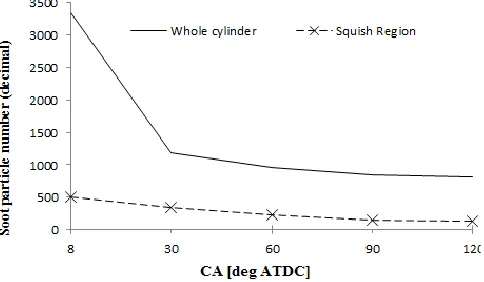
To further understand the relation between soot particle number and time step or crank angle, Fig. 11 was provided. The soot particle number started at around 3500 particles, then the number dropped to below 1500 particles at 30° CA ATDC. After that soot particle number slowly decreased until around
Fig. 7 Surface growth rate and oxidation rate versus crank angle in whole cylinder. The data recorded in this paper start at 8° to 120° CA ATDC.
TABLEIII
SOOT PARTICLE SIZE DISTRIBUTION IN THE WHOLE CYLINDER
CA
Percentage of soot size distribution in nm (%) Soot average size
(nm) <2 2-10 10-20 20-50 50-100 >100
8 0.00 0.33 24.74 69.29 5.25 0.39 25.8
30 1.34 9.93 50.88 18.16 5.36 14.32 38.5
60 3.47 16.85 48.68 13.59 5.83 11.58 33.7
90 5.47 17.56 48.76 12.51 5.40 10.31 30.9
120 6.72 17.63 47.54 12.72 6.14 9.25 29.8 Soot particle size distribution according to the size bin at selected crank angle. The value showed in percentage of particle number at that instant CA.
TABLEIV
SOOT PARTICLE SIZE DISTRIBUTION IN THE SQUISH REGION
CA
Size (nm) (%)
Average Size (nm) <2 2-<10 10-<20 20-<50 50-<100 >100
8 0.00 0.00 4.61 93.00 0.85 1.54 25.2
30 2.27 18.18 54.34 22.31 1.03 1.86 18.5
60 8.81 20.04 50.22 19.60 0.88 0.44 15.5
90 7.32 22.62 50.11 19.07 0.44 0.44 15.1
120 7.33 23.33 49.56 18.89 0.44 0.44 14.9
Soot particle size distribution according to the size bin at selected crank angle. The value showed in percentage of particle number at that instant CA. Fig. 8 Surface growth rate and oxidation rate versus crank angle in squish
region. The data recorded in this paper start at 8° to 120° CA ATDC.
1000 particle at 120° CA ATDC. For the squish region soot particle number started at around 500 particle and dropped significantly to 120 particles at 120° CA ATDC. Fig. 12 explains the soot particle average size in the squish region and in the entire cylinder. At earlier combustion process in the squish region, the soot oxidation rate increases rapidly after 8° CA ATDC [4] to overcome the surface growth of soot. Soot particle average size in the squish region slowly decreased from 25 nm at 8 CA ATDC to 15 nm at exhaust valve opening (EVO). Soot particle size in the whole cylinder displayed a different result, where the soot particle average size at inlet valve closing (IVC) was 25 nm and increase to 40 nm at 30° CA ATDC. Beyond that the soot average size starts to decrease to 30 nm at EVO. The oxidation process started to dominate the overall soot formation process at higher crank angle, namely 30º CA ATDC, thus reduced the overall soot intensity, size and particles.
IV. CONCLUSION
Soot particle distribution with different size bins in an engine cylinder with a focus on soot in the squish regions has been successfully predicted by post-processing CFD simulation data using sets of Matlab routines. Surface growth and soot oxidation were the only processes considered in the present Investigation. The soot particle size in the squish region decreased rapidly from the start of tracking calculation to about 30° CA ATDC. After that the soot particle size
decreased slowly due to the slower rate of soot oxidation process. The dominant soot size at the start was in the range of 20-50 nm and shifted to 2-10 nm at the end of the cycle. Soot particles near the wall cylinder were observed to be in smaller size range compare to other regions inside the engine cylinder. The soot particles in the squish region have high possibilities to be deposited onto the cylinder walls through one or various transfer mechanisms.
ACKNOWLEDGMENT
The authors would like to express their gratitude to the Ministry of Higher Education of Malaysia and National University of Malaysia for supporting this research through
their research grants of GGPM-2011-055 and
FRGS/1/2013/TK01/UKM/02/2.
REFERENCES
[1] S. Mosbach, M. S. Celnik, A. Raj, M. Kraft, H. R. Zhang, S. Kubo, and K. O. Kim, ―Towards a detailed soot model for internal combustion engines”, Combust. Flame, vol. 156, no. 6, pp. 1156–1165, Jan. 2009. [2] B. Menkiel, ―Investigation of soot processes in an optical diesel engine,‖
Ph.D. dissertation, School of Eng. and Design, Brunel University, 2012. [3] W. M. F. Wan Mahmood, A. Larocca, P. J. Shayler, I. Pegg, and F.
Bonatesta, ―Predicted Paths of Soot Particles in the Cylinders of a Direct Injection Diesel Engine,‖ SAE International, no. 2012-01-0148, Apr. 2012.
[4] Z. Han, A. Uludogan, G. Hampson, and R. Reitz, ―Mechanism of soot Fig. 9 Soot particle size distribution at 8° CA ATDC. The distribution
exhibit Gaussian distribution.
Fig. 10 Soot particle size distribution at 120° CA ATDC. The distribution exhibited bimodal distribution.
Fig. 11 Soot particle number in decimal against the crank angle. Soot particle numbers reduce as the crank angle increase.
144105-2929-IJMME-IJENS © October 2014 IJENS
and NOx emission reduction using multiple-injection in a diesel engine,‖ SAE Transactions, no. 960633, Feb. 1996.
[5] T. V. Johnson, ―Diesel Emission Control in Review-The Last 12 Months,‖ SAE Int. J. Fuels Lubr., no. 2003-01-0039, pp. 68-81, Mar. 2003.
[6] N. Englert, ―Fine particles and human health a review of epidemiological studies,‖ Toxicol. Lett. vol. 149, pp. 235–42, 2004. [7] B. Brunekreef, and S. T. Holgate, ―Air pollution and health,‖ Lancet,
vol. 360, pp. 1233–1242, Oct. 2002.
[8] N. Künzli, R. Kaiser, S. Medina, M. Studnicka, O. Chanel, P. Filliger, and H. Sommer, ―Public-health impact of outdoor and traffic-related air pollution: a European assessment,‖ Lancet, vol. 356, pp. 795–801, Sept. 2000.
[9] M. D. Thomas, Effects of Air Pollution on Plants, in Air Pollution World Health Organization Monograph Series No. 46, Columbia University Press, New York, 1961, pp. 233-278.
[10] C. Rodriguez-Navarro, and E. Sebastian, ―Role of particulate matter from vehicle exhaust on porous building stones (limestone) sulfation,‖ Sci. Total Environ., vol. 187, pp. 79–91, Mar. 1996.
[11] S. Aldajah, O. O. Ajayi, G. R. Fenske, and I. L. Goldblatt, ―Effect of exhaust gas recirculation (EGR) contamination of diesel engine oil on wear,‖ Wear, vol. 263, pp. 93–98, May 2007.
[12] S. George, S. Balla, and M. Gautam, ―Effect of diesel soot contaminated oil on engine wear,‖ Wear, vol. 262, pp. 1113–1122, 2007.
[13] S. George, S. Balla, V. Gautam, and M. Gautam, ―Effect of diesel soot on lubricant oil viscosity,‖ Tribol. Int., vol. 40, pp. 809–818, 2007. [14] M. Gautam, K. Chitoor, M. Durbha, and J. C. Summers, ―Effect of
diesel soot contaminated oil on engine wear — investigation of novel oil formulations,‖ Tribology International, vol. 32, no. 12, pp. 687–699, Oct. 1999.
[15] J. B. Heywood, Internal combustion engine fundamentals, McGraw-Hill, Michigan, 1988.
[16] K. Kannan, and M. Udayakumar, ―NOx and HC emission control using water emulsified diesel in single cylinder diesel engine,‖ J. Eng. Appl.Sci., vol. 4, no. 8, pp. 59–62, Oct. 2009.
[17] W. Wei, and L. Na, ―Study on Exhaust Emission and its Control Techniques in Diesel Engine,‖ 2011 Fourth International Conference on Intelligent Computation Technology and Automation, vol. 2, pp. 710– 713, 2011.
[18] T. Kawatani, K. Mori, I. Fukano, K. Sugawara, and T. Kayama, ―Technology for Meeting the 1994 USA Exhaust Emission Regulations on Heavy-Duty Diesel Engine,‖ SAE Papers, no. 932654, Oct. 1993. [19] M. Frenklach, ―Reaction mechanism of soot formation in flames,‖ Phys.
Chem. Chem. Phys., vol. 4, pp. 2028-2037, Feb. 2002.
[20] E. Weingartner, H. Burtscher, and U. Baltenspergertx, ―Hygroscopic properties of carbon and diesel soot particles,‖ Atmos. Environ., vol. 31, pp. 2311-2327, May 1997.
[21] A. Sarvi, J. Lyyränen, J. Jokiniemi, and R. Zevenhoven, ―Particulate emissions from large-scale medium-speed diesel engines: 1. Particle size distribution,‖ Fuel Process Technol., vol. 92, pp. 1855–1861, May 2011. [22] X. Cheng, L. Chen, F. Yan, and S. Dong, ―Study on soot formation characteristics in the diesel combustion process based on an improved detailed soot model,‖ Energy Conversion and Management, vol. 75, pp. 1–10, May 2013.
[23] S. Schraml, C. Heimgatner, C. Fettes, and A. Leipertz, ―Investigation of In-Cylinder Soot Formation and Oxidation by Means of Two-Dimensional Laser-Induced Incandescence (LII),‖ 10th International Symposium on Application of Laser Techniques to Fluid Mechanics, Lisbon, 2000.
[24] J. R. Needham, D. M. Doyle, S. A. Faulkner, and H. D. Freeman, ―Technology for 1994,‖ SAE paper, no. 891949, Sept. 1989.
[25] R. Finesso, D. Misul, and E. Spessa, ―Development and validation of a semi-empirical model for the estimation of particulate matter in diesel engines,‖ Energy Conversion and Management, vol. 84, pp. 374–389, Apr. 2014.
[26] R. P. Hessel, D. E. Foster, R. R. Steeper, S, M, Aceves, and D. L. Flowers, ―Pathline analysis of full-cycle four-stroke HCCI engine combustion using CFD and multi-zone modelling,‖ SAE Papers, no. 2008-01-0048, Apr. 2008.
[27] M. Bissoli, A. Cuoci, A. Frassoldati, T. Faravelli, E. Ranzi, T. Lucchini, G. D’Errico, and F. Contino, ―Detailed Kinetic Analysis of HCCI Combustion Using a New Multi-Zone Model and CFD Simulations,‖ SAE Int. J. Engines, vol. 6, pp. 1594-1609, Sept. 2013. [28] K. Puduppakkam, A. Modak, and C. Naik, ―Soot Particle Tracking with
FORTÉ CFD Using Method of Moments and a Detailed Soot Chemistry
Mechanism,‖ presented at the International Multidimensional Engine Modeling User’s Group Meeting, Detroit, Michigan, Apr. 15, 2013. [29] Wan Mohd Faizal Wan Mahmood, ―Computational Studies of Soot
Paths to Cylinder Wall Layers of a Direct Injection Diesel Engine,‖ Ph.D. dissertation, Nottingham University, 2011.
[30] K. M Pang, H. K. Ng, and S. Gan, ―Development of an integrated reduced fuel oxidation and soot precursor formation mechanism for CFD simulations of diesel combustion,‖ Fuel, vol. 90, no. 9, pp. 2902–2914, May 2011.
[31] K. M. Pang, H. K. Ng, and S. Gan, ―Simulation of temporal and spatial soot evolution in an automotive diesel engine using the Moss–Brookes soot model,‖ Energy Conversion and Management, vol. 58, pp. 171– 184, Feb. 2012.
[32] V. Rao, and D. Honnery, ―Application of a multi-step soot model in a thermodynamic diesel engine model,‖ Fuel, vol. 135, pp. 269–278, July 2014.
[33] S. M. Tan, H. K. Ng, and S. Gan, ―CFD modelling of soot entrainment via thermophoretic deposition and crevice flow in a diesel engine,‖ Journal of Aerosol Science, vol. 66, pp. 83–95, Aug. 2013.
[34] S. M. Tan, H. K. Ng, and S. Gan, ―Computational study of crevice soot entrainment in a diesel engine,‖ Applied Energy, vol. 102, pp. 898–907, Nov. 2013.
[35] D.C. Amsden, and A.A. Amsden, ―The KIVA Story: A Paradigm of Technology Transfer,‖ IEEE Transactions on Professional Communication, vol. 36, no. 4, pp. 190-195. Dec. 1993.