Study on Properties of Concrete using Robosand
as Fine Aggregate
Ganta Shanmukha Rao Rahul Morampudi
M. Tech. Student M. Tech. Student Department of Civil Engineering Department of Civil Engineering Andhra University College of Engineering (A),
Visakhapatnam, Andhra Pradesh, India
Andhra University College of Engineering (A), Visakhapatnam, Andhra Pradesh, India
Dr. Shaik Yajdani
Associate Professor Department of Civil Engineering
Andhra University College of Engineering (A), Visakhapatnam, Andhra Pradesh, India
Abstract
Concrete is widely used material in the world. Based on global usage it is placed at second position after water. Natural river sand which is one of the constituents used in the production of conventional concrete has become highly expensive and also scarce. Sand is basic concrete making construction material required in large quantities. Robosand is one among such materials to replace river sand, which can be used as an alternative fine aggregate in mortars and concrete. In this present research work, M20 and M30 grades of concrete are used as reference mixes. The fine aggregate (natural sand) was replaced with percentages 0% (for conventional concrete mixture ), 20%, 40%, 60%, 80% and 100% of robosand by weight and tests were conducted on the properties of fresh and hardened concrete. Slump-cone test, Compaction factor test and Vee-Bee Consistometer tests were performed to evaluate the workability characteristics of fresh Concrete. Compressive strength, Flexural strength and Split tensile strength were determined at the age of 7, 28, 56 and 91 days respectively. The results indicate that workability decreases with increase in robosand percentage which is due to the high water absorption capacity of robosand. The compressive strength is observed to be increasing up to 60% replacement of robosand and then decreased. Similar correlation was observed in both split tensile strength and flexural strength.
Keywords: Robosand, Natural Sand, Concrete, Mortar, Replacement, Compressive Strength, Split Tensile Strength, Flexural Strength
________________________________________________________________________________________________________
I. INTRODUCTION
Concrete is the most widely used construction material in the world. In concrete aggregates are considered as one of the main constituents of concrete since they occupy 70-80 percent of the volume of concrete matrix. In order to reduce dependence on natural aggregates as the main source of aggregate in concrete, artificially manufactured aggregates and artificial aggregates generated from industrial wastes provides an alternative for the construction industry. Robosand is the best alternative material for the replacement of fine aggregate in concrete mix
Objectives of present work
The objective of the study is to conduct feasibility study producing Concrete using robosand.
To design and proportioning the concrete mix for M20 and M30 grades of concrete as per IS 10262:2009. To study the properties of concrete in fresh and hardened state.
To evaluate the workability characteristics in terms of slump, compaction factor, and Vee-Bee time for M20 and M30 grades of concrete by replacing the fine aggregates with robosand by percentages of weight i.e., (0%, 20%, 40%, 60%, 80%, 100%). To evaluate percentage increase in compressive strength, flexural strength and split tensile strength, for M20 and M30 grades
of concrete with robosand.
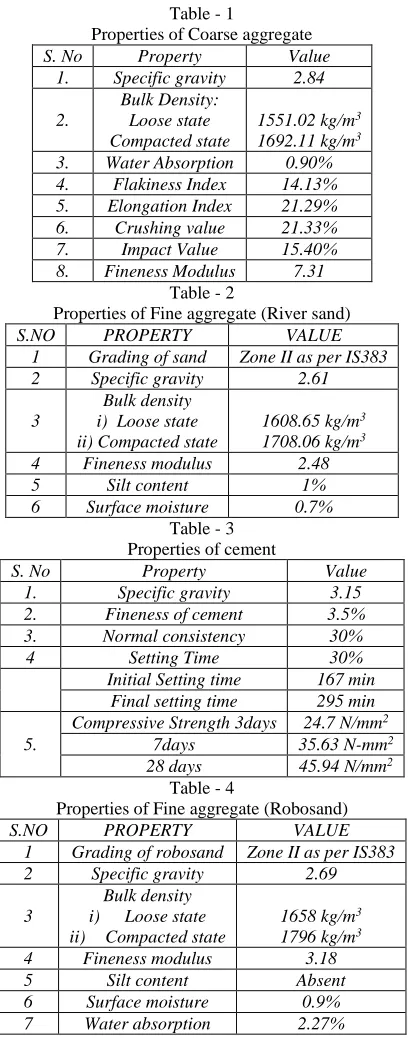
Table - 1
Properties of Coarse aggregate
S. No Property Value
1. Specific gravity 2.84
2.
Bulk Density: Loose state Compacted state
1551.02 kg/m3 1692.11 kg/m3 3. Water Absorption 0.90% 4. Flakiness Index 14.13% 5. Elongation Index 21.29%
6. Crushing value 21.33%
7. Impact Value 15.40%
8. Fineness Modulus 7.31 Table - 2
Properties of Fine aggregate (River sand)
S.NO PROPERTY VALUE
1 Grading of sand Zone II as per IS383
2 Specific gravity 2.61
3
Bulk density i) Loose state ii) Compacted state
1608.65 kg/m3 1708.06 kg/m3
4 Fineness modulus 2.48
5 Silt content 1%
6 Surface moisture 0.7%
Table - 3 Properties of cement
S. No Property Value
1. Specific gravity 3.15
2. Fineness of cement 3.5%
3. Normal consistency 30%
4 Setting Time 30%
Initial Setting time 167 min Final setting time 295 min
5.
Compressive Strength 3days 24.7 N/mm2
7days 35.63 N-mm2
28 days 45.94 N/mm2
Table - 4
Properties of Fine aggregate (Robosand)
S.NO PROPERTY VALUE
1 Grading of robosand Zone II as per IS383
2 Specific gravity 2.69
3
Bulk density i) Loose state ii) Compacted state
1658 kg/m3 1796 kg/m3
4 Fineness modulus 3.18
5 Silt content Absent
6 Surface moisture 0.9%
7 Water absorption 2.27%
III. MIX DESIGN
IV. RESULTS AND DISCUSSIONS
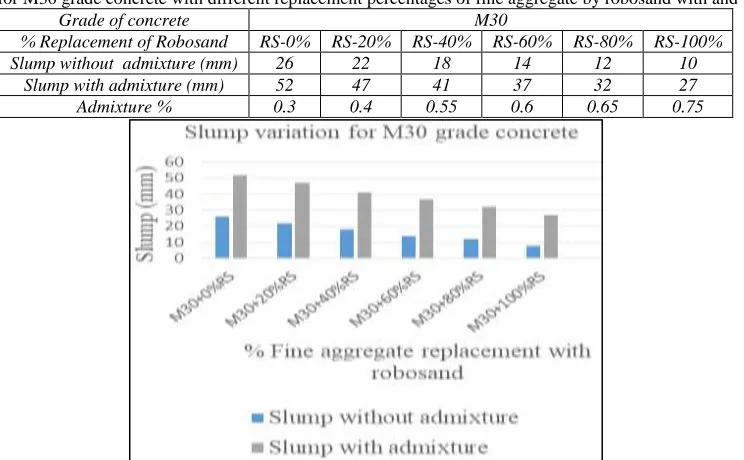
Workability in Terms of Slump
Slump study is conducted with and without admixture. It can be observed that as the percentage of the replacement of fine aggregate with robosand increases the slump is decreasing as the water absorption capacity of robosand is more compared to river sand hence the workability also decreases.
Table - 5
Variation of slump for M20 grade concrete with different replacement percentages of Fine aggregate by robosand with and without admixture
Grade of concrete M20
% Replacement of Robosand RS-0% RS-20% RS-40% RS-60% RS-80% RS-100%
Slump without admixture (mm) 27 25 21 17 14 10
Slump with admixture (mm) 54 49 44 36 31 28
Admixture % 0.2 0.35 0.5 0.6 0.65 0.7
Fig. 1: Variation of slump with and without admixture for M20 grade concrete with different replacement percentages of fine aggregate by robosand
Table - 6
Variation of slump for M30 grade concrete with different replacement percentages of fine aggregate by robosand with and without admixture
Grade of concrete M30
% Replacement of Robosand RS-0% RS-20% RS-40% RS-60% RS-80% RS-100%
Slump without admixture (mm) 26 22 18 14 12 10
Slump with admixture (mm) 52 47 41 37 32 27
Admixture % 0.3 0.4 0.55 0.6 0.65 0.75
Table - 7
Variation of Compaction factor for M20 grade concrete with different replacement percentages of fine aggregate by robosand with admixture
Grade of Concrete M20
% Replacement of Robosand RS-0% RS-20% RS-40% RS-60% RS-80% RS-100%
Compaction Factor 0.8 4 0.83 0.82 0.81 0.8 0.79
Fig. 3: Variation of compaction factor for M20 grade concrete with different replacement percentages of fine aggregate by robosand with admixture
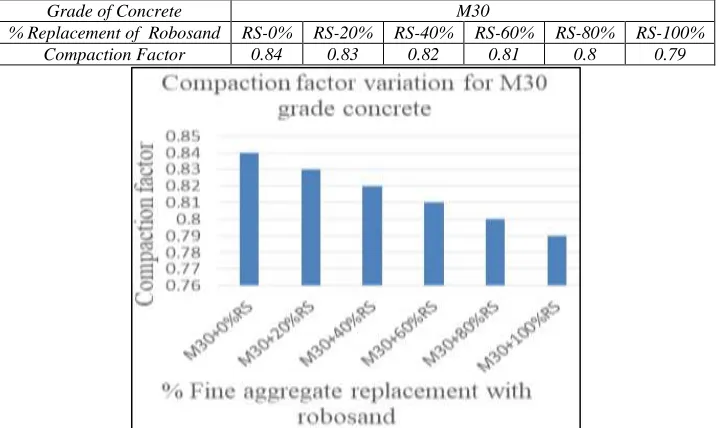
Table - 8
Variation of Compaction factor for M30 grade concrete with different replacement Percentages of fine aggregate by robosand with admixture
Grade of Concrete M30
% Replacement of Robosand RS-0% RS-20% RS-40% RS-60% RS-80% RS-100%
Compaction Factor 0.84 0.83 0.82 0.81 0.8 0.79
Fig. 4: Variation of compaction factor for M30 grade concrete with different replacement percentages of fine aggregate by robosand with admixture
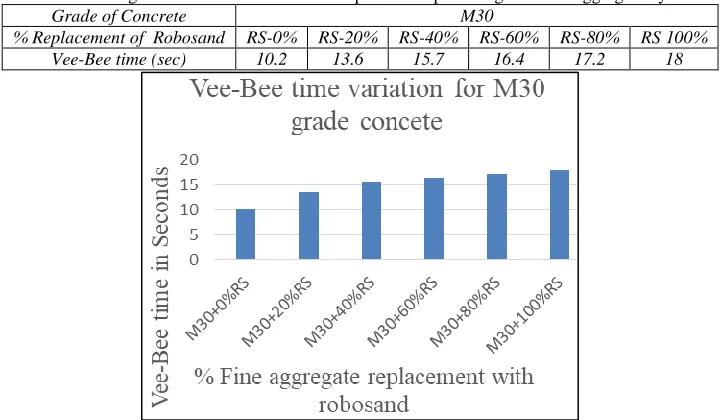
Workability in terms of Vee-Bee time
It can be observed that as the percentage of the replacement of fine aggregate with robosand increases the vee-bee time increases. Hence it can be concluded that as % of robosand increases the workability decreases this is due to the fact that robosand has more water absorption capacity compared to natural sand.
Table - 9
Variation of Vee-Bee time for M20 grade concrete with different replacement percentages of fine aggregate by robosand with admixture
Grade of Concrete M20
% Replacement of Robosand RS-0% RS-20% RS-40% RS-60% RS-80% RS-100 %
Fig. 5: Variation of Vee-Bee time for M20 grade concrete with different replacement percentages of fine aggregate by robosand with admixture
Table - 10
Variation of Vee-Bee time for M30 grade concrete with different replacement percentages of fine aggregate by robosand with admixture
Grade of Concrete M30
% Replacement of Robosand RS-0% RS-20% RS-40% RS-60% RS-80% RS 100%
Vee-Bee time (sec) 10.2 13.6 15.7 16.4 17.2 18
Fig. 6: Variation of Vee-Bee time for M30 grade concrete with different replacement percentages of fine aggregate by robosand with admixture
Effect of addition of robosand for M20 Mix
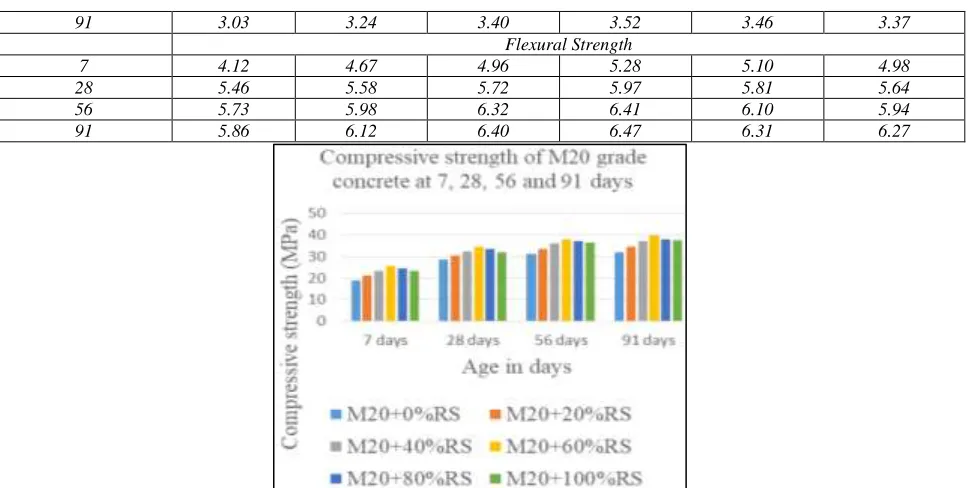
The compressive strength, split tensile strength and flexural strength of M20 grade concrete is determined by conducting the tests on cubes of size 150X150X150 mm, cylinders of 100mm diameter and 300mm length, prisms of 100X100X500 mm. The tests were conducted according to IS: 516- 1959 for compressive strength test and flexural strength test and flexural strength test was conducted according to IS: 5816-1999. The compressive strength, split tensile strength and flexural strength are increasing from 0%,20%,40%,60% replacement of fine aggregate with robosand and then they are decreasing from 80% and 100% replacement of fine aggregate with robosand For M20 grade concrete the compressive strength at 28 days is of order 0%, 5.74%, 12.52%, 20%, 16.21%, 11.69%, the split tensile strength at 28 days is of order 0%, 7.44%, 16.66%, 19.85%, 13.47%, 11.34% and the flexural strength at 28 days is of order 0%, 6.48%, 9.16%, 13.93%, 10.87%, 8.25% for 0%, 20%, 40%, 60%, 80% and 100% replacement of robosand.
Table – 11
Strength characteristics of M20 grade concrete with different proportions of robosand
Test at the age (days) RS-0% (MPa) RS-20% (MPa) RS-40% (MPa) RS-60% (MPa) RS-80% (MPa) RS-100% (MPa) Compressive Strength
7 19.07 21.17 23.51 25.46 24.43 23.47
91 3.03 3.24 3.40 3.52 3.46 3.37 Flexural Strength
7 4.12 4.67 4.96 5.28 5.10 4.98
28 5.46 5.58 5.72 5.97 5.81 5.64
56 5.73 5.98 6.32 6.41 6.10 5.94
91 5.86 6.12 6.40 6.47 6.31 6.27
Fig. 7: Variation of compressive strength for M20 grade concrete at 7, 28, 56 and 91 days age with different replacement percentage of fine aggregate by robosand
Fig. 8: Variation of split tensile strength for M20 grade concrete at 7, 28, 56 and 91 days age with different replacement percentages of fine aggregate by robosand
Effect of addition of robosand for M30 Mix
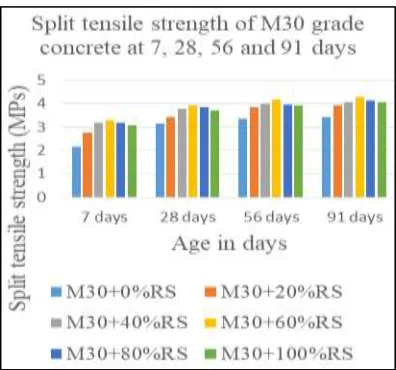
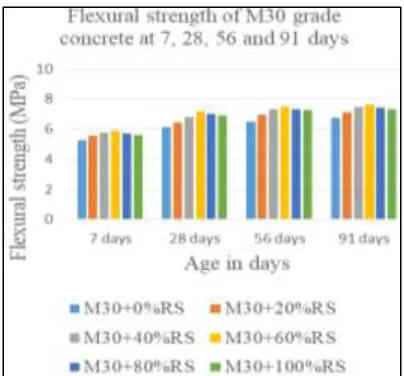
The compressive strength, split tensile strength and flexural strength are increasing from 0% to 60% and decreasing from 80% to 100% replacement of robosand. For M30 grade concrete the compressive strength is of order 0%, 8.2%, 17.21%, 24.8%, 20.69%, 17.98%, the split tensile strength is of order 0%, 8.52%, 19.36%, 24.44%, 21.90%, 17.97% and the flexural strength is of order 0%, 6.48%, 9.16%, 13.93%, 10.87%, 8.25% for 0%, 20%, 40%, 60%, 80% and 100% replacement of robosand.
Table – 12
Strength characteristics of M30 grade concrete with different proportions of robosand Test at the age
(days)
RS-0% (MPa)
RS-20% (MPa)
RS-40% (MPa)
RS-60% (MPa)
RS-80% (MPa)
RS-100% (MPa) Compressive Strength
7 27.04 28.73 30.86 33.24 31.62 30.78
28 40.15 43.45 47.06 50.11 48.46 47.37
56 43.35 45.87 48.65 51.61 49.92 48.27
91 43.90 46.24 48.92 52.15 51.04 49.10
Split Tensile Strength
7 2.16 2.75 3.19 3.27 3.18 3.07
28 3.15 3.42 3.76 3.92 3.84 3.71
56 3.34 3.83 3.98 4.17 3.94 3.90
91 3.41 3.90 4.04 4.28 4.13 4.06
Flexural Strength
7 5.25 5.55 5.76 5.89 5.72 5.64
28 6.13 6.46 6.79 7.19 7.02 6.93
56 6.48 6.98 7.33 7.47 7.31 7.29
91 6.76 7.11 7.48 7.65 7.43 7.34
Fig. 12: Variation of flexural strength for M30 grade concrete at 7, 28, 56 and 91 days age with different replacement percentages of fine aggregate by robosand
V. CONCLUSIONS
Results were analyzed to derive useful conclusions regarding the workability, strength characteristics of concrete with replacement of natural sand with robosand in different proportions for M20 and M30 grade concrete. The following conclusions were drawn from the study
The robosand can be used as a best alternative material for partial replacement of natural sand as fine aggregate and gives more compressive strength in order of 5.74% to 20% for M20 grade concrete and 8.2% to 24.8% for M30 grade concrete than conventional concrete.
The slump values of concrete with robosand were observed to be relatively less when compared to conventional concrete. As robosand had more water absorption capacity compared to the river sand. Therefore, workability of concrete decreases significantly with the increase of robosand percentage in concrete.
As the percentage of replacement of robosand increases slump and compaction factor decreases which shows decrease in workability.
The slump in terms of vee-bee time increases with increase in percentage replacement of robosand
It is observed that 60% replacement of natural sand by robosand is giving better compressive strength, for M20 and M30 grade concrete compared to other proportions of mixes.
It is observed that 60% replacement of natural sand by robosand is giving better split tensile strength, for M20 and M30 grade concrete compared to other proportions of mixes.
It is observed that 60% replacement of natural sand by robosand is giving better flexural strength, for M20 and M30 grade concrete compared to other proportions of mixes.
The increase in compressive strength for M20 grade concrete is of order 0%, 5.74%, 12.52%, 20%, 16.21%, 11.69% for 0%, 20%, 40%, 60%, 80%, 100% replacement of robosand and for M30 grade concrete is of order 0%, 8.2%, 17.21%, 24.8%, 20.69%, 17.98% for 0%, 20%, 40%, 60%, 80%, 100% replacement of robosand.
The increase in split tensile strength for M20 grade concrete is of order 0%, 7.44%,
16.66%, 19.85%, 13.47%, 11.34% for 0%, 20%, 40%, 60%, 80%, 100% replacement of robosand and for M30 grade concrete is of order 0%, 8.52%, 19.36%, 24.44%, 21.90%, 17.77% for 0%, 20%, 40%, 60%, 80%, 100% replacement of robosand. The increase in flexural strength for M20 grade concrete is of order 0%, 6.48%, 9.16%, 13.93%, 10.87%, 8.25% for 0%, 20%,
40%, 60%, 80%, 100% replacement of robosand and for M30 grade concrete is of order 0%, 5.38%, 10.76%, 17.29%, 14.51%, 13.05% for 0%, 20%, 40%, 60%, 80%, 100% replacement of robosand.
NOTATIONS
RS-RobosandREFERENCES
[1] Hudson and B. P. “Manufactured Sand for concrete”, The Indian concrete Journal, May 1997, pp.237-240.
[2] IlangovanaR.Mahendranand Nagamanib. K “ strength and durability properties of concrete containing quarry rock dust as fine aggregate” ARPN Journal of Engineering and Applied Sciences VOL .3, NO. 5, OCTOBER 2008 ISSN 1819-6608
[3] IS: 8112-1989. Specification for 43 grade ordinary Portland cement. Bureau of Indian Standardas, New Delhi.
[5] IS: 2386-1963 Part I to VIII. Indian standard Methods of test for aggregate for concrete. Bureau of Indian standards, New Delhi. [6] IS: 1199-1959. Indian standard methods of sampling and analysis of concrete. Bureau of Indian standards, New Delhi. [7] IS: 516-1959. Indian standard methods of test for strength of concrete. Bureau of Indian standards, New Delhi. [8] IS: 10262-2009 and SP 23: 1982. Recommended guidelines for concrete mix. Bureau of Indian standards, New Delhi.
[9] Mahzuz. H. M. A. M and Yusuf. M. A “ Use of stone powder in concrete mortar as an alternative of sand “ African Journal of Environmental Science and technology Vol. 5(5), pp. 381-388, May 2011 ISSN 1996-0786 ©2011 Academic Journals
[10] Mohaiminul Haque, Sourav Ray, H. M. A. Mahzuz“ Use of stone powder with sand in concrete and mortar : A waste utilization Approach” APRN Journal of Science and Technology VOL. 2, NO.7, August 2012 ISSN 22257217
[11] Nagabhusan and Sharadabai. H “Use of crushed rock powder as replacement of fine aggregate in mortar and concrete “Indian Journal of Science and Technology VOL. 4, NO. 8 (Aug 2011) ISSN : 0974-6846
[12] Plain and Reinforced Concrete Code of Practice (Fourth Revision), IS 456:2000, Bureau of Indian Standards, New Delhi. [13] Shetty, M.S “Concrete technology” Chand S and Co.Ltd, India (2009).
[14] Saeed Ahmad and ShahidMahmood “Effect of crushed and natural sand on the properties of fresh and hardened concrete”.
[15] Sivakumar. A and Prakash. M “Characteristic studies on the mechanical properties of quarry dust addition in conventional concrete “Journal of Civil Engineering and Con struction Technology VOL. 2(10), pp.218-235, October 2011 ISSN 2141-2634 © 2011 Academic Journals.
[16] Veera Reddy. M “ Investigations on stone dust and ceramic scrap as aggregate replacement in concrete “ international journal of Civil and Structural Engineering Vol.1, No 3, 2010.